The Start of New Year

an old post card
an old post card (Photo credit: Wikipedia)

According to sources on the Internet, the winter solstice in the Southern Hemisphere occurs at 10:51 am UT on 21 June (this year, 2014). That translates to 10:51 pm in New Zealand. Just as in the Northern Hemisphere the start of the year corresponds roughly to the winter solstice  there, I like to think that the winter solstice in the Southern Hemisphere corresponds to the start of the year in the Southern Hemisphere. I don’t think that I would get much support to the start of the year officially changed, though!

The Earth at the start of the 4 (astronomical)...
The Earth at the start of the 4 (astronomical) seasons as seen from the south and ignoring the atmosphere (no clouds, no twilight). (Photo credit: Wikipedia)

The year can be divided into halves by the solstices, the winter solstice marking the sun’s most negative elevation with respect to the South Astronomical Pole since the previous June. From that moment in time the sun starts to move higher into the sky until, at or around 21 December, when the summer solstice occurs.

Midway between the solstices falls a time when the day and night are roughly equal in length. Around this time the sun crosses the celestial equator, and this time is called an equinox. There are two in the year, one when the sun is apparently moving south in the sky (the vernal equinox in the Southern Hemisphere) and one when it is moving north in the sky (the autumnal equinox in the Southern Hemisphere).

The Sun & the ecliptic rotation around the Ear...
The Sun & the ecliptic rotation around the Earth : The green Sun is the one of the vernal equinox (march), it is followed by a summer solstice Sun. Then automn equinox and winter solstice. The ground plane (latitude 50°N) is green, the rotating ecliptic plane is blue. Also represented are the celestial equator, the two tropics and the rotation axis. (Photo credit: Wikipedia)

Each of these quarter points of the year is or was celebrated with a festival of some sort, some of which, particularly the winter solstice were supposedly characterised by “unrestrained revelry“. The summer solstice was comparatively restrained, the vernal equinox was a celebration of new growth, and the autumnal equinox was a harvest festival, a gathering in and celebration of bounty produced by the year’s hard work.

What I wasn’t aware of is that there were other events called “Cross Quarter moments”. These are moments halfway between the equinoxes and solstices, and they are known as Embolc, Beltaine, Lughnasad, and Samhain. The Cross Quarter moments. the solstices and the equinoxes are set out in order for 2014 in the chart referenced here.

English: Wheel of the Year with Fire Festivals...
English: Wheel of the Year with Fire Festivals and Quarter Festivals, Neopagan holidays: Yule, Imbolc, Ostara, Beltane, Litha, Lughnasadh, Mabon, Samhain (Photo credit: Wikipedia)

Two of the Cross Quarter moments I have heard of, Beltane and Samhain. Beltane falls between the vernal equinox and the summer solstice and is roughly at the beginning of May, so corresponds roughly with May Day. It is astronomically the beginning of summer, but seasonal lag means that the season starts a little later than this.

English: Beer brewed during the night of Samha...
English: Beer brewed during the night of Samhain. Français : Bière brassée pendant la nuit de Samain. (Photo credit: Wikipedia)

Children (usually girls) still dance around the maypole or maytree, but few of them, and probably few of the adults have any idea of the origins of this ritual. Although it probably is related to Beltane or the start of summer, the significance and symbolism of the maypole is still debated. Some of the possible suggestions seem dubious and far-fetched, and I don’t think that is wrong to suggest that they reflect the prejudices of the people that make them. In particular it appears that Puritan Christians may have over-emphasised some aspects of the dance and celebration to argue for its banning.

English: Dance around the maypole during the M...
English: Dance around the maypole during the Midsummer celebration, in Åmmeberg, Sweden. (Photo credit: Wikipedia)

Morris dancing is also associated with a spring festival, usually Whitsun. It may possibly have been associated with Beltrane, but I don’t know the history of morris dancing, Whitsun and Beltrane or spring festivals in general well enough to assert this. There is a long tradition of ancient non-Christian rituals being adopted and given a Christian slant, so this may be possible.

Cotswold-style morris dancing in the grounds o...
Cotswold-style morris dancing in the grounds of Wells Cathedral, Wells, England — Exeter Morris Men (Photo credit: Wikipedia)

Samhain also has a long history and probably pre-dates Christianity. It is associated with the beginning of winter and marks the point where all crops are gathered and animals prepared for winter. Once again the Christian church has adopted the festival and the roots of “harvest festivals” are to be found in Samhain’s pre-Christian traditions.

English: A Donjari float used in Saijo's fall ...
English: A Donjari float used in Saijo’s fall harvest festival. I took this photo in October 2004. (Photo credit: Wikipedia)

The Christian church adopted the festival as All Saints (Hallows) Eve or Halloween. I note from the Wikipedia article that I linked to that some people consider that Halloween has no relationship with Samhain, but considering the similarities of the two traditions which happen at the same time of the year, I think that this seems unlikely.

Jack-o-lantern
Jack-o-lantern (Photo credit: Wikipedia)

Bonfires form a great part of the Samhain festival, maybe as an attempt to ward off the coming darkness of winter. I don’t think that it is a coincidence that there are still “celebrations” on 5 November, otherwise known as Guy Fawkes Day. An effigy of Guy Fawkes is burnt on a bonfire, in spite of the fact that Guy Fawkes was actually hanged.

All of the example above refer to the “Gaelic versions” of the various dates and festivals. It’s a bit simplistic to refer to a single “Gaelic version” as the dates and festivals have, naturally, changed over the years. Other cultures of course have their own versions of the various festivals. In the Tropics (between the Tropic of Cancer and the Tropic of Capricorn the sun is overhead at least once in the year, an obvious time for a festival!

English: Vector version of a design from the B...
English: Vector version of a design from the Book of Kells, fol. 29r. Traced outlines in black and white representing three intertwined dogs. (Photo credit: Wikipedia)

Since we have just passed the winter solstice, we can look forward to longer days and shorter nights from now until the summer solstice, which for us in the Southern Hemisphere comes around 21 December. So far this year winter has been fairly mild and a little wet. As we move towards the vernal equinox we still have the bulk of winter to come, as the astronomical year does not match the climatic year because of the seasonal lag.

English: Winter landscape off Ham Wall Somerse...
English: Winter landscape off Ham Wall Somerset. The most peaceful place on earth created from worked-out peat diggings. Excellent wetland habitat with characteristic reed beds. (Photo credit: Wikipedia)

Nevertheless it is a time to look forward and one can understand why the winter solstice is a such a time. It is a time of feasting, of using up some of the stores put away at the time of the autumnal equinox, the salted beef and cured hams. It is a time to relax, for mending and repairing, and for staying out of the weather as much as possible, as the weather of winter means that essential tasks only will be undertaken and the rush of springtime is still ahead. While the end of winter may bring shortages , it is still near the beginning and the stores are still full.

Russian Celebration Zakuski
Russian Celebration Zakuski (Photo credit: Wikipedia)


Is “schooling” an education?

School
School (Photo credit: Krzysztof Pacholak)

Well, schooling should be an education. It should prepare the pupil for life. Dictionary.com has this as a prime definition of education:

The act or process of imparting or acquiring general knowledge, developing the powers of reasoning and judgement, and generally of preparing oneself or others intellectually for life.

Schooling doesn’t always do this – Greek history is probably of little use to a car mechanic and scientists are only interested in Greek history in so far as it has cool cast list of names and an alphabet from which they can plunder names for obscure fundamental particles or asteroids.

View from one end of Eros across the gouge on ...
View from one end of Eros across the gouge on its side towards the opposite end.(greyscale) (Photo credit: Wikipedia)

Arguably, though, Greek history is a fascinating window into an early culture, and studying events in Greek history can provide insights into contemporary society and while it may not be of obvious direct benefit to the mechanic and the scientist, such studies can inform sociologists, political studies specialists and many others, and it is worth remembering that mathematics, science, logic, philosophy, politics and many other fields of human endeavour have their roots in ancient Greece.

Temple Statue of Poseidon
Temple Statue of Poseidon (Photo credit: greekgeek)

But back to schooling. Everyone has been bored at school, for a number of reasons. The subject could be more than the student can handle, or it could be too simple, or it may not be a subject in which the student has no interest.

One of the issues with schooling is that we are taught, well, “subjects”. Well, we are taught “maths” or “biology” or “French”, or “Woodworking” or whatever. We are taught “English”, which is about how sentences are formed and we are drilled in verbs, nouns, adjectives and more esoteric beasts of the English language. Then there is “English Literature”, which largely consists of forcing pupils to read and “study” relatively old English language texts ranging from Shakespeare to Dickens. Rarely anything more modern.

English: Literature
English: Literature (Photo credit: Wikipedia)

There is a syllabus, specifying what we are to be taught. This is used to constrain the teachers and students, so that they can be set examinations to see, basically, how much the teachers have been able to force into usually unwilling minds.

writing/editing my environmental sustainabilit...
writing/editing my environmental sustainability cornerstone seminar syllabus at nabolom bakery in berkeley (Photo credit: davidsilver)

This all seems mechanical and soulless, but a good teacher will try to insert into the gaps and voids of the subject and the syllabus a little education. He or she will try to convey the beauty of the English language as used by Shakespeare and the other authors, he or she will try to make Romeo and Juliet into real people for the students, he or she will explain the societal background of the Dickens tales.

English: Title page of the second quarto editi...
English: Title page of the second quarto edition (Q2) of William Shakespeare’s play Romeo and Juliet printed by Thomas Creede in 1599. (Photo credit: Wikipedia)

The good teacher will teach something more – how to look beyond the surface story to the people and the societal background, not just in the set books or any books, but in all the situations that life may throw at the student over the years.

"Good Teacher"
“Good Teacher” (Photo credit: MightyBoyBrian)

A study of literature can not only give the student the knowledge of what is in the books, and maybe an appreciation of the era in which the books are set but may also provide the student with the ability to look critically at the era in which they are living. For some, maybe more than a few of the students, this will provide them with the tools to examine sources like the media and consider such things as bias and veracity.

A book pile illustrating the theme of the fest...
A book pile illustrating the theme of the festival of 2005 “Education, why?”. (Photo credit: Wikipedia)

A teacher of maths will try to not only enable the students to pass their maths exams but also to prepare them, a little, for life. The simple techniques of addition and subtraction may be all that they need, but sometimes they may need a bit more. Some of the students may go on to be mathematicians, to study the subject in its own right. But many more may acquire the tools to understand some of the numbers that surround us all in our daily lives.

Day 304: Problem Solving Strategies for Math
Day 304: Problem Solving Strategies for Math (Photo credit: Old Shoe Woman)

For instance, when a poll result is given on television, often they also quote a ‘margin of error’. A small but significant number of people will have some idea of what that actually means from some long ago statistics class. The vast majority doesn’t have a clue as to what it means, but the brightest might gather that it relates to how accurately the poll represents the wider population.

Margin of error-visual
Margin of error-visual (Photo credit: Wikipedia)

Another example of a mathematical tool that could be useful is contained in an episode of the British sitcom, “Please Sir!”. This is a comedy about an inspirational teacher and a class of pupils who are rejects from other classes. The teacher follows an informal teaching agenda as it is evident that his class is not going to pass any exams.

English: Statue of Sir Hugh Owen , A Pioneer o...
English: Statue of Sir Hugh Owen , A Pioneer of Welsh Education Sir Hugh Owen was a pioneer of secondary and tertiary education in Wales. (Photo credit: Wikipedia)

He tries to instil some mathematics into his students, using as an example a bet on a horse race. He calculates the odds only for one of his students, the son of a bookie, to correct him. The teacher is astounded that the student can calculate the odds so accurately in his head, saying to the student that he didn’t know that the student was good with maths. The student replies that this wasn’t maths, it was “odds”.

At the bookies
At the bookies (Photo credit: Phil Burns)

Science, likewise, has ramifications beyond the bland and often boring stuff a student learns at school. While he or she may come close to disaster in a lab, he or she may take away the concept of analysis and the scientific method that may help him or her in later life. At least when one of the TV detectives grabs a scrap of clothing or a sample of blood or something and sends it for analysis, he or she may have an inkling of what is happening. Though these shows are an education of a sort in themselves.

Day 53 - West Midlands Police Forensic Scene I...
Day 53 – West Midlands Police Forensic Scene Investigators Lab (Photo credit: West Midlands Police)

So why is the educational system focussed on schooling rather than educating? Well, for one thing it is easier to measure schooling rather than education. Facts trotted out for an exam yield a measurable yardstick to judge both student and teacher. It’s altogether more difficult to measure education.

Seal of the United States Department of Education
Seal of the United States Department of Education (Photo credit: Wikipedia)

That’s because an education is not about facts learned. It’s about facts learned and a deeper understanding of how the facts interrelate within the system, be it Greek history, English literature, maths or science. Nevertheless, the best teachers provide an education as well as schooling. They should be applauded for it.

English: Primary School in "open air"...
English: Primary School in “open air”, in Bucharest, around 1842. Wood engraving, 11x22cm (Photo credit: Wikipedia)


Random musings

sigh-ness#1
sigh-ness#1 (Photo credit: parth joshi)


My musings are pretty random anyway, so here’s some musings on randomness.

Most people have an inkling of what the word ‘random’ means, but if you try and tie it down, it proves to be a concept that is difficult to define. OK, let me start with a dictionary definition from Dictionary.com:

Lacking any definite plan or prearranged order; haphazard

That’s just one of many similar definitions of ‘random’ to be found at Dictionary.com. But hang on a minute – isn’t having no definite plan a plan of sorts. We can imagine Mad King Wotzit from Philopotamia talking with his generals. “Look, we don’t know where the enemy is, and we don’t know many of them there are, and we don’t know if they have muskets, so the plan is to go ahead with no plan and react to circumstances as they arise. Are we all agreed?”

Coup d'oeil #25
Coup d’oeil #25 (Photo credit: ryansarnowski)

I don’t think that definition is strong enough. We often proceed without a plan, but not randomly, and the obstacles in our way may appear haphazard but there will be a reason why every single one exists.

Randomness for a mathematician, a statistician or a philosopher is something deeper. Take, for instance, the tossing of a coin. It may come down head up or tail up and there are no other options (if we declare the case where it lands on its edge as a no throw). So a sequence of throws could go H, T, T, T, H, T…..


Commandant of the Marine Corps James T. Conway...
Commandant of the Marine Corps James T. Conway participates in the coin toss at the New Orleans Saints Military Appreciation Game against the Atlanta Falcons at the Louisiana Superdome. (Photo credit: Wikipedia)

The critical thing is that any toss doesn’t depend on any of the previous tosses, so it has a 50% chance of being heads and 50% chance of being tails. If we have tossed the coin one million times we would ‘expect’ to get 500,000 heads  and 500,000 tails, but, if fact we may get 499,997 heads meaning we tossed a tail 500,003 times. The average number of heads we would get if we did this a number of times would be very close to 500,000, but it might, by chance, be several hundred away.

English: Five flips of a fair coin. Español: C...
English: Five flips of a fair coin. Español: Cinco lanzamientos de una moneda. (Photo credit: Wikipedia)

Suppose we had thrown the fair coin a million times and we came up with 499.000 heads and 501,000 tails, and we continue for another million tosses. Should we expect more heads this time, so that the average comes out right? I believe that it is obvious that if the coin and tosses are fair, then we cannot tell before hand if the gap between heads and tails would close or get wider. The second million, like the first million will result in about 500,000 each heads and tails.

One-tenth penny coins from British West Africa...

One-tenth penny coins from British West Africa, dated 1936 and 1939. (Photo credit: Wikipedia)

Nevertheless gamblers waste their money on the belief that the odds will even up over time. This is therefore known as the Gambler’s Fallacy.


English: Simulation illustrating the Law of La...
English: Simulation illustrating the Law of Large Numbers. Each frame, you flip a coin that is red on one side and blue on the other, and put a dot in the corresponding column. A pie chart notes the proportion of red and blue so far. Notice that the proportion varies a lot at first, but gradually approaches 50%. Animation made in Mathematica–I’m happy to give you the source code if you want to improve the animation or for any other reason. (Photo credit: Wikipedia)

But how do you know if a real coin, as opposed to a theoretical coin is fair. Well, you test it of course. You toss the coin, say 1,000,000 times and see if you achieve 500,000 heads and 500,000 tails. If you get 500,000 heads or near that number, you can say that the coin is ‘probably fair’. What you can’t say, of course, is that the coin is ‘definitely fair’ as the coin could be a dud, but still produce, by chance, the result that a fair coin would.

Shove ha'penny for charity
Shove ha’penny for charity (Photo credit: HowardLake) A coin, at a fair – fair coin?

In addition a real coin is subject to physical laws. Given the starting conditions of the flip, and given the laws of physics, a tossed coin behaves deterministically, resulting in only one possible outcome for the toss. So the toss is not random as people usually use the term. Calculating  what the result might be will likely forever be impossible though.


Uni Cricket: Captain PJ and the Coin Toss
Uni Cricket: Captain PJ and the Coin Toss (Photo credit: pj_in_oz)

Do things happen randomly? I don’t believe that real events can be random. If an event is truly random it cannot depend on events that have gone before, because otherwise it would be, in principle, be predictable from the earlier events. The real events that come closest to being unpredictable are decay events and other events at the quantum level, but even there the outcome is fixed, and only the time that the event happens is variable.


English: Simulation of many identical atoms un...
English: Simulation of many identical atoms undergoing radioactive decay, starting with either four atoms (left) or 400 atoms (right). The number at the top indicates how many half-lives have elapsed. Note the law of large numbers: With more atoms, the overall decay is less random. Image made with Mathematica, I am happy to send the source code if you would like to make this image more beautiful, or for any other reason. (Photo credit: Wikipedia)

Computer science requires randomness for various purposes, most notably for generation of keys for ciphers for encryption. However the numbers that are generated are not truly random, but involve some heavy computation with very large integers. Encrypted information requires decryption, which also requires some very heavy computational lifting. Often extra ‘entropy’ is added from mouse movements and key presses.


Thermodynamic system with a small entropy
Thermodynamic system with a small entropy (Photo credit: Wikipedia)

Computer and other physical random numbers can use physical sources such as cosmic rays or the decay of an unstable atom to seed the calculation of a random number. Both the cosmic ray count and the decay of an unstable atom appear to be random locally, but cosmologically both events are the result of the state of the universe and its history to that point in time which is deterministic and deterministic processes are the opposite of random.


Thermodynamic system with a high entropy
Thermodynamic system with a high entropy (Photo credit: Wikipedia)

I feel strongly that the universe is deterministic, and at a classical level this is almost indisputable, but at the quantum level things are not so clear and at our current level of understanding, I believe that it is correct to say that happenings at the quantum level appear to be only statistically predictable. I understand that this is not because of some aspect of quantum mechanics that is currently unknown. There are no ‘hidden variables‘. Some other way around this dilemma may be found, probably involving another way of looking at the problem.


TESORO DE CORAL, NOSTOC
TESORO DE CORAL, NOSTOC (Photo credit: PROYECTO AGUA** /** WATER PROJECT)

Since the numbers generated by a computational process are not truly random, it is theoretically possible to crack the cipher and decode the message without the key. The numbers involved are so large that this would be extremely difficult and time-consuming using conventional techniques. Quantum computing techniques can theoretically be used to crack current classical encryption schemes.

Mathematical randomness is a totally different thing. Any finite number can be generated by many methods and if the method is known, then the number can’t be called random. This is the basis of a mathematical game where a sequence of numbers is given and the next number is required to solve the puzzle. I don’t like these games because it is possible that two different algorithms may produce the required answer, and an algorithm could be imagined that gives an answer different to the ‘solution’. In other words there is not one unique solution.


A roulette wheel.
A roulette wheel. (Photo credit: Wikipedia)

This makes it extremely hard, if not impossible to decide if a ‘black-box’ algorithm (one where the working are unknown) is producing a random sequence of numbers. Beyond that point, I’m not going to go, as I do not have the knowledge, nor currently the space in this post, to make a stab at a decent discussion. Maybe I’ll come back to the topic.

Toledo 65 algorithm - 8 / 12
Toledo 65 algorithm – 8 / 12 (Photo credit: jm_escalante)


Enhanced by Zemanta

Where sex came from

Sex
Sex (Photo credit: danielito311)

When I decide on a topic, I usually hold onto it in my mind, and maybe flesh out a few ideas mentally. I’ve mentioned this before. This topic suddenly came to mind for no good reason, and I haven’t thought of any significant lines of discussion. I wish I could snapshot the “Related Articles” that have popped up, but it looks like they will lead me to places I do not intend to go. An example is “Casual sex isn’t just for college kids”. Mmm. As if college kids a) invented it b) have a monopoly in it.

The Cool Kids
The Cool Kids (Photo credit: TheMarque)

But I digress. Sex. Most living organisms have it. Amoeba, the popularly held archetype of the simple single celled organism, was believed to reproduce simply by fission. I’m unable to understand much of the scientific literature about amoeba reproduction, and there doesn’t seem to be much material about it anyway, but fission, I believe, results in each child organism having half the genetic material of the parent cell.

AMOEBA PROTEUS
AMOEBA PROTEUS (Photo credit: PROYECTO AGUA** /** WATER PROJECT)

Maybe nuclear genetic material is doubled before the split. Maybe each ‘individual’ is half an individual and needs to find another ‘individual’ in the same state to merge with? Merging has been observed in amoeba.

What is certain is the enormous size of the genome of an amoeba species. Some of them have genomes which are more than 200 times the size of the human genome. Amoeba are presented to us in school as possibly the simplest organism that there is. Based simply on the size of genome, this isn’t true.

human genome
human genome (Photo credit: vaXzine)

I can conjecture, based on little to no knowledge at all of the genetics of amoeba, that fission and fusion would enable amoeba species to mix and match their genetic material with much greater freedom than simple sexual reproduction.

So, amoeba splitting and merging could create an enormous genome, even in a simple organism. The size of a genome could be just a result of a less restrictive reproductive process than applies to more “advanced” multi-celled organisms (not to mention more “advanced” single-celled organisms.

Martin Krzywinski, Circles of Life - a compari...
Martin Krzywinski, Circles of Life – a comparison of human and dog genomes (Photo credit: chrisjohnbeckett)

If I’m correct or anywhere near close to correct about the amoeba genome and its reproduction, amoeba may represent an early stage of sexual reproduction. Amoeba were inventing reproduction, in a way. One can imagine that early organisms would absorb other weaker organisms, and in doing so, acquire their genetic material or proto-genetic material.

a haploid cell
a haploid cell (Photo credit: Wikipedia)

Of course in most cases they would simply digest it,  but in those days, the early days of life, when the chemical processes and genetic processes of life were shaking down into the rules that we know today, things would have been more fluid and the genetic material could have been incorporated into the organism’s own genetic material. Indeed, in the beginning the genetic material would probably not be distinguishable from other material in the organism. There wouldn’t have been a nucleus, as such.

English: In telophase, the nucleus of one cell...
English: In telophase, the nucleus of one cell is divided equally into two nuclei.It is the last stage of mitosis and directly proceeds interphase. (Photo credit: Wikipedia)

One can imagine that in the beginning, organisms just didn’t reproduce, by fission or any other method. They would have fairly quickly died out. Then organisms could have happened which just grew and grew until they split. Parts would have died off, parts would have lived.

The parts that survived would have been changed, modified by the environment, until the bits that would have earlier died, survived as new individuals. Maybe they couldn’t themselves reproduce, but eventually, the split off bits would have survived and been able to reproduce.

Diagram of bacterial binary fission.
Diagram of bacterial binary fission. (Photo credit: Wikipedia)

In retrospect, it appears that the best way to be able to reproduce is to separate the reproductive materials and functions mainly into a single location, the nucleus.

Organisms can they reproduce simply by duplication of the genetic information in the nucleus, producing a clone of themselves, which they can hive off as a new individual. Some organisms bud off a clone of themselves as a reproductive process.

Production of new individuals along a leaf mar...
Production of new individuals along a leaf margin of the air plant, Kalanchoe pinnata. The small plant in front is about 1 cm tall (Photo credit: Wikipedia)

This doesn’t allow for change in environment though. A self-cloning organism can’t react to environment changes. However if organisms can exchange genetic material while creating a child, it may be that the child’s genetic make up may allow it to survive where its parents would struggle.

The process used by amoebas, that is to say the process of division and merging of individual organisations could be the first step in that direction. Of course, uncontrolled merging could result in possibly viable individuals with large genomes, which is what we see in some amoeba.

Immature and mature fruits of Cocculus orbicul...
Immature and mature fruits of Cocculus orbiculatus….Trái của dây Sâm, dây xanh, Mộc Phòng kỷ … (Photo credit: Vietnam Plants & The USA. plants)

There are two routes here. Either an organism would clone its nucleus including its genetic material, then split, producing two identical organisms. or it could halve its genetic material and merge with a similarly haploid organism, resulting in a diploid individual.

The advantages of the haploid/diploid cycle are obvious – genetic material is mixed so at least some individuals may survive an environmental change, because the expression of the genome in the individual (the phenotype) allows them to differ from their parents and survive the change.

English: Illustration of the chromosomal organ...
English: Illustration of the chromosomal organisation of haploid and diploid organisms. (Photo credit: Wikipedia)

What is less obvious is why organisms split into male and female sexualities. It’s possible that the difference is caused by the necessity of one set of haploid individuals to supply an environment in which the child organism can develop. The other set of haploid individuals merely supplies the other half of the necessary genetic material.

So the female supplies the support environment plus the genetic material, or egg (ovum) and the male supplies only the genetic material, the sperm. One can imagine that originally organisms would directly exchange genetic material by fusion and fission, like amoeba, but at some time it became more efficient to disseminate genetic material outside the organism.

English: Electron microscope image of sperm.
English: Electron microscope image of sperm. (Photo credit: Wikipedia)

Cells within multicellular organisms or possibly unicellular organisms developed the ability to create new haploid cells with a copy of half the genetic information leaving behind unicellular haploid organisms or haploid cells within a diploid organism.  In female organisms the haploid cell would be an egg and would have the support environment to create a new diploid individual, and in male organism the haploid cell would just have half the genetic material and be a sperm.

Description unavailable
Description unavailable (Photo credit: EYECCD)

There are some hermaphroditic animals, for example some snails and slugs, which produce both eggs and sperms and many plants have both male and female characteristics, but many, many animals have separate male and female individuals. (I’m not keen on saying the majority of animals display sexual differentiation, because I don’t know if it is true.)

English: hermaphrodite symbol
English: hermaphrodite symbol (Photo credit: Wikipedia)

So, when life began it would have been simple unprotected self-replicating molecules. Growth would have been by accretion. At some stage the molecules would have evolved to the point where they developed some structure around themselves, maybe by rejecting some unwelcome molecules. Organelles, small biological factories would have developed as the organisms became more complex, all enclosed in a membrane that allowed the necessary chemicals in and unwanted ones out. This membrane would eventually enclose the nucleus of the cell. More complexity, more biological factories, and the cell would have formed an outer membrane, that enclosed all the necessary mechanisms that modern cells contain and require. (OK, I’m no expert so some of these conjectures may be wrong).

High magnification transmission electron micro...
High magnification transmission electron microscope image of a human leukocyte, showing golgi, which is a structure involved in protein transport in the cytoplasm of the cell. JEOL 100CX TEM (Photo credit: Wikipedia)

Cells would initially have not had any reproductive mechanism. They would grow and then split when they got too big. When cells developed specialised mechanisms for reproduction they needed some way of passing on the genetic material. Some cells would have developed a method of creating haploid individuals and these would have then merged with other haploid individuals to create normal diploid individuals.

English: Male and Female Superb Fairy-Wren.Tak...
English: Male and Female Superb Fairy-Wren.Taken in Ensay, Victoria. (Photo credit: Wikipedia)

Or maybe so-called haploid individuals arose first and diploid individuals arose from the merger of two haploid individuals.  When multi-cellular organism arose, they evolved special organs related to reproduction. Such organs created haploid versions of the organism and a method of delivery to the outside world of these eggs and sperm.

Once individuals have evolved to specifically create eggs or sperm, they are sexual individuals. If an individual evolved to create a support system for their haploid genetic material, for example eggs, it would find it difficult to find similar individuals to merge with since eggs are not particularly mobile. Sperm on the other hand are specialised to be mobile, so are ideal for merging with the eggs.

English: Male and female Sockeye salmon (Oncor...
English: Male and female Sockeye salmon (Oncorhynchus nerka) specimens. (Photo credit: Wikipedia)

Once the individuals have sexual differentiating characteristics this would flow through to the phenotype (physical expression of the genetic material – the multi-cellular organism). And that is my guess, as a complete amateur in the field of genetics is where sex came from. So the above may make sense at some level, or not. Even it does make a sort of sense, I may well be wrong about the detail! But it has been fun speculating.

here comes life
here comes life (Photo credit: AlicePopkorn)


Enhanced by Zemanta

Weather

The Weather Station
The Weather Station (Photo credit: Stuck in Customs)

It is a cliché that if two Englishmen meet they will always first talk about the weather. Samuel Johnson once said:


“It is commonly observed, that when two Englishmen meet, their first talk is of the weather; they are in haste to tell each other, what each must already know, that it is hot or cold, bright or cloudy, windy or calm.”

When Stanley met Livingtstone and said “Doctor Livingstone, I presume?” they probably then started to discuss the weather.


David Livingstone staue near Victoria Falls, Z...
David Livingstone staue near Victoria Falls, Zambia (Photo credit: Wikipedia)

Noel Coward once sung that “Mad dogs and Englishmen go out in the noonday sun“. The song is a reference to the days of the British Empire in what were, in those days referred to as “colonial times” and the self-perceived “sang froid” of the colonial rulers of the time. In these post-colonial times the attitude expressed in the song is embarrassing.


Mad Dogs and Englishmen; Marsaxlokk, Malta
Mad Dogs and Englishmen; Marsaxlokk, Malta (Photo credit: foxypar4)

Although the English may care about the current weather to some extent, I think that the initial conversation gives the conversationalists the chance to size each other up, to fit the other person into one’s world-view so to speak. The other person’s way of speaking allow one to decide if they are “posh” or “common” or somewhere in between. Voice and body language would offer other clues during this initial meteorological discussion.


All the Leaves are Brown, the Skies are Grey, ...
All the Leaves are Brown, the Skies are Grey, and Someone Wearing a Blue Coat Walked into My Picture (Photo credit: bitzcelt)

The English are proud of their weather which they informal believe is the worst in the world. Of course they are wrong, as their bad weather and their extremely boring weather is neither as bad nor as boring as the weather in other places in the world. They love to complain about the weather, and this has perhaps led somewhat unfairly to the stereotype of the “whinging pom“.


English: Earliest known map of the Gulf Stream
English: Earliest known map of the Gulf Stream (Photo credit: Wikipedia)

Most English people don’t realise that the ocean current of the Gulf Stream ensures that the British Isles don’t freeze in winter and boil in summer as it moderates the climate that the English and the other nations of the British Isles receive. A glance at a map will show that the British Isles are several degrees further north than Labrador in Canada, and only a few degrees further north than Moscow.


Belle Isle off the coast of Labrador Français ...
Belle Isle off the coast of Labrador Français : Belle Isle, au large du Labrador. (Photo credit: Wikipedia)

What I remember about the English climate was long weeks of gun-metal grey skies, but however I also remember long warm summer days as a child. I don’t have sufficient real evidence to support these memories, and although the climate is changing, I suspect that my mind is editing my memories somewhat!


I’ve moved to the other side of the globe, where weather patterns are distinctly different. (Aside: I originally wrote “the other end of the globe”, but that is a more mathematical topic, I think). Wellington has a temperate maritime climate and the weather is changeable, meaning that we may see “Four Seasons in One Day“. The Crowded House song, though, was not written about Wellington, but was inspired by Melbourne, Australia where Crowded House was based at the time.


Four Seasons in One Day
Four Seasons in One Day (Photo credit: horrigans)

The weather in New Zealand originates in and around the eastern parts of Australia. Anti-cyclones spin up off the south coast of Australia, past Tasmania and over New Zealand. High pressure bubbles emerge from the main land mass of Australia, and tropical cyclones can dip far enough south to cover New Zealand.


Looking Out over the Sea
Looking Out over the Sea (Photo credit: Jocey K)

It is no wonder with these competing factors that New Zealand’s weather can change from minute to minute. Fronts can sweep rapidly across the country, bringing rapid changes of temperature as they do so. Temperatures can change by ten degrees or more between morning and afternoon.


The weather is not always changeable though. If a high pressure area extends from Australia across New Zealand the weather may “stall” and an extended period of warm weather in the summer or cooler weather in the winter may ensue, with clear skies and sunshine across the country.


'A Reflective Moment', New Zealand, Tasman Sea...
‘A Reflective Moment’, New Zealand, Tasman Sea Coast (Photo credit: WanderingtheWorld (www.ChrisFord.com))

Wellington is close to the Cook Straight, the gap between the North and South Islands. The Straight acts as a funnel for wind, and Wellington has a deserved reputation for being windy. However the average wind speed is not that exceptional, However, as the linked article says, there are more windy days per year than in most other New Zealand coastal cities. Hmmm. Some gusts can be exceptionally strong lifting roofs and knocking over trees, but the occasional strong blasts also happen outside of Wellington.


English: Wellington Airport, New Zealand.
English: Wellington Airport, New Zealand. (Photo credit: Wikipedia)

I was at Wellington airport yesterday, seeing my daughter off to Auckland. Several flights were cancelled but fortunately not my daughter’s flight, though apparently it was a rough take off. What we didn’t see was an incoming flight which actually did a touch and go before diverting elsewhere. I did wonder why the crash trucks were speeding about! No wonder New Zealanders, like the English, like to discuss the weather.


737 Touch and Go practice
737 Touch and Go practice (Photo credit: Fly For Fun)

The changeable weather in New Zealand often catches tourists out. Mountain weather in any country can change rapidly, and New Zealand is no exception. Bright sunny days can often turn very bad, very quickly. Mist and cloud can suddenly descend and remove all visible landmarks, and if the tramper (hiker) is not well prepared, he or she might well be in trouble, and several foreign tourists do get themselves into trouble every year.


Hiking the ridge line
Hiking the ridge line (Photo credit: IamNotUnique)

This is no different from elsewhere of course, but it seems that tourists may underestimate the wildness of the New Zealand “bush”, maybe because they come from countries where the countryside is more benign, or maybe because they overestimate their own abilities. Sometimes tourists venture into the bush, totally under equipped and are caught out by the rapidity of the changes in the weather.

change in the weather
change in the weather (Photo credit: paparutzi)

In spite of my discussion of the bad weather above, New Zealand also has glorious weather. Following the winter storms, in the clear weather under a high pressure system, New Zealanders and tourists alike head for mountains and a number of world class ski fields. In the summer, glorious weather under a high pressure system leads people heading for the beach, or heading to the bush, or merely staying home and firing up the barbecue.

20111130-IMG_2576
20111130-IMG_2576 (Photo credit: vauvau)

There is a saying in Wellington – “You can’t beat Wellington on a good day”, and I would add that the good days outweigh the occasional windy and rainy days!

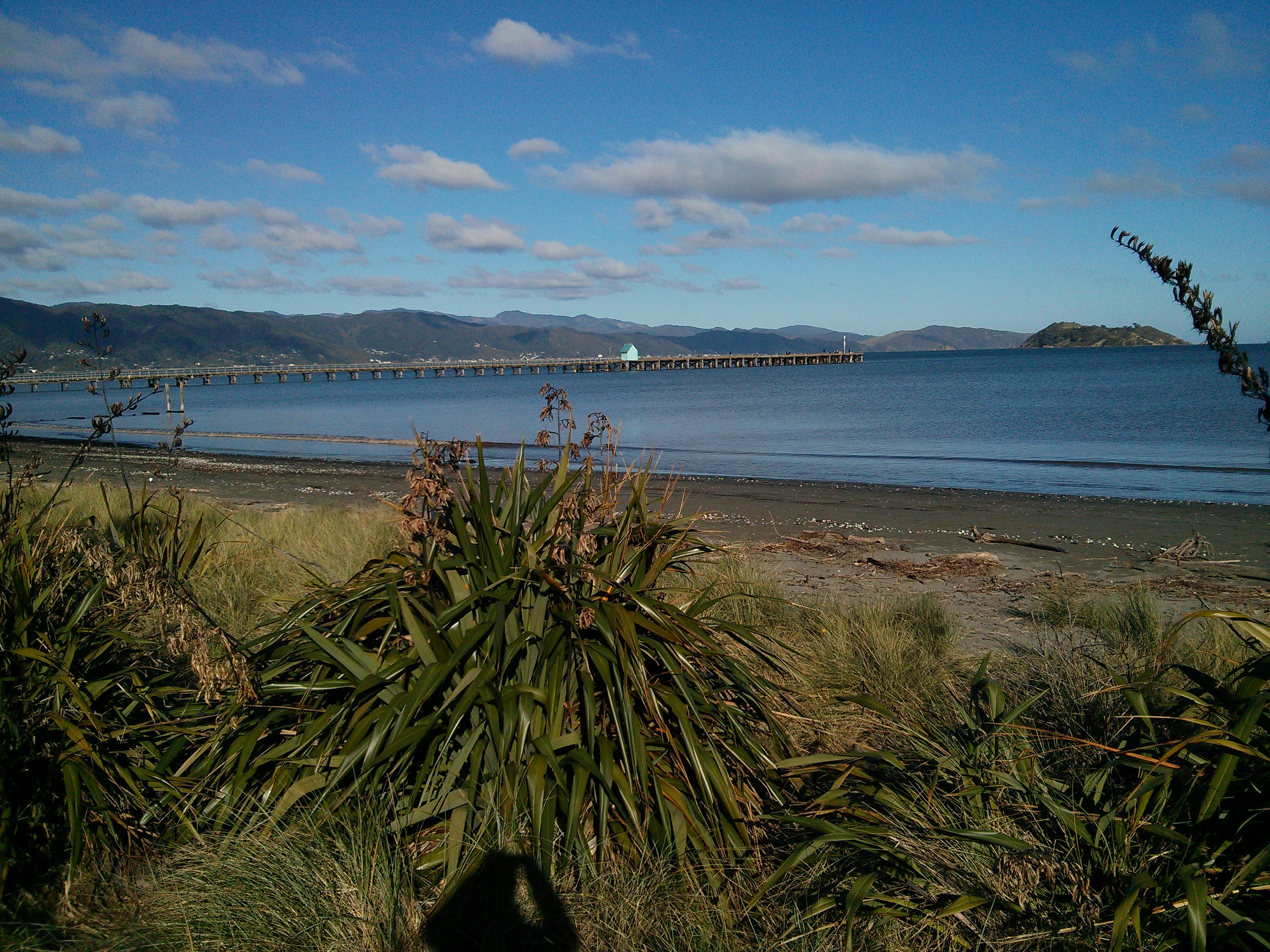
Update: After writing the above, Wellington turned on a great morning, a crisp autumn sunny day. The first picture below is of the city of Wellington from Petone, framed by a couple of flax plants.

IMG_20140527_135052

The second picture is of Petone Wharf from about the same spot.

IMG_20140527_135059

Of course, in accordance with the principle of perversity and the “four seasons in one day”, the weather has turned grey.


Enhanced by Zemanta

Death of print

English: A stack of copy paper.
English: A stack of copy paper. (Photo credit: Wikipedia)

It’s amazing how the world has changed in a lifetime. My lifetime. Phones, TV, the Internet, electronic funds transfers, payment by waving a plastic card.

My parents were paid by their employers in cash and they paid for everything in cash. Most people didn’t have cars and relied on public transport and paid in cash for their tickets. Today cash is endangered.

Money Cards
Money Cards (Photo credit: jacqui.brown33)

A little later, people started to acquire bank accounts, usually in conjunction with a mortgage. Their pay was paid into their bank accounts and the mortgage payments were extracted from the bank account directly. The thing was, the bank account came a lot of paperwork. There were statements and cheque books. To whip out a cheque book and offer to pay for something was a real show of status. Today cheques are almost unused, being almost completely replaced by credit cards, debit cards and charge cards. Some younger people have never seen a cheque and most shops will not accept one. Many banks will supply statements over the Internet these days.

English: 1912 US cartoon by Rollin Kirby, show...
English: 1912 US cartoon by Rollin Kirby, showing George Walbridge Perkins (with a check book symbolizing control of money) and Amos Pinchot (weilding a letter of support from Theodore Roosevelt campaing manager Senator Joseph M. Dixon) battling for control of the U.S. Progressive Party. Figure in the distance presumbably represents Roosevelt coming with his “big stick” to settle things. (Photo credit: Wikipedia)

Most people got their news through newspapers. Paper newspapers, from the rarefied air of the Times to the slightly more foetid air of the tabloids. The network of distribution of news via started from the printing presses and initially was distributed by vans, trains, and more vans. Bundles of papers were dropped off at strategic points, and newsagents picked them up, sorted them and gave them to young boys and girls to distribute, dropping them into letter boxes, countrywide.

Galveston, Texas, 1943. Newspaper delivery boy...
Galveston, Texas, 1943. Newspaper delivery boys with bicycles. (Photo credit: Wikipedia)

A similar distribution network was used for the evening papers. These however were distributed mostly to the streets around business places and railway stations and similar places where people would pick them up on their way home from work. The main headlines would be prominently displayed as teasers to persuade people to buy them.

Checking the headlines
Checking the headlines (Photo credit: gato-gato-gato)

Newsagents existed to distribute the paper that the news was printed on. As a sideline, they would sell other things, like magazines, tobacco, and confectionery. As newsprint volumes have fallen, the old time newsagents had to specialise in something else, like the confectionery that they used to sell as a sideline, or in some cases groceries, particularly the staples such as canned foods and milk. Some might sell books or glossy magazines, but even these versions of print material are under threat.

dakar newsagent
dakar newsagent (Photo credit: noodlepie)

My letter box is still full of paper. Much of it is the ubiquitous junk mail, of course, the flyers and offers which advertisers hope will entice us into buying. It appears that the expense of creating and sending junk mail is still worthwhile, or so the advertisers believe. Some of the paper is comprised of what can loosely be called “community newspapers”. These papers, largely funded by advertising, and run on the cheap, are distributed free, and contain local news only, mainly sports and local politics.

“Letter boxes” in the UK are slots in the front door of a house, not actual boxes on poles as in many other countries.)

English: Letter Box Detail of an old front doo...
English: Letter Box Detail of an old front door which now graces a small shed. (Photo credit: Wikipedia)

What my letter box rarely contains is an actual letter, written by someone, stamped and posted by someone, sorted and delivered to my letter box by a real postman. There are a few firms that still insist on paper invoices and local tradesmen tend to still prefer papers invoices but apart from that and a few real letters from older relatives, I receive little real mail these days. No wonder that postal services world-wide are having issues.

Typical advertising mail
Typical advertising mail (Photo credit: Wikipedia)

It is easy to see the reason for the decline of the print industries world-wide. In a word, the Internet. When it is simple and cheap to sit at a computer and type an email, or finger tap a  message into a tablet or phone, and have a response in minutes, why would anyone manually write a letter, find an envelope, find or purchase a stamp, and find a post box to drop the letter in? Although the vast majority of letters get through safely, there are exceptions, while email is almost certainly going to be delivered and you will get a message if your email doesn’t go through.

Email email email
Email email email (Photo credit: RambergMediaImages)

Similarly in banking. Once every transaction had a paper trail. All transfers and payments were neatly written in books, all ledgers were balanced by hand and banks shifted huge numbers of notes, cheques, coins and other forms of paper money. These days I rarely carry cash, and I haven’t seen or used a cheque in years.

I do all my banking on the Internet, using my computer or phone. I pay for things, even small things like a cup of coffee (actually I drink tea), with a debit card, with a credit card as backup for emergencies. Gas stations, grocery stores, tradesmen, and every other kind of store takes the plastic.

Swipes, Bytes, and Debit Cards
Swipes, Bytes, and Debit Cards (Photo credit: SimpleIllustrations)

More and more our transactions with government departments, like car licensing or tax matters, are conducted online. Even if you have to go in to a government agency for some matter or other, they will scan your documents rather than copy them. If you fill in a paper form, they will transfer the data to their computer systems while you wait.

Picture Scanner
Picture Scanner (Photo credit: Wikipedia)

In all fields, except possibly the field of junk mail, paper is being used less and less. Even magazines are headed online, with smartphone apps for New Scientist magazine allowing you to read it anywhere that you may be. An added advantage of on-line magazines is that the electronic copy is, in general, cheaper than the paper version.

HTC Aria android 2.2 smart phone review www.li...
HTC Aria android 2.2 smart phone review http://www.liewcf.com/review-htc-aria-android-2-2-6878/ (Photo credit: Wikipedia)

I have forgotten, until now, that I was going to mention books. Books are nice objects to hold, and they make a nice addition to one’s decor. I enjoy reading a book and have several shelves full. Maybe 200 books? But on my electronic devices I have maybe 10 times that number. OK, most are old classics, which are out of copyright, but a number I have bought specifically to read on-line. An on-line reader keeps your place, let’s you bookmark passages and allows you to quickly search for something that you read somewhere in your on-line collection.

books
books (Photo credit: brody4)

Books are not yet redundant, but they are slowly heading on-line. While it may not be soon, and while not every book will disappear on-line, printed books may become rare and expensive.

Print is dying everywhere and the amazing thing is that it has happened in a short period of time. The spread of computers first caused volumes of paper generated to increase, but the Internet and the way that it has allowed sharing of documents, plus the smaller and faster computers and hugely capacious hard drives, culminating is the ubiquitous smart phones has saved millions of trees from destruction.

Tree in Fog
Tree in Fog (Photo credit: Photomatt28)


Enhanced by Zemanta

Inequality and equality

Triangle_inequality
Triangle_inequality (Photo credit: Wikipedia)

Usually, but not always, I have an idea in the back of my mind of the structure of a post before I write it. Well, I have an idea of a few key concepts and how they will fit together. Sometimes it goes much like my skeleton idea and sometimes it turns out completely different. However, today, I have no structure in mind.

Inequality. It’s an interesting concept. The things that are being compared can be practically anything, but have to be of the same sort, hence the saying “you can’t compare apples with oranges”. Like all adages, this saying has more depth than appears at first glance. Of course you can compare apples with oranges if, for example, you are comparing their Vitamin C content or their fibre content. What the saying conveys is that it is incorrect to mix categories when the attribute being comparing is obviously not found in one of the categories, or the attribute is expressed differently in the two categories.

Apples & Oranges - They Don't Compare
Apples & Oranges – They Don’t Compare (Photo credit: TheBusyBrain)

For example, it would be wrong in most cases to compare the tastes of apples and oranges since the tastes of apples and oranges are significantly different. Or one might compare the performance of a truck and sedan car, and someone might object that any comparison is like comparing apples and oranges – while both are vehicles, but they are by nature significantly different.

Apples and Oranges
Apples and Oranges (Photo credit: Automania)

An inequality yields a true or false verdict. In logic and mathematics this is often called a Boolean value after mathematician and philosopher George Boole. In computer languages a Boolean value is usually, but not invariably, given a value of 1 for true and 0 for false.

George Boole, mathematician, 1858-1908
George Boole, mathematician, 1858-1908 (Photo credit: Wikipedia)

When children learn arithmetic and mathematics the emphasis is usually on equality rather than inequality. They learn that 1 + 1 = 2 and often don’t get taught such formulations as 1 + 1 < 6. When learning algebra they may be taught that y = x² is the equation of a parabola, but they may only learn in passing that y > x² represents all the points in the plane inside the parabola, and that y ≥ x² also includes the points on the parabola.

This is a graph of an inequality.
This is a graph of an inequality. (Photo credit: Wikipedia)

Computer programmers are usually deft at dealing with inequalities. When programming a payroll for example, the programmer may be required to calculate the tax that an employee may have to pay. Say the first $10,000 is taxed at 5%, and anything between $10,000 and $50,000 is taxed at 7%, and anything over $50,000 is taxed at 10%.

Tax
Tax (Photo credit: 401(K) 2013)

The programmer has to check if the salary is less than or equal to $15,000 (≤) and if it is he or she taxes the pay at 5%. If the pay is greater than (>) $10,000 and less than or equal to (≤) $50,000 he or she subtracts $15,000 from the salary and calculates 7% of that. He or she then calculates 5% of $15,000 and adds the two numbers to make up the tax for that employee. And so on, for the CEO who obviously exceeds the $50,000 threshold.

"Pay Day! Pay Day!"
“Pay Day! Pay Day!” (Photo credit: JD Hancock)

The simple statement – “Is the pay ≤ $15,000?” hides a complexity that is not obvious. It can be rewritten as – “Is it true that the pay ≤ $15,000?”. Such a statement has a value of “true” or “false”. The sub-statement “the pay ≤ $15,000” has a value of “true” or “false “. If the pay is $9,000 then the sub-statement  has the value “true”. Putting that back in the original statement yields “Is it true that true”. A little ungrammatical maybe, but it can seen that the whole statement is in this case true. This sort of complexity can trip up the unwary.

True/False Film Festival
True/False Film Festival (Photo credit: Wikipedia)

Logicians and mathematicians aren’t content with simple “true” and “false”. They have contemplated a third value, neither true nor false. Some versions call it “unknown” but it could be called “fred” or something. It doesn’t make any difference. Of course, mathematicians would not be satisfied with that, so they have derived “many-valued” logic systems.

It’s probably worth mentioning that some computer language allow for a “null” value, which is essentially the value you have when you haven’t set a value. Using the old pigeon hole analogy, if a pigeon hole is called “A”, then when the pigeon hole is empty, its value is “null”. When it contains, say, the integer 3, it’s value can be said to be “the integer 3”, so the statement “A contains a value greater than 1?” can be “true”, “false” or “null” so multi-valued logics can be more than an intellectual exercise.

Graphic for "the present king of France&q...
Graphic for “the present king of France”, a philosophical quasi-paradox from Bertrand Russell’s work on “definite descriptions” (is the statement “The present King of France is bald” true or false if France is a republic?). (Photo credit: Wikipedia)

Another form of inequality relates to societal inequality. There are very poor people and astronomically rich people. Of course people will never be universally equal, but a society that doesn’t recognise the extreme inequalities will not be a good society by most people. We don’t have a working philosophy which can address this inequalities. We have Marxism economics which favours the workers, and the Smithian lassez-faire economics which favours market forces, and Keynesian which has supply and demand economics.

English: The invisible hand of the market. Fra...
English: The invisible hand of the market. Français : La main invisible du marché. (Photo credit: Wikipedia)

None of these philosophies (and there are many others to choose from) really deal with the gap between the rich and the poor. Marxists would destroy society to rebuild it, but there is no guarantee that it will be better, and a very large chance that society would easily recover from such a cataclysm. Smithian economics would not admit to there being a problem. Keynesian economics at least considers unemployment but doesn’t directly address poverty.

English: Differences in national income equali...
English: Differences in national income equality around the world as measured by the national Gini coefficient. The Gini coefficient is a number between 0 and 1, where 0 corresponds with perfect equality (where everyone has the same income) and 1 corresponds with perfect inequality (where one person has all the income, and everyone else has zero income). (Photo credit: Wikipedia)

There does not appear to be a working economic model that deals with poverty as such. Distributing public funds through the dole doesn’t result in a decrease in poverty and merely reduces the self-esteem of the poor. Likewise, reducing support through reduced “benefits” doesn’t drive the poor into employment and doesn’t reduce poverty by providing an incentive to the poor. This is largely because the few jobs available to the unskilled don’t provide a route out of poverty as they are not well paid.

English: Arkwright - Colliery wages office Sho...
English: Arkwright – Colliery wages office Shortly after the pit closed in 1988. (Photo credit: Wikipedia)

There is no doubt that poverty is relative. The poor in the developed countries are well off as compared to the poor in developing countries, but that’s not really a justification for the vast inequality that is seen between the very rich and the very poor, in any country.

Strike Solidarity
Strike Solidarity (Photo credit: Light Brigading)
Enhanced by Zemanta

The process of Philosophy

Philosophy & Poetry
Philosophy & Poetry (Photo credit: Lawrence OP)

Philosophy is a strange pastime. Scientists measure and weigh. Mathematicians wrangle axioms and logical steps. All other disciplines draw on these two fields, which are probably linked at deep level, but philosophy draws from nothing except thoughts and the philosopher’s view of the Universe.


Mathematics
Mathematics (Photo credit: Wikipedia)

Well, that’s not completely accurate because philosophy has to be about something and the only something we have is the universe. But philosophy does not have to be about the universe as we know it. What if there was no such thing as electrical charge, or, the prudent philosopher thinks, what if there was no such thing as the thing we call electrical charge. At a more basic level, what is electrical charge.

Lichtenberg
Lichtenberg (Photo credit: caddymob)


Philosophers are always getting pushed back by scientists as scientists figure what they think is the case. If there is a scientific consensus on what comprises an electric charge then that question no longer interest philosophers to any great extent. Philosophers mentally travel through the lands marked “Here be dragons”.


Dragon from PSF D-270006.png
Dragon from PSF D-270006.png (Photo credit: Wikipedia)

Philosophy is also interested in less “physical” things like ethics and morals, what comprises identity, predestination or free will, what can we know and what knowing is all about. How did the Universe come to exist, or more basically, why is there something rather than nothing?


If you look at this list it comprises extensions to or extrapolations from physics, psychology, physiology, medicine, biology, and other fields of science. Philosophy doesn’t use mathematics (usually), but it uses logical argument or should. It not (usually) built on axioms, so doesn’t have the rigid formality of mathematics.

Illustration of Plato's Allegory of the cave.
Illustration of Plato’s Allegory of the cave. (Photo credit: Wikipedia)

Philosophers are big users of metaphor, such as Plato’s “Allegory of the Cave”. A metaphor of the expansion of a balloon was used as a philosophical explanation of the expansion of the Universe discovered by Edwin Hubble. Philosophers also imagine physical machines which do not yet exist and which may never exist, such as the ‘teleporter’ which makes a material object at point A disappear and reappear at point B.

Star Trek - Enterprise D Transporter
Star Trek – Enterprise D Transporter (Photo credit: tkksummers)

Quantum physicists have teleported quantum information from one point to another, but this is not the same as teleporting atoms. So far as I can gather from the Wikipedia article, what is teleported is information about the state of an atom, so the same atoms must already be at point B before the teleportation event, and the event is a sort of imprinting on the target atoms. It sounds like the atoms at point A remain in situ, so it is more of a tele-duplication process really. However I don’t really understand the Wikipedia article so I may be wrong.

Diagram for quantum teleportation of a photon
Diagram for quantum teleportation of a photon (Photo credit: Wikipedia)

The philosopher is not interested in the quantum nuts and bolts though. He or she would be interested in the process – is a person walks in to the teleporter at point A the same person as the person who walks out of the transporter at point B? Unless his actual atoms are transported by the process, which seems an unlikely implementation, the person at point A shares nothing with the person at point B except a configuration of a second set of atoms. Is the person at point A destroyed by the machine and recreated at point B? What if something goes wrong and the person at point A does not disappear when the button is pressed? Then we have two instances of the person. Which is the real instance?

Unknown Person
Unknown Person (Photo credit: Wikipedia)

Notice that the philosopher takes a physical situation of travel from point A to point B and considers a special case, that of travelling between the two point without travelling the old slow way of travelling between all the intervening points and doing it quickly. There is no physics which can currently perform this task, but as usual, scientists are working to, one might say, fill in the gaps.

The Sci-Fi Fly!
The Sci-Fi Fly! (Photo credit: Carolyn Lehrke)

Many times the scientist is also a philosopher – he may have at the back of his mind the concept of teleportation when he creates his hypotheses and does his experiments, but he probably doesn’t concern himself with identity. That is still the realm of the philosopher at present, but if a teleportation device were ever created, it would stop being a philosophical matter, and become a matter of law and psychology and maybe some field that does not exist yet, just as the field of psychology did not exist at one time.

General Psychology
General Psychology (Photo credit: Psychology Pictures)

I’m trying to paint a picture of the area that a philosopher is interested in. If the whole of human knowledge is a planet, then physics and maths are part of the outer most layers of the atmosphere, the exosphere, and this merges with the depths of space are the domain of philosophy. At lower levels are things like chemistry, biology, psychology and other more applied sciences. Don’t look too closely at this analogy because I can see two or three things wrong with it, and I’m not even trying.

English: View of the crescent moon through the...
English: View of the crescent moon through the top of the earth’s atmosphere. Photographed above 21.5°N, 113.3°E. by International Space Station crew Expedition 13 over the South China Sea, just south of Macau (NASA image ID: ISS013-E-54329). Français : Photo des couches hautes de l’atmosphère terrestre. Polski: Zdjęcie górnych warstw atmosfery ziemskiej z widocznym przejściem w przestrzeń kosmiczną. Ελληνικά: Η Γήινη ατμόσφαιρα, η φωτογραφία ελήφθη από το διάστημα κι ύψος 335 χιλιόμετρα (Photo credit: Wikipedia)

But the main point I am making is that philosophy purposefully pokes and prods the areas beyond the domain of current mathematics and physics. Of course the line is not a definite line and there is a grey area. Some physical hypotheses verge into philosophy and some philosophical ideas are one step from becoming physical hypotheses. The suggestion that there be many universe like and unlike ours is one such suggestion that physicists are taking seriously these days.

2-step branching in many-worlds theory
2-step branching in many-worlds theory (Photo credit: Wikipedia)

Many of these ideas are not new and many have been used in what has been called “science fiction” for many years, especially the parallel universe theory. Time travel is another common science fiction theme. Although these ideas are used and developed by authors of fiction, physicists have adopted such ideas to advance science, though I don’t mean to suggest that scientists have directly borrowed the ideas of science fiction authors. It is probable that many ideas actually travelled in the opposite direction, from science to fiction.

English: Minkowski diagram of the twin paradox.
English: Minkowski diagram of the twin paradox. (Photo credit: Wikipedia)

Since philosophy is at heart discursive and not rigidly analytical (in most cases), there is more freedom to expand on ideas that are not what is called “mainstream”. Because of this freedom it is likely that (like economists) no two philosophers will agree on anything, but they will have fun arguing about it.


The Argument Sketch
The Argument Sketch (Photo credit: Wikipedia)


Related articles


Enhanced by Zemanta

Photographic Honesty

Category:Wikipedia requested photographs of ph...
Category:Wikipedia requested photographs of photography (Photo credit: Wikipedia)

I’m going to do something that I’ve never done before, something a little risky. I’m going to write a piece about an article on someone else’s website, a piece which resonated with me. Of course, I may have totally missed the point of the other person’s article. I hope not, and I can only apologise in advance for any misconceptions that I have about the article.

Please note that the pictures in this article are mere decorations and do not and not intended to relate to Tony Bridge and his art. Think of them as free association based on the words that I type.

English: Photography forbidden. A nightmare......
English: Photography forbidden. A nightmare… Français : Un cauchemar… Deutsch: Fotografieren verboten. Ein Albtraum… (Photo credit: Wikipedia)

The writer of the piece is Tony Bridge (http://www.thistonybridge.com) and the piece is entitled “On honesty in photography“.

Firstly I urge you to visit Tony Bridge’s site and view the many amazing and attention grabbing photographs that Tony has assembled on his site. I am in awe of his skill, his technique, and particularly of his professional photographer’s eye. (Please remember that none of these images are his. I would not presume…)

English: A photographer between waves and mussels
English: A photographer between waves and mussels (Photo credit: Wikipedia)

I’m no photographer. I take photographs, I try to ensure that the photographs are interesting, I try to “compose” them a little, I try to pay attention to the lighting of the subject versus the background and things like that, but these days I rarely stray from the automatic settings on my camera, which is a cheap FujiFilm one.

As for post-production, the removal of perceived mistakes in composition and specks of dust, changing hues and saturation and so on, well, I rarely do more than remove red-eye and shift the contrast. Tony’s article talks about a possible perceived over emphasis on the post-production of some modern photography. It is the main topic of Tony’s article.

Photoshop-work
Photoshop-work (Photo credit: Kjell Eson)

With tools like Photoshop anything in or about a picture can be manipulated, from simple removal of flaws to major changes to the image. Indeed there are numerous  photo manipulation “fails” to be found on the Internet, ranging from failed enhancements of “beauty” shots, to badly photoshopped propaganda photographs from the likes of North Korea.

Follow Me, Ladies
Follow Me, Ladies (Photo credit: Dοn)

Is this new? I think not. Apparently Henry VIII of England was deceived by a painted likeness of Anne of Cleves, complaining that “She is nothing so fair as she hath been reported.” To be sure this is not post production alteration of the image, but it is similar in kind. Henry could, probably justifiably, have called for more honesty in image production.

Painting of Anne of Cleves, fourth wife of the...
Painting of Anne of Cleves, fourth wife of the English King Henry VIII, by Hans Holbein the Younger (Photo credit: Wikipedia)

Of course there were movements in portraiture and other painting for more honesty in portrayal. Oliver Cromwell, is alleged to have required that his portrait be painted “warts and all”. However most painting tended to emphasise some aspects of the subject over others, the epitome being the painting of “The Monarch of the Glen” by Landseer, an over idealised painting of a stag. Nevertheless, a great painting.

sir Edwin Landseer, The Monarch of the Glen (1...
sir Edwin Landseer, The Monarch of the Glen (1851) in the Museum of Scotland. (Photo credit: Wikipedia)

Some painters realised the way that images were being enhanced and moved in another direction away from realism, leading to such schools of painting as impressionism, cubism, surrealism,  pop art, to name only a few. Again the paintings were, are amazing. I draw a parallel between non-realistic art with highly post-processed photography.

Photography, springing up in the early 20th century in the shadow of painting, at first had few tools to do other than report what the lens had seen. Photographers were still learning about the new medium, but soon techniques started to arise, such as vignetting (softening the corners of an image) to alter the image.

Untitled
Untitled (Photo credit: Smithsonian Institution)

But the tools soon arrived. The standard model of camera has the image plane perpendicular to the lens axis with the lens axis at or near to the centre of the image plane. Later cameras allowed the lens to be shifted and twisted to allow various effects, such as better images of tall buildings and so on. No doubt the photographers of the time might argue for a more honest approach, though I’m pushing the analogy to breaking point.

In the darkroom similar effects could be performed by manipulating the chemical baths and the enlarger used for the printing process. Many of the image manipulation processes are over 100 years old according to Wikipedia. It was probably the advert of colour films and processing that severely reduced the amateur use of darkroom processes in photography, because of the extra complexity of processes. That’s a pity, as nothing beats the feeling you get when an image appears from nothing on a white piece of paper.

Student developing a map image. Photograph tak...
Student developing a map image. Photograph taken during the making of a BBC documentary. IMAGELIBRARY/166 Persistent URL: archives.lse.ac.uk/dserve.exe?dsqServer=lib-4.lse.ac.uk&a… (Photo credit: Wikipedia)

The digital revolution has put the power back in the hands of the amateur again. Anyone with a phone can take a photograph, process it through Instagram and the result has been …. a cascade of rubbish!

Against this unprecedented tide of rubbish, real photographers, amateur and professional struggle to promote their art. So is real photography the poorly lit, over exposed, blurry, shaky, hand-held phone stuff, or the highly processed, sharp as a tack, rigidly tripod mounted, Canon/Nikon/Hasselblad shot stuff, or the story board, lightly processed, possibly hand held stuff?

English: Hasselblad 503 CW with Zeiss F-Distag...
English: Hasselblad 503 CW with Zeiss F-Distagon 3,5/30 and digital back Ixpress V96C (16 megapixel sensor). Français : Appareil moyen format Hasselblad 503 CW avec optique Zeiss Distagon 3,5/30 et dos numérique Ixpress V96C (Résolution 16 MP). Nederlands: Middenformaatcamera Hasselblad 503 CW met Zeiss F-Distagon 3,5/30 en digitale achterwand Ixpress V96C (16 megapixel). (Photo credit: Wikipedia)

In my opinion, it is an invalid question. Consider the famous “Monsoon Girl” photograph by Brian Brake. This is an awesome photograph and I don’t see why it should denigrated because it was a set up. Is it honest? It is honest to the story it told. It expresses perfectly the promise that the monsoon brings of growing things and plenty in the future. However it wasn’t a real photograph of a real girl in real monsoon rain.

Monsoon Girl
Monsoon Girl (Photo credit: colonos)

Similarly with the awesome images that can be created by Photoshop and other tools. One of my favourite site for images is the NASA site. Wonderful images! However many of them are “false colour” images, of the sun and other objects. It’s not Photoshop, (so far as I know) but it is highly manipulated images. Are they “honest”? In one sense they are in another they are not. Are they amazing photographs? Yes, of course.

English: Landsat 7 false colour image of the N...
English: Landsat 7 false colour image of the Nile Delta (Photo credit: Wikipedia)

If I had a photo good enough to be used in a magazine or book or whatever, would I do whatever I could to make it as defect free as possible? Yes, I would and I would not consider that dishonest.

Tony Bridge questions whether or not we need the latest cameras, a longer lens, the next highest resolution or the next update of photo manipulation software. Of course we don’t. But if they help us get our message across, then they are useful. They are pretty nice toys, too! A long lens is great. An extremely long lens may enable things to be photographed that can’t otherwise be photographed, but only the photographer’s eye can make the picture shine.
Schematic of a catadioptric (mirror-lens) tele...
Schematic of a catadioptric (mirror-lens) telephoto camera lens (Photo credit: Wikipedia)

I recall that I posted an image on Facebook of a stick insect shedding its skin. This event occurred practically right in front of my nose, just outside my front door. I really couldn’t have missed it. Brian Harmer, a photographer and blogger friend of mine congratulated me on my photo, and when I said that I couldn’t have missed it, he wisely said “Most of the genius in any image is what you point it at when you shoot. Your eye saw the image. the (camera) merely recorded it”.

Stick insect shedding skin


My picture was no work of art, but I take his point. What makes a good photo or photo essay is the photographer’s eye and the photographer’s heart, and I believe that is something like what Tony Bridge means by “honesty”. Technique and tools can aid the photographer but they can’t make a mediocre picture into a great one. 

One last comment. Does the use of less post-processing in digital photography. and a reliance on more honest photography mean that digital photography is maturing? Again, I will sit on the fence. Yes, it shows maturity if it erases the distinction between prior photography (analog photography?) and digital photography. When a photograph is just a photograph, and digital or analog post processing is not relevant, then digital photography has matured.

A 1.5 bit Multiplying Digital to Analog Converter
A 1.5 bit Multiplying Digital to Analog Converter (Photo credit: Wikipedia)

But I hope that is not totally true, as with maturity comes the danger of stagnation. I don’t believe that as technical a pastime or profession as photography can ever mature in that sense, fortunately. The technology will keep changing, opening new avenues for photographers, both amateur and professional, as its sisterly arts of painting and sculpture demonstrate.

Employees of Southern Bell & Telegraph Company...
Employees of Southern Bell & Telegraph Company at work: Miami, Florida (Photo credit: State Library and Archives of Florida)

Thank you Tony Bridge for providing your thought provoking article, which has been the inspiration of this post.

Enhanced by Zemanta

Two-ness

Lane #2 Swimming
Lane #2 Swimming (Photo credit: clappstar)

Last week’s post was going to be about the number two, but I got diverted into talking about existence/non-existence instead. Existence/non-existence is only one of the many attributes that comes in only two possible varieties or types. Up and down, left and right, in and out, positive and negative.

These attributes might be associated with another attribute representing a magnitude, such as distance, weight or other attribute. So we may say 20 metres to the left, thus locating the object or event in relation to the datum or origin. Both attributes are required in such circumstances, since the directional attribute (left/right) does not completely locate whatever it is, event or object. Neither does distance, by itself, locate the event or object.

Directions
Directions (Photo credit: Gerry Dincher)

Relative to datum, in a three dimensional world, any three axes define direction and the datum itself divides the direction into two opposite parts. If you include the fourth dimension of time, the datum, now, still divides the direction into two parts, before and after. This of course can be extended to as many dimensions as you may choose to conjecture.

English: A compact convex set has finite perim...
English: A compact convex set has finite perimeter in dimension 2 Français : Figure illustrative du fait qu’un compact convex est de périmètre fini en dimension 2. (Photo credit: Wikipedia)

One interesting two-ism is the two-ism of a mirror. When you look in the mirror you see an image of yourself. When you move your left hand, the image appears to move its right hand, and the image’s hair parting appears to be on the opposite side to yours. This is a mind trick, since if you see a person raise the hand on their right as you look at them, your mind says that it is their left hand that has been raised. If they have a parting on the left as you look at them, your mind tells you that their parting is on their right.

English: : A mirror, reflecting a vase. Españo...
English: : A mirror, reflecting a vase. Español: : Un espejo, reflejando un vasija. (Photo credit: Wikipedia)

This illusion is so strong that people misunderstand the reason why words appear reversed in the mirror, and why it is hard to trim your moustache, or pluck hairs in the mirror.

Many people are puzzled because a mirror appears to reverse things left-to-right but not up-to-down. It doesn’t – your left hand is still on the left, and your right hand is still on the right, your head is still at the top and your feet are at the bottom.

Flowers in Mirror Image
Flowers in Mirror Image (Photo credit: ClaraDon)

The trick is that your nose is closer to the mirror than the back of your head and the same is true of the image. The image’s nose is closer to the mirror than the back of the image’s head. If you draw a map of yourself, the mirror and the image, you will see that the mirror reverses the axis between the original and the image. The front/back axis. Once you see that, it is obvious, and it is hard to see how you could have thought otherwise. It doesn’t help your coordination when you part your hair though!

"The Strange Case of Dr. Jekyll and Mr. H...
“The Strange Case of Dr. Jekyll and Mr. Hyde” (Photo credit: Profound Whatever)

When we consider the number two, it is an interesting integer, the second of the natural numbers. Interestingly we use the second ordinal number to describe the second natural number, and we use the second ordinal number in that definition too. I’m sure that the circular nature of this description is apparent.

English: Odd numbers : Even numbers Sedgefield...
English: Odd numbers : Even numbers Sedgefield Close of course. Somehow at the time this sign just seemed odd. Even now it still does. (Photo credit: Wikipedia)

I’m a fan of the axiomatic approach to number theory. An axiomatic system consists of a set of axioms that are used as the basis of reasoning. A theorem in such a system is a set of steps leading from a premise to a conclusion. A premise should be the conclusion of a previous theorem.

Skipping a lot of details, one axiomatic approach is to define a function S, the successor function. S(x) then refers to the successor of x, where x is a natural number. So S(7) is 8, S(1,000,000) is 1,000,001. S(1) is 2, and we have a non-circular definition of the number 2. Erm, almost. The number and its successor form a pair and a pair has how many members? Two. There’s still a whiff of circularity there, to my mind.

Two of Arts - 2000 Visual Mashups
Two of Arts – 2000 Visual Mashups (Photo credit: qthomasbower)

Two is an even number and the first of them. An even number is a number which can be split into two in such a way that the two parts are the same number. To put it another way, if you take an even number of stones and put them alternately into two piles, you will be left with two piles each with the same number of stones. If you take an odd number of stones, and perform this test, you will find that the two piles have a different number of stones.

Stone Texture
Stone Texture (Photo credit: Poe Tatum)

If you consider the set of even number and the set of all natural numbers you might conclude that there will be less even numbers than natural numbers. Paradoxically, there are as many even numbers as there are natural numbers.

It is possible to demonstrate this by a process of mapping the even numbers to the natural numbers. 1 then maps to 2, 2 maps to 4, 3 maps to 6 and so on. This mapping process is also called ‘counting’. For each and every natural number there is a corresponding even number and for each and every even number there is a natural number. The two sets of numbers map one to one. If two sets map one to one, it is said that their cardinality is the same, or in common language, they are the same size.

Pack of playing cards.
Pack of playing cards. (Photo credit: Wikipedia)

We are more used to finite sets of things (like the set consisting of a pack of cards) than infinite sets of things (like the set of even numbers or the set of natural numbers). If you take half the members of a finite set away, you have a smaller set of things. For example if you take all the black cards out of a set consisting of a pack of cards, the resulting set is smaller, but for infinite sets of things like the natural numbers this is just not true. If you take the odd numbers from the set of natural numbers, the resulting set of even numbers is the same size as the original set, not smaller.

English: Combe Martin, The "Pack 'o Cards...
English: Combe Martin, The “Pack ‘o Cards” Inn. Built to relate to a pack of cards, i.e. 4 floors to represent suits in a pack and 13 fireplaces to correspond to the number of cards in a suit and reputedly 52 windows as per the number of cards in a pack. (Photo credit: Wikipedia)

Much of the above is far from rigorous, and I’m aware of that. However, the main thrust of the arguments is still, I believe, valid. Numbers are fascinating things, with each one having unique properties, and a whole lifetime could be spent considering just one number.

English: Unusual chimney These brick chimneypo...
English: Unusual chimney These brick chimneypots can be seen on the original school building, dated 1857, which lies behind its successor, see 438699. (Photo credit: Wikipedia)


Enhanced by Zemanta