The Laws of Science and Magic

English: Magic wand, pointing up and to the right.
English: Magic wand, pointing up and to the right. (Photo credit: Wikipedia)

Everyone is familiar with the use of magic in stories, movies and video games. While it seems that it is possible for anything to happen in such environments, usually it is implicit that this is not so. It may even been touched on explicitly in the narrative.

What exactly is magic, though? Arthur C Clarke said that “Any sufficiently advanced technology is indistinguishable from magic” and that’s an excellent angle to approach magic from. An obvious example from the “magic is technology and technology is magic” approach is the introduction of guns to people who only knew spears and bows and arrows.

English: Firing French Charleville Musket
English: Firing French Charleville Musket (Photo credit: Wikipedia)

There are many laws of physics but the major ones comprise “classical physics”. I don’t propose to touch on quantum physics here – though magical devices might need to use such physics to account for the huge energy densities involved.

One of the cornerstones of classical physics is that you don’t get something for nothing. Energy is conserved and not created, though Einstein has shown that energy and mass are much the same thing.


Embed from Getty Images

When Harry Potter waves his wand and his enemies are thrown backwards, the energy must come from somewhere, and that is from or through the wand. If the energy is stored in the wand, it would have to be stored very densely, and the densest form of energy is matter.

Does Harry’s wand transform mass to energy in a controlled way? Perhaps it does. Scientists talk about “cold fusion” and while it has not been demonstrated for real, perhaps it will be possible with future technologies.

Plot of the fusion reaction rate (average of c...
Plot of the fusion reaction rate (average of cross-section times speed) vs. temperature for three common reactions. The average is over Maxwellian ion distributions with the appropriate temperature. The plot was made with scientific Python tools using data from the NRL Plasma Formulary, 2006 revision. (Photo credit: Wikipedia)

Another possibility is that Harry’s wand is merely a channel for magical energies. Well, anything is possible, but I doubt it. The energies used in magic, for example, when used to repel attackers, are so large that the slightest inefficiencies in the process would probably melt the wand and destroy it and Harry with it.

Magic has been used to suspend people in the air, to overcome gravity. It usually requires the use of energy, so that the suspended person will eventually succumb to gravity eventually. Scientists have suspended small animals using magnetic fields, so it is definitely possible to achieve levitation with current scientific knowledge, this gives a hint about how magic might achieve the feat.

Daniel Dunglas Home, the famous Scots-born med...
Daniel Dunglas Home, the famous Scots-born medium of the nineteeth century, levitates himself in front of witnesses in the home of Ward Cheney in South Manchester, Connecticut on August 8, 1852. This illustration was first published in 1887 in the book Les Mystères de la science (The Mysteries of Science) by French psychical researcher Louis Figuier. (Photo credit: Wikipedia)

Wands are often controlled by voice. This again is not a huge step beyond current technologies. Our wands, I mean cell phones, can already be controlled by voice.

That actually brings up an interesting point. Wands are used for all sorts of things, to battle enemies, gain access to secure places, to travel in time, but they are rarely, if at all used for communications. Harry Potter does not talk into his wand to communicate with Ron Weasley and Hermione Granger, so maybe modern technology has something that is one up over magic.

English: Igor Sagdejev speaking on a mobile ph...
English: Igor Sagdejev speaking on a mobile phone in a parking lot in Chapel Hill, North Carolina. (Photo credit: Wikipedia)

When Harry throws a fireball from his wand, there is no recoil. This would appear to violate a number of physical laws. Energy appears to be created from nothing and the Law of Equal and Opposite Reaction (Newton’s Third Law) does not seem to apply.

The energy necessary to create the fireball can be attributed to a mass to energy conversion process as above. Such a process would, as described above, use very little mass to create the fireball and to send it towards Harry’s opponent. It’s possible that the reaction to the throwing of the fireball is absorbed by the wand or harmlessly directed in the opposite direction, much as the recoil of a “recoiless gun or rifle” absorbs or redirects any recoil.

Movie of a Fireball
Movie of a Fireball (Photo credit: Wikipedia)

Interestingly Harry’s opponents don’t usually appear to be seriously injured by his fireballs. They are thrown backwards and are usually discomforted by the fireball, but there is no sign of any wounds or other injury. Evidently they are cushioned in some way.

However several people were killed by the wands during battles, so it is evident that as weapon, the wands could be controlled by the users.


Embed from Getty Images

Magic is able to transform things. Sometimes this is permanent, sometimes temporary. Sometimes people have the ability to change form, like the werewolves in many stories. Science does not have the ability to do things like this, but it occurs in nature, when a caterpillar metamorphoses into a butterfly.

Maybe science will be able to perform such feats, when we have mastered the genetic code. The body shows remarkable abilities to recover from trauma, to repair itself. Maybe we will some day learn how to use these abilities to modify our bodies in a similar way to the way that magic does.

Monarch Butterfly chrysalis
Monarch Butterfly chrysalis (Photo credit: Wikipedia)

It is unlikely that we will achieve the instant transformations of magic in the near future, but we may be able to regrow damaged arms, to change our heights and bodily appearance. For most people the first priority will be to gain the ability to control obesity!

Invisibility is a theme of magic. The hero uses the ability to become invisible to sneak past the guards and to rescue the maiden, recover the lost valuable, or defeat the evil overlord. Science has been trying to perform this trick for a long time, and has achieved some success. At the very least you can use an “Invisible Fence” to contain your pets!

Beyond the Invisible
Beyond the Invisible (Photo credit: Wikipedia)

Things can be made invisible by the use of mirrors, but that’s not quite the same as an Invisibility Cloak. Things can be made invisible by camouflage too, though that again can be considered as cheating, I suppose. Real invisibility, which amounts to complete transparency, is currently unachievable by science. I would not bet against science being able to bend light around objects to make them properly invisible in the long term though.

A disadvantage to becoming invisible, apart from people tending to walk into you of course, is that you would not be able to see where you are going without disrupting the very fact of your invisibility. This is because you need to capture photons to be able to see. You may not need a lot of photons, but it would mean that there would be a slightly dim patch where you are standing with your Invisibility Cloak and you would not be able to see what is around you.


http://www.gettyimages.com/detail/594206149

Arthur C Clarke’s dictum implies that everything achievable by magic would eventually be achievable by science. It may be that some things achievable by magic in stories are actually physically impossible, so we will never be able to achieve them. But it is interesting to think of ways that they might be achieved by science.

2001's Discovery miniature
2001’s Discovery miniature (Photo credit: Wikipedia)

What shall I talk about now? Families?


Embed from Getty Images

I thought that this week’s subject might be politics, but I decided to check if I had already selected politics as a topic to talk about. So I searched my posts for the word “politics” and lo and behold, I had addressed it, along with the Trump phenomenon just over a month ago.

I hope to produce something original, at least, original to me, in each post that I make. Clearly, there are topics that I return to time and time again. That’s very depressing! So I won’t be talking about politicians and why they are one of the least trusted professions, and I am going to talk about some aspects of society and how we as humans manage it.


Embed from Getty Images

That sounds more high brow that it will no doubt turn out to be, and I’m not even going to bother to check if I’ve addressed it before!

The very basic societal unit is the couple, I’d say. Very few people go through life as a singleton, even the most anti-social of us. The bond between a couple is often lifelong, though breakups happen often enough that we are totally disbelieving when a couple does split.

Public art: anachronistic 1950s nuclear family...
Public art: anachronistic 1950s nuclear family plus lovable pooch in Edinburg/Scotland (Photo credit: Wikipedia)

Stable and possibly lifelong couple are recognised by the state of matrimony. This not only recognises the bond between the couple, but adds a layer of legalisation to the state. Married couples may share possessions equally or one, usually the male in a two sex couple, may control their joint assets.

The female in a two sex relationship may have less say in the control of the joint assets, and in return will be provided with protection and can expect that any children would also inherit that protection.

English: Hindu marriage ceremony from a Rajput...
English: Hindu marriage ceremony from a Rajput wedding. ‪Norsk (nynorsk)‬: Rajput-par i ein hinduistisk vigsel. (Photo credit: Wikipedia)

Today, in most societies, assets are under the joint control of both partners in a couple, both may bear some responsibility for bringing an income into the partnership and both are responsible for the care and protection of any children.

In spite of the more equal status of two partners in a couple these days, it is evident that full equality has not been achieved. While there is room to move in the direction of complete equality, the fact that the female has to bear the children, seems to imply that full equality is not physically possible.

Family (mother, father, son, daughter)
Family (mother, father, son, daughter) (Photo credit: Wikipedia)

Obviously I’m referring to heterosexual couples above. Bonds between same sex partners have only relatively recently started to be recognised in our society and others. Since the partners start off more equal, one would assume that complete equality between the partners would be easier, but I think that roles would be assigned unequally in practise – one partner does the cooking, the other the cleaning. One may control the purse strings while the other does the actual shopping!

The arrival of a child alters the dynamics of the couple, and the three form the basis of a family. Of course the couple reside in a familial soup of siblings, parents, grandparents, cousins and so on, but the inter-familial bonds are a lot stronger than these looser ones.

English: Jiang Qing, Mao Zedong with extended ...
English: Jiang Qing, Mao Zedong with extended family. (Photo credit: Wikipedia)

That brings up another point about familial bonds – they change and weaken over time. A baby is completely dependant on his/her parents, a toddler less so. A teenager even less, and a mature child may have only a remote relationship with its parents.

When a couple gets married, there is an implicit “hands off” warning to others. This warning can be ignore, and may result in a catastrophic break up of the couple. In the past this was frowned upon by the establishment, usually the local religious hierarchy, but these days things are a lot less strict.

English: Old marriage at Plac Kaszubski in Gdy...
English: Old marriage at Plac Kaszubski in Gdynia. Polski: Rzeźba przedstawiająca starsze małżeństwo na Placu Kaszubskim w Gdyni. (Photo credit: Wikipedia)

While the strongest bonds are between the couple and their children, the other familial bonds are fairly strong too. Your parents don’t stop being your parents because you have moved away and are married to someone not part of the wider family.

There are other groups, like neighbourhoods, and even nations that everyone is part of. A person may profess membership or belief in a religion. One might take part in a sport and become a member of a team. One may be part of a group where one works, and such a group may be a part of a hierarchy at work, which is part of an industry, which makes up a significant sector of a country.

Strathcona neighbourhood
Strathcona neighbourhood (Photo credit: Wikipedia)

The nuclear family, father, mother, and any kids, is often seen these days as the foundation of society,  which it is, and as the smallest functionally and financially viable unit of society. This latter is much more debatable. While such families have been around for a long time, it is only relatively recently that nuclear families have been able to operate as independent units.

In many countries and societies the nuclear family exists and operates within an extended family group. On a farm, several generations may have lived and often still do live in close quarters and may even live within a single large dwelling house. This has obvious advantages as aunties and grannies can share cooking, cleaning and babysitting chores, freeing up the parents for other jobs.

English: Family portrait taken in front of the...
English: Family portrait taken in front of the family home at Gayndah, Queensland, 1890s Portrait of an unidentified family in the Gayndah district, ca. 1890s. (Photo credit: Wikipedia)

The rise of the nuclear family as an independent unit can be attributed to the industrial revolution. The industrial revolution provided jobs outside the family business, it produced enough financial surplus to fund the provision of single family houses, and it spurred the transport revolution which allowed people to move from the countryside to the cities.

Transport and communications has enabled people to live in small family units, while still maintaining a slightly looser connection to other family members. Family members may live on opposite sides of the globe and still be in frequent contact with each other. We have lost the intimacy of having several generations and branches of a family being in constant physical contact, but we have the consolation of the looser electronic communication.

Highways in the USA circa 1825
Highways in the USA circa 1825 (Photo credit: Wikipedia)

In days past, even just over a century ago, emigrating to a new country thousands of miles away would mean only the possibility of sporadic contact with family members via letters carried over unreliable routes, but these days we can email from one side of the globe to the other and remain in contact with family thousands of miles away.

Contacts--from-email--scree
Contacts–from-email–scree (Photo credit: Wikipedia)

Is the Brain a Computer?

English: a human brain in a jar
English: a human brain in a jar (Photo credit: Wikipedia)

I’ve just read an interesting article by Robert Epstein which tries to debunk the idea that the brain is a computer. His main thrust seems to be that the idea that the brain is a computer is just a metaphor, which it is. Metaphors however are extremely useful devices that use similarities between different systems to perhaps understand the least understood of the two systems.

Epstein points out that we have used several metaphors to try to understand the mind and the brain, depending on the current state of human knowledge (such as the hydraulic metaphor). This is true, but each metaphor is more accurate than the last. The computer model may well be the most accurate yet.

Cork in a hydraulic ram
Cork in a hydraulic ram (Photo credit: Wikipedia)

The computer model may well be all that we need to use to explain the operation of the brain and mind with very high accuracy. Brain and mind research may eventually inform the computer or information technology.

It is evident that Epstein bases his exposition on a partially understood model of computing – for instance it appears that he thinks that data is stored in a more or less permanent fashion in a computer. He says:

The idea, advanced by several scientists, that specific memories are somehow stored in individual neurons is preposterous; if anything, that assertion just pushes the problem of memory to an even more challenging level: how and where, after all, is the memory stored in the cell?

This describes one particular method of storing data only. It sort of equates with the way that data is stored on a hard disk. On a disk, a magnetic bit of the disk is flipped into a particular configuration which is permanent. However, in the memory of a computer, the RAM, the data is not permanent and will disappear when the computer is switched off. In fact the data has to be refreshed on every cycle of the computer’s timer. RAM is therefore called volatile memory.

English: Several PATA hard disk drives.
English: Several PATA hard disk drives. (Photo credit: Wikipedia)

In the early days of computing, data was stored in “delay line memory“. This is a type of memory which needs to be refreshed to preserve information contained in it. Essentially data is fed in and read out of a pipeline simultaneously, the read out being fed back to input again to complete the cycle and maintain the memory.

I expect that something similar may be happening in the brain when remembering something. It does mean that a memory may well be distributed throughout the brain at any one time. There is evidence that memory fades over time, and this could be related to an imperfect refresh process.

Schematic diagram of a delay locked loop (DLL)
Schematic diagram of a delay locked loop (DLL) (Photo credit: Wikipedia)

Epstein also has issues with the imperfect recall that we have of real life objects (and presumably events). He cites the recall of a dollar bill as an example. The version of the bill that people drew from memory was very simplified as compared to the version that they merely copied.

All that this really demonstrates is that when we remember things a lot of the information about the object is not stored and is lost. Similarly, when an image of the dollar bill is stored in a computer, information is lost. When it is restored to a computer screen it is not exactly the same as thing that is imaged. It is not the same as the image as stored in the computer.

Newfoundland 2 dollar bill
Newfoundland 2 dollar bill (Photo credit: Wikipedia)

It’s worth noting the image file in a computer is not the same as the real thing that it is an image of, as it is just a digitisation of the real thing as captured by the camera that created the image.

The image on the screen is not the same as either the original or the image in the computer, but the same is true of the image that the mind sees. It is digitised by the eye’s rods and cones and converted to an image in the brain.

English: Stylized idea of the communication be...
English: Stylized idea of the communication between the eye and the brain. (Photo credit: Wikipedia)

This digitised copy is what is recalled to the mind’s eye when we remember of recall it. The remembered copy of the original is therefore an interpretation of a digitised version of the original and therefore has lost information.

Just as the memory in our minds is imperfect, so is the image in the computer. Firstly the image in the computer is digital. The original object is continuous. Secondly, the resolution of the computer image has a certain resolution, say 1024 x 768, and some details in the original object will inevitably be lost. More details are lost with a lower resolution.

Computer monitor screen image simulated
Computer monitor screen image simulated (Photo credit: Wikipedia)

In addition the resolution of the image stored in the computer may not match the capabilities of the screen on which it is displayed and may need to be interpolated which produces another error. In the example of the dollar bill, the “resolution” in the mind is remarkably small and the “interpolation” onto the whiteboard is very imperfect.

Epstein also assumes a particular architecture of a computer which may be superseded quite soon in the future. In particular in a computer there is one timing circuit, a clock, that all other parts of the computer rely on. It is so important that the speed of a computer is related to the speed of this clock.

Clock signal + legend
Clock signal + legend (Photo credit: Wikipedia)

It may be that the brain may operate more like a network, where each part of the network keeps its own time and synchronisation is performed by a message based scheme. Or the parts of the brain may cooperate by some means that we don’t currently understand. I’m sure that the parts of the brain do cooperate and that we will eventually discover how it does it.

Epstein points out that babies appear to come with built in abilities to do such things as recognise faces, to have certain reflexes and so on. He doesn’t appear to know that computers also have built in certain basic abilities without which they would be useless hunks of silicon and metal.

An American Megatrends BIOS registering the “I...
An American Megatrends BIOS registering the “Intel CPU uCode Error” while doing POST, most likely a problem with the POST. (Photo credit: Wikipedia)

When you switch on a computer all it can do is read a disk and write data to RAM memory. That is all. When it has done this is gives control to program in RAM which, as a second stage, loads more information from the disk.

It may at this stage seek more information from the world around it by writing to the screen using a program loaded in the second stage and reading input from the keyboard or mouse, again using a program loaded in the second stage. Finally it gives control to the user via the programs loaded in the second stage. This process is called “bootstrapping” and relies on the simple hard coded abilities of the computer.

English: grub boot menu Nederlands: grub boot menu
English: grub boot menu Nederlands: grub boot menu (Photo credit: Wikipedia)

But humans learn and computers don’t. Isn’t that right? No, not exactly. A human brain learns by changing itself depending on what happens in the world outside itself. So do computers!

Say we have a bug in a computer program. This information is fed to the outside world and eventually the bug gets fixed and is manually or automatically downloaded and installed and the computer “learns” to avoid the bug.

Learning Organism
Learning Organism (Photo credit: Wikipedia)

It may be possible in the future for malfunction computer programs to update themselves automatically if made aware of the issue by the user just as a baby learns that poking Mum in the eye is an error, as Mum says “Ouch!” and backs off a little.

All in all, I believe that the computer analogy is a very good one and there is no good reason to toss it aside, especially if, as in Epstein’s article, there appears to be no concrete suggestion for a replacement for it. On the contrary, as knowledge of the brain grows, I will expect us to find more and more ways in which the brain resembles a computer and that possibly as a result, computers will become more and more like brains.

Brain 1
Brain 1 (Photo credit: Wikipedia)


Inspiration

A woman searches for inspiration, in this 1898...
A woman searches for inspiration, in this 1898 painting by William-Adolphe Bouguereau. (Photo credit: Wikipedia)

In Terry Pratchett’s series of Discworld books, one of the characters, Hwel, a dwarf, is a playwright, and writes plays which are obvious references to Shakespeare’s plays. Indeed some of the books themselves have themes based around Shakespeare’s plays.

Hwel is tormented by inspiration. He is a dwarf, and therefore by heredity a dour reclusive and unimaginative entity, but because of his mind is full of myriads of ideas, he is compelled to travel among humans and write his plays.

The witches (Jennifer Hunt, Suzanne Curtis, an...
The witches (Jennifer Hunt, Suzanne Curtis, and Sonja Lanzener) surround Macbeth (Remi Sandri) in this 2004 Alabama Shakespeare Festival production of the Shakespear masterpiece. (Photo credit: Wikipedia)

These ideas sleet through the Discworld universe impinging on and inflaming his dwarf brain. Hwel is also tormented by vivid dreams, which he then struggles to put down on paper. He is always dissatisfied with the result and is constantly revising and rewriting his plays.

Hwel is an excellent example of an inspired individual. His character is obviously a reference to Shakespeare, and many of his traits, such as his dissatisfaction with his inability to capture his ideas and concepts on paper, are traits found in many inspired individuals.


Embed from Getty Images

Pratchett leaves the question of the source inspiration open. As above, they sleet through the Discworld universe impinging on the brains of all, especially those like Hwel, like neutrinos sleet through the material universe, only rarely interacting with other matter.

Everyone has ideas. Inspiration is a sort of high grade idea that has the wow factor and it is likely that simple ideas and inspiration have the same source. It is also obvious that ideas and inspiration actually spring from inside us, from inside our minds.

Inspiration (sculpture)
Inspiration (sculpture) (Photo credit: Wikipedia)

There is probably not a particular part of the brain where ideas arise and inspiration is found, though some brain injuries result in people being unable to act voluntarily, these people however responding to instruction. (Caveat emptor: I’ve not been able to find an example of this on Google)

Inspiration seems to happen more frequently when a person is forced or required to look at a problem or issue from a different point of view, or when novel ideas are considered in conjunction with one another.

Think outside the box
Think outside the box (Photo credit: Wikipedia)

As I sit here, wondering what I should type next, I am looking for inspiration to come to me. In my mind I consider a number of possibilities, which run through my mind one after another, quite quickly. Some seem to be more attractive than others and the rejects seem to fade or drop back into the background.

So, it turns out that I decided to write about what goes on in my head when I get an idea. I can only assume that similar happens to others when the undertake a similar activity like writing a blog, or a novel, or even a letter to a friend.

Thoughts in the Night, Dreams During the Day
Thoughts in the Night, Dreams During the Day (Photo credit: Wikipedia)

Often, I find, one idea leads clearly and obviously to another. I write one sentence and soon find I’ve written a paragraph or two, and then I pause for thought and the process repeats. Eventually I end up with the full completed letter or blog post or whatever.

Inspiration is thinking outside the box. Terry Pratchett once said “I’ll be more enthusiastic about encouraging thinking outside the box when there’s evidence of any thinking going on inside it”. That’s true indeed, but the point of the “thinking outside the box” idea is to encourage people to discard conventional thinking and think in an unconventional manner. That’s easier said than done.

Schroedinger's Cat
Schroedinger’s Cat (Photo credit: Wikipedia)

One way is to take conventional thinking and analyse it into facets or factors, and discard or reverse one of them. In a scientific but probabilistic setting, such as that of Schroedinger’s cat thought experiment, conventional thinking is that the cat must be either alive or dead. Thinking outside the box leads many people to consider that the cat is both alive and dead.

Some people seem to have success in deriving inspiration from a mind map or even a list of words. Some people have been known to use drugs or meditation to aid inspiration. It seems that the human mind is conservative and conventional in the most part, and that inspiration, when it doesn’t come freely, can be aided by persuading it to be more adventurous.

example mind map with Mapul
example mind map with Mapul (Photo credit: Wikipedia)

Meditation and mind maps or whatever tool is used to free the mind for inspirational thinking may be necessary in some cases, but in many others inspiration comes without the need for such things. Some people, like the dwarf Hwel above can’t help being inspired and this, as in Hwel’s case, is not necessarily a comfortable feeling.

Inspiration come in small chunks, such as the decision to drop all plans and do something different from usual or huge blocks, such as Hwel’s and Shakespeare’s plays. As I said above, it does some to vary from person to person, and possibly from time to time. For instance, if I’ve done the same thing 20 to 30 times recently, I may be inspired to do something different, for a change.

weather symbol
weather symbol (Photo credit: Wikipedia)

If you search on Google for “inspirational” you will find that many of the search results are for “inspirational quotes”. Most of these are in fact trite homilies, intended to list the spirits of those who need it, exhortations to remember and to treat friends and families well, and similar.

They are not inspirational in the sense that I have been using the word above. Nevertheless, the sheer number of such quotes appears to indicate that some people feel the need to post them in the hope that they will help others. Whether or not they actually help others is something that it would be hard to gauge. I sometimes wonder if only the people creating and posting these posts get any benefit from them.


Embed from Getty Images

Some people are inspirational in that they persuade people to do things that they would otherwise not do. This could be good (Mahatma Gandhi) or bad (Adolf Hitler). A truly inspirational leader can change the world.

Inspirational leaders can be bad because their rhetoric and behaviours can override the sensibilities and consciences of their followers, which is particularly true of Hitler. Even the followers of good leaders can do evil at times, instituting pograms and wars against followers of other religions.

English: journey of people's crusade
English: journey of people’s crusade (Photo credit: Wikipedia)


Would you Adam and Eve it?

IMG_20160507_160912
A fig tree in Autumn colours. Willowbank Reserve, Tawa, New Zealand

I’ve been re-reading the story of Adam and Eve in the Bible and I believe that Eve has been given a raw deal! Nowhere in the Bible does God forbid Eve from eating fruit from the tree of Knowledge of Good and Evil. Eve had not been created when Adam was given the prohibition!

Secondly, before Eve ate from the tree, she would not have known that it was wrong, as she would as yet have no idea of right or wrong. She would not have known that what she was doing was evil.

English: Adam and Eve are being sent out of th...
English: Adam and Eve are being sent out of the garden of Eden Русский: Адам и Ева изгоняются из Эдемского сада (Photo credit: Wikipedia)

Thirdly, why did God put the tree there at all? He had no need of it? The Garden of Eden was put there for Adam’s use, with two trees in the centre which Adam was told not to touch. What did God think was going to happen, given that both Adam and Eve were innocents and didn’t know Good and Evil?

And the serpent, described as “crafty” in the New International Version of the Bible. Its intent was obviously not good. Had it already tasted the fruit from the tree? Poor is loaded with the burden of the Original Sin and it should probably have been just the serpent that got the boot from the Garden of Eden with all his offspring.

Anglo-Catalan Psalter or The Great Canterbury ...
Anglo-Catalan Psalter or The Great Canterbury Psalter, folio 1 recto: Genesis (Photo credit: Wikipedia)

While the Bible cannot literally be true, given that we appear to live in a deterministic scientifically describable Universe, and the events in the Bible, the miracles, seem to be both non-deterministic and scientifically highly improbable, we can use examples from the Bible to investigate moral and ethical matters.

The Bible story is an early attempt to investigate moral concepts. A mountain exploding is neither good nor evil, but if we tell a little story about the original people and how they came to know good and evil we can begin to get some idea of the concepts.

English: Bible of Lilienfeld
English: Bible of Lilienfeld (Photo credit: Wikipedia)

According to the story God is responsible for the whole shebang. Why on earth did he introduce good and evil into the world? For that matter, what are good and evil?

In the story the Original Sin was Eve doing something that a higher authority (the Highest Authority!) told Adam, and by extension Eve, not to do. This then opened a Pandora’s Box of things good and evil, like not romping around with no clothes on.


http://www.gettyimages.com/detail/542735657

Philosophers note that this does not actually answer the question of where good and evil, bad and good, arise from. It doesn’t answer the questions of what exactly good and evil are and why they exist in the first place. The Universe would no doubt be a less interesting place without the concepts.

While good and bad are similar to good and evil, there are differences and the word “good” is used in a different sense in the two pairs of concepts. A good harvest means a plentiful one and there is no moral aspect to it (except possibly if it is a reward for serious toil), whereas giving part of the harvest to someone in need is a good deed and is good in a moral sense.

Charity
Charity (Photo credit: Wikipedia)

Similarly a bad harvest is a light one, and again has no moral aspect to it, but refusing to spare a part of the harvest with those in need or stealing the harvest of someone else is morally bad thing to do. It is an evil act.

So, Eve was set up. She had no concept of good and evil, she was persuaded by the serpent who it appears might have already sampled the fruit, and God had placed the trees in the Garden of Eden to tempt her, and for her to be the channel by which good and evil entered the world.

English: Bronnbach Abbey. Choir stalls by Dani...
English: Bronnbach Abbey. Choir stalls by Daniel Aschauer (1778): Tree of Knowledge of Good and Evil Deutsch: Kloster Bronnbach. Chorgestühl von Daniel Aschauer (1778): Baum der Erkenntnis (Photo credit: Wikipedia)

The end result, apart from the expulsion, was the question of what was allowed and what was not. Obviously, doing what you are told by authority is high on the list, as is walking around with no clothes on.

Theologians of all religions have spent a great deal of time and effort deciding what is good and what is bad. Much of the thinking is encapsulated in the “Ten Commandments” (in Judaism, Christianity and Islam at least), and Jesus’ First Amendment to love others as one loves oneself.

The place of Ten Commandment made from Murano ...
The place of Ten Commandment made from Murano glass at Kedumim Synagogue SHetibe, up from the stand. (Photo credit: Wikipedia)

Other attempts to codify the concept of good and evil have been attempted over time. One such is the Universal Declaration of Human Rights, as advocated by Eleanor Roosevelt. This document is good in its intent, but lacking in its understanding of the realities of life. For example, during a war many of the so-called “Human Rights” may need to be abrogated.

For instance, an individual should never undergo torture. However, what if torturing one individual one can save millions of others? I don’t answer this question – I merely pose it. Indeed did God breach the Human Rights of Adam and Eve by evicting them from their home in the Garden of Eden, perhaps?

Adam and Eve ( )
Adam and Eve ( ) (Photo credit: Wikipedia)

Arguments like this abound – is it acceptable to transport a man to “the colonies” for stealing a loaf of bread? What if he did it, not for himself, but for his family? The law, which is at its base a codification of good and evil, said at the time that this was acceptable, and indeed necessary, but today it seems barbaric. Morals seem to be mutable.

Poor old Eve gets the blame for everything. Literally everything. For pain, childbirth, and the whole Human Being thing, not to mention venomous snakes. Snakes may, if they were conscious beings might consider themselves hard done by, because after all, if God had not put the tempting tree there would have been no problem.

Red milk snake (Lampropeltis triangulum syspil...
Red milk snake (Lampropeltis triangulum syspila) User licence kindly provided to Wikipedia under the GFDL by photographer: Mike Pingleton Mike’s page (Photo credit: Wikipedia)

What about all those fleas and mosquitoes too? They have probably killed more people than snakes ever have. Maybe it wasn’t the serpent’s argument that persuaded Eve. Maybe it was a mosquito whispering in her ear that tipped the tables.

It’s a great story, a story of innocence lost. It conveniently encapsulates a reason for good and evil, and accounts for the fact that humans have to toil for a living, either by tilling a field and fighting weeds and thorns, pest and crop diseases, or by piloting a desk in a modern city.


Embed from Getty Images

But it is unfair that Eve gets all the blame. If Eve were being tried in a court of law, I’d believe that she would have a good case, being set up by God and beguiled by His servant the serpent, all when Eve was in a state of innocence, not knowing at the time that what she was doing was wrong. Yes, I reckon she’d be let off with a caution.

Depiction of Adam and Eve being cast out from ...
Depiction of Adam and Eve being cast out from the Garden of Eden in the Dispersed Falnama (Photo credit: Wikipedia)


Thinking Inside of the Box

Illustration of the expansion of the Universe ...
Illustration of the expansion of the Universe after the Big bang. In Bulgarian. (Photo credit: Wikipedia)

Science aims to explain things, and by extension to explain everything. Is this even possible? Suppose the Universe consisted of a box, 20 million metres in each direction. Scientists inside this box could investigate this universe, but could they explain everything about this universal Box?

Suppose that the Box had impenetrable walls, so scientists could not probe outside of it. So they could say that the width, height, depth of the universe was 20 million metres and they could describe what was in it. They could also say that one side of the cube attracted everything in the Box and that side could be labelled “down” and the opposite side “up”.

English: Snapshot from a simulation of large s...
English: Snapshot from a simulation of large scale structure formation in a ΛCDM universe. The size of the box is (50 h -1 Mpc) 3 . Run using GADGET (GPL software) (Photo credit: Wikipedia)

There also might be statistical laws, so that the temperature, on average, might be 20 degrees Celsius, but could differ from that norm from place to place and from time to time. Box scientists might determine that everything appeared to be made up of tiny indivisible particles. Box atoms.

Some Box philosophers might ponder what was beyond the limits of the Box. They’d ponder the fact that starting from one side of the Box, one could travel 20 million metres in a perpendicular direction, but one could not travel 20 million and one metres. Why not?


Embed from Getty Images

I’m sure that they would have plenty of theories. For instance, one philosopher might contend that the Box was embedded in an infinite impenetrable bedrock, while another might say that it was obvious – the Box was embedded in nothing. No space, no time, no thing!

Meanwhile scientists probing the Box atoms might split them and discover a whole new world of sub-atomic particles. Others might conceive of space in the Box as being a seething mass of pairs of virtual particles, being created and moving apart for a brief instant and then merging into nothing, no thing, again.

English: Tracks of ionizing radiation in a clo...
English: Tracks of ionizing radiation in a cloud chamber (thick, short: alpha particles; long, thin: beta particles). Français : Traces d’ionisation matérialisées sous forme de micro-trainées de condensation par des particules radioactives dans une chambre à brouillard ; Les trainées épaisses et courtes signalent des particules alpha ; les longues et files matérialisent le passage de particules beta). (Photo credit: Wikipedia)

But, says one bright spark, what about a particle pair created on the boundary of the Box? One particle would enter the Box, and the other would travel somewhere else! This would lead to other speculation – if the second particle travelled in another Box, then that other Box would presumably be a mirror image of our Box!

Such speculation would wait on experimentation by the Box scientists and I’m aware that I cannot push the Box analogy too far with out it breaking. But, just as in the case of the Box scientists, philosophers and scientists in this Universe have similar issue.

An illustration of a ramified analogy, one com...
An illustration of a ramified analogy, one component of Gordon Pask’s Conversation Theory. Self-made (Photo credit: Wikipedia)

In our Universe there are no bounds (under current theories, I believe) but that doesn’t mean that we can’t speculate about what is beyond our Universe, whatever “beyond” may mean in this context.

The Box scientists could potentially explain every thing in the Box, maybe even the fact that it had existed, pretty much unchanged (on average) for all time, and that is periodically, over astronomically long time scale is doomed to repeat itself, time and time again.

Mesquita, repeat ad infinitum
Mesquita, repeat ad infinitum (Photo credit: Wikipedia)

When they go further than that, it is pure speculation, as all the data that they have relates to the Box. They have no data from outside of the Box. All the waves and particles that are observed originate in the Box. All the forces and fields are part of the Box. While scientists may speculate about “other Boxes”, that is all that they can do.

That’s the problem. The Box scientists, and the scientists from our Universe, can only observe events in the Universe in which they are embedded. Observations relate only to events in the local Universe.

English: Multiverse, a light sculpture by Leo ...
English: Multiverse, a light sculpture by Leo Villareal featuring 41,000 computer-programmed LED nodes, located between the National Gallery of Art’s East and West Buildings, on the National Mall in Washington, D.C. (Photo credit: Wikipedia)

Some conjectures suggest that our Universe is one of many universes all linked together in some way. Some conjectures suggest that the laws of our Universe apply in many other similar universes separate from ours. Some people conjecture that universes may exist where there are no laws or the laws that there are have no similarity in any way to the laws of our Universe.

In the Box universe these conjecture would amount to ideas that there may be other Box universes out there with similar laws to the Box universe, maybe linked in some way to the hypothetical Box universe. There may even be universes which have laws which are not at all similar to those of the Box universe. For instance a universe which springs from a single point in a vast explosion and expands at a vast rate either forever or to a certain point only to collapse once again. How bizarre!

The Big Bang era of the universe, presented as...
The Big Bang era of the universe, presented as a manifold in two dimensions (1-space and time); the shape is right (approximately), but it’s not to scale. (Photo credit: Wikipedia)

The Box scientists would not have any way to decide whether or not their were any other Boxes as their observations would only observe events in their own Box. The only way that events in one Box could possibly affect the events in another Box would be if there was a link between them in some way.

This doesn’t necessarily mean that the event would be observable as the effect of one universe on the other universe. It would just appear as an event in each universe as it transpires as a result of the laws of the universe in question.


Embed from Getty Images

The theory may posit a link between two universes but the events in one universe can only result from events within that universe. If this were not so, the event in the universe would appear to happen without any causation in the universe. In other words it would be an anomaly or a miracle.

In other words, suppose a scientist in one universe knows of a law where he can cause an effect in another universe. If he can cause this effect in his universe then in the other universe something will also appear to cause this effect. Maybe this cause will be a scientist in the other universe trying to create an effect in the first universe!


Embed from Getty Images

This possible symmetry of cause and effect across more than one universe would mean that it would be difficult if not impossible to detect the presence of another universe by its effects on our universe.

The person in the Box universe would likely be in the same position. This means that he would never know if there were anything outside of his 20 million metre cube. He could postulate an infinite series of Boxes stacked like bricks in an endless array. Or he could postulate Boxes grouped into “houses”. Or he could postulate that his was the only Box and that speculations about universes started from “Big Bang” explosions are mere fiction.

Detail of the bricks in the Great Wall at Muti...
Detail of the bricks in the Great Wall at Mutianyu. (Photo credit: Wikipedia)

Caves, real and virtual

English: The Hall of the Mountain King, Ogof C...
English: The Hall of the Mountain King, Ogof Craig a Ffynnon, South Wales. Photo by Daniel Jackson, who has released the image under the GNU FDL. Subject in the photo is the submitter. (Photo credit: Wikipedia)

When I was younger I did a bit of caving, spelunking, potholing, call it what you will. This mainly consisted of donning smelly boiler suits or wet suits and crawling, and in some cases, swimming through muddy, dusty, or wet caves, and later downing a few pints at the pub.

I and my friends visited caves in England and South Wales. Some cavers went further a field to places like Ireland, and places in Europe. I expect that most countries have caves of some sort, either limestone caves carved by streams and rivers, or sea caves blasted out of the rock by the waves, or even lava caves created by volcanoes.


Embed from Getty Images

We always wore hard hats and carried lamps, and sometimes we would carry ropes and coiled ladders for the bits that we could not otherwise free climb. (This is not meant to refer to the technical sport of climbing without aids – in caving, the climbing is secondary to the prime purpose of exploring the cave).

Lamps varied from the usually reliable “carbide” lamps, through various type of “miner’s” lamps to sophisticated battery powered lamps. All were worn mounted on the helmet.

Brass carbide lamp by Justrite
Brass carbide lamp by Justrite (Photo credit: Wikipedia)

The carbide lamps, usually reliable, burned acetylene created by dripping water onto calcium carbide. Starting them up was occasionally difficult and involved opening the water valve and lighting the gas thus generated. They were usually reliable (unless clogged with mud) and gave a bright light. However there were problems with the disposal of “spent” calcium carbide and many people didn’t like the idea of carrying a lighted flame on their head!

The “miner’s” lamps were usually second hand, sourced from coal mines. They could be recharged many times, but because they were second hand, they could be fickle and could discharge rapidly, leading to the user relying on his/her companions for light. They also contained lithium hydroxide, which is pretty powerful chemical and this could leak from the old rubber seals, possibly resulting in burns.

Caver with carbide lamp
Caver with carbide lamp (Photo credit: Wikipedia)

The newer lamps were electric, with batteries that could be recharged and I see that the newer ones can have battery packs that are mounted on the helmet, which could be useful. I suspect that one could take spare power packs and plug them in as needed. The older “miner’s” lamps had a cable that allowed the battery pack to be strapped around the waist.

Of course, all the lamps had a limited range. This did not matter too much as the view tended to be restricted to the back of the person in front for most of the time. When the group entered a larger cavern however, a caver’s view of it depended on the power of his/her headlamp.


Embed from Getty Images

In general a headlamp could not easily distinguish details in the distance in a cave, but a group of people in a cavern could illuminate it pretty well, or enough to spot the things that needed a closer look, like cave formations and stalactites and stalagmites, and the next bit of the intended route.

Nevertheless, the beauty of some of the formations in a cave is breathtaking. Huge stalactite flows, hanging curtains and sheets, rimmed pools of mirror like water in glorious colours can be seen. I’ve several times seen delicate helictites, which are rarely to be seen in show caves.


Embed from Getty Images

“Real” cavers scorn the show caves, but I’d guess that all have visited them at some time or other. For a “retired” caver they are a reminder of all those hours spent underground. The cave formations are pretty ordinary as compared to those found in the more natural caves, and the lighting and concrete paths, stairs and indeed the touristy commentaries by the guides seem laughable to those have experienced “real” caving.

When you visit a cave, at least those that have formed in limestone, they have been carved out of the rock by water (“phreatic”) and therefore have a distinct slope. There are exceptions but in most caves you go down into them and up out of them.

English: Scalloped limestone Limestone, now in...
English: Scalloped limestone Limestone, now in a stream bed but showing the typical scallop marks formed in a phreatic cave environment. (Ie indicating that it was once in a totally water filled cave) (Photo credit: Wikipedia)

When you are exploring a cave, you generally don’t have a map, but in most cases you will be following someone who has already visited that part of the cave that you are exploring. You look forwards and down going in, pointing your headlamp at place, generally, below you. On the way out you look upwards, pointing your lamp in the direction of the exit.

You look into interesting nooks and crannies which points your light into them. Interestingly, when I have visited show caves I have looked into nooks and crannies and unconsciously expected them to light up. Of course they don’t as show caves don’t supply helmets with lights on them!

English: This is a picture taken looking out a...
English: This is a picture taken looking out at the sea lions from inside the main cavern of the cave. (Photo credit: Wikipedia)

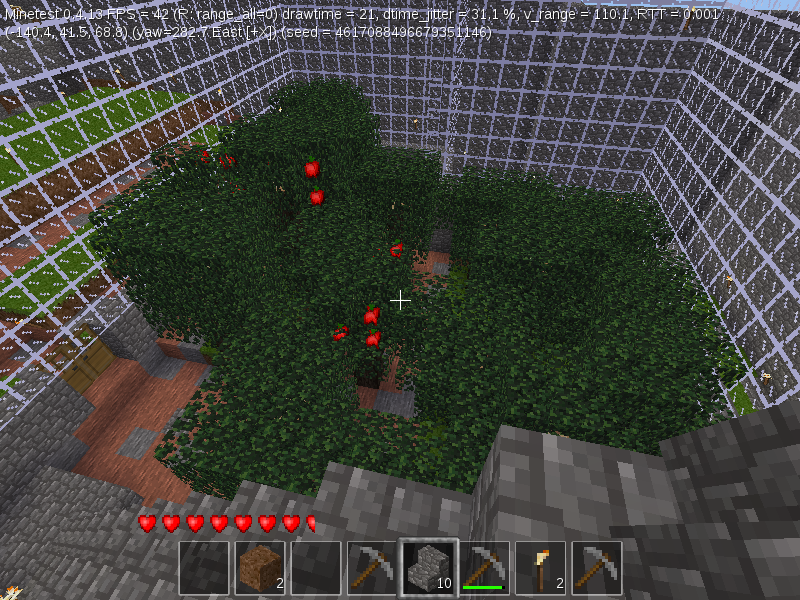
I’ve played the game Minecraft quite a bit, and that has a feature which resembles caving. When you dig a mine in Minecraft you generally dig downwards. At first you might just hammer rocks to clear your way, but sooner or later you will hit a void in the ground. The trick here is not to fall into it.

You may hit the void or cave at any point – the bottom, the middle or the top. In any case you will initially see only darkness with maybe a a few blocks dimly visible in the gloom. To proceed further (and find all the desirable ores and minerals) you will need to get down to the bottom and root around.

A view of a set of steps in a Minecraft clone game

This generally means that you carefully cut steps around the edges of the void until you reach the bottom. I generally leave torches attached to the walls of the excavation as I go, as a sort of “breadcrumb trail“. Eventually one reaches the bottom of the void and can go exploring.

At the bottom of a void, it is much like the bottom of a cave. A jumble of blocks and the occasional pitfall await. The only difference is that the blocks that form the virtual cave are all cubes and don’t move as you walk over them, whereas in a real cave there are all sorts of shapes, and they can move under your feet.

Trees in a glass building

Interestingly coming upon a gaping void in Minecraft induces the same gripping tension as entering a large, unknown chamber in a real cave, at least to some extent.

Looking up from the depths at the bottom of the pothole

Crime and Punishment

English: Donald Trump at a press conference an...
English: Donald Trump at a press conference announcing David Blaine’s latest feat in New York City at the Trump Tower. (Photo credit: Wikipedia)

Donald Trump got into trouble the other for, if you read the media, suggesting that women who seek abortions should be punished if abortion was made illegal in the US. Much as I dislike the Trump and fear for the US and possibly the world if he should become president, he is right.

It’s the conditional that makes the difference. If abortion was to be made illegal, it would make it a crime, and all crimes have an associated punishment. I think that Trump made a political misstep, and that he should have stood firm on the matter, explaining the logic of his statement.

A bar chart depicting selected data from the 1...
A bar chart depicting selected data from the 1998 AGI meta-study on the reasons women stated for having an abortion. (Photo credit: Wikipedia)

He doesn’t even have to support the outlawing of abortion. He just has to explain the logic. Of course, if abortion were illegal, then the doctors and nurses who perform the operation would also be help responsible and punished. But if abortion were ruled illegal then the woman seeking the abortion would be breaking the law, and that implies punishment.

I personally believe that abortion, per se, should never be made illegal, although it should not be treated as just another birth control method, and should not be undertaken casually by the woman, or casually by the doctors and nurses. Clearly something living dies in the process.


Embed from Getty Images

The Trump got caught out by knee-jerk and politically based reactions all round. Logically, the stand makes sense – if a crime is committed, then the perpetrators should be punished. Trump wisely backed down on this position in the case of a hypothetical law, and may have missed his chance at the presidency because of this political gaffe on a hypothetical situation!

Crime and punishment go together like Adam and Eve, like right and left, like good and evil, like a fine rump steak and a good Cab Sav. Ahem. As a determinist, I feel that choice is illusory and that the apparent choices that we make in fact depend totally on past events that narrow down our options to just one.


Embed from Getty Images

Let’s take the case of a woman who “chooses” to have an abortion. She may have been informed that this is the safest option by medical specialists, she may be carrying a child who will not be viable when delivered because of genetic and other defect, or she may unable to care for a child for whatever reason. There is always a reason.

The woman balances all the information that comes to her and uses that information to “choose” to have an abortion. What really happens is that all the factors added together result in her trying to get an abortion.

English: Female demonstrator wearing a hat in ...
English: Female demonstrator wearing a hat in Madrid. It says “Abortion is my freedom, my choice.” She protested against Pope visit to Spain. Español: Chica manifestante con un sombrero en Madrid. Protesta contra la visita del papa a España. (Photo credit: Wikipedia)

You could of course argue that she could/should have decided to have the baby and adopt it out (assuming that the child is viable outside the womb, but that option is often not viable.

In general, punishment of a criminal is used to deter other criminals (and the criminal his/her self) from committing a similar crime in the future. Punishment should always give the criminal and similar people like him/her pause for thought. It is a factor that determines whether or not someone commits the crime in the future.

Crime and Punishment
Crime and Punishment (Photo credit: Wikipedia)

When a criminal is thinking about committing a crime he/she will (consciously or unconsciously) consider the implications. If he/she chances it anyway, that will be because the pros outweigh the cons from their point of view at the time, not as a result of any free choice.

If someone is starving they may well steal a loaf of bread as one of the pros in the case may be continuing to live. This trumps any cons there may be if the person is desperate enough. Of course the person may be caught and fined or imprisoned or even transported to Australia, but at least he/she will be alive!

Tolpuddle Martyrs' Memorial Shelter, Tolpuddle...
Tolpuddle Martyrs’ Memorial Shelter, Tolpuddle Tolpuddle, Dorset, UK. (Photo credit: Wikipedia)

The justice system still works even if the concept of choice is removed. The person who commits a crime does so because they cannot do otherwise, and any punishment is merely the result of the actions that the person is destined to take. Such punishment is seen by others and becomes a factor that is considered when another person is contemplating a similar crime.

All the factors that go into the mental consideration of committing a crime result in either the crime being committed or not. They don’t result in a choice being made as the factors involved result in the person committing the crime or alternatively the factors may add up to the person not committing the crime.

English: 'Campus Watch' sign, Belfast One of d...
English: ‘Campus Watch’ sign, Belfast One of dozens erected around the university area of Belfast, this sign promotes the ‘Campus Watch’ scheme for students. Developed by the police in Belfast in partnership with the Northern Ireland Office, University of Ulster & Queen’s Students’ Union, it is similar to a neighbourhood watch scheme and promotes practical crime prevention for students. (Photo credit: Wikipedia)

If you get people to “make a choice” where they have no sufficiently compelling reason to “choose” one way or another, they find it very difficult to do so. For example if you put a person in a room with two unmarked buttons and told them to push a button when a buzzer went, I’d say that they would initially have great difficulty, but once they had pushed a button once, it would become easier, I suspect.

If asked why they pushed one button on the third trial, they might reply that they had pressed the other button twice so it was the button’s turn to be pressed. Consciously or unconsciously I’d suggest that they would be led to make the choices random.

English: 'Arcade Button' photo by Daniel, free...
English: ‘Arcade Button’ photo by Daniel, free to use (Photo credit: Wikipedia)

If the experimenter then pauses the test and mentions that the subject had favoured one button over the other and then continued, I’d guess that this would cause the subject to favour the unfavoured button more. I have no idea if such experiments have been done.

We are machines of meat, and machines don’t have any choice – they behave in a way that is built in, or lately, programmed in. Would you punish a machine that gives an answer that doesn’t satisfy you? You’d maybe add a new input into the machine to achieve a desired result.


Embed from Getty Images

In humans punishment is a new input. It could affect the result of the calculation that the brain makes and hence the human would come up with a result different to the result that would be observed without the punishment. Perhaps if or when machines become intelligent, it may be that we will need to introduce the concept of punishment to make them do what is required. Let’s hope not.


Embed from Getty Images

Politicians


Embed from Getty Images

(Photographs of politicians below are not intended to imply that the pictured politician is any way corrupt or discredited. Even Trump.)

Donald Trump appears to be on the verge of being named the Republican candidate for President of the United States. While it is unlikely that he will become president, his rise has been amazing, and his appeal surprises many, in the USA and elsewhere.

He has made some astounding promises but it is unlikely that people really believe that he is going to be able to achieve them. However, as a many shared post on Facebook has it, people are really looking more at the direction he is promising to move the country.

English: Donald Trump's signature hairstyle
English: Donald Trump’s signature hairstyle (Photo credit: Wikipedia)

Trump is not a politician in the usual way. A politician would normally take great care not to upset people, not to rock the boat as it were. Politicians almost always try not to promise anything, as they might not be able to deliver what they promise and that will harm their re-election chances.

All human interactions involve politics to some extent. When a group of people forms, be it a family or a tribe or a nation and selects one of their number to represent them in an interaction with another group of people, that’s politics.


Embed from Getty Images

Human nature being what it is, the representative feels empowered by this responsibility, and often becomes arrogant and domineering. This may or may not result in the representative being replaced by someone else.

However there are advantages in having someone as figurehead in interaction with other groups. The elevation of someone to be the group’s representative can become permanent, with the representative becoming the chief, the king, the emperor. Or even the President of the United States.

The figurehead and prow of the SS Great Britain.
The figurehead and prow of the SS Great Britain. (Photo credit: Wikipedia)

Politicians in general do not have a high reputation. Mark Twain once said “Politicians and diapers must be changed often, and for the same reason”. The implication is that while politicians may start off idealistic, they may often come to become arrogant and believe that they are better in some way than the people who gave them the power.

Lord Acton’s dictum often appears to be true of politicians. The more power that they have, the more they consider themselves to be more important than the average man in the street. They may come to believe that they are above the law, and eventually fall foul of it. While power does not directly corrupt, the feeling of importance and the ability to wield power sometimes does.


Embed from Getty Images

Politicians do recognise this fact and, if they are sensible, try to  avoid this trap. They try to remain “grounded”. They talk about getting back to the roots, keeping in touch and other such phrases, but it is very hard to do this as when they try to interact with those who put them in power, those people treat them as special, and tend to address the role and not the person.

Politicians are overthrown all the time. It may be that they no longer serve the people who selected them, or it may be that they have become arrogant and have been caught doing something illegal or dubious.


Embed from Getty Images

Often these peccadilloes are things that would not get a normal person into too much trouble. An insulting email, maybe, or perhaps an affair with a person that the politician works with. Or getting someone to paint the roof, when the politician is in a position to help the painter.

Sometimes, though, the politician takes advantage of their position in ways which are very wrong. Sometimes they accept money to advance someone’s business, or they may divert money to their own bank accounts, when it should be spent to further the aims for which they were selected. They might take holidays overseas or travel to conferences for which their seems little justification.


Embed from Getty Images

It’s no wonder then, that people look on politicians with distrust. They are aware of all the temptations that beset politicians and they are aware that such temptations are hard to resist and that some politicians may be corruptible.

That’s why we surround our politicians with laws and rules above and beyond those that apply to the man in the street. We want our politicians to be above reproach, but we know that they are fallible.


Embed from Getty Images

But we do not hold them to their promises, which is why Trump can get away with promising that he would build a wall between the United States and Mexico, if he gets elected, when everyone knows that such a wall is very unlikely to be built. Even if it is, illegal immigrants from Mexico to the United States will find ways around it. Or under it. There are already tunnels under the border between the two countries.

The electors in the United States know that Trump’s promises are hogwash, but they like the way that he promises something towards dealing with the problem of illegal immigration. It shows that he is thinking about it, and may well do something.

English: American politician Hubert Work.
English: American politician Hubert Work. (Photo credit: Wikipedia)

The same goes for Trump’s promise to prevent Muslims entering the United States for a period. It will never happen, and if it did, it would not be effective, as many potential IS terrorists are already in the country, and such a move would likely persuade them to actively attack the United States from within.

But Trump promises something to deal with the entry of terrorists into the country. Once again, while he probably will not do anything like this, people hope that he will do something.


Embed from Getty Images

However, the big thing that Trump has going for him is that he is not a politician, in the sense that he has not had a career in politics, he has not worked his way up in politics. No, Trump has started at the top. Trump is a businessman. If he does get elected he will probably find that his business skills don’t really equip him for a life in politics, and persuading people to go along with his schemes will make herding cats look easy.

After all, in the business world Trump may be able to hire and fire as he wishes, but in government, the other elected representatives cannot be fired and he will need their cooperation. Trump’s (apparent) bullying tactics will not work in government. In some ways it would be interesting to see if he could achieve anything if he were the POTUS.

Plaque of the Seal of the President of the Uni...
Plaque of the Seal of the President of the United States on the southeast side of Hoover Tower on the campus in Stanford, California. (Photo credit: Wikipedia)

Religion

Bulgarian orthodox Easter Eggs.
Bulgarian orthodox Easter Eggs. (Photo credit: Wikipedia)

At a time like Easter it is common to ponder on one’s faith. Whether one is religious or considers religion to be a delusion and waste of time and effort, one almost certainly aware of the origins of Easter, if one lives in an even nominally Christian country.

One may feel disgust that a religious occasion has been hijacked by commercialism, even if one is not religious, but one may still tuck in to Hot Cross Buns and chocolate Easter Eggs, and even partake of a slice of Simnal Cake.

Kulichs (kulich is a kind of Easter cake, trad...
Kulichs (kulich is a kind of Easter cake, traditional in the Orthodox Christian faith) (Photo credit: Wikipedia)

Some people pride themselves on having no faith, maybe even declaring themselves to be atheists. I feel though, that deep down everyone has some foundation philosophy or beliefs that seem to them to be unquestionable and obvious, that are in fact part of their make up.

Some people think that religion is silly and obviously wrong. They forget that religion as a world view has a long and successful heritage that has enabled people, in the main, to get along, and survive, and cooperate with other people.

The Army of Super Creatures
The Army of Super Creatures (Photo credit: Wikipedia)

It has, it is true, been blamed for a long list of atrocities as well (and still is, of course), but much of that is as a result of people’s’ usage of religion and not the idea of religion itself.

What is religion? It is the belief that the world is controlled and run by some supernatural being or beings, and that everything happens as a result of the aims and intervention of these supernatural being or beings.

English: "Hands of God", symbol of t...
English: “Hands of God”, symbol of the early ethnic religions of the Slavs and Vandals. (Photo credit: Wikipedia)

Before the invention of science, this would have seemed to be a reasonable theory. Of course, since we are only physical beings, we can only imagine why the supposed divine being causes things to happen that happen to us and to others.

And that’s what people do. In the absence of any other information, they imagine aims and objectives of the divine being or beings. The people who do the imagining are often called prophets or shamans or priests.

Retouched photograph of a shaman of the Ket pe...
Retouched photograph of a shaman of the Ket people. (Photo credit: Wikipedia)

Of course the shaman’s own people should be the ones favoured by deity, and of course they would be justified in all sorts underhand actions. All the people who did not belong to the shaman’s own people were obviously wrong or deluded and needed to be shown the error of their waves.

One might reasonably ask of the shaman, how does he know the wishes of the deity when the deity doesn’t converse with human beings. The shaman will have all sorts of esoteric methods for determining the wishes of the deity. Tossing bones, disemboweling chickens and taking various mind altering substances to enter trances.


Embed from Getty Images

In many cases the shaman may believe that he is receiving instructions from the deity, though in some the shaman is possibly at least partly a pragmatic politician – it would career and life threatening to tell the tribal chieftain that he is going to lose the next challenge to his supremacy, or that the big tribe next door were going to conquer them.

Of course someone decided to write all the information about the tribe into a big book. Mostly the stuff written down was the history of the tribe and tall tales were OK, as it “proved” that the tribe was big and powerful and supported by the supreme being.

English: Title page of a 1830 copy of The Book...
English: Title page of a 1830 copy of The Book of Mormon: An Account Written by the Hand of Mormon upon Plates Taken from the Plates of Nephi (Photo credit: Wikipedia)

Of course such and such a hero defeated 1,000 opponents single handed. How could he do otherwise with the deity on his side? The trouble with writing it down is that fixes the story. There is no scope for the shaman to, shall we say, ad lib.

Also included in the written down texts, handed down from the aural tradition were the rules that the people had to adhere to, and the punishments handed out. Or supposedly handed out. As a punishment for a transgression some ancient person was put to death, but to deter others the punishment was supposedly horrific. And this punishment was enshrined in the holy text, so it became the official punishment.

English: Type of contracts at sharia law
English: Type of contracts at sharia law (Photo credit: Wikipedia)

As religion got institutionalised, it was used to justify wars and genocides and other atrocities, and still is to this day. One of the issues with religions and religious books is that things happened in the past and stuff got written to the books, and only a tenuous link between the two. There probably was a king called David, and he probably did some of the things attributed to him, but it is unlikely that the Bible gives an accurate description of his reign.

There is a philosophical problem with the idea of supernatural beings anyway. The only way that we can conceive of such entities is by giving them physical and human attributes – the supreme being is usually male for example. Generally the supernatural being is paternal and judgemental, and favours one particular set of people over others.

Although the Norse god Freyr functions as Hraf...
Although the Norse god Freyr functions as Hrafnkell’s patron deity, the saga contains few supernatural elements (Photo credit: Wikipedia)

To influence matters in the physical universe a supernatural being would need to manifest itself in physical ways. The problem is that a supernatural being is, by definition, non-physical and therefore cannot affect the physical world.

Some people have considered this issue and suggested that the supernatural being merely set up the universe and its laws in the beginning and has had no input since. While that removes the initial problem of the physical/supernatural interaction, it doesn’t address the physical question of how the universe was set up in the first place. It merely pushes the issue back beyond the Big Bang.


Embed from Getty Images

Besides, many religions would be uncomfortable with a deity who merely set things up and then stepped away. Where would they get their laws and stories from? They’d have to make them up!

That’s the problem. Even if somehow the supernatural being’s wishes came to be embedded in a book (or even an aural tradition) someone has to read the book and interpret the words (as originally, the man in the street would not have been able to read) and for any number of reasons, the reader might, probably unconsciously, interpret the words in a way favourable to his biasses.

Setting aside (ordination) as readers of semin...
Setting aside (ordination) as readers of seminary students in Russia (Photo credit: Wikipedia)

And that might be the start of a crusade, and it’s difficult to conceive of a supernatural being who would favour people killing one another in its name. But the get out clause is that we can never understand the aims of such a being, should there be one, and this may be what the supernatural being needs to happen.

Captioned as "Balder und Nanna". The...
Captioned as “Balder und Nanna”. The god Baldr and his wife Nanna. (Photo credit: Wikipedia)