Weather

The Weather Station
The Weather Station (Photo credit: Stuck in Customs)

It is a cliché that if two Englishmen meet they will always first talk about the weather. Samuel Johnson once said:


“It is commonly observed, that when two Englishmen meet, their first talk is of the weather; they are in haste to tell each other, what each must already know, that it is hot or cold, bright or cloudy, windy or calm.”

When Stanley met Livingtstone and said “Doctor Livingstone, I presume?” they probably then started to discuss the weather.


David Livingstone staue near Victoria Falls, Z...
David Livingstone staue near Victoria Falls, Zambia (Photo credit: Wikipedia)

Noel Coward once sung that “Mad dogs and Englishmen go out in the noonday sun“. The song is a reference to the days of the British Empire in what were, in those days referred to as “colonial times” and the self-perceived “sang froid” of the colonial rulers of the time. In these post-colonial times the attitude expressed in the song is embarrassing.


Mad Dogs and Englishmen; Marsaxlokk, Malta
Mad Dogs and Englishmen; Marsaxlokk, Malta (Photo credit: foxypar4)

Although the English may care about the current weather to some extent, I think that the initial conversation gives the conversationalists the chance to size each other up, to fit the other person into one’s world-view so to speak. The other person’s way of speaking allow one to decide if they are “posh” or “common” or somewhere in between. Voice and body language would offer other clues during this initial meteorological discussion.


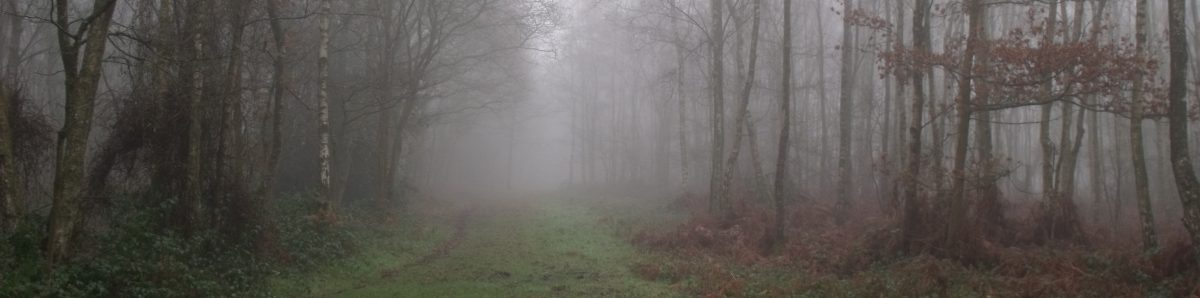
All the Leaves are Brown, the Skies are Grey, ...
All the Leaves are Brown, the Skies are Grey, and Someone Wearing a Blue Coat Walked into My Picture (Photo credit: bitzcelt)

The English are proud of their weather which they informal believe is the worst in the world. Of course they are wrong, as their bad weather and their extremely boring weather is neither as bad nor as boring as the weather in other places in the world. They love to complain about the weather, and this has perhaps led somewhat unfairly to the stereotype of the “whinging pom“.


English: Earliest known map of the Gulf Stream
English: Earliest known map of the Gulf Stream (Photo credit: Wikipedia)

Most English people don’t realise that the ocean current of the Gulf Stream ensures that the British Isles don’t freeze in winter and boil in summer as it moderates the climate that the English and the other nations of the British Isles receive. A glance at a map will show that the British Isles are several degrees further north than Labrador in Canada, and only a few degrees further north than Moscow.


Belle Isle off the coast of Labrador Français ...
Belle Isle off the coast of Labrador Français : Belle Isle, au large du Labrador. (Photo credit: Wikipedia)

What I remember about the English climate was long weeks of gun-metal grey skies, but however I also remember long warm summer days as a child. I don’t have sufficient real evidence to support these memories, and although the climate is changing, I suspect that my mind is editing my memories somewhat!


I’ve moved to the other side of the globe, where weather patterns are distinctly different. (Aside: I originally wrote “the other end of the globe”, but that is a more mathematical topic, I think). Wellington has a temperate maritime climate and the weather is changeable, meaning that we may see “Four Seasons in One Day“. The Crowded House song, though, was not written about Wellington, but was inspired by Melbourne, Australia where Crowded House was based at the time.


Four Seasons in One Day
Four Seasons in One Day (Photo credit: horrigans)

The weather in New Zealand originates in and around the eastern parts of Australia. Anti-cyclones spin up off the south coast of Australia, past Tasmania and over New Zealand. High pressure bubbles emerge from the main land mass of Australia, and tropical cyclones can dip far enough south to cover New Zealand.


Looking Out over the Sea
Looking Out over the Sea (Photo credit: Jocey K)

It is no wonder with these competing factors that New Zealand’s weather can change from minute to minute. Fronts can sweep rapidly across the country, bringing rapid changes of temperature as they do so. Temperatures can change by ten degrees or more between morning and afternoon.


The weather is not always changeable though. If a high pressure area extends from Australia across New Zealand the weather may “stall” and an extended period of warm weather in the summer or cooler weather in the winter may ensue, with clear skies and sunshine across the country.


'A Reflective Moment', New Zealand, Tasman Sea...
‘A Reflective Moment’, New Zealand, Tasman Sea Coast (Photo credit: WanderingtheWorld (www.ChrisFord.com))

Wellington is close to the Cook Straight, the gap between the North and South Islands. The Straight acts as a funnel for wind, and Wellington has a deserved reputation for being windy. However the average wind speed is not that exceptional, However, as the linked article says, there are more windy days per year than in most other New Zealand coastal cities. Hmmm. Some gusts can be exceptionally strong lifting roofs and knocking over trees, but the occasional strong blasts also happen outside of Wellington.


English: Wellington Airport, New Zealand.
English: Wellington Airport, New Zealand. (Photo credit: Wikipedia)

I was at Wellington airport yesterday, seeing my daughter off to Auckland. Several flights were cancelled but fortunately not my daughter’s flight, though apparently it was a rough take off. What we didn’t see was an incoming flight which actually did a touch and go before diverting elsewhere. I did wonder why the crash trucks were speeding about! No wonder New Zealanders, like the English, like to discuss the weather.


737 Touch and Go practice
737 Touch and Go practice (Photo credit: Fly For Fun)

The changeable weather in New Zealand often catches tourists out. Mountain weather in any country can change rapidly, and New Zealand is no exception. Bright sunny days can often turn very bad, very quickly. Mist and cloud can suddenly descend and remove all visible landmarks, and if the tramper (hiker) is not well prepared, he or she might well be in trouble, and several foreign tourists do get themselves into trouble every year.


Hiking the ridge line
Hiking the ridge line (Photo credit: IamNotUnique)

This is no different from elsewhere of course, but it seems that tourists may underestimate the wildness of the New Zealand “bush”, maybe because they come from countries where the countryside is more benign, or maybe because they overestimate their own abilities. Sometimes tourists venture into the bush, totally under equipped and are caught out by the rapidity of the changes in the weather.

change in the weather
change in the weather (Photo credit: paparutzi)

In spite of my discussion of the bad weather above, New Zealand also has glorious weather. Following the winter storms, in the clear weather under a high pressure system, New Zealanders and tourists alike head for mountains and a number of world class ski fields. In the summer, glorious weather under a high pressure system leads people heading for the beach, or heading to the bush, or merely staying home and firing up the barbecue.

20111130-IMG_2576
20111130-IMG_2576 (Photo credit: vauvau)

There is a saying in Wellington – “You can’t beat Wellington on a good day”, and I would add that the good days outweigh the occasional windy and rainy days!

Update: After writing the above, Wellington turned on a great morning, a crisp autumn sunny day. The first picture below is of the city of Wellington from Petone, framed by a couple of flax plants.

IMG_20140527_135052

The second picture is of Petone Wharf from about the same spot.
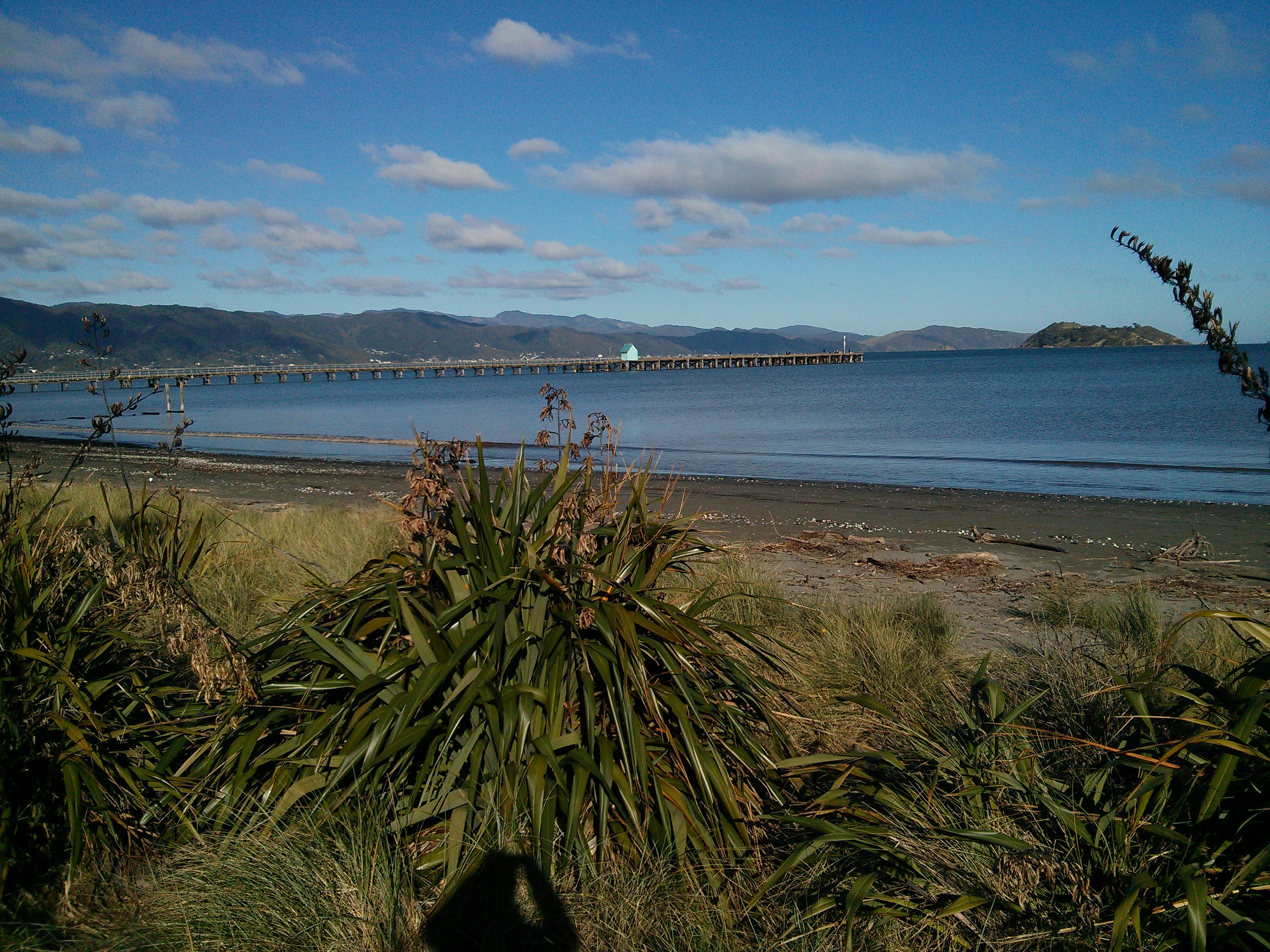
IMG_20140527_135059

Of course, in accordance with the principle of perversity and the “four seasons in one day”, the weather has turned grey.


Enhanced by Zemanta

The process of Philosophy

Philosophy & Poetry
Philosophy & Poetry (Photo credit: Lawrence OP)

Philosophy is a strange pastime. Scientists measure and weigh. Mathematicians wrangle axioms and logical steps. All other disciplines draw on these two fields, which are probably linked at deep level, but philosophy draws from nothing except thoughts and the philosopher’s view of the Universe.


Mathematics
Mathematics (Photo credit: Wikipedia)

Well, that’s not completely accurate because philosophy has to be about something and the only something we have is the universe. But philosophy does not have to be about the universe as we know it. What if there was no such thing as electrical charge, or, the prudent philosopher thinks, what if there was no such thing as the thing we call electrical charge. At a more basic level, what is electrical charge.

Lichtenberg
Lichtenberg (Photo credit: caddymob)


Philosophers are always getting pushed back by scientists as scientists figure what they think is the case. If there is a scientific consensus on what comprises an electric charge then that question no longer interest philosophers to any great extent. Philosophers mentally travel through the lands marked “Here be dragons”.


Dragon from PSF D-270006.png
Dragon from PSF D-270006.png (Photo credit: Wikipedia)

Philosophy is also interested in less “physical” things like ethics and morals, what comprises identity, predestination or free will, what can we know and what knowing is all about. How did the Universe come to exist, or more basically, why is there something rather than nothing?


If you look at this list it comprises extensions to or extrapolations from physics, psychology, physiology, medicine, biology, and other fields of science. Philosophy doesn’t use mathematics (usually), but it uses logical argument or should. It not (usually) built on axioms, so doesn’t have the rigid formality of mathematics.

Illustration of Plato's Allegory of the cave.
Illustration of Plato’s Allegory of the cave. (Photo credit: Wikipedia)

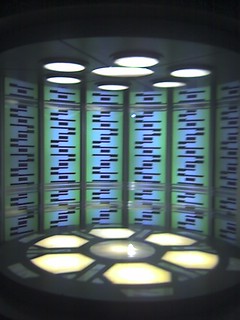
Philosophers are big users of metaphor, such as Plato’s “Allegory of the Cave”. A metaphor of the expansion of a balloon was used as a philosophical explanation of the expansion of the Universe discovered by Edwin Hubble. Philosophers also imagine physical machines which do not yet exist and which may never exist, such as the ‘teleporter’ which makes a material object at point A disappear and reappear at point B.

Star Trek - Enterprise D Transporter
Star Trek – Enterprise D Transporter (Photo credit: tkksummers)

Quantum physicists have teleported quantum information from one point to another, but this is not the same as teleporting atoms. So far as I can gather from the Wikipedia article, what is teleported is information about the state of an atom, so the same atoms must already be at point B before the teleportation event, and the event is a sort of imprinting on the target atoms. It sounds like the atoms at point A remain in situ, so it is more of a tele-duplication process really. However I don’t really understand the Wikipedia article so I may be wrong.

Diagram for quantum teleportation of a photon
Diagram for quantum teleportation of a photon (Photo credit: Wikipedia)

The philosopher is not interested in the quantum nuts and bolts though. He or she would be interested in the process – is a person walks in to the teleporter at point A the same person as the person who walks out of the transporter at point B? Unless his actual atoms are transported by the process, which seems an unlikely implementation, the person at point A shares nothing with the person at point B except a configuration of a second set of atoms. Is the person at point A destroyed by the machine and recreated at point B? What if something goes wrong and the person at point A does not disappear when the button is pressed? Then we have two instances of the person. Which is the real instance?

Unknown Person
Unknown Person (Photo credit: Wikipedia)

Notice that the philosopher takes a physical situation of travel from point A to point B and considers a special case, that of travelling between the two point without travelling the old slow way of travelling between all the intervening points and doing it quickly. There is no physics which can currently perform this task, but as usual, scientists are working to, one might say, fill in the gaps.

The Sci-Fi Fly!
The Sci-Fi Fly! (Photo credit: Carolyn Lehrke)

Many times the scientist is also a philosopher – he may have at the back of his mind the concept of teleportation when he creates his hypotheses and does his experiments, but he probably doesn’t concern himself with identity. That is still the realm of the philosopher at present, but if a teleportation device were ever created, it would stop being a philosophical matter, and become a matter of law and psychology and maybe some field that does not exist yet, just as the field of psychology did not exist at one time.

General Psychology
General Psychology (Photo credit: Psychology Pictures)

I’m trying to paint a picture of the area that a philosopher is interested in. If the whole of human knowledge is a planet, then physics and maths are part of the outer most layers of the atmosphere, the exosphere, and this merges with the depths of space are the domain of philosophy. At lower levels are things like chemistry, biology, psychology and other more applied sciences. Don’t look too closely at this analogy because I can see two or three things wrong with it, and I’m not even trying.

English: View of the crescent moon through the...
English: View of the crescent moon through the top of the earth’s atmosphere. Photographed above 21.5°N, 113.3°E. by International Space Station crew Expedition 13 over the South China Sea, just south of Macau (NASA image ID: ISS013-E-54329). Français : Photo des couches hautes de l’atmosphère terrestre. Polski: Zdjęcie górnych warstw atmosfery ziemskiej z widocznym przejściem w przestrzeń kosmiczną. Ελληνικά: Η Γήινη ατμόσφαιρα, η φωτογραφία ελήφθη από το διάστημα κι ύψος 335 χιλιόμετρα (Photo credit: Wikipedia)

But the main point I am making is that philosophy purposefully pokes and prods the areas beyond the domain of current mathematics and physics. Of course the line is not a definite line and there is a grey area. Some physical hypotheses verge into philosophy and some philosophical ideas are one step from becoming physical hypotheses. The suggestion that there be many universe like and unlike ours is one such suggestion that physicists are taking seriously these days.

2-step branching in many-worlds theory
2-step branching in many-worlds theory (Photo credit: Wikipedia)

Many of these ideas are not new and many have been used in what has been called “science fiction” for many years, especially the parallel universe theory. Time travel is another common science fiction theme. Although these ideas are used and developed by authors of fiction, physicists have adopted such ideas to advance science, though I don’t mean to suggest that scientists have directly borrowed the ideas of science fiction authors. It is probable that many ideas actually travelled in the opposite direction, from science to fiction.

English: Minkowski diagram of the twin paradox.
English: Minkowski diagram of the twin paradox. (Photo credit: Wikipedia)

Since philosophy is at heart discursive and not rigidly analytical (in most cases), there is more freedom to expand on ideas that are not what is called “mainstream”. Because of this freedom it is likely that (like economists) no two philosophers will agree on anything, but they will have fun arguing about it.


The Argument Sketch
The Argument Sketch (Photo credit: Wikipedia)


Related articles


Enhanced by Zemanta

Photographic Honesty

Category:Wikipedia requested photographs of ph...
Category:Wikipedia requested photographs of photography (Photo credit: Wikipedia)

I’m going to do something that I’ve never done before, something a little risky. I’m going to write a piece about an article on someone else’s website, a piece which resonated with me. Of course, I may have totally missed the point of the other person’s article. I hope not, and I can only apologise in advance for any misconceptions that I have about the article.

Please note that the pictures in this article are mere decorations and do not and not intended to relate to Tony Bridge and his art. Think of them as free association based on the words that I type.

English: Photography forbidden. A nightmare......
English: Photography forbidden. A nightmare… Français : Un cauchemar… Deutsch: Fotografieren verboten. Ein Albtraum… (Photo credit: Wikipedia)

The writer of the piece is Tony Bridge (http://www.thistonybridge.com) and the piece is entitled “On honesty in photography“.

Firstly I urge you to visit Tony Bridge’s site and view the many amazing and attention grabbing photographs that Tony has assembled on his site. I am in awe of his skill, his technique, and particularly of his professional photographer’s eye. (Please remember that none of these images are his. I would not presume…)

English: A photographer between waves and mussels
English: A photographer between waves and mussels (Photo credit: Wikipedia)

I’m no photographer. I take photographs, I try to ensure that the photographs are interesting, I try to “compose” them a little, I try to pay attention to the lighting of the subject versus the background and things like that, but these days I rarely stray from the automatic settings on my camera, which is a cheap FujiFilm one.

As for post-production, the removal of perceived mistakes in composition and specks of dust, changing hues and saturation and so on, well, I rarely do more than remove red-eye and shift the contrast. Tony’s article talks about a possible perceived over emphasis on the post-production of some modern photography. It is the main topic of Tony’s article.

Photoshop-work
Photoshop-work (Photo credit: Kjell Eson)

With tools like Photoshop anything in or about a picture can be manipulated, from simple removal of flaws to major changes to the image. Indeed there are numerous  photo manipulation “fails” to be found on the Internet, ranging from failed enhancements of “beauty” shots, to badly photoshopped propaganda photographs from the likes of North Korea.

Follow Me, Ladies
Follow Me, Ladies (Photo credit: Dοn)

Is this new? I think not. Apparently Henry VIII of England was deceived by a painted likeness of Anne of Cleves, complaining that “She is nothing so fair as she hath been reported.” To be sure this is not post production alteration of the image, but it is similar in kind. Henry could, probably justifiably, have called for more honesty in image production.

Painting of Anne of Cleves, fourth wife of the...
Painting of Anne of Cleves, fourth wife of the English King Henry VIII, by Hans Holbein the Younger (Photo credit: Wikipedia)

Of course there were movements in portraiture and other painting for more honesty in portrayal. Oliver Cromwell, is alleged to have required that his portrait be painted “warts and all”. However most painting tended to emphasise some aspects of the subject over others, the epitome being the painting of “The Monarch of the Glen” by Landseer, an over idealised painting of a stag. Nevertheless, a great painting.

sir Edwin Landseer, The Monarch of the Glen (1...
sir Edwin Landseer, The Monarch of the Glen (1851) in the Museum of Scotland. (Photo credit: Wikipedia)

Some painters realised the way that images were being enhanced and moved in another direction away from realism, leading to such schools of painting as impressionism, cubism, surrealism,  pop art, to name only a few. Again the paintings were, are amazing. I draw a parallel between non-realistic art with highly post-processed photography.

Photography, springing up in the early 20th century in the shadow of painting, at first had few tools to do other than report what the lens had seen. Photographers were still learning about the new medium, but soon techniques started to arise, such as vignetting (softening the corners of an image) to alter the image.

Untitled
Untitled (Photo credit: Smithsonian Institution)

But the tools soon arrived. The standard model of camera has the image plane perpendicular to the lens axis with the lens axis at or near to the centre of the image plane. Later cameras allowed the lens to be shifted and twisted to allow various effects, such as better images of tall buildings and so on. No doubt the photographers of the time might argue for a more honest approach, though I’m pushing the analogy to breaking point.

In the darkroom similar effects could be performed by manipulating the chemical baths and the enlarger used for the printing process. Many of the image manipulation processes are over 100 years old according to Wikipedia. It was probably the advert of colour films and processing that severely reduced the amateur use of darkroom processes in photography, because of the extra complexity of processes. That’s a pity, as nothing beats the feeling you get when an image appears from nothing on a white piece of paper.

Student developing a map image. Photograph tak...
Student developing a map image. Photograph taken during the making of a BBC documentary. IMAGELIBRARY/166 Persistent URL: archives.lse.ac.uk/dserve.exe?dsqServer=lib-4.lse.ac.uk&a… (Photo credit: Wikipedia)

The digital revolution has put the power back in the hands of the amateur again. Anyone with a phone can take a photograph, process it through Instagram and the result has been …. a cascade of rubbish!

Against this unprecedented tide of rubbish, real photographers, amateur and professional struggle to promote their art. So is real photography the poorly lit, over exposed, blurry, shaky, hand-held phone stuff, or the highly processed, sharp as a tack, rigidly tripod mounted, Canon/Nikon/Hasselblad shot stuff, or the story board, lightly processed, possibly hand held stuff?

English: Hasselblad 503 CW with Zeiss F-Distag...
English: Hasselblad 503 CW with Zeiss F-Distagon 3,5/30 and digital back Ixpress V96C (16 megapixel sensor). Français : Appareil moyen format Hasselblad 503 CW avec optique Zeiss Distagon 3,5/30 et dos numérique Ixpress V96C (Résolution 16 MP). Nederlands: Middenformaatcamera Hasselblad 503 CW met Zeiss F-Distagon 3,5/30 en digitale achterwand Ixpress V96C (16 megapixel). (Photo credit: Wikipedia)

In my opinion, it is an invalid question. Consider the famous “Monsoon Girl” photograph by Brian Brake. This is an awesome photograph and I don’t see why it should denigrated because it was a set up. Is it honest? It is honest to the story it told. It expresses perfectly the promise that the monsoon brings of growing things and plenty in the future. However it wasn’t a real photograph of a real girl in real monsoon rain.

Monsoon Girl
Monsoon Girl (Photo credit: colonos)

Similarly with the awesome images that can be created by Photoshop and other tools. One of my favourite site for images is the NASA site. Wonderful images! However many of them are “false colour” images, of the sun and other objects. It’s not Photoshop, (so far as I know) but it is highly manipulated images. Are they “honest”? In one sense they are in another they are not. Are they amazing photographs? Yes, of course.

English: Landsat 7 false colour image of the N...
English: Landsat 7 false colour image of the Nile Delta (Photo credit: Wikipedia)

If I had a photo good enough to be used in a magazine or book or whatever, would I do whatever I could to make it as defect free as possible? Yes, I would and I would not consider that dishonest.

Tony Bridge questions whether or not we need the latest cameras, a longer lens, the next highest resolution or the next update of photo manipulation software. Of course we don’t. But if they help us get our message across, then they are useful. They are pretty nice toys, too! A long lens is great. An extremely long lens may enable things to be photographed that can’t otherwise be photographed, but only the photographer’s eye can make the picture shine.

Schematic of a catadioptric (mirror-lens) tele...
Schematic of a catadioptric (mirror-lens) telephoto camera lens (Photo credit: Wikipedia)

I recall that I posted an image on Facebook of a stick insect shedding its skin. This event occurred practically right in front of my nose, just outside my front door. I really couldn’t have missed it. Brian Harmer, a photographer and blogger friend of mine congratulated me on my photo, and when I said that I couldn’t have missed it, he wisely said “Most of the genius in any image is what you point it at when you shoot. Your eye saw the image. the (camera) merely recorded it”.

Stick insect shedding skin


My picture was no work of art, but I take his point. What makes a good photo or photo essay is the photographer’s eye and the photographer’s heart, and I believe that is something like what Tony Bridge means by “honesty”. Technique and tools can aid the photographer but they can’t make a mediocre picture into a great one. 

One last comment. Does the use of less post-processing in digital photography. and a reliance on more honest photography mean that digital photography is maturing? Again, I will sit on the fence. Yes, it shows maturity if it erases the distinction between prior photography (analog photography?) and digital photography. When a photograph is just a photograph, and digital or analog post processing is not relevant, then digital photography has matured.

A 1.5 bit Multiplying Digital to Analog Converter
A 1.5 bit Multiplying Digital to Analog Converter (Photo credit: Wikipedia)

But I hope that is not totally true, as with maturity comes the danger of stagnation. I don’t believe that as technical a pastime or profession as photography can ever mature in that sense, fortunately. The technology will keep changing, opening new avenues for photographers, both amateur and professional, as its sisterly arts of painting and sculpture demonstrate.

Employees of Southern Bell & Telegraph Company...
Employees of Southern Bell & Telegraph Company at work: Miami, Florida (Photo credit: State Library and Archives of Florida)

Thank you Tony Bridge for providing your thought provoking article, which has been the inspiration of this post.

Enhanced by Zemanta

Two-ness

Lane #2 Swimming
Lane #2 Swimming (Photo credit: clappstar)

Last week’s post was going to be about the number two, but I got diverted into talking about existence/non-existence instead. Existence/non-existence is only one of the many attributes that comes in only two possible varieties or types. Up and down, left and right, in and out, positive and negative.

These attributes might be associated with another attribute representing a magnitude, such as distance, weight or other attribute. So we may say 20 metres to the left, thus locating the object or event in relation to the datum or origin. Both attributes are required in such circumstances, since the directional attribute (left/right) does not completely locate whatever it is, event or object. Neither does distance, by itself, locate the event or object.

Directions
Directions (Photo credit: Gerry Dincher)

Relative to datum, in a three dimensional world, any three axes define direction and the datum itself divides the direction into two opposite parts. If you include the fourth dimension of time, the datum, now, still divides the direction into two parts, before and after. This of course can be extended to as many dimensions as you may choose to conjecture.

English: A compact convex set has finite perim...
English: A compact convex set has finite perimeter in dimension 2 Français : Figure illustrative du fait qu’un compact convex est de périmètre fini en dimension 2. (Photo credit: Wikipedia)

One interesting two-ism is the two-ism of a mirror. When you look in the mirror you see an image of yourself. When you move your left hand, the image appears to move its right hand, and the image’s hair parting appears to be on the opposite side to yours. This is a mind trick, since if you see a person raise the hand on their right as you look at them, your mind says that it is their left hand that has been raised. If they have a parting on the left as you look at them, your mind tells you that their parting is on their right.

English: : A mirror, reflecting a vase. Españo...
English: : A mirror, reflecting a vase. Español: : Un espejo, reflejando un vasija. (Photo credit: Wikipedia)

This illusion is so strong that people misunderstand the reason why words appear reversed in the mirror, and why it is hard to trim your moustache, or pluck hairs in the mirror.

Many people are puzzled because a mirror appears to reverse things left-to-right but not up-to-down. It doesn’t – your left hand is still on the left, and your right hand is still on the right, your head is still at the top and your feet are at the bottom.

Flowers in Mirror Image
Flowers in Mirror Image (Photo credit: ClaraDon)

The trick is that your nose is closer to the mirror than the back of your head and the same is true of the image. The image’s nose is closer to the mirror than the back of the image’s head. If you draw a map of yourself, the mirror and the image, you will see that the mirror reverses the axis between the original and the image. The front/back axis. Once you see that, it is obvious, and it is hard to see how you could have thought otherwise. It doesn’t help your coordination when you part your hair though!

"The Strange Case of Dr. Jekyll and Mr. H...
“The Strange Case of Dr. Jekyll and Mr. Hyde” (Photo credit: Profound Whatever)

When we consider the number two, it is an interesting integer, the second of the natural numbers. Interestingly we use the second ordinal number to describe the second natural number, and we use the second ordinal number in that definition too. I’m sure that the circular nature of this description is apparent.

English: Odd numbers : Even numbers Sedgefield...
English: Odd numbers : Even numbers Sedgefield Close of course. Somehow at the time this sign just seemed odd. Even now it still does. (Photo credit: Wikipedia)

I’m a fan of the axiomatic approach to number theory. An axiomatic system consists of a set of axioms that are used as the basis of reasoning. A theorem in such a system is a set of steps leading from a premise to a conclusion. A premise should be the conclusion of a previous theorem.

Skipping a lot of details, one axiomatic approach is to define a function S, the successor function. S(x) then refers to the successor of x, where x is a natural number. So S(7) is 8, S(1,000,000) is 1,000,001. S(1) is 2, and we have a non-circular definition of the number 2. Erm, almost. The number and its successor form a pair and a pair has how many members? Two. There’s still a whiff of circularity there, to my mind.

Two of Arts - 2000 Visual Mashups
Two of Arts – 2000 Visual Mashups (Photo credit: qthomasbower)

Two is an even number and the first of them. An even number is a number which can be split into two in such a way that the two parts are the same number. To put it another way, if you take an even number of stones and put them alternately into two piles, you will be left with two piles each with the same number of stones. If you take an odd number of stones, and perform this test, you will find that the two piles have a different number of stones.

Stone Texture
Stone Texture (Photo credit: Poe Tatum)

If you consider the set of even number and the set of all natural numbers you might conclude that there will be less even numbers than natural numbers. Paradoxically, there are as many even numbers as there are natural numbers.

It is possible to demonstrate this by a process of mapping the even numbers to the natural numbers. 1 then maps to 2, 2 maps to 4, 3 maps to 6 and so on. This mapping process is also called ‘counting’. For each and every natural number there is a corresponding even number and for each and every even number there is a natural number. The two sets of numbers map one to one. If two sets map one to one, it is said that their cardinality is the same, or in common language, they are the same size.

Pack of playing cards.
Pack of playing cards. (Photo credit: Wikipedia)

We are more used to finite sets of things (like the set consisting of a pack of cards) than infinite sets of things (like the set of even numbers or the set of natural numbers). If you take half the members of a finite set away, you have a smaller set of things. For example if you take all the black cards out of a set consisting of a pack of cards, the resulting set is smaller, but for infinite sets of things like the natural numbers this is just not true. If you take the odd numbers from the set of natural numbers, the resulting set of even numbers is the same size as the original set, not smaller.

English: Combe Martin, The "Pack 'o Cards...
English: Combe Martin, The “Pack ‘o Cards” Inn. Built to relate to a pack of cards, i.e. 4 floors to represent suits in a pack and 13 fireplaces to correspond to the number of cards in a suit and reputedly 52 windows as per the number of cards in a pack. (Photo credit: Wikipedia)

Much of the above is far from rigorous, and I’m aware of that. However, the main thrust of the arguments is still, I believe, valid. Numbers are fascinating things, with each one having unique properties, and a whole lifetime could be spent considering just one number.

English: Unusual chimney These brick chimneypo...
English: Unusual chimney These brick chimneypots can be seen on the original school building, dated 1857, which lies behind its successor, see 438699. (Photo credit: Wikipedia)


Enhanced by Zemanta

Granny has an iPad

Español: Tim Berners-Lee En el Foro de la Gobe...
Español: Tim Berners-Lee En el Foro de la Gobernanza de Internet. (Photo credit: Wikipedia)

On 12 March 1989 Tim Berners-Lee wrote a proposal for what would become the “World Wide Web”, now enshrined in the “www” that is part of the name of many websites. This is often now voiced as “dub, dub, dub”, causing many people to cringe. Through 1990 and into 1991 Tim’s idea was refined until the idea was announced publicly on 7 August 1991.

Granny would have about 30 at the time, or maybe younger.

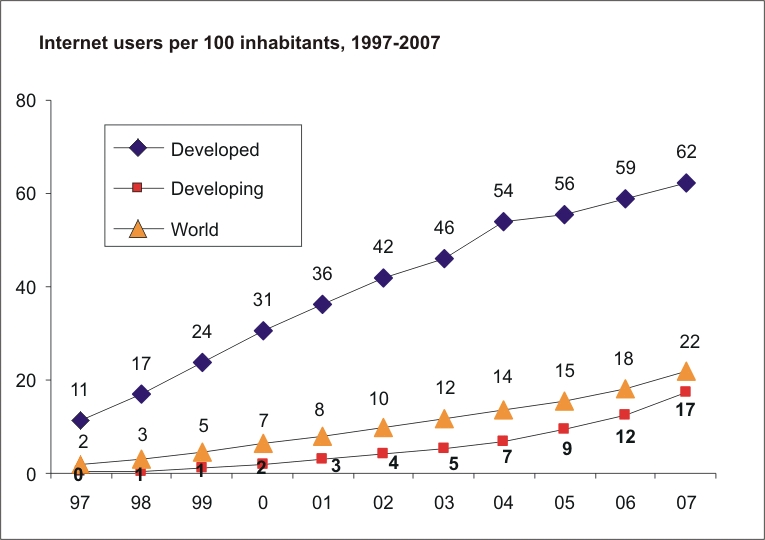
English: Graph of internet users per 100 inhab...
English: Graph of internet users per 100 inhabitants between 1997 and 2007 by International Telecommunication Union (ITU) recreated in OpenOffice Calc, source: http://www.itu.int/ITU-D/ict/statistics/ict/graphs/internet.jpg) (Photo credit: Wikipedia)

It’s worth remembering that the Internet had been around for a decade or so, in rudimentary form, so the chances are that Granny might have come into contact with it if she was working in it at the time, maybe at a university. It’s far more likely though that Granny’s first contact with computing would have come from working at a large firm where they had a mainframe computer.

IBM 3279-S3G
IBM 3279-S3G (Photo credit: vaxomatic)

Maybe she sat at an IBM 3270 screen and typed accounting data into it, or maybe she was one of the people who loaded punched cards into a reader or tended the huge printers  that spat out piles of paper with horizontal green stripes and sprocket holes down the edge. Or maybe she loaded magnetic tape reels into one of the tape reader machines which for some reason came to signify “computing” in many films of the era.

The Internet started as a linked network of computers, running online databases, using names such as “Archie” and “Gopher”. Everything was text based and there was no linking. That had to wait for Tim Berners-Lee’s insight. Universities embraced the new medium and most databases were held on University servers.

Gopher
Gopher (Photo credit: cambodia4kidsorg)

When you blithely click on link to visit a web page a number of things happen. Firstly your computer recognises that you want to do something. A program on your computer called the browser (Firefox, or Chrome or Internet Explorer) analyses your input and decides what you want it to do.

This may involve sending a request to a remote server, but your computer doesn’t know where the server, so it needs to find out. This is done by sending a message to yet another server which has information about where the requested server is on the Internet, or knows how to find out.

Description unavailable
Description unavailable (Photo credit: Forest Service Southwestern Region)

In the early days of the Internet, when Granny may have first come into contact with it, this system did not exist, so every computer on the Internet was required to know the whereabouts of every other computer on the Internet. As you can imagine, updating the address information became a tedious chore and that is why the system that I sketchily outlined above was invented.

Once Granny found a document whose title looked interesting, she would have to download it. Today we click on a link and the document appears on our screen. But Granny would have had to tediously search likely sources for the document, then she would transfer it to the server that she was connected to, and finally she would be able to print it on a printer. If she was lucky the printer would be nearby and it would actually have some paper in it. Granny’s document would be printed in a fixed width font on striped paper by a printer with a ribbon and little hammers, like a glorified typewriter.

English: demonstration of how an impact printe...
English: demonstration of how an impact printer works (Photo credit: Wikipedia)

Granny would have been around 20 when IBM introduced the first “IBM Personal Computer” in 1981, but she might have first come into contact with something like a Commodore 64 or Sinclair ZX 81 or Spectrum. She might have played games loaded tedious by command line commands from cassette tape. It’s possible that she was amazed by the blocky coloured graphics and the clunky game play, considering that the next best thing around was “Pong”, a primitive tennis game on a fixed device, sometimes set into a tabletop, or maybe “Space Invaders”, also hosted on a single purpose device.

English: Commodore 64 computer (1982). Post pr...
English: Commodore 64 computer (1982). Post processing: BG, B/C, noise, dust, spot Français : Ordinateur Commodore 64. Suomi: Commodore 64 -tietokone (Photo credit: Wikipedia)

If Granny had anything to do with computers in the early days of personal computers she would have had to deal with machines that by default booted into BASIC. That’s pretty much a fall-back as usually would have inserted a floppy disk with some version of DOS into the machine. Then she would have had to have loaded whatever program she wanted to run by using another floppy disk.

She would have had to become familiar with the DOS command line, including such quirks as the A: and B: drive referring to the same device. Most of the time. She might even have edited configuration files by hand.

Computer directory listing in a command shell.
Computer directory listing in a command shell. (Photo credit: Wikipedia)

When she got her first hard disk she would have installed DOS or even Windows on it from maybe three or four floppy disks. The first Windows versions ran as a shell on top of DOS, so she would have still needed to have a knowledge of DOS.

In addition she would have had to handle the dreaded device drivers. These were (and still are) small programs that handled interactions with specific installed hardware. Which in the early days of DOS and Windows meant just about any piece of hardware.

Mini CD used for delivering USB drivers for a ...
Mini CD used for delivering USB drivers for a webcam. Photo taken by user: O mores. (Photo credit: Wikipedia)

When Granny installed her new scanner she would have received a disk with it containing the drivers. She would know from prior experience that installing a driver could possibly make her system crash and be unbootable. But she would have still installed it and most probably (eventually) come out on top of it.

In addition before Granny got broadband she would have experienced the doubtful pleasures of using a dial-up modem, and would be familiar with the weird little song it sings to itself when it is handshaking with the remote modem. And she would certainly be familiar with waiting for half an hour to download a megabyte file and Grandad picking up the phone one minute before the end and breaking the connection.

Quicktel 2400EX
Quicktel 2400EX (Photo credit: debagel)

So, now Granny has bought an iPad. Don’t be surprised if she takes to it like a duck to water. After all, she probably has decades more experience with computers and networks, the Internet and downloading than you have. You weren’t born when she started!

she has a thing for it
she has a thing for it (Photo credit: creaid)
Enhanced by Zemanta

The beginning of things and the ending of things.

The Big Bang era of the universe, presented as...
The Big Bang era of the universe, presented as a manifold in two dimensions (1-space and time); the shape is right (approximately), but it’s not to scale. (Photo credit: Wikipedia)

The origin of the Universe, the start of everything, including time. That’s a grand concept. In our usual view of the Universe, we define any event by three space dimensions and one time dimension, but mathematics can deal with any number of dimensions. Some physical models of the Universe use many more than four dimensions, sometimes 10 or 11, and even an infinite number of dimensions.

Normally the space dimensions are depicted as being measured along three orthogonal axes, otherwise known as a Cartesian coordinate system. However there are alternate ways of specifying three space dimensions.

coordinate_system
coordinate_system (Photo credit: williamcromar)

For instance, on the Earth’s we specify locations by latitude and longitude, which gives us two dimensions. Astronomical objects are specified by Right Ascension and Declination, again resulting in two dimensions. In both cases the third space dimension can be specified as distance, in the first case from the centre of the earth, and in the second case from the observer, but in the general case, the origin can be any arbitrary point.

This second method of specifying the position of an object is known as a Polar coordinate system, and there are many other ways that the position of an object can be specified. Of course, these positioning schemes only really work locally. If the origin of the coordinate system were on Mars for example then the coordinates of, say Jupiter, would differ from the coordinates of Jupiter as measured on Earth.

Point in Polar coordinates
Point in Polar coordinates (Photo credit: Wikipedia)

If we add time into the picture, we have four dimension to cater for. Since we live in a Universe where there appear to be three space dimensions we have difficulty in considering time to be a dimension like the three space dimensions.

A four dimensional Cartesian coordinate system seems to us to be impossible to conceive, but mathematicians don’t have any problems with the concept, and some have expended time and effort to be able to mentally conceive of four dimensional spaces.

Cartesian Perspective
Cartesian Perspective (Photo credit: Jan Tik)

I wish them luck but I don’t see that it is necessary. The equations have four variable, hence four dimensions, end of story. There is no need to imagine four Cartesian dimensions.

Some people might consider time to be different in nature to space. It is after all measured in seconds, and space is measured in millimetres. That’s a valid point, but consider that in a Polar coordinate system the distance dimension is different to the other two dimensions. The distance is measured in millimetres and the other two in degrees or radians.

Time and Space v2
Time and Space v2 (Photo credit: dkuropatwa)

It seems that it all depends on your point of view, and indeed we can measure distances in seconds too. All that we have to do is to say that the distance coordinate of an object is the number of seconds that it takes light to travel that distance. Essentially to convert from millimetres to seconds we divide by the speed of light, which, as we all learned in school is a constant.

So we have four or more dimensions in our Universe and all events in the Universe can be plotted in a space of four or more dimensions. I don’t think that it follows that every point in that space represent an event in our Universe – there may exist points in that space which don’t represent points in the space-time history of our Universe.

parabola
parabola (Photo credit: pixelthing)

Consider for example a space with dimension two, which corresponds to the points on the surface of the earth (ignoring the altitude variation which corresponds the distance of the point on the surface of the earth from the centre of the earth). Every point on the surface of the earth could be plotted on Cartesian axes.

It would be a weird map with the origin representing the point on the earth which is on the equator and due South of Greenwich, the opposite side of the earth appearing at both -180 degrees and +180 degrees and the poles spread into a line at +90 degrees and -90 degrees.

TTT #2... 256365
TTT #2… 256365 (Photo credit: paloetic)

However, no point on the earth’s surface would have a longitude coordinate that is greater than +180 or a latitude coordinate that is greater than +90. Those points just don’t represent a point on the earth’s surface. OK, the map could repeat, I guess, an infinite number of times, but I’m arbitrarily going to rule out that suggestion, as each point would not have a unique pair of coordinates.

This issue only arises because I am suggesting a mapping of Polar coordinates onto a Cartesian grid. Now I’m going to consider the four main dimensions of our Universe in a similar light.

time-zero blue
time-zero blue (Photo credit: futurowoman)

As time is traced backwards, according to the Big Bang theory, the Universe is seen to be smaller. The further back we go, the smaller it is, until at some point the past, the whole Universe shrinks to a point. Some questioners of this theory ask “What happened before that point in time?”.

OK, let’s for the moment ignore two of the space dimensions. Let’s just consider time and, let’s say, a dimension that I’ll call width, as in the width of the Universe. We can then plot the changing width of the Universe as the vertical axis and time as the horizontal axis on a set of Cartesian axes.

width & depth [CIMG2033]
width & depth [CIMG2033] (Photo credit: TheAlieness GiselaGiardino²³)
Arbitrarily setting the origin at now, and the width as the current width of the Universe, let’s consider what happens as we trace the graph to the left. The width, shown on the vertical axis reduces until it eventually reaches the time axis and, pop, the Universe disappears. Or appears, if we trace from left to right in the normally accepted direction of the flow of time.

“What happened one second before that point?” asks the sceptic. The answer is that the question doesn’t make sense. In the analogy above, of the latitude/longitude map, it is like asking “What is 181 degrees West of Greenwich?”, to which the answer is “There is no 181 degrees West of Greenwich.” Similarly there is no Big Bang – 1 second.

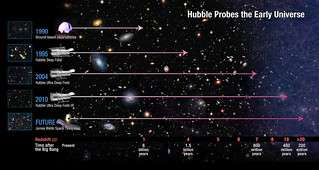
How far does Hubble see?
How far does Hubble see? (Photo credit: NASA Goddard Photo and Video)

You will note that in that latitude/longitude example above, the map can be said to “wrap around” and if one sails 181 degrees West of Greenwich, one finds oneself at 179 degrees East of Greenwich. A similar wrap around in the case of the Universe would be for someone who somehow managed to get to Big Bang – 1 second to find that they had arrived at one second before the end of time.

However I do not know if the theories of the Big Bang allow for this possibility. Certainly the concept makes a sort of sense if the Universe is destined to collapse into a “Big Crunch”, like a Big Bang in reverse, but if the Universe is destined to expand without limit, then there is no analogy to “181 degrees West of Greenwich”.

:From Image:Big_crunch.png According to the Bi...
:From Image:Big_crunch.png According to the Big Crunch theory, the universe will end in an infinitely dense singularity. (Photo credit: Wikipedia)

In any case the problem likely only arises because the Cartesian coordinate system in inadequate for plotting the origin of the Universe.

The Restaurant at the End of the Universe. Almost.
The Restaurant at the End of the Universe. Almost. (Photo credit: Geir Halvorsen)
Enhanced by Zemanta

Synergy and Emergence

English: Logo used by the Synergy project (htt...
English: Logo used by the Synergy project (http://synergy-foss.org/). (Photo credit: Wikipedia)

I’m fascinated by the phenomenon of synergy. Wikipedia defines it as follows:

Synergy is the interaction of multiple elements in a system to produce an effect different from or greater than the sum of their individual effects.

Giant's Causeway in Northern Ireland is an exa...
Giant’s Causeway in Northern Ireland is an example of a complex emergent structure created by natural processes (Photo credit: Wikipedia)

One man might be unable to move a heavy load, but two men working together might be able to move it easily. Ants individually can only move very small objects, but working together can build very large structures, their nests. Synergy is related to emergent phenomenon, where a complex system shows behaviours which are not apparent in the system’s constituent parts. For example a water molecule cannot said to have the property of “wetness”, but a large collection of water molecules does have that property. Wikipedia defines it as follows:

Emergence is the way complex systems and patterns arise out of a multiplicity of relatively simple interactions.

English: A collage of organisms.
English: A collage of organisms. (Photo credit: Wikipedia)

Synergy and emergent systems are found in all levels of physical and biological systems. In fact the whole of biology could be considered to be an emergent system from physics – animals, plants and other living things are after all, only collections of molecules, and molecules are not, of themselves, alive.

At the highest level of all, consciousness is an emergent system of the synergy of astronomical numbers of brain cells. At the lowest level, all of physics is an emergent system of the state of the universe at the beginning, the Big Bang.

English: Big Bang
English: Big Bang (Photo credit: Wikipedia)

After I wrote that I looked up “emergence” on Wikipedia and found this:

Biology can be viewed as an emergent property of the laws of chemistry which, in turn, can be viewed as an emergent property of particle physics. Similarly, psychology could be understood as an emergent property of neurobiological dynamics, and free-market theories understand economy as an emergent feature of psychology.

The writer of the Wikipedia article is obviously on the same page as me!

water-molecule-vector_500x500
water-molecule-vector_500x500 (Photo credit: Shmector)

Each water molecule has a myriad of properties, none of which is “wetness”. However “wetness” can be explained by considering the behaviour of the various types of bonds that would be formed between water molecules and a consideration of how the molecules would move around each other, and react to other molecules such as those of the surface that the water is placed on. On some surfaces (such as the surface of a leaf) the molecules will organise themselves into “beads”, on others the water will “wet” the surface.

Water Beads
Water Beads (Photo credit: s_gibson72)

Obviously molecules don’t have volition, and the way I expressed the idea above is much too anthropomorphic, and indeed the behaviour can be described by referring to the physical behaviour of the water molecules, and there is nothing particularly mysterious about this, at least at the level at which I am pitching my suggested explanation.

Moving at the Speed of Life ...
Moving at the Speed of Life … (Photo credit: д§mд)

There are other emergent phenomena that are more difficult to explain. Life, for example. Living organisms are made up of various more or less esoteric chemical compounds, including some really, really large molecules. These large molecules (DNA) are made up of a small number of much smaller molecules (bases) which are strung together in the famous double helix. This double helix is folded in complex ways into truly enormous (at a chemical level) structures called chromosomes. These structures encode all the information necessary to create the organism.

Chromosome segregation during mitosis
Chromosome segregation during mitosis (Photo credit: TheJCB)

This in itself is a paradox – a small part of the organisation contains all the information necessary to construct the whole organism. It resembles a bootstrap situation. It seems to me that much of the genetic information  has to be instructions for constructing the information and not a detailed description of the organism.

Cells are complex and are individually alive, in some sense, since they are created, produce offspring and eventually die, but with some exceptions (unicellular organisms) a single cell can’t live on its own.

Chemistry Is What We Are
Chemistry Is What We Are (Photo credit: Wikipedia)

But to get back to the subject, I’ve described (probably pretty badly) a lot of chemistry, but I haven’t been able to describe where life comes from. It’s difficult, but possible, to describe how cells function in a mechanical, chemical sense, but it is not easy to say what it is that makes them alive. You can tell from the over use of bold that I’m having difficulty expressing my meanings here!

Living cells make copies of themselves, but so do some mechanical or chemical processes. Crystals and snowflakes spring to mind. Living cells consume chemicals from their surroundings and so do some complex non-living processes (I’m thinking of weather systems that circulate water and air, but that’s maybe not a good example). Living cells are self organising, altering surroundings to suit themselves, it’s true, but they are simply little complex chemical factories. Where’s the life in that?

A diagram showing a mitochondrion of the eukar...
A diagram showing a mitochondrion of the eukaryotic cell. Mitochondria are organelles surrounded by membranes, distributed in the cytosol of most eukaryotic cells. Its main function is the conversion of potential energy of pyruvate molecules into ATP. (Photo credit: Wikipedia)

In spite of the argument above, it is undeniable that life exists and practically, it is relatively easy to distinguish living things from non-living things. There are some “edge cases” though. Is a virus a living organism or merely a result of a chemical process. At the other end of the scale, is a rain forest a living organism? It certainly contains living organisms, but can the rain forest as an entity be described accurately as a living organism? My answer would be “probably yes” in both cases.

Computational consciousness
Computational consciousness (Photo credit: brewbooks)

The other example of emergence that I want to consider is “consciousness” and its cousin “mind”. We are conscious and we have minds, but are we the only animals that are conscious and have minds? I find the idea unlikely but possible. Animals have evolved over many millions of years and every feature of our bodies has been evolved gradually and incrementally. Our brains have evolved from one or two neurons in one of our ancestor’s bodies and have been incrementally expanded over a long long time.

English: Marine flatworm Pseudobiceros glorios...
English: Marine flatworm Pseudobiceros gloriosus. Lembeh straits, North Sulawesi, Indonesia. Français : Pseudobiceros gloriosus, un plathelminthe. Détroit de Lembeh, nord de Célèbes, Indonésie. (Photo credit: Wikipedia)

But our ancestor was not a human being and many animals with varying sized brains. Our pets and the bird outside the window have evolved from that animal. Consciousness and mind are related to the brain, so it is highly likely that as the brain evolved, so did mind and consciousness, which implies that our pets and the bird in the tree and all other animals with brains has a greater or lesser consciousness and mind.

It is possible, but unlikely that there is some threshold where an increasingly complex brain becomes conscious. My dog acts as if it were conscious and has a mind, but that could be merely a mechanical function of the brain. Personally I doubt it. I think that lower animals like dogs are conscious, have a mind and are self-aware, but at a lower level than humans.

Dog dog
Dog dog (Photo credit: Wikipedia)

There is no test for consciousness so far as I know. Oh, if an unconscious person’s eyelids flicker, we might say that he is “coming round”, but it could be that these mechanical processes could have no consciousness behind them. A similar argument is the “android” argument – if a man is replaced by an android, which has no consciousness or mind, and the android completely emulates the behaviour of a conscious and minded person, how would we tell, and by emulating the behaviour, would the android in fact possess a mind and consciousness?

Android x86
Android x86 (Photo credit: Wikipedia)

That’s another way of putting the question “what is this emergent phenomenon called consciousness, and how does it arise from the way that the brain works”. I’ve read some discussion of this issue by various philosophers, and I still have no opinion on the matter.

This article has expanded to well over my self-imposed target of 1000 words. It is however a subject that I find interesting, and I hope that any readers do so too.

globe of blogs
globe of blogs (Photo credit: shankargallery)
Enhanced by Zemanta

Three philosophers

Morton's Fork in Labels (Extra #252)
Morton’s Fork in Labels (Extra #252) (Photo credit: Cycrolu)

In this post I’m going to talk about three statements about three particular situations which are basically the same. The first one was made by John Morton, Archbishop of Canterbury in the late 15th century. The second was made in the book “Catch 22” by Joseph Heller. And the third was made by Bart Simpson in the Simpson’s cartoon.

Morton’s Fork, as defined in the Wikipedia article linked to above is as follows:

A Morton’s Fork is a specious piece of reasoning in which contradictory arguments lead to the same (unpleasant) conclusion. It is said to originate with the collecting of taxes by John Morton, Archbishop of Canterbury in the late 15th century, who held that a man living modestly must be saving money and could therefore afford taxes, whereas if he was living extravagantly then he was obviously rich and could still afford them.

Obviously there are counter examples to Morton’s assertions. A man living “modestly” may be simply living on a modest income, and a person living extravagantly may well be spending money that he does not have and be sliding into debt. The Wikipedia article does not record whether or not Morton’s Fork succeed in its aim, which was presumably to extract more tax money from tax payers, but I suspect its effect was minimal.

English: Catch 22 With a little imagination th...
English: Catch 22 With a little imagination the bus company could have called this service, seen at Scunthorpe bus terminal, not “Shuttle 22” but “Catch 22”. (Photo credit: Wikipedia)

In Joseph Heller’s novel “Catch 22”, the protagonists are pilots, bombardiers and other aircrew ranks during the second World War. Yossarian and his associates have to contend not only with the enemy, but also with the bumbling stupidity of military rules and the equalling bumbling stupidity or malice of the commanding officers.

Anti-war demonstration, Seattle, Washington, 1...
Anti-war demonstration, Seattle, Washington, 19 March 2007. Marchers head south on Fifth Avenue. Sign: “Iraq: Blood and stupidity”. (Photo credit: Wikipedia)

A good example is the “dead man” in Yossarian’s tent. The man had actually survived a mission in which many of his crew mates had died, but since he had be recorded as having been killed, the military refused to acknowledge his existence. He was forced to live a shadowy existence, living in Yossarian’s tent.

Tent op kamp
Tent op kamp (Photo credit: florisla)

Catch 22 is a non-existent military rule. The book defines it like this:

There was only one catch and that was Catch-22, which specified that a concern for one’s safety in the face of dangers that were real and immediate was the process of a rational mind. Orr was crazy and could be grounded. All he had to do was ask; and as soon as he did, he would no longer be crazy and would have to fly more missions. Orr would be crazy to fly more missions and sane if he didn’t, but if he were sane he had to fly them. If he flew them he was crazy and didn’t have to; but if he didn’t want to he was sane and had to.

Obviously Orr could not want to fly the missions and still be crazy, or be crazy and still want to fly them, so the logical bind fails, and for analogous reasons to Morton’s Fork. Such situations are sometimes referred to as paradoxes, but I don’t think that they are, unless they can be considered a special type of paradox called an antinomy. I think that Morton’s Fork and Catch 22 work by excluding valid situations from consideration, and hence are failures of the logical argument.

Bart Simpson statue
Bart Simpson statue (Photo credit: Gage Skidmore)

In the Simpson cartoon “Bart the Genius”, Bart Simpson cheats his way into a school for intellectually advanced students by stealing another student’s test paper. Bart is pretty much out of his depth from the start, as the other students quickly detect that he is not intellectually advanced as is claimed. In the classroom students are asked to come up with an example of a paradox. Under pressure Bart blurts out “You’re damned if you do, and you’re damned if you don’t”. This is grudgingly accepted as a paradox by the teacher.

Animatie van Olbers paradox Olbers' paradox is...
Animatie van Olbers paradox Olbers’ paradox is the argument that the darkness of the night sky conflicts with the supposition of an infinite and eternal static universe. http://en.wikipedia.org/wiki/Olbers%27_paradox?uselang=en (Photo credit: Wikipedia)

In a marital situation Bart’s formulation is well known. One partner asks a innocuous question. The other party knows that that there are two possible answers, neither of which is going to lead to a positive outcome. “Do you mind if I watch the rugby?” is going to lead to significant grumpiness or an argument if the answer is yes, or a couple of hours of boredom and noise if the answer is no.

Damned if you do and damned if you don’t. Of course couples evolve methods for resolving such issues. Maybe a good book and a gin and tonic in another room is a solution or maybe the rugby might turn out to be interesting after all.

Married
Married (Photo credit: hjrosasq)

Bart’s expression of the idea is slightly different. In the first two the idea is expressed in terms of rules, Morton’s Fork being about tax, and Catch 22 in a rule about sanity and flying dangerous missions. Bart’s is a more general cry from the heart, about the cantankerousness of the world.

Life sucks
Life sucks
Enhanced by Zemanta

…Rain.

Rain camera

It might be a little perverse to write about rain when I look out of the window and see brilliant sunshine, but on the other side of the world they are thinking about building arks! They have had more than their fair share of rainy days recently, maybe more than forty of them perhaps.

In the West of England. south of the Mendip hills is an area I know quite well. It is known as the “Somerset Levels” and is essentially a large are of low lying land that would be either under water or marshy if it were not for the drains and pumps that keep the area relatively dry.

Map of the Somerset Levels, UK (and surroundin...

In the current few months torrential rain has fallen on the whole of the UK and in the Somerset Levels this has caused problems with the drainage systems. The rivers are full and overflowing which means that there is nowhere to pump the water from the low-lying areas, and large parts of the Levels have been flooded.

Some locals complain that the reason for the flooding is that the rivers have not been dredged by the local councils and so can’t carry the amount of water that they should be able to. Even if this is true, which it may well be, it is hard to see how the rivers could cope with the vat amounts of water that will have to be pumped off the levels.

Blagdon Pumping Station

North of the Mendip Hills is another low lying area which I am not sure can be considered part of the Levels. However this area has (so far as I know) been pretty much untouched by the floods. It is interesting to note that the village of Nailsea was originally on an island though it would be hard to tell that now. Besides the village has expanded vastly even in the time that I’ve known North Somerset, so most of it would probably be flooded if the waters came back.

English: Steam pumping engine Curry Moor Somer...

Most of the roads in the Levels follow the rivers and drainage channels and tend to be pretty straight, most of the time. Many of them date for Roman times or earlier and they were built over marshy land. The original road builders made causeways of bundles of reeds as foundations for the roads and new roads were simply built over the old roads. Over the years the reed bundles have not all rotted away equally, and as a result in some places the road level varies. As a result if you drive fast along some of the straighter roads it can feel like a gentle rollercoaster and can induce motion sickness in susceptible people.

Floods On The Levels - 3

It can also cause drivers to lose control and end up the drainage channel or rhyne, as they are known as in Somerset. This happened to a friend of mine, who then had to get the farmer to drag his car out of the rhyne. This obviously was not the first such happening at that spot (which was on a slight bend) because the car came out with someone else’s number plate hooked to the back.

My friend took another friend to show him where the accident had occurred and, in reversing the car onto a little bridge over the rhyne, missed the bridge and the car ended up in the rhyne again. The farmer, who towed him out again, grumpily mentioned that if this happened much more, he’d have to start charging.

English: Edmund, OK, June 15, 2010 --A car lie...

I should not give the impression that the flooding issues recently (2013-2014) were only in the West of England. I’ve seen reports of flooding in many areas of the UK, including low lying areas around the Thames and in places in the Weald, south of the North Downs and north of the South downs. There were even floods near my old school, in an area that I would not have thought to have been prone to flooding. These are only the places that I recall being flooded and I’ve remembered them because I know the areas. Other places were also flooded.

The River Mole Bursts Its Banks In Leatherhead

The recent heavy rain in the UK is unprecedented or at least very uncommon. It could be that this is merely a conjunction of unusual events that have happened by chance, or it could be that the cause is global warning, or at least global change. If it is caused by global warming, this could be caused by human activity or it be caused by something else, such as changes in the sun.

Global Warming

I tend to think that the increases in temperature and the changes in climate are undeniable and probably due to the activities of humans. I say “increases in temperature”, but the recent very cold weather in the USA probably a result of the warming too, as the changes in climate are all linked. As you raise one end of a balance you cause the other end to dip. Or it may be simply that the climate variations are becoming more extreme.

Since at the end of January and the beginning of February 2014 is close to a new moon, tides will be higher than usual. As result the storm swell which increases the height of a tide is going to cause flooding in coastal areas. While this is not directly related to rain, already sodden coastal areas can expect even more flooding.

IMGP7820-king tide over footpath

As a side note, the “king tides” caused by lunar conjunction have caused minor flooding in some areas in Auckland, New Zealand. However the weather is fine here, and it is mid-summer so people have been out and about observing and even enjoying the high tide. A recreational area has been partly flooded by the tide and provided some safe fun for children in canoes and on boogie boards.

Auckland residents have all headed to the beach to experience the super high tides, but because of the high tides there was little beach to see! Still, people had fun riding through the shallow water in the cycle lanes beside the motorway with other canoeing alongside them!

Wild Wild West

Enhanced by Zemanta

Yellow

English: yellow traffic light Español: señal d...
English: yellow traffic light Español: señal de tráfico amarilla Deutsch: gelbes Verkehrszeichen Français : feux de signalisation jaunes Italiano: segnale stradale giallo (Photo credit: Wikipedia)

I believe that some firm or other once tried to patent the colour yellow, but I’ve not be able to track this down so far. Although this sounds silly, I believe that the firm extensively used the colour yellow in all its adverts and publicity material and believe that people identified the firm’s adverts by the blocks of yellow colour used in the adverts and that a competitor could take advantage of this by using adverts with similar blocks of yellow. One can see where the firm was coming from, of course, but thankfully the attempt failed I believe.

Yellow is, in the societies that I have lived in anyway, associated with sun, well-being, summer and generally good and beneficial things. In subtractive combinations of colours, yellow, along with magenta and cyan are the primary colours. Many computer printers use these three colour. When I was researching this post I found that computer screens use additive combinations and the primary colours are red, green and blue. (“Research” is a fancy name I use for Googling for something – I usually end up at Wikipedia, so ‘caveat emptor‘!) Apparently the reason that there are three primary colours is that the human eye contains three types of cone cells, and each type is most sensitive to one of the ‘primary colours’.

English: Three doors in Wilmington Square Thre...
English: Three doors in Wilmington Square Three adjacent doors in the primary colours in one corner of the square. (Photo credit: Wikipedia)

Some animals have four types of cone cells and thus would see four primary colours. According to the Wikipedia article on the subject some human females may have four types of cone cells. Most placental mammals seem to have only two types of cone cells so can only distinguish two primary colours. As Wikipedia says, it would be wrong to suggest therefore the world ‘looks tinted’ to them. It would look normal to them.

I said above that the colour yellow is generally associated with positive things, like summer, warmth and other things. It is however also associated with cowardice, but I haven’t really been able to find out why. This Yahoo Answer is inconclusive, for example. The best answers, in my opinion, relate it to the ‘yellow bile’, one of the four fluids that were assumed to circulate around the human body. It was assumed that one character was determined by the balance of these four ‘humours’.

English: An un-official 80cm FITA archery targ...
English: An un-official 80cm FITA archery target Italiano: un bersaglio FITA non ufficiale da 80cm per il tiro con l’arco (Photo credit: Wikipedia)

Hmm, what else about yellow? The centre of an archery target is yellow, although it is often referred to as ‘gold’ for some reason. Interestingly, in the obviously related sport of darts the centre ring is red or black. Rifle shooting, which also uses a target of concentric circles, uses only black and white, with the circles quartered and the inner circles all coloured black, the outer ones being white.

Yellow flags flown on a ship used to indicate that the vessel had a contagious disease on board. A plain yellow flag stands for the letter ‘Q’ in semaphore core and the speculation is that this was used because it was the initial letter for the word ‘quarantine’. The Wikipedia articles says that these days the plain yellow flag is used to indicate that a vessel is free of contagious disease and requests boarding for customs inspection. I had not heard of that change of meaning, but then again, I’ve not had need to raise a yellow flag! The current flag used to indicate contagious is a quartered yellow and black flag which stands for the letter ‘L’ in semaphore code.

Edited version of Image:Color_icon_blue.svg.
Edited version of Image:Color_icon_blue.svg. (Photo credit: Wikipedia)

In many cases yellow is used to indicate warnings as in ‘yellow alert’. A yellow alert is usually one level below a red alert which is usually the top level of seriousness.  Generally a yellow alert means ‘avoid, take care, and be alert’. The GeoNet site currently shows a yellow alert level for the volcano called ‘White Island’ which is around 50k from the coast of New Zealand. The volcanoes on the mainland are currently quiet. Incidentally if you look closely at the Crater Floor image at the bottom right you will see Dino the Dinosaur quietly monitoring the volcano as he has done for several years.

Warning sign.
Warning sign. (Photo credit: Wikipedia)

Animals are often referred to as ‘yellow’ although it might be more accurate to describe them as ‘light brown’. Some birds, however, are definitely yellow and domestic canaries have given their name to the colour ‘Canary Yellow’. The Yellowhammer, introduced into New Zealand from Britain is a handsome bird with a yellow head breast and belly, marked with black, and with a yellowish brown back. They can form quite large flocks and are probably more numerous in New Zealand than they are back in Britain (as are many European species). The American Yellow Warbler is also a fine yellow plumaged bird.

A Yellowhammer on North Island, New Zealand.
A Yellowhammer on North Island, New Zealand. (Photo credit: Wikipedia)

There are some yellow animals and someone has made a collection on this web page. Most appear to be cold blooded or insects, but there are a few ‘yellow’ mammals. The mammals don’t look particularly yellow actually, but the snakes, spiders and crabs certainly are. Some albino animals (eg ferrets) tend to look distinctly yellow at times.

English: Tree with yellow leaves in autumn
English: Tree with yellow leaves in autumn (Photo credit: Wikipedia)

In autumn (fall) leaves on some trees go yellow, while species have leaves that turn red. This is because the chlorophyll which is green is lost in the autumn as the trees prepare for winter. Many flowers, like the buttercup, have yellow flowers and domestic plants like the tulip or the rose have been bred to have yellow blossoms too. Daisies also have yellow centres and I’ve seen speculation that yellow plants are the colour that they are because the pollinating insects are sensitive to that colour, which makes sense, but I’m not sure if that is the whole story, since I believe that most insects’ eyes are most sensitive to ultraviolet. The pollen that the insects inadvertently transfer from flower to flower is often yellow.

English: Daisy (Bellis perennis), Wellington, ...
English: Daisy (Bellis perennis), Wellington, New Zealand (Photo credit: Wikipedia)

Finally to end this ramble through the colour yellow, I’ll just mention that the inanimate world also has yellow chemicals. The element sulphur is the obvious one, though some Chromates, some Iron compounds, and lead iodide are examples of yellow compounds. In addition chemists (and almost any schoolboy) who have put sodium compounds into a flame will be familiar with the deep yellow colouration of the flame that results. It’s often the first step in the analysis of a compound.

Sulfur
Sulfur (Photo credit: d4vidbruce)