Sickness

Flu
Flu (Photo credit: IK’s World Trip)

Today I am going to reflect on sickness. As an aside, my aim was to write something every Friday and post it here, but lately the deadlines have been slipping past and I didn’t complete the previous post until Tuesday. This Friday I was still suffering from the bug that I caught, and motivation and energy levels were low, so I didn’t start this until Sunday. The effects hang on, but if I don’t start now, I may not get a post done at all! So here goes.

Last Monday I was feeling like I was coming down with something but struggled into work anyway. A couple of hours into the day it was obvious to me that I was rapidly getting worse so I headed home and put my feet up. I fully expected to be over the worst by Wednesday but on Wednesday morning it was obvious that I wasn’t recovered enough to return to work, so I visited the doctor who confirmed a flu-type illness.

Visit of the Doctor
Visit of the Doctor (Photo credit: Wikipedia)

The doctor didn’t prescribe anything apart from rest, which suited me. I must write a post about over prescribing of medicines by doctors as I see it sometime. So the rest of the week was taken up by lying around, drinking copious tea, coughing and aching. I believe that one of the symptoms of the sickness I am still suffering from is to make everything ache. Of course, the constant coughing results in aching of the chest muscles, but my arms and legs and head also ached. Not nice.

Add on on shivering fits and sweats and it all makes for a fun week. Did I mention a sore throat?

English: Hamlin's Wizard Oil, the greatest fam...
English: Hamlin’s Wizard Oil, the greatest family remedy for rheumatism, neuralgia, toothache, headache, diphtheria, sore throat, lame back, sprains, bruises, corns, cramps, colic, diarrhœa and all pain and inflammation. Sold by all druggists. Advertising for turn-of-the-century miracle cure, chromolithograph by Hughes Lithographers, Chicago. Undated, estimated to be from around 1890. (Photo credit: Wikipedia)

I think that I am suffering the attack of a flu virus, but obviously not a strain that was targeted by the flu jab that I had. Since it was presumably a virus there is no treatment possible, apart from alleviating the symptoms.

Speaking anthropomorphically, it is in the virus’ interest to not reduce the functional level of the organism that it attacks to the level where it quickly dies and so cannot pass on the infection, so viruses tend to merely make you sick. So infected organisms remain more or less functional. They still eat, drink, and interrelate with others of their type, which allows the virus to spread by coughs and sneezes which fill the air with the virus which can then be inhaled by well individuals.

virus
virus (Photo credit: twenty_questions)

It is good strategy for the virus to irritate the nose and the the chest, increasing the possibility of the virus being passed on. I say “strategy”, though of course it is pure evolution in action – viruses which don’t cause you to cough and sneeze don’t get spread around so easily and so tend to die out. Of course there are other ways to spread a virus or other disease, STDs and diseases transferred by physical contact spring to mind.

When you think about it, sneezes and coughs are a pretty damn efficient way of spreading a virus. A cough or sneezes creates a mist of tiny virus-laden particles that can be inhaled or picked up from surfaces where they settle. It follows that viruses at least of this type would spread most efficiently in enclosed spaces such as homes and workplaces. A farmer could sneeze in the fields and not affect anyone, but a sneeze in a packed classroom could result in several pupils being missing in the next day or two, not to mention the teacher.

A man mid-sneeze. Original CDC caption: "...
A man mid-sneeze. Original CDC caption: “This 2009 photograph captured a sneeze in progress, revealing the plume of salivary droplets as they are expelled in a large cone-shaped array from this man’s open mouth, thereby dramatically illustrating the reason one needs to cover his/her mouth when coughing, or sneezing, in order to protect others from germ exposure.” (Photo credit: Wikipedia)

One of the silly things about employment laws is that a person who takes leave from work because of sickness can be asked to provide a medical certificate, even if the employer doesn’t believe that the worker is faking the sickness. Usually there is a day or two’s grace to allow the sick person to obtain a certificate from the doctor. This usually means that the sick person has to go out into the community, sit in a waiting room which is probably a miasma of viruses, and talk to a doctor who is then subjected to the airborne virus! It’s possible that evolution will favour viruses which reach maximum infectiveness in 2 – 3 days!

The reason for the laws is to prevent people from claiming to be sick when they aren’t (known colloquially as “taking a sickie”). While this is obviously a problem it does mean that people may struggle into work when sick in order to avoid the expense of a doctor’s visit, and they may spread the virus around the workplace, resulting in more absences and more costs to the employer.

duvet day
duvet day (Photo credit: Βethan)

Viruses are amazing things, on the borders of death and life. They are simply little packets of genetic code for self-replication which utilise the organism’s own machinery against it. Of course all living organisms are packets of genetic code for self-replication, but viruses are the smallest possible, with the possible exception of things like prions. (Which, I’ve just read, don’t contain any genetic code).

The immune system of the body is triggered by viruses (which results in all the coughing and sneezing) and so the body is not defenceless. However viruses mutate quite quickly, so we have many ‘strains’ of common viruses. The common cold is, I believe, a particularly mutable virus which is probably why research into it has not gone far in combating it. The flu virus that attacked me is likely to have been a mutation of a strain of the flu virus that was targeted by the flu jab that I had.

And so the war goes on.

Comparison of mechanisms of drug resistance am...
Comparison of mechanisms of drug resistance among viruses (Photo credit: AJC1)

The number of the universe.

English: Measurement unit

Anything that can be measured can be encoded in a single number. Take for instance the trajectory of a stone thrown into the air. Its position in relation to the point of launch and the time it has taken to reach that point can be encoded into a set of numbers, three for the spacial dimensions and one for the time dimension. This can be done for all the points that it passes through. These individual numbers can then be encoded into a single number that uniquely identifies the trajectory of the stone.

Or, a physicist can describe the motion of the thrown stone by using generic equations and plug in the starting position and starting velocity of the stone, which can then be encoded, probably in a simpler fashion than the above point by point encoding.

Throwing Stones

If we can imagine a set of equations that describe all the possible physical processes (the “laws of nature”?) and we can imagine that we can measure the positions of all the particles (including photons,’dark matter’ and any more esoteric things that might be out these), then we could encode all this in a huge number which we could call the ‘number of the universe’. Such a number would be literally astronomical and I do mean ‘literally’ here.

The most concise expression of the state of the universe over all time is probably the universe itself and the laws that govern it. Each individual particle has its own attribute, like charge, mass, position and so on as well as things like spin, charm and color. Some of these change over time and some are fundamental to the particle itself – if they change so does the nature of the particle. The rest of the universe consists of other particles which have a lesser or greater effect on the particle, all of which sum together to describe the forces which affect the particle.

English: Position and momentum of a particle p...

There are a couple of things which might derail the concept of the number of the universe. Firstly there is Heisenberg’s Uncertainty Principle and secondly there is the apparent probabilistic nature of some physical processes.

What follows is my take on these two issues. It may make a physicist laugh, or maybe grimace, but, hey, I’m trying to make sense of the universe to the best on my abilities.

uncertainty principle

People may have heard of the Uncertainty Principle, which states that there are pairs of physical properties which cannot both be accurately known at the same time. You may be able to know the position of a particle accurately, but you would not then be able to tell its momentum, for example.

It is usually explained in terms of how one measures the position of something, which boils down to hitting it with something else, such as a photon or other particle. The trouble here is that if you hit the particle with something else, you change its momentum. This is, at best, only a metaphor, as the uncertainty principle is more fundamental to quantum physics than this.

Staccato aerophagia waveform. Its characterise...

Wikipedia talks about waveforms and Fourier analysis and an aspect of waves that I’ve noticed myself over the years. If you send a sound wave to a frequency analyser you will see a number of peaks at various frequencies but you cannot tell how the amplitude of the wave changes with time. However, if you display the signal on an oscilloscope you can get a picture of the shape of the wave, that is the amplitude at any point in time, but not the frequencies of the wave and its side bands. Err. I know what I mean, but I don’t know if I can communicate what I mean!

The picture above shows a spectrum analysis of a waveform. I don’t have the oscilloscope version of the above, but below is a time-based view of a waveform.

English: sinusoidal waveform

In any case, the uncertainty doesn’t imply any indeterminacy. A particle doesn’t know its position and momentum, and these values are the result of its properties and the state of the rest of the universe and the history of both. This means that the uncertainty principle doesn’t introduce any possible indeterminacy into the number of the universe.

On the second point, some physical processes are probabilistic, such as the decay of a radioactive atom. I don’t believe that this has any effect on the number of the universe. The number incorporates the probabilistic nature of the decay, including all the possibilities.

There is an interpretation of quantum physics called the “Many Worlds Interpretation“, where each possible outcome of a probabilistic process splits off into a separate world, resulting in an infinity of separate worlds. I don’t believe that this tree of probabilistic worlds is a useful view of the situation.

English: Schrödinger's Cat, many worlds interp...

No, I think that there is a probabilistic dimension, just like time or space. All the things that can happen, ‘happen’ in some sense. The probability of you throwing 100 tails in a row with a fair coin is very small, but it is possible. As I see it the main objection to this view is the fact that we only see one view of the universe and we don’t appear to experience any other possible views of the universe, but this is exactly the same with the dimensions of space and time. We only experience one view of space at a time as we can’t be in two places at the same time. While we could be in the same place at two times they are two distinct views of the universe.

In any case the number of the universe encompasses all probabilities so if you still adhere to the single probability model of the universe, our universe and all possible universes are encoded by it. The question then becomes how you can extract the smaller number that encoded the single universe that we experience. I believe that that is not a question that needs to be answered.

The question that does remain open is – why is that number the number of our universe? Why not some other number?

English: Level II Multiverse: every disk is a ...

America’s Cup revisited

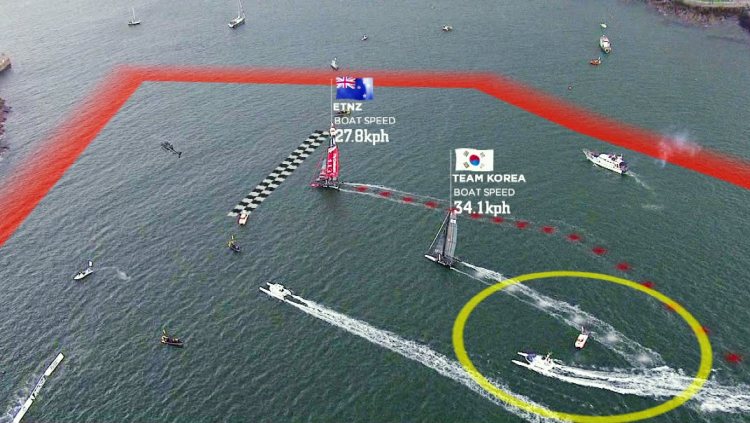
The Emirates Team New Zealand yacht passing Dr...
The Emirates Team New Zealand yacht passing Drake’s Island, at the start of their run during the America’s Cup AC500 speed trial on 2011-09-11 (Photo credit: Wikipedia)

I started thinking about this week’s posting and had settled on writing about the role that supporters play in the context of sports when I suddenly realised that I’d written about this subject before. After pondering for a bit, I decided to write instead about the Americas Cup, which I have also written about earlier. For those who don’t know, this yacht competition, sailed in the thrilling AC72 yachts, was won 9-8 by Oracle Team USA, who made an amazing comeback from 8-1 down.

I think that it is fair to say that New Zealanders expected their team to win from 8-1 in the lead as they only needed to win one race to win the regatta and the cup. It is also fair to say that almost everyone in the country both knew about and supported Emirates Team New Zealand, to the extent that the whole country almost came to a standstill at 8am which is when the racing started, New Zealand time. I can definitely state that the traffic on the motorway as I drove to work at 8am was much lighter than usual. Many people in Auckland decided to make their way to Shed 10 on the waterfront where the matches were shown on giant TV screens.

Go @EmiratesTeamNZ. #americascup
Go @EmiratesTeamNZ. #americascup (Photo credit: KLIM ANDREEV)

When the score was 8-1 the supporters were ecstatic, expecting a quick finish to the regatta, but as the Oracle Team USA yacht continued to win, the feelings changed first to worry then to despair, however I don’t think that many if any failed to hang on until the bitter end.

Emirates Team New Zealand
Emirates Team New Zealand racing


Contrast this to the situation in the US where most people didn’t even know that there was a yacht race on!

There is no doubt that Oracle Team New Zealand appreciated the support from the supporters in New Zealand and for that matter in the US, and acknowledged the continuing support in defeat. They would have also felt that they were representing New Zealand and would have felt a huge responsibility as a result. The looks on the faces of the team members after the final race would have reflected their own personal disappointment and the disappointment for having let their supporters down.

Watching the racing
Watching the racing

Explanations for the extraordinary comeback by Oracle Team USA are naturally speculative. It is probably down to a number of factors, but was likely to stem firstly from the alterations that Oracle Team USA made to their yacht during the regatta, making it faster and more manoeuverable and secondly from better boat handling learnt during the regatta, not least of all from Emirates Team New Zealand.

Dean Barker
Dean Barker

Reactions in the US to the win are interesting. The Slate expounds at length on the fact that Larry Ellison, chief executive of Oracle has expended multi-millions of dollars on the America’s Cup, that holder of the cup can pretty much determine the rules of the regatta and that the yachts are so expensive. They touched on the fact that the Oracle Team USA yacht had only one American on board, the team being predominately from New Zealand and Australia, with the only other American starting the regatta on the boat being kicked off in favour of Ben Ainslie, who is British. It almost seems that the Slate was on the side of Emirates Team New Zealand!

Ben Ainslie
Ben Ainslie

The New York Times is more restrained, merely pointing out the huge input of cash that Larry Ellison has injected into Oracle Team USA, and commenting on the fact that yachting is a niche sport in the US but that 1 million out of 4 and a half million in New Zealand were watching the cup. (I actually think that it was much higher than a mere one million!). So, no denigration of Oracle Team USA, but no real congratulations either.

An interesting thing about all the reporting of the 2013 America’s Cup is that the American yacht has been almost universally been referred to as “Oracle” while the other yacht has generally been referred to as “Team New Zealand”, which says a lot about the general perception of who was actually racing for the America’s Cup. I believe that the Oracle Team USA yacht does not have a name beyond “17” but the Emirates Team New Zealand yacht is named “Aotearoa”, which caused American commentators some problems.

Larry Ellison on stage.
Larry Ellison on stage. (Photo credit: Wikipedia)

The challenger of record for the next America’s Cup regatta is likely to be an Australian yacht club, which brings back memories of the other remarkable comeback in the America’s Cup history, when the Australian team came back from 3-1 down to win 4-3 and end the longest winning run in sport, but nothing is likely to top the sheer spectacle of the wonderful AC72 yachts flying on foils in the 2013 America’s Cup regatta using techniques developed and perfected by Emirates Team New Zealand and adopted with such success by Oracle Team USA.

Flying on foils
Flying on foils

There has been no criticism or vilification of Oracle Team USA by New Zealanders or the New Zealand press so far as I know, although the Oracle Team USA team boss, Russell Coutts, has come in for a little criticism, simply because Coutts is a New Zealander. There is talk, though, that Coutts may return to Team New Zealand, if Team New Zealand in fact survives. This might be an issue since Team New Zealand do not have a billionaire backer and mounting an America’s Cup campaign takes a mountain of money.

Russell Coutts
Russell Coutts

Ben Ainslie, the British tactician on board Oracle Team USA in the later races has mentioned that he would see a British challenge for the America’s Cup. It would certainly be fitting if a British challenge were to prevail and finally take home the America’s Cup. Although it officially belongs to the New York Yacht Club I believe, it was originally awarded by the Royal Yacht Squadron (Based on the Isle of Wight in England) to the yacht America in the very first race for the cup.

The Yacht America
The Yacht America

Wine

Assortment of wine from Domaine Chandon in Yar...
Assortment of wine from Domaine Chandon in Yarra Australia showing their sparkling Chardonnay and Pinot noir wine as well as a still pinot noir. (Photo credit: Wikipedia)

Most cultures have some substance that they use to relax inhibitions and induce euphoria. Overindulgence leads to intoxication, the word acknowledging that the substance, whatever it is, damages the body in some way. It is toxic. The most widespread substance that is used is alcohol, and the reason it is so common is probably because it is easy to produce and acquire. Just let some fruit go rotten.

Of course, rotten fruit is pretty nasty, and people are ingenious, and it was soon discovered that fruits and grains and some root vegetables could be made to ferment without first going rotten. In fact it is a yeast that is the agent which facilitates the necessary chemical reaction, which takes in sugars in some form and produces carbon dioxide and alcohol. “Alcohol” when referred to in relation to recreational drinking is ethyl alcohol or ethanol, a substance that has now and then suggested as a fuel for cars.

English: Bai jiu, or Chinese white hard alcoho...
English: Bai jiu, or Chinese white hard alcohol that was made locally in Haikou, Hainan, China, and sold in a dedicated alcohol shop. The signs hanging on the stone bottles show alcohol percentag above, and price in yuan (2009) below. (Photo credit: Wikipedia)

Alcoholic drinks can be made from practically anything and can contain varying levels of alcohol, from relatively low alcohol drinks like beers and ales, through to wines, which represent the strongest drinks that can be made by simple fermentation and on to distilled alcoholic drinks which contain large amounts of alcohol.

English: Elderberries Ripe elderberries growin...
English: Elderberries Ripe elderberries growing by the Roman wall at Calleva Atrebatum. Elderberries can be used in a number of ways, including making elderberry wine. (Photo credit: Wikipedia)

Wine is these days made from grapes, and alcoholic drinks made from other fruits are usually referred to as “fruit wines“. There is an unfair implication that “fruit wines” are not real wines and are inferior to grape wines. While “fruit wines” are generally not as good as grape wines, the reason is probably more to do with the centuries of development and improvements that have gone into modern grape wines than any inherent superiority of grapes as a prime ingredient of wines.

Wines are typically made from the grapes of Vitis vinifera though occasionally other grapes are used, and hybrids of V. vinifera with other species are not uncommon. Wines are classified as either white or red, the colour coming from the colour of the skin of the grapes that were used in the production of the wine. Rosé wines are usually pinkish or pale red and are usually made from red wine grapes. The paler colour results from the removal of the skins at an early stage of production.

Several French rose wines from the Rhone Valle...
Several French rose wines from the Rhone Valley and Provence. (Photo credit: Wikipedia)

There are all sorts of varieties of wine, named after the varieties of grape vines that produce the grapes. I’ve a couple of books on wine which detail the genealogy of grape vines and it is a complicated messy and incestuous family tree. There are stories of skullduggery, stealing, and smuggling. There are stories of cataclysmic crop failures and noble experiments and migrations between countries.

Climate change comes into the picture too. Grapes are grown in areas of southern England where grapes have not been grown since Roman times, when younger and more robust varieties were grown. But the ability to grow grapes commercially in England can’t all be put down to global warming since techniques for protecting vines from frost (the main cause of crop failure in grape vines) have been vastly improved.

Madeleine Angevine growing in England
Madeleine Angevine growing in England (Photo credit: Wikipedia)

Smoke producing machines are used to protect vines from frost and helicopters have been used to good effect too. I’m not sure how these techniques work, but I believe they do. One of the most bizarre protection methods is to spray the vines with water which instantly freezes and cocoons  the buds in an envelope of ice apparently protecting them from freezing.

I find this stuff interesting, but the reason people buy wine is because of the alcohol in it, and the reason that they prefer some wines over others is the taste. I prefer red wines, because white wines seem astringent and too sweet. Which is odd because red wines can also be astringent and sweet! Well, maybe I am exaggerating somewhat, but the beauty of the wine is definitely on the tongue of the taster.

When tasters taste wine, they have a problem. Sweetness or dryness is pretty much describable, as is the tannin level, which gives all wines, red or white, its astringency, but when the subtleties of the flavour have to be described, especially to someone who has not yet tasted the wine, then there are issues.

Vineyard owned by California wine producer Fer...
Vineyard owned by California wine producer Ferrari-Carano in the Dry Creek region of Sonoma county. (Photo credit: Wikipedia)

Wines may be described as “fruity” or “full-bodied”, which gives some impression of the experience of tasting the wine. The taster may have to descend to using analogies for further details. To quote from a bottle label : “This wine is fruit driven with flavours of red berry fruit and black cherries….”.

However, if you actually taste the wine, you won’t taste berries or cherries. What you will taste is firstly the major type, red or white. Secondly you are likely to be able to distinguish the variety, for example Pinot Noir, or at least the style for a blended wine. Then you will get the overall ‘shape’ of the wine (robust maybe, or delicate). You will note different aspects of the wine at different stages of drinking, at first hit, in the mouth and the aftertaste. I find that some wines have distinctive phases of this sort and others don’t.

You certainly don’t want to be analysing every sip of every wine when you drink it, but I do try to taste it like above at least on one mouthful, but I don’t always remember to do so. It does help you when you choose a wine in the store though.

Typical shape and design of a white wine tasti...
Typical shape and design of a white wine tasting glass. New Zealand wine (Photo credit: Wikipedia)

To get back to the red berries and cherries for a moment, you may taste a wine and not be able to detect them in your tasting. That’s because, in my opinion, those tastes are not there as such. So what do the tasting notes mean by these comments? They mean that the taster is reminded by some flavours of the wine of some aspects of the taste of berries. A faint echo of the richly complex flavours of red berry fruit echoes in the mind of the taster, and that is all that he has to work with when trying to describe some of the flavours in the wine.

In terms of familial relationships the flavour being described by the taster is not as close as brother or sister to the flavour mentioned by the taster. It’s more a second cousin twice removed relationship, and the taster is not saying that it is the second cousin twice removed, but that it reminds him or her of the second cousin twice removed. So you may think that there is hint of gooseberry in flavour of the wine and for you there are.

I think that the ability to even register some flavours varies from person to person and not just in wine. One person may taste something complex and say “mint”, while another may say “cloves”.

Wine tasting bar at Ridge/Lytton Springs, Sono...
Wine tasting bar at Ridge/Lytton Springs, Sonoma, California (Photo credit: Wikipedia)

So where does it leave those of us who read wine labels and try to match the description with the label? Well, unless you drink a lot of wine and have an ability to distinguish the flavours that is practised, and have a similar sort of palate to the usually anonymous taster, then the bottle labels or tasting notes don’t mean a great deal. If it says “robust” or “full-bodied” for example, most people would be able to agree, but if it says “hints of gooseberry” you may well not agree that those flavours are there. It might remind you more of apples.

Image of an old Kazakhstan wine bottle.
Image of an old Kazakhstan wine bottle. (Photo credit: Wikipedia)

The America’s Cup

There’s a competition going on in San Francisco to decide the winner of the America’s Cup. Those people who do not have an interest in yachting may not have heard of it, but it is the Superbowl of the yachting world. Currently it is being fought out between Oracle Team USA and Emirates Team New Zealand. The New Zealand team currently lead 6 wins to 1. [Update: The score is now 6 – 2.]

For spectators on the shore yacht racing normally happens a long way off and with few visual clues as to what is happening and it is often next to impossible to tell who is leading and even who won the race. The yachts are visible as small white dots although the deployment of a spinnaker will swell the dots and may introduce a bit of colour, but the to-ing and fro-ing of the yachts is still difficult to decipher.

The America’s Cup is different in that technology has come to the spectators’ assistance. A view can be shown on television of the yachts as seen from a helicopter or motorboat shadowing the yachts, but it will still not be obvious who is leading, since when going upwind the yachts travel at a significant angle to their target course. At each side of the course the yachts must change direction, a procedure known as a ‘tack’. If both yachts are travelling on parallel courses it is possible for the trailing boat to appear to be leading.

So to help spectators the live view is overlaid with graphics which show each yacht’s distance from the mark (the target for this leg) or from the finish line if the leg is the last one. The graphics also show the boundaries of the course if the yachts are approaching them. The distance between the lines for the two yachts shown who is in the lead and by how much.

Ac45
A graphic from an earlier America’s Cup Regatta race featuring the smaller AC45 yachts.

The graphics also show the yacht speeds though I’m not sure if that is the speed towards the mark or finish line or merely the straight line speed. Another thing that the graphics can show is any ‘bad air’ that the leading yacht is casting over the trailing yacht. The leading yacht’s sail disturbs the the air as it flows over it, and this disturbed air is less efficient at providing the trailing yacht with energy and so it tends to travel a little slower. The leading yacht is said to cover the trailing yacht and the trailing yacht will endeavour to escape the cover.

The most interesting times in a yacht race are when the vessels are rounding a mark. The graphics for this are a circle round the mark and a series of dots or blobs representing the yacht’s course, as if the yacht were dropping a bucket of dye every second. There is also a countdown clock indicating the number of seconds that one yacht is behind the other.

The two finalists
The two finalists

So there’s plenty of information about the races and it makes for fascinating viewing. (There are some people who still don’t get it and who watch it for 5 minute or so and then go and do something else, but then again, Formula 1 leaves me yawning). The course in San Francisco is very close to the shore and this does allow spectators a good view of the yachts, though I suspect that most of them will be keeping up to date via cellphones. There’s an app for it!

Race six, won by Emirates Team New Zealand
The huge number of on course spectators can be seen in the bacground

[Update: I just watched latest race. Oracle Team USA won this after a near capsize by Emirates Team New Zealand.]

The class of yacht being used in the America’s Cup in San Francisco is designated as AC72. These are huge catamarans (dual-hulled yachts) with fixed sails and full of the latest technology, computers and hydraulics. A failed battery cost Emirates Team New Zealand one race!

Oracle Team USA
Oracle Team USA (boat #2)

The yachts are spectacular in action as they rise up out of the water on hydrofoils, which reduces hull drag to nothing and allows the yachts to reach speeds of up to 50mph (44 knots). This does not come without its dangers and several of the yachts have dipped their bows into the water leading to at least two incidents where yachts have “pole-pitched” and tipped over in one case killing one of the crew. In both cases the yachts were severely damaged. Emirates Team New Zealand dropped their bows into the water in one case  but appeared in no danger of flipping over. Oracle Team USA were one of the teams whose yacht was almost destroyed  in an incident.

Capsize
Oracle Team USA yacht capsizes

The yachts are filled with technology and are very technical to race, apparently, and have proved very popular in San Francisco with huge crowds turning out to watch action. Millions more are of course glued to their TV screens and cellphones. And this, below, is what it is all about.

English: The America's Cup
English: The America’s Cup (Photo credit: Wikipedia)

Hey Noni No

It was a lover and his lass,
   With a hey, and a ho, and a hey nonino,
That o’er the green cornfield did pass,
   In springtime, the only pretty ring time,
When birds do sing, hey ding a ding, ding;
Sweet lovers love the spring.

I haven’t written a poem for a long time and I was lacking a topic for today, so I started on a poem about the spring. However it didn’t work, wasn’t working, so I gave up and quoted the bard, above.

Spring seems to engender creativity to match the burgeoning growth and fecundity of nature. As the days get lighter in the mornings the birds seem to get louder and louder as well as earlier and earlier, so that you almost feel guilty when indulging in a lie in.

spring
spring (Photo credit: promanex)

The birds are of course breeding, nest building, and raising young. Round here that seems to mean that the Tuis rattle through the air, crashing from tree to tree. Tuis are not clumsy flyers, but are noisy ones. This means that the smaller and quieter birds get on with their business less noticeably, though a fantail was curiously looking at me while he was hopping about in the bushes. Who knows what he was up to?

Fantail 1
Fantail 1 (Photo credit: A. Sparrow)

The feathered pommie immigrants are mostly songbirds, and so thrushes and blackbirds are evident in the dawn chorus. Oh, and there are plenty of chattering sparrows here. I may have mentioned this before but in the UK the sparrow population is still declining, and if the sparrows here continue to prosper, it could be that we could send some back to repopulate their original homelands.

English: House Sparrows on a restaurant roof n...
English: House Sparrows on a restaurant roof near Mt. Cook in New Zealand (Photo credit: Wikipedia)

We have had a really good spring so far and all the plants and animals are a week or two ahead of where they would normally be. In particular the grapevines are reported to be doing really well this year. The danger is that a wintery throwback may occur, nipping all the buds off the sprouting plants, including the vines, killing early insects and dooming some of the new chicks to starvation. I understand that early and luxurious growth is not necessarily good news for the wine industry either, since restricted growth concentrates the flavours or something.

Grape Vine
Grape Vine (Photo credit: Fire Engine Red)

The wine industry use helicopters to reduce the effects of late frosts. Hiring a helicopter for a few hours is apparently a cost-effective way of fighting frosts. This has led to conflicts between wineries and their neighbours in some places – who wants to be woken by a helicopter at 2am?

Hmm, well, I started talking about spring and seems to have moved on to talking about wine. One more comment about wine before I move on. New Zealand has many wineries and most welcome visitors to taste and buy wines. Many are small and welcoming and others are large and welcoming.

One of the smaller ones is Salvare. We enjoyed a platter of food there on the deck overlooking the vineyards. We also sampled their wines and their olive oil in a very relaxed atmosphere.

One of the larger ones is Mission Estate. Mission Estate was set up by a religious order and is a luxurious place with an award-winning restaurant and is located on the outskirts of Napier. We had tea there in the grounds of the splendid house overlooking the vineyards and Napier. There was a wedding being hosted there in that lovely environment.

If you go there be sure to see the Quiet Room which reflects the religious nature of the founders of the Estate. While we were there I bought a very nice bottle of wine, ironically produced in Marlborough and not Hawkes Bay and I would have bought the t-shirt if there had been one in my size!

These two wineries are merely examples of ones that we have visited. There are many, many others and scattered amongst the vineries are artisan breweries, olive oil producers and similar enterprises most of whom welcome visitors, (though opening times vary).

Back to spring in Wellington. Apart from the deafening clamour of the birds and their to-ing and fro-ing, spring is evident in the foliage. The lawn, which I last cut a week or two is showing a green flush already and the bushes are all sprouting pale green leaves. There is a small bush by our front door which is home to stick insects later in the year. Being a northern hemisphere species it loses its leaves in the winter and becomes stick-like and dead-looking and is now bursting into leaf. No stick insects yet, though.

Water spheres on spring larch foliage
Water spheres on spring larch foliage (Photo credit: OpenEye)

The temperatures have been high for this time of year, mostly. Clear skies have meant the occasional nippy morning and cars left out have had films of ice on their windscreens, but generally spring this year has been very pleasant. However, we are currently heading for a reminder that winter is not long gone, since the forecast is for wild weather on Tuesday and Wednesday. Batten down the hatches!

English: Spring storm, Queen Charlton The scen...
English: Spring storm, Queen Charlton The scene is similar to 180243 by Derek Harper. It is included for the difference in conditions, weather and time of year. (Photo credit: Wikipedia)

Why does cancer spread?

The Human Body -- Cancer
The Human Body — Cancer (Photo credit: n0cturbulous)

Everyone, I’m sure, knows of someone who has died of cancer. It’s a disease that is wide-spread and seems to be more common now that other diseases are coming under control. It may be that cancer is certain to appear in the human body if it lives long enough. There’s a cheery thought.

Wikipedia describes cancer as follows: “known medically as a malignant neoplasm, (it) is a broad group of diseases involving unregulated cell growth. In cancer, cells divide and grow uncontrollably, forming malignant tumours, and invade nearby parts of the body”.

Cross section of a human liver, taken at autop...
Cross section of a human liver, taken at autopsy examination, showing multiple large pale tumor deposits. The tumor is an adenocarcinoma derived from a primary lesion in the body of the pancreas. (Photo credit: Wikipedia)

There’s two parts of this definition. Firstly there is the unregulated cell growth and secondly there is the spread of the growth to other parts of the body. The unregulated cell growth is usually attributed to a number of causes, but the mechanism is usually given as damage to the genetic material. The causative agent whatever it might be, damages the genetic material and this results in a huge proliferation of cells.

I write computer programs as tools for doing my job. Each program ends up as a string of data which a human has a hard time decoding, though of course the computer hardware has no problems. The effect of changing a single bit (actually, a byte) of a program would almost certainly cause it to crash. In so far as the analogy that the genetic code resembles a computer program holds, this indicates that a random change to the genetic code would most likely result in the death of the cell. It would require a specific hit, to say a piece of code that control the termination of a loop that would let the program “grow out of control”.

Out of memory ATM
Out of memory ATM (Photo credit: RuiPereira)

I’d guess, from a position of almost total ignorance, that changes to the cells in the body occur all the time. Changes happen to the genetic code in a cell, and it almost certainly dies. (A side question is : what exactly happens to a cell when it dies? Presumably some process or other ‘detects’ the death and breaks it up? Or does the first failure cause other processes to fail until the integrity of the cell is lost? Lots of questions). However, unless the failure is dramatic, explosion-like rather than simple deflation, it should not affect its neighbouring cells, should it? So in general the death of a single cell is probably not noticeable.

Going back to the computer program analogy, in a computer there are dozens, if not hundreds of programs running all the time, but the user is not aware of any other than the one he is interacting with. Equating cells with computer programs, it is most likely that a random change would cause a program or a cell to die, with little effect on the computer or body as a whole.

Facit computer memory
Facit computer memory (Photo credit: liftarn)

All the programs running in a computer need ‘memory’ to run in, and there is a limited supply of memory, so (conceptually at least) one program is given the task of managing the memory allocations. Damaging the memory manager program could theoretically lead to it repeatedly allocating memory until there was none free for allocation. The computer would, once again, crash. If a program is damaged in a particular way it could ask repeatedly for memory and again cause itself or other programs. or even the whole computer to crash.

In a living organism there does not seem to be a single equivalent of the ‘memory manager’ or ‘resource manager’. In a living organism everything seems to be done by consensus between cells. (That is both anthropomorphic and probably naive, but it will do, I think).

So, although I’d estimate that the vast majority of changes to the genetic code would result in cell death and nothing else, a very, very small number of changes could result in the cell soaking up as much of the cell-level resources as it can and damaging the cell itself, its neighbouring cells or the whole organism.

Genetic code
Genetic code (Photo credit: Martina Gobec)

That, however, is not cancer. For damage to result in a cancer it has to damage the cell in a particular way. In a computer, cancer would be analogous to a program continually creating copies of itself and using up all the system resources, which would result in the system crashing. Almost all cells have the ability to duplicate themselves, but whether or not they do replicate is, so far as I know, determined by the conditions in the cell itself and conditions in its environment, ie the surrounding cells, possibly signalled by chemicals or chemical gradients.

For a cell to become cancerous, it first of all must be inclined to duplicate itself and it would also have to be able to ignore any signals from its environment. The damage to the genetic structure to achieve this seems to me to be remarkably specific. Its like damaging a computer program in such a way as to destroy a control loop. Possible, but not very likely.

Main sites of metastases for some common cance...
Main sites of metastases for some common cancer types. Primary cancers are denoted by “…cancer” and their main metastasis sites are denoted by “…metastases”. List of included entries and references is found on main image page in Commons: (Photo credit: Wikipedia)

Then there is the issue of metastasis. This is how cancer spreads. It first of all attacks the boundary of the organ it is embedded in, then some cancer cells migrate into other organs. Interestingly, when they start to form a cancerous tumour in the new organ, they are still identifiable as cells from the original organ.

Think for a moment about what that means. A cancer which metastasizes has to have its genetic material damaged in such a way that it can do all of the following :

  • divide in an uncontrolled manner
  • attack the walls of the organ it is contained in
  • migrate to other organs (and it can be very specific about the organs it migrates to)
  • settle there and start to divide again

That’s a remarkably specific set of actions to occur as the result of damage. Damage usually results in less efficient operation, both of computer programs and bodies. Of course the damage doesn’t have to create these action ‘programs’ in the genetic material. They may be already there. All that the damage needs to do is somehow kick off those actions in sequence to cause the cancer to form and metastasize. To a programmer it would look like a small chunk of code to call those routines which I’ve called ‘actions’. The only other time in one’s life that one’s body experiences explosive growth and cell migration is in the womb and as a young child. One can imagine that damage could somehow kick off the genes or part of the genetic code that was used when one was a developing foetus.

foetus
foetus (Photo credit: Leo Reynolds)

This is easier to contemplate than damage which somehow creates the whole process from scratch. It does imply that the damaging agent somehow attacks a specific part of the genetic material and replaces it with some very specific other material that has the specific effect of kicking off explosive growth and metastasis.

I’m not geneticist or cancer specialist of course, so my musings above may be way, way off beam. They could be and probably are complete rubbish. I can’t and won’t defend them if anyone were to attack them. My main thesis is that it seems incredibly unlikely that damage to the genetic material could cause the specific effects of cancer, which are uncontrolled growth and metastasis.

Yet cancer happens and happens frequently and in varied ways. There are many sorts of cancer and they appear to be often triggered by specific stimuli. All my arguments above founder on that logical rock.

Shipwreck
Shipwreck (Photo credit: Wikipedia)

Earthquakes

English: Quake epicenters. Română: Epicentre a...
English: Quake epicenters. Română: Epicentre ale cutremurelor produse în intervalul de ani 1963–1998. (Photo credit: Wikipedia)

This week’s subject pretty much suggested itself. There I was, sitting at my desk, and suddenly I felt this rolling, shaking sensation. Well, I feel it every time a truck goes past, but this time the shaking continued and it became apparent that this was an earthquake. It measured 6.6 on the earthquake scale and was the biggest one I can remember for a long time. Fortunately we were not at the epicentre and no one was killed. Those living close to the epicentre had a rougher time than we did and many houses were damaged, though only one appears to have been severely damaged.

(Note: Images in this post are not from the Wellington earthquakes that I am talking about in this post).

Since we are prone to earthquakes here the children in school are drilled in what to do when an earthquake strikes. I particularly like the idea expressed by one child that “earthquakes cause salamis”. (See the second video on the page that is linked to above.)

Earthquake Drill
Earthquake Drill (Photo credit: Benjamin Chun)

The previous earthquake happened when I was at home. Instinctively my wife ran for the door. I equally instinctively rushed to stop the TV from toppling! It’s funny what you do in an emergency.

Luckily no one was seriously hurt in the earthquakes though people in lifts (elevators) and at the top of high buildings were shaken about a bit. Apparently lifts (elevators) are designed to stop moving if there is a big quake.

In the city nothing much was damaged, although a lift (elevator) shaft which was damaged in an earlier quake is scheduled to be removed and one ‘lane’ (pedestrian access between buildings) in the city centre was taped off by authorities. Last time there was a certain amount of damage but nothing significant, though people were sent home so that the buildings could be checked. A rugby test match between New Zealand and Australia may be cancelled. That’s classified as a Big Thing round here.

Footbridge over Avon river following both Sept...
Footbridge over Avon river following both September and February earthquakes. (Photo credit: Wikipedia)

All in all, people have taken the earthquake in their stride, though news pictures showed some people who appeared to be in shock. The one injury that I heard of was one woman who tried to dive under her desk and missed cracking her head against it. I saw a picture of two girls hiding under a desk with a bottle of wine. That’s apparently what they had been doing all afternoon. One guy texted from the airport and said that he would be glad to get up into the air. (As it happens the airport stopped flights in and out for a while, but they soon caught up with the backlog).

Naturally people wanted to go home to be with their families and to check that their houses had not been damaged. This led to the roads out of and around the city becoming gridlocked. I didn’t want to get caught up in that so I hung around until just before the time that rush hour usually happens  and my trip home was in fact easier than usual. I did wonder what would happen if a significant earthquake or after shock happened while I was travelling at 100kph on the motorway! Also, there is a part of my route that lies under a motorway bridge, and there was a chance that I’d get stuck at the traffic lights. Fortunately they were showing green so I did not have to stop under the heavy concrete spans of the motorway. That would have been scary.

Footbridge over Avon river following both Sept...
Footbridge over Avon river following both September and February earthquakes. (Photo credit: Wikipedia)

The thing about earthquakes is that you don’t know how powerful they are going to be. You don’t know if it is going to be a jiggle and a roll or whether it is going to rip the building apart underneath you. I find them scary and exhilarating. After one is over people are often more relaxed than before it, and gather to exchange news and ‘war stories’. At least, that is so in the earthquakes that I have so far experienced. But they have been relatively benign.

Unfortunately this was not true nearer the epicentre where almost all the houses had some damage, though no serious injuries have been suffered and no fatalities have happened.

Wellington office after earthquake.

Why do things make sense?

Make it make sense
Make it make sense (Photo credit: edmittance)

Things pretty much make sense. If they don’t we feel that there is a reason that they don’t. We laughingly make up goblins and poltergeist to explain how the keys came to be in the location in which they are finally found, but we, mostly, have an underlying belief that there are good, physical reasons why they ended up there.

Things appear to get a little murkier at the level of the quantum, the incredibly small, but even there, I believe that scientists are looking for an explanation of the behaviour of things, no matter how bizarre. One of the concepts that appears to have to be abandoned is that of every day causality, although scientists appear to be replacing that concept with a more probabilistic version of  the concept of causality. But I’m not going to go there, as quantum physics has to be spelled out in mathematics or explained inaccurately using analogies. I note that there is still discussion about what quantum physics means.

English: Schrödinger equation of quantum mecha...
English: Schrödinger equation of quantum mechanics (1927). (Photo credit: Wikipedia)

We strive for meaning when we consider why things happen. When a stone is dropped it accelerates towards the earth. This is observation. We also observe the way in which it accelerates and Sir Isaac Newton, who would have known from his mathematics the equation which governed this acceleration, had the genius to realise that the mutual attraction of the earth and the stone followed an inverse square law and, even more importantly, that this applied to any two objects which have mass in the entire universe.

English: Mural, Balfour Avenue, Belfast Mural ...
English: Mural, Balfour Avenue, Belfast Mural on a gable wall on Balfour Avenue in Belfast (see also 978903). The mural “How can quantum gravity help explain the origin of the universe?” was created by artist Liam Gillick and is part of a series of contemporary art projects designed to alert people to the ‘10 remaining unanswered questions in science’ at public sites across Belfast. (Photo credit: Wikipedia)

So, that’s done. We know why stones fall and why the earth unmeasurably and unnoticeably jumps to meet it. It is all explained, or is it? Why should any two massy objects experience this attraction? Let’s call it ‘gravity’, shall we? How can we explain gravity?

Well, we could say that it is a consequence of the object having mass, or in other words, it is an intrinsic property of massy objects, which if you think about it, explains nothing, or we can talk about curvature of space, which is interesting, but again explains nothing.

Curved Spaces
Curved Spaces (Photo credit: Digitalnative)

Can you see where I am going with this? Every concept that we consider is either ‘just the way things are’ or requires explanation. Every explanation that we can think up either has to be taken as axiomatic or has to be explained further. Nevertheless most people act as if they believe that there is a logical explanation for things and  that things ultimately make sense.

It is possible that there is no logical explanation of things, and that the apparent relationships between things is an illusion. I once read a science fiction story where someone invented a time machine. Everywhere the machine stopped there was chaos, because there were no laws of nature and our little sliver of time was a mere statistical fluke. When they tried to return to the present they could not find it. This little story demonstrates that although we appear to live in a universe that is logical and there appears to be a structure to it, this may just be an illusion.

English: Illustration of the difference betwee...
English: Illustration of the difference between high statistical significance and statistical meaningfulness of time trends. See Wikipedia article “Statistical meaningfulness test” for more info (Photo credit: Wikipedia)

If we do live in a logical universe we not be able to access and understand the basis and structure of it. We may see things “through a glass darkly”. We may be like the inhabitants of Plato’s Cave. Everything we experience we experience through our senses, so our experience of the world is already second-hand and for many purposes we use tools and instruments to view the world around us. Also, our sense impressions are filtered, modified and processed by our brains in the process of experiencing something. We can take prescribed or non-prescribed drugs which alter our view of the world. So how can we know anything about the universe.

Alternatively there may be order to the universe. There may be ‘laws of nature’ and we may be slowly discovering them. I like the analogy of the blanket – a blanket is held between us and the universe but we are able to poke holes in it. Each hole reveals a metaphoric pixel of information about what lies behind the blanket. Over the years, decades, centuries and millennia we have poked an astronomical number of holes in the blanket, so we have a good idea of the shape of what lies behind it.

Cámara estenopéica / Pinhole camera
Cámara estenopéica / Pinhole camera (Photo credit: RubioBuitrago)

So why do things make sense? Is it because there is a structure to the universe that we are either discovering or fooling ourselves into believing that we are discovering, or is there no structure whatsoever and any beliefs that there are illusions. Maybe there’s another possibility. Maybe the universe does have the structure but it is an ‘ad hoc’ structure with no inherent logic to it all!

Highly Illogical
Highly Illogical (Photo credit: Wikipedia)

Birthdays

birthday cake
birthday cake (Photo credit: freakgirl)


Today (Sunday 28th July) is my birthday, which naturally had me pondering birthdays in general. In July I have my birthday, my son’s birthday is a few days earlier and my granddaughter’s is next month. It turns out that a friend of a Facebook friend also has her birthday today, on my birthday. Jim Davis, the creator of Garfield was also born on my birthday. And finally, George, the latest addition to the royal family and third heir to the British throne was also born in July, the same month as me and my son.

The maths of birthdays is interesting. If you have 23 randomly selected people then the probability that at least two of them share a birthday is a shade greater than 50% (50.7297%). If you have 53 people the probability goes above 99%. This is known as the Birthday Problem or the Birthday Paradox, though it is not really a paradox, I believe. There are a number of simplification used in calculating the above. For instance, it assumes that all birth dates are equally probable, but they are not, and it also ignores leap days. Also mothers can sometimes, within bounds, select the day that their baby is born, especially for at risk babies and this potentially could cause a skew in the probabilities.

English: The birthday paradox: p(n) represents...
English: The birthday paradox: p(n) represents the probability that in a room with n people, some two (or more) will share the same birthday; q(n) represents the probability that in a room with n people, that at least one person will have the same birthday as a previously selected person. 中文: 生日悖论 2个人生日相同和跟某人生日形同的概率变化 (Photo credit: Wikipedia)

Some people have two birthdays. Well, the Queen has a real birthday and an official one, so that celebrations of her birthday would not fall too early in the year, but later, when the weather would hopefully be better. Unfortunately that means that in the Southern Hemisphere her birthday falls in the depths of winter!

2013 VividSydney on Queen's Birthday 10 Jun 2013
2013 VividSydney on Queen’s Birthday 10 Jun 2013 (Photo credit: hto2008)

Our years these days are defined in terms of “CE” or “Common Era” and “BCE” or “Before Common Era”. Older people can remember when it was “Before Christian Era” or even “BC” for “Before Christ” and “AD” for “Anno Domini” or “Year of Our Lord”.

I’m not going to argue whether or not Jesus really existed and whether or not he was divine, but if we assume for a moment that he was born, there is a lot of discussion on what year it was that he was born. Using the gospels and other historical information as a guide, many people believe that he was born 4 to 6 years before start of the Common Era. Or using the terminology, he was born up 6 years “Before Christ”! Humorous, I suppose.

Christ's Birth Orthodox church
Christ’s Birth Orthodox church (Photo credit: baswallet)

Most people view history as continuous and the dates as fixed and well known. That’s not the case of course – the calendar has been revised several times, and  even countries which are Christian may have different calendars. Other religions naturally don’t relate their calendars to the birth of Christ. I believe that some even count backwards.

Calendars have grown out of necessity. Tax collectors in particular love calendars. Calendars are used to keep track of one’s age. Before calendars were widespread years were kept track of by relating births and deaths to important events, like the installation of a particular ruler. For instance, the gospel writer Luke relates Jesus’s birth to a census taken at the time:

<code>In those days Caesar Augustus issued a decree that a census should be taken of the entire Roman world. 2 (This was the first census that took place while[a] Quirinius was governor of Syria.) 3 And everyone went to their own town to register. Luke 2 1-3</code>

This shows the way that all dates were reckoned, relative to fairly recent events. The possibilities for error are obvious. Even if the events are written down, going more than a few years into the past involves research and calculation. Such calculations lead to such absurdities as Bishop Ussher’s calculation of the age of the earth as around 6,000 years. Even the dates of events early in the Common Era  can be dubious. This seems strange to citizens of the modern world, who can measure time to the accuracy of the vibration of an atom, and can accurately date events for at least a hundred or more years into the past.

Animated version of the lead isotope isochron ...
Animated version of the lead isotope isochron that Clair Patterson used to determine the age of the solar system and Earth (Patterson, C., 1956, Age of meteorites and the earth: Geochimica et Cosmochimica Acta 10: 230-237). The animation shows progressive growth over 4550 million years (Myr) of the lead isotope ratios for two stony meteorites (Nuevo Laredo and Forest City) from initial lead isotope ratios matching those of the Canyon Diablo iron meteorite. (Photo credit: Wikipedia)

One last comment – people who were born in the same year as the Queen, but born after her actual birthday and before her official birthday can claim to be both older and younger than the Queen.

Queen of United Kingdom (as well as Canada, Au...
Queen of United Kingdom (as well as Canada, Australia, and other Commonwealth realms) (Photo credit: Wikipedia)