English: Random copolymer brush (Photo credit: Wikipedia)
I’m always interested in random happenings. Of course ‘random happenings’ always have a cause. Or less linearly, the whole field of the past results in the outcome at the point in question and all other points at the moment in time under consideration and at future moments in time. Or the space-time continuum is not mutable.
Multiverse (Photo credit: kevin dooley)
Whatever. We have recently had a couple of big storms. it being the winter season, and debris has piled up on the beach. This detritus is mostly of marine origin, mostly seaweed, with a sprinkling of other marine debris, such as mollusc shells, not to mention non-organic materials like rocks and sand.
Debris. Notice the small pieces of plastic.
There is a noticeable contribution of terrestrial origin of course, like tree trunks, limbs and even foliage. A significant portion is of anthropological origin, such as worked wood and plastic, and even concrete, tarmacadam, glass and metals.
The plastic is interesting. With the exception of the occasional chunks of polystyrene foam or similar, most of the plastic debris is small, like the rings from the necks of plastic topped containers or the teats from the tops of water bottles. (Aside: Why buy water when you can get it from the tap?) Whole bottles are rare for some reason.
Debris. If you look carefully you may see a few ballpoint pens.
To get back on topic, one of the things that I’ve noticed about the debris is that some objects tend to be found together – for instance left footed shoes may be found on one beach and right footed shoes on another. There is an unconvincing (to me) theory about this.
Right foot shoe
I’ve discovered that things appear to be washed ashore in groups. This may be a statistical aberration, but, for instance, after a recent storm I came across a group of toothbrushes scattered over a relatively small area. Now, there were about a dozen, which rules out a single source, like a flat or house, and they weren’t packaged in any way so that rules out a commercial source, so what could explain it?
Another time the flotsam consisted in part of what was probably spoon worm corpses. In two particular areas there were hundreds of the disgusting looking things.
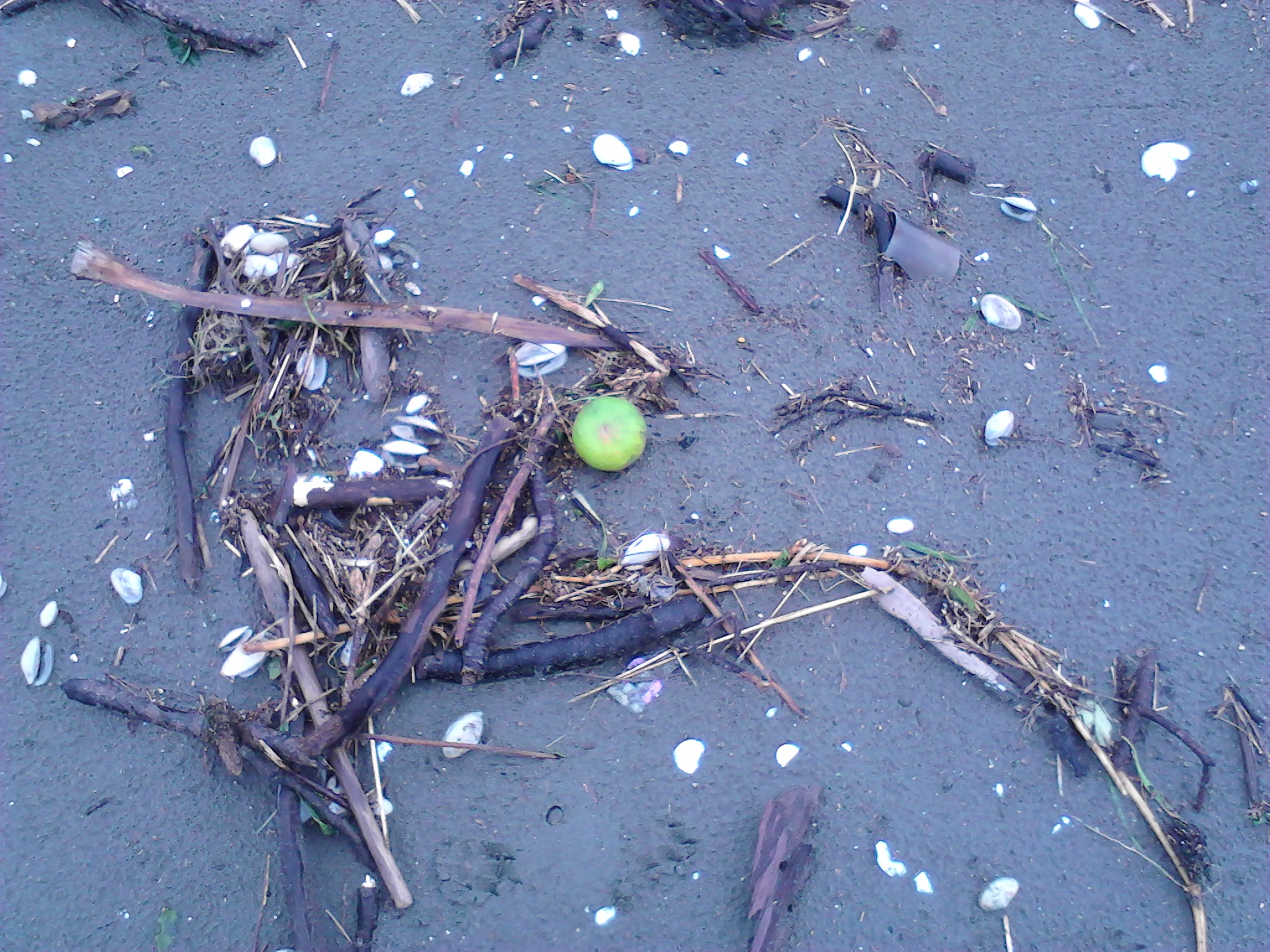
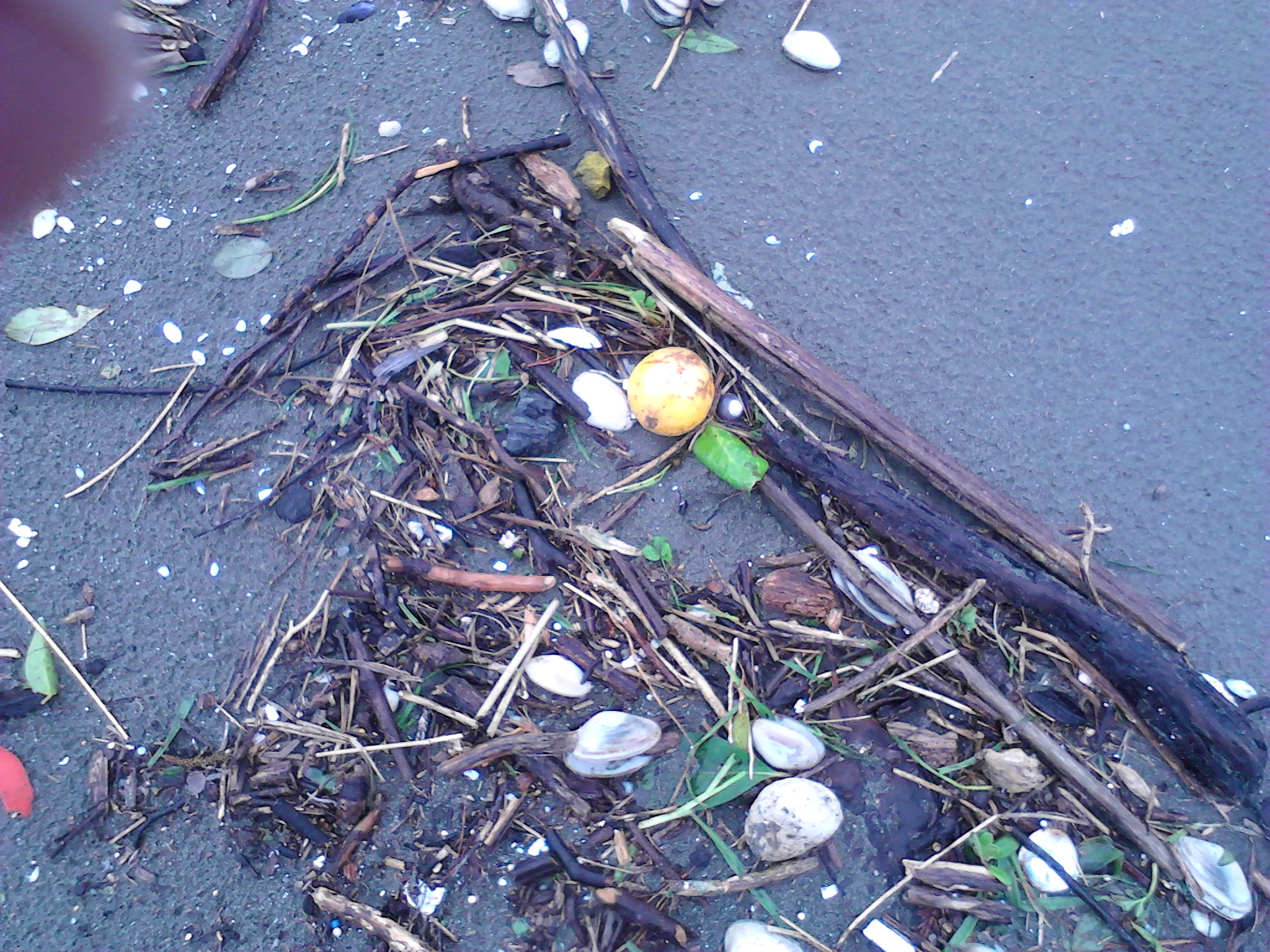
Debris with lemon
I don’t know the reasons for these groupings, but obviously some set of circumstances must have resulted in these happenings. Of more obvious provenance are the mass strandings of jellyfish at some times of the year which are no doubt related to the breeding cycle of these animals and particular wind direction. The occasional tennis balls or golf balls that I spot are easily explained too.
But…. But there are always lemons. Whenever I walk along the beach after a storm, I can almost guarantee that I will find at least one lemon. Why? I don’t tend to find apples, though apples float too. Nor, typically any other fruits. Maybe apples are softer and easily broken up?
Regardless, there are always lemons. Why are there always lemons?
The farmer fed the chicken every morning at the same. The chicken realised this and ran up to the farmer every morning to be fed. One morning the chicken ran up to the farmer who grabbed it and chopped off its head. This demonstrates the dangers of inductive reasoning. The old turkey was a little more sophisticated however. When asked by a younger turkey when Thanksgiving was, he replied that it was on the fourth Friday in November. The younger turkey was incensed to find out that it was the fourth Thursday in November. The older turkey said to him “Boy, the humans celebrate it on the Thursday, but if I wake up on Friday morning, then I give thanks”.
Induction is looking at the past in a particular way to predict the future. Specifically, induction looks at a series of events in the past to predict the future. The sun has risen like clockwork every day, whether or not you can see it, for as long as anyone can remember and for as long as we can determine from reports from the past. Will it rise tomorrow morning? I would put money on it because either it will, and I win, or it won’t and it won’t matter because we will almost certainly be dead. The argument comes down to “It has always happened in the past, so it will (or it is extremely like to) happen in the future.
Zabriskie Point at sunrise in Death Valley (Photo credit: Wikipedia)
The alternative method of reasoning is deductive reasoning. The deductive argument is that the rising of the sun is a consequence of the rotation of the earth. As the earth rotates, the sun appears to us on the earth’s surface to appear from beneath the horizon and travel across the sky. Actually, it is us who move, a good demonstration of relativity (but maybe I’ll go there another day). The argument goes stepwise from fact to fact and leads inevitably or logically to a conclusion.
Horus, ancient Egyptian God, the Sun God, depicted on papyrus (Photo credit: Wikipedia)
The trouble with this approach is that, for all its logical stepwise approach it is built on two things, a theory and a set of past observations. A scientist has a theory or decides to check a theory, so he does an experiment, and the results of his experiment support or do not support the experiment. The scientist assumes that the theory is true and bases his predictions on this. Unfortunately there is an inductive element to this – if the theory is true for the experiment, there is no guarantee that it will be true for subsequent experiments, even given that ‘ceteris paribus’ (all things remain the same). Some other unconsidered cause could affect the result. The argument is deductive, proceeding in logical steps from the theory, but the practise is inductive – the data has always supported the theory in the past, so it will continue to support the theory in the future.
New Scientist (Photo credit: Wikipedia)
To be fair to the inductivists, todays’ inductivists tend to specify the results of their arguments in terms of probabilities: the probability of the sun rising tomorrow is close to 100%, given that it has always risen in the morning for as far back as we can see, but there is a minute but finite possibility that it won’t for known or unknown reasons.
Let’s consider the case of the sun rising each day and suppose that the fact that the earth rotates is not known. To make the argument more deductive we can postulate causes and so long as the cause fits the facts, we can tentatively label the cause as a hypothesis. Suppose we conjecture that some deity causes the sun to rise each morning. This hypothesis certainly fits the facts and predicts with accuracy that the sun will continue to rise each morning. Such a hypothesis would not be accepted today, of course, except by some individuals.
Mathematical induction can be informally illustrated by reference to the sequential effect of falling dominoes. (Photo credit: Wikipedia)
Is there any great difference between the theist and the scientist? The theist says “all things happen because of God”. The scientist says “all things happen because of the laws of nature”. They both explain things on the basis of their fundamental beliefs.
It is possible that people in the future may look at our theories of the sun rising and other things and consider them naive and consider our view of everything happening according to the laws of nature to be a quaint misunderstanding, in much the same way as many people would consider the “deity hypothesis” to be today.
cubed earth theory (Photo credit: Joelstuff V4)
In mathematics the situation is different. Induction is a much more formal process and is applied on top of an axiomatic system. Proved theorems are the results of the applying the axioms repeatedly to another proved theorem or the axioms themselves. Unproven assertions can be proved and turned into theorems or disproved and discarded (or possibly modified so that they can be proved). If something is proved in an axiomatic system, it is true for all time, and cannot be disproved in that system.
Specifically an inductive proof would go something like this: firstly the theorem would be proved for a generic case (eg if statement N is true, then statement N + 1 is true) and secondly it is proved for a specific case (eg statement 1 is true). Then all applicable statements are true because, if statement 1 is true, the generic case means that statement 2 is true, and so on for all cases. Because of the rigor of the argument and the undeniable conclusion of the argument, mathematical inductive proofs are of the same order of reliability as deductive proofs, that is, they are only wrong if there is an error in the logic.
English: Mathematical induction as domino effect, with text in Esperanto Esperanto: Matematika indukto kiel domen-efiko, kun teksto en Esperanto (Photo credit: Wikipedia)
Why the difference between scientific induction and mathematical induction? Well, I think that it is related to the fact that mathematics is axiomatic and therefore certain, whereas scientific induction is based on the laws of nature which are not and never will be, in my opinion, completely defined. If the basis of your argument is not certain, how can your conclusion be certain?
If you want to count sheep, count the legs and divide by four. This piece of faux folk-wisdom has, as is usual in such cases, a grain of truth. The human eye finds it easier to distinguish elongated objects if the axes of the object are separated and perpendicular (or so I believe). It is easier to count the candles mounted on a cake than the same candles arranged in a line. This – | | | | | | | – is easier to count than this – _ _ _ _ _ _ _ , I feel. (I’ve used Google to see if I can find evidence and came across this, which seems to align with what I am saying, though I’ve not accessed the paper).
Ankole cattle
If I am correct it is easier to, say, count the horns on a herd of cattle and divide by two than count their backs. It occurs to me that an optical-electrical counting device might have issues in this regard too, since a leg might stand out from the background, and produce a short pulse in the sensor, but a whole cow might take a while and its colours would blend into the next cow. Of course, one could always use higher technology to resolve the issue with respect to cow counting, (RFIDs in ear tags would be an obvious solution), but it doesn’t solve the wider issue.
Maybe the reason that the counting device and the eye/brain find it easier to distinguish objects orientated (roughly) perpendicular to their (roughly) linear arrangement is similar. If they are (roughly) aligned in the same direction as their linear arrangement they may, possibly, overlap, and this can confuse sensor and/or eye. Was that one, two, or three objects that passed the sensor? It’s easy if they are perpendicular, but harder if they are aligned.
I’m pretty much reduced to saying the same thing in different words, but I hope that what I am trying to get at is clear. It may or may not be relevant that humans and higher primates tend to stand more or less vertically, so one individual is more easily distinguished from others than an individual cow is from the herd.
A self-imposed deadline is, I think, the worst sort. I set my phone to alert me once a week to blog something. And it just went off. I have no definite plan so this is going to be off the top of my head. Call it “philosophy” or call it “miscellaneous”. I don’t care!
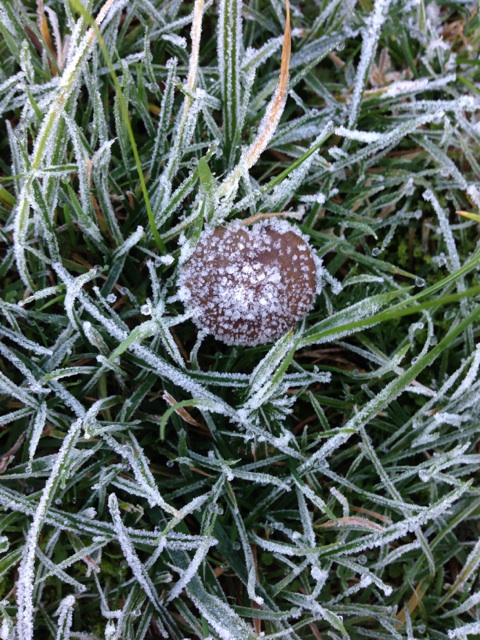
An interesting fungus
Today my daughter texted me a picture of a smallish fungus. (Aside – the spell checker doesn’t recognise “texted”. The spell checker needs to be updated!) Apparently my grand-daughter, who knows of my interest in fungi, thought that Grandad might like this “interesting fungus”. Who knows, because of me she might grow up to be a famous mycologist, the one who saves the human race from the mutant spores. Hmm!
Which made me wonder about the effect we have on our descendants. Obviously there are two ways we can do that -the genetic and the environmental. Our genes may predispose our offspring to certain tendencies and our personal influences plus the environments (in the widest sense) in which we live effect the way that we and our children behave.
Genes
Of course I don’t know where Loulou will head in life, but I do recognise some traits in her which I see in myself, but I can’t tell whether or not these are inherited traits or learned ones. Computers are no mystery to her, and she knows that it is possible to take a photo (on a phone) and send it to Grandad. She knows how to unlock the iPad and has no fear of the Android tablet. She and I have a liking for a particular on-line game.
Loulou’s Dad works with computers. She has two older brothers who are computer literate. Her mother grew up with Commodore 64s and computer games loaded from tape. Loulou’s mother’s Dad (me!) worked in computers from before Loulou’s mum was born, but I don’t think I bought the job home, though we did get a Vic 20 and later a Commodore 64.
Vic 20
But Loulou is not a geek. When we went on a walk Loulou decided that tights, t-shirt, a tutu, and gumboots were the appropriate wear. (I think that, stylistically, it worked). She’s a fan of Dora the Explorer but is not a fanatic. Maybe she will grow into that. However, her Mum and Auntie weren’t particularly doll orientated.
Hmm, this article seems to be all about Loulou. It’s too early to tell, but I won’t be disappointed if she goes down the geeky route. I’d be interested in how she gets on in that world. I won’t be disappointed if she *doesn’t* either. Either way she’s the most wonderful granddaughter.
On 21st June we in the Southern Hemisphere get our shortest day of the year. This corresponds to the longest day in the Northern Hemisphere of course, and my wall calendar, which originates from the Northern half of the planet says that 21st June is the start of summer. I believe that the official start of winter, here in New Zealand, is 1st June.
That started me thinking. One would expect that 21st June, the southern winter solstice, would be the middle on winter, since the earth is tilted furthest away from the sun in southern latitudes at that date, and that the seasons would change mid way between the solstices and the equinoxes in both hemispheres for similar reasons. The equinoxes are the days when the night and days are the same length in both the northern and southern hemispheres. (Pedants will notice that I’m not being precisely correct in my explanations of equinoxes and solstices, but that doesn’t matter for my purposes.)
Equinoxes
It is obvious to anyone who has reached a sufficient age that the warmest and coldest parts of the year don’t correspond to the solstices and that the change from higher than average temperatures to lower than average temperatures and vice versa don’t happen at the equinoxes, though these latter events are probably not that noticeable. There is obviously some seasonal lag.
So I browsed to Wikipedia, which is a useful place to start, even if some people question its accuracy and veracity. I’ve not found it too bad, myself. Sure enough, there is an article on seasonal lag, and I’ve no reason to doubt the information there. To summarise, the authors of the article attribute the lag to the oceans which, because of the latent heat of their water absorb heat energy and release energy as the seasons change. I’m not sure that I completely understand the reasons for this, but there are undoubtedly deeper analyses on the Internet. The Wikipedia article contains one reference.
Apparently the seasonal lag is different in each half of the year. I believe that means that the four seasons are not all equal in length. Hmm, summer does seem shorter than the other seasons, but that may be only subjective. However, our shortest day is only four weeks away, so we will at least be seeing more daylight each day from then on. We will be on the upwards slide to Spring and Summer, even though Winter will not have bottomed out, and we can look forward to barbecues and a summertime Christmas!
Pohutakawa flowers. They bloom at Christmas, in early summer.
I can understand the Pope, who is old, sick, and reportedly tired of the job, resigning. I can see that it has come as a surprise to many people. What I can’t understand is the reactions that people have to the announcement. It isn’t unprecedented, as Popes have resigned before.
Pope Benedict XVI
However, some people believe that the Pope is elected for life and that resigning as Benedict XVI has done is close to sacrilege. I believe that the thinking goes something like this: God has chosen a particular man to be Pope. For that man to relinquish the post is for that man to, by his actions, imply that God is mistaken, and that cannot be.
If there is a God, and I’m firmly in the other camp, then He, being omnipotent and omniscient, not to mention omni-temporal, must know that His chosen candidate will resign the post, and has arranged matters so that this happens. In other words the resignation was ordained. It seems that one cannot get away from predestination! (The above description of God ‘knowing’ and ‘arranging’ is of course anthropomorphic).
Someone similar in appearance from the back to the Pope contemplates the works of God or nature.
Put into a religious context, the debate over predestination versus free will comes down to the following:
If God is all-seeing and all powerful then He has control over everything and nothing happens which He hasn’t caused to happen. If there were something that He hadn’t caused to happen, then that would have to (de facto) be caused externally to God. God and whatever outside of God that caused the event would have to exist in much the same sense and such an existence would have to have a frame of existence, a ‘container’ if you like, that contains both God and the other thing. However, I started out by crediting God as being all-seeing and all powerful and that doesn’t seem to leave room for things outside of God as that implies something greater than God. So given the concept of an all powerful God there can be nothing that He hasn’t caused to happen and which he does not know about.
OK, so if God causes everything, then he causes every event to happen. He (ultimately) causes us to make the particular decisions that we make. So the concept of free will evaporates, as God causes us pick the options that we do, even if we think that we make a choice.
God, the Father watches us all everywhere.
Of course God may be a compatibilist – He may believe that if he presents us with a number of options, we have the free will to select an option, even though the selection is in fact predetermined by Him.
Thomas Hobbes was a classical compatibilist
Of course, shorn of the religious tones, the above argument still applies, if, for example, you replace the references to God with references to ‘Nature’ or ‘the natural laws’.
Any blog needs a theme. Well, this one has at least three.
Firstly, I’ve long wanted to gather my thoughts on philosophical topics in one place, so there should be some philosophy in there. I must admit that my philosophical thoughts are a bit of a mish-mash, but in writing them down, maybe I will be able to rationalise them a bit!
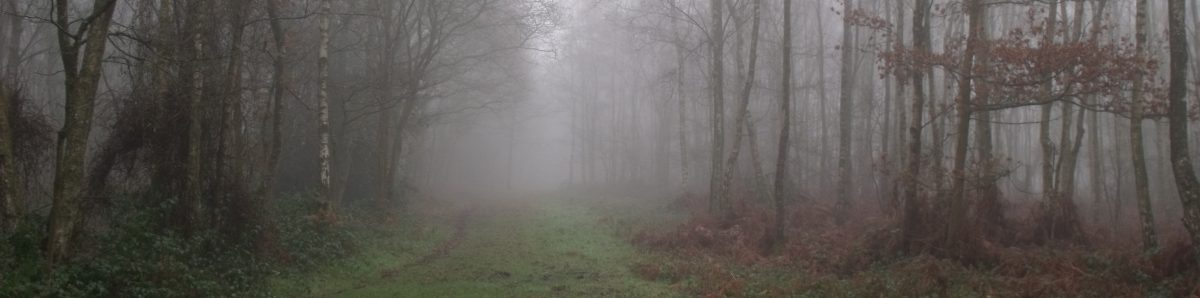
Secondly, I want to throw up some of my photographs, both of my family and of other things. Here’s a photo I took on my last visit to England for my father’s 90th birthday.
Surrey woods near Walton on the Hill
Thirdly, I want to blog my notes on my cooking exploits. Currently these comprise mostly baking breads. This is the latest loaf, a white bread one, made in a Breville “Baker’s Oven”.








 Me on the net