Death of print

English: A stack of copy paper.
English: A stack of copy paper. (Photo credit: Wikipedia)

It’s amazing how the world has changed in a lifetime. My lifetime. Phones, TV, the Internet, electronic funds transfers, payment by waving a plastic card.

My parents were paid by their employers in cash and they paid for everything in cash. Most people didn’t have cars and relied on public transport and paid in cash for their tickets. Today cash is endangered.

Money Cards
Money Cards (Photo credit: jacqui.brown33)

A little later, people started to acquire bank accounts, usually in conjunction with a mortgage. Their pay was paid into their bank accounts and the mortgage payments were extracted from the bank account directly. The thing was, the bank account came a lot of paperwork. There were statements and cheque books. To whip out a cheque book and offer to pay for something was a real show of status. Today cheques are almost unused, being almost completely replaced by credit cards, debit cards and charge cards. Some younger people have never seen a cheque and most shops will not accept one. Many banks will supply statements over the Internet these days.

English: 1912 US cartoon by Rollin Kirby, show...
English: 1912 US cartoon by Rollin Kirby, showing George Walbridge Perkins (with a check book symbolizing control of money) and Amos Pinchot (weilding a letter of support from Theodore Roosevelt campaing manager Senator Joseph M. Dixon) battling for control of the U.S. Progressive Party. Figure in the distance presumbably represents Roosevelt coming with his “big stick” to settle things. (Photo credit: Wikipedia)

Most people got their news through newspapers. Paper newspapers, from the rarefied air of the Times to the slightly more foetid air of the tabloids. The network of distribution of news via started from the printing presses and initially was distributed by vans, trains, and more vans. Bundles of papers were dropped off at strategic points, and newsagents picked them up, sorted them and gave them to young boys and girls to distribute, dropping them into letter boxes, countrywide.

Galveston, Texas, 1943. Newspaper delivery boy...
Galveston, Texas, 1943. Newspaper delivery boys with bicycles. (Photo credit: Wikipedia)

A similar distribution network was used for the evening papers. These however were distributed mostly to the streets around business places and railway stations and similar places where people would pick them up on their way home from work. The main headlines would be prominently displayed as teasers to persuade people to buy them.

Checking the headlines
Checking the headlines (Photo credit: gato-gato-gato)

Newsagents existed to distribute the paper that the news was printed on. As a sideline, they would sell other things, like magazines, tobacco, and confectionery. As newsprint volumes have fallen, the old time newsagents had to specialise in something else, like the confectionery that they used to sell as a sideline, or in some cases groceries, particularly the staples such as canned foods and milk. Some might sell books or glossy magazines, but even these versions of print material are under threat.

dakar newsagent
dakar newsagent (Photo credit: noodlepie)

My letter box is still full of paper. Much of it is the ubiquitous junk mail, of course, the flyers and offers which advertisers hope will entice us into buying. It appears that the expense of creating and sending junk mail is still worthwhile, or so the advertisers believe. Some of the paper is comprised of what can loosely be called “community newspapers”. These papers, largely funded by advertising, and run on the cheap, are distributed free, and contain local news only, mainly sports and local politics.

“Letter boxes” in the UK are slots in the front door of a house, not actual boxes on poles as in many other countries.)

English: Letter Box Detail of an old front doo...
English: Letter Box Detail of an old front door which now graces a small shed. (Photo credit: Wikipedia)

What my letter box rarely contains is an actual letter, written by someone, stamped and posted by someone, sorted and delivered to my letter box by a real postman. There are a few firms that still insist on paper invoices and local tradesmen tend to still prefer papers invoices but apart from that and a few real letters from older relatives, I receive little real mail these days. No wonder that postal services world-wide are having issues.

Typical advertising mail
Typical advertising mail (Photo credit: Wikipedia)

It is easy to see the reason for the decline of the print industries world-wide. In a word, the Internet. When it is simple and cheap to sit at a computer and type an email, or finger tap a  message into a tablet or phone, and have a response in minutes, why would anyone manually write a letter, find an envelope, find or purchase a stamp, and find a post box to drop the letter in? Although the vast majority of letters get through safely, there are exceptions, while email is almost certainly going to be delivered and you will get a message if your email doesn’t go through.

Email email email
Email email email (Photo credit: RambergMediaImages)

Similarly in banking. Once every transaction had a paper trail. All transfers and payments were neatly written in books, all ledgers were balanced by hand and banks shifted huge numbers of notes, cheques, coins and other forms of paper money. These days I rarely carry cash, and I haven’t seen or used a cheque in years.

I do all my banking on the Internet, using my computer or phone. I pay for things, even small things like a cup of coffee (actually I drink tea), with a debit card, with a credit card as backup for emergencies. Gas stations, grocery stores, tradesmen, and every other kind of store takes the plastic.

Swipes, Bytes, and Debit Cards
Swipes, Bytes, and Debit Cards (Photo credit: SimpleIllustrations)

More and more our transactions with government departments, like car licensing or tax matters, are conducted online. Even if you have to go in to a government agency for some matter or other, they will scan your documents rather than copy them. If you fill in a paper form, they will transfer the data to their computer systems while you wait.

Picture Scanner
Picture Scanner (Photo credit: Wikipedia)

In all fields, except possibly the field of junk mail, paper is being used less and less. Even magazines are headed online, with smartphone apps for New Scientist magazine allowing you to read it anywhere that you may be. An added advantage of on-line magazines is that the electronic copy is, in general, cheaper than the paper version.

HTC Aria android 2.2 smart phone review www.li...
HTC Aria android 2.2 smart phone review http://www.liewcf.com/review-htc-aria-android-2-2-6878/ (Photo credit: Wikipedia)

I have forgotten, until now, that I was going to mention books. Books are nice objects to hold, and they make a nice addition to one’s decor. I enjoy reading a book and have several shelves full. Maybe 200 books? But on my electronic devices I have maybe 10 times that number. OK, most are old classics, which are out of copyright, but a number I have bought specifically to read on-line. An on-line reader keeps your place, let’s you bookmark passages and allows you to quickly search for something that you read somewhere in your on-line collection.

books
books (Photo credit: brody4)

Books are not yet redundant, but they are slowly heading on-line. While it may not be soon, and while not every book will disappear on-line, printed books may become rare and expensive.

Print is dying everywhere and the amazing thing is that it has happened in a short period of time. The spread of computers first caused volumes of paper generated to increase, but the Internet and the way that it has allowed sharing of documents, plus the smaller and faster computers and hugely capacious hard drives, culminating is the ubiquitous smart phones has saved millions of trees from destruction.

Tree in Fog
Tree in Fog (Photo credit: Photomatt28)


Enhanced by Zemanta

Inequality and equality

Triangle_inequality
Triangle_inequality (Photo credit: Wikipedia)

Usually, but not always, I have an idea in the back of my mind of the structure of a post before I write it. Well, I have an idea of a few key concepts and how they will fit together. Sometimes it goes much like my skeleton idea and sometimes it turns out completely different. However, today, I have no structure in mind.

Inequality. It’s an interesting concept. The things that are being compared can be practically anything, but have to be of the same sort, hence the saying “you can’t compare apples with oranges”. Like all adages, this saying has more depth than appears at first glance. Of course you can compare apples with oranges if, for example, you are comparing their Vitamin C content or their fibre content. What the saying conveys is that it is incorrect to mix categories when the attribute being comparing is obviously not found in one of the categories, or the attribute is expressed differently in the two categories.

Apples & Oranges - They Don't Compare
Apples & Oranges – They Don’t Compare (Photo credit: TheBusyBrain)

For example, it would be wrong in most cases to compare the tastes of apples and oranges since the tastes of apples and oranges are significantly different. Or one might compare the performance of a truck and sedan car, and someone might object that any comparison is like comparing apples and oranges – while both are vehicles, but they are by nature significantly different.

Apples and Oranges
Apples and Oranges (Photo credit: Automania)

An inequality yields a true or false verdict. In logic and mathematics this is often called a Boolean value after mathematician and philosopher George Boole. In computer languages a Boolean value is usually, but not invariably, given a value of 1 for true and 0 for false.

George Boole, mathematician, 1858-1908
George Boole, mathematician, 1858-1908 (Photo credit: Wikipedia)

When children learn arithmetic and mathematics the emphasis is usually on equality rather than inequality. They learn that 1 + 1 = 2 and often don’t get taught such formulations as 1 + 1 < 6. When learning algebra they may be taught that y = x² is the equation of a parabola, but they may only learn in passing that y > x² represents all the points in the plane inside the parabola, and that y ≥ x² also includes the points on the parabola.

This is a graph of an inequality.
This is a graph of an inequality. (Photo credit: Wikipedia)

Computer programmers are usually deft at dealing with inequalities. When programming a payroll for example, the programmer may be required to calculate the tax that an employee may have to pay. Say the first $10,000 is taxed at 5%, and anything between $10,000 and $50,000 is taxed at 7%, and anything over $50,000 is taxed at 10%.

Tax
Tax (Photo credit: 401(K) 2013)

The programmer has to check if the salary is less than or equal to $15,000 (≤) and if it is he or she taxes the pay at 5%. If the pay is greater than (>) $10,000 and less than or equal to (≤) $50,000 he or she subtracts $15,000 from the salary and calculates 7% of that. He or she then calculates 5% of $15,000 and adds the two numbers to make up the tax for that employee. And so on, for the CEO who obviously exceeds the $50,000 threshold.

"Pay Day! Pay Day!"
“Pay Day! Pay Day!” (Photo credit: JD Hancock)

The simple statement – “Is the pay ≤ $15,000?” hides a complexity that is not obvious. It can be rewritten as – “Is it true that the pay ≤ $15,000?”. Such a statement has a value of “true” or “false”. The sub-statement “the pay ≤ $15,000” has a value of “true” or “false “. If the pay is $9,000 then the sub-statement  has the value “true”. Putting that back in the original statement yields “Is it true that true”. A little ungrammatical maybe, but it can seen that the whole statement is in this case true. This sort of complexity can trip up the unwary.

True/False Film Festival
True/False Film Festival (Photo credit: Wikipedia)

Logicians and mathematicians aren’t content with simple “true” and “false”. They have contemplated a third value, neither true nor false. Some versions call it “unknown” but it could be called “fred” or something. It doesn’t make any difference. Of course, mathematicians would not be satisfied with that, so they have derived “many-valued” logic systems.

It’s probably worth mentioning that some computer language allow for a “null” value, which is essentially the value you have when you haven’t set a value. Using the old pigeon hole analogy, if a pigeon hole is called “A”, then when the pigeon hole is empty, its value is “null”. When it contains, say, the integer 3, it’s value can be said to be “the integer 3”, so the statement “A contains a value greater than 1?” can be “true”, “false” or “null” so multi-valued logics can be more than an intellectual exercise.

Graphic for "the present king of France&q...
Graphic for “the present king of France”, a philosophical quasi-paradox from Bertrand Russell’s work on “definite descriptions” (is the statement “The present King of France is bald” true or false if France is a republic?). (Photo credit: Wikipedia)

Another form of inequality relates to societal inequality. There are very poor people and astronomically rich people. Of course people will never be universally equal, but a society that doesn’t recognise the extreme inequalities will not be a good society by most people. We don’t have a working philosophy which can address this inequalities. We have Marxism economics which favours the workers, and the Smithian lassez-faire economics which favours market forces, and Keynesian which has supply and demand economics.

English: The invisible hand of the market. Fra...
English: The invisible hand of the market. Français : La main invisible du marché. (Photo credit: Wikipedia)

None of these philosophies (and there are many others to choose from) really deal with the gap between the rich and the poor. Marxists would destroy society to rebuild it, but there is no guarantee that it will be better, and a very large chance that society would easily recover from such a cataclysm. Smithian economics would not admit to there being a problem. Keynesian economics at least considers unemployment but doesn’t directly address poverty.

English: Differences in national income equali...
English: Differences in national income equality around the world as measured by the national Gini coefficient. The Gini coefficient is a number between 0 and 1, where 0 corresponds with perfect equality (where everyone has the same income) and 1 corresponds with perfect inequality (where one person has all the income, and everyone else has zero income). (Photo credit: Wikipedia)

There does not appear to be a working economic model that deals with poverty as such. Distributing public funds through the dole doesn’t result in a decrease in poverty and merely reduces the self-esteem of the poor. Likewise, reducing support through reduced “benefits” doesn’t drive the poor into employment and doesn’t reduce poverty by providing an incentive to the poor. This is largely because the few jobs available to the unskilled don’t provide a route out of poverty as they are not well paid.

English: Arkwright - Colliery wages office Sho...
English: Arkwright – Colliery wages office Shortly after the pit closed in 1988. (Photo credit: Wikipedia)

There is no doubt that poverty is relative. The poor in the developed countries are well off as compared to the poor in developing countries, but that’s not really a justification for the vast inequality that is seen between the very rich and the very poor, in any country.

Strike Solidarity
Strike Solidarity (Photo credit: Light Brigading)
Enhanced by Zemanta

The process of Philosophy

Philosophy & Poetry
Philosophy & Poetry (Photo credit: Lawrence OP)

Philosophy is a strange pastime. Scientists measure and weigh. Mathematicians wrangle axioms and logical steps. All other disciplines draw on these two fields, which are probably linked at deep level, but philosophy draws from nothing except thoughts and the philosopher’s view of the Universe.


Mathematics
Mathematics (Photo credit: Wikipedia)

Well, that’s not completely accurate because philosophy has to be about something and the only something we have is the universe. But philosophy does not have to be about the universe as we know it. What if there was no such thing as electrical charge, or, the prudent philosopher thinks, what if there was no such thing as the thing we call electrical charge. At a more basic level, what is electrical charge.

Lichtenberg
Lichtenberg (Photo credit: caddymob)


Philosophers are always getting pushed back by scientists as scientists figure what they think is the case. If there is a scientific consensus on what comprises an electric charge then that question no longer interest philosophers to any great extent. Philosophers mentally travel through the lands marked “Here be dragons”.


Dragon from PSF D-270006.png
Dragon from PSF D-270006.png (Photo credit: Wikipedia)

Philosophy is also interested in less “physical” things like ethics and morals, what comprises identity, predestination or free will, what can we know and what knowing is all about. How did the Universe come to exist, or more basically, why is there something rather than nothing?


If you look at this list it comprises extensions to or extrapolations from physics, psychology, physiology, medicine, biology, and other fields of science. Philosophy doesn’t use mathematics (usually), but it uses logical argument or should. It not (usually) built on axioms, so doesn’t have the rigid formality of mathematics.

Illustration of Plato's Allegory of the cave.
Illustration of Plato’s Allegory of the cave. (Photo credit: Wikipedia)

Philosophers are big users of metaphor, such as Plato’s “Allegory of the Cave”. A metaphor of the expansion of a balloon was used as a philosophical explanation of the expansion of the Universe discovered by Edwin Hubble. Philosophers also imagine physical machines which do not yet exist and which may never exist, such as the ‘teleporter’ which makes a material object at point A disappear and reappear at point B.

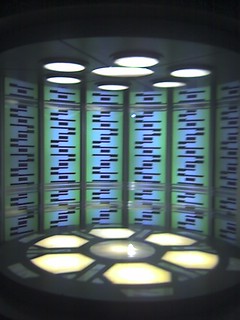
Star Trek - Enterprise D Transporter
Star Trek – Enterprise D Transporter (Photo credit: tkksummers)

Quantum physicists have teleported quantum information from one point to another, but this is not the same as teleporting atoms. So far as I can gather from the Wikipedia article, what is teleported is information about the state of an atom, so the same atoms must already be at point B before the teleportation event, and the event is a sort of imprinting on the target atoms. It sounds like the atoms at point A remain in situ, so it is more of a tele-duplication process really. However I don’t really understand the Wikipedia article so I may be wrong.

Diagram for quantum teleportation of a photon
Diagram for quantum teleportation of a photon (Photo credit: Wikipedia)

The philosopher is not interested in the quantum nuts and bolts though. He or she would be interested in the process – is a person walks in to the teleporter at point A the same person as the person who walks out of the transporter at point B? Unless his actual atoms are transported by the process, which seems an unlikely implementation, the person at point A shares nothing with the person at point B except a configuration of a second set of atoms. Is the person at point A destroyed by the machine and recreated at point B? What if something goes wrong and the person at point A does not disappear when the button is pressed? Then we have two instances of the person. Which is the real instance?

Unknown Person
Unknown Person (Photo credit: Wikipedia)

Notice that the philosopher takes a physical situation of travel from point A to point B and considers a special case, that of travelling between the two point without travelling the old slow way of travelling between all the intervening points and doing it quickly. There is no physics which can currently perform this task, but as usual, scientists are working to, one might say, fill in the gaps.

The Sci-Fi Fly!
The Sci-Fi Fly! (Photo credit: Carolyn Lehrke)

Many times the scientist is also a philosopher – he may have at the back of his mind the concept of teleportation when he creates his hypotheses and does his experiments, but he probably doesn’t concern himself with identity. That is still the realm of the philosopher at present, but if a teleportation device were ever created, it would stop being a philosophical matter, and become a matter of law and psychology and maybe some field that does not exist yet, just as the field of psychology did not exist at one time.

General Psychology
General Psychology (Photo credit: Psychology Pictures)

I’m trying to paint a picture of the area that a philosopher is interested in. If the whole of human knowledge is a planet, then physics and maths are part of the outer most layers of the atmosphere, the exosphere, and this merges with the depths of space are the domain of philosophy. At lower levels are things like chemistry, biology, psychology and other more applied sciences. Don’t look too closely at this analogy because I can see two or three things wrong with it, and I’m not even trying.

English: View of the crescent moon through the...
English: View of the crescent moon through the top of the earth’s atmosphere. Photographed above 21.5°N, 113.3°E. by International Space Station crew Expedition 13 over the South China Sea, just south of Macau (NASA image ID: ISS013-E-54329). Français : Photo des couches hautes de l’atmosphère terrestre. Polski: Zdjęcie górnych warstw atmosfery ziemskiej z widocznym przejściem w przestrzeń kosmiczną. Ελληνικά: Η Γήινη ατμόσφαιρα, η φωτογραφία ελήφθη από το διάστημα κι ύψος 335 χιλιόμετρα (Photo credit: Wikipedia)

But the main point I am making is that philosophy purposefully pokes and prods the areas beyond the domain of current mathematics and physics. Of course the line is not a definite line and there is a grey area. Some physical hypotheses verge into philosophy and some philosophical ideas are one step from becoming physical hypotheses. The suggestion that there be many universe like and unlike ours is one such suggestion that physicists are taking seriously these days.

2-step branching in many-worlds theory
2-step branching in many-worlds theory (Photo credit: Wikipedia)

Many of these ideas are not new and many have been used in what has been called “science fiction” for many years, especially the parallel universe theory. Time travel is another common science fiction theme. Although these ideas are used and developed by authors of fiction, physicists have adopted such ideas to advance science, though I don’t mean to suggest that scientists have directly borrowed the ideas of science fiction authors. It is probable that many ideas actually travelled in the opposite direction, from science to fiction.

English: Minkowski diagram of the twin paradox.
English: Minkowski diagram of the twin paradox. (Photo credit: Wikipedia)

Since philosophy is at heart discursive and not rigidly analytical (in most cases), there is more freedom to expand on ideas that are not what is called “mainstream”. Because of this freedom it is likely that (like economists) no two philosophers will agree on anything, but they will have fun arguing about it.


The Argument Sketch
The Argument Sketch (Photo credit: Wikipedia)


Related articles


Enhanced by Zemanta

Photographic Honesty

Category:Wikipedia requested photographs of ph...
Category:Wikipedia requested photographs of photography (Photo credit: Wikipedia)

I’m going to do something that I’ve never done before, something a little risky. I’m going to write a piece about an article on someone else’s website, a piece which resonated with me. Of course, I may have totally missed the point of the other person’s article. I hope not, and I can only apologise in advance for any misconceptions that I have about the article.

Please note that the pictures in this article are mere decorations and do not and not intended to relate to Tony Bridge and his art. Think of them as free association based on the words that I type.

English: Photography forbidden. A nightmare......
English: Photography forbidden. A nightmare… Français : Un cauchemar… Deutsch: Fotografieren verboten. Ein Albtraum… (Photo credit: Wikipedia)

The writer of the piece is Tony Bridge (http://www.thistonybridge.com) and the piece is entitled “On honesty in photography“.

Firstly I urge you to visit Tony Bridge’s site and view the many amazing and attention grabbing photographs that Tony has assembled on his site. I am in awe of his skill, his technique, and particularly of his professional photographer’s eye. (Please remember that none of these images are his. I would not presume…)

English: A photographer between waves and mussels
English: A photographer between waves and mussels (Photo credit: Wikipedia)

I’m no photographer. I take photographs, I try to ensure that the photographs are interesting, I try to “compose” them a little, I try to pay attention to the lighting of the subject versus the background and things like that, but these days I rarely stray from the automatic settings on my camera, which is a cheap FujiFilm one.

As for post-production, the removal of perceived mistakes in composition and specks of dust, changing hues and saturation and so on, well, I rarely do more than remove red-eye and shift the contrast. Tony’s article talks about a possible perceived over emphasis on the post-production of some modern photography. It is the main topic of Tony’s article.

Photoshop-work
Photoshop-work (Photo credit: Kjell Eson)

With tools like Photoshop anything in or about a picture can be manipulated, from simple removal of flaws to major changes to the image. Indeed there are numerous  photo manipulation “fails” to be found on the Internet, ranging from failed enhancements of “beauty” shots, to badly photoshopped propaganda photographs from the likes of North Korea.

Follow Me, Ladies
Follow Me, Ladies (Photo credit: Dοn)

Is this new? I think not. Apparently Henry VIII of England was deceived by a painted likeness of Anne of Cleves, complaining that “She is nothing so fair as she hath been reported.” To be sure this is not post production alteration of the image, but it is similar in kind. Henry could, probably justifiably, have called for more honesty in image production.

Painting of Anne of Cleves, fourth wife of the...
Painting of Anne of Cleves, fourth wife of the English King Henry VIII, by Hans Holbein the Younger (Photo credit: Wikipedia)

Of course there were movements in portraiture and other painting for more honesty in portrayal. Oliver Cromwell, is alleged to have required that his portrait be painted “warts and all”. However most painting tended to emphasise some aspects of the subject over others, the epitome being the painting of “The Monarch of the Glen” by Landseer, an over idealised painting of a stag. Nevertheless, a great painting.

sir Edwin Landseer, The Monarch of the Glen (1...
sir Edwin Landseer, The Monarch of the Glen (1851) in the Museum of Scotland. (Photo credit: Wikipedia)

Some painters realised the way that images were being enhanced and moved in another direction away from realism, leading to such schools of painting as impressionism, cubism, surrealism,  pop art, to name only a few. Again the paintings were, are amazing. I draw a parallel between non-realistic art with highly post-processed photography.

Photography, springing up in the early 20th century in the shadow of painting, at first had few tools to do other than report what the lens had seen. Photographers were still learning about the new medium, but soon techniques started to arise, such as vignetting (softening the corners of an image) to alter the image.

Untitled
Untitled (Photo credit: Smithsonian Institution)

But the tools soon arrived. The standard model of camera has the image plane perpendicular to the lens axis with the lens axis at or near to the centre of the image plane. Later cameras allowed the lens to be shifted and twisted to allow various effects, such as better images of tall buildings and so on. No doubt the photographers of the time might argue for a more honest approach, though I’m pushing the analogy to breaking point.

In the darkroom similar effects could be performed by manipulating the chemical baths and the enlarger used for the printing process. Many of the image manipulation processes are over 100 years old according to Wikipedia. It was probably the advert of colour films and processing that severely reduced the amateur use of darkroom processes in photography, because of the extra complexity of processes. That’s a pity, as nothing beats the feeling you get when an image appears from nothing on a white piece of paper.

Student developing a map image. Photograph tak...
Student developing a map image. Photograph taken during the making of a BBC documentary. IMAGELIBRARY/166 Persistent URL: archives.lse.ac.uk/dserve.exe?dsqServer=lib-4.lse.ac.uk&a… (Photo credit: Wikipedia)

The digital revolution has put the power back in the hands of the amateur again. Anyone with a phone can take a photograph, process it through Instagram and the result has been …. a cascade of rubbish!

Against this unprecedented tide of rubbish, real photographers, amateur and professional struggle to promote their art. So is real photography the poorly lit, over exposed, blurry, shaky, hand-held phone stuff, or the highly processed, sharp as a tack, rigidly tripod mounted, Canon/Nikon/Hasselblad shot stuff, or the story board, lightly processed, possibly hand held stuff?

English: Hasselblad 503 CW with Zeiss F-Distag...
English: Hasselblad 503 CW with Zeiss F-Distagon 3,5/30 and digital back Ixpress V96C (16 megapixel sensor). Français : Appareil moyen format Hasselblad 503 CW avec optique Zeiss Distagon 3,5/30 et dos numérique Ixpress V96C (Résolution 16 MP). Nederlands: Middenformaatcamera Hasselblad 503 CW met Zeiss F-Distagon 3,5/30 en digitale achterwand Ixpress V96C (16 megapixel). (Photo credit: Wikipedia)

In my opinion, it is an invalid question. Consider the famous “Monsoon Girl” photograph by Brian Brake. This is an awesome photograph and I don’t see why it should denigrated because it was a set up. Is it honest? It is honest to the story it told. It expresses perfectly the promise that the monsoon brings of growing things and plenty in the future. However it wasn’t a real photograph of a real girl in real monsoon rain.

Monsoon Girl
Monsoon Girl (Photo credit: colonos)

Similarly with the awesome images that can be created by Photoshop and other tools. One of my favourite site for images is the NASA site. Wonderful images! However many of them are “false colour” images, of the sun and other objects. It’s not Photoshop, (so far as I know) but it is highly manipulated images. Are they “honest”? In one sense they are in another they are not. Are they amazing photographs? Yes, of course.

English: Landsat 7 false colour image of the N...
English: Landsat 7 false colour image of the Nile Delta (Photo credit: Wikipedia)

If I had a photo good enough to be used in a magazine or book or whatever, would I do whatever I could to make it as defect free as possible? Yes, I would and I would not consider that dishonest.

Tony Bridge questions whether or not we need the latest cameras, a longer lens, the next highest resolution or the next update of photo manipulation software. Of course we don’t. But if they help us get our message across, then they are useful. They are pretty nice toys, too! A long lens is great. An extremely long lens may enable things to be photographed that can’t otherwise be photographed, but only the photographer’s eye can make the picture shine.

Schematic of a catadioptric (mirror-lens) tele...
Schematic of a catadioptric (mirror-lens) telephoto camera lens (Photo credit: Wikipedia)

I recall that I posted an image on Facebook of a stick insect shedding its skin. This event occurred practically right in front of my nose, just outside my front door. I really couldn’t have missed it. Brian Harmer, a photographer and blogger friend of mine congratulated me on my photo, and when I said that I couldn’t have missed it, he wisely said “Most of the genius in any image is what you point it at when you shoot. Your eye saw the image. the (camera) merely recorded it”.

Stick insect shedding skin


My picture was no work of art, but I take his point. What makes a good photo or photo essay is the photographer’s eye and the photographer’s heart, and I believe that is something like what Tony Bridge means by “honesty”. Technique and tools can aid the photographer but they can’t make a mediocre picture into a great one. 

One last comment. Does the use of less post-processing in digital photography. and a reliance on more honest photography mean that digital photography is maturing? Again, I will sit on the fence. Yes, it shows maturity if it erases the distinction between prior photography (analog photography?) and digital photography. When a photograph is just a photograph, and digital or analog post processing is not relevant, then digital photography has matured.

A 1.5 bit Multiplying Digital to Analog Converter
A 1.5 bit Multiplying Digital to Analog Converter (Photo credit: Wikipedia)

But I hope that is not totally true, as with maturity comes the danger of stagnation. I don’t believe that as technical a pastime or profession as photography can ever mature in that sense, fortunately. The technology will keep changing, opening new avenues for photographers, both amateur and professional, as its sisterly arts of painting and sculpture demonstrate.

Employees of Southern Bell & Telegraph Company...
Employees of Southern Bell & Telegraph Company at work: Miami, Florida (Photo credit: State Library and Archives of Florida)

Thank you Tony Bridge for providing your thought provoking article, which has been the inspiration of this post.

Enhanced by Zemanta

Two-ness

Lane #2 Swimming
Lane #2 Swimming (Photo credit: clappstar)

Last week’s post was going to be about the number two, but I got diverted into talking about existence/non-existence instead. Existence/non-existence is only one of the many attributes that comes in only two possible varieties or types. Up and down, left and right, in and out, positive and negative.

These attributes might be associated with another attribute representing a magnitude, such as distance, weight or other attribute. So we may say 20 metres to the left, thus locating the object or event in relation to the datum or origin. Both attributes are required in such circumstances, since the directional attribute (left/right) does not completely locate whatever it is, event or object. Neither does distance, by itself, locate the event or object.

Directions
Directions (Photo credit: Gerry Dincher)

Relative to datum, in a three dimensional world, any three axes define direction and the datum itself divides the direction into two opposite parts. If you include the fourth dimension of time, the datum, now, still divides the direction into two parts, before and after. This of course can be extended to as many dimensions as you may choose to conjecture.

English: A compact convex set has finite perim...
English: A compact convex set has finite perimeter in dimension 2 Français : Figure illustrative du fait qu’un compact convex est de périmètre fini en dimension 2. (Photo credit: Wikipedia)

One interesting two-ism is the two-ism of a mirror. When you look in the mirror you see an image of yourself. When you move your left hand, the image appears to move its right hand, and the image’s hair parting appears to be on the opposite side to yours. This is a mind trick, since if you see a person raise the hand on their right as you look at them, your mind says that it is their left hand that has been raised. If they have a parting on the left as you look at them, your mind tells you that their parting is on their right.

English: : A mirror, reflecting a vase. Españo...
English: : A mirror, reflecting a vase. Español: : Un espejo, reflejando un vasija. (Photo credit: Wikipedia)

This illusion is so strong that people misunderstand the reason why words appear reversed in the mirror, and why it is hard to trim your moustache, or pluck hairs in the mirror.

Many people are puzzled because a mirror appears to reverse things left-to-right but not up-to-down. It doesn’t – your left hand is still on the left, and your right hand is still on the right, your head is still at the top and your feet are at the bottom.

Flowers in Mirror Image
Flowers in Mirror Image (Photo credit: ClaraDon)

The trick is that your nose is closer to the mirror than the back of your head and the same is true of the image. The image’s nose is closer to the mirror than the back of the image’s head. If you draw a map of yourself, the mirror and the image, you will see that the mirror reverses the axis between the original and the image. The front/back axis. Once you see that, it is obvious, and it is hard to see how you could have thought otherwise. It doesn’t help your coordination when you part your hair though!

"The Strange Case of Dr. Jekyll and Mr. H...
“The Strange Case of Dr. Jekyll and Mr. Hyde” (Photo credit: Profound Whatever)

When we consider the number two, it is an interesting integer, the second of the natural numbers. Interestingly we use the second ordinal number to describe the second natural number, and we use the second ordinal number in that definition too. I’m sure that the circular nature of this description is apparent.

English: Odd numbers : Even numbers Sedgefield...
English: Odd numbers : Even numbers Sedgefield Close of course. Somehow at the time this sign just seemed odd. Even now it still does. (Photo credit: Wikipedia)

I’m a fan of the axiomatic approach to number theory. An axiomatic system consists of a set of axioms that are used as the basis of reasoning. A theorem in such a system is a set of steps leading from a premise to a conclusion. A premise should be the conclusion of a previous theorem.

Skipping a lot of details, one axiomatic approach is to define a function S, the successor function. S(x) then refers to the successor of x, where x is a natural number. So S(7) is 8, S(1,000,000) is 1,000,001. S(1) is 2, and we have a non-circular definition of the number 2. Erm, almost. The number and its successor form a pair and a pair has how many members? Two. There’s still a whiff of circularity there, to my mind.

Two of Arts - 2000 Visual Mashups
Two of Arts – 2000 Visual Mashups (Photo credit: qthomasbower)

Two is an even number and the first of them. An even number is a number which can be split into two in such a way that the two parts are the same number. To put it another way, if you take an even number of stones and put them alternately into two piles, you will be left with two piles each with the same number of stones. If you take an odd number of stones, and perform this test, you will find that the two piles have a different number of stones.

Stone Texture
Stone Texture (Photo credit: Poe Tatum)

If you consider the set of even number and the set of all natural numbers you might conclude that there will be less even numbers than natural numbers. Paradoxically, there are as many even numbers as there are natural numbers.

It is possible to demonstrate this by a process of mapping the even numbers to the natural numbers. 1 then maps to 2, 2 maps to 4, 3 maps to 6 and so on. This mapping process is also called ‘counting’. For each and every natural number there is a corresponding even number and for each and every even number there is a natural number. The two sets of numbers map one to one. If two sets map one to one, it is said that their cardinality is the same, or in common language, they are the same size.

Pack of playing cards.
Pack of playing cards. (Photo credit: Wikipedia)

We are more used to finite sets of things (like the set consisting of a pack of cards) than infinite sets of things (like the set of even numbers or the set of natural numbers). If you take half the members of a finite set away, you have a smaller set of things. For example if you take all the black cards out of a set consisting of a pack of cards, the resulting set is smaller, but for infinite sets of things like the natural numbers this is just not true. If you take the odd numbers from the set of natural numbers, the resulting set of even numbers is the same size as the original set, not smaller.

English: Combe Martin, The "Pack 'o Cards...
English: Combe Martin, The “Pack ‘o Cards” Inn. Built to relate to a pack of cards, i.e. 4 floors to represent suits in a pack and 13 fireplaces to correspond to the number of cards in a suit and reputedly 52 windows as per the number of cards in a pack. (Photo credit: Wikipedia)

Much of the above is far from rigorous, and I’m aware of that. However, the main thrust of the arguments is still, I believe, valid. Numbers are fascinating things, with each one having unique properties, and a whole lifetime could be spent considering just one number.

English: Unusual chimney These brick chimneypo...
English: Unusual chimney These brick chimneypots can be seen on the original school building, dated 1857, which lies behind its successor, see 438699. (Photo credit: Wikipedia)


Enhanced by Zemanta

Existence of things – Ontological questions

unfolding
unfolding (Photo credit: ecstaticist)

“Just the two of us”. This song by Bill_Withers encapsulates the idea of a pair of people (male and female from the context) and the separation of the pair from everyone around them. The lyrics assert that “we can make it if we try”, although what “it” refers to is not made apparent. It’s a pleasant, smooth song and serves well enough to introduce my post for this week. I like it.

Eggistentialism 1.5 or Three of a Perfect Pair
Eggistentialism 1.5 or Three of a Perfect Pair (Photo credit: bitzcelt)

The idea of a couple or pair is a concept that acts to separate or compartmentalise one object and another related object from all possible instances of the class of object. Eleven and twelve. Fred Astaire and Ginger Rogers. POTUS and FLOTUS. Mercury and Venus.

It can also relate members of one class of object with another class of object. Seven and fourteen (the seventh natural number and the seventh even natural number).  28th and January. “x” and “y”.

Complete coloring sample of Clebsch Graph with...
Complete coloring sample of Clebsch Graph with 8 colors (Photo credit: Wikipedia)

It can also be a generator of other objects. The number one and the operation of addition leads to two, three, four and so on for ever. (OK, I missed a huge chunk of detail there and it is nowhere near as simple as that).

Another twoism is the concept of opposites. Black and white, top and bottom, man and woman. OK, that last concept is a bit blurry these days, but everyone (with the exception of a few genetically different individuals) is genetically male or female. XY or XX.

DNA, human male chromosomes
DNA, human male chromosomes (Photo credit: Wikipedia)

The big twoism is the concept of existence/non-existence. Is there a river of lava flowing through my garden? No, there isn’t. Such a river does not exist. But if I lived in Iceland or in Hawaii, or in another location near a volcano, such a river might exist. My cat Madonna doesn’t exist, but my dog Ben does.

This seems such a definite concept, but looked at a bit closer, and it begins to get fuzzy. There is in fact a river of lava flowing through my garden! Eh? Well let me start up Minecraft and the world where I’ve been building a garden, with a lava river flowing through it.

Minecraft/DwarfFortress Entrance with Lava Trap
Minecraft/DwarfFortress Entrance with Lava Trap (Photo credit: colmmcsky)

Of course you might argue that the Minecraft world doesn’t really exist. But it does! It exists in Minecraft, and Minecraft exists in this world, so the Minecraft lava river exists in this world. If A exists in B, and B exists in C then A exists in C.

Actually the Minecraft world only exists in my thoughts. I haven’t built a garden in Minecraft and I haven’t got a river of lava flowing through it, but by the logic above, the river of lava exists in my mind in a Minecraft world, my mind exists in the real world, so the river of lava exists. If A exists in B, and B exists in C then A exists in C.

English: illustration for the transitive relat...
English: illustration for the transitive relation Magyar: illusztráció a tranzitivitáshoz (Photo credit: Wikipedia)

Of course, some people might have issues with that logic. Does the lava river really exist? Well, I maintain that it does, but it is necessary to specify that it exists in my mind. Anything that I can think of exists in my mind and since my mind is part of the real world, “anything that I can think of” exists in the real world.

There is a difficulty here. Consider the sentence “The present King of France is bald“.  The issue is whether or not this sentence is true. It would appear not, since there is no present King of France, but the negation “It is not true that the present King of France is bald” is also (apparently) not true. The difficulty is that there is no present King of France, since France is a republic.

Portrait of Louis XIV
Portrait of Louis XIV (Photo credit: Wikipedia)

However “the present King of France” exists in my mind, and the mind of anyone who reads the sentence. The King of France in my mind may be bald or he may not, so the sentence may be true or false, and the difficulty does not arise. Provided we consider the sentence as applying to a mental image of the King of France.

The King of France, bald-headed or not, exists in my mind if I consider him, and my mind exists in the real world so in that sense he exists. What though, of the existence of things that exist in the real world, but differently in one’s mind?

Paradoxes, I
Paradoxes, I (Photo credit: Newtown grafitti)

The British TV Series “Call the Midwife” is set in the 1950s. It is obviously not the 50s. At the time Queen Elizabeth was about to ascend the throne, or had already done so. Does Jenny Lee live at Nonnatus House? Since neither exist in the real world, my argument above applies. However,  consider the question “Has Queen Elizabeth II ascended the throne yet?” We have no difficulty in ascertaining that the question is most likely about a fictitious or historical event, since it is well known that she has been Queen for a long time.

Coronation of Queen Elizabeth II X
Coronation of Queen Elizabeth II X (Photo credit: Wikipedia)

I suggest that the same is true of the bald/not bald King of France. We know that there is no present King of France so can conclude that the King of France in question must be a historical or fictional figure. If I have no preconceptions about the fictitious King of France, I might envisage him in ‘period’ costume with a huge powdered wig (is that in period? I’m not sure), so I would probably guess that he was shaven-headed if not bald. But you might disagree. Your “present King of France” could sport a full head of hair.

One Young Man in a Powdered Wig
One Young Man in a Powdered Wig (Photo credit: Emily Barney)

But what of things that don’t exist in the (loosely speaking) real world, and no one has ever thought about? Do they exist in any sense? I believe that the Universe is deterministic, so any future event or thing, is implied by the current state of the Universe, so if anyone will think of something, or if some event happens in the future, then it exists in the present, and not even simply as a potential. If the Universe is deterministic, it must happen.

I was going to talk about Schrödinger’s cat in the context of existence but he was squeezed out by the present King of France. Maybe I’ll get to the cat in another post.

English: Diagram of Schrodinger's cat theory. ...
English: Diagram of Schrodinger’s cat theory. Roughly based on Image:Schroedingerscat3.jpg (Photo credit: Wikipedia)


Enhanced by Zemanta

Little Green Men revisited.

Offset Gregorian antenna used in the Allen Tel...
Offset Gregorian antenna used in the Allen Telescope Array, a radio telescope at the University of California at Berkeley, USA. (Photo credit: Wikipedia)

I’m going to continue the LGM theme. I don’t plan on doing multiple posts on a single subject very often, but there were some things that I want to add to my previous post.

It seems to me that the difficulties of point to point interstellar communication are such that it makes it unlikely that we will be able to find LGM by searching for intentional broadcasting or unicasting of signals, for the reasons that I raised in the previous post. There are other reasons that I haven’t touched too.


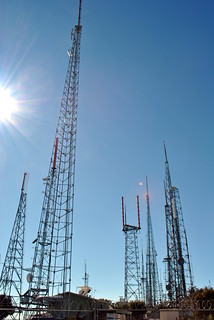
Radio Transmission Towers Atop Mt. Wilson
Radio Transmission Towers Atop Mt. Wilson (Photo credit: FastLizard4)

One big question is one that occurs to me, probably because I am a computer professional. Why would a civilisation want to be found? If you broadcast something on the Internet, you attract all sorts of undesirables trying to access your systems, your data, your private stuff.


US Mail
US Mail


Some of the undesirables might be governments of course, depending on your point of view and political affiliations. On a more personal level, people have told friends on social networking sites of a private party and hundreds of people have read this and gatecrashed. As a consequence the party gets overrun and the house gets trashed, the police get called.


A party at Colorado State University -- yeah, ...
A party at Colorado State University — yeah, that’s a riot. (11pm on April 27) …item 2.. a combination of Woodstock, ‘Animal House’ and Girls Gone Wild. (08/30/2011) … (Photo credit: marsmet553)

If you broadcast to the Universe the same sort of thing might happen. The LGM might not be friendly and with benign intent. Why would you risk attracting undesirables? Of course, the civilisation sending the signals may not be benign. Such a signal could be a honeypot, designed to attract unwary civilisations.


Lavender Attracting Bees
Lavender Attracting Bees (Photo credit: rutthenut)

So, it seems that it might be unwise to respond to alien signals. Murray Leinster’s novelette “First Contact” explores the issues, albeit in a first contact away from the origins of the contactees.


Two technologically equal species are making first contact in deep space. Both desire the technology and trade the other can provide, but neither can risk the fate of the home planet based on unfounded trust.

Another danger would be encountering a more advanced civilisations. In all cases where this has happened on earth, this has always resulted in disaster and absorption of the less advanced civilisation. This usually starts with disease, both sexual and non-sexual, which may be common in the more advanced civilisation but which the less advanced civilisation has no defence against. However, ultimately it is foreign ideas that cause the destruction of the less advanced civilisation and there’s no vaccine against that.


With masks over their faces, members of the Am...
With masks over their faces, members of the American Red Cross remove a victim of the Spanish Flu from a house at Etzel and Page Avenues, St. Louis, Missouri. (Photo credit: Wikipedia)

So, maybe we should avoid alien civilisations, at least until we can be sure that contact will not harm us. But how will we know that they are there, so that we can avoid them? Can we detect them before we blunder into something we can’t handle?


One possible way would be to observe the rate of emission of radio waves from a stellar system. If the electromagnetic spectrum emission in the wavelengths that are used for TV and radio is unusually high, it may indicate that a civilisation exists in the stellar system.


United States radio spectrum frequency allocat...
United States radio spectrum frequency allocations chart as of 2003 (Photo credit: Wikipedia)

So if an otherwise unremarkable star should suddenly (in astronomical terms) start emit radio waves it might indicate that an advanced civilisation might have discovered radio on a planet orbiting the star. Or, rather, that it did discover it, a long time ago. If we did discover such a star (and I’ve no idea if it is remotely possible to detect such an anomalous production of radio waves), it may be thousands of light years away, which means that the waves have been on their way for thousands of years.


A supernova remnant about 20,000 light years f...
A supernova remnant about 20,000 light years from Earth (Photo credit: Smithsonian Institution)

If we then send an expedition to a star at, say 20,000 light years, it would take us 20,000 years at least to get there, and probably many, many more. That 40,000 years that would have passed since the wave were generated and no civilisation that we know off has lasted for more than a few hundred. They might have all died out or reverted to savagery or evolved into something that we can’t understand. We might have done similar in the 20,000 years that it would take to get there.


Cycle of paintings History of civilisation in ...
Cycle of paintings History of civilisation in Poland. (Photo credit: Wikipedia)

It’s unclear why we would want to contact them anyway. A conversation that takes millennia would be a strange one. About all we could say would be “Hi from Earth. Here are some snaps from our family album”. Of course, when we decode their signals, as XKCD notes, we would most likely find that they are unintentionally broadcasting the alien equivalent of cheesy TV shows like “I Love Lucy” or contrived  “reality” shows. After all, that’s what we have been broadcasting.


Fox Reality Channel
Fox Reality Channel (Photo credit: Wikipedia)

All of the above is moot as is my previous post if the LGM do not exist. The most famous attempt to estimate the likelihood of there being other civilisations other than ours out there is the Drake Equation. As I mentioned in my previous post, this equation irritates real mathematicians, since it is not derived from anything, but is merely a string of terms strung together to look like an equation. Plausible values for the components of the equation can give answers ranging from almost zero (there are no other civilisations other than ours in our galaxy) to 38 million or more.


"Where is Everybody?", or "Why ...
“Where is Everybody?”, or “Why am I so Lonely?”: Fermi’s Paradox / the Drake Equation, Logocentrism and Gabriel Garcial Marquez (Photo credit: timtak)

The SETI Institute concludes that “The importance of the Drake Equation is not in the solving, but rather in the contemplation”. Certainly the values of most of the terms of the equation are not really known, though estimates can be made. Investigation of one term may throw up information which throws some light on the other terms.


Drake Equation
Drake Equation (Photo credit: Merritt Boyd)

The crucial term is, I feel, “L”, the length of time that a civilisation will be able to and desire to make radio signals. Looking at how we have used radio waves, there seems to be a trend from the low end to the high and very high end of the broadcast spectrum. Early experiments and usage was in the VLF (very low frequency) band, but the frequencies used for most radio broadcasting moved to medium frequencies. TC, both digital and analog use VHF (Very High Frequencies) and UHF (Ultra High Frequencies). Satellite broadcasts use even shorter wavelengths (higher frequencies). So our radio usage has changed over the 100 years or so that we have had radio receivers and transmitters.


Aerials
Aerials (Photo credit: ettlz)

All in all I think that it is unlikely that we will contact LGM. We may stumble over some, if we ever manage to go Interstellar, and it may be that some as yet unknown technology might enable us to easily spot advanced civilisations from a distance, so that we can signal or visit, but although I applaude the SETI effort I don’t think that the search will be fruitful.


SETI@home logo
SETI@home logo (Photo credit: Wikipedia)

It may be that we can never visit other stars because no way exists for us to do so. In a story that I once read, but can no longer remember the name of, one character referred to star systems as “God’s test tubes”. I recall that at the end of the story the human race had just found a way to escape its “test tube”.


A,B,C - test tubes
A,B,C – test tubes (Photo credit: Wikipedia)
Enhanced by Zemanta

Little Green Men

SETI
SETI

SETI is short for “Search for Extraterrestrial Intelligence”, or in other words, a search for the “Little Green Men”. The main thrust of SETI is to examine the light from other stars for signs of intelligent life, often on well known wavelengths such as wavelengths near the “water hole“,  a section of the electromagnetic spectrum associated with hydrogen and hydroxyl ions emissions lines. Hydrogen and hydroxyl together make water and water is supposedly necessary for life, so the thinking is that technically advanced life would possibly use this frequency to initiate contact with other civilisations.

Denomination of atomic shells and of character...
Denomination of atomic shells and of characteristic emission lines (Photo credit: Wikipedia)

The trouble is that this is just a guess and there are many possible frequencies that might seem plausible to technically advanced civilisations. If the little green men are not made of water, as we essentially are, they might pick a different frequency band to search. XKCD, my favourite web site has a cartoon which makes this point:

XKCD - the search
The Search

Suppose a remote civilisation did decide to broadcast in that waveband. If they are just announcing their presence, they would need to broadcast their signal in all directions, or they would need to pick out some likely looking star systems and send a directed signal in just a few directions.

If they broadcast in all directions, the power that they would require would be huge. The problem is that in any average stellar neighbourhood, there aren’t many stars. In the sun’s neighbourhood there is an average of 0.004 stars in a cubic light year. So the probability of finding a star one light year from a star in a neighbourhood like the sun’s is four in 1,000. If you look two light years out from the star, you will enclose a volume of eight times the volume of the search area up to one light year, meaning that the probability of finding a star in that volume is 0.032. You would need to look further than five light years out for there to be a fifty-fifty chance of finding a star in that volume, which would be 125 time the size of the original volume of one cubic light year. At 15 lightyears, there would likely be at least 10 stars within the search area.

Globular Cluster NGC 6397
Globular Cluster NGC 6397 (Photo credit: Hubble Heritage)

That’s all very well, but most if not all of these stars will be of the wrong type to support planets of the type that will have free water on them. In fact it is extremely unlikely that a suitable star with suitable planets can be found within, say 200 light years of our hypothetical advanced civilisation. (That’s an out and out guess, but see later).

The remnant of a supernova located 6000 light ...
The remnant of a supernova located 6000 light years from Earth in the constellation Taurus. (Photo credit: Smithsonian Institution)

The trouble is that the signal gets weaker and weaker the further it travels. If you use the signal strength at one light year as the yardstick, the strength is reduced to one quarter at two light years, one ninth at three light years and one sixteenth at four light years and so on because the signal is spread over an area proportional to the square of the distance from the source.  So if the signal strength at 200 light years will be 1/40,000th of the strength of the signal at one light year. If the signal has to travel further it will be correspondingly weaker.

My second attempt at illustrating the Inverse ...
My second attempt at illustrating the Inverse Square Law. S represents an ideal source of electromagnetic radiation and A represents an arbitrary segment of the surface of a sphere of radius r. (Photo credit: Wikipedia)

So likely systems are rare and the signal strength will be weak at the distance of a suitable system. This means that the signal needs to be very strong to be detectable.  Very strong means lots of energy. To broadcast to the Universe at large the civilisation would have to expend a considerable amount of its available energy to only potentially contact another civilisation. Imagine trying to get a project like into the planetary budget!

Clark's accompanying book to Civilisation
Clark’s accompanying book to Civilisation (Photo credit: Wikipedia)

So the hypothetical civilisation is probably desperate to make contact. That may be because either they are in trouble themselves, or they want to warn all local civilisations about something. They are unlikely to do it on a whim, as they must know that the chances of success are pretty close to zero. There’s a faint possibility of a sort of “vampire civilisation” that must prey on other civilisations and so chooses to broadcast in the hope of finding a new victim. I consider that highly unlikely, since as I said the chances of success are nearly zero, and such a civilisation would need to find a new host in a relatively short period of time, astronomically speaking.

Mark of the Vampire
Mark of the Vampire (Photo credit: Wikipedia)

If a broadcast signal is very unlikely to find a receiver, how about a directional signal, maybe driven by a laser. The spread of a laser signal is much less than a broadcast signal, but the signal does spread. An advanced civilisation would still have to divert significant resources into sending the signal but it might be possible.

The civilisation would have an issue, though. If they wanted to get a signal to us and they used a ground based laser, their ground station would be in line with us once each local day, and our receiver would be in line with them once in every day too. Since it is unlikely that the day lengths would match, so the window for transmission would be short, even down to a minute or less.

Window of opportunity
Window of opportunity (Photo credit: GioPhotos)

The hypothetical aliens would most likely opt for an orbital laser. That could be pointed in our direction all the time, for every hour of every alien day, unless some local object got in the way. However we have a problem now. We would need to detect that a signal is coming from a point in space, in spite of all the extraneous noise that might mask it, and then we would need to concentrate our resources looking in that direction for a length of time. The hard part would probably be convincing ourselves that a signal is from LGM (little green men).

Littler Green Men
Littler Green Men (Photo credit: JD Hancock)

There’s an equation that purports to estimate the possible frequency of extraterrestrial civilisations, called the “Drake Equation”. It’s the sort of “equation” that gives mathematicians the heebie-jeebies, since it is derived from nothing and nothing is derivable from it. XKCD cruelly lampoons the equation, and while I don’t much like the sentiment expressed, I can understand why the Drake equation raises his ire – it is ad hoc, probabalistic, and presents as constants things which are fundamentally unknown. In other words, your guess is as good as mine, and both will fit comfortably in the Drake equation. I may return to the equation in a later post.

XKCD - the Drake Equation
The Drake equation as extended by XKCD


Enhanced by Zemanta

The Psi thing

Greek psi
Greek psi (Photo credit: Wikipedia)

I read a book recently, a real paper book, which was called “brain wars” and was written by Mario Beauregard, who is a neuroscience professor at the University of Montreal. The book amounts to an attack on materialist philosophy, arguing that the materialist philosophy cannot explain everything, especially the phenomenon of consciousness and “psi” phenomena.

One of the cornerstones of his argument is based around the dualist notion that mind and brain are separate “things”, and indeed one key section from the text, quoted in the blurb on the dust cover as follows:

The brain can be weighed, measured, scanned, dissected, and studied. The mind that we conceive to be generated by the brain, however, remains a mystery. It has no mass, no volume, and no shape and it cannot be measured in space and time. Yet it is as real as neurons, neurotransmitters, and synaptic junctions. It is also very powerful.

A little later he poses the question that the opponents of Decartes posed : “How, they asked, can an immaterial, mental substance act upon the material brain?”

A diagrammatic section of human brain by René ...

Beauregard later quotes Minsky’s statement “The brain is just a computer made out of meat”. For reasons that he goes into in depth later he states that quantum mechanics “has effectively smashed the scientific materialist worldview.” He then complacently concludes that “(m)aterialistic theories, despite their stubborn persistence in the scientific community, cannot solve the mind-brain problem”.

This despite the fact that Quantum Mechanics is completely materialistic and rational!

Marvin Minsky at the KI 2006 artificial intell...
Marvin Minsky at the KI 2006 artificial intelligence conference in Bremen (Photo credit: Wikipedia)

I believe that Minsky’s view is closer to true than the view that there is more to reality than the materialistic view allows. Beauregard is not a computer scientist so he would not know, in detail, how computers work, under the covers. At a basic level running computer is all about signals. These signals flow through the computer like signals flow through the brain’s network of neurons. (Caveat: I’m not a neuroscientist like Beauregard so I may be misrepresenting his field.)

neuron fractal 1
neuron fractal 1 (Photo credit: Anthony Mattox)

At a slightly higher level, a computer runs an operating system. This is program that runs all the time on the computer, running the programs that the user requires, handling the users input by running other little pieces of code, and handling all the bits of equipment (peripherals) that are connected to the computer. Crucially, the operating system can make the peripherals do things, like print the letter “A” on a sheet of paper, or spit out the sheet from the printer. Special purpose computers are the core of the robots that build cars or assemble toasters and pack them  and label them. They can even sort letters, reading ordinary human writing, much of the time accurately.

Factory Automation with industrial robots for ...
Factory Automation with industrial robots for metal die casting in foundry industry, robotics in metal manufacturing (Photo credit: Wikipedia)

Interestingly people don’t think of robots as mobile computers that can interact with physical objects. The computers in robots run an operating system like your ordinary laptop or desktop, but they are often special versions called “embedded” operating systems.

Open up a computer though, and boot it up. Although you can point to various named parts, like the CPU, or the memory chips, you can’t point to the operating system. It essentially just a pattern impressed on the memory and the various registers and the CPU, and it changes over time. As Beauregard said about the mind, “it has no mass, no volume, and no shape, and it cannot be measured in space and time”. Yet it can influence things, print a letter or paint a car chassis.

June 11, 2007
June 11, 2007 (Photo credit: HeatherKaiser)

It seems that the computer, with its operating system and subsidiary programs, is a good analogy for the brain/mind duality. A big caution here, in that this analogy is just analogy, but it could form the basis of a model of the way that the mind and brain work together. It doesn’t, per se, explain consciousness, but I think that I have, above, provided an explanation of how the supposedly immaterial mind can, through the brain, affect the body, so that we can think above moving a limb, and it happens.

Quantum Physics
Quantum Physics (Photo credit: Jonathan Thorne CC)

Beauregard fastens on “quantum physics” as a possible enabler of psi phenomena, arguing that in quantum physics there is no separation between the mental and the physical. He bases this on what he calls the observer effect : “particles being observed and the observer are linked, and the results of the observation are influenced by the observer’s conscious attempt”.

Hmm. Wikipedia defines the “observer effect” as follows :

In science, the term observer effect refers to changes that the act of observation will make on a phenomenon being observed. This is often the result of instruments that, by necessity, alter the state of what they measure in some manner. A commonplace example is checking the pressure in an automobile tire; this is difficult to do without letting out some of the air, thus changing the pressure. This effect can be observed in many domains of physics.

This is a purely physical effect of measurement – the measuring photon knocks the observed particle slightly off course. Nothing to do with the observer. (A related effect, the Heisenberg principle puts limits on the accuracy with which we can know both the original values of a pair related properties and the subsequent values – roughly speaking).

An optical illusion. Square A is exactly the s...
An optical illusion. Square A is exactly the same shade of grey as square B. See demonstration. (Photo credit: Wikipedia)

I think that Beauregard is actually referring to is an interpretation of quantum mechanics known as the “Copenhagen Interpretation” otherwise known as the “Collapse of the Waveform”. As such he interprets it as saying that the act of observation affects the result of the observation. This is fundamentally not true, because what really happens is that the act of observation merely determines which of probabilities is true. As Wikipedia says :

What collapses in this interpretation is the knowledge of the observer and not an “objective” wavefunction.

In no way does the observer influence the results of the experiment except as a result of the real “observer effect” above, so there is no room there for psi effects.

English: Example of a subject in a Ganzfeld ex...
English: Example of a subject in a Ganzfeld experiment. (Photo credit: Wikipedia)

You may think that I didn’t enjoy the book, but I did! There are unexplained and challenging events described in the book, but I don’t think that it goes anywhere near challenging the materialistic philosophy of science. The only part that I have issue with is when Beauregard challenges what he calls “pseudoskeptics”, those who profess to be skeptics and who are unwilling to look at the evidence for psi phenomenon.

USE IT...
USE IT… (Photo credit: Demetrios Georgalas aka brexians)

In fact these so called pseudoskeptics have probably looked into psi phenomenon at some stage and decided that further consideration is pointless given the diffuse and dubious nature of some evidence and the lack of any information about how this could tie in to or extend in some logical way existing materialistic physics.

Enhanced by Zemanta

The beginning of things and the ending of things.

The Big Bang era of the universe, presented as...
The Big Bang era of the universe, presented as a manifold in two dimensions (1-space and time); the shape is right (approximately), but it’s not to scale. (Photo credit: Wikipedia)

The origin of the Universe, the start of everything, including time. That’s a grand concept. In our usual view of the Universe, we define any event by three space dimensions and one time dimension, but mathematics can deal with any number of dimensions. Some physical models of the Universe use many more than four dimensions, sometimes 10 or 11, and even an infinite number of dimensions.

Normally the space dimensions are depicted as being measured along three orthogonal axes, otherwise known as a Cartesian coordinate system. However there are alternate ways of specifying three space dimensions.

coordinate_system
coordinate_system (Photo credit: williamcromar)

For instance, on the Earth’s we specify locations by latitude and longitude, which gives us two dimensions. Astronomical objects are specified by Right Ascension and Declination, again resulting in two dimensions. In both cases the third space dimension can be specified as distance, in the first case from the centre of the earth, and in the second case from the observer, but in the general case, the origin can be any arbitrary point.

This second method of specifying the position of an object is known as a Polar coordinate system, and there are many other ways that the position of an object can be specified. Of course, these positioning schemes only really work locally. If the origin of the coordinate system were on Mars for example then the coordinates of, say Jupiter, would differ from the coordinates of Jupiter as measured on Earth.

Point in Polar coordinates
Point in Polar coordinates (Photo credit: Wikipedia)

If we add time into the picture, we have four dimension to cater for. Since we live in a Universe where there appear to be three space dimensions we have difficulty in considering time to be a dimension like the three space dimensions.

A four dimensional Cartesian coordinate system seems to us to be impossible to conceive, but mathematicians don’t have any problems with the concept, and some have expended time and effort to be able to mentally conceive of four dimensional spaces.

Cartesian Perspective
Cartesian Perspective (Photo credit: Jan Tik)

I wish them luck but I don’t see that it is necessary. The equations have four variable, hence four dimensions, end of story. There is no need to imagine four Cartesian dimensions.

Some people might consider time to be different in nature to space. It is after all measured in seconds, and space is measured in millimetres. That’s a valid point, but consider that in a Polar coordinate system the distance dimension is different to the other two dimensions. The distance is measured in millimetres and the other two in degrees or radians.

Time and Space v2
Time and Space v2 (Photo credit: dkuropatwa)

It seems that it all depends on your point of view, and indeed we can measure distances in seconds too. All that we have to do is to say that the distance coordinate of an object is the number of seconds that it takes light to travel that distance. Essentially to convert from millimetres to seconds we divide by the speed of light, which, as we all learned in school is a constant.

So we have four or more dimensions in our Universe and all events in the Universe can be plotted in a space of four or more dimensions. I don’t think that it follows that every point in that space represent an event in our Universe – there may exist points in that space which don’t represent points in the space-time history of our Universe.

parabola
parabola (Photo credit: pixelthing)

Consider for example a space with dimension two, which corresponds to the points on the surface of the earth (ignoring the altitude variation which corresponds the distance of the point on the surface of the earth from the centre of the earth). Every point on the surface of the earth could be plotted on Cartesian axes.

It would be a weird map with the origin representing the point on the earth which is on the equator and due South of Greenwich, the opposite side of the earth appearing at both -180 degrees and +180 degrees and the poles spread into a line at +90 degrees and -90 degrees.

TTT #2... 256365
TTT #2… 256365 (Photo credit: paloetic)

However, no point on the earth’s surface would have a longitude coordinate that is greater than +180 or a latitude coordinate that is greater than +90. Those points just don’t represent a point on the earth’s surface. OK, the map could repeat, I guess, an infinite number of times, but I’m arbitrarily going to rule out that suggestion, as each point would not have a unique pair of coordinates.

This issue only arises because I am suggesting a mapping of Polar coordinates onto a Cartesian grid. Now I’m going to consider the four main dimensions of our Universe in a similar light.

time-zero blue
time-zero blue (Photo credit: futurowoman)

As time is traced backwards, according to the Big Bang theory, the Universe is seen to be smaller. The further back we go, the smaller it is, until at some point the past, the whole Universe shrinks to a point. Some questioners of this theory ask “What happened before that point in time?”.

OK, let’s for the moment ignore two of the space dimensions. Let’s just consider time and, let’s say, a dimension that I’ll call width, as in the width of the Universe. We can then plot the changing width of the Universe as the vertical axis and time as the horizontal axis on a set of Cartesian axes.

width & depth [CIMG2033]
width & depth [CIMG2033] (Photo credit: TheAlieness GiselaGiardino²³)
Arbitrarily setting the origin at now, and the width as the current width of the Universe, let’s consider what happens as we trace the graph to the left. The width, shown on the vertical axis reduces until it eventually reaches the time axis and, pop, the Universe disappears. Or appears, if we trace from left to right in the normally accepted direction of the flow of time.

“What happened one second before that point?” asks the sceptic. The answer is that the question doesn’t make sense. In the analogy above, of the latitude/longitude map, it is like asking “What is 181 degrees West of Greenwich?”, to which the answer is “There is no 181 degrees West of Greenwich.” Similarly there is no Big Bang – 1 second.

How far does Hubble see?
How far does Hubble see? (Photo credit: NASA Goddard Photo and Video)

You will note that in that latitude/longitude example above, the map can be said to “wrap around” and if one sails 181 degrees West of Greenwich, one finds oneself at 179 degrees East of Greenwich. A similar wrap around in the case of the Universe would be for someone who somehow managed to get to Big Bang – 1 second to find that they had arrived at one second before the end of time.

However I do not know if the theories of the Big Bang allow for this possibility. Certainly the concept makes a sort of sense if the Universe is destined to collapse into a “Big Crunch”, like a Big Bang in reverse, but if the Universe is destined to expand without limit, then there is no analogy to “181 degrees West of Greenwich”.

:From Image:Big_crunch.png According to the Bi...
:From Image:Big_crunch.png According to the Big Crunch theory, the universe will end in an infinitely dense singularity. (Photo credit: Wikipedia)

In any case the problem likely only arises because the Cartesian coordinate system in inadequate for plotting the origin of the Universe.

The Restaurant at the End of the Universe. Almost.
The Restaurant at the End of the Universe. Almost. (Photo credit: Geir Halvorsen)
Enhanced by Zemanta