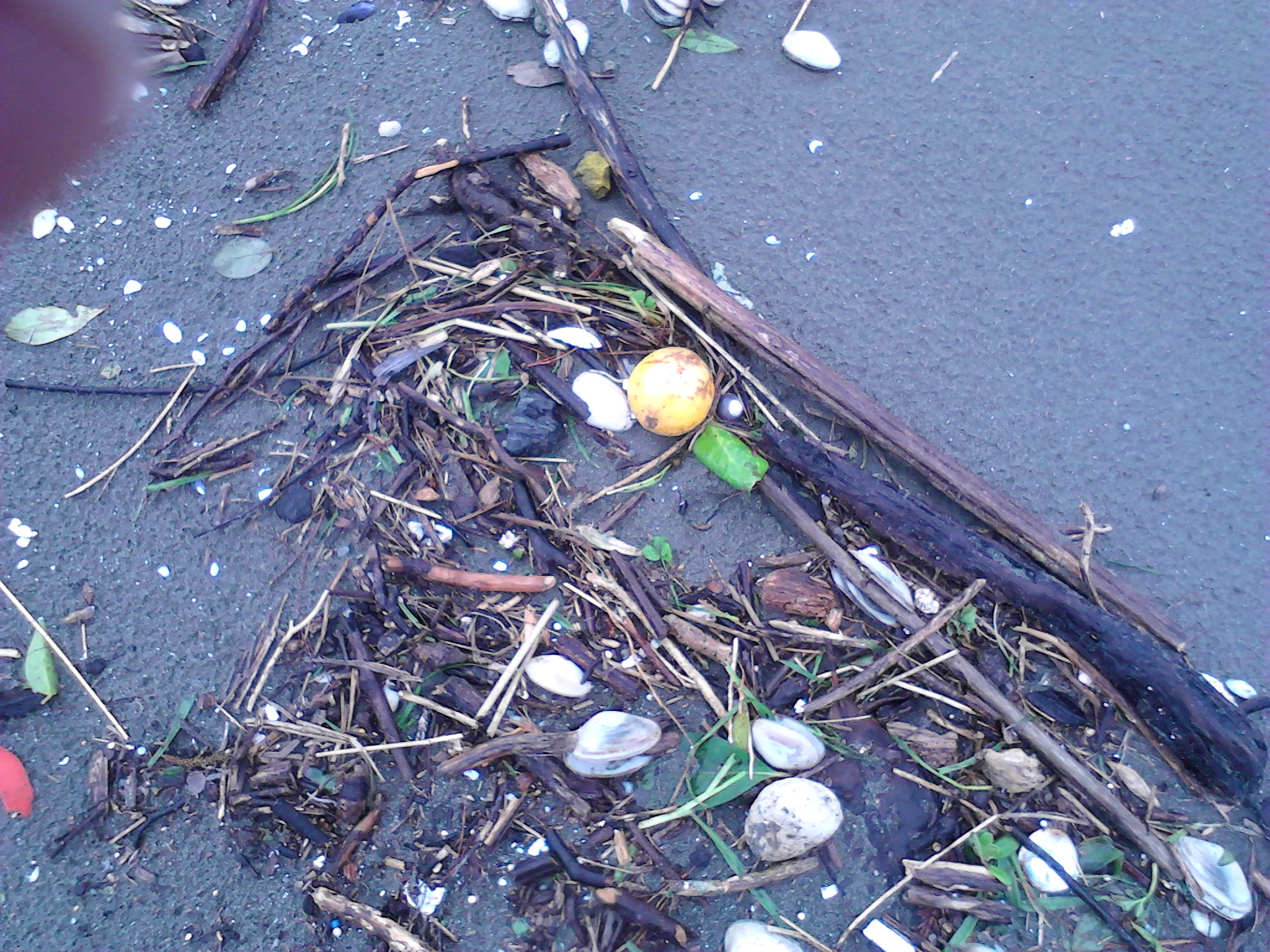
Nothing

The Story of Nothing, in Arizona
The Story of Nothing, in Arizona (Photo credit: cobalt123)

Nothing is an interesting concept with many different aspects. Maths, science, philosophy and many other fields of endeavour have their own overlapping concepts of nothing, zero, null or just the absence of anything.

Some computer languages have a concept of ‘null’. This is not the same as the concept of ‘zero’. To use the usual analogy of pigeonholes, numbers and other things in computers are conceptually stored like objects stored in pigeonholes. Each pigeonhole must have a location, sort of like ‘third row down, fourth hole in the row’. A pigeonhole could be empty or it could contain a number or a string of characters or more complicated objects that the computer recognizes. It could optionally have a label so that it can be found quickly.

Pigeon Holes
Pigeon Holes (Photo credit: Graela)

A computer moves things around and in the process it manipulates them. Given this analogy, what is ‘nothing’ to a computer?  It could mean several things. It could mean the number zero, stored in a pigeonhole or it could refer to an ’empty string’ stored in a pigeonhole. (An ’empty string’ is like the object ‘where’ when the individual letters ‘w’, ‘h’, ‘r’, and the two ‘e’s have been removed. It is represented by two ). It can be a more complicated object that hasn’t been completely set up. Alternatively it could refer to an empty pigeonhole. It could even refer to a label which has not yet been allocated to a pigeonhole. Pity the poor programmer who has to keep all these ‘nothings’ separate in his or her mind (and a few others that I’ve not mentioned!).

Zero
Zero (Photo credit: chrisinplymouth)

In mathematics we have the concept of zero, but this is a fairly newly introduced concept. Some number systems, such the Roman Numeral system do not have a zero, and it was a big conceptual jump to add zero to the mathematical number systems. After all, what do you hold when you have two oranges and you give them away? Nothing! You can’t see zero oranges in your hands, unless you are a modern mathematician of course.

So mathematically ‘nothing’ is zero then? It could be, though ‘nothing’ could be integer zero, ‘0’, rational zero, ‘0/any number’, real number zero, ‘0.0’, complex zero, ‘0 + 0i’, or many many other versions of zero. Maths also has a concept of a set, which is just a collection of objects, which can be pretty much anything. An analogy often used is to liken a set to a bag which contains any sort of object. Statisticians are fond of sets which comprise a set of balls which can be of more than one colour but are usually otherwise identical. If all the balls are removed from the bag, what do you have? A bag with nothing in it! It is usually referred to as an ’empty set’. Note the similarity with the ’empty string’ mentioned above. There’s nothing coincidental there.

Illustration of Function (mathematics).
Illustration of Function (mathematics). (Photo credit: Wikipedia)

There are other sorts of ‘nothing’ in mathematics. A mathematical ‘function’ is a way of relating ‘variables’. The details don’t matter, just the fact that functions have ‘zeros’. They may have one or more zeros or they may have none. Having no zeroes could be considered a sort of ‘nothing’, in a way, though the functions in question are no less proper functions than any other. I’m sure that there are other more esoteric ‘nothings’ in maths.

In physics things should be clearer, right? In physics a vacuum is created is all matter is removed, leaving … nothing. Except that it appears to be impossible to actually remove everything from a container leaving nothing. Even the best pumps will leave a considerable numbers of atoms floating around inside the container. Other methods of emptying the container may reduce slightly the number of atoms in it, but we can’t even reach the very low densities found in the gas clouds visible to astronomers. Even in the depths of space between the galaxies we still find the occasional atom, usually of hydrogen.

Vacuum Pump
Vacuum Pump (Photo credit: Sascha Grant)

Maybe we should look between the atoms for nothing? Most people have an image of an atom as a sort of miniature solar system with the nucleus standing in for the sun and the electrons standing in for the planets. Unfortunately the analogy breaks down if you look closely. Electrons are only found in certain orbits around an atom and even that is an over-simplification. Their location depends on a probability function and in some views this means that the electron is sort of smeared out in space and doesn’t have a strict location and you can’t say specifically that it is ‘there’ at a particular location, only that it has a particular possibility of being there.

One consequence of this is that you can’t say that is isn’t at a particular location, so it is impossible to declare that there is nothing at a particular point in space at any one time. If you consider all the particles in the universe, they all have a probability of being there, so you might be surprised not to find a particle there at a particular moment in time.

Vacuum polarization
Vacuum polarization (Photo credit: Wikipedia)

In addition to this, I have read article which describe ’empty space’ as a seething mass of pseudo particles or virtual particles. These come in pairs of particle and anti-particle which are continually coming into existence, mutually annihilating each other out of existence again. Viewed in this way it is difficult to describe ’empty space’ as containing nothing, so we still haven’t found ‘nothing’. Although physics has the concept it is hard to find a physical instance of it.

The Big Bang era of the universe, presented as...
The Big Bang era of the universe, presented as a manifold in two dimensions (1-space and time); the shape is right (approximately), but it’s not to scale. (Photo credit: Wikipedia)

Cosmologists talk about the “Big Bang” when everything came into existence. Before the Big Bang, they say, there was nothing. Nothing! But what does this mean. I like to think of it by analogy. If you take a piece of paper and draw a circle on it, you can consider this circle to contain all space and time and everything that exists in space and time. If you draw a line horizontally through it you can label the big inside the circle as ‘time’. Note that the line should not extend beyond the circle.

The point where the line reaches the left hand side of the circle is the Big Bang. The point where the line reaches the right hand side of the circle is the point where everything collapses on itself and space and time cease to exist.

Some cosmologists think that there will not be a collapse, so the curve is not a circle but a curve open to the right. This doesn’t affect my argument – everything and every time is included inside the curve.

English: Shows slices of expansion of universe...
English: Shows slices of expansion of universe without an initial singularity (Photo credit: Wikipedia)

If you now draw a line vertically, not extending beyond the curve, and label it ‘space’. If you move the line to the left, the graphical distance between the top point and the bottom shrinks. Moving the line to the left moves it back along the time axis and represents an earlier state of everything. When the line just touches the curve the point of intersection of the two lines represents the Big Bang.

What about the points outside of the curve? This is where the analogy breaks down. Since we have included all space and time inside the curve the points outside the curve do not represent real points in space and time at all. In short, they do not exist. We could loosely say that nothing exists outside the curve of space and time, but that is not true. ‘Nothing’ is a concept based on space and time, being the opposite of ‘something’ or the potentiality for ‘something’ and as such needs a space-time framework to mean anything. If there is no space and time, there can be no ‘something’ and therefore ‘nothing’ is meaningless. Beginners in science and astronomy might ask what is beyond the boundary of the universe, but the question doesn’t mean anything. The universe contains everything.

If there were other universes, with their own space and time, they would have to be right alongside our universe (that is an analogy of course – language fails us in this situation) as there is nothing to be between the two universes. If you were able to travel from one universe to the other, a concept which I don’t believe stands up to examination, you probably wouldn’t notice the difference. Maybe nothing is a sort of inability to be. But that language implies an intent, which implies a lot of other things and maybe leads to pantheism and I don’t wish to go there.

Absolutely Nothing is Allowed Here
Absolutely Nothing is Allowed Here (Photo credit: Vicki & Chuck Rogers)

Well, I’ve used over 1300 words to talk about ‘nothing’, so I will stop here. What comes after the end of this post? Why, nothing, of course!

Earthquakes

English: Quake epicenters. Română: Epicentre a...
English: Quake epicenters. Română: Epicentre ale cutremurelor produse în intervalul de ani 1963–1998. (Photo credit: Wikipedia)

This week’s subject pretty much suggested itself. There I was, sitting at my desk, and suddenly I felt this rolling, shaking sensation. Well, I feel it every time a truck goes past, but this time the shaking continued and it became apparent that this was an earthquake. It measured 6.6 on the earthquake scale and was the biggest one I can remember for a long time. Fortunately we were not at the epicentre and no one was killed. Those living close to the epicentre had a rougher time than we did and many houses were damaged, though only one appears to have been severely damaged.

(Note: Images in this post are not from the Wellington earthquakes that I am talking about in this post).

Since we are prone to earthquakes here the children in school are drilled in what to do when an earthquake strikes. I particularly like the idea expressed by one child that “earthquakes cause salamis”. (See the second video on the page that is linked to above.)

Earthquake Drill
Earthquake Drill (Photo credit: Benjamin Chun)

The previous earthquake happened when I was at home. Instinctively my wife ran for the door. I equally instinctively rushed to stop the TV from toppling! It’s funny what you do in an emergency.

Luckily no one was seriously hurt in the earthquakes though people in lifts (elevators) and at the top of high buildings were shaken about a bit. Apparently lifts (elevators) are designed to stop moving if there is a big quake.

In the city nothing much was damaged, although a lift (elevator) shaft which was damaged in an earlier quake is scheduled to be removed and one ‘lane’ (pedestrian access between buildings) in the city centre was taped off by authorities. Last time there was a certain amount of damage but nothing significant, though people were sent home so that the buildings could be checked. A rugby test match between New Zealand and Australia may be cancelled. That’s classified as a Big Thing round here.

Footbridge over Avon river following both Sept...
Footbridge over Avon river following both September and February earthquakes. (Photo credit: Wikipedia)

All in all, people have taken the earthquake in their stride, though news pictures showed some people who appeared to be in shock. The one injury that I heard of was one woman who tried to dive under her desk and missed cracking her head against it. I saw a picture of two girls hiding under a desk with a bottle of wine. That’s apparently what they had been doing all afternoon. One guy texted from the airport and said that he would be glad to get up into the air. (As it happens the airport stopped flights in and out for a while, but they soon caught up with the backlog).

Naturally people wanted to go home to be with their families and to check that their houses had not been damaged. This led to the roads out of and around the city becoming gridlocked. I didn’t want to get caught up in that so I hung around until just before the time that rush hour usually happens  and my trip home was in fact easier than usual. I did wonder what would happen if a significant earthquake or after shock happened while I was travelling at 100kph on the motorway! Also, there is a part of my route that lies under a motorway bridge, and there was a chance that I’d get stuck at the traffic lights. Fortunately they were showing green so I did not have to stop under the heavy concrete spans of the motorway. That would have been scary.

Footbridge over Avon river following both Sept...
Footbridge over Avon river following both September and February earthquakes. (Photo credit: Wikipedia)

The thing about earthquakes is that you don’t know how powerful they are going to be. You don’t know if it is going to be a jiggle and a roll or whether it is going to rip the building apart underneath you. I find them scary and exhilarating. After one is over people are often more relaxed than before it, and gather to exchange news and ‘war stories’. At least, that is so in the earthquakes that I have so far experienced. But they have been relatively benign.

Unfortunately this was not true nearer the epicentre where almost all the houses had some damage, though no serious injuries have been suffered and no fatalities have happened.

Wellington office after earthquake.

Why do things make sense?

Make it make sense
Make it make sense (Photo credit: edmittance)

Things pretty much make sense. If they don’t we feel that there is a reason that they don’t. We laughingly make up goblins and poltergeist to explain how the keys came to be in the location in which they are finally found, but we, mostly, have an underlying belief that there are good, physical reasons why they ended up there.

Things appear to get a little murkier at the level of the quantum, the incredibly small, but even there, I believe that scientists are looking for an explanation of the behaviour of things, no matter how bizarre. One of the concepts that appears to have to be abandoned is that of every day causality, although scientists appear to be replacing that concept with a more probabilistic version of  the concept of causality. But I’m not going to go there, as quantum physics has to be spelled out in mathematics or explained inaccurately using analogies. I note that there is still discussion about what quantum physics means.

English: Schrödinger equation of quantum mecha...
English: Schrödinger equation of quantum mechanics (1927). (Photo credit: Wikipedia)

We strive for meaning when we consider why things happen. When a stone is dropped it accelerates towards the earth. This is observation. We also observe the way in which it accelerates and Sir Isaac Newton, who would have known from his mathematics the equation which governed this acceleration, had the genius to realise that the mutual attraction of the earth and the stone followed an inverse square law and, even more importantly, that this applied to any two objects which have mass in the entire universe.

English: Mural, Balfour Avenue, Belfast Mural ...
English: Mural, Balfour Avenue, Belfast Mural on a gable wall on Balfour Avenue in Belfast (see also 978903). The mural “How can quantum gravity help explain the origin of the universe?” was created by artist Liam Gillick and is part of a series of contemporary art projects designed to alert people to the ‘10 remaining unanswered questions in science’ at public sites across Belfast. (Photo credit: Wikipedia)

So, that’s done. We know why stones fall and why the earth unmeasurably and unnoticeably jumps to meet it. It is all explained, or is it? Why should any two massy objects experience this attraction? Let’s call it ‘gravity’, shall we? How can we explain gravity?

Well, we could say that it is a consequence of the object having mass, or in other words, it is an intrinsic property of massy objects, which if you think about it, explains nothing, or we can talk about curvature of space, which is interesting, but again explains nothing.

Curved Spaces
Curved Spaces (Photo credit: Digitalnative)

Can you see where I am going with this? Every concept that we consider is either ‘just the way things are’ or requires explanation. Every explanation that we can think up either has to be taken as axiomatic or has to be explained further. Nevertheless most people act as if they believe that there is a logical explanation for things and  that things ultimately make sense.

It is possible that there is no logical explanation of things, and that the apparent relationships between things is an illusion. I once read a science fiction story where someone invented a time machine. Everywhere the machine stopped there was chaos, because there were no laws of nature and our little sliver of time was a mere statistical fluke. When they tried to return to the present they could not find it. This little story demonstrates that although we appear to live in a universe that is logical and there appears to be a structure to it, this may just be an illusion.

English: Illustration of the difference betwee...
English: Illustration of the difference between high statistical significance and statistical meaningfulness of time trends. See Wikipedia article “Statistical meaningfulness test” for more info (Photo credit: Wikipedia)

If we do live in a logical universe we not be able to access and understand the basis and structure of it. We may see things “through a glass darkly”. We may be like the inhabitants of Plato’s Cave. Everything we experience we experience through our senses, so our experience of the world is already second-hand and for many purposes we use tools and instruments to view the world around us. Also, our sense impressions are filtered, modified and processed by our brains in the process of experiencing something. We can take prescribed or non-prescribed drugs which alter our view of the world. So how can we know anything about the universe.

Alternatively there may be order to the universe. There may be ‘laws of nature’ and we may be slowly discovering them. I like the analogy of the blanket – a blanket is held between us and the universe but we are able to poke holes in it. Each hole reveals a metaphoric pixel of information about what lies behind the blanket. Over the years, decades, centuries and millennia we have poked an astronomical number of holes in the blanket, so we have a good idea of the shape of what lies behind it.

Cámara estenopéica / Pinhole camera
Cámara estenopéica / Pinhole camera (Photo credit: RubioBuitrago)

So why do things make sense? Is it because there is a structure to the universe that we are either discovering or fooling ourselves into believing that we are discovering, or is there no structure whatsoever and any beliefs that there are illusions. Maybe there’s another possibility. Maybe the universe does have the structure but it is an ‘ad hoc’ structure with no inherent logic to it all!

Highly Illogical
Highly Illogical (Photo credit: Wikipedia)

Banding together

Flag ~ Romania, Roumanie
Flag ~ Romania, also by chance the Tawa colours.

Our local rugby team has made it to the final of a competition (they won!) and naturally supporters are getting ready for the final match. They are organising coaches to take people to the match and no doubt there will be a good turn out. This got me thinking about how humans like to form bands and groups and supporter groups.

I think that banding together is at heart a self-protection thing. A human who belongs to a group gets supported by the group and reciprocally supports the group himself. In many cases the group is in competition against other groups of humans for a scarce resource such as food or territory, or in the case of sport points on the board of the elusive trophy. There is a synergy when people work together.

A rugby union scrum between the British and Ir...
A rugby union scrum between the British and Irish Lions and the All Blacks. (Photo credit: Wikipedia)

It’s not always humans versus humans though. A group may be formed to overcome some physical difficulty or to provide something that an individual can’t provide or achieve by themselves. That’s why travellers form caravans to cross deserts and a group of individuals might be able to buy a bigger boat together than they could have bought alone and take turns using it. Musicians of all genres usually form groups, at least to get started.

Les Rolling Stones à l'Olympia Stadion de Müni...
Les Rolling Stones à l’Olympia Stadion de Münich, alors qu’une partie de la scène avançait dans la foule (Photo credit: Wikipedia)

Forming a group allows individuals to specialise – in a hamlet or village one person becomes the smith, another the baker, another the mayor and another the constable, each person his or her particular skills in the role.

The role of supporters is to encourage and assist but not to actually take part in the contest or enterprise, but sometimes the line is blurred. For example the coach and trainer might not take part in a game, but in some ways they are part of the team. The supporters on the sidelines, yelling encouragement and advice, are even less part of the team, but they can certainly help out, and they form a larger group surrounding the team.

English: Greece - Russia Euro 2008
English: Greece – Russia Euro 2008 (Photo credit: Wikipedia)

Sometimes, of course, two groups of supporters clash. This is generally agreed to be a bad thing, but if you take a step back and think about it, it is to be expected, but not encouraged. It is an unwritten but basic rule of sport that the conflict, physically at least, stay on the field of play. Non-physical conflict, such as chants, banners and team regalia, is permitted between opposing spectators and even encouraged. “Get behind the team” is a rousing call for supporters. No wonder the non-physical conflict fairly often becomes physical.

The biggest ‘teams’ are countries, which strike me as being somewhat artificial in this day and age. Can one supergroup really speak for people who might be thousands of miles away? There may be an aboriginal population in a country that has far more inhabitants of immigrant origins, and these people may not consider themselves to be truly part of the nation in which they reside. Some nomadic people may travel through several countries, and may not consider themselves to be a part of any of them. The sheer size of modern countries almost invites the formation of ethnically or geographically ‘seperatists’ groups.

Matthes -- Separatists at Coblenz  (LOC)
Matthes — Separatists at Coblenz (LOC) (Photo credit: The Library of Congress)

Mankind probably started out as family groups, and were probably nomadic. When they settled down (perhaps as a result of developing agriculture) it would seem natural to settle down in larger groups, maybe two or three families to provide defence against those still travelling around. As mankind spread and became more numerous these little settlements would grow into towns, with inhabitants specialising into roles like the smith or baker mentioned above.

At some stage strong leaders became feudal lords. This appears to have been common, but was possibly not universal. Eventually the lords and barons gave their allegiance to a king or overlord and a number of small (by current standards) states were formed, sometimes based around a city as in Sparta in Greece or sometimes based in a geographical area. The debatably mythical Arthur around the 5th or 6th centuries in Britain was supposedly king of Britain, although at that time there were probably several kingdoms in what is now Britain, and Athelstan is usually considered the first true English king.

English: King
English: King (Photo credit: Wikipedia)

The nations of the world are these days largely static in shape and size, but they do still change now and then. Czechoslovakia split apart in 1993, and the Soviet Union (USSR) formed in 1922 and split up in 1991.

The next logical step in this process, one would have expected, would be the formation of a global entity, grouping the whole of mankind into one huge group, but this has not happened. There are a number of global entities, notably the United Nations, but they tend to concentrate on specific areas of endeavour rather than being the World Government that would have been expected. There are ‘blocs’ of similarly inclined countries but these also don’t have the spread of activities that would make them a ‘super-government’.

English: Global map of noted supranational uni...
English: Global map of noted supranational unions. Based roughly upon http://www.towardsunity.org/. (Photo credit: Wikipedia)

It may be that the only thing that would cause the formation of a super-group encompassing all of humanity would be an encounter with hostile and destructive aliens, but the chances of that would be very small.

Take me to your leader. iPhone 3GS
Take me to your leader. iPhone 3GS (Photo credit: Kimb0lene)

Birthdays

birthday cake
birthday cake (Photo credit: freakgirl)


Today (Sunday 28th July) is my birthday, which naturally had me pondering birthdays in general. In July I have my birthday, my son’s birthday is a few days earlier and my granddaughter’s is next month. It turns out that a friend of a Facebook friend also has her birthday today, on my birthday. Jim Davis, the creator of Garfield was also born on my birthday. And finally, George, the latest addition to the royal family and third heir to the British throne was also born in July, the same month as me and my son.

The maths of birthdays is interesting. If you have 23 randomly selected people then the probability that at least two of them share a birthday is a shade greater than 50% (50.7297%). If you have 53 people the probability goes above 99%. This is known as the Birthday Problem or the Birthday Paradox, though it is not really a paradox, I believe. There are a number of simplification used in calculating the above. For instance, it assumes that all birth dates are equally probable, but they are not, and it also ignores leap days. Also mothers can sometimes, within bounds, select the day that their baby is born, especially for at risk babies and this potentially could cause a skew in the probabilities.

English: The birthday paradox: p(n) represents...
English: The birthday paradox: p(n) represents the probability that in a room with n people, some two (or more) will share the same birthday; q(n) represents the probability that in a room with n people, that at least one person will have the same birthday as a previously selected person. 中文: 生日悖论 2个人生日相同和跟某人生日形同的概率变化 (Photo credit: Wikipedia)

Some people have two birthdays. Well, the Queen has a real birthday and an official one, so that celebrations of her birthday would not fall too early in the year, but later, when the weather would hopefully be better. Unfortunately that means that in the Southern Hemisphere her birthday falls in the depths of winter!

2013 VividSydney on Queen's Birthday 10 Jun 2013
2013 VividSydney on Queen’s Birthday 10 Jun 2013 (Photo credit: hto2008)

Our years these days are defined in terms of “CE” or “Common Era” and “BCE” or “Before Common Era”. Older people can remember when it was “Before Christian Era” or even “BC” for “Before Christ” and “AD” for “Anno Domini” or “Year of Our Lord”.

I’m not going to argue whether or not Jesus really existed and whether or not he was divine, but if we assume for a moment that he was born, there is a lot of discussion on what year it was that he was born. Using the gospels and other historical information as a guide, many people believe that he was born 4 to 6 years before start of the Common Era. Or using the terminology, he was born up 6 years “Before Christ”! Humorous, I suppose.

Christ's Birth Orthodox church
Christ’s Birth Orthodox church (Photo credit: baswallet)

Most people view history as continuous and the dates as fixed and well known. That’s not the case of course – the calendar has been revised several times, and  even countries which are Christian may have different calendars. Other religions naturally don’t relate their calendars to the birth of Christ. I believe that some even count backwards.

Calendars have grown out of necessity. Tax collectors in particular love calendars. Calendars are used to keep track of one’s age. Before calendars were widespread years were kept track of by relating births and deaths to important events, like the installation of a particular ruler. For instance, the gospel writer Luke relates Jesus’s birth to a census taken at the time:

<code>In those days Caesar Augustus issued a decree that a census should be taken of the entire Roman world. 2 (This was the first census that took place while[a] Quirinius was governor of Syria.) 3 And everyone went to their own town to register. Luke 2 1-3</code>

This shows the way that all dates were reckoned, relative to fairly recent events. The possibilities for error are obvious. Even if the events are written down, going more than a few years into the past involves research and calculation. Such calculations lead to such absurdities as Bishop Ussher’s calculation of the age of the earth as around 6,000 years. Even the dates of events early in the Common Era  can be dubious. This seems strange to citizens of the modern world, who can measure time to the accuracy of the vibration of an atom, and can accurately date events for at least a hundred or more years into the past.

Animated version of the lead isotope isochron ...
Animated version of the lead isotope isochron that Clair Patterson used to determine the age of the solar system and Earth (Patterson, C., 1956, Age of meteorites and the earth: Geochimica et Cosmochimica Acta 10: 230-237). The animation shows progressive growth over 4550 million years (Myr) of the lead isotope ratios for two stony meteorites (Nuevo Laredo and Forest City) from initial lead isotope ratios matching those of the Canyon Diablo iron meteorite. (Photo credit: Wikipedia)

One last comment – people who were born in the same year as the Queen, but born after her actual birthday and before her official birthday can claim to be both older and younger than the Queen.

Queen of United Kingdom (as well as Canada, Au...
Queen of United Kingdom (as well as Canada, Australia, and other Commonwealth realms) (Photo credit: Wikipedia)

Where do ideas come from?

ideas
ideas (Photo credit: Sean MacEntee)

I was watching this on Youtube, and I found myself saying “Yes, but…”. What Stephen Johnson says in there is all true. I like his idea of a “slow hunch” that takes several years or decades to develop. Stephen’s environmental approach looks at the places that provide the environment where ideas flourish, such as coffee shops which flourished in the 17th century and later. The Wikipedia article notes that

Though Charles II later tried to suppress the London coffeehouses as “places where the disaffected met, and spread scandalous reports concerning the conduct of His Majesty and his Ministers”, the public flocked to them.

Apparently Charles did not like the new ideas emanating from the coffee shops and thought that doing away with them would do away with the ideas. I’m not so sure – the discussion groups from the coffee shops would almost certainly have moved elsewhere.

Lloyd's Coffee House
Lloyd’s Coffee House (Photo credit: Wikipedia)

Ideas certainly sprang from the coffee houses which mutated into or gave rise to the London Stock Exchange, Lloyd’s of London and some famous auction houses. I refer you to the Wikipedia article.

Stephen Johnson describes the environments that provide fertile ground for new ideas, and similar places have been invented and reinvented over the years. While Universities were, I believe, originally set up as places for the studying of religion, the concentration of bright people and the opportunities for discussion inevitably led to ideas which were not to the taste of the religious establishment.

Victoria University, Kelburn, Wellington, New ...
Victoria University, Kelburn, Wellington, New Zealand. (Photo credit: Wikipedia)

My “yes, but..” in relation to the Youtube article was not in relation to the matters Johnson discusses, which was the types of environments that favour new ideas, but how the ideas are formed in the human brain. Johnson talks about one person having “a piece of the puzzle” that completes a new idea, but I think that that is an oversimplification. I see it more like a huge floating jigsaw puzzle, with no edges and maybe many many puzzles. Each person gets millions of puzzle pieces and each person does his or her best to fit together as many pieces as possible and some of the pieces may be assembled incorrectly. I’m thinking of the “Intelligent Design” people when I write that.

a drawing of a 4 piece jigsaw puzzle
a drawing of a 4 piece jigsaw puzzle (Photo credit: Wikipedia)

An idea in that model is simply a realisation that that piece or pieces of the puzzle over here seem to fit with the piece or pieces over there. Any idea is based on innumerable prior ideas or realisations.

Ideas also seem to change over time. I think that I recall that when the idea that white light can be split into many colours was first put to me I accepted it with some reservations. Sort of “If you say so”. But today it seems obvious to me, though it can be that probes into the obvious turn up the un-obvious.

Classic Albums: Pink Floyd – The Making of The...
Classic Albums: Pink Floyd – The Making of The Dark Side of the Moon (Photo credit: Wikipedia)

So where do ideas come from? I’m uncertain. I’m not sure that there aren’t several sources of new ideas, but one that I keep coming back to is that there might be some process in our brains of which we are not conscious that continually and somewhat dumbly searches the puzzle pieces and tries to fit them together. It probably has guidance rules that say that, metaphorically, knobs must fit into sockets, there should be no gaps or space between puzzle pieces.

I call the process dumb because it seems to favour picking close by pieces, and it seems to repeatedly try the same configurations that have failed previously. I say this because sometimes, looking at a fact a new way or introducing a concept from another field may result in a totally new solution to a problem.

Visual Example of the Eight Queens backtrack A...
Visual Example of the Eight Queens backtrack Algorithm (Photo credit: Wikipedia)

I’m aware that I’ve used the word “idea” in a number of senses above, but I hope that it doesn’t detract too much from the argument. I’m also aware that I’ve stretched the jigsaw analogy well beyond the bounds!

As a final comment, I think that people misunderstand the Eureka Moment. The moment occurs not when one solves the puzzle, but the moment that one realises that the puzzle is solved. For instance, when a mathematician works on a proof he may get stuck on a particular step. He may try several solutions, proceeding from the solution under test through several other steps in the proof before he discovers the solution which works. The Eureka Moment happens when he discovers that the solution he is trying is the correct one, not when he chooses the solution. A subtle but definite difference.

archimedes
archimedes (Photo credit: Sputnik Beanburger III)

Why are there always lemons?

English: Random copolymer brush
English: Random copolymer brush (Photo credit: Wikipedia)

I’m always interested in random happenings. Of course ‘random happenings’ always have a cause. Or less linearly, the whole field of the past results in the outcome at the point in question and all other points at the moment in time under consideration and at future moments in time. Or the space-time continuum is not mutable.

Multiverse
Multiverse (Photo credit: kevin dooley)

Whatever. We have recently had a couple of big storms. it being the winter season, and debris has piled up on the beach. This detritus is mostly of marine origin, mostly seaweed, with a sprinkling of other marine debris, such as mollusc shells, not to mention non-organic materials like rocks and sand.

IMG_20130712_131400
Debris. Notice the small pieces of plastic.

There is a noticeable contribution of terrestrial origin of course, like tree trunks, limbs and even foliage. A significant portion is of anthropological origin, such as worked wood and plastic, and even concrete, tarmacadam, glass and metals.

The plastic is interesting. With the exception of the occasional chunks of polystyrene foam or similar, most of the plastic debris is small, like the rings from the necks of plastic topped containers or the teats from the tops of water bottles. (Aside: Why buy water when you can get it from the tap?) Whole bottles are rare for some reason.

IMG_20130712_131406
Debris. If you look carefully you may see a few ballpoint pens.

To get back on topic, one of the things that I’ve noticed about the debris is that some objects tend to be found together – for instance left footed shoes may be found on one beach and right footed shoes on another. There is an unconvincing (to me) theory about this.

IMG_20130712_132614
Right foot shoe

I’ve discovered that things appear to be washed ashore in groups. This may be a statistical aberration, but, for instance, after a recent storm I came across a group of toothbrushes scattered over a relatively small area. Now, there were about a dozen, which rules out a single source, like a flat or house, and they weren’t packaged in any way so that rules out a commercial source, so what could explain it?

Another time the flotsam consisted in part of  what was probably spoon worm corpses. In two particular areas there were hundreds of the disgusting looking things.

IMG_20130712_132603
Debris with lemon

I don’t know the reasons for these groupings, but obviously some set of circumstances must have resulted in these happenings. Of more obvious provenance are the mass strandings of jellyfish at some times of the year which are no doubt related to the breeding cycle of these animals and particular wind direction. The occasional tennis balls or golf balls that I spot are easily explained too.

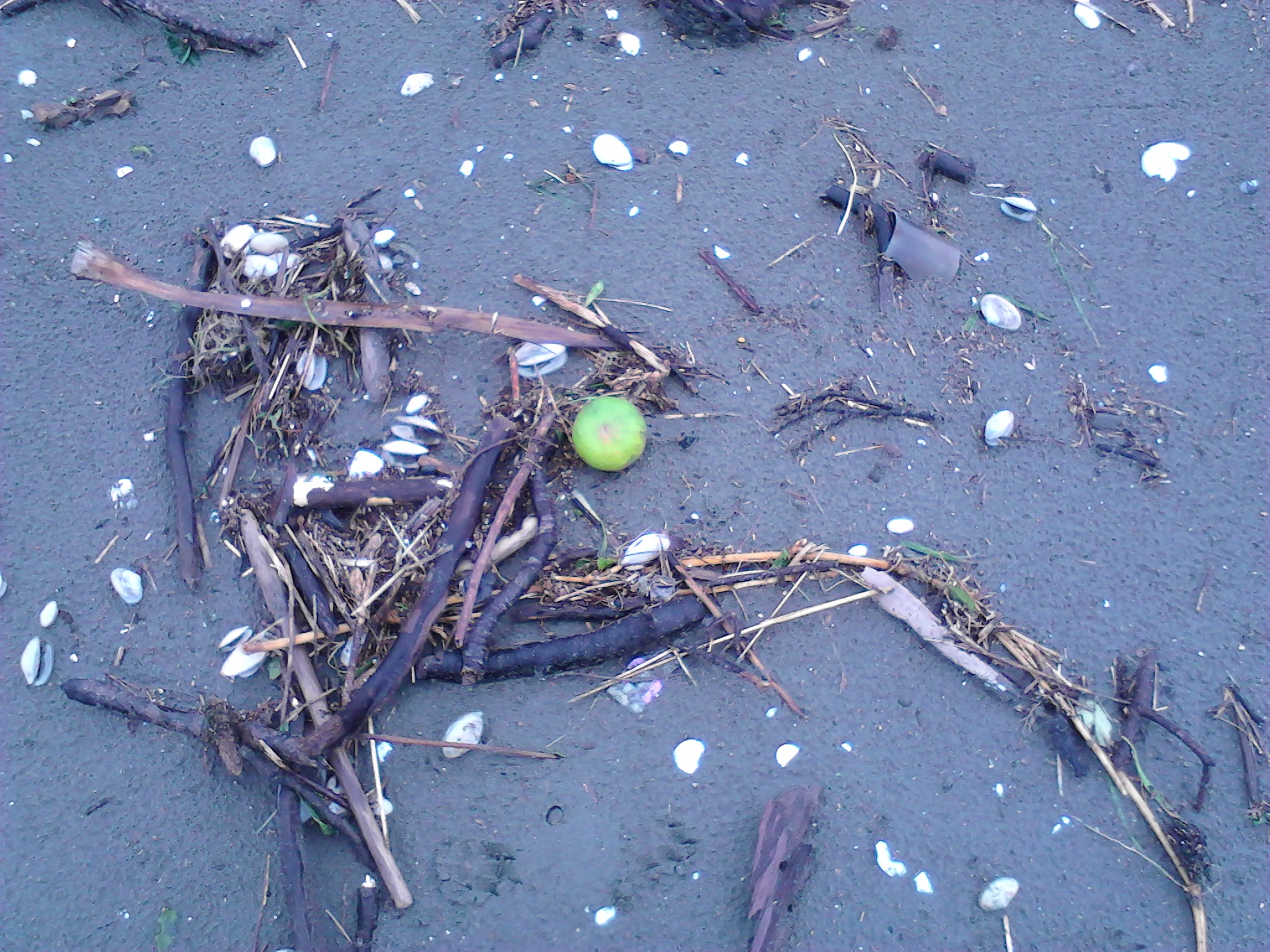
But…. But there are always lemons. Whenever I walk along the beach after a storm, I can almost guarantee that I will find at least one lemon. Why? I don’t tend to find apples, though apples float too. Nor, typically any other fruits. Maybe apples are softer and easily broken up?

Regardless, there are always lemons. Why are there always lemons?

IMG_20130712_133036
Debris with lemon


Predicting the future

Future car!
Future car! (Photo credit: Little Black Cherry)

The farmer fed the chicken every morning at the same. The chicken realised this and ran up to the farmer every morning to be fed. One morning the chicken ran up to the farmer who grabbed it and chopped off its head. This demonstrates the dangers of inductive reasoning. The old turkey was a little more sophisticated however. When asked by a younger turkey when Thanksgiving was, he replied that it was on the fourth Friday in November. The younger turkey was incensed to find out that it was the fourth Thursday in November. The older turkey said to him “Boy, the humans celebrate it on the Thursday, but if I wake up on Friday morning, then I give thanks”.

Induction is looking at the past in a particular way to predict the future. Specifically, induction looks at a series of events in the past to predict the future. The sun has risen like clockwork every day, whether or not you can see it, for as long as anyone can remember and for as long as we can determine from reports from the past. Will it rise tomorrow morning?  I would put money on it because either it will, and I win, or it won’t and it won’t matter because we will almost certainly be dead. The argument comes down to “It has always happened in the past, so it will (or it is extremely like to) happen in the future.

Zabriskie Point at sunrise in Death Valley
Zabriskie Point at sunrise in Death Valley (Photo credit: Wikipedia)

The alternative method of reasoning is deductive reasoning. The deductive argument is that the rising of the sun is a consequence of the rotation of the earth. As the earth rotates, the sun appears to us on the earth’s surface to appear from beneath the horizon and travel across the sky. Actually, it is us who move, a good demonstration of relativity (but maybe I’ll go there another day). The argument goes stepwise from fact to fact and leads inevitably or logically to a conclusion.

Horus, ancient Egyptian God, the Sun God, depi...
Horus, ancient Egyptian God, the Sun God, depicted on papyrus (Photo credit: Wikipedia)

The trouble with this approach is that, for all its logical stepwise approach it is built on two things, a theory and a set of past observations. A scientist has a theory or decides to check a theory, so he does an experiment, and the results of his experiment support or do not support the experiment. The scientist assumes that the theory is true and bases his predictions on this. Unfortunately there is an inductive element to this – if the theory is true for the experiment, there is no guarantee that it will be true for subsequent experiments, even given that ‘ceteris paribus’ (all things remain the same). Some other unconsidered cause could affect the result. The argument is deductive, proceeding in logical steps from the theory, but the practise is inductive – the data has always supported the theory in the past, so it will continue to support the theory in the future.

New Scientist
New Scientist (Photo credit: Wikipedia)

To be fair to the inductivists, todays’ inductivists tend to specify the results of their arguments in terms of probabilities: the probability of the sun rising tomorrow is close to 100%, given that it has always risen in the morning for as far back as we can see, but there is a minute but finite possibility that it won’t for known or unknown reasons.

Let’s consider the case of the sun rising each day and suppose that the fact that the earth rotates is not known. To make the argument more deductive we can postulate causes and so long as the cause fits the facts, we can tentatively label the cause as a hypothesis. Suppose we conjecture that some deity causes the sun to rise each morning. This hypothesis certainly fits the facts and predicts with accuracy that the sun will continue to rise each morning. Such a hypothesis would not be accepted today, of course, except by some individuals.

Mathematical induction can be informally illus...
Mathematical induction can be informally illustrated by reference to the sequential effect of falling dominoes. (Photo credit: Wikipedia)

Is there any great difference between the theist and the scientist? The theist says “all things happen because of God”. The scientist says “all things happen because of the laws of nature”. They both explain things on the basis of their fundamental beliefs.

It is possible that people in the future may look at our theories of the sun rising and other things and consider them naive and consider our view of everything happening according to the laws of nature to be a quaint misunderstanding, in much the same way as many people would consider the “deity hypothesis” to be today.

cubed earth theory
cubed earth theory (Photo credit: Joelstuff V4)

In mathematics the situation is different. Induction is a much more formal process and is applied on top of an axiomatic system. Proved theorems are the results of the applying the axioms repeatedly to another proved theorem or the axioms themselves. Unproven assertions can be proved and turned into theorems or disproved and discarded (or possibly modified so that they can be proved). If something is proved in an axiomatic system, it is true for all time, and cannot be disproved in that system.

Specifically an inductive proof would go something like this: firstly the theorem would be proved for a generic case (eg if statement N is true, then statement N + 1 is true) and secondly it is proved for a specific case (eg statement 1 is true). Then all applicable statements are true because, if statement 1 is true, the generic case means that statement 2 is true, and so on for all cases. Because of the rigor of the argument and the undeniable conclusion of the argument, mathematical inductive proofs are of the same order of reliability as deductive proofs, that is, they are only wrong if there is an error in the logic.

English: Mathematical induction as domino effe...
English: Mathematical induction as domino effect, with text in Esperanto Esperanto: Matematika indukto kiel domen-efiko, kun teksto en Esperanto (Photo credit: Wikipedia)

Why the difference between scientific induction and mathematical induction? Well, I think that it is related to the fact that mathematics is axiomatic and therefore certain, whereas scientific induction is based on the laws of nature which are not and never will be, in my opinion, completely defined. If the basis of your argument is not certain, how can your conclusion be certain?

The End Of Certainty?
The End Of Certainty? (Photo credit: minifig)

There’s a Song in my Head.

Delicate (album)
Delicate (album) (Photo credit: Wikipedia)

(“There’s a song in my head” by Martha and the Muffins 1985 – NOT my kind of music by the way.)


The way the brain works fascinates me. It seems to favour the most unexpected linkages between memories. What brought this to mind was the fact that when I do some daily activity I often find myself humming a particular tune which my brain somehow for some reason links to that task. Now, sometimes it is easy to remember why there is a connection, but other times, I can think of no idea why that particular tune relates to that task.


Cassatt Mary The Cup of Tea 1880
Cassatt Mary The Cup of Tea 1880 (Photo credit: Wikipedia)

Obviously, it is probably true that at some time in the past there was an event, or even events which have caused that linkage to be formed. It may be that the linkage was indirect, through some other occurrence, but in any case the cause of the linkage has been long forgotten.


Evidently linkages can outlive the events that caused them. It may be that some traumatic event caused the linkage, and I have suppressed it. I think that this is unlikely, since it happens too often, and I don’t have that much trauma in my life, I believe!


It may be that my brain favours musical themes as mnemonics. Songs, poetry and repetition (chanting) are often used in schools to help student memorise things. How many days are there in June? And how many of you started mentally reciting that rhyme – “30 days hath September…”?


Knuckle mnemonic for the number of days in eac...
Knuckle mnemonic for the number of days in each month of the Gregorian Calendar. Each projecting knuckle represents a 31-day month. (Photo credit: Wikipedia)

When I make a cup of tea and the tune springs to mind, what is my brain trying to do? (He said, anthropomorphically). Is it trying to remind me of something important? If so, it is likely that the thing that it considers important is important no longer, so my response, when it occurs to me, is one of puzzlement.


There’s another category of “songs in your head” and that is the “mind worm”. I can think of several. There’s the tinkly accompaniment to Gotye’s “Somebody that I used to know”, There’s the Disney “Small World” theme, which may be merely more pervasive and not a true mind worm. Just recently there’s been the rail safety commercial “Dumb ways to die”. By the way, don’t click on the links unless you want the songs in your brain. Too late!
 

The hidden auditorium of my skull
The hidden auditorium of my skull (Photo credit: id-iom)

I can’t think of a good reason for musical mind worms. Maybe, as an offshoot of the remembering process the brain is so susceptible to simple musical phrases that it picks up these tunes because they are simple and memorable and this is the sort of thing that the brain finds easy to recall as well as remember, and each recollection reinforces the memory in a self maintaining endless cycle.

English: Animated Atkinson cycle.
English: Animated Atkinson cycle. (Photo credit: Wikipedia)

The Philosophy of Photography

Photomontage - Composite of 16 different photo...
Photomontage – Composite of 16 different photos which have been digitally manipulated to give the impression that it is a real landscape. Software used: Adobe Photoshop (Photo credit: Wikipedia)

One of my Facebook friends (a photographer) commented on another photographer’s picture, so I got to see the photo too. It was a stunning photograph but an interesting thing for me was the photographer’s description of the ‘post-processing’ that the picture had been subjected to. It was ‘soft’ because of the rain on the lens, but among things the photographer had done to the picture was to alter the contrast, and heightened the colour in the swathes of grass.

Now, I have no issue with post-processing and the photo in question was stunning, but it does raise the question as to at what point a processed photograph becomes less a photograph and more of a different type of work of art! Some people would not consider such a work a proper photograph. One wonders where they would draw the line. Would they, for example, allow that a cropped photo would be, in some sense, OK?

Interestingly (well, I think that it is interesting!) the photographers do it to themselves, too. Apparently a wild life photo was ruled out of a competition because it chopped off the heron’s toes. I’d be pleased to get any sort of a decent photograph of a heron.

A Great Blue Heron flying with nesting materia...
A Great Blue Heron flying with nesting material in Illinois, USA. There is a colony of about 20 heron nests in trees nearby. (Photo credit: Wikipedia)

Photos can be considered dubious for other reasons too. Brian Brake’s photo of a girl enjoying the onset of the monsoon was reputedly created with the aid of a watering can. It’s still a great photograph and does convey meaning and emotion.

Monsoon Girl
Monsoon Girl (Photo credit: colonos) Not the famous Brake picture however.

One of the factors that has perhaps brought such matters to the fore, at least for those who muse about philosophical matters, I suppose, is the digital revolution in photography. Post-processing used to be confined to the dark room, involving the use of dubious chemicals and often highly technical equipment. These days post-processing can be done on a computer, in comfort, with powerful helper programs such as Photoshop, and no chemicals, except possibly a quantity of water tainted with alcohol. And even more important perhaps, mistakes don’t matter so much. If the picture doesn’t turn out OK, hit the delete button and try again starting with the original image.

Photoshop Cow
Photoshop Cow (Photo credit: @Doug88888)

There are (at least) two other categories of photographs that are considered dubious. Photographs taken of glamourous people for glossy magazines are often highly touched up in post-processing, sometimes to an extraordinary extent. The pop singer Beyoncé was reportedly annoyed that her body shape was altered in a clothing commercial in which she starred (as reported by the Huffington Post anyway). The ethics of such ‘photoshopping’ as the above, and the removal of perceived blemishes, emphasis of facial symmetry, feature highlighting and so on are indeed dubious, and can give rise to unrealistic expectations in susceptible people. Against that, most people at least acknowledge that this manipulation of photographs is common, though few suspect the extent to which it goes on.

Popular Beauty Retouch
Popular Beauty Retouch (Photo credit: Tucia)

Secondly, and more troubling, it appears that news related photographs (and video materials) are often ‘doctored’. This could be used to promote a particular philosophy or point of view. For instance the North Korean regime appears to use photo manipulation to overstate its military capabilities. While this is amusing, one can’t help but wonder if our more benevolent regimes also use such alteration and exaggeration extensively. It is known that they do, on occasion, stretch the truth. For example, while TV was showing the successful recovery of the capsule ‘Liberty Bell’ of the fourth Mercury astronautical  test mission from the sea, the capsule was actually sinking in 15,000 feet of water.

Grissom Climbs into Liberty Bell 7
Grissom Climbs into Liberty Bell 7 (Photo credit: NASA on The Commons)

I’m not going to argue one way or the other. No doubt those who alter photographs as an attempt to make them better photographs in whatever way you use the word ‘better’ have the best of intentions. However there is a difference between the person who modifies his photograph to, say, enhance the colour of the grass and the person who manipulates a photograph of a political figure or a model selling hair treatments, or yet the person who modifies a photo for propaganda purposes. But they can all be considered art, even the propaganda. I’m thinking of Leni Riefenstahl, whose propaganda films are certainly art.

Bundesarchiv Bild 146-2004-0020, Polen, Truppe...
Bundesarchiv Bild 146-2004-0020, Polen, Truppenbesuch von Leni Riefenstahl (Photo credit: Wikipedia)