Existence of things – Ontological questions

unfolding
unfolding (Photo credit: ecstaticist)

“Just the two of us”. This song by Bill_Withers encapsulates the idea of a pair of people (male and female from the context) and the separation of the pair from everyone around them. The lyrics assert that “we can make it if we try”, although what “it” refers to is not made apparent. It’s a pleasant, smooth song and serves well enough to introduce my post for this week. I like it.

Eggistentialism 1.5 or Three of a Perfect Pair
Eggistentialism 1.5 or Three of a Perfect Pair (Photo credit: bitzcelt)

The idea of a couple or pair is a concept that acts to separate or compartmentalise one object and another related object from all possible instances of the class of object. Eleven and twelve. Fred Astaire and Ginger Rogers. POTUS and FLOTUS. Mercury and Venus.

It can also relate members of one class of object with another class of object. Seven and fourteen (the seventh natural number and the seventh even natural number).  28th and January. “x” and “y”.

Complete coloring sample of Clebsch Graph with...
Complete coloring sample of Clebsch Graph with 8 colors (Photo credit: Wikipedia)

It can also be a generator of other objects. The number one and the operation of addition leads to two, three, four and so on for ever. (OK, I missed a huge chunk of detail there and it is nowhere near as simple as that).

Another twoism is the concept of opposites. Black and white, top and bottom, man and woman. OK, that last concept is a bit blurry these days, but everyone (with the exception of a few genetically different individuals) is genetically male or female. XY or XX.

DNA, human male chromosomes
DNA, human male chromosomes (Photo credit: Wikipedia)

The big twoism is the concept of existence/non-existence. Is there a river of lava flowing through my garden? No, there isn’t. Such a river does not exist. But if I lived in Iceland or in Hawaii, or in another location near a volcano, such a river might exist. My cat Madonna doesn’t exist, but my dog Ben does.

This seems such a definite concept, but looked at a bit closer, and it begins to get fuzzy. There is in fact a river of lava flowing through my garden! Eh? Well let me start up Minecraft and the world where I’ve been building a garden, with a lava river flowing through it.

Minecraft/DwarfFortress Entrance with Lava Trap
Minecraft/DwarfFortress Entrance with Lava Trap (Photo credit: colmmcsky)

Of course you might argue that the Minecraft world doesn’t really exist. But it does! It exists in Minecraft, and Minecraft exists in this world, so the Minecraft lava river exists in this world. If A exists in B, and B exists in C then A exists in C.

Actually the Minecraft world only exists in my thoughts. I haven’t built a garden in Minecraft and I haven’t got a river of lava flowing through it, but by the logic above, the river of lava exists in my mind in a Minecraft world, my mind exists in the real world, so the river of lava exists. If A exists in B, and B exists in C then A exists in C.

English: illustration for the transitive relat...
English: illustration for the transitive relation Magyar: illusztráció a tranzitivitáshoz (Photo credit: Wikipedia)

Of course, some people might have issues with that logic. Does the lava river really exist? Well, I maintain that it does, but it is necessary to specify that it exists in my mind. Anything that I can think of exists in my mind and since my mind is part of the real world, “anything that I can think of” exists in the real world.

There is a difficulty here. Consider the sentence “The present King of France is bald“.  The issue is whether or not this sentence is true. It would appear not, since there is no present King of France, but the negation “It is not true that the present King of France is bald” is also (apparently) not true. The difficulty is that there is no present King of France, since France is a republic.

Portrait of Louis XIV
Portrait of Louis XIV (Photo credit: Wikipedia)

However “the present King of France” exists in my mind, and the mind of anyone who reads the sentence. The King of France in my mind may be bald or he may not, so the sentence may be true or false, and the difficulty does not arise. Provided we consider the sentence as applying to a mental image of the King of France.

The King of France, bald-headed or not, exists in my mind if I consider him, and my mind exists in the real world so in that sense he exists. What though, of the existence of things that exist in the real world, but differently in one’s mind?

Paradoxes, I
Paradoxes, I (Photo credit: Newtown grafitti)

The British TV Series “Call the Midwife” is set in the 1950s. It is obviously not the 50s. At the time Queen Elizabeth was about to ascend the throne, or had already done so. Does Jenny Lee live at Nonnatus House? Since neither exist in the real world, my argument above applies. However,  consider the question “Has Queen Elizabeth II ascended the throne yet?” We have no difficulty in ascertaining that the question is most likely about a fictitious or historical event, since it is well known that she has been Queen for a long time.

Coronation of Queen Elizabeth II X
Coronation of Queen Elizabeth II X (Photo credit: Wikipedia)

I suggest that the same is true of the bald/not bald King of France. We know that there is no present King of France so can conclude that the King of France in question must be a historical or fictional figure. If I have no preconceptions about the fictitious King of France, I might envisage him in ‘period’ costume with a huge powdered wig (is that in period? I’m not sure), so I would probably guess that he was shaven-headed if not bald. But you might disagree. Your “present King of France” could sport a full head of hair.

One Young Man in a Powdered Wig
One Young Man in a Powdered Wig (Photo credit: Emily Barney)

But what of things that don’t exist in the (loosely speaking) real world, and no one has ever thought about? Do they exist in any sense? I believe that the Universe is deterministic, so any future event or thing, is implied by the current state of the Universe, so if anyone will think of something, or if some event happens in the future, then it exists in the present, and not even simply as a potential. If the Universe is deterministic, it must happen.

I was going to talk about Schrödinger’s cat in the context of existence but he was squeezed out by the present King of France. Maybe I’ll get to the cat in another post.

English: Diagram of Schrodinger's cat theory. ...
English: Diagram of Schrodinger’s cat theory. Roughly based on Image:Schroedingerscat3.jpg (Photo credit: Wikipedia)


Enhanced by Zemanta

The Psi thing

Greek psi
Greek psi (Photo credit: Wikipedia)

I read a book recently, a real paper book, which was called “brain wars” and was written by Mario Beauregard, who is a neuroscience professor at the University of Montreal. The book amounts to an attack on materialist philosophy, arguing that the materialist philosophy cannot explain everything, especially the phenomenon of consciousness and “psi” phenomena.

One of the cornerstones of his argument is based around the dualist notion that mind and brain are separate “things”, and indeed one key section from the text, quoted in the blurb on the dust cover as follows:

The brain can be weighed, measured, scanned, dissected, and studied. The mind that we conceive to be generated by the brain, however, remains a mystery. It has no mass, no volume, and no shape and it cannot be measured in space and time. Yet it is as real as neurons, neurotransmitters, and synaptic junctions. It is also very powerful.

A little later he poses the question that the opponents of Decartes posed : “How, they asked, can an immaterial, mental substance act upon the material brain?”

A diagrammatic section of human brain by René ...

Beauregard later quotes Minsky’s statement “The brain is just a computer made out of meat”. For reasons that he goes into in depth later he states that quantum mechanics “has effectively smashed the scientific materialist worldview.” He then complacently concludes that “(m)aterialistic theories, despite their stubborn persistence in the scientific community, cannot solve the mind-brain problem”.

This despite the fact that Quantum Mechanics is completely materialistic and rational!

Marvin Minsky at the KI 2006 artificial intell...
Marvin Minsky at the KI 2006 artificial intelligence conference in Bremen (Photo credit: Wikipedia)

I believe that Minsky’s view is closer to true than the view that there is more to reality than the materialistic view allows. Beauregard is not a computer scientist so he would not know, in detail, how computers work, under the covers. At a basic level running computer is all about signals. These signals flow through the computer like signals flow through the brain’s network of neurons. (Caveat: I’m not a neuroscientist like Beauregard so I may be misrepresenting his field.)

neuron fractal 1
neuron fractal 1 (Photo credit: Anthony Mattox)

At a slightly higher level, a computer runs an operating system. This is program that runs all the time on the computer, running the programs that the user requires, handling the users input by running other little pieces of code, and handling all the bits of equipment (peripherals) that are connected to the computer. Crucially, the operating system can make the peripherals do things, like print the letter “A” on a sheet of paper, or spit out the sheet from the printer. Special purpose computers are the core of the robots that build cars or assemble toasters and pack them  and label them. They can even sort letters, reading ordinary human writing, much of the time accurately.

Factory Automation with industrial robots for ...
Factory Automation with industrial robots for metal die casting in foundry industry, robotics in metal manufacturing (Photo credit: Wikipedia)

Interestingly people don’t think of robots as mobile computers that can interact with physical objects. The computers in robots run an operating system like your ordinary laptop or desktop, but they are often special versions called “embedded” operating systems.

Open up a computer though, and boot it up. Although you can point to various named parts, like the CPU, or the memory chips, you can’t point to the operating system. It essentially just a pattern impressed on the memory and the various registers and the CPU, and it changes over time. As Beauregard said about the mind, “it has no mass, no volume, and no shape, and it cannot be measured in space and time”. Yet it can influence things, print a letter or paint a car chassis.

June 11, 2007
June 11, 2007 (Photo credit: HeatherKaiser)

It seems that the computer, with its operating system and subsidiary programs, is a good analogy for the brain/mind duality. A big caution here, in that this analogy is just analogy, but it could form the basis of a model of the way that the mind and brain work together. It doesn’t, per se, explain consciousness, but I think that I have, above, provided an explanation of how the supposedly immaterial mind can, through the brain, affect the body, so that we can think above moving a limb, and it happens.

Quantum Physics
Quantum Physics (Photo credit: Jonathan Thorne CC)

Beauregard fastens on “quantum physics” as a possible enabler of psi phenomena, arguing that in quantum physics there is no separation between the mental and the physical. He bases this on what he calls the observer effect : “particles being observed and the observer are linked, and the results of the observation are influenced by the observer’s conscious attempt”.

Hmm. Wikipedia defines the “observer effect” as follows :

In science, the term observer effect refers to changes that the act of observation will make on a phenomenon being observed. This is often the result of instruments that, by necessity, alter the state of what they measure in some manner. A commonplace example is checking the pressure in an automobile tire; this is difficult to do without letting out some of the air, thus changing the pressure. This effect can be observed in many domains of physics.

This is a purely physical effect of measurement – the measuring photon knocks the observed particle slightly off course. Nothing to do with the observer. (A related effect, the Heisenberg principle puts limits on the accuracy with which we can know both the original values of a pair related properties and the subsequent values – roughly speaking).

An optical illusion. Square A is exactly the s...
An optical illusion. Square A is exactly the same shade of grey as square B. See demonstration. (Photo credit: Wikipedia)

I think that Beauregard is actually referring to is an interpretation of quantum mechanics known as the “Copenhagen Interpretation” otherwise known as the “Collapse of the Waveform”. As such he interprets it as saying that the act of observation affects the result of the observation. This is fundamentally not true, because what really happens is that the act of observation merely determines which of probabilities is true. As Wikipedia says :

What collapses in this interpretation is the knowledge of the observer and not an “objective” wavefunction.

In no way does the observer influence the results of the experiment except as a result of the real “observer effect” above, so there is no room there for psi effects.

English: Example of a subject in a Ganzfeld ex...
English: Example of a subject in a Ganzfeld experiment. (Photo credit: Wikipedia)

You may think that I didn’t enjoy the book, but I did! There are unexplained and challenging events described in the book, but I don’t think that it goes anywhere near challenging the materialistic philosophy of science. The only part that I have issue with is when Beauregard challenges what he calls “pseudoskeptics”, those who profess to be skeptics and who are unwilling to look at the evidence for psi phenomenon.

USE IT...
USE IT… (Photo credit: Demetrios Georgalas aka brexians)

In fact these so called pseudoskeptics have probably looked into psi phenomenon at some stage and decided that further consideration is pointless given the diffuse and dubious nature of some evidence and the lack of any information about how this could tie in to or extend in some logical way existing materialistic physics.

Enhanced by Zemanta

Synergy and Emergence

English: Logo used by the Synergy project (htt...
English: Logo used by the Synergy project (http://synergy-foss.org/). (Photo credit: Wikipedia)

I’m fascinated by the phenomenon of synergy. Wikipedia defines it as follows:

Synergy is the interaction of multiple elements in a system to produce an effect different from or greater than the sum of their individual effects.

Giant's Causeway in Northern Ireland is an exa...
Giant’s Causeway in Northern Ireland is an example of a complex emergent structure created by natural processes (Photo credit: Wikipedia)

One man might be unable to move a heavy load, but two men working together might be able to move it easily. Ants individually can only move very small objects, but working together can build very large structures, their nests. Synergy is related to emergent phenomenon, where a complex system shows behaviours which are not apparent in the system’s constituent parts. For example a water molecule cannot said to have the property of “wetness”, but a large collection of water molecules does have that property. Wikipedia defines it as follows:

Emergence is the way complex systems and patterns arise out of a multiplicity of relatively simple interactions.

English: A collage of organisms.
English: A collage of organisms. (Photo credit: Wikipedia)

Synergy and emergent systems are found in all levels of physical and biological systems. In fact the whole of biology could be considered to be an emergent system from physics – animals, plants and other living things are after all, only collections of molecules, and molecules are not, of themselves, alive.

At the highest level of all, consciousness is an emergent system of the synergy of astronomical numbers of brain cells. At the lowest level, all of physics is an emergent system of the state of the universe at the beginning, the Big Bang.

English: Big Bang
English: Big Bang (Photo credit: Wikipedia)

After I wrote that I looked up “emergence” on Wikipedia and found this:

Biology can be viewed as an emergent property of the laws of chemistry which, in turn, can be viewed as an emergent property of particle physics. Similarly, psychology could be understood as an emergent property of neurobiological dynamics, and free-market theories understand economy as an emergent feature of psychology.

The writer of the Wikipedia article is obviously on the same page as me!

water-molecule-vector_500x500
water-molecule-vector_500x500 (Photo credit: Shmector)

Each water molecule has a myriad of properties, none of which is “wetness”. However “wetness” can be explained by considering the behaviour of the various types of bonds that would be formed between water molecules and a consideration of how the molecules would move around each other, and react to other molecules such as those of the surface that the water is placed on. On some surfaces (such as the surface of a leaf) the molecules will organise themselves into “beads”, on others the water will “wet” the surface.

Water Beads
Water Beads (Photo credit: s_gibson72)

Obviously molecules don’t have volition, and the way I expressed the idea above is much too anthropomorphic, and indeed the behaviour can be described by referring to the physical behaviour of the water molecules, and there is nothing particularly mysterious about this, at least at the level at which I am pitching my suggested explanation.

Moving at the Speed of Life ...
Moving at the Speed of Life … (Photo credit: д§mд)

There are other emergent phenomena that are more difficult to explain. Life, for example. Living organisms are made up of various more or less esoteric chemical compounds, including some really, really large molecules. These large molecules (DNA) are made up of a small number of much smaller molecules (bases) which are strung together in the famous double helix. This double helix is folded in complex ways into truly enormous (at a chemical level) structures called chromosomes. These structures encode all the information necessary to create the organism.

Chromosome segregation during mitosis
Chromosome segregation during mitosis (Photo credit: TheJCB)

This in itself is a paradox – a small part of the organisation contains all the information necessary to construct the whole organism. It resembles a bootstrap situation. It seems to me that much of the genetic information  has to be instructions for constructing the information and not a detailed description of the organism.

Cells are complex and are individually alive, in some sense, since they are created, produce offspring and eventually die, but with some exceptions (unicellular organisms) a single cell can’t live on its own.

Chemistry Is What We Are
Chemistry Is What We Are (Photo credit: Wikipedia)

But to get back to the subject, I’ve described (probably pretty badly) a lot of chemistry, but I haven’t been able to describe where life comes from. It’s difficult, but possible, to describe how cells function in a mechanical, chemical sense, but it is not easy to say what it is that makes them alive. You can tell from the over use of bold that I’m having difficulty expressing my meanings here!

Living cells make copies of themselves, but so do some mechanical or chemical processes. Crystals and snowflakes spring to mind. Living cells consume chemicals from their surroundings and so do some complex non-living processes (I’m thinking of weather systems that circulate water and air, but that’s maybe not a good example). Living cells are self organising, altering surroundings to suit themselves, it’s true, but they are simply little complex chemical factories. Where’s the life in that?

A diagram showing a mitochondrion of the eukar...
A diagram showing a mitochondrion of the eukaryotic cell. Mitochondria are organelles surrounded by membranes, distributed in the cytosol of most eukaryotic cells. Its main function is the conversion of potential energy of pyruvate molecules into ATP. (Photo credit: Wikipedia)

In spite of the argument above, it is undeniable that life exists and practically, it is relatively easy to distinguish living things from non-living things. There are some “edge cases” though. Is a virus a living organism or merely a result of a chemical process. At the other end of the scale, is a rain forest a living organism? It certainly contains living organisms, but can the rain forest as an entity be described accurately as a living organism? My answer would be “probably yes” in both cases.

Computational consciousness
Computational consciousness (Photo credit: brewbooks)

The other example of emergence that I want to consider is “consciousness” and its cousin “mind”. We are conscious and we have minds, but are we the only animals that are conscious and have minds? I find the idea unlikely but possible. Animals have evolved over many millions of years and every feature of our bodies has been evolved gradually and incrementally. Our brains have evolved from one or two neurons in one of our ancestor’s bodies and have been incrementally expanded over a long long time.

English: Marine flatworm Pseudobiceros glorios...
English: Marine flatworm Pseudobiceros gloriosus. Lembeh straits, North Sulawesi, Indonesia. Français : Pseudobiceros gloriosus, un plathelminthe. Détroit de Lembeh, nord de Célèbes, Indonésie. (Photo credit: Wikipedia)

But our ancestor was not a human being and many animals with varying sized brains. Our pets and the bird outside the window have evolved from that animal. Consciousness and mind are related to the brain, so it is highly likely that as the brain evolved, so did mind and consciousness, which implies that our pets and the bird in the tree and all other animals with brains has a greater or lesser consciousness and mind.

It is possible, but unlikely that there is some threshold where an increasingly complex brain becomes conscious. My dog acts as if it were conscious and has a mind, but that could be merely a mechanical function of the brain. Personally I doubt it. I think that lower animals like dogs are conscious, have a mind and are self-aware, but at a lower level than humans.

Dog dog
Dog dog (Photo credit: Wikipedia)

There is no test for consciousness so far as I know. Oh, if an unconscious person’s eyelids flicker, we might say that he is “coming round”, but it could be that these mechanical processes could have no consciousness behind them. A similar argument is the “android” argument – if a man is replaced by an android, which has no consciousness or mind, and the android completely emulates the behaviour of a conscious and minded person, how would we tell, and by emulating the behaviour, would the android in fact possess a mind and consciousness?

Android x86
Android x86 (Photo credit: Wikipedia)

That’s another way of putting the question “what is this emergent phenomenon called consciousness, and how does it arise from the way that the brain works”. I’ve read some discussion of this issue by various philosophers, and I still have no opinion on the matter.

This article has expanded to well over my self-imposed target of 1000 words. It is however a subject that I find interesting, and I hope that any readers do so too.

globe of blogs
globe of blogs (Photo credit: shankargallery)
Enhanced by Zemanta

Blogging – how is it going?

blogging
blogging (Photo credit: Sean MacEntee)

When I started this blog, 60-odd posts ago, I had no idea where it was going. Of course I had some ideas on what I wanted. Philosophy, cooking and photography. As it turns out, there’s been a bit of philosophy going on, but it’s not been centre stage, as it were. There’s been a decline in the cooking posts, which I intend to remedy sooner or later, and the photography has been non-existent. That’s because most of my photography has gone into my Facebook page.

So what have I been blogging about? I looked back and, well, I’m surprised to note that my posts, were philosophical in tone, but not necessarily what I’d call “philosophically motivated”, but often triggered by events that have come to my attention either in my personal life or in the media. Some serious and some not serious. As an example this post has turned into a philosophical review of earlier posts.

P philosophy
P philosophy (Photo credit: Wikipedia)

So what can I reflect on over 60-odd posts, apart from my apparent tendency to seek deeper meaning in the relatively trivial? Because I don’t consider my posts to be “deeply meanignful”.

Well one aspect of this one-a-week blogging thing strikes me immediately. I am a procrastinator and my previous attempts at blogging or similar have failed miserably. Currently I am up to 60-odd posts and still going. (Pats self on back). What is different this time?

English: Old gatepost Field openings used to b...
English: Old gatepost Field openings used to be closed by putting posts in the holes. (Photo credit: Wikipedia)

Well, one of the factors I think is WordPress. As a confirmed technophile, I have tried many other solutions, and even tried the DIY approach. I can speak several computer languages like a native, and I can achieve passable programs in several others. I don’t care what language it is, if I want to learn it for anything, it doesn’t take me long. (Note to self: write an article about programming “in the zone” and “thinking in a programming language”!)

WordPress
WordPress (Photo credit: Adriano Gasparri)

WordPress is different in that I don’t have to program anything. I just write my thoughts in a fairly forgiving editor, add a few images and click the “Publish” button. No doubt there are other similar systems out there, but I came across WordPress and it works for me. I can bash out 1000-ish words per week and cast them into the ether, or at least the Internet, and I have achieved my self-imposed goal.

cassini science targets
cassini science targets (Photo credit: Wikipedia)

What happens when it gets out there depends on whether my thinking resonates with others out there on the Internet. I get emails saying that so-and-so “liked” a post, which is nice, or that so-and-so is now “following” my posts, which is nicer, but comments on my posts are rare. Insert not-smiley emoticon. I’m not sure why. Maybe I should solicit and respond to comments? Insert smiley emoticon.

Smiley Rocks
Smiley Rocks (Photo credit: w3i_yu)

Anyhow, I like WordPress and it works for me, but there are probably, almost certainly, other blogging systems that would do as well, each with their own quirks and wrinkles. I wouldn’t presume to say that WordPress is the best or that WordPress is for everyone. But it works for me.

I aim to do approximately 1000 words per post (the editor tells me I’m just over half way there – helpful). I base this on the concept that if the post is too long, it won’t get read to the end, unless it is *really* interesting. I don’t aspire to be more than 1000 words interesting! I think that’s reasonable and I hope it *is* reasonable, otherwise I’m wasting my time.

English: This is a modification of File:200902...
English: This is a modification of File:20090211 thousand words-01.jpg, which I digitally cropped, to remove the title and the copyright notice. (Photo credit: Wikipedia)

When I started this blog, I decided that I would post on Friday or Saturday each week. That has slid out to Tuesday occasionally, but I’m pleased to say that I have maintained the once a week target since I decided to attempt it. Yay! There are personal reasons why Friday and Saturday are not conducive to blog writing, and Sunday is the day that I am (effectively) targetting these days. I’m writing this on a Sunday.

Who am I blogging to? I putting these posts out there, on the Internet, and presumably I hope that someone will read them. Actually, that not as clear cut as all that. While I love the idea that some people might find my posts (ruminations? ramblings?) interesting, I don’t think that I’d be disappointed if nobody read them. If anyone does, please comment with “Hey, Cliff, I read the post.” Extra comments optional!

Duty Calls
Duty calls.

Blogging is a narcissistic occupation. The blogger puts his thoughts out there, on the Internet, because he thinks his thoughts are of some value. Maybe they are, maybe they aren’t. It doesn’t matter to the blogger, or at least to this blogger.  If you figure out the millions of bloggers world-wide and the number of postings that they make per day, it is unlikely that any one blogger is likely to attract a lot of attention. Unless they happen to be President of the United States or something.

I’m always grateful when someone comments on my posts though. I don’t think that the blogging medium is particularly good for having a conversation or discussion though, as I don’t spend a lot of time on it, and I don’t get a huge number of comments. I do know that some people do end up with 1000s of comments on their posts, but those blogs tend to be specialised – political blogs for example. I don’t have such a detailed target, so I’m happy with the few comments and likes that I get.

Models of Blogs: Blog as Participant in Conver...
Models of Blogs: Blog as Participant in Conversation (3 of 3) (Photo credit: robinhamman)
Enhanced by Zemanta

Three philosophers

Morton's Fork in Labels (Extra #252)
Morton’s Fork in Labels (Extra #252) (Photo credit: Cycrolu)

In this post I’m going to talk about three statements about three particular situations which are basically the same. The first one was made by John Morton, Archbishop of Canterbury in the late 15th century. The second was made in the book “Catch 22” by Joseph Heller. And the third was made by Bart Simpson in the Simpson’s cartoon.

Morton’s Fork, as defined in the Wikipedia article linked to above is as follows:

A Morton’s Fork is a specious piece of reasoning in which contradictory arguments lead to the same (unpleasant) conclusion. It is said to originate with the collecting of taxes by John Morton, Archbishop of Canterbury in the late 15th century, who held that a man living modestly must be saving money and could therefore afford taxes, whereas if he was living extravagantly then he was obviously rich and could still afford them.

Obviously there are counter examples to Morton’s assertions. A man living “modestly” may be simply living on a modest income, and a person living extravagantly may well be spending money that he does not have and be sliding into debt. The Wikipedia article does not record whether or not Morton’s Fork succeed in its aim, which was presumably to extract more tax money from tax payers, but I suspect its effect was minimal.

English: Catch 22 With a little imagination th...
English: Catch 22 With a little imagination the bus company could have called this service, seen at Scunthorpe bus terminal, not “Shuttle 22” but “Catch 22”. (Photo credit: Wikipedia)

In Joseph Heller’s novel “Catch 22”, the protagonists are pilots, bombardiers and other aircrew ranks during the second World War. Yossarian and his associates have to contend not only with the enemy, but also with the bumbling stupidity of military rules and the equalling bumbling stupidity or malice of the commanding officers.

Anti-war demonstration, Seattle, Washington, 1...
Anti-war demonstration, Seattle, Washington, 19 March 2007. Marchers head south on Fifth Avenue. Sign: “Iraq: Blood and stupidity”. (Photo credit: Wikipedia)

A good example is the “dead man” in Yossarian’s tent. The man had actually survived a mission in which many of his crew mates had died, but since he had be recorded as having been killed, the military refused to acknowledge his existence. He was forced to live a shadowy existence, living in Yossarian’s tent.

Tent op kamp
Tent op kamp (Photo credit: florisla)

Catch 22 is a non-existent military rule. The book defines it like this:

There was only one catch and that was Catch-22, which specified that a concern for one’s safety in the face of dangers that were real and immediate was the process of a rational mind. Orr was crazy and could be grounded. All he had to do was ask; and as soon as he did, he would no longer be crazy and would have to fly more missions. Orr would be crazy to fly more missions and sane if he didn’t, but if he were sane he had to fly them. If he flew them he was crazy and didn’t have to; but if he didn’t want to he was sane and had to.

Obviously Orr could not want to fly the missions and still be crazy, or be crazy and still want to fly them, so the logical bind fails, and for analogous reasons to Morton’s Fork. Such situations are sometimes referred to as paradoxes, but I don’t think that they are, unless they can be considered a special type of paradox called an antinomy. I think that Morton’s Fork and Catch 22 work by excluding valid situations from consideration, and hence are failures of the logical argument.

Bart Simpson statue
Bart Simpson statue (Photo credit: Gage Skidmore)

In the Simpson cartoon “Bart the Genius”, Bart Simpson cheats his way into a school for intellectually advanced students by stealing another student’s test paper. Bart is pretty much out of his depth from the start, as the other students quickly detect that he is not intellectually advanced as is claimed. In the classroom students are asked to come up with an example of a paradox. Under pressure Bart blurts out “You’re damned if you do, and you’re damned if you don’t”. This is grudgingly accepted as a paradox by the teacher.

Animatie van Olbers paradox Olbers' paradox is...
Animatie van Olbers paradox Olbers’ paradox is the argument that the darkness of the night sky conflicts with the supposition of an infinite and eternal static universe. http://en.wikipedia.org/wiki/Olbers%27_paradox?uselang=en (Photo credit: Wikipedia)

In a marital situation Bart’s formulation is well known. One partner asks a innocuous question. The other party knows that that there are two possible answers, neither of which is going to lead to a positive outcome. “Do you mind if I watch the rugby?” is going to lead to significant grumpiness or an argument if the answer is yes, or a couple of hours of boredom and noise if the answer is no.

Damned if you do and damned if you don’t. Of course couples evolve methods for resolving such issues. Maybe a good book and a gin and tonic in another room is a solution or maybe the rugby might turn out to be interesting after all.

Married
Married (Photo credit: hjrosasq)

Bart’s expression of the idea is slightly different. In the first two the idea is expressed in terms of rules, Morton’s Fork being about tax, and Catch 22 in a rule about sanity and flying dangerous missions. Bart’s is a more general cry from the heart, about the cantankerousness of the world.

Life sucks
Life sucks
Enhanced by Zemanta

Why do people do evil and nasty things?

The Detective Game
The Detective Game (Photo credit: Wikipedia)

It is common in crime dramas on TV for the detective to exclaim “Where is the motive?”.  When the motive is found it goes a long way towards solving the crime. Eventually the perpetrator gives in and confesses or is carried away by the police and the closing credits roll. All good entertainment.

Every crime has a motive of some sort – that is fairly obvious – but some acts in the commission of a crime are very difficult to explain or for which it is difficult to find a motive. A robber may rob a store and on his way out, he may smash something or cause some damage. A burglar may steal from a house and then turn on all the taps or knock holes in walls or do even more obnoxious things.

Suprunyuck photographed with a hammer; the cou...
Suprunyuck photographed with a hammer; the court described the motive of the killers as “morbid self-affirmation.” (Photo credit: Wikipedia)

The reason that they do such things is a mystery to me. It’s not as if their original nefarious plans would have included such actions, I imagine, in so far as they had plans anyway. The only thing that I can think of is that it is a throwback to some distant time when an invading force (such as a Viking  band) would rape any women they came across, kill any men, steal any valuable goods, and burn down the houses.

Rape, pillage, kill and destroy. Raping the women and killing the men would ensure that the invaders genes would spread at the expense of the victims’ genes and destroying the houses would demonstrate the invaders’ power and discourage the victims from following and seeking revenge. I’m not sure if this is a likely motive for such ancillary acts in the commission of a crime.

viking
viking (Photo credit: What What)

Mass killers are another group where it is difficult to image what the motive for their crimes is. We tend to think of mass killers as a new phenomenon, but I’m not sure that they are. The earliest one that I can think of is “Jack the Ripper” who operated 1888. He was an instance of a subset of mass killers, a serial killer. Another type of mass killer is the person who open fires usually more of less indiscriminately in a public place. John Brunner’s 1968 prophetic novel “Stand on Zanzibar” calls such people “muckers” from the work “amok”.

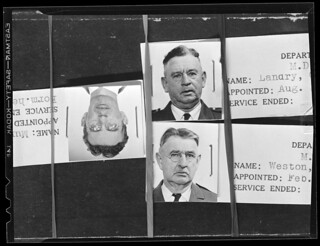
2 Bridgewater inmates kill 3 guards: sets fire...
2 Bridgewater inmates kill 3 guards: sets fire to building housing 545. State Farm guards killed by 2 inmates who ran amok in the Bridgewater institution yesterday. Frank L. Weston, Howard V. Murphy and George Landry. – Boston Herald (Photo credit: Boston Public Library)

I suspect that mass killers have been part of the human race for a very long time. In the bible Herod orders the “Slaughter of the Innocents”, which could be considered an early mass killing. Even if the event was made up by the gospel writer it was likely to have been based on some other real event. There is a story in the Old Testament about the killing of the Canaanites (the people who inhabited Canaan before Moses and his followers took over the land), a mass murder or genocide which is discussed (from a Christian perspective) in this article. Whether or not you believe the bible to be the word of God, or merely a collection of folk tales this could be construed to be evidence that mass killings have occurred for millennia.

English: A Land Flowing with Milk and Honey, i...
English: A Land Flowing with Milk and Honey, illustration from Henry Davenport Northrop’s 1894 “Treasures of the Bible” (Photo credit: Wikipedia)

After hunting about on theInternet for a while I came across the names of two serial killers,  Gilles de Rais and Elizabeth Bathory. I guess that while these two cases are the most prominent and remembered there have almost certainly been others that have not been recorded, or that I have missed.

de Rais’ motives appear to be purely sexual, and strongly sadistic, since there was no monetary or other advantage to him. Elizabeth Bathory’s motives do not on the face of it appear to be sexually motivated and appear pure sadistic. However, it is hard to tell for sure as I don’t believe that investigations would have been rigorous in those days and rumour and speculation was apparently often taken as fact.

Français : Exécution de Gilles de Rais (gibet ...
Français : Exécution de Gilles de Rais (gibet et bûcher). Armes du président Bouhier (Photo credit: Wikipedia)

It’s pretty certain that people like these are not normal, whatever normal is. As such I don’t think that we can guess their real motives, if they had any. They appear to be driven by urges which they were unable to control, and de Rais is supposed to have exhibited remorse, although that didn’t seem to stop him.

In modern times, there seems to be an increase in a particular sort of killing. This is where the perpetrator, usually a teenager or fairly young person, takes a gun into a public place and more or less indiscriminately  starts shooting, killing as many people as he can, before he is killed by the police or commits suicide. Of course, the ready availability of guns and ammunition facilitates these killing sprees – you probably couldn’t kill many people in a short time with a bow and arrow or a spear or a sword.

Boston Marathon 2013 ... Confronting Terror in...
Boston Marathon 2013 … Confronting Terror in Boston — Find ways to help (April 16, 2013 / 6 Iyar 5773) …item 2.. Meditation and Sleep Music — 30 minutes …item 3.. Mail Online – Daily Mail — WARNING: GRAPHIC CONTENT … (Photo credit: marsmet547)

Many of the perpetrators of these mass killings seem to be maladjusted or social outcasts, who are often fans of guns and weaponry. As outcasts, it is probably to simplistic to assume that their actions were some sort of revenge against society or against people around him, but that could possibly be a factor.

I don’t think that I have really answered the question I raised when I started this piece. People who are not extreme, as these killers are, can’t reliably guess the killers’ motives, I guess. What is apparent is that the killers don’t appear to have much control, if any, over their actions. It seems that the way to stop similar mass killings is to locate the killers before they have killed. It doesn’t seem that short of locking them up, there is any way to prevent them killing. Some potential killers have been given drugs and some killers have previously received drugs, but stopped taking them for one reason or another. All in all, I think that society is a long way from understanding the phenomenon of mass killers.

Forensic sketch of the Unabomber, commissioned...
Forensic sketch of the Unabomber, commissioned by the FBI, drawn by Jeanne Boylan. This copy was found at the url: http://members.aol.com/alvertc/Sketch.gif. According to Encarta, the drawing was released by the FBI in 1987. (Photo credit: Wikipedia)

I’ve had a lot of trouble writing this piece. Once I started I was determined to complete it, but I made at least two starts. My first start tended towards being an apologia for Naziism and I definitely didn’t want my piece to be that! The Nazis started from an invalid premise (the superiority of the Aryan race and the consequential inferiority of the other races) and their flawed logic led to the concept of racial cleansing. That together with the erroneous idea that the Jews caused the surrender of Germany at the end of the First World War did not justify their horrendous actions.

English: Adolf Hitler
English: Adolf Hitler (Photo credit: Wikipedia)

Hopefully I’ll hit on a much lighter topic next week.

Sun Rising in Kuakata, Bangladesh
Sun Rising in Kuakata, Bangladesh (Photo credit: Wikipedia)
Enhanced by Zemanta

Yellow

English: yellow traffic light Español: señal d...
English: yellow traffic light Español: señal de tráfico amarilla Deutsch: gelbes Verkehrszeichen Français : feux de signalisation jaunes Italiano: segnale stradale giallo (Photo credit: Wikipedia)

I believe that some firm or other once tried to patent the colour yellow, but I’ve not be able to track this down so far. Although this sounds silly, I believe that the firm extensively used the colour yellow in all its adverts and publicity material and believe that people identified the firm’s adverts by the blocks of yellow colour used in the adverts and that a competitor could take advantage of this by using adverts with similar blocks of yellow. One can see where the firm was coming from, of course, but thankfully the attempt failed I believe.

Yellow is, in the societies that I have lived in anyway, associated with sun, well-being, summer and generally good and beneficial things. In subtractive combinations of colours, yellow, along with magenta and cyan are the primary colours. Many computer printers use these three colour. When I was researching this post I found that computer screens use additive combinations and the primary colours are red, green and blue. (“Research” is a fancy name I use for Googling for something – I usually end up at Wikipedia, so ‘caveat emptor‘!) Apparently the reason that there are three primary colours is that the human eye contains three types of cone cells, and each type is most sensitive to one of the ‘primary colours’.

English: Three doors in Wilmington Square Thre...
English: Three doors in Wilmington Square Three adjacent doors in the primary colours in one corner of the square. (Photo credit: Wikipedia)

Some animals have four types of cone cells and thus would see four primary colours. According to the Wikipedia article on the subject some human females may have four types of cone cells. Most placental mammals seem to have only two types of cone cells so can only distinguish two primary colours. As Wikipedia says, it would be wrong to suggest therefore the world ‘looks tinted’ to them. It would look normal to them.

I said above that the colour yellow is generally associated with positive things, like summer, warmth and other things. It is however also associated with cowardice, but I haven’t really been able to find out why. This Yahoo Answer is inconclusive, for example. The best answers, in my opinion, relate it to the ‘yellow bile’, one of the four fluids that were assumed to circulate around the human body. It was assumed that one character was determined by the balance of these four ‘humours’.

English: An un-official 80cm FITA archery targ...
English: An un-official 80cm FITA archery target Italiano: un bersaglio FITA non ufficiale da 80cm per il tiro con l’arco (Photo credit: Wikipedia)

Hmm, what else about yellow? The centre of an archery target is yellow, although it is often referred to as ‘gold’ for some reason. Interestingly, in the obviously related sport of darts the centre ring is red or black. Rifle shooting, which also uses a target of concentric circles, uses only black and white, with the circles quartered and the inner circles all coloured black, the outer ones being white.

Yellow flags flown on a ship used to indicate that the vessel had a contagious disease on board. A plain yellow flag stands for the letter ‘Q’ in semaphore core and the speculation is that this was used because it was the initial letter for the word ‘quarantine’. The Wikipedia articles says that these days the plain yellow flag is used to indicate that a vessel is free of contagious disease and requests boarding for customs inspection. I had not heard of that change of meaning, but then again, I’ve not had need to raise a yellow flag! The current flag used to indicate contagious is a quartered yellow and black flag which stands for the letter ‘L’ in semaphore code.

Edited version of Image:Color_icon_blue.svg.
Edited version of Image:Color_icon_blue.svg. (Photo credit: Wikipedia)

In many cases yellow is used to indicate warnings as in ‘yellow alert’. A yellow alert is usually one level below a red alert which is usually the top level of seriousness.  Generally a yellow alert means ‘avoid, take care, and be alert’. The GeoNet site currently shows a yellow alert level for the volcano called ‘White Island’ which is around 50k from the coast of New Zealand. The volcanoes on the mainland are currently quiet. Incidentally if you look closely at the Crater Floor image at the bottom right you will see Dino the Dinosaur quietly monitoring the volcano as he has done for several years.

Warning sign.
Warning sign. (Photo credit: Wikipedia)

Animals are often referred to as ‘yellow’ although it might be more accurate to describe them as ‘light brown’. Some birds, however, are definitely yellow and domestic canaries have given their name to the colour ‘Canary Yellow’. The Yellowhammer, introduced into New Zealand from Britain is a handsome bird with a yellow head breast and belly, marked with black, and with a yellowish brown back. They can form quite large flocks and are probably more numerous in New Zealand than they are back in Britain (as are many European species). The American Yellow Warbler is also a fine yellow plumaged bird.

A Yellowhammer on North Island, New Zealand.
A Yellowhammer on North Island, New Zealand. (Photo credit: Wikipedia)

There are some yellow animals and someone has made a collection on this web page. Most appear to be cold blooded or insects, but there are a few ‘yellow’ mammals. The mammals don’t look particularly yellow actually, but the snakes, spiders and crabs certainly are. Some albino animals (eg ferrets) tend to look distinctly yellow at times.

English: Tree with yellow leaves in autumn
English: Tree with yellow leaves in autumn (Photo credit: Wikipedia)

In autumn (fall) leaves on some trees go yellow, while species have leaves that turn red. This is because the chlorophyll which is green is lost in the autumn as the trees prepare for winter. Many flowers, like the buttercup, have yellow flowers and domestic plants like the tulip or the rose have been bred to have yellow blossoms too. Daisies also have yellow centres and I’ve seen speculation that yellow plants are the colour that they are because the pollinating insects are sensitive to that colour, which makes sense, but I’m not sure if that is the whole story, since I believe that most insects’ eyes are most sensitive to ultraviolet. The pollen that the insects inadvertently transfer from flower to flower is often yellow.

English: Daisy (Bellis perennis), Wellington, ...
English: Daisy (Bellis perennis), Wellington, New Zealand (Photo credit: Wikipedia)

Finally to end this ramble through the colour yellow, I’ll just mention that the inanimate world also has yellow chemicals. The element sulphur is the obvious one, though some Chromates, some Iron compounds, and lead iodide are examples of yellow compounds. In addition chemists (and almost any schoolboy) who have put sodium compounds into a flame will be familiar with the deep yellow colouration of the flame that results. It’s often the first step in the analysis of a compound.

Sulfur
Sulfur (Photo credit: d4vidbruce)

Why does cancer spread?

The Human Body -- Cancer
The Human Body — Cancer (Photo credit: n0cturbulous)

Everyone, I’m sure, knows of someone who has died of cancer. It’s a disease that is wide-spread and seems to be more common now that other diseases are coming under control. It may be that cancer is certain to appear in the human body if it lives long enough. There’s a cheery thought.

Wikipedia describes cancer as follows: “known medically as a malignant neoplasm, (it) is a broad group of diseases involving unregulated cell growth. In cancer, cells divide and grow uncontrollably, forming malignant tumours, and invade nearby parts of the body”.

Cross section of a human liver, taken at autop...
Cross section of a human liver, taken at autopsy examination, showing multiple large pale tumor deposits. The tumor is an adenocarcinoma derived from a primary lesion in the body of the pancreas. (Photo credit: Wikipedia)

There’s two parts of this definition. Firstly there is the unregulated cell growth and secondly there is the spread of the growth to other parts of the body. The unregulated cell growth is usually attributed to a number of causes, but the mechanism is usually given as damage to the genetic material. The causative agent whatever it might be, damages the genetic material and this results in a huge proliferation of cells.

I write computer programs as tools for doing my job. Each program ends up as a string of data which a human has a hard time decoding, though of course the computer hardware has no problems. The effect of changing a single bit (actually, a byte) of a program would almost certainly cause it to crash. In so far as the analogy that the genetic code resembles a computer program holds, this indicates that a random change to the genetic code would most likely result in the death of the cell. It would require a specific hit, to say a piece of code that control the termination of a loop that would let the program “grow out of control”.

Out of memory ATM
Out of memory ATM (Photo credit: RuiPereira)

I’d guess, from a position of almost total ignorance, that changes to the cells in the body occur all the time. Changes happen to the genetic code in a cell, and it almost certainly dies. (A side question is : what exactly happens to a cell when it dies? Presumably some process or other ‘detects’ the death and breaks it up? Or does the first failure cause other processes to fail until the integrity of the cell is lost? Lots of questions). However, unless the failure is dramatic, explosion-like rather than simple deflation, it should not affect its neighbouring cells, should it? So in general the death of a single cell is probably not noticeable.

Going back to the computer program analogy, in a computer there are dozens, if not hundreds of programs running all the time, but the user is not aware of any other than the one he is interacting with. Equating cells with computer programs, it is most likely that a random change would cause a program or a cell to die, with little effect on the computer or body as a whole.

Facit computer memory
Facit computer memory (Photo credit: liftarn)

All the programs running in a computer need ‘memory’ to run in, and there is a limited supply of memory, so (conceptually at least) one program is given the task of managing the memory allocations. Damaging the memory manager program could theoretically lead to it repeatedly allocating memory until there was none free for allocation. The computer would, once again, crash. If a program is damaged in a particular way it could ask repeatedly for memory and again cause itself or other programs. or even the whole computer to crash.

In a living organism there does not seem to be a single equivalent of the ‘memory manager’ or ‘resource manager’. In a living organism everything seems to be done by consensus between cells. (That is both anthropomorphic and probably naive, but it will do, I think).

So, although I’d estimate that the vast majority of changes to the genetic code would result in cell death and nothing else, a very, very small number of changes could result in the cell soaking up as much of the cell-level resources as it can and damaging the cell itself, its neighbouring cells or the whole organism.

Genetic code
Genetic code (Photo credit: Martina Gobec)

That, however, is not cancer. For damage to result in a cancer it has to damage the cell in a particular way. In a computer, cancer would be analogous to a program continually creating copies of itself and using up all the system resources, which would result in the system crashing. Almost all cells have the ability to duplicate themselves, but whether or not they do replicate is, so far as I know, determined by the conditions in the cell itself and conditions in its environment, ie the surrounding cells, possibly signalled by chemicals or chemical gradients.

For a cell to become cancerous, it first of all must be inclined to duplicate itself and it would also have to be able to ignore any signals from its environment. The damage to the genetic structure to achieve this seems to me to be remarkably specific. Its like damaging a computer program in such a way as to destroy a control loop. Possible, but not very likely.

Main sites of metastases for some common cance...
Main sites of metastases for some common cancer types. Primary cancers are denoted by “…cancer” and their main metastasis sites are denoted by “…metastases”. List of included entries and references is found on main image page in Commons: (Photo credit: Wikipedia)

Then there is the issue of metastasis. This is how cancer spreads. It first of all attacks the boundary of the organ it is embedded in, then some cancer cells migrate into other organs. Interestingly, when they start to form a cancerous tumour in the new organ, they are still identifiable as cells from the original organ.

Think for a moment about what that means. A cancer which metastasizes has to have its genetic material damaged in such a way that it can do all of the following :

  • divide in an uncontrolled manner
  • attack the walls of the organ it is contained in
  • migrate to other organs (and it can be very specific about the organs it migrates to)
  • settle there and start to divide again

That’s a remarkably specific set of actions to occur as the result of damage. Damage usually results in less efficient operation, both of computer programs and bodies. Of course the damage doesn’t have to create these action ‘programs’ in the genetic material. They may be already there. All that the damage needs to do is somehow kick off those actions in sequence to cause the cancer to form and metastasize. To a programmer it would look like a small chunk of code to call those routines which I’ve called ‘actions’. The only other time in one’s life that one’s body experiences explosive growth and cell migration is in the womb and as a young child. One can imagine that damage could somehow kick off the genes or part of the genetic code that was used when one was a developing foetus.

foetus
foetus (Photo credit: Leo Reynolds)

This is easier to contemplate than damage which somehow creates the whole process from scratch. It does imply that the damaging agent somehow attacks a specific part of the genetic material and replaces it with some very specific other material that has the specific effect of kicking off explosive growth and metastasis.

I’m not geneticist or cancer specialist of course, so my musings above may be way, way off beam. They could be and probably are complete rubbish. I can’t and won’t defend them if anyone were to attack them. My main thesis is that it seems incredibly unlikely that damage to the genetic material could cause the specific effects of cancer, which are uncontrolled growth and metastasis.

Yet cancer happens and happens frequently and in varied ways. There are many sorts of cancer and they appear to be often triggered by specific stimuli. All my arguments above founder on that logical rock.

Shipwreck
Shipwreck (Photo credit: Wikipedia)

Where do ideas come from?

ideas
ideas (Photo credit: Sean MacEntee)

I was watching this on Youtube, and I found myself saying “Yes, but…”. What Stephen Johnson says in there is all true. I like his idea of a “slow hunch” that takes several years or decades to develop. Stephen’s environmental approach looks at the places that provide the environment where ideas flourish, such as coffee shops which flourished in the 17th century and later. The Wikipedia article notes that

Though Charles II later tried to suppress the London coffeehouses as “places where the disaffected met, and spread scandalous reports concerning the conduct of His Majesty and his Ministers”, the public flocked to them.

Apparently Charles did not like the new ideas emanating from the coffee shops and thought that doing away with them would do away with the ideas. I’m not so sure – the discussion groups from the coffee shops would almost certainly have moved elsewhere.

Lloyd's Coffee House
Lloyd’s Coffee House (Photo credit: Wikipedia)

Ideas certainly sprang from the coffee houses which mutated into or gave rise to the London Stock Exchange, Lloyd’s of London and some famous auction houses. I refer you to the Wikipedia article.

Stephen Johnson describes the environments that provide fertile ground for new ideas, and similar places have been invented and reinvented over the years. While Universities were, I believe, originally set up as places for the studying of religion, the concentration of bright people and the opportunities for discussion inevitably led to ideas which were not to the taste of the religious establishment.

Victoria University, Kelburn, Wellington, New ...
Victoria University, Kelburn, Wellington, New Zealand. (Photo credit: Wikipedia)

My “yes, but..” in relation to the Youtube article was not in relation to the matters Johnson discusses, which was the types of environments that favour new ideas, but how the ideas are formed in the human brain. Johnson talks about one person having “a piece of the puzzle” that completes a new idea, but I think that that is an oversimplification. I see it more like a huge floating jigsaw puzzle, with no edges and maybe many many puzzles. Each person gets millions of puzzle pieces and each person does his or her best to fit together as many pieces as possible and some of the pieces may be assembled incorrectly. I’m thinking of the “Intelligent Design” people when I write that.

a drawing of a 4 piece jigsaw puzzle
a drawing of a 4 piece jigsaw puzzle (Photo credit: Wikipedia)

An idea in that model is simply a realisation that that piece or pieces of the puzzle over here seem to fit with the piece or pieces over there. Any idea is based on innumerable prior ideas or realisations.

Ideas also seem to change over time. I think that I recall that when the idea that white light can be split into many colours was first put to me I accepted it with some reservations. Sort of “If you say so”. But today it seems obvious to me, though it can be that probes into the obvious turn up the un-obvious.

Classic Albums: Pink Floyd – The Making of The...
Classic Albums: Pink Floyd – The Making of The Dark Side of the Moon (Photo credit: Wikipedia)

So where do ideas come from? I’m uncertain. I’m not sure that there aren’t several sources of new ideas, but one that I keep coming back to is that there might be some process in our brains of which we are not conscious that continually and somewhat dumbly searches the puzzle pieces and tries to fit them together. It probably has guidance rules that say that, metaphorically, knobs must fit into sockets, there should be no gaps or space between puzzle pieces.

I call the process dumb because it seems to favour picking close by pieces, and it seems to repeatedly try the same configurations that have failed previously. I say this because sometimes, looking at a fact a new way or introducing a concept from another field may result in a totally new solution to a problem.

Visual Example of the Eight Queens backtrack A...
Visual Example of the Eight Queens backtrack Algorithm (Photo credit: Wikipedia)

I’m aware that I’ve used the word “idea” in a number of senses above, but I hope that it doesn’t detract too much from the argument. I’m also aware that I’ve stretched the jigsaw analogy well beyond the bounds!

As a final comment, I think that people misunderstand the Eureka Moment. The moment occurs not when one solves the puzzle, but the moment that one realises that the puzzle is solved. For instance, when a mathematician works on a proof he may get stuck on a particular step. He may try several solutions, proceeding from the solution under test through several other steps in the proof before he discovers the solution which works. The Eureka Moment happens when he discovers that the solution he is trying is the correct one, not when he chooses the solution. A subtle but definite difference.

archimedes
archimedes (Photo credit: Sputnik Beanburger III)

Summer, Autumn, Winter and Spring

Revolving earth at winter solstice on the nort...
Northern winter solstice

On 21st June we in the Southern Hemisphere get our shortest day of the year. This corresponds to the longest day in the Northern Hemisphere of course, and my wall calendar, which originates from the Northern half of the planet says that 21st June is the start of summer. I believe that the official start of winter, here in New Zealand, is 1st June.

That started me thinking. One would expect that 21st June, the southern winter solstice, would be the middle on winter, since the earth is tilted furthest away from the sun in southern latitudes at that date, and that the seasons would change mid way between the solstices and the equinoxes in both hemispheres for similar reasons. The equinoxes are the days when the night and days are the same length in both the northern and southern hemispheres. (Pedants will notice that I’m not being precisely correct in my explanations of equinoxes and solstices, but that doesn’t matter for my purposes.)

English: Two equinoxes are shown as the inters...
Equinoxes

It is obvious to anyone who has reached a sufficient age that the warmest and coldest parts of the year don’t correspond to the solstices and that the change from higher than average temperatures to lower than average temperatures and vice versa don’t happen at the equinoxes, though these latter events are probably not that noticeable. There is obviously some seasonal lag.

Image representing Wikipedia as depicted in Cr...

So I browsed to Wikipedia, which is a useful place to start, even if some people question its accuracy and veracity. I’ve not found it too bad, myself. Sure enough, there is an article on seasonal lag, and I’ve no reason to doubt the information there. To summarise, the authors of the article attribute the lag to the oceans which, because of the latent heat of their water absorb heat energy and release energy as the seasons change. I’m not sure that I completely understand the reasons for this, but there are undoubtedly deeper analyses on the Internet. The Wikipedia article contains one reference.

Apparently the seasonal lag is different in each half of the year. I believe that means that the four seasons are not all equal in length. Hmm, summer does seem shorter than the other seasons, but that may be only subjective. However, our shortest day is only four weeks away, so we will at least be seeing more daylight each day from then on. We will be on the upwards slide to Spring and Summer, even though Winter will not have bottomed out, and we can look forward to barbecues and a summertime Christmas!

Pohutakawa
Pohutakawa flowers. They bloom at Christmas, in early summer.