Existence of things – Ontological questions

unfolding
unfolding (Photo credit: ecstaticist)

“Just the two of us”. This song by Bill_Withers encapsulates the idea of a pair of people (male and female from the context) and the separation of the pair from everyone around them. The lyrics assert that “we can make it if we try”, although what “it” refers to is not made apparent. It’s a pleasant, smooth song and serves well enough to introduce my post for this week. I like it.

Eggistentialism 1.5 or Three of a Perfect Pair
Eggistentialism 1.5 or Three of a Perfect Pair (Photo credit: bitzcelt)

The idea of a couple or pair is a concept that acts to separate or compartmentalise one object and another related object from all possible instances of the class of object. Eleven and twelve. Fred Astaire and Ginger Rogers. POTUS and FLOTUS. Mercury and Venus.

It can also relate members of one class of object with another class of object. Seven and fourteen (the seventh natural number and the seventh even natural number).  28th and January. “x” and “y”.

Complete coloring sample of Clebsch Graph with...
Complete coloring sample of Clebsch Graph with 8 colors (Photo credit: Wikipedia)

It can also be a generator of other objects. The number one and the operation of addition leads to two, three, four and so on for ever. (OK, I missed a huge chunk of detail there and it is nowhere near as simple as that).

Another twoism is the concept of opposites. Black and white, top and bottom, man and woman. OK, that last concept is a bit blurry these days, but everyone (with the exception of a few genetically different individuals) is genetically male or female. XY or XX.

DNA, human male chromosomes
DNA, human male chromosomes (Photo credit: Wikipedia)

The big twoism is the concept of existence/non-existence. Is there a river of lava flowing through my garden? No, there isn’t. Such a river does not exist. But if I lived in Iceland or in Hawaii, or in another location near a volcano, such a river might exist. My cat Madonna doesn’t exist, but my dog Ben does.

This seems such a definite concept, but looked at a bit closer, and it begins to get fuzzy. There is in fact a river of lava flowing through my garden! Eh? Well let me start up Minecraft and the world where I’ve been building a garden, with a lava river flowing through it.

Minecraft/DwarfFortress Entrance with Lava Trap
Minecraft/DwarfFortress Entrance with Lava Trap (Photo credit: colmmcsky)

Of course you might argue that the Minecraft world doesn’t really exist. But it does! It exists in Minecraft, and Minecraft exists in this world, so the Minecraft lava river exists in this world. If A exists in B, and B exists in C then A exists in C.

Actually the Minecraft world only exists in my thoughts. I haven’t built a garden in Minecraft and I haven’t got a river of lava flowing through it, but by the logic above, the river of lava exists in my mind in a Minecraft world, my mind exists in the real world, so the river of lava exists. If A exists in B, and B exists in C then A exists in C.

English: illustration for the transitive relat...
English: illustration for the transitive relation Magyar: illusztráció a tranzitivitáshoz (Photo credit: Wikipedia)

Of course, some people might have issues with that logic. Does the lava river really exist? Well, I maintain that it does, but it is necessary to specify that it exists in my mind. Anything that I can think of exists in my mind and since my mind is part of the real world, “anything that I can think of” exists in the real world.

There is a difficulty here. Consider the sentence “The present King of France is bald“.  The issue is whether or not this sentence is true. It would appear not, since there is no present King of France, but the negation “It is not true that the present King of France is bald” is also (apparently) not true. The difficulty is that there is no present King of France, since France is a republic.

Portrait of Louis XIV
Portrait of Louis XIV (Photo credit: Wikipedia)

However “the present King of France” exists in my mind, and the mind of anyone who reads the sentence. The King of France in my mind may be bald or he may not, so the sentence may be true or false, and the difficulty does not arise. Provided we consider the sentence as applying to a mental image of the King of France.

The King of France, bald-headed or not, exists in my mind if I consider him, and my mind exists in the real world so in that sense he exists. What though, of the existence of things that exist in the real world, but differently in one’s mind?

Paradoxes, I
Paradoxes, I (Photo credit: Newtown grafitti)

The British TV Series “Call the Midwife” is set in the 1950s. It is obviously not the 50s. At the time Queen Elizabeth was about to ascend the throne, or had already done so. Does Jenny Lee live at Nonnatus House? Since neither exist in the real world, my argument above applies. However,  consider the question “Has Queen Elizabeth II ascended the throne yet?” We have no difficulty in ascertaining that the question is most likely about a fictitious or historical event, since it is well known that she has been Queen for a long time.

Coronation of Queen Elizabeth II X
Coronation of Queen Elizabeth II X (Photo credit: Wikipedia)

I suggest that the same is true of the bald/not bald King of France. We know that there is no present King of France so can conclude that the King of France in question must be a historical or fictional figure. If I have no preconceptions about the fictitious King of France, I might envisage him in ‘period’ costume with a huge powdered wig (is that in period? I’m not sure), so I would probably guess that he was shaven-headed if not bald. But you might disagree. Your “present King of France” could sport a full head of hair.

One Young Man in a Powdered Wig
One Young Man in a Powdered Wig (Photo credit: Emily Barney)

But what of things that don’t exist in the (loosely speaking) real world, and no one has ever thought about? Do they exist in any sense? I believe that the Universe is deterministic, so any future event or thing, is implied by the current state of the Universe, so if anyone will think of something, or if some event happens in the future, then it exists in the present, and not even simply as a potential. If the Universe is deterministic, it must happen.

I was going to talk about Schrödinger’s cat in the context of existence but he was squeezed out by the present King of France. Maybe I’ll get to the cat in another post.

English: Diagram of Schrodinger's cat theory. ...
English: Diagram of Schrodinger’s cat theory. Roughly based on Image:Schroedingerscat3.jpg (Photo credit: Wikipedia)


Enhanced by Zemanta

Little Green Men revisited.

Offset Gregorian antenna used in the Allen Tel...
Offset Gregorian antenna used in the Allen Telescope Array, a radio telescope at the University of California at Berkeley, USA. (Photo credit: Wikipedia)

I’m going to continue the LGM theme. I don’t plan on doing multiple posts on a single subject very often, but there were some things that I want to add to my previous post.

It seems to me that the difficulties of point to point interstellar communication are such that it makes it unlikely that we will be able to find LGM by searching for intentional broadcasting or unicasting of signals, for the reasons that I raised in the previous post. There are other reasons that I haven’t touched too.


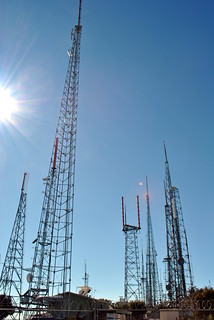
Radio Transmission Towers Atop Mt. Wilson
Radio Transmission Towers Atop Mt. Wilson (Photo credit: FastLizard4)

One big question is one that occurs to me, probably because I am a computer professional. Why would a civilisation want to be found? If you broadcast something on the Internet, you attract all sorts of undesirables trying to access your systems, your data, your private stuff.


US Mail
US Mail


Some of the undesirables might be governments of course, depending on your point of view and political affiliations. On a more personal level, people have told friends on social networking sites of a private party and hundreds of people have read this and gatecrashed. As a consequence the party gets overrun and the house gets trashed, the police get called.


A party at Colorado State University -- yeah, ...
A party at Colorado State University — yeah, that’s a riot. (11pm on April 27) …item 2.. a combination of Woodstock, ‘Animal House’ and Girls Gone Wild. (08/30/2011) … (Photo credit: marsmet553)

If you broadcast to the Universe the same sort of thing might happen. The LGM might not be friendly and with benign intent. Why would you risk attracting undesirables? Of course, the civilisation sending the signals may not be benign. Such a signal could be a honeypot, designed to attract unwary civilisations.


Lavender Attracting Bees
Lavender Attracting Bees (Photo credit: rutthenut)

So, it seems that it might be unwise to respond to alien signals. Murray Leinster’s novelette “First Contact” explores the issues, albeit in a first contact away from the origins of the contactees.


Two technologically equal species are making first contact in deep space. Both desire the technology and trade the other can provide, but neither can risk the fate of the home planet based on unfounded trust.

Another danger would be encountering a more advanced civilisations. In all cases where this has happened on earth, this has always resulted in disaster and absorption of the less advanced civilisation. This usually starts with disease, both sexual and non-sexual, which may be common in the more advanced civilisation but which the less advanced civilisation has no defence against. However, ultimately it is foreign ideas that cause the destruction of the less advanced civilisation and there’s no vaccine against that.


With masks over their faces, members of the Am...
With masks over their faces, members of the American Red Cross remove a victim of the Spanish Flu from a house at Etzel and Page Avenues, St. Louis, Missouri. (Photo credit: Wikipedia)

So, maybe we should avoid alien civilisations, at least until we can be sure that contact will not harm us. But how will we know that they are there, so that we can avoid them? Can we detect them before we blunder into something we can’t handle?


One possible way would be to observe the rate of emission of radio waves from a stellar system. If the electromagnetic spectrum emission in the wavelengths that are used for TV and radio is unusually high, it may indicate that a civilisation exists in the stellar system.


United States radio spectrum frequency allocat...
United States radio spectrum frequency allocations chart as of 2003 (Photo credit: Wikipedia)

So if an otherwise unremarkable star should suddenly (in astronomical terms) start emit radio waves it might indicate that an advanced civilisation might have discovered radio on a planet orbiting the star. Or, rather, that it did discover it, a long time ago. If we did discover such a star (and I’ve no idea if it is remotely possible to detect such an anomalous production of radio waves), it may be thousands of light years away, which means that the waves have been on their way for thousands of years.


A supernova remnant about 20,000 light years f...
A supernova remnant about 20,000 light years from Earth (Photo credit: Smithsonian Institution)

If we then send an expedition to a star at, say 20,000 light years, it would take us 20,000 years at least to get there, and probably many, many more. That 40,000 years that would have passed since the wave were generated and no civilisation that we know off has lasted for more than a few hundred. They might have all died out or reverted to savagery or evolved into something that we can’t understand. We might have done similar in the 20,000 years that it would take to get there.


Cycle of paintings History of civilisation in ...
Cycle of paintings History of civilisation in Poland. (Photo credit: Wikipedia)

It’s unclear why we would want to contact them anyway. A conversation that takes millennia would be a strange one. About all we could say would be “Hi from Earth. Here are some snaps from our family album”. Of course, when we decode their signals, as XKCD notes, we would most likely find that they are unintentionally broadcasting the alien equivalent of cheesy TV shows like “I Love Lucy” or contrived  “reality” shows. After all, that’s what we have been broadcasting.


Fox Reality Channel
Fox Reality Channel (Photo credit: Wikipedia)

All of the above is moot as is my previous post if the LGM do not exist. The most famous attempt to estimate the likelihood of there being other civilisations other than ours out there is the Drake Equation. As I mentioned in my previous post, this equation irritates real mathematicians, since it is not derived from anything, but is merely a string of terms strung together to look like an equation. Plausible values for the components of the equation can give answers ranging from almost zero (there are no other civilisations other than ours in our galaxy) to 38 million or more.


"Where is Everybody?", or "Why ...
“Where is Everybody?”, or “Why am I so Lonely?”: Fermi’s Paradox / the Drake Equation, Logocentrism and Gabriel Garcial Marquez (Photo credit: timtak)

The SETI Institute concludes that “The importance of the Drake Equation is not in the solving, but rather in the contemplation”. Certainly the values of most of the terms of the equation are not really known, though estimates can be made. Investigation of one term may throw up information which throws some light on the other terms.


Drake Equation
Drake Equation (Photo credit: Merritt Boyd)

The crucial term is, I feel, “L”, the length of time that a civilisation will be able to and desire to make radio signals. Looking at how we have used radio waves, there seems to be a trend from the low end to the high and very high end of the broadcast spectrum. Early experiments and usage was in the VLF (very low frequency) band, but the frequencies used for most radio broadcasting moved to medium frequencies. TC, both digital and analog use VHF (Very High Frequencies) and UHF (Ultra High Frequencies). Satellite broadcasts use even shorter wavelengths (higher frequencies). So our radio usage has changed over the 100 years or so that we have had radio receivers and transmitters.


Aerials
Aerials (Photo credit: ettlz)

All in all I think that it is unlikely that we will contact LGM. We may stumble over some, if we ever manage to go Interstellar, and it may be that some as yet unknown technology might enable us to easily spot advanced civilisations from a distance, so that we can signal or visit, but although I applaude the SETI effort I don’t think that the search will be fruitful.


SETI@home logo
SETI@home logo (Photo credit: Wikipedia)

It may be that we can never visit other stars because no way exists for us to do so. In a story that I once read, but can no longer remember the name of, one character referred to star systems as “God’s test tubes”. I recall that at the end of the story the human race had just found a way to escape its “test tube”.


A,B,C - test tubes
A,B,C – test tubes (Photo credit: Wikipedia)
Enhanced by Zemanta

Little Green Men

SETI
SETI

SETI is short for “Search for Extraterrestrial Intelligence”, or in other words, a search for the “Little Green Men”. The main thrust of SETI is to examine the light from other stars for signs of intelligent life, often on well known wavelengths such as wavelengths near the “water hole“,  a section of the electromagnetic spectrum associated with hydrogen and hydroxyl ions emissions lines. Hydrogen and hydroxyl together make water and water is supposedly necessary for life, so the thinking is that technically advanced life would possibly use this frequency to initiate contact with other civilisations.

Denomination of atomic shells and of character...
Denomination of atomic shells and of characteristic emission lines (Photo credit: Wikipedia)

The trouble is that this is just a guess and there are many possible frequencies that might seem plausible to technically advanced civilisations. If the little green men are not made of water, as we essentially are, they might pick a different frequency band to search. XKCD, my favourite web site has a cartoon which makes this point:

XKCD - the search
The Search

Suppose a remote civilisation did decide to broadcast in that waveband. If they are just announcing their presence, they would need to broadcast their signal in all directions, or they would need to pick out some likely looking star systems and send a directed signal in just a few directions.

If they broadcast in all directions, the power that they would require would be huge. The problem is that in any average stellar neighbourhood, there aren’t many stars. In the sun’s neighbourhood there is an average of 0.004 stars in a cubic light year. So the probability of finding a star one light year from a star in a neighbourhood like the sun’s is four in 1,000. If you look two light years out from the star, you will enclose a volume of eight times the volume of the search area up to one light year, meaning that the probability of finding a star in that volume is 0.032. You would need to look further than five light years out for there to be a fifty-fifty chance of finding a star in that volume, which would be 125 time the size of the original volume of one cubic light year. At 15 lightyears, there would likely be at least 10 stars within the search area.

Globular Cluster NGC 6397
Globular Cluster NGC 6397 (Photo credit: Hubble Heritage)

That’s all very well, but most if not all of these stars will be of the wrong type to support planets of the type that will have free water on them. In fact it is extremely unlikely that a suitable star with suitable planets can be found within, say 200 light years of our hypothetical advanced civilisation. (That’s an out and out guess, but see later).

The remnant of a supernova located 6000 light ...
The remnant of a supernova located 6000 light years from Earth in the constellation Taurus. (Photo credit: Smithsonian Institution)

The trouble is that the signal gets weaker and weaker the further it travels. If you use the signal strength at one light year as the yardstick, the strength is reduced to one quarter at two light years, one ninth at three light years and one sixteenth at four light years and so on because the signal is spread over an area proportional to the square of the distance from the source.  So if the signal strength at 200 light years will be 1/40,000th of the strength of the signal at one light year. If the signal has to travel further it will be correspondingly weaker.

My second attempt at illustrating the Inverse ...
My second attempt at illustrating the Inverse Square Law. S represents an ideal source of electromagnetic radiation and A represents an arbitrary segment of the surface of a sphere of radius r. (Photo credit: Wikipedia)

So likely systems are rare and the signal strength will be weak at the distance of a suitable system. This means that the signal needs to be very strong to be detectable.  Very strong means lots of energy. To broadcast to the Universe at large the civilisation would have to expend a considerable amount of its available energy to only potentially contact another civilisation. Imagine trying to get a project like into the planetary budget!

Clark's accompanying book to Civilisation
Clark’s accompanying book to Civilisation (Photo credit: Wikipedia)

So the hypothetical civilisation is probably desperate to make contact. That may be because either they are in trouble themselves, or they want to warn all local civilisations about something. They are unlikely to do it on a whim, as they must know that the chances of success are pretty close to zero. There’s a faint possibility of a sort of “vampire civilisation” that must prey on other civilisations and so chooses to broadcast in the hope of finding a new victim. I consider that highly unlikely, since as I said the chances of success are nearly zero, and such a civilisation would need to find a new host in a relatively short period of time, astronomically speaking.

Mark of the Vampire
Mark of the Vampire (Photo credit: Wikipedia)

If a broadcast signal is very unlikely to find a receiver, how about a directional signal, maybe driven by a laser. The spread of a laser signal is much less than a broadcast signal, but the signal does spread. An advanced civilisation would still have to divert significant resources into sending the signal but it might be possible.

The civilisation would have an issue, though. If they wanted to get a signal to us and they used a ground based laser, their ground station would be in line with us once each local day, and our receiver would be in line with them once in every day too. Since it is unlikely that the day lengths would match, so the window for transmission would be short, even down to a minute or less.

Window of opportunity
Window of opportunity (Photo credit: GioPhotos)

The hypothetical aliens would most likely opt for an orbital laser. That could be pointed in our direction all the time, for every hour of every alien day, unless some local object got in the way. However we have a problem now. We would need to detect that a signal is coming from a point in space, in spite of all the extraneous noise that might mask it, and then we would need to concentrate our resources looking in that direction for a length of time. The hard part would probably be convincing ourselves that a signal is from LGM (little green men).

Littler Green Men
Littler Green Men (Photo credit: JD Hancock)

There’s an equation that purports to estimate the possible frequency of extraterrestrial civilisations, called the “Drake Equation”. It’s the sort of “equation” that gives mathematicians the heebie-jeebies, since it is derived from nothing and nothing is derivable from it. XKCD cruelly lampoons the equation, and while I don’t much like the sentiment expressed, I can understand why the Drake equation raises his ire – it is ad hoc, probabalistic, and presents as constants things which are fundamentally unknown. In other words, your guess is as good as mine, and both will fit comfortably in the Drake equation. I may return to the equation in a later post.

XKCD - the Drake Equation
The Drake equation as extended by XKCD


Enhanced by Zemanta

The Psi thing

Greek psi
Greek psi (Photo credit: Wikipedia)

I read a book recently, a real paper book, which was called “brain wars” and was written by Mario Beauregard, who is a neuroscience professor at the University of Montreal. The book amounts to an attack on materialist philosophy, arguing that the materialist philosophy cannot explain everything, especially the phenomenon of consciousness and “psi” phenomena.

One of the cornerstones of his argument is based around the dualist notion that mind and brain are separate “things”, and indeed one key section from the text, quoted in the blurb on the dust cover as follows:

The brain can be weighed, measured, scanned, dissected, and studied. The mind that we conceive to be generated by the brain, however, remains a mystery. It has no mass, no volume, and no shape and it cannot be measured in space and time. Yet it is as real as neurons, neurotransmitters, and synaptic junctions. It is also very powerful.

A little later he poses the question that the opponents of Decartes posed : “How, they asked, can an immaterial, mental substance act upon the material brain?”

A diagrammatic section of human brain by René ...

Beauregard later quotes Minsky’s statement “The brain is just a computer made out of meat”. For reasons that he goes into in depth later he states that quantum mechanics “has effectively smashed the scientific materialist worldview.” He then complacently concludes that “(m)aterialistic theories, despite their stubborn persistence in the scientific community, cannot solve the mind-brain problem”.

This despite the fact that Quantum Mechanics is completely materialistic and rational!

Marvin Minsky at the KI 2006 artificial intell...
Marvin Minsky at the KI 2006 artificial intelligence conference in Bremen (Photo credit: Wikipedia)

I believe that Minsky’s view is closer to true than the view that there is more to reality than the materialistic view allows. Beauregard is not a computer scientist so he would not know, in detail, how computers work, under the covers. At a basic level running computer is all about signals. These signals flow through the computer like signals flow through the brain’s network of neurons. (Caveat: I’m not a neuroscientist like Beauregard so I may be misrepresenting his field.)

neuron fractal 1
neuron fractal 1 (Photo credit: Anthony Mattox)

At a slightly higher level, a computer runs an operating system. This is program that runs all the time on the computer, running the programs that the user requires, handling the users input by running other little pieces of code, and handling all the bits of equipment (peripherals) that are connected to the computer. Crucially, the operating system can make the peripherals do things, like print the letter “A” on a sheet of paper, or spit out the sheet from the printer. Special purpose computers are the core of the robots that build cars or assemble toasters and pack them  and label them. They can even sort letters, reading ordinary human writing, much of the time accurately.

Factory Automation with industrial robots for ...
Factory Automation with industrial robots for metal die casting in foundry industry, robotics in metal manufacturing (Photo credit: Wikipedia)

Interestingly people don’t think of robots as mobile computers that can interact with physical objects. The computers in robots run an operating system like your ordinary laptop or desktop, but they are often special versions called “embedded” operating systems.

Open up a computer though, and boot it up. Although you can point to various named parts, like the CPU, or the memory chips, you can’t point to the operating system. It essentially just a pattern impressed on the memory and the various registers and the CPU, and it changes over time. As Beauregard said about the mind, “it has no mass, no volume, and no shape, and it cannot be measured in space and time”. Yet it can influence things, print a letter or paint a car chassis.

June 11, 2007
June 11, 2007 (Photo credit: HeatherKaiser)

It seems that the computer, with its operating system and subsidiary programs, is a good analogy for the brain/mind duality. A big caution here, in that this analogy is just analogy, but it could form the basis of a model of the way that the mind and brain work together. It doesn’t, per se, explain consciousness, but I think that I have, above, provided an explanation of how the supposedly immaterial mind can, through the brain, affect the body, so that we can think above moving a limb, and it happens.

Quantum Physics
Quantum Physics (Photo credit: Jonathan Thorne CC)

Beauregard fastens on “quantum physics” as a possible enabler of psi phenomena, arguing that in quantum physics there is no separation between the mental and the physical. He bases this on what he calls the observer effect : “particles being observed and the observer are linked, and the results of the observation are influenced by the observer’s conscious attempt”.

Hmm. Wikipedia defines the “observer effect” as follows :

In science, the term observer effect refers to changes that the act of observation will make on a phenomenon being observed. This is often the result of instruments that, by necessity, alter the state of what they measure in some manner. A commonplace example is checking the pressure in an automobile tire; this is difficult to do without letting out some of the air, thus changing the pressure. This effect can be observed in many domains of physics.

This is a purely physical effect of measurement – the measuring photon knocks the observed particle slightly off course. Nothing to do with the observer. (A related effect, the Heisenberg principle puts limits on the accuracy with which we can know both the original values of a pair related properties and the subsequent values – roughly speaking).

An optical illusion. Square A is exactly the s...
An optical illusion. Square A is exactly the same shade of grey as square B. See demonstration. (Photo credit: Wikipedia)

I think that Beauregard is actually referring to is an interpretation of quantum mechanics known as the “Copenhagen Interpretation” otherwise known as the “Collapse of the Waveform”. As such he interprets it as saying that the act of observation affects the result of the observation. This is fundamentally not true, because what really happens is that the act of observation merely determines which of probabilities is true. As Wikipedia says :

What collapses in this interpretation is the knowledge of the observer and not an “objective” wavefunction.

In no way does the observer influence the results of the experiment except as a result of the real “observer effect” above, so there is no room there for psi effects.

English: Example of a subject in a Ganzfeld ex...
English: Example of a subject in a Ganzfeld experiment. (Photo credit: Wikipedia)

You may think that I didn’t enjoy the book, but I did! There are unexplained and challenging events described in the book, but I don’t think that it goes anywhere near challenging the materialistic philosophy of science. The only part that I have issue with is when Beauregard challenges what he calls “pseudoskeptics”, those who profess to be skeptics and who are unwilling to look at the evidence for psi phenomenon.

USE IT...
USE IT… (Photo credit: Demetrios Georgalas aka brexians)

In fact these so called pseudoskeptics have probably looked into psi phenomenon at some stage and decided that further consideration is pointless given the diffuse and dubious nature of some evidence and the lack of any information about how this could tie in to or extend in some logical way existing materialistic physics.

Enhanced by Zemanta

Granny has an iPad

Español: Tim Berners-Lee En el Foro de la Gobe...
Español: Tim Berners-Lee En el Foro de la Gobernanza de Internet. (Photo credit: Wikipedia)

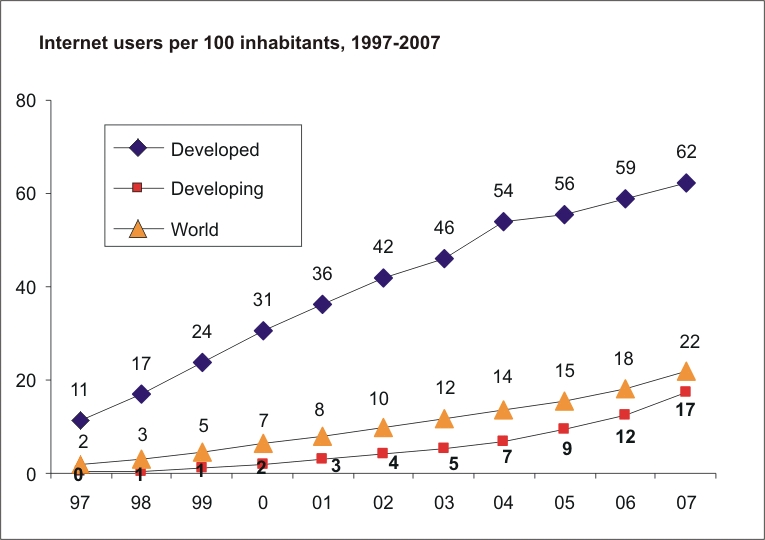
On 12 March 1989 Tim Berners-Lee wrote a proposal for what would become the “World Wide Web”, now enshrined in the “www” that is part of the name of many websites. This is often now voiced as “dub, dub, dub”, causing many people to cringe. Through 1990 and into 1991 Tim’s idea was refined until the idea was announced publicly on 7 August 1991.

Granny would have about 30 at the time, or maybe younger.

English: Graph of internet users per 100 inhab...
English: Graph of internet users per 100 inhabitants between 1997 and 2007 by International Telecommunication Union (ITU) recreated in OpenOffice Calc, source: http://www.itu.int/ITU-D/ict/statistics/ict/graphs/internet.jpg) (Photo credit: Wikipedia)

It’s worth remembering that the Internet had been around for a decade or so, in rudimentary form, so the chances are that Granny might have come into contact with it if she was working in it at the time, maybe at a university. It’s far more likely though that Granny’s first contact with computing would have come from working at a large firm where they had a mainframe computer.

IBM 3279-S3G
IBM 3279-S3G (Photo credit: vaxomatic)

Maybe she sat at an IBM 3270 screen and typed accounting data into it, or maybe she was one of the people who loaded punched cards into a reader or tended the huge printers  that spat out piles of paper with horizontal green stripes and sprocket holes down the edge. Or maybe she loaded magnetic tape reels into one of the tape reader machines which for some reason came to signify “computing” in many films of the era.

The Internet started as a linked network of computers, running online databases, using names such as “Archie” and “Gopher”. Everything was text based and there was no linking. That had to wait for Tim Berners-Lee’s insight. Universities embraced the new medium and most databases were held on University servers.

Gopher
Gopher (Photo credit: cambodia4kidsorg)

When you blithely click on link to visit a web page a number of things happen. Firstly your computer recognises that you want to do something. A program on your computer called the browser (Firefox, or Chrome or Internet Explorer) analyses your input and decides what you want it to do.

This may involve sending a request to a remote server, but your computer doesn’t know where the server, so it needs to find out. This is done by sending a message to yet another server which has information about where the requested server is on the Internet, or knows how to find out.

Description unavailable
Description unavailable (Photo credit: Forest Service Southwestern Region)

In the early days of the Internet, when Granny may have first come into contact with it, this system did not exist, so every computer on the Internet was required to know the whereabouts of every other computer on the Internet. As you can imagine, updating the address information became a tedious chore and that is why the system that I sketchily outlined above was invented.

Once Granny found a document whose title looked interesting, she would have to download it. Today we click on a link and the document appears on our screen. But Granny would have had to tediously search likely sources for the document, then she would transfer it to the server that she was connected to, and finally she would be able to print it on a printer. If she was lucky the printer would be nearby and it would actually have some paper in it. Granny’s document would be printed in a fixed width font on striped paper by a printer with a ribbon and little hammers, like a glorified typewriter.

English: demonstration of how an impact printe...
English: demonstration of how an impact printer works (Photo credit: Wikipedia)

Granny would have been around 20 when IBM introduced the first “IBM Personal Computer” in 1981, but she might have first come into contact with something like a Commodore 64 or Sinclair ZX 81 or Spectrum. She might have played games loaded tedious by command line commands from cassette tape. It’s possible that she was amazed by the blocky coloured graphics and the clunky game play, considering that the next best thing around was “Pong”, a primitive tennis game on a fixed device, sometimes set into a tabletop, or maybe “Space Invaders”, also hosted on a single purpose device.

English: Commodore 64 computer (1982). Post pr...
English: Commodore 64 computer (1982). Post processing: BG, B/C, noise, dust, spot Français : Ordinateur Commodore 64. Suomi: Commodore 64 -tietokone (Photo credit: Wikipedia)

If Granny had anything to do with computers in the early days of personal computers she would have had to deal with machines that by default booted into BASIC. That’s pretty much a fall-back as usually would have inserted a floppy disk with some version of DOS into the machine. Then she would have had to have loaded whatever program she wanted to run by using another floppy disk.

She would have had to become familiar with the DOS command line, including such quirks as the A: and B: drive referring to the same device. Most of the time. She might even have edited configuration files by hand.

Computer directory listing in a command shell.
Computer directory listing in a command shell. (Photo credit: Wikipedia)

When she got her first hard disk she would have installed DOS or even Windows on it from maybe three or four floppy disks. The first Windows versions ran as a shell on top of DOS, so she would have still needed to have a knowledge of DOS.

In addition she would have had to handle the dreaded device drivers. These were (and still are) small programs that handled interactions with specific installed hardware. Which in the early days of DOS and Windows meant just about any piece of hardware.

Mini CD used for delivering USB drivers for a ...
Mini CD used for delivering USB drivers for a webcam. Photo taken by user: O mores. (Photo credit: Wikipedia)

When Granny installed her new scanner she would have received a disk with it containing the drivers. She would know from prior experience that installing a driver could possibly make her system crash and be unbootable. But she would have still installed it and most probably (eventually) come out on top of it.

In addition before Granny got broadband she would have experienced the doubtful pleasures of using a dial-up modem, and would be familiar with the weird little song it sings to itself when it is handshaking with the remote modem. And she would certainly be familiar with waiting for half an hour to download a megabyte file and Grandad picking up the phone one minute before the end and breaking the connection.

Quicktel 2400EX
Quicktel 2400EX (Photo credit: debagel)

So, now Granny has bought an iPad. Don’t be surprised if she takes to it like a duck to water. After all, she probably has decades more experience with computers and networks, the Internet and downloading than you have. You weren’t born when she started!

she has a thing for it
she has a thing for it (Photo credit: creaid)
Enhanced by Zemanta

The beginning of things and the ending of things.

The Big Bang era of the universe, presented as...
The Big Bang era of the universe, presented as a manifold in two dimensions (1-space and time); the shape is right (approximately), but it’s not to scale. (Photo credit: Wikipedia)

The origin of the Universe, the start of everything, including time. That’s a grand concept. In our usual view of the Universe, we define any event by three space dimensions and one time dimension, but mathematics can deal with any number of dimensions. Some physical models of the Universe use many more than four dimensions, sometimes 10 or 11, and even an infinite number of dimensions.

Normally the space dimensions are depicted as being measured along three orthogonal axes, otherwise known as a Cartesian coordinate system. However there are alternate ways of specifying three space dimensions.

coordinate_system
coordinate_system (Photo credit: williamcromar)

For instance, on the Earth’s we specify locations by latitude and longitude, which gives us two dimensions. Astronomical objects are specified by Right Ascension and Declination, again resulting in two dimensions. In both cases the third space dimension can be specified as distance, in the first case from the centre of the earth, and in the second case from the observer, but in the general case, the origin can be any arbitrary point.

This second method of specifying the position of an object is known as a Polar coordinate system, and there are many other ways that the position of an object can be specified. Of course, these positioning schemes only really work locally. If the origin of the coordinate system were on Mars for example then the coordinates of, say Jupiter, would differ from the coordinates of Jupiter as measured on Earth.

Point in Polar coordinates
Point in Polar coordinates (Photo credit: Wikipedia)

If we add time into the picture, we have four dimension to cater for. Since we live in a Universe where there appear to be three space dimensions we have difficulty in considering time to be a dimension like the three space dimensions.

A four dimensional Cartesian coordinate system seems to us to be impossible to conceive, but mathematicians don’t have any problems with the concept, and some have expended time and effort to be able to mentally conceive of four dimensional spaces.

Cartesian Perspective
Cartesian Perspective (Photo credit: Jan Tik)

I wish them luck but I don’t see that it is necessary. The equations have four variable, hence four dimensions, end of story. There is no need to imagine four Cartesian dimensions.

Some people might consider time to be different in nature to space. It is after all measured in seconds, and space is measured in millimetres. That’s a valid point, but consider that in a Polar coordinate system the distance dimension is different to the other two dimensions. The distance is measured in millimetres and the other two in degrees or radians.

Time and Space v2
Time and Space v2 (Photo credit: dkuropatwa)

It seems that it all depends on your point of view, and indeed we can measure distances in seconds too. All that we have to do is to say that the distance coordinate of an object is the number of seconds that it takes light to travel that distance. Essentially to convert from millimetres to seconds we divide by the speed of light, which, as we all learned in school is a constant.

So we have four or more dimensions in our Universe and all events in the Universe can be plotted in a space of four or more dimensions. I don’t think that it follows that every point in that space represent an event in our Universe – there may exist points in that space which don’t represent points in the space-time history of our Universe.

parabola
parabola (Photo credit: pixelthing)

Consider for example a space with dimension two, which corresponds to the points on the surface of the earth (ignoring the altitude variation which corresponds the distance of the point on the surface of the earth from the centre of the earth). Every point on the surface of the earth could be plotted on Cartesian axes.

It would be a weird map with the origin representing the point on the earth which is on the equator and due South of Greenwich, the opposite side of the earth appearing at both -180 degrees and +180 degrees and the poles spread into a line at +90 degrees and -90 degrees.

TTT #2... 256365
TTT #2… 256365 (Photo credit: paloetic)

However, no point on the earth’s surface would have a longitude coordinate that is greater than +180 or a latitude coordinate that is greater than +90. Those points just don’t represent a point on the earth’s surface. OK, the map could repeat, I guess, an infinite number of times, but I’m arbitrarily going to rule out that suggestion, as each point would not have a unique pair of coordinates.

This issue only arises because I am suggesting a mapping of Polar coordinates onto a Cartesian grid. Now I’m going to consider the four main dimensions of our Universe in a similar light.

time-zero blue
time-zero blue (Photo credit: futurowoman)

As time is traced backwards, according to the Big Bang theory, the Universe is seen to be smaller. The further back we go, the smaller it is, until at some point the past, the whole Universe shrinks to a point. Some questioners of this theory ask “What happened before that point in time?”.

OK, let’s for the moment ignore two of the space dimensions. Let’s just consider time and, let’s say, a dimension that I’ll call width, as in the width of the Universe. We can then plot the changing width of the Universe as the vertical axis and time as the horizontal axis on a set of Cartesian axes.

width & depth [CIMG2033]
width & depth [CIMG2033] (Photo credit: TheAlieness GiselaGiardino²³)
Arbitrarily setting the origin at now, and the width as the current width of the Universe, let’s consider what happens as we trace the graph to the left. The width, shown on the vertical axis reduces until it eventually reaches the time axis and, pop, the Universe disappears. Or appears, if we trace from left to right in the normally accepted direction of the flow of time.

“What happened one second before that point?” asks the sceptic. The answer is that the question doesn’t make sense. In the analogy above, of the latitude/longitude map, it is like asking “What is 181 degrees West of Greenwich?”, to which the answer is “There is no 181 degrees West of Greenwich.” Similarly there is no Big Bang – 1 second.

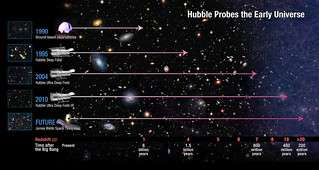
How far does Hubble see?
How far does Hubble see? (Photo credit: NASA Goddard Photo and Video)

You will note that in that latitude/longitude example above, the map can be said to “wrap around” and if one sails 181 degrees West of Greenwich, one finds oneself at 179 degrees East of Greenwich. A similar wrap around in the case of the Universe would be for someone who somehow managed to get to Big Bang – 1 second to find that they had arrived at one second before the end of time.

However I do not know if the theories of the Big Bang allow for this possibility. Certainly the concept makes a sort of sense if the Universe is destined to collapse into a “Big Crunch”, like a Big Bang in reverse, but if the Universe is destined to expand without limit, then there is no analogy to “181 degrees West of Greenwich”.

:From Image:Big_crunch.png According to the Bi...
:From Image:Big_crunch.png According to the Big Crunch theory, the universe will end in an infinitely dense singularity. (Photo credit: Wikipedia)

In any case the problem likely only arises because the Cartesian coordinate system in inadequate for plotting the origin of the Universe.

The Restaurant at the End of the Universe. Almost.
The Restaurant at the End of the Universe. Almost. (Photo credit: Geir Halvorsen)
Enhanced by Zemanta

Consciousness, in mice and men and flatworms

Deutsch: Phrenologie
Deutsch: Phrenologie (Photo credit: Wikipedia)

Of all emergent phenomena consciousness is the most mysterious, probably because we don’t seem to have a handle on the concept. We don’t understand how it arises and probably not much about what it comprises and how it works. We know that it, apparently, can be switched on and off, as when we go to sleep or are sedated or knocked out by some accident or other.

It is only marginally under our control. In general terms we can be conscious or awake, but not conscious of anything specific. We can be in a reverie or day dream, or we can be doing something semi-automatically, like driving. But we can “snap to” and be conscious of something specific, as when some event happens while driving that needs our full attention. Or the door bell snaps us out of our reverie, or we notice a cloud that looks like a dog, or cat, or, more likely, a sheep!

English: We're following the leader! What caus...
English: We’re following the leader! What caused the car in front to brake? Was it a horse and rider? Was it someone coming off the public footpath on the brow of the hill? That’s the pleasure of nose-to-tail driving on the A158. It just keeps your brain alert all the time! (Photo credit: Wikipedia)

Even when we are fully awake and concentrating on the idiot who just pulled out in front of us, we perform actions of which we are not fully aware, such as change down a gear or put on the brakes. We are aware of these actions to some extent as they are not fully automatic, like the movement of our legs when we walk, but we don’t have to think about which pedal to press or how to move the gear lever to change gear, as we did when we were learning to drive.

Washoe
Washoe (Photo credit: Wikipedia)

I might have said before, in a previous post, that I don’t think that it is feasible that consciousness is only found in mankind. Chimpanzees share 98.8% of our genes, so it reasonable that they share many of our abilities and they can certainly use tools and reason. It is unlikely that consciousness is an expression of something in the 1.2% of the genes that are unique to humans. Chimpanzees show fear and happiness , they sulk, they get angry and show other emotions. While the expression of emotions doesn’t prove that they are conscious, I find it hard to imagine a conscious entity would not express its consciousness through emotions, and that a non-conscious entity would show any emotions.

Computer mouse
Computer mouse (Photo credit: Pockafwye)

If chimpanzees are conscious animals as we are, then it follows that other animals are conscious entities to some extent or other. Some people believe that it has been demonstrated that most animals have consciousness, but I consider to be very likely, but not yet proved. Even a mouse, a “Wee, sleekit, cow’rin, tim’rous beastie” as Robert Burns put it, demonstrates its fear, and with its own species, anger. It is unlikely that a mouse is *as* aware as a human or even a chimpanzee, and it would be very difficult to find self consciousness in a flatworm though.

English: The planarian Schmidtea mediterranea
English: The planarian Schmidtea mediterranea (Photo credit: Wikipedia)

But then again, consciousness is related to mind and to the brain, and the brain is the major part of the “Central Nervous System” in mammals. It is possible that the more complicated a brain the more consciousness a animal possesses. Even a flatworm possesses a very simple brain-like structure called a ganglion. So, maybe, a flatworm posses a spark of consciousness, an atom of awareness of the most rudimentary sort.

English: Main regions of the vertebrate brain,...
English: Main regions of the vertebrate brain, shown for a shark and a human brain (the human brain is sliced along the midline). The two brains are not on the same scale. (Photo credit: Wikipedia)

Or there may be some threshold below which consciousness is impossible. A simple eyespot, such as flatworms possess cannot form an image. To form an image a much more complicated eye structure is required, so there must some limit of animal complexity at which vision can be said to be possible. A fuzzy limit, maybe, but a limit nevertheless.

If consciousness is truly an emergent phenomenon of the brain, the what properties of the brain could enable consciousness? Just as the chemical and electrical properties of water molecules are what enable the emergent property of wetness, some features of the brain and its shadow partner, the mind, must lead in some way to the phenomenon of consciousness.

English: Two water molecules
English: Two water molecules (Photo credit: Wikipedia)

The most obvious characteristic of the brain that really differentiates the brain from other organs is the concentration of neurons, billions of them, each connected to thousands of others by synapses. The number of connections is immense, but sheer complexity in itself does not imply consciousness.

In the case of emergent phenomena in general, it seems to me that it is easier to work from the top down as it were, the macro and consider what micro properties could feasibly cause the phenomenon. If we look at the wetness of water and consider that water is made up of molecules with physical, chemical and electrical characteristics we can at least speculate that the wetness of water is at least partly caused by the way that the molecules stick to and move across other molecules in a surface such as the skin. The water molecules are able to stick and let go and move over other molecules in a way that wets a surface, and forms a concave meniscus in a tube in a characteristic way.

English: Pendle Water, Nelson, Lancashire At t...
English: Pendle Water, Nelson, Lancashire At the South end of Victoria Park, Pendle Water flows out of the park, for a couple of miles to join the Lancashire Calder, which after a few miles westward, itself will flow into the River Ribble and hence to Preston and the Irish Sea and the Atlantic Ocean. Who knows where the water molecules that we see here passing in December 2008 will have got to by now? (Photo credit: Wikipedia)

In  comparison mercury atoms have different electrical chemical and physical characteristics. They don’t form molecules in the same way, and while they slide over one another, they don’t stick to other molecules and let go in the way that water molecules do. Consequently mercury atoms don’t wet surfaces like water molecules do and a mercury meniscus is convex not concave.

Close-up of a mercury-filled maximum thermomet...
Close-up of a mercury-filled maximum thermometer. The break in the column of mercury is visible. (Photo credit: Wikipedia)

So, we can work out, in rough terms, why water is wet, by comparing water and mercury, and noting their micro-properties. Can we achieve the same with the phenomenon of consciousness? Well, the brain is a computation engine of sorts, and so maybe we can compare it to a computer. Computers are not (yet) conscious and brains contain minds which are conscious. Can we make any guesses based on that?

Babbage difference engine
Babbage difference engine (Photo credit: tolomea)

You can probably tell from the questioning way that I am discussing this topic that I don’t have any firm opinions on the matter. There are a couple of differences that I will point out though.

Computers are highly organised and computational functions and memory functions are completely separate, physically and computationally. A computer is also clock driven, with each operation taking up exactly the same number of “clock ticks” each time it is performed. In contrast, while a brain does have areas in which functions seem to reside, and a particular area may “light up” every time one raises a finger for example, memory seems to be more diffuse in its location, as compared to a computer.

English: Thalamus. Part of the brain. MRI image.
English: Thalamus. Part of the brain. MRI image. (Photo credit: Wikipedia)

Secondly, a brain’s “architecture” changes over time, whereas a computer’s does not. A brain may make new connections (which may have something to do with memory), while a computer stays as it was when built.

Thirdly, a brain is enormously more complex than any computer yet built, at least in terms of the number of interconnections in it and its ability to re-wire itself with new connections.

Synaptical transmission (chemical). A: Neuron ...
Synaptical transmission (chemical). A: Neuron (Presynaptic) B: Neuron (Postsynaptic) Mitochondria Synaptic vesicle full of neurotransmitter Autoreceptor Synaptic cleft Neurotransmitter receptor Calcium Channel Fused vesicle releasing neurotransmitter Neurotransmitter re-uptake pump (Photo credit: Wikipedia)

I don’t know if these differences are significant in terms of explaining the problem of consciousness. I suspect that they are at the root of the problem, but I could be totally wrong. It may be the “programs” that run in the brain and computer that make the difference, but that just moves the issue to another arena.

And I’ve run out of space. I could touch on the “android” question, but I’ll leave that for now.

English: This is a photograph of EveR-2, a fem...
English: This is a photograph of EveR-2, a female android developed by the Korea Institute of Industrial Technology and demonstrated to the public in October 2006. It is 165cm tall and weighs 60kg. (Photo credit: Wikipedia)
Enhanced by Zemanta

Synergy and Emergence

English: Logo used by the Synergy project (htt...
English: Logo used by the Synergy project (http://synergy-foss.org/). (Photo credit: Wikipedia)

I’m fascinated by the phenomenon of synergy. Wikipedia defines it as follows:

Synergy is the interaction of multiple elements in a system to produce an effect different from or greater than the sum of their individual effects.

Giant's Causeway in Northern Ireland is an exa...
Giant’s Causeway in Northern Ireland is an example of a complex emergent structure created by natural processes (Photo credit: Wikipedia)

One man might be unable to move a heavy load, but two men working together might be able to move it easily. Ants individually can only move very small objects, but working together can build very large structures, their nests. Synergy is related to emergent phenomenon, where a complex system shows behaviours which are not apparent in the system’s constituent parts. For example a water molecule cannot said to have the property of “wetness”, but a large collection of water molecules does have that property. Wikipedia defines it as follows:

Emergence is the way complex systems and patterns arise out of a multiplicity of relatively simple interactions.

English: A collage of organisms.
English: A collage of organisms. (Photo credit: Wikipedia)

Synergy and emergent systems are found in all levels of physical and biological systems. In fact the whole of biology could be considered to be an emergent system from physics – animals, plants and other living things are after all, only collections of molecules, and molecules are not, of themselves, alive.

At the highest level of all, consciousness is an emergent system of the synergy of astronomical numbers of brain cells. At the lowest level, all of physics is an emergent system of the state of the universe at the beginning, the Big Bang.

English: Big Bang
English: Big Bang (Photo credit: Wikipedia)

After I wrote that I looked up “emergence” on Wikipedia and found this:

Biology can be viewed as an emergent property of the laws of chemistry which, in turn, can be viewed as an emergent property of particle physics. Similarly, psychology could be understood as an emergent property of neurobiological dynamics, and free-market theories understand economy as an emergent feature of psychology.

The writer of the Wikipedia article is obviously on the same page as me!

water-molecule-vector_500x500
water-molecule-vector_500x500 (Photo credit: Shmector)

Each water molecule has a myriad of properties, none of which is “wetness”. However “wetness” can be explained by considering the behaviour of the various types of bonds that would be formed between water molecules and a consideration of how the molecules would move around each other, and react to other molecules such as those of the surface that the water is placed on. On some surfaces (such as the surface of a leaf) the molecules will organise themselves into “beads”, on others the water will “wet” the surface.

Water Beads
Water Beads (Photo credit: s_gibson72)

Obviously molecules don’t have volition, and the way I expressed the idea above is much too anthropomorphic, and indeed the behaviour can be described by referring to the physical behaviour of the water molecules, and there is nothing particularly mysterious about this, at least at the level at which I am pitching my suggested explanation.

Moving at the Speed of Life ...
Moving at the Speed of Life … (Photo credit: д§mд)

There are other emergent phenomena that are more difficult to explain. Life, for example. Living organisms are made up of various more or less esoteric chemical compounds, including some really, really large molecules. These large molecules (DNA) are made up of a small number of much smaller molecules (bases) which are strung together in the famous double helix. This double helix is folded in complex ways into truly enormous (at a chemical level) structures called chromosomes. These structures encode all the information necessary to create the organism.

Chromosome segregation during mitosis
Chromosome segregation during mitosis (Photo credit: TheJCB)

This in itself is a paradox – a small part of the organisation contains all the information necessary to construct the whole organism. It resembles a bootstrap situation. It seems to me that much of the genetic information  has to be instructions for constructing the information and not a detailed description of the organism.

Cells are complex and are individually alive, in some sense, since they are created, produce offspring and eventually die, but with some exceptions (unicellular organisms) a single cell can’t live on its own.

Chemistry Is What We Are
Chemistry Is What We Are (Photo credit: Wikipedia)

But to get back to the subject, I’ve described (probably pretty badly) a lot of chemistry, but I haven’t been able to describe where life comes from. It’s difficult, but possible, to describe how cells function in a mechanical, chemical sense, but it is not easy to say what it is that makes them alive. You can tell from the over use of bold that I’m having difficulty expressing my meanings here!

Living cells make copies of themselves, but so do some mechanical or chemical processes. Crystals and snowflakes spring to mind. Living cells consume chemicals from their surroundings and so do some complex non-living processes (I’m thinking of weather systems that circulate water and air, but that’s maybe not a good example). Living cells are self organising, altering surroundings to suit themselves, it’s true, but they are simply little complex chemical factories. Where’s the life in that?

A diagram showing a mitochondrion of the eukar...
A diagram showing a mitochondrion of the eukaryotic cell. Mitochondria are organelles surrounded by membranes, distributed in the cytosol of most eukaryotic cells. Its main function is the conversion of potential energy of pyruvate molecules into ATP. (Photo credit: Wikipedia)

In spite of the argument above, it is undeniable that life exists and practically, it is relatively easy to distinguish living things from non-living things. There are some “edge cases” though. Is a virus a living organism or merely a result of a chemical process. At the other end of the scale, is a rain forest a living organism? It certainly contains living organisms, but can the rain forest as an entity be described accurately as a living organism? My answer would be “probably yes” in both cases.

Computational consciousness
Computational consciousness (Photo credit: brewbooks)

The other example of emergence that I want to consider is “consciousness” and its cousin “mind”. We are conscious and we have minds, but are we the only animals that are conscious and have minds? I find the idea unlikely but possible. Animals have evolved over many millions of years and every feature of our bodies has been evolved gradually and incrementally. Our brains have evolved from one or two neurons in one of our ancestor’s bodies and have been incrementally expanded over a long long time.

English: Marine flatworm Pseudobiceros glorios...
English: Marine flatworm Pseudobiceros gloriosus. Lembeh straits, North Sulawesi, Indonesia. Français : Pseudobiceros gloriosus, un plathelminthe. Détroit de Lembeh, nord de Célèbes, Indonésie. (Photo credit: Wikipedia)

But our ancestor was not a human being and many animals with varying sized brains. Our pets and the bird outside the window have evolved from that animal. Consciousness and mind are related to the brain, so it is highly likely that as the brain evolved, so did mind and consciousness, which implies that our pets and the bird in the tree and all other animals with brains has a greater or lesser consciousness and mind.

It is possible, but unlikely that there is some threshold where an increasingly complex brain becomes conscious. My dog acts as if it were conscious and has a mind, but that could be merely a mechanical function of the brain. Personally I doubt it. I think that lower animals like dogs are conscious, have a mind and are self-aware, but at a lower level than humans.

Dog dog
Dog dog (Photo credit: Wikipedia)

There is no test for consciousness so far as I know. Oh, if an unconscious person’s eyelids flicker, we might say that he is “coming round”, but it could be that these mechanical processes could have no consciousness behind them. A similar argument is the “android” argument – if a man is replaced by an android, which has no consciousness or mind, and the android completely emulates the behaviour of a conscious and minded person, how would we tell, and by emulating the behaviour, would the android in fact possess a mind and consciousness?

Android x86
Android x86 (Photo credit: Wikipedia)

That’s another way of putting the question “what is this emergent phenomenon called consciousness, and how does it arise from the way that the brain works”. I’ve read some discussion of this issue by various philosophers, and I still have no opinion on the matter.

This article has expanded to well over my self-imposed target of 1000 words. It is however a subject that I find interesting, and I hope that any readers do so too.

globe of blogs
globe of blogs (Photo credit: shankargallery)
Enhanced by Zemanta

Blogging – how is it going?

blogging
blogging (Photo credit: Sean MacEntee)

When I started this blog, 60-odd posts ago, I had no idea where it was going. Of course I had some ideas on what I wanted. Philosophy, cooking and photography. As it turns out, there’s been a bit of philosophy going on, but it’s not been centre stage, as it were. There’s been a decline in the cooking posts, which I intend to remedy sooner or later, and the photography has been non-existent. That’s because most of my photography has gone into my Facebook page.

So what have I been blogging about? I looked back and, well, I’m surprised to note that my posts, were philosophical in tone, but not necessarily what I’d call “philosophically motivated”, but often triggered by events that have come to my attention either in my personal life or in the media. Some serious and some not serious. As an example this post has turned into a philosophical review of earlier posts.

P philosophy
P philosophy (Photo credit: Wikipedia)

So what can I reflect on over 60-odd posts, apart from my apparent tendency to seek deeper meaning in the relatively trivial? Because I don’t consider my posts to be “deeply meanignful”.

Well one aspect of this one-a-week blogging thing strikes me immediately. I am a procrastinator and my previous attempts at blogging or similar have failed miserably. Currently I am up to 60-odd posts and still going. (Pats self on back). What is different this time?

English: Old gatepost Field openings used to b...
English: Old gatepost Field openings used to be closed by putting posts in the holes. (Photo credit: Wikipedia)

Well, one of the factors I think is WordPress. As a confirmed technophile, I have tried many other solutions, and even tried the DIY approach. I can speak several computer languages like a native, and I can achieve passable programs in several others. I don’t care what language it is, if I want to learn it for anything, it doesn’t take me long. (Note to self: write an article about programming “in the zone” and “thinking in a programming language”!)

WordPress
WordPress (Photo credit: Adriano Gasparri)

WordPress is different in that I don’t have to program anything. I just write my thoughts in a fairly forgiving editor, add a few images and click the “Publish” button. No doubt there are other similar systems out there, but I came across WordPress and it works for me. I can bash out 1000-ish words per week and cast them into the ether, or at least the Internet, and I have achieved my self-imposed goal.

cassini science targets
cassini science targets (Photo credit: Wikipedia)

What happens when it gets out there depends on whether my thinking resonates with others out there on the Internet. I get emails saying that so-and-so “liked” a post, which is nice, or that so-and-so is now “following” my posts, which is nicer, but comments on my posts are rare. Insert not-smiley emoticon. I’m not sure why. Maybe I should solicit and respond to comments? Insert smiley emoticon.

Smiley Rocks
Smiley Rocks (Photo credit: w3i_yu)

Anyhow, I like WordPress and it works for me, but there are probably, almost certainly, other blogging systems that would do as well, each with their own quirks and wrinkles. I wouldn’t presume to say that WordPress is the best or that WordPress is for everyone. But it works for me.

I aim to do approximately 1000 words per post (the editor tells me I’m just over half way there – helpful). I base this on the concept that if the post is too long, it won’t get read to the end, unless it is *really* interesting. I don’t aspire to be more than 1000 words interesting! I think that’s reasonable and I hope it *is* reasonable, otherwise I’m wasting my time.

English: This is a modification of File:200902...
English: This is a modification of File:20090211 thousand words-01.jpg, which I digitally cropped, to remove the title and the copyright notice. (Photo credit: Wikipedia)

When I started this blog, I decided that I would post on Friday or Saturday each week. That has slid out to Tuesday occasionally, but I’m pleased to say that I have maintained the once a week target since I decided to attempt it. Yay! There are personal reasons why Friday and Saturday are not conducive to blog writing, and Sunday is the day that I am (effectively) targetting these days. I’m writing this on a Sunday.

Who am I blogging to? I putting these posts out there, on the Internet, and presumably I hope that someone will read them. Actually, that not as clear cut as all that. While I love the idea that some people might find my posts (ruminations? ramblings?) interesting, I don’t think that I’d be disappointed if nobody read them. If anyone does, please comment with “Hey, Cliff, I read the post.” Extra comments optional!

Duty Calls
Duty calls.

Blogging is a narcissistic occupation. The blogger puts his thoughts out there, on the Internet, because he thinks his thoughts are of some value. Maybe they are, maybe they aren’t. It doesn’t matter to the blogger, or at least to this blogger.  If you figure out the millions of bloggers world-wide and the number of postings that they make per day, it is unlikely that any one blogger is likely to attract a lot of attention. Unless they happen to be President of the United States or something.

I’m always grateful when someone comments on my posts though. I don’t think that the blogging medium is particularly good for having a conversation or discussion though, as I don’t spend a lot of time on it, and I don’t get a huge number of comments. I do know that some people do end up with 1000s of comments on their posts, but those blogs tend to be specialised – political blogs for example. I don’t have such a detailed target, so I’m happy with the few comments and likes that I get.

Models of Blogs: Blog as Participant in Conver...
Models of Blogs: Blog as Participant in Conversation (3 of 3) (Photo credit: robinhamman)
Enhanced by Zemanta

Three philosophers

Morton's Fork in Labels (Extra #252)
Morton’s Fork in Labels (Extra #252) (Photo credit: Cycrolu)

In this post I’m going to talk about three statements about three particular situations which are basically the same. The first one was made by John Morton, Archbishop of Canterbury in the late 15th century. The second was made in the book “Catch 22” by Joseph Heller. And the third was made by Bart Simpson in the Simpson’s cartoon.

Morton’s Fork, as defined in the Wikipedia article linked to above is as follows:

A Morton’s Fork is a specious piece of reasoning in which contradictory arguments lead to the same (unpleasant) conclusion. It is said to originate with the collecting of taxes by John Morton, Archbishop of Canterbury in the late 15th century, who held that a man living modestly must be saving money and could therefore afford taxes, whereas if he was living extravagantly then he was obviously rich and could still afford them.

Obviously there are counter examples to Morton’s assertions. A man living “modestly” may be simply living on a modest income, and a person living extravagantly may well be spending money that he does not have and be sliding into debt. The Wikipedia article does not record whether or not Morton’s Fork succeed in its aim, which was presumably to extract more tax money from tax payers, but I suspect its effect was minimal.

English: Catch 22 With a little imagination th...
English: Catch 22 With a little imagination the bus company could have called this service, seen at Scunthorpe bus terminal, not “Shuttle 22” but “Catch 22”. (Photo credit: Wikipedia)

In Joseph Heller’s novel “Catch 22”, the protagonists are pilots, bombardiers and other aircrew ranks during the second World War. Yossarian and his associates have to contend not only with the enemy, but also with the bumbling stupidity of military rules and the equalling bumbling stupidity or malice of the commanding officers.

Anti-war demonstration, Seattle, Washington, 1...
Anti-war demonstration, Seattle, Washington, 19 March 2007. Marchers head south on Fifth Avenue. Sign: “Iraq: Blood and stupidity”. (Photo credit: Wikipedia)

A good example is the “dead man” in Yossarian’s tent. The man had actually survived a mission in which many of his crew mates had died, but since he had be recorded as having been killed, the military refused to acknowledge his existence. He was forced to live a shadowy existence, living in Yossarian’s tent.

Tent op kamp
Tent op kamp (Photo credit: florisla)

Catch 22 is a non-existent military rule. The book defines it like this:

There was only one catch and that was Catch-22, which specified that a concern for one’s safety in the face of dangers that were real and immediate was the process of a rational mind. Orr was crazy and could be grounded. All he had to do was ask; and as soon as he did, he would no longer be crazy and would have to fly more missions. Orr would be crazy to fly more missions and sane if he didn’t, but if he were sane he had to fly them. If he flew them he was crazy and didn’t have to; but if he didn’t want to he was sane and had to.

Obviously Orr could not want to fly the missions and still be crazy, or be crazy and still want to fly them, so the logical bind fails, and for analogous reasons to Morton’s Fork. Such situations are sometimes referred to as paradoxes, but I don’t think that they are, unless they can be considered a special type of paradox called an antinomy. I think that Morton’s Fork and Catch 22 work by excluding valid situations from consideration, and hence are failures of the logical argument.

Bart Simpson statue
Bart Simpson statue (Photo credit: Gage Skidmore)

In the Simpson cartoon “Bart the Genius”, Bart Simpson cheats his way into a school for intellectually advanced students by stealing another student’s test paper. Bart is pretty much out of his depth from the start, as the other students quickly detect that he is not intellectually advanced as is claimed. In the classroom students are asked to come up with an example of a paradox. Under pressure Bart blurts out “You’re damned if you do, and you’re damned if you don’t”. This is grudgingly accepted as a paradox by the teacher.

Animatie van Olbers paradox Olbers' paradox is...
Animatie van Olbers paradox Olbers’ paradox is the argument that the darkness of the night sky conflicts with the supposition of an infinite and eternal static universe. http://en.wikipedia.org/wiki/Olbers%27_paradox?uselang=en (Photo credit: Wikipedia)

In a marital situation Bart’s formulation is well known. One partner asks a innocuous question. The other party knows that that there are two possible answers, neither of which is going to lead to a positive outcome. “Do you mind if I watch the rugby?” is going to lead to significant grumpiness or an argument if the answer is yes, or a couple of hours of boredom and noise if the answer is no.

Damned if you do and damned if you don’t. Of course couples evolve methods for resolving such issues. Maybe a good book and a gin and tonic in another room is a solution or maybe the rugby might turn out to be interesting after all.

Married
Married (Photo credit: hjrosasq)

Bart’s expression of the idea is slightly different. In the first two the idea is expressed in terms of rules, Morton’s Fork being about tax, and Catch 22 in a rule about sanity and flying dangerous missions. Bart’s is a more general cry from the heart, about the cantankerousness of the world.

Life sucks
Life sucks
Enhanced by Zemanta