Measuring things

English: Ruler Italiano: Righello
English: Ruler Italiano: Righello (Photo credit: Wikipedia)

When we measure a length, with a ruler, say, we can’t measure it exactly. The ruler will be marked off in, say, millimetres, and the length we are measuring will probably fall somewhere between two markings on the ruler, so we can only say that the length is somewhere between the distance between the two markings and the start of the ruler.

Probably. Actually there are a number of things that could mess up our measurement. We may not be able to line up the start of the length we are measuring with the start marking on the ruler, as the marking on the ruler is not of zero width. The best we can do, when aligning one end of the length to be measured with the ruler, is to align the start of the length to the middle of the marking on the ruler.

English: A close-up picture of a section of ru...
English: A close-up picture of a section of ruler with British (inches) and Chinese (cun) scales on its two sides. This is the 10th cun – the last cun of a chi, so that one can see that 1 chi (10 cun) was equal to 14+5/8 inches, i.e. 371 mm. A metric ruler is shown next to it for scale. As can be seen from the worn corners, the ruler has been well used in measurements of length, such as perhaps of garment cloth, for trade transactions. (Photo credit: Wikipedia)

We then have to transfer our attention to the other end of the ruler. Probably the other end of the length and the edge of the ruler don’t align, so we shuffle the ruler to try to align the two ends of the length with the edge of the ruler, checking all the time that the start of the ruler is in line with the start of the length to be measured.

When all is aligned we can then read of the approximate value of the length, assuming that the ruler is still properly aligned and that the start of the ruler is still properly aligned with the start of the length. However, as mentioned above the end of the distance being measured will probably fall between two markings.

A carpenters' ruler with centimetre divisions
A carpenters’ ruler with centimetre divisions (Photo credit: Wikipedia)

So any measurement with the ruler should be stated with an estimate of the margin of error in the answer. “About 73mm, with an error of about 0.5mm” might be a reasonable estimate.

The accuracy of a measurement may depend on the material from which the ruler is made. It may be wood, plastic or metal, or some other material. Wood is a natural material, and as such it may warp, or shrink or expand unevenly. It may deteriorate over time, so that today’s measurement may be slightly different from today’s. The ink used to make the markings may migrate into the wood through natural pores and cracks in the wood, rendering them wider and fuzzier than when the ruler is new.

Diagram showing operation of temperature compe...
Diagram showing operation of temperature compensated “gridiron” pendulum, invented in 1726 by British clockmaker John Harrison. The pendulum uses rods of a high thermal expansion metal, zinc (yellow) to compensate for the expansion of rods of a low thermal expansion metal, iron (blue), so the overall pendulum doesn’t change in length with temperature changes. Therefore the period of swing of the pendulum, and the rate of the clock, are constant with temperature. (Photo credit: Wikipedia)

A metal ruler can be marked more accurately, and the markings won’t blur, and the markings can be much thinner or sharper than those of a wooden ruler. Unfortunately metal will expand and contract depending on the temperature, adding errors to the measurements. This can be alleviated by careful choice of alloy for the ruler, but not eliminated.

All rulers are these days fabricated by machines of course, and the markings are made by these machines. Such a machine has to be as accurate or more accurate than the end product of course, which means that the scale marks must be located more accurately, and probably be narrower than those of the end product.


Embed from Getty Images

In order to be more accurate, various techniques are used to achieve the extra accuracy, and I’m not going to discuss them here, mainly because I can only guess what they are! Vernier scales and error averaging techniques spring to mind, but as I said, I don’t what is actually used.

Microscopes and similar allow the measurement of very small distances against a scale calibrated to very small tolerances. This pattern is repeated endlessly – to measure small distances accurately your measuring device (or technique) needs to be an order of magnitude more accurate than the distance to be measured.

Microlitic volcanic lithic fragment, scale in ...
Microlitic volcanic lithic fragment, scale in millimeters. Top picture in plane-polarized light, bottom picture in cross-polarized light. (Photo credit: Wikipedia)

If we want to measure atoms, we need an atomic sized scale and that cannot be made of atoms, obviously. We can use electromagnetic waves, other atoms, subatomic particles and so on, of course, but we are now in the quantum world, so not only do we have the sorts of issues mentioned above, but we have issues that related primarily to the quantum world – such as the Uncertainty Principle, and the fact that an atom can behave like a particle or a wave.

Down at these levels we use atoms to measure other atoms – there is of course no possibility of a ruler type scale which is made up of atoms. Instead things are measured by noting the frequency of emissions from the atom as its electrons changes from one quantum state to another.

Atomic Clock FOCS-1 (Switzerland). The primary...
Atomic Clock FOCS-1 (Switzerland). The primary frequency standard device, FOCS-1, one of the most accurate devices for measuring time in the world. It stands in a laboratory of the Swiss Federal Office of Metrology METAS in Bern. (Photo credit: Wikipedia)

This is referred to as a quantum jump and is popularly interpreted as an electron moving from one electron shell to another, in the common view of an electron orbit around the nucleus of an atom like a planet around a star.

A popular view is that at quantum levels the apparent continuity in time and space is not seen and that space and time appear to have a discrete structure. At some scale this makes it impossible to measure very small lengths, as it is impossible to tell whether or not two points are at different locations or not.

Dr. Max Planck
Dr. Max Planck (Photo credit: Wikipedia)

It follows that in the usual macro world that apparent continuity is probably illusory – if we can’t tell the difference between two points at a very small level, our measurements at the macro level are not well defined. It seems that the appearance of continuity at the macro level is an emergent phenomenon.

Maybe. The appearance of continuity probably comes from the fact that when we look at a line from A to B we can always pick a point C between them. We can then pick a point D between A and C and a point E between A and D and so on, apparently forever. But in fact the process has to stop, and the stopping point is where we find that we can’t distinguish the two end points of the line.

Reality-Virtuality Continuum.
Reality-Virtuality Continuum. (Photo credit: Wikipedia)

Is the issue caused by a conflict between our physics, which is at heart a description of the world as we see it, and what the world is actually like? A line is a mathematical concept which has extent (length), but no width. In the real world a line is marked by some means, pencil or laser beam, and has an extent, which is what we are trying to measure, and certainly has some width, the width of the lead of the pencil, the width of the laser beam. Are we starting to find out about the things that we can’t know about the world?

PencilTip
PencilTip (Photo credit: Wikipedia)

Imagine this….

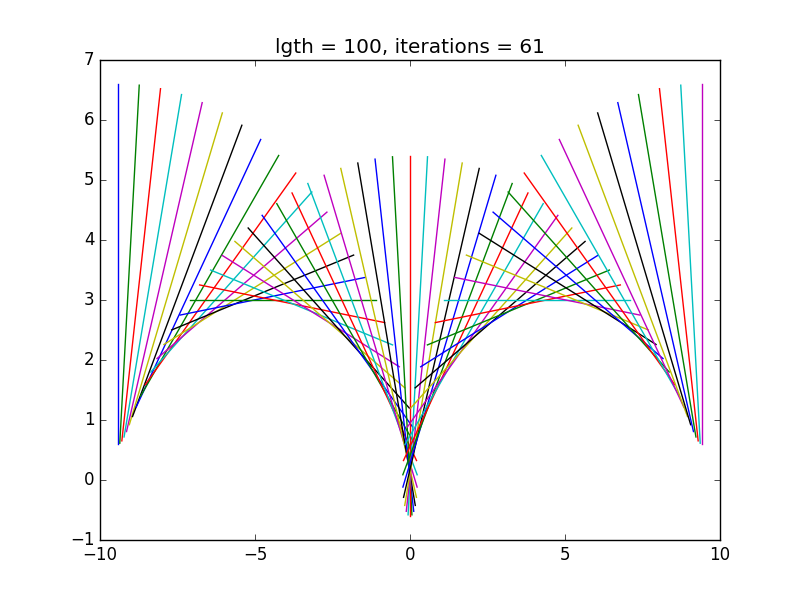
Flying Swan
Drawn using Python and Matplotlib. This picture is serendipitous and not intended.

[Grr! While I finished my previous post, I didn’t publish it. Darn it.]

Since I’ve been playing around with computer generated images recently, my thoughts turned to how we see images. When you look at a computer or television screen these days, you are looking at a matrix of pixels. A pixel can be thought of as a very tiny point of light, or a location that can be switched on and off very rapidly.

Pixels are small. There’s 1920 across my screen at the current resolution, and while I can just about see the individual pixels if I look up close, they are small. To get the same resolution with an array of 5cm light bulbs, the screen would need to be 96 metres in size! You’d probably want to sit at about 150m from the screen to watch it.

A closeup of pixels.
A closeup of pixels. (Photo credit: Wikipedia)

The actual size of a pixel is a complicated matter, and depends on the resolution setting of your screen. However, the rating of a camera sensor is a different matter entirely. When I started looking into this, I thought that I understood it, but I discovered that I didn’t.

What complicates things as regards camera sensor resolutions is that typically a camera will store an image as a JPG/JPEG image file, though some will save the image as a RAW image file. The JPG format is “lossy” so some information is lost in the process (though typically not much). RAW image file are minimally processed from the sensor data so contain as much information about what the sensor sees as is possible. Naturally they are larger than JPG format images.


Embed from Getty Images

When we look at a screen we don’t see an array of dots. We pretty much see a smooth image. If the resolution is low, we might consider the image to be grainy, or fuzzy, but we don’t actually “see” the individual pixels as such, unless we specifically look closely. This is because the brain does a lot of processing of an image before we “see” it.

I’ve used the scare quotes around the word “see”, because seeing is very much a mental process. The brain cells extend right out to the eye, with the nerves from the eye being connected directly into the brain.

Schematic diagram of the human eye in greek.
Schematic diagram of the human eye in greek. (Photo credit: Wikipedia)

The eye, much like a camera, consists of a hole to let in the light, a lens to focus it, and sensor at the back of the eye to capture the image. Apparently the measured resolution of the eye is 576 megapixels, but the eye has a number of tricks to improve its apparent resolution. Firstly, we have two eyes and the slightly different images are used to deduce detail that one eye alone will not resolve. Secondly, the eye moves slightly and this also enables it to deduce more detail than would be apparent otherwise.

That said, the eye is not made of plastic metal and glass. It is essentially a ball of jelly, mostly opaque but with a transparent window in it. The size of the window or pupil is controlled by small muscles which contract or expand the size of the pupil depending on the light level (and other factors, such as excitement).

English: A close up of the human eye. Notice t...
English: A close up of the human eye. Notice the reflection of the photographer. (Photo credit: Wikipedia)

The light is focused on to an area at the back of the eye, which is obviously not flat, but curved. Most the focusing is done by the cornea, the outermost layer of the eye, but the lens is fine tuned by muscles which stretch and relax the lens as necessary. This doesn’t on the face of it seem as accurate as a mechanical focusing system.

In addition to these factors, human eyes are prone to various issues where the eye cannot focus properly, such as myopia (short sightedness) or hyperopia (long sightedness) and similar issues. In addition the jelly that forms the bulk of the eye is not completely transparent, with “floaters” obstructing vision. Cataracts may cloud the front of the cornea, blurring vision.

English: Artist's impression of appearance of ...
English: Artist’s impression of appearance of ocular floaters. (Photo credit: Wikipedia)

When all this is considered, it’s amazing that our vision works as well as it does. One of the reasons that it does so well is, as I mentioned above, the amazing processing that our brains. Interestingly, what it works with is the rods and cones at the back of the eye, which may or may not be excited by light falling on them. This in not exactly digital data, since the associated nerve cells may react when the state of the receptor changes, but it is close.

It is unclear how images are stored in the brain as memories. One thing is for sure, and that is that it is not possible to dissect the brain and locate the image anywhere in the brain. Instead an image is stored, as it is in a computer, as a pattern. I suspect that the location of the pattern may be variable, just as a file in a computer may move as files are moved about.

Expanded version, with explanations.
Expanded version, with explanations. (Photo credit: Wikipedia)

The mind processes images after the raw data is captured by the eye and any gaps (caused by, for example, blood vessels in the eye blocking the light). This is why, most of the time, we don’t notice floaters, as the mind edits them out. The mind also uses the little movements of the eye to refine information that the mind uses to present the image to our “mind’s eye“. The two eyes, and the difference between the images on the backs of them also helps to build up the image.

It seems likely to me that memories that come in the form of images are not raw images, but are memories of the image that appears in the mind’s eye. If it were otherwise the image would lacking the edits that are applied to the raw images. If I think of an image that I remember, I find that it is embedded in a narrative.

Narrative frieze.
Narrative frieze. (Photo credit: Wikipedia)

That is, it doesn’t just appear, but appears in a context. For instance, if I recall an image of a particular horse race, I remember it as a radio or television commentary on the race. Obviously, I don’t know if others remember images in a similar way, but I suspect that images stored in the brain are not stored in isolation, like computer files, but as part of a narrative. That narrative may or may not relate to the occasion when the image was acquired. Indeed the narrative may be a total fiction and probably exists so that the mental image may be easily retrieved.

One bubble memory track and loop
One bubble memory track and loop (Photo credit: Wikipedia)


The Banach Tarski Theorem


Embed from Getty Images

There’s a mathematical theorem (the Banach Tarski theorem) which states that

Given a solid ball in 3‑dimensional space, there exists a decomposition of the ball into a finite number of disjoint subsets, which can then be put back together in a different way to yield two identical copies of the original ball.

This is, to say the least, counter intuitive! It suggests that you can dissect a beach ball, put the parts back together and get two beach balls for the price of one.

This brings up the question of what mathematics really is, and how it is related to what we loosely call reality? Scientists use mathematics to describe the world, and indeed some aspects of reality, such as relativity or quantum mechanics, can only be accurately described in mathematics.


Embed from Getty Images

So we know that there is a relationship of some sort between mathematics and reality as our maths is the best tool that we have found to talk about scientific things in an accurate way. Just how close this relationship is has been discussed by philosophers and scientists for millennia. The Greek philosophers, Aristotle, Plato, Socrates and others, reputedly thought that “all phenomena in the universe can be reduced to whole numbers and their ratios“.

The Banach Tarski theorem seems to go against all sense. It seems to be an example of getting something for nothing, and appears to contravene the restrictions of the first law of thermodynamics. The volume (and hence the amount of matter) appears to have doubled, and hence the amount of energy contain as matter in the balls appears to have doubled. It does not appear that the matter in the resulting balls is more attenuated than that in the original ball.

The Banach–Tarski paradox: A ball can be decom...
The Banach–Tarski paradox: A ball can be decomposed and reassembled into two balls the same size as the original. (Photo credit: Wikipedia)

Since the result appears to be counter intuitive, the question is raised as to whether or not it is merely a mathematical curiosity or whether it has any basis in reality, It asks something fundamental about the relationship between maths and reality.

It’s not the first time that such questions have been asked. When the existence of the irrational numbers was demonstrated, Greek mathematicians were horrified, and the discoverer of the proof (Hippasus) was either killed or exiled, depending on the source quoted. This was because the early mathematicians believed that everything could be reduced to integers and rational numbers, and their world did not have room for irrational numbers in it. In their minds numbers directly related to reality and reality was rational mathematically and in actuality.

English: Dedekind cut defining √2. Created usi...
English: Dedekind cut defining √2. Created using Inkscape. (Photo credit: Wikipedia)

These days we are used to irrational numbers and we see where they fit into the scheme of things. We know that there are many more irrational numbers than rational numbers and that the ‘real’ numbers (the rational and irrational numbers together) can be described by points on a line.

Interestingly we don’t, when do an experiment, use real numbers, because to specify a real number we would have write down an infinite sequence of digits. Instead we approximate the values we read from our meters and gauges with an appropriate rational number. We measure 1.2A for example, where the value 1.2 which equals 12/10 stands in for the real number that corresponds to the actual current flowing.

English: A vintage ampere meter. Français : Un...
English: A vintage ampere meter. Français : Un Ampèremètre à l’ancienne. (Photo credit: Wikipedia)

We then plug this value into our equations, and out pops an answer. Or we plot the values on a graph read off the approximate answer. The equations may have constants which we can only express as rational numbers (that is, we approximate them) so our experimental physics can only ever be approximate.

It’s a wonder that we can get useful results at all, what with the approximation of experimental results, the approximated constants in our equations and the approximated results we get. If we plot our results the graph line will have a certain thickness, of a pencil line or a set of pixels. The best we can do is estimate error bounds on our experimental results, and the constants in our equations, and hence the error bounds in our results. We will probably statistically estimate the confidence that the results show what we believe they show through this miasma of approximations.

Image of simulated dead pixels. Made with Macr...
Image of simulated dead pixels. Made with Macromedia Fireworks. (Photo credit: Wikipedia)

It’s surprising in some ways what we know about the world. We may measure the diameter of a circle somewhat inaccurately, we multiply it by an approximation to the irrational number pi, and we know that the answer we get will be close to the measured circumference of the circle.

It seems that our world resembles the theoretical world only approximately. The theoretical world has perfect circles, with well-defined diameters and circumference, exactly related by an irrational number. The real world has shapes that are more or less circular, with more or less accurately measured diameters and circumferences, related more or less accurately by an rational number approximating the irrational number, pi.

Pi Animation Example
Pi Animation Example (Photo credit: Wikipedia)

We seem to be very much like the residents of Plato’s Cave and we can only see a shadow of reality, and indeed we can only measure the shadows on the walls of the cave. In spite of this, we apparently can reason pretty well what the real world is like.

Our mathematical ruminations seem to be reflected in reality, even if at the time they seem bizarre. The number pi has been known for so long that it no longer seems strange to us. Real numbers have also been known for millennia and don’t appear to us to be strange, though people don’t seem to realise that when they measure a real number they can only state it as a rational number, like 1.234.

English: The School of Athens (detail). Fresco...
English: The School of Athens (detail). Fresco, Stanza della Segnatura, Palazzi Pontifici, Vatican. (Photo credit: Wikipedia)

For the Greeks, the irrational numbers which actually comprise almost all of the real numbers, were bizarre. For us, they don’t seem strange. It may be that in some way, as yet unknown, the Banach Tarski theorem will not seem strange, and may seem obvious.

It may be that we will use it, but approximately, much as we use the real numbers in our calculations and theories, but only approximately. I doubt that we will be duplicating beach balls, or dissecting a pea and reconstituting it the same size as the sun, but I’m pretty sure that we will be using it for something.


Embed from Getty Images

I see maths as descriptive. It describes the ideal world, it describes the shape of it. I don’t think that the world IS mathematics in the Pythagorean sense, but numbers are an aspect of the real world, and as such can’t help but describe the real world exactly, while we can only measure it approximately. But that’s a very circular description.

English: Illustrates the relationship of a cir...
English: Illustrates the relationship of a circle’s diameter to its circumference. (Photo credit: Wikipedia)


Turtles and More

Kina
Turtle graphics. This to me resembles a Kina or Sea Urchin

My wife recently became interested in the Spirograph (™) system. Since her birthday was coming up, so did I, for obvious reasons. If you have never come across Spirograph (™) I can highly recommend it, as it enables the production of glorious swirls and spirals, using a system of toothed wheels and other shapes. When you use multicoloured pen, the results can be amazing.

Of course, I had to translate this interest into the computer sphere, and I immediately recalled “Turtle Graphics” which I have used before. It is possible to create graphics very similar to the Spirograph (™) designs very simply with Turtle Graphics.

Trefoil
This resembles the sort of things generated by Spirograph (TM)

Turtle Graphics have a long history, stretching back at least to the educational programming language Logo. Although variations of the original Logo language exist, they are fairly rare, but the concept of Turtle Graphics, where a cursor (sometimes shown as the image of a cartoon turtle) draws a line on a page, still exists. The turtle can be directed to move in a particular way, based on instructions by the programmer.

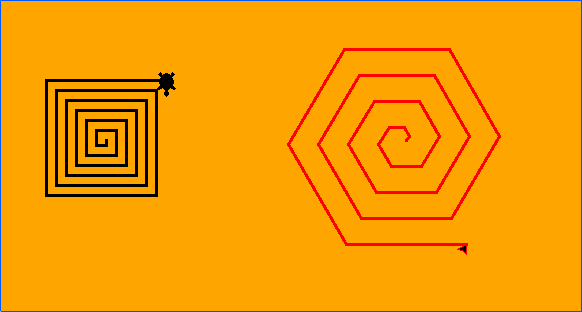
For instance the turtle can be instructed to move forward a certain distance, turn right through 90°, and repeat this process three times. The result is a small square. Or the turtle could be instructed to move forward and turn only 60°, repeating this 5 times to draw a hexagon. Using simple instructions like this allow the drawing of practically anything.

Square and Hexagonal spirals
Square and hexagonal spirals drawn by Turtle Graphics

I use an implementation of Turtle Graphics in the turtle module of the Python programming language but it is probably available for other programming languages. Python is probably an easy language to learn from scratch than Logo, and in addition Python can be used for many other things than Turtle Graphics. Python is available for Windows, OS/X, and Linux/Unix, and for several other older or less well known platforms.

Where things become interesting is when the looping abilities of Python are used to enhance a program. If the programmer gets the turtle to draw a square, then makes the turtle turn a little and repeats the process, the result is a circular pattern. Starting with a more interesting shape can produce some interesting patterns.

Rotated Square - Turtle graphics
Rotated Square – Turtle graphics

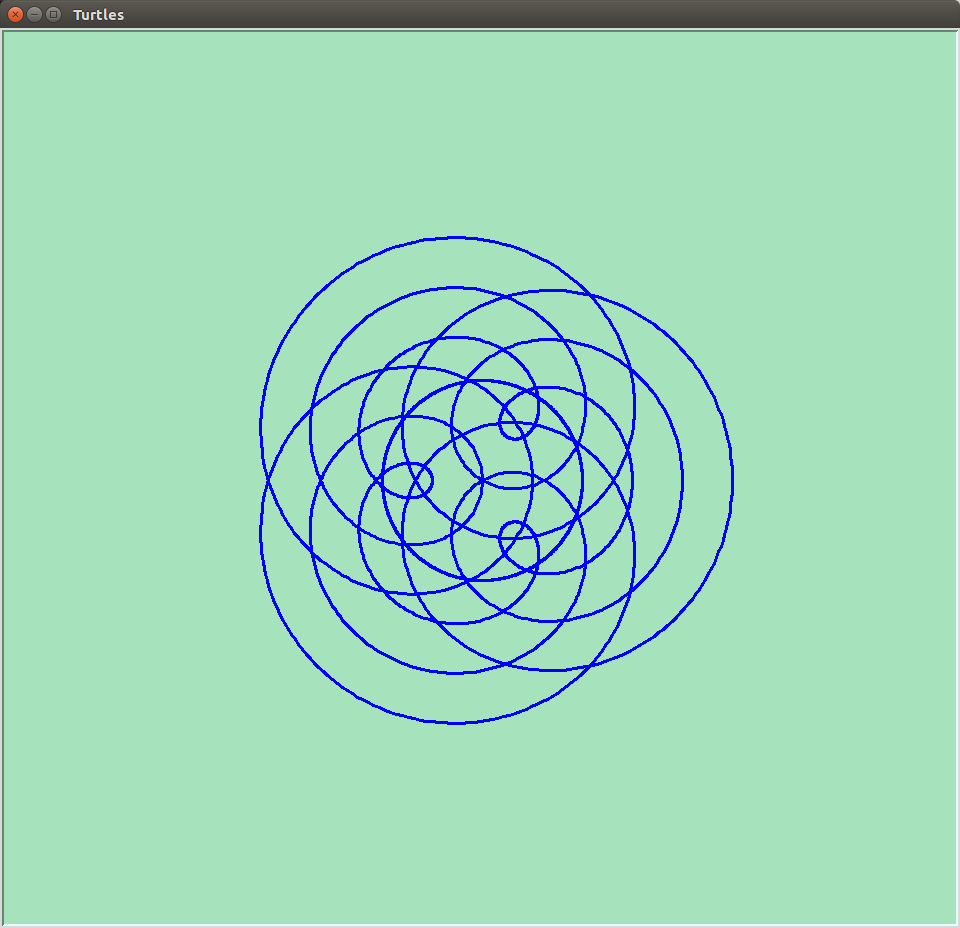
After a while, though, the patterns begin to seem very similar to one another. One way to add a bit of variation is to use the ability to make the turtle move to a specific position, drawing a line on the way. As an example, consider a stick hinged to another stick, much like a nunchaku. If one stick rotates as a constant speed and the second stick rotates at some multiple of that, then the end of the second stick traces out a complex curve.

Flower shape
Flower shape – turtle graphics

In Python this can be expressed like this:

x = int(a * math.sin(math.radians(c * i)) + b * math.sin(math.radians(d * i)))
y = int(a * math.cos(math.radians(c * i)) + b * math.cos(math.radians(d * i)))

where c and d are the rates of rotation of the two sticks and and b are the lengths of the stick. i is a counter that causes the two sticks to rotate. If the turtle is moved to the position x, y, a line is drawn from the previous position, and a curve is drawn.

The fun part is varying the various parameters, a, b, c, d, to see what effect that has. The type of curve that is created here is an epicycloid. For larger values of c and d the curves resemble the familiar shapes generated by Spirograph (™).

Epitrochoids
Epitrochoids

The equations above use the same constants in each equation. If the constant are different, some very interesting shapes appear, but I’m not going to go into that here. Suffice it to say, I got distracted from writing this post by playing around with those constants!

The above equations do tend to produce curves with radial symmetry, but there is another method that can be used to produce other curves, this time with rotational symmetry. For instance, a curve can be generated by moving to new point depending on the latest move. This process is then iterative.

Gravity Wave - turtle graphics
Gravity Wave turtle graphics

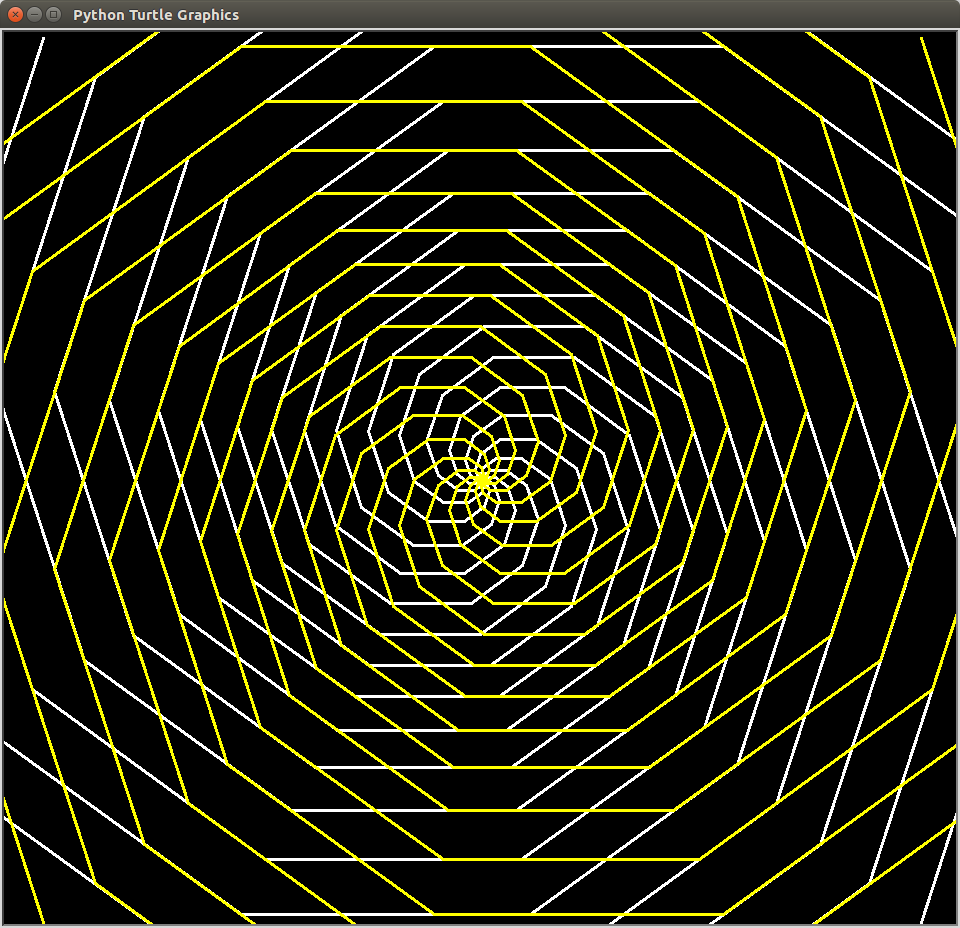
For instance, the next position could be determined by turning through an angle and move forward a little more than the last time. Something like this snippet of code would do that:

for i in range(1, 200):
t.forward(a)
t.pendown()

t.left(c)
a = a + 1
c = c + 10

This brings up a point of interest. If you run code like this, ensure that you don’t stop it too soon. This code causes the turtle to spin and draw in a small area for a while, and then fly off. However it quickly starts to spin again in a relatively small area before once more shooting off again. Evidently it repeats this process as it continues to move off in a particular direction.

Turtle graphics - a complex curve from a simple equation
Turtle graphics – a complex curve from a simple equation

Another use of turtle graphics is to draw graphs of functions, much like we learnt to do in school with pencil and squared paper. One such function is the cycloid function:

x = r(t – sine(t))

y = r(1 – cosine))

This function describes the motion of a wheel rolling along a level surface and can easily be translated into Python. More generally it is the equation of a radius of a circle rolling along a straight line. If a different point is picked, such a point on a radius inside the circle or a point outside the circle on the radius extended, a family of curves can be generated.

Cycloid curve - turtle graphics
Cycloid curve – turtle graphics

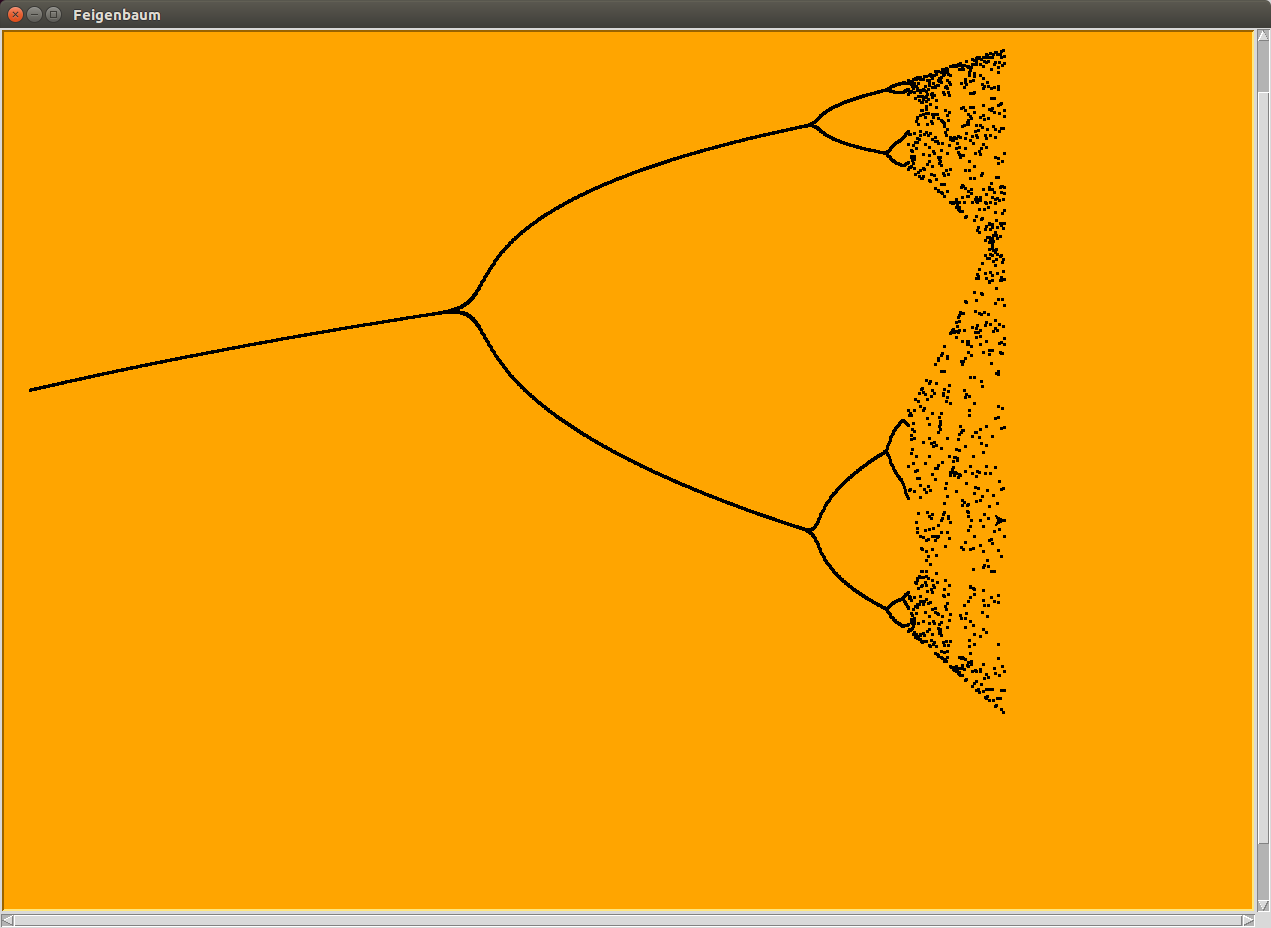
Finally, a really technical example. An equation like the following is called a dynamic equation. Each new ‘x’ is generated from the equation using the previous ‘x’. If this process is repeated many times, then depending on the value of ‘r’, the new value of ‘x’ may become ever closer to the previous value of ‘x’.

x(n+1) = rx(n)(1 – x(n))

If the value of ‘r’ is bigger than a certain value and less than another value, then ‘x’ flip-flops between two values. If the value of ‘r’ is bigger than the other value, and smaller than yet another value then ‘x’ rotates between 4 values. This doubling happens again and again in a “period doubling cascade“.

Turtle graphics - electron orbitals
Turtle graphics – electron orbitals

I’ve written a turtle program to demonstrate this. First a value for ‘r’ is chosen, then the equation is repeated applied 1,000 times, and the next 100 results are plotted, x against r. In the end result, the period doubling can easily be seen, although after a few doubling, the results become messy (which may be related to the accuracy and validity of my equations, and the various conversion between float and integer types).

Period doubling
The “fig tree” curve calculated in Python and plotted by Turtle Graphics.

Many worlds or only one?

English: Position and momentum of a particle p...
English: Position and momentum of a particle presented in the phase space. (Photo credit: Wikipedia)

Scientists often use the concept of a “phase space“, which is basically a representation of all the possible states that a system may be in. For the trajectory of a thrown stone for instance, the phase space would be a four-dimensional space, comprising the three dimensions of space, which define where the stone is, and one of time, which defines when the stone is in a particular position.

The trajectory of the stone is a line in this 4-d space, as the location and time information about the stone is known exactly. However, the stone is not a point and maybe be spinning at the same time that the whole object is flying through the air. This means that the trajectory would actually be a complex four-dimensional worm in phase space.

An animated GIF of a tesseract
An animated GIF of a tesseract (Photo credit: Wikipedia)

What if we were to introduce a probability factor into the experiment? Maybe we would set up the projectile to be triggered by an atomic decay or something similar. We would get a different worm depending on how long the atom takes to decay.

Clearly, if we want to show the all of the possible versions of the worm, the worm now becomes a sort of 4 dimensional sheet. Well, more like a 4-d duvet really, as the stone is not a point object.

Bedding comforter or duvet. Français : Couette...
Bedding comforter or duvet. Français : Couette (literie). Deutsch: Daunendecke, umgangssprachlich Federbett. (Photo credit: Wikipedia)

Within the 4-d duvet, each worm represents a case where the atom has decayed, and each of these cases has a probability associated with it. The probability can be expressed as the probability that the atom has decayed by that time or not, and can run from one to zero.

Actually the probability starts from zero and approaches one but doesn’t quite reach it. In practise in a group of atoms some will decay quickly and others will take longer. If there are a finite number of them, then the chances of any one lasting a long, long time are quite small, and all of the atoms are likely to decay in a moderately short time, a few multiples of the half-life anyway. However there will be a finite but microscopic in the extreme possibility, that an atom will survive for as long as you may consider.


Embed from Getty Images

We can add another dimension to the phase space, one of probability. This gives us a five dimensional phase space, and the duvet becomes five dimensional. However, an atom decays at a certain time, and there is a single five dimensional worm in the phase space going forward. The space is no longer a phase space though, as a phase space, by definition, describes all possible states of the rock/launcher/atomic trigger, and doesn’t change.

According to the Copenhagen interpretation of quantum physics the state of a quantum system is described by a set of probabilities. When a measurement of the system is made the state becomes certain, and it is said that the waveform described by the probability function has “collapsed”.

Copenhagen
Copenhagen (Photo credit: Wikipedia)

The famous thought experiment of Schrodinger’s Cat is a description of the difficulties of such a case. The cat is enclosed in a box equipped with a mechanism which will release a poison and kill the cat if triggered by the decay of an atom. At some time after the experiment starts the atom may or may not have decayed so the quantum states “decayed” and “not decayed” are superimposed, and therefore so are the states “dead” and “not dead” of the cat.

How do we know if the stone has been fired yet? Well, we go and look to see, and we either see the stone in its launcher or we don’t. Quantum physics says that the stone exists in a superposition of states – launcher and not launched. The question this raises is, if this is so, how does looking at the stone “collapse” the superposition when we look?

Three wavefunction solutions to the Time-Depen...
Three wavefunction solutions to the Time-Dependent Schrödinger equation for a harmonic oscillator. Left: The real part (blue) and imaginary part (red) of the wavefunction. Right: The probability of finding the particle at a certain position. The top two rows are the lowest two energy eigenstates, and the bottom is the superposition state \psi_N = (\psi_0+\psi_1)/\sqrt{2} , which is not an energy eigenstate. The right column illustrates why energy eigenstates are also called “stationary states”. (Photo credit: Wikipedia)

That quantum superposition is real is indicated by any number of experiments, even though many physicists working in the field (including Schrodinger himself) have expressed discomfort at the idea.

In quantum physics the evolution of everything is defined by the Universal Wave Function. This can be used to predict the future of any quantum physical system (and all physical systems are fundamentally quantum physical systems). Unfortunately for easy understanding, interpretation leads to the superposition problem mentioned above.


http://www.gettyimages.com/detail/177864874

Many people have tried to resolve this issue, and the best success has been achieved by the exponents of the Many Worlds Interpretation (MWI), as described by Everett and championed by Bryce DeWitt and David Deutsch. The view of the MWI exponents is that the Universal Wave Function is fundamental and expresses a true picture of all reality. All of it, that is. Not just a physical system and its observer.

Everett’s view, as described in his thesis, is that an observer, as well as the object that he is observing is a subsystem of the system described by the Universal Wave Function. The wave function of these two subsystems does not describe a single state for each of these subsystems, but the states of the two subsystems are superposed, or in Everett’s term, correlated.

en:Many-worlds interpretation
en:Many-worlds interpretation (Photo credit: Wikipedia)

When a particle is observed it may appear to be in state A 70% of the time (correlated with a state A for the observer). Similarly it may appear to be in state B 30% of the time (correlated with a state B for the observer). This led Everett to postulate a ‘split’ of the universe into a state A and a state B.  (The term ‘split’ appears to come from DeWitt’s interpretation of Everett’s work).

The probabilities don’t seem to have a function in this model, and this is odd. The probability that the cat is dead when you open the depends on how long you wait until you open the box. If you wait a long time the cat will more likely be dead than if you opened it earlier.

English: Diagram of Schrodinger's cat theory. ...
English: Diagram of Schrodinger’s cat theory. Roughly based on Image:Schroedingerscat3.jpg (Photo credit: Wikipedia)

This means that the world splits when the cat is put in the box, as from any moment it can be alive or dead, but you do not find out which branch you are in until you open the box sometime later.

I’m ambivalent about the MWI. On the one hand it is a good explanation of what happens when a measurement is made or the cat’s box is opened, and it does away with the need for a waveform collapse, which Everett argued against in his paper. However it is profligate in terms of world creation.

English: Schrödinger's Cat, many worlds interp...
English: Schrödinger’s Cat, many worlds interpretation, with universe branching (Photo credit: Wikipedia)

Another issue is that the split is decidedly binary. The cat is alive in this world and dead in that one. However most other physical processes are, at the macro level anyway, continuous. When a scientist takes a measurement he writes down, for example, 2.5, but this is only inaccurate value as it is impossible to measure something exactly and it may be wrong by up to 0.05 on either side of 2.5 (given the one decimal point value shown).

Consequently, I’d prefer an interpretation where there is no split, but instead a continuum of possibilities as part of a single world. Maybe the single path that we tread through life is an illusion and across the Universe, by virtue of the Universal Wave Function, we experience all possibilities, though to us it feels like we are only experiencing the one.


Embed from Getty Images


Software

ModernSoftwareDevelopment

Coding is a strange process. Sometimes you start with a blank space, fill it with symbols and numbers, and eventually a program appears at the end. Other times you take your or someone else’s work and modify it, changing it, correcting it, or extending it.

The medium that you do this in can be varied. It could be as simple as a command line, a special “Integrated Development Environment” or “IDE” or it could be a fancy drag and drop within a special graphical programming application such as “Scratch“. It could even be within another application such as a spreadsheet or database program. I’ve tried all of these.


BasictoPHP - Integrated Development Environment

The thing that is common to all these programming environments is that they run inside another program – the command line version (obviously enough) requires that the command line program, which receives the key presses necessary to build the new program and interprets them, must be running, and the command line program itself runs in another program.

Which itself runs in yet another program, and so on. So, is it programs all the way down? Well, no. One is tempted to say “of course not”, but it is not immediately apparent what happens “down there”.

Hawaiian Green Sea Turtle

What happens down there is that the software merges into the hardware. At the lowest software level the programs do things like read or write data values in specific bits of hardware, and move or copy data values from one place to another. One effect of a write, move or copy might be to cause the hardware to add two numbers together.

Also, the instruction may cause the hardware to select the next instruction to be executed depending on the data being executed. It may default to the next sequential instruction, or it may execute an instruction found elsewhere.

MCS650x Instruction Set

An instruction is just a number, an entity with a specific pattern within the computer. It has a location in the hardware, and is executed by being moved to another location in the hardware. The pattern is usually “binary code” or a string of ones and zeroes.

In the hardware component called a CPU, there are several locations which are used for specific purposes. Data may be found there or it may be copied there. At certain times the data will be executed or processed. Whatever the purpose of the data, it will travel as a train of zeroes and ones though the hardware, splitting, merging and being transformed by the hardware. It may also set signals and block or release other data in the CPU.

Acorn 2MHz6502CPUA

The designers of the CPU hardware have to design this “train system” so that the correct result is achieved when an instruction is processed. Their tools are simple logic circuits which do things like merge two incoming trains of zeroes or ones or split one train into two or maybe replace all the zeroes by ones and vice versa. I think that it is fairly accurate to say that the CPU designers write a program using physical switches and wires in the hardware itself.

So we have reached the bottom and it is not programs, but logic gates, and there are many layers of programming above that to enable us to write “Hello World” on our monitor devices. It’s an elegant if complex system.

Of course we can’t program in logic gates to achieve the “Hello World” objective. We have many layers of programs to help us. But how do the various layers of programs work?

Hello World App

The designers of the CPUs hardware program the device to perform certain actions when a special code is dropped into a special location. There are only 100 to 200 special codes that a CPU recognises and they are patterns of zeroes and ones as described above.

Obviously it would be tedious and error prone to actually code those special codes (and the associated data locations, known as addresses) directly into the computer, so small programs were written in the special codes to recognise mnemonics for the codes and these were then used to write more complex programs to automatically create the strings of codes and addresses necessary to create the lowest level code.

This process is known as boot-strapping, as ever more complex programs are built, culminating in what are known as high level languages, where little or no knowledge of the hardware is required. When a new type of machine comes along, using a different type of hardware, it is even possible to write the programs at a high level on different hardware so that the software can be “ported” to the new system.

Lighthouse at Port Adelaide

The highest level of programs are the ones that actually do the work. These programs may be something like a browser which fetches data and displays it for the user, but a browser is created by a programmer using another program called a compiler. A compiler’s function is to create other programs for the end user.

However to write or modify a compiler you need another program, or maybe a suite of programs. Code is usually written in a human readable form called “source code”. An editor program is needed to read, modify and write the source code. A compiler is needed to change the human readable code to machine executable code and a linker is usually required to add all the bits of code together and make it executable.

GCC-4.0.2-screenshot

All these programs have their own source code, their compiler and linkers, and it may seen as if we have an issue with all programs requiring their own source code and so on. It seems that we have an infinite regress again. But once we have an editor, a compiler and a linker we can compile any program we like, and we don’t need to know the details of the hardware.

And what is more those programs, editor, compiler and linker, can created using an existing compiler, editor and linker on another different machine and simply transferred to the new one. In some ways every compiler, editor and linker program can trace its ancestry back to a prototype written at the dawn of the computer age.

IMGP1181 Colossus

What’s the probability?


transparent_die
Transparent die

We can do a lot with probability and statistics. If we consider the case of a tossed die, we know that it will result in a six about one time in six in the die is not biassed in any way. A die that turns up six one time in six, and the other numbers also one time in six, we call a “fair” die.

We know that at any particular throw the chance of a six coming up is one in six, but what if the last six throws have all been sixes? We might become suspicious that the die is not after all a fair one.

Dice
Dice

The probability of six sixes in a row is one in six to the power of six or one in 46656. That’s really not that improbable if the die is fair. The probability of the next throw of the die, if it is a fair one, is still one in six, and the stream of sixes does not mean that a non six is any more probable in the near future.

The “expected value” of the throw of a fair die is 3.5. This means that if you throw the die a large numbers of time, add up the shown values and divide by the number of throws, the average will be close to three and a half. The larger the number of throws the more likely the measured average will be to 3.5.

craps_table
Crap table

This leads to a paradoxical situation. Suppose that by chance the first 100 throws of a fair die average 3.3. That is, the die has shown more than the expected number of low numbers. Many gamblers erroneously think that the die is more likely to favour the higher numbers in the future, so that the average will get closer to 3.5 over a much larger number of throws. In other words, the future average will favour the higher numbers to offset the lower numbers in the past.

In fact, the “expected value” for the next 999,900 is still 3.5, and there is no favouring of the higher numbers at all. (In fact the “expected value” of the next single throw, and the next 100 throws is also 3.5).

pile_of_cash
Pile of cash

If, as is likely, the average for the 999,900 throws is pretty close to 3.5, the average for the 1,000,000 throws is going to be almost indistinguishable from the average for 999,900. The 999,900 throws don’t compensate for the variation in the first 100 throws – they overwhelm them. A fair die, and the Universe, have no memory of the previous throws.

But hang on a minute. The Universe appears to be deterministic. I believe that it is deterministic, but I’ve argued that elsewhere. How does that square with all the stuff about chance and probability?

orbital
Orbital

Given the shape of the die, its trajectory from the hand to the table, given all the extra little factors like any local draughts, variations in temperature, gravity, viscosity of the air and so on, it is theoretically possible, if we knew all the affecting factors, that, given enough computing power, we could presumably calculate what the die would show on each throw.

It’s much easier of course to toss the die and read the value from the top of the cube, but that doesn’t change anything. If we knew all the details we could theoretically calculate the die value without actually throwing it.

abacus
abacus

The difficulty is that we cannot know all the minute details of each throw. Maybe the throwers hand is slightly wetter than the time before because he/she has wagered more than he/she ought to on the fall of the die.

There are a myriad of small factors which go into a throw and only six possible outcomes. With a fair die and a fair throw, the small factors average out over a large number of throws. We can’t even be sure what factors affect the outcome – for instance, if the die is held with the six on top on each throw, is this likely to affect the result? Probably not.

Einstein's equation
E = mc2

So while we can argue that when the die is thrown that deterministic laws result in the number that comes up top on the die, we always rely on probability and statistics to inform us of the result of throwing the die multiple times.

In spite the seemingly random string of numbers from one to six that throwing the die produces, there appears to be no randomness in the cause of the string of results from throwing the die.

popcorn
Popcorn

The apparent randomness appears to be the result of variations in the starting conditions, such as how the die is held for throwing and how it hits the table and even the elastic properties of the die and the table.

Of course there may be some effects from the quantum level of the Universe. In the macro world the die shows only one number at a time. In the quantum world a quantum die may show 99% one, 0.8% two, 0.11% three… etc all adding up to 100%. We look at the die in the macro world and see a one, or a two, or a three… but the result is not predictable from the initial conditions.

Random
Random

Over a large number of trials, however, it is very likely that these quantum effects cancel out at the macro level. In maybe one in a very large number of trials the outcome is not the most likely outcome, and this or similar probabilities apply to all the numbers on the die. The effect is for the quantum effects to be averaged out. (Caveat: I’m not quantum expert, and the above argument may be invalid.)

In other cases, however, where the quantum effects do not cancel out, then the results will be unpredictable. One possibility is the case of weather prediction. Weather prediction is a notoriously difficult problem, weather forecasters are often castigated if they get it wrong.

lightning
Lightning

So is weather prediction inherently impossible because of such quantum level unpredictability? It’s actually hard to gauge. Certainly weather prediction has improved over the years, so that if you are told by the weather man to pack a raincoat, then it is advisable to do so.

However, now and then, forecasters get it dramatically wrong. But I suspect that that is more to do with limited understanding of the weather systems than any quantum unpredictability.

Flooded
Flooded


Is the Brain a Computer?

English: a human brain in a jar
English: a human brain in a jar (Photo credit: Wikipedia)

I’ve just read an interesting article by Robert Epstein which tries to debunk the idea that the brain is a computer. His main thrust seems to be that the idea that the brain is a computer is just a metaphor, which it is. Metaphors however are extremely useful devices that use similarities between different systems to perhaps understand the least understood of the two systems.

Epstein points out that we have used several metaphors to try to understand the mind and the brain, depending on the current state of human knowledge (such as the hydraulic metaphor). This is true, but each metaphor is more accurate than the last. The computer model may well be the most accurate yet.

Cork in a hydraulic ram
Cork in a hydraulic ram (Photo credit: Wikipedia)

The computer model may well be all that we need to use to explain the operation of the brain and mind with very high accuracy. Brain and mind research may eventually inform the computer or information technology.

It is evident that Epstein bases his exposition on a partially understood model of computing – for instance it appears that he thinks that data is stored in a more or less permanent fashion in a computer. He says:

The idea, advanced by several scientists, that specific memories are somehow stored in individual neurons is preposterous; if anything, that assertion just pushes the problem of memory to an even more challenging level: how and where, after all, is the memory stored in the cell?

This describes one particular method of storing data only. It sort of equates with the way that data is stored on a hard disk. On a disk, a magnetic bit of the disk is flipped into a particular configuration which is permanent. However, in the memory of a computer, the RAM, the data is not permanent and will disappear when the computer is switched off. In fact the data has to be refreshed on every cycle of the computer’s timer. RAM is therefore called volatile memory.

English: Several PATA hard disk drives.
English: Several PATA hard disk drives. (Photo credit: Wikipedia)

In the early days of computing, data was stored in “delay line memory“. This is a type of memory which needs to be refreshed to preserve information contained in it. Essentially data is fed in and read out of a pipeline simultaneously, the read out being fed back to input again to complete the cycle and maintain the memory.

I expect that something similar may be happening in the brain when remembering something. It does mean that a memory may well be distributed throughout the brain at any one time. There is evidence that memory fades over time, and this could be related to an imperfect refresh process.

Schematic diagram of a delay locked loop (DLL)
Schematic diagram of a delay locked loop (DLL) (Photo credit: Wikipedia)

Epstein also has issues with the imperfect recall that we have of real life objects (and presumably events). He cites the recall of a dollar bill as an example. The version of the bill that people drew from memory was very simplified as compared to the version that they merely copied.

All that this really demonstrates is that when we remember things a lot of the information about the object is not stored and is lost. Similarly, when an image of the dollar bill is stored in a computer, information is lost. When it is restored to a computer screen it is not exactly the same as thing that is imaged. It is not the same as the image as stored in the computer.

Newfoundland 2 dollar bill
Newfoundland 2 dollar bill (Photo credit: Wikipedia)

It’s worth noting the image file in a computer is not the same as the real thing that it is an image of, as it is just a digitisation of the real thing as captured by the camera that created the image.

The image on the screen is not the same as either the original or the image in the computer, but the same is true of the image that the mind sees. It is digitised by the eye’s rods and cones and converted to an image in the brain.

English: Stylized idea of the communication be...
English: Stylized idea of the communication between the eye and the brain. (Photo credit: Wikipedia)

This digitised copy is what is recalled to the mind’s eye when we remember of recall it. The remembered copy of the original is therefore an interpretation of a digitised version of the original and therefore has lost information.

Just as the memory in our minds is imperfect, so is the image in the computer. Firstly the image in the computer is digital. The original object is continuous. Secondly, the resolution of the computer image has a certain resolution, say 1024 x 768, and some details in the original object will inevitably be lost. More details are lost with a lower resolution.

Computer monitor screen image simulated
Computer monitor screen image simulated (Photo credit: Wikipedia)

In addition the resolution of the image stored in the computer may not match the capabilities of the screen on which it is displayed and may need to be interpolated which produces another error. In the example of the dollar bill, the “resolution” in the mind is remarkably small and the “interpolation” onto the whiteboard is very imperfect.

Epstein also assumes a particular architecture of a computer which may be superseded quite soon in the future. In particular in a computer there is one timing circuit, a clock, that all other parts of the computer rely on. It is so important that the speed of a computer is related to the speed of this clock.

Clock signal + legend
Clock signal + legend (Photo credit: Wikipedia)

It may be that the brain may operate more like a network, where each part of the network keeps its own time and synchronisation is performed by a message based scheme. Or the parts of the brain may cooperate by some means that we don’t currently understand. I’m sure that the parts of the brain do cooperate and that we will eventually discover how it does it.

Epstein points out that babies appear to come with built in abilities to do such things as recognise faces, to have certain reflexes and so on. He doesn’t appear to know that computers also have built in certain basic abilities without which they would be useless hunks of silicon and metal.

An American Megatrends BIOS registering the “I...
An American Megatrends BIOS registering the “Intel CPU uCode Error” while doing POST, most likely a problem with the POST. (Photo credit: Wikipedia)

When you switch on a computer all it can do is read a disk and write data to RAM memory. That is all. When it has done this is gives control to program in RAM which, as a second stage, loads more information from the disk.

It may at this stage seek more information from the world around it by writing to the screen using a program loaded in the second stage and reading input from the keyboard or mouse, again using a program loaded in the second stage. Finally it gives control to the user via the programs loaded in the second stage. This process is called “bootstrapping” and relies on the simple hard coded abilities of the computer.

English: grub boot menu Nederlands: grub boot menu
English: grub boot menu Nederlands: grub boot menu (Photo credit: Wikipedia)

But humans learn and computers don’t. Isn’t that right? No, not exactly. A human brain learns by changing itself depending on what happens in the world outside itself. So do computers!

Say we have a bug in a computer program. This information is fed to the outside world and eventually the bug gets fixed and is manually or automatically downloaded and installed and the computer “learns” to avoid the bug.

Learning Organism
Learning Organism (Photo credit: Wikipedia)

It may be possible in the future for malfunction computer programs to update themselves automatically if made aware of the issue by the user just as a baby learns that poking Mum in the eye is an error, as Mum says “Ouch!” and backs off a little.

All in all, I believe that the computer analogy is a very good one and there is no good reason to toss it aside, especially if, as in Epstein’s article, there appears to be no concrete suggestion for a replacement for it. On the contrary, as knowledge of the brain grows, I will expect us to find more and more ways in which the brain resembles a computer and that possibly as a result, computers will become more and more like brains.

Brain 1
Brain 1 (Photo credit: Wikipedia)


Thinking my Thoughts

Swirling thoughts
Swirling thoughts (Photo credit: Wikipedia)

Thoughts. We pump them out like a sausage machine pushes out sausages.Some of them we even push out onto paper or a computer screen and some pass on to other people by way of speech.

Thoughts are private to us and are never visible to the outside world. Each of us has their own thoughts, unless you are all zombies and my thoughts are the only ones that exist. Most people, I would guess, have thoughts that they would rather that other people do not know about, which would embarrass them if made public.


Embed from Getty Images

Descartes believed that since he thought, that he must exist. One can chip away philosophically at that belief, but there is no doubting that Descartes exists and that he thought. We all do, solipsistic philosophy aside, even if Descartes’ argument is not correct.

The difficulty comes when we look at where thoughts come from and, indeed, what thoughts are. We may think “Did I leave the gas on?” or “I must change my library books”. Thoughts seem to happen unconsciously at first, and then move into the consciousness, at some level or other.


Embed from Getty Images

The type of thought that I mention above about the gas and the library books spring right to the front or top of the consciousness, sometime surprising us. Other thought don’t impact so much on the consciousness, such as the thoughts that occur during a conversation.

For instance, suppose that you were chatting to friends, someone might question how you all got onto a subject. You are having coffee and find that you are discussing Amazonian Army Ants. How did you get on to the subject? On thinking back you piece together a chain of thought, that goes back to some totally unrelated topic, like the quality of fruit in the supermarket.


http://www.gettyimages.com/detail/576831345

To be sure, I’ve suggested a conversation between several people, but similar happens in one person’s brain, as you can verify for yourself. Just grab a passing thought and work backwards from there and you will see what I mean.

Thoughts tend to be like cetaceans or some varieties of fish that live beneath the surface but sometime broach the surface before sinking back into the depths. It appears that the actual generation of thoughts happen below the level of consciousness, and then sink back into the unconscious. Memories of past thoughts can however be retrieved.


Embed from Getty Images

Although we do not perceive thoughts being created, the thoughts passing through our consciousness and things happening external to our minds play a part in creating our thoughts. If I think of the first few digits of π, it is because I am looking around for an example of prior thoughts affecting current ones – I consciously decide to think of an example, and immediately became a past thought and so I thought of the first few digits of π.

I suggested that we pop out thoughts like a sausage machine pops out sausages. Unfortunately that analogy breaks down somewhat as current sausages are not influenced by prior sausages unless you really stretch the analogy by saying that the delicious taste of past sausages leads you to create the current sausage!


Embed from Getty Images

The analogy does help a little though. What comes out of the sausage machine depends on what is put into the hopper. You won’t get pork sausages by filling the hopper with bits of beef of course, and in much the same way you will only get certain thoughts coming out if you have certain inputs going in.

The type of thoughts that we have can be changed by various methods, including repetition and example. We can learn by example and it influences what thoughts we have. If we see people standing for others in the train, we think to do this on other occasions.

English: Seat on Hoist Point A very smart new ...
English: Seat on Hoist Point A very smart new seat in a dramatic position with astonishing views (see 1511570, for instance). At the risk of being thought churlish, however, I have found more comfortable seats on which to rest aching legs. (Photo credit: Wikipedia)

A group of people will often start to think similarly, as the group forms and develops. A team that works well together may act as if they are reading one another’s minds, simply because they have learned to think in similar ways, and the team is said to have gelled.

It’s possible to force someone to think the way that you want them to think, by repetition and making things uncomfortable for them. This is called brainwashing and is for obvious reasons frowned upon. A fictional example come from the end of the book 1984 where Winston Smith is brainwashed into loving Big Brother by O’Brien.

Big Brother (David Graham) speaking to his aud...
Big Brother (David Graham) speaking to his audience of proles. (Photo credit: Wikipedia)

When people live closely together they tend to start to think alike as in the sports team mentioned above. Another example would be the cases where hostages have come to espouse the aims and objectives of the people who have taken them captive, such as the heiress Patty Hearst who was kidnapped by a terrorist group but came to support their cause even to the point of taking part on in armed robberies.

Thoughts can be directed by a person, but only to an extent. One can concentrate one’s thoughts on study, but it is difficult to know how that happens. The experience of study (or the loosely related one of computer programming) can an in depth totally encompassing one, leading to a condition known to programmers as “being in the zone“. This can also apply in other fields of human endeavour too.


Embed from Getty Images

Often though, without the person being aware, the zone drifts away and the person ends up in the day dream state, thinking of things other than the topic that is supposed to be being thought about. This usually happens when the person has difficulty in concentrating on the topic as it bores them or they don’t understand it.

Some thoughts are completely below the level of the conscious, such as those that one has when one is asleep. Like all thoughts they soon fade into the depths and mostly leave no impression on the memory. Occasionally though, some dreaming thoughts survive in the memory through the process of waking, but they often seem bizarre or irrelevant to anything to do with our conscious lives. Sometimes though, they can be source of inspiration, as in the case of one of the inventors of the sewing machine, Elias Howe.

Sewing machine, type Calanda 17
Sewing machine, type Calanda 17 (Photo credit: Wikipedia)

Feedback

A Kahn process network of three processes with...
A Kahn process network of three processes without feedback communication. Edges A, B and C are communication channels. One of the processes is named process P. (Photo credit: Wikipedia)

When an output of a process is taken and fed back to the input of a process it causes changes to the output. This changed output is then fed back to the input and so on. This basic idea has myriads of applications, in nature, in science, and in real life.

Feedback can be positive or negative. If it is positive, it adds to the input, which increases the output, which is then fed back to the input, which increases it still more, and we have a runaway increase. This is what causes the howl that occurs when the output from a microphone amplifier is accidentally fed back to the microphone.

US664A University Sound Dynamic Supercardioid ...
US664A University Sound Dynamic Supercardioid Microphone (Photo credit: Wikipedia)

Negative feedback subtracts from the input, which can result in a reduction of the output  of the process. It won’t necessarily result in NO output however, as the amount of feedback is reduced as a result of the output being reduced, and therefore the output may drop to a fixed value. There are relatively complex equations which govern feedback behaviour which I’m not going to go into here.

Of course the input and output must be related for feedback to be possible. Electrical circuits are a classic example, of course where the input and output are both voltages, and in the case of a cruise control system, the speed of the car is converted to a signal (which may be a voltage, I’d guess) and the feedback is via a signal applied to the fuel control system, which again could be a voltage.

Illustration for bowden cable. Highlighted vie...
Illustration for bowden cable. Highlighted view of the throttle cables on a 1998 model Chrysler Town & Country minivan. To the best of my knowledge, one cable comes from the gas pedal and one comes from the cruise control. (Photo credit: Wikipedia)

Feedback is inevitably delayed with respect to the inputs. In any real system the input takes time to be fed back, and sometimes this interferes with the intended operation of the feedback loop. It can cause swings in the size of the output, and the system state oscillates.

This is how electronic oscillators are designed to work, but in control systems such oscillations are unwanted and could be destructive. One way to deal with this is to “damp” the circuit, which effectively slows the feedback so that the system state moves more slowly towards the desired state rather than attempting to jump directly to it. Such damping helps reduces overshoot where the momentum of the raw feedback would cause the output to go past the required value.


Embed from Getty Images

The input and output together with the feedback form a feedback loop. Feedback loops can be found everywhere, in mechanical and electrical systems, in climate systems and biological systems.

One interesting question is whether or not there is a long term feedback loop that will react to global warming to reduce the effects after a while. If so, would the feedback be more detrimental to the human race than global warming itself.


Embed from Getty Images

Such feedback could be something like increased storms and disappearance of seasonal rain that will eventually finish off the human race, perhaps. According to the Gaia hypothesis the Earth is a dynamical system that help to maintain life on Earth. If that is true, it may be broken by global warming, or it may react against global warming in ways which may not yet be apparent.

Systems may have more complex feedback going on than a single simple positive/negative. A process may have several independent positive and negative feedback loops operating at the same time. The various loops may be connected in complex ways and the behaviour may be impossible to accurately predict.

A general representation of a closed loop feed...
A general representation of a closed loop feedback system (Photo credit: Wikipedia)

A biological example is the case of the rabbits and the foxes. The population of the rabbits depends on many things – how many bunnies there are, the extent of their food supply, the maturity of the average bunny – how many are mature enough to be able to produce more bunnies. Similarly such factors apply to Basil Brush and his cohorts.

If the rabbits food is plentiful, then they will breed, well, like rabbits and the population will rise. This provides an increased food supply for the foxes and their population increases. Eventually the rabbits manage to increase to the stage where the food becomes limited and the population stops increasing.

Die Gartenlaube (1889) b 497
Die Gartenlaube (1889) b 497 (Photo credit: Wikipedia)

Alternatively the increase in the fox population may grow faster than the rabbit population. The foxes kill more rabbits than the rabbits can replace and the rabbit population crashes. The foxes then starve to death as the rabbits start to recover. There are various opinions as to the exact mechanism is concerned, but there is no doubt that boom and bust cycles are seen in the predator/prey relationship, and there is no doubt that feedback cycles are involved somehow.

It is often said that negative feedback acts to return the system to equilibrium. While this may be true in the short term, any such equilibrium is temporary, and as the rabbits and foxes example shows, it is more likely that a system will only temporarily return to the equilibrium and often a system will pass through equilibrium many times as it oscillates too and fro.


Embed from Getty Images

In fact, in most cases the “equilibrium position” will rarely be occupied by the system for any length of time. The typical system that oscillates about an “equilibrium position” is a pendulum. A pendulum is travelling its fastest when it passes the lowest point of its arc. The “feedback” in this case is provided by gravity of course.

Feedback also describes the missives and reports sent to an organisation about its services. The organisation may have sought such feedback by distributing questionnaires, by links on a web site, or maybe by word of mouth. Respondents have the opportunity to provide both positive and negative feedback depending on their experience with the organisation.

English: Overview of four different options to...
English: Overview of four different options to be A/B tested for Wikimedia’s Article Feedback Tool V5. This A/B test would let us compare these different options for an improved feedback form, to find out which version is most effective for engaging readers and improving article quality. See project page (Photo credit: Wikipedia)

Such research and feedback is called “market research” and has seen organisations change their stance on some topics. McDonald’s Corporation has banned plastic food containers (in 1990) and plastic drink containers (in 2013) as a result of feedback from environmental lobby groups.

Politicians also get feedback from the voters in the form of opinion polls and surveys. It would be a brave politician (perhaps a soon to be former politician) who ignores the opinion polls. Such a politician would be looking for a fresh job after the next election.

UNDP Helen Clark meeting with New Zealand Prim...
UNDP Helen Clark meeting with New Zealand Prime Minister John Key (Photo credit: Wikipedia)

(I believe that I am now all caught up on the posts that I missed. Yeah!)