I intend to post the occasional poem to this blog. So that it is easy to distinguish the poems from the ordinary (weekly) posts I will prefix the title with the warning “POETRY.”. What follows is my first such post.
The words come easily or they don’t.
The concepts come simply or they don’t.
If they don’t, there is nothing that you can do.
If they do, you just go with it.
They flow on to the paper or they don’t.
The words hold all the aces.
The words come easily or they don’t.
The concepts come simply or they don’t.
I’ve tried a few times to force it, but it doesn’t work.
I read the words back and they don’t talk to me.
They don’t mean a thing.
When I write prose it seems easier.
I lay the words down and one follows the other,
There seems to be less pressure somehow,
Though they lead me where they want to go,
Which is often into strange lands.
A poem is a song without a melody,
A thing of meter and rythm,
Though prose has its rythm too.
I only write poetry when I have to,
When something tells me to,
When something forces me to,
And almost never when I want to.
The words come easily or they don’t.
The concepts come simply or they don’t.
Prose and poetry both come from within,
But poetry seems to come from somewhere deeper.
My first guess is that there is more of “me” invested in it,
But prose also contains part of “me” too.
I’m bemused/confused by this thing called poetry that I do.
From inside on of the hobbit holes, on location at the Hobbiton set, as used in the Lord of the Rings films. (Photo credit: Wikipedia)
The title is part of the poem spoken by Bilbo Baggins at the end of “The Hobbit” by J.R.R Tolkein, as he sees his home from afar on his return. However he did not finally settle there, moving to Rivendel before the events of “The Lord of the Rings”. Eventually he and others, including Frodo and Gandalf sailed off to the West and out of the knowledge of the people of Middle Earth.
This poem came to mind as we returned to New Zealand from England, having visited relatives in England, Wales and Ireland. We had a great time and it was sad to leave, but when we touched down in Auckland I have never previously felt so deeply that we had arrived home. And we still had the leg to Wellington to complete!
http://www.gettyimages.com/detail/551459357
The leg from Auckland to Wellington was brilliant! The air was so clear, although with some cloud, so the mountains poked their snowy heads through the white blanket. Even the lower peaks of some of the hills showed snow cover, as New Zealand had just emerged from a cold snap.
As we closed on Wellington I could see Kapiti Island from the window. Unfortunately my cell phone had run out of power so I could not take any pictures. To add insult to injury we turned left and passed south of Kapiti Island before passing to the west of Titahi Bay Porirua Harbour.
English: The Burren, Ireland (Photo credit: Wikipedia)
Just before Porirua city the clouds closed in, hiding the city itself and the northern suburbs of Wellington. The cloud cleared a little further south but not in time for me to spot our roof from the air!
As we passed over Wellington Harbour I got a good view of the lower Hutt Valley, including Petone and its wharf, close to where I used to work. Then it was all stations go for landing.
View of Aotea Lagoon, North Island, New Zealand from the north-east. Royal New Zealand Police College chalets in the foreground with Pipitea miniature railway station across the lagoon. To the right State Highway 1 and the North Island Main Trunk railway line with a southbound Capital Connection train. Further right is Porirua Harbour, in the background Porirua city centre and the Colonial Knob ridge. (Photo credit: Wikipedia)
My own experiences led me to consider travels in general. As you do. We were excited to leave, since were going to see our relatives and have interesting times. Bilbo Baggins set out excitedly and with trepidation. In his case he knew very little about what was going to happen to him, and had he known, his cautious streak may well have impeded his going.
As with Bilbo’s travels, our travels had their excitements and their tedious aspects. As with Bilbo, the first sight of home came as an immense relief and the experiences of our travels became things to tell other about, to share with them. We however met no dragons though we saw many representations of them in Wales.
English: Side view of Smaug at the Juarez street portion of the parade. (Photo credit: Wikipedia)
This seems to me to be a common pattern. Even to blasé businessman travellers there must be some slight anticipation of events of the day or days ahead. When returning home, even the businessman would probably be looking forward to sleeping in his own bed. Even a simple commute to work embodies this pattern of anticipation, experiencing and relief on return to home.
Couple in Bed (Photo credit: Wikipedia)
Frodo reports that Bilbo warned of the dangers of going on a journey.
“He used often to say there was only one Road; that it was like a great river: its springs were at every doorstep, and every path was its tributary. ‘It’s a dangerous business, Frodo, going out of your door,’ he used to say. ‘You step onto the Road, and if you don’t keep your feet, there is no knowing where you might be swept off to.'”.
While neither Bilbo (in “The Hobbit”) or Frodo (in “The Lord of the Rings”) left home completely willingly, Bilbo being chivvied into it by Gandalf, and Frodo out of duty, many people completely willingly step into the “great river” that starts at every doorstep. There appears to be a conflict between the desire to remain comfortable at home and to experience new things.
We were extremely tired by our journey which took a mere month or so. I can’t imagine how people such as Christopher Columbus and Marco Polo spent so long travelling. Marco Polo was away for 24 years!
Interestingly many travellers returned with truly amazing tales, of tribes of people with no heads, their faces in their torsos. Of people who consisted of large feet with eyes and mouths, presumably divided into left-footed and right-footed tribes. Where are these strange tribes today?
Today of course we can travel round the earth in a day, and to places in between in a few days or so. It is apparent to us that those fanciful peoples could never have existed, so where did they spring from?
Well, a traveller would know that his tall tales would be next to unverifiable. He may well have been travelling for months and would know that it was unlikely that anyone would go and check his reports. It may be that his communications with local inhabitants was limited and that he misunderstood the locals and then reported what he thought they had told him as his own experiences.
Maybe the traveller would be trying to source funds to go back again, maybe to bring back one of these mysterious people. I can report that all the people that I met and saw were built to the standard pattern!
One thing that Columbus and Polo would not have had to cope with is jet lag. This condition is a consequence of moving to fast between time zones. At the rate that Polo was travelling that would be the least of his problems. I’ve not read his history but I can guess that he did not so much as travel slowly as move his home steadily to the east and then to the west as the commercial opportunities arose. While Columbus travelled faster, his rate of travel through the time zones probably caused him few problems.
So, glad as I am to get home, I find jet lag debilitating. I’m fine when I get up, and fine during the day, but for some reason, when 7pm or 8pm rolls around my eyes start to droop. They say that jet lag lasts for a few days, so I should be over it in a day or so.
As I am travelling, visiting relatives, my next few posts are going to be brief. I’ve flown to Singapore for two days and then on to London. In a day or two we go on to Ireland, which I have never visited.
One interesting moment on the trip was when I was trying to post a photo of the plane’s progress screen to Facebook via the on board WiFi while we were way out over the ocean! While I could post text, I couldn’t get the image to upload.
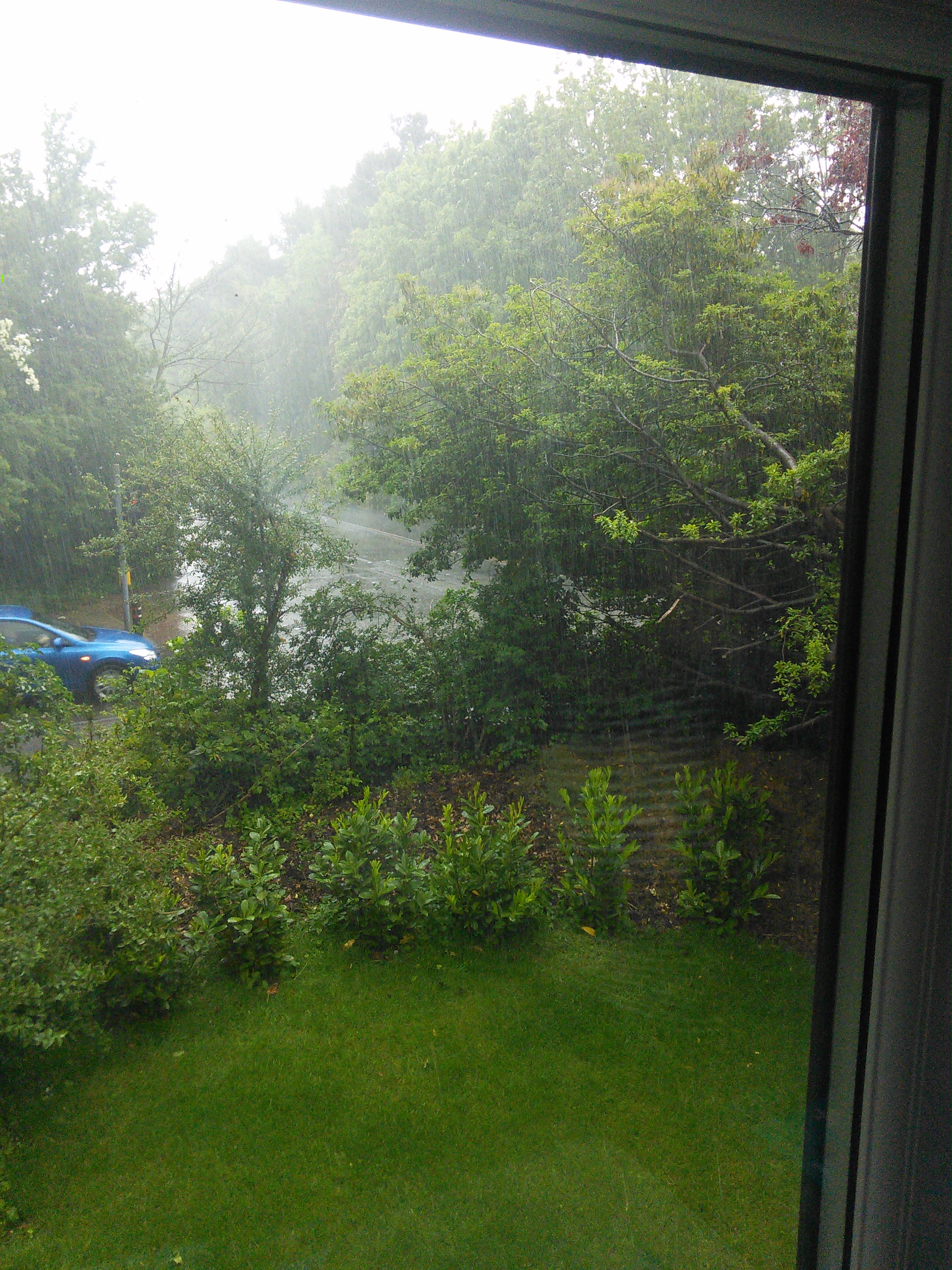
My photos are mostly not on this device, but I may move some up to post here later. To finish this brief post I will post a picture of a spring time rain shower from the window in my sister’s house. Fortunately the weather hasn’t been too bad so far.
Every time I write my 1,000 words it is a challenge but sometimes it is more of a challenge. As I’ve said before, sometimes I know roughly what I want to include, while other times I pick a topic and go for it. This post is one of the latter.
Speed. Anyone who has been on the Internet since the early days knows about speed. When I hear people complaining about the speed of their connection I quietly laugh as I consider the days of dial-up, and of 2400 baud modems. A megabit download could take half an hour to an hour if the connection held up that long.
A Telia SurfinBird 56k modem, made by Telia. They often came with a Internet package from the company in the late 1990s. (Photo credit: Wikipedia)
As an aside, the “skreee, Kaboinga, boinga, boinga, skeeee…” of a dial up modem connecting induces nostalgia in me, though I’d not go back to those days! Today’s Internet is sometimes called the Information Superhighway. The old dial up Internet was much like a dirt road. With potholes.
When one takes a journey, say from one end of the country to the other, one sets out on local roads, which may or may not be congested, then one travels over the Motorways, or the Interstates, or the Autobahns. Then one travels on the local roads at the far end. Any of these may be congested, but the local roads are most likely to be slower to traverse.
English: An automobile on the sweeping curves of the Autobahn with view of the countryside. (Photo credit: Wikipedia)
The same is true of the Internet. Your local ISP is equivalent to the local roads at your end of the trip, and the target website or whatever you are connecting to is in their ISP’s local network.
If we delve a little further, it is evident that the copper or fibre that makes up the Internet is not really a factor in the speed of the Internet. Signals in the fibre travel at light speed. Typically this is less than light speed in empty space, but it is close to it. Signals in copper travel slower than this, but still at a significant percentage of the speed of light. (I’d put a link in here, but the subject is complex and I found no clear explanation. YMMV).
English: Fibre Optic cables sign at Exe Water Bridge Over the last few years fibre optic cables for TV and phones have been laid along many rural roads. Usually the indication of their presence is the presence of manhole covers at intervals along the road. Here it is evident that the cable had to go beside the road at the bridge – and probably under the river – so the sign is a warning to other utilities who may dig up the roadside. (Photo credit: Wikipedia)
The real reasons that fibre is preferred over copper is the huge bandwidth and the much smaller attenuation in fibre cables. Bandwidth is often described in terms of how many lanes a highway has. Obviously the more lanes the more traffic a highway can handle. Attenuation is interesting. It’s as if your car starts out in New York in pristine condition, but deteriorates en route to Los Angeles, until it arrives at its destination looking like a bucket of bolts, if it makes it that far.
Whether or not the packets are transmitted by fibre or copper, the signal must somehow be loaded onto the cable, and this takes significant time. The packet of data is placed into a register on the network connector by the computer and a special chip translates that to a stream of bits on the wire, or pulses of light in the fibre.
These pulses then whiz off onto the network. However they don’t travel all the way in one hop. Your computer connects to a modem device that sends the signal to your ISP, where the signals hit a router. This device looks and a whole packet of data, then send it off again towards its destination. It doesn’t get to its destination in one hop, and there may be a dozen or more hops before it gets there.
At the beginning and the end of each and every hop there is a device that grabs the packet of data off the wire, decides where to send it and puts it on another wire. These devices are called ‘routers’, a term which many people will have heard. As you can imagine, each hop adds a delay (or latency) to the packet of data. These delays are quite small but they add up.
English: Avaya ERS 8600. (Photo credit: Wikipedia)
So the Information Superhighway doesn’t look that flash after all. Sometimes I wonder how data actually gets through at all. It’s as if there was a multi-lane highway across the country (the world even), but it is studded with interchanges which take significant time to traverse, increasing the time taken for the trip – light would take nanoseconds to get from here to Sydney if we had line of sight, but over the Internet it takes milliseconds.
Satellites are even worse. To reach a geostationary communications satellite and return takes of the order of half a second, an age in computing terms. Of course most communication satellites are lower than that so the delay is not as much as half a second, but it is still significant.
The advent of streaming services has exacerbated the problem. The basic issue is twofold. To use the motorway analogy, there are many more cars on the road and as a result the interchanges are becoming crowded resulting in congestion. In general the motorways themselves are fast and free-flowing, but the interchanges have not caught up.
An ingenious partial solution is to strategically place machines around the world which effectively distribute the stuff that people want to receive, so that the same content is available locally. It’s like taking all the copies of the pictures in a gallery in Los Angeles and storing the copies in New York, Miami, Washington and so on. Rather than having to go all the way to Los Angeles, a New York viewer sees the picture locally.
In the diagram shown, we see an “Akamaized” website; this simply means that certain content within the website (usually media objects such as audio, graphics, animation, video) will not point to servers owned by the original website, in this case ACME, but to servers owned by Akamai. It is important to note that even though the domain name is the same, namely http://www.acme.com and image.acme.com, the ip address (server) that image.acme.com points to is actually owned by Akamai and not ACME. (Photo credit: Wikipedia)
So the sources of delay to your streaming the latest version of TV shows are many. The first possibility is your own setup. Maybe your network and modem are not up to the task. Secondly there is the telecom network. Tricky stuff happens between you and your ISP which if the province of the telcos. I don’t know the ins and outs of it, but in some cases switching a couple of connection in the roadside cabinet or in the exchange helps.
Then there is your ISP. ISP will be keeping a close eye on the traffic through their part of the network, but the rapid rise of the streaming services has caught them a little bit unawares, and some are scrambling to keep up. Then there is the Internet backbone. It is unlikely that there are issues here. Finally there is the target ISP’s network and the target site’s network and the site itself. Any of these could cause issues, but they are way beyond the control of the end user and his/her ISP.
Speeds on the Internet are phenomenal when compared to the early days. Things are much more complex these days. It is amazing what can be achieved, and those of us who have experienced the early days are less likely to whinge about speed issues as we remember that it was like!
Television as a medium is less than one hundred years old, yet in the sense of a broadcast over radio waves, it seems doomed as the rise of “streaming” sites takes over the role of providing the entertainment traditionally provided by broadcast television.
My first recollection of television was watching the televising of the coronation of Queen Elizabeth the Second. I can’t say that I was particularly interested at the time, but I do remember that what seemed a large number of people (probably 20 or so, kids and adults) crowded on one side of the room while the television across the room showed its flickering images on its nine inch screen.
Coronation of Queen Elizabeth II X (Photo credit: Wikipedia)
I remember when at a later date my father brought home our first television. It was a large brown cabinet with a tiny noticeably curved screen. When it was set up properly and working, it displayed a black and white image on a screen which was smaller than the screen of an iPad.
The scan lines on the screen were easily visible, and the stability of the circuits that generated the scan were unstable, so the picture would flicker and roll from top to bottom and tear from left to right. Then someone would have to jump up and twiddle some knobs on the rear of the set to adjust it back into stability, or near stability.
To start with many people did not have aerials on their roofs. For one thing, television was new, and secondly the aerials were huge. They were generally large constructions, either in an X shape or in a H shape several feet in length. Most people started with an internal aerial, the so-called “rabbit’s ear” aerials.
These were small, low down and generally didn’t work too well as they were nowhere near comparable to the wavelength of the transmitted signal. Nevertheless they enabled people to, in most cases, get some sort of a picture on their new televisions.
The trouble was that with a weak signal and unstable circuits, the person leaning over the television to tune it more often than not affected the circuits and signal. With the rest of the family yelling instructions and with a clear(-ish) picture on the screen, it only took the movement of the person tuning the set away from the set for the picture to be lost again.
Of course soon everyone had an aerial on the roof, and the aerials shrunk in size as television was moved to higher frequencies, and as the technology improved. The classic shape of a television receiver aerial consists of a bristly device, sometimes with smallish mesh reflector, one dipole and several reflectors and directors, which pretty obviously points towards a television broadcast station.
Many tower sprung up on the tops of convenient hills to provide the necessary coverage and it is a rare place these days when the terrain or other problems prevent the reception of a television signal. Even then, coverage could probably be obtained by usage of satellite technology.
However, after several decades of dominance the end of the broadcast network looks like it is in sight. The beginning of the end was probably signalled by the Video Cassette Recorder, which enabled people to record programs for viewing later. People were no longer tied to the schedule of a broadcaster, and if they wanted to watch something that was not on the schedule, they went to a store and hired it.
The video cassette stores appear to be going to have an even shorter lifetime than television itself. Of course most of them have switched to DVD as the medium but that doesn’t make a significant difference.
What does make a difference is the Internet. Most people are now connected to the Internet in one way or another, and that is where they are getting a major part of their entertainment, music, news, films, games, and also that is increasingly where they are getting their TV-style entertainment, what would otherwise be called “TV series”.
English: Intertitle from the The CW television program Nikita (Photo credit: Wikipedia)
TV companies produce these popular series, an example of which would be “The Big Bang Theory”. This show has run for years and is still very popular on television, but it also available for download (legitimately) from one or more companies that are set up expressly for the purpose of providing these series online, on the Internet.
In countries at the end of the world, like here, it takes months or even years for the latest episodes to be broadcast here. If they ever are. So more and more people are downloading the episodes directly from the US, either legitimately or illegitimately.
English: Step 3 of Download (Photo credit: Wikipedia)
This obviously hits at the revenues of the companies that make these costly shows, so, equally obviously they are trying to prevent this drain on their revenues. The trouble is that there is no simple way of ensuring that those who download these programs are paying for the service. If they are paying and the supplier is legitimate then presumably the supplier will be paying the show producers.
Once an episode is downloaded, then it is out of the control of the show’s producers. The recipient’s ethics determine if he will share it around to his friends or keep it to himself. If thousands of people (legitimately) download it, then presumably some of the less ethical will then share it on, and it soon becomes available everywhere for free.
icon for Japanese File-sharing program perfect dark. (Photo credit: Wikipedia)
It will at some stage reach a point where broadcasting a television program is no longer economic. The producers will have to primarily distribute their programs via the Internet and somehow limit or discourage the sharing of the programs around. That would mean the end of TV broadcasting as we know it.
We are not anywhere near that situation yet, and the program production companies will have to come up with a new economic model that allows them to make a profit on the shows without broadcasting them over radio waves. The more able companies will survive, although they may be considerably smaller. TV actors will only be able to demand much smaller salaries, and budgets will be tighter.
English: Captioned with “Professor A.W.H (Bill) Phillips with Phillip’s Machine.” Phillips was an LSE economist known for the Phillips curve and he developed MONIAC, the analog computer, shown here, that modeled economic theory with water flows. (Photo credit: Wikipedia)
Another factor that the program production companies will have to take into account would be loss of advertising revenue. Losing advertisers can scuttle a television show, so this is not a minor factor.
Whatever happens in the long term, as I said above, a new economic model is necessary. I’ve no idea what this will look like, but I foresee the big shows moving to the Internet in a big way.
Broadcast TV will continue for some time, I think, as there are people who would resist moving away from it, but it is likely to be much reduced, with less new content and more reruns. It may be that the broadcast TV may be reduced to a shop window, with viewers seeing the previews and buying a series with a push of a button on their smart TVs.
The staircase at the National Museum of Crime & Punishment (Photo credit: Wikipedia)
I’m convinced that most people go through life making few real choices. Oh, we all can all look back and say “Oh, decided to do so-and-so”, but I’m convinced that we didn’t make a choice in the sense of sitting down, making list, considering alternatives, options and consequences. I guess that the nearest that we would come to doing that would be when we are budgeting, or deciding where to go on holiday.
No, our “choices” are driven by needs (“We need to go to the mall to buy….”) or desires (“Let’s eat at the Peppermill today. I had a great omelette there last week!”). Someone comes up with a need or desire and we go along with it or we don’t.
My point is that there is a thing, which I believe doesn’t exist, called “Free Will” which allows a free choice between alternatives. There is a philosophical war going on between the believers in “Free Will” and those believing in “Predestination” for millennia.
It seems to me that the closer you look at the Free Will/Free Choice thing, the more you discover the reasons that people make the choices that they do. The more reasons, obviously the less “free” the choice will be, and the more you dig the more reasons you find and the less free the choice becomes. I contend that eventually, the room for freedom of choice shrinks to nothing.
An interesting test would be to put people into a box with a screen and two buttons, and not give them any instructions except “Go into the box and sit down”. Maybe play them some elevator music to set the tone. When you pull them out after 10 minutes or so, they will have pushed zero, one or two buttons. If you then say, in a neutral tone, “You pushed zero, one, two buttons”, they will immediately begin to tell you their justifications for their action or actions.
Justification are not reasons. People often something like “Well, you left me in there with no instructions. Buttons are for pushing, So I thought that I would push one and see what happens” or “Nobody told me to push the buttons, so I didn’t”.
Traffic light aid for the blind, Herzliya, Israel (Photo credit: Wikipedia)
These statements say little about the reasons for the person’s actions or inactions. The reasons that they press or don’t press the buttons relate more to a person’s character and state of mind at the time than the justifications given. For instance, the person may be a rule follower, and without rules, would do nothing. Another person may be a rule breaker and, without rules, feels free to do whatever they wish. We all are a mix of both types of course.
People don’t think “I’m a rule-breaker, I’ll push a button”, so they can’t really claim this as a reason for their choice, and they can’t be said to have made a free choice if constrained by this innate or learned facet of their behaviour.
Some people believe that, in spite of the postulated fact that there is only one possible outcome when a choice is made, that a choice has in fact been made, since if the circumstances had been different a different choice would have been made.
This seems to me to be dodging the question. (It’s not “begging the question” in the strict usage of the phrase). I look at it like this: if we were to roll back time to before the moment that a choice was supposedly made, such as the point when the door of the box closed, and we let time roll forward again, could anything different happen. It is my contention that since all other factors remain the same, that the same thing would definitely happen.
תרשים כללי של פנופטיקון, מבנה הטרוטופי (פוקו) (Photo credit: Wikipedia)
Which brings me to the point of this post, which is, how do we justify meting out punishment for a crime, when the criminal was unable to choose not to commit it. Take away the concept of free will and punishment of the criminal seems cruel, unnecessary and unethical at the first glance. Wikipedia gives four justifications for punishment.
Justifications for punishment include retribution, deterrence, rehabilitation, and incapacitation.
Of those justifications the first, retribution, is problematic in a predestined world. The criminal could not have not committed the crime, so revenge or retribution loses most of its point.
Image of “Dawn: Luther at Erfurt” which depicts Martin Luther discovering the doctrine of Justification by Faith. (Photo credit: Wikipedia)
However, retribution is rolled up into deterrence. If other criminals see what happens to the criminal in question, they will possibly be less likely to commit similar crimes. In other words the reluctance to suffer the consequences becomes part of their character which results in them not doing similar. When the chance to commit a similar crime arises then this factor becomes part of the character and they do not do it.
Similarly the criminal in question will be deterred (one hopes) from committing the crime again. He will hopefully be rehabilitated and the punishment for his current crime will influence him when the possibility of committing a similar crimes turns up. The punishment is in his memory and is a part of his personality and could be a reason for not committing the crime in the future. He may claim, in the future, that he “chose” not to repeat his crime, but in fact he could not chose to do it because of his personality and his memory of his punishment.
“A Dream of Crime & Punishment”, engraving by J.J. Grandville. As reproduced in “Harper’s Magazine” shortly after Grandville’s death in 1847. “It is the dream of an assasin overcome by remose” (Photo credit: Wikipedia)
If the punishment results in a prison sentence then of course he cannot commit the crime or similar crimes. Wikipedia uses the term “incapacitated” and indeed that is so if he is imprisoned. An execution is a pretty final way of “incapacitating” a criminal and for many justice systems it it the ultimate punishment for severe crimes.
In the past in many countries, the criminal was tortured before execution, a process which horrifies us these days, but which seemed justified at the time. It at least some of these cases the intent was “drive out” evil influences.
Evil Twin (Photo credit: Wikipedia)
The past crimes of others and their subsequent treatment, whatever it was, also serves to warn and influence others who might also have otherwise committed similar crimes. So even in a predestined world punishment would have a deterrent effect on others as it will influence others. In fact the only difference between a universe which allows for free will (somehow) and a predestined universe is the idea of “blame”.
The “free will” universe blames the wrongdoer, but the predestined universe doesn’t as the wrongdoer could not do otherwise than he did. There are still reasons for punishment in a deterministic universe in spite of that.
Incompatiblists agree that determinism leaves no room for free will. As a result, they reject one or both. (Photo credit: Wikipedia)
Plymouth Valiant 100 of some 40 years ago seen on street in New Orleans (Photo credit: Wikipedia)
Forty years, around 14,600 days, 350,400 hours, 21,024,000 minutes, or 1,261,440,000 seconds. In other words around 1.3 gigaseconds. That’s the amount of time that I have been married to my wife, Elizabeth, known to everyone as Matty. I don’t mean to imply that it seems a long time – it doesn’t! Far from it. But it has been a long time, and I am amazed. Firstly because it has been a long time and secondly because we have stuck together for that long.
In that time the earth has travelled 37,600 million kilometres, light from earth or the sun has travelled 40 light years, or 3.8 x 10^14 kilometres. There are around 2,000 known stars within 50 light years of earth, with 133 falling among the brightest 10%, and according to my calculations around half of them are less than 40 light years away. That means that there is little chance that any LGMs will have been blinded by the flash of the photographer’s camera.
Alien2 (Photo credit: Wikipedia)
In that time a lot has happened. We have had three children and shortly after that, moved half way around the world. The kids have grown up and we now have three grandchildren, who are also growing up fast. The youngest has been at school for a year now, and it seem only recently that her mother was just starting school herself. Thankfully the kids have not dispersed too widely and they and the grandkids will be lunching with us tomorrow to celebrate.
I’ve been looking at the things that have happened and changed in that 40 years. Strangely I had thought that the moon landings had not finished when we got married, but in fact there was no overlap. The last moon landing (Apollo 17) happened in 1972, before we were married. (The first landing was in 1969). Weird!
While men have not been to the moon in the last 40 years, many man-made devices have been sent to other planets and even to comets, The Hubble space telescope has sent back amazing photographs of the depths of space and other such telescopes have followed suit.
Eta Carinae captured by the Hubble Space Telescope. (Photo credit: Wikipedia)
One of the biggest successes in exploration of the solar system has been the Mars Rover Opportunity which has operated on the surface of Mars since 2004. It’s original planned activity period was scheduled to be 90 sols or Martian days (slightly longer than an Earth day). However Opportunity is still functioning and sending back amazing photographs much more than 10 years since it landed.
Many of Opportunity’s photographs and panoramas can be found on the NASA web site, which also contains stunning photographs, both modern and historical, of rocket and shuttle launches. It also includes astronomical photographs taken by many different telescopes and photographs taken on the moon and from orbit. I highly recommend it.
The NASA/ESA Hubble Space Telescope in space. (Photo credit: Wikipedia)
Most people spend a lot of time on the Internet using a browser and viewing sites and that aspect of the Internet, originally called “the World Wide Web”, originated in CERN in the late 1980s. At some time a lot later than that I downloaded a copy of the NCSA web server and create a “Hello World” web page. I then pointed a browser at it (probably an early version of Internet Explorer) and up popped my “Hello World” page! At the time I was thrilled and delighted!
Another notable event around 1975 was the first commercial flight of Concorde in 1976. It went out of service in 2003 having failed to become a commercial success. I worked for British Aerospace at one time, though not directly on anything to do with Concorde. I also worked for British Aerospace who made the Olympus engines for the Concordes.
In 1977 the Queen celebrated her celebrated her silver jubilee, and she is still going 40 years later! I don’t remember much of the celebrations but I do remember that it was a big thing at the time!
While searching around for links for this post I came across this useful link from the Sunday Telegraph which lists events from the last 50 years. It’s amazing how many seem to be fairly recent and at the same time a long time ago. The first case of AIDS was diagnosed in 1980, for example. The Vietnam war ended in 1975. The first test tube baby was born in 1978. Her son was conceived naturally and was born in 2006.
So much that we take for granted today was not around when we got married. No Internet as above. No cell phones. According to the Sunday Times list above, the first British mobile phone call was made by the comedian Ernie Wise to Vodafone. The first mobile phones were small bricks and had battery lives which were very short. They were also rare and expensive. Facebook, Twitter and all the other “Social Media” sites were well in the future and the multifunction devices that mobile phones have become were almost unimaginable.
So many things have changed that it is a wonder that anything has lasted. Our marriage has lasted, even though the concept of marriage itself has changed to include same-sex marriage, over the four decades. It seems that even same-sex marriage is becoming less popular, with couples often having children first and getting married later. That still seems odd to me, but it seems to work for many people.
We’ve made it through 40 years while all things have changed around us. I’m proud of that fact and hope that we can continue for many more. But we have a long way to go to beat my parents – they just recently celebrated 70 years of marriage.
Great Observatories’ Unique Views of the Milky Way (Photo credit: Wikipedia)
The Cricket World Cup continues and now we have only the final match left. New Zealand versus Australia. The success of the New Zealand team and the reaction to their semi final win led me to think about heroes.
The saying goes that every one likes a winner, and since the New Zealand team has exceeded many peoples’ expectations, the local media are ecstatic. Most ordinary New Zealanders who would not normally be interested in cricket have been tuning their radios and TV to the match commentary or streaming the matches from the Internet. Indeed it would be fair to say that the whole country is behind the team.
Interestingly, the New Zealand commentators, who covered the semi final and who were jumping for joy when New Zealand won, were almost as quick to sympathise with the losing South African team. This empathy was probably because it was an amazing game with a breath taking finale, played all the way through in good spirit, and the South African team who so nearly won it called truly be called gallant in defeat.
The match could have gone either way up until the very end, and I think this helped the New Zealand team and the New Zealand public to commiserate with the South Africans. It so nearly was the New Zealand team on the losing end of the match. It was an amazing end, with grown men hugging and grown men crying.
Being a small country New Zealand doesn’t often have sporting heroes or heroines, but it does happen. New Zealand players have gone to Australia the UK, Japan, France and even the US to play their sport, be it soccer, basketball, rugby union or rugby league. New Zealand doesn’t have the funds to pay professional sports persons that these other countries do.
Somehow or other this doesn’t seem to affect the quality of the sports stars in the local sporting arenas. In fact returning players often find it a little difficult to get back into the top level teams on their return from an overseas period of their career.
In New Zealand the public has a curious attitude to top sports persons. If a New Zealander were to meet one of his or her sports idols, he or she would probably as likely offer to buy him or her a drink as ask him or her for an autograph.
New Zealanders expect sports stars to be approachable, and in many cases they are. Because it is a small country, a sizeable number of the fans will have gone to school with them, or lived next door to them, or perhaps worked with them when they were starting out, before they became professional sports persons.
New Zealanders tends to excel in what could be called minor sports. This is probably partially because in the larger countries, the ones in which the sport arose or where it has become very popular the best athletes are attracted to the major sports. When a New Zealander or New Zealand team do succeed in major sports it is front page news ‘back home’.
Even when it is a minor sport (such as Greco-Rona wrestling or lawn bowls) if a New Zealander does well they become well known, at least in New Zealand. New Zealanders realise this full well and wryly comment that something is “world famous in New Zealand“.
English: L & P bottle model in Paeroa, showing the label design as used from the 1970s to the 1990s Deutsch: L&P Modellflasche in Paeroa mit dem Label, dass von 1970gern bis 1990gern verwendet wurde. (Photo credit: Wikipedia)
So we have the likes of Stephen Adams doing well in American basketball, and the average New Zealand man in the street knows that he plays for Oklahoma City Thunder, and the average New Zealand sports buff could probably tell you what his scores were.
Heroes and heroines have been around since people started to form towns and cities and to write down their histories. Back in the times that the Greeks and Romans held sway in Europe, it is likely that total population of the Earth would have been measured in millions rather than the billions that live on the Earth today. Towns and cities of the time would probably have appear small to modern eyes – Rome is believed to have peaked at around one million people at its peak in the second century of the Common Era.
Roman Infantry Edit (Photo credit: Wikipedia)
Since the populations were so small compared to today it is likely that the heroes and heroines of the time were known personally to a large part of the population. Since the population was so small the six degrees of separation of the modern world are likely to be reduced to three or four. Admittedly the lines of communication would likely be way slower in the ancient world but Julius Caesar was likely be a friend of a friend of a friend of every person in the world at that time.
English: Map of the Roman Republic in 40 BC after the recent conquests of Julius Caesar. (Photo credit: Wikipedia)
Given the small population of the time, heroic events would be quickly well known and the heroes and heroines would become household names. Since this would happen mostly by word of mouth, the Chinese Whispers effect would be strong. Intentional and unintentional misunderstandings would mount up and would inflate the story, so that instead of the hero overcoming three others, one at a time, he instead reputedly takes on a dozen all at once.
When you read of Julius Caesar and his legions, I at least get the image of vast armies, but a legion was between 5,000 and 1,500 men. Caesar conquered Gaul with only a few legions, say 10,000 men probably which doesn’t seem very many, but there was little real opposition in numerical terms.
The initials SPQR stood for Senātus Populusque Rōmānus (“The Senate and the People of Rome”). They were emblazoned on the banners of Roman legions. (Photo credit: Wikipedia)
It’s not as if there were a strong national structure to oppose him, as the tribal structure common in those days might extend to a city or two, or a region and Julius Caesar was able to exploit regional rivalries to take control of the region. He of course had to contend with heroes popping up, like Vercingetorix who unified the previous divided Gauls.
Heroes and heroines have only one fate – they win at first (which makes them heroes or heroines), but eventually they lose and then they usually die. Vercingetorix eventually lost to Julius Caesar at the battle of Alesia, and Julius Caesar cemented his hold over Gaul.
English: Monument of Vercingétorix in Alesia (Alise-Sainte-Reine) Deutsch: Denkmal des Vercingétorix in Alesia (Alise-Sainte-Reine) (Photo credit: Wikipedia)
Even Julius Caesar, eventually, lost both his empire and his life, at the hands of his former friends, who briefly became heroes themselves, before quickly losing their lives too.
While modern day sporting heroes and heroines don’t actually die, they eventually suffer defeat and become radio or TV commentators, which may be a worse fate. So I hope that the New Zealand cricket team wins the Cricket World Cup tomorrow, but if they can’t manage it, they have put on an amazing show in getting this far.
Many young British Pakistanis play cricket for recreation (Photo credit: Wikipedia)
That’s how Wikipedia describes cricket – as a bat and ball game. Since the Cricket World Cup is currently being staged in Australia and New Zealand, I thought that I would choose cricket as the topic for the week.
The roots of cricket are in England, though it so happens that the mother country of cricket has been eliminated from the Cricket World Cup (CWC). Cricket has spread to a number of other countries as a result of colonial and other influences and 14 teams have been taking part in the 2015 CWC.
List of ICC cricket member nations. Orange marked countries are test teams, yellow are associate and purple are affiliate member nations. (Note: Certain island nations may not be shown.) For those who may not be able to make out the colours: Shade used for Australia is orange Shade used for United States is yellow Shade used for Mexico is purple (Photo credit: Wikipedia)
Cricket playing nations are either full members of the International Cricket Council or associate or affiliate members. The CWC contestants are the 10 full members and 4 other members who are required to qualify for the tournament. The ‘minnows’ as the associates and affiliates are often referred to rarely trouble the full members in matches, but upsets are not unknown.
Of the bat and ball games, cricket is of the class where a batsman defends a target from a ball thrown (“pitched” or “bowled”) by a player from the other team. Points (referred to as runs) are scored by running from one end of the pitch to the other, or by hitting the ball out of bounds.
Sri Lankan bowler Muttiah Muralitharan, the highest wicket taker in both Test and ODI forms of cricket bowls to Adam Gilchrist. (Photo credit: Wikipedia)
Cricket is similar to baseball and softball and the informal game of rounders in the sense that the members of the batting team take turns ‘at bat’. The target area is a physical target in cricket (“stumps” and “bails”) but is a virtual box in baseball and softball. There is no specific target in rounders, where the ball just has to be hittable by the batter.
Cricket has two “targets” or wickets, and I can’t think of any other bat and ball sport that has two wickets or the equivalent. The wickets are one chain apart in the old Imperial measures, and the person who delivers the ball to the batsman throws or bowls the ball from one wicket to the other. The game switches around after every 6 balls, with a second bowler bowling at the batsman at the other end of the pitch. This is termed an “over” as the supervising official, the umpire, calls “Over” when six balls have be bowled.
English: Wicket, the stumps being hit by a ball (Photo credit: Wikipedia)
In informal or backyard cricket it is common to have just one wicket and a single pole (or stump) for the bowler to deliver the ball from. Other rules are ignored or modified as appropriate from the much smaller space available. In recent years, there has been a move to formalise at least some games of backyard or beach cricket and to institute competitions in the formalised code. These are still considered “fun” games though.
There are variants of cricket played in some Pacific Islands, The rules of these variants are also informal, team sizes are variable, and the bat often resembles a war weapon. Teams can contain both men and women and people of all ages. The Wikipedia article mentions that there have been attempts to formalize the rules of this variant of the sport.
The original format of the formal game of cricket is multi-day, multi-innings. Even the Island form of the game runs to several days, but that may be related more to the social nature of island cricket than anything else. As in any formal game the equipment and the uniform is closely specified and in particular the uniform is white – known as “cricket whites”.
The multi-day format is unusual in sports and arises from the fact that each team has eleven players and each may have to have their time at bat twice in a game. Shorter forms are often played at a semi-formal or provincial level, many being completed in one innings in one day. Cricket is not a quick game in terms of time taken, as each batsman may face upwards of one hundred balls. The semi-formal “village green” cricket is a leisurely affair, in spite of the fact that the ball may be bowled at speeds of up to 150kph.
A family playing cricket on the Village Green (Photo credit: Wikipedia)
A new form of cricket has developed where the number of overs or sets of six balls is restricted to 50 for each team. The uniforms are not restricted to white and some other minor changes have been made to the rules. These changes have led to a more exciting, quicker form of the game and the matches are over in one day. This is the form that is being played for the Cricket World Cup.
There is an even shorter version of the game called Twenty20, which is a fast paced version with only 20 overs per side. Both the 20 over and (slightly less so) 50 over versions of the game result in fast scoring and more excitement than the standard version of the game as teams, both fielders and batsman take a more highly charged attitude.
Turner slides to prevent a boundary during a Twenty20 Cup match against Gloucestershire. (Photo credit: Wikipedia)
The sport is professional at the top level, and the top players are treated as celebrities. Since the sport is international these days players get to play in many countries. In particular many overseas players play in the Indian Premier League, a very rich Twenty20 competition based, as the name implies, in the Indian sub-continent.
The stance of a batsman in cricket is side on, with the bat grounded before the bowler start his delivery and raised backwards in preparation for the stroke. Consequently there are left hand and right batsmen (and bowlers). Since the game has been around there are unique terms for various matters to do with the game.
For example, the field positions have traditional names which might seem whimsical. “Silly Mid On” is one of them. It certainly is “silly” as it is close to the batsman in the natural line of a stroke on the on or leg side. The position is intended for a close in catch and is obviously dangerous as the ball is hard, much like a baseball. Some Silly Mid On fielders wear protective helmets and other gear.
One field position that I had not heard of until recently is “Cow Corner”. A fielder at Cow Corner is in much the same line from the bat as Silly Mid On, but much further away, almost on the edge of the field (the “boundary”). The name seemly relates to the rustic roots of the game where the field was indeed a field or paddock that had to be cleared of livestock before a game could commence.
Terry Pratchett, Park Branch Library, San Francisco, on tour promoting the 34th Discworld novel, “Thud!”, in a book signing organized by Booksmith. This was before the 1 1/2 hour chat – Pratchett arrived early and, with grudging efficiency, settled down to sign some books beforehand to get some of that out of the way. (Photo credit: Wikipedia)
There’s an apocryphal story of an eminent lecturer (some say Bertrand Russell) giving a lecture on astronomy, describing how the earth orbits the sun, the sun orbits the centre of the Home Galaxy, the Milky Way, when someone objects and states that the earth is a flat surface, balanced on the back or a turtle.
The lecturer questions what it is that the turtle is standing on, and the objector states that the turtle is standing on the back of another turtle. The lecturer asks what the second turtle is standing and gets the answer “It’s turtles all the way down“.
It’s always struck me that the objector’s argument is paralleled by the lecturer’s own argument. The moon orbits the earth, the earth orbits the sun, the sun orbits the Home Galaxy, the Home Galaxy orbits the Local Cluster of galaxies. It’s orbits all the way down.
Of course the lecturer’s world view is a lot more sensible than the objector’s world view, wouldn’t you say? Well a confirmed sceptic would be dubious about both claims, but the man in the street assuming he wasn’t by chance a turtle believer would probably side with the lecturer.
Yertle the Turtle and Other Stories (Photo credit: Wikipedia)
It’s worth remembering that the current view of the universe as espoused by the lecturer is fairly recent in historical terms. Sir Isaac Newton and his near contemporaries (both in Britain and elsewhere) cemented the physical view of the world as the paramount paradigm. Again it’s worth noting that Sir Isaac and co did not completely ditch the mystical view of the world. He was very interested in alchemy for example, though this could be considered to be a rational belief at a time when the field of chemistry was still relatively immature.
Sir Terry Pratchett took the turtle theory and ran with it in the Discworld series of books. What would life be like on a world shaped like a disc, carried by four elephants, on the back of a gigantic turtle? This is the basic premise of Pratchett’s books, which I enjoy immensely.
P Elephant (Photo credit: Wikipedia)
Obviously, sort of, such a world cannot be ruled by the laws of physics, so it is ruled by the laws of magic, which seem parallel the physical laws in some ways. Pratchett’s Discworld clockwork is run by magic, not by physics. Indeed one of the characters muses on the magical laws and wonder whether or not there might be “another way”.
Threading the Discworld books and the Discworld universe are certain key characters, the first of whom is the failed wizard and professional coward Rincewind, from the first Discworld book “The Colour of Magic”. Rincewind’s quest for a quiet life is forever dashed by circumstances which often result in Rincewind escaping from some life-threatening situation or other by the skin of his teeth.
Rincewind as illustrated by Paul Kidby in The Art of Discworld. (Photo credit: Wikipedia)
Rincewind’s case is watched over by Death, who describes himself as an “anthropomorphical manifestion” and who looks after a room full of “life-timers”, huge hour glasses containing the sands of a person’s existence. When the sand runs out, Death appears to the person and with a sweep of his scythe cuts the person’s lifeline. What happens then varies, but usually the person or soul travels over a dark plain.
Rincewind’s lifetimer apparently looks as though it was constructed by a glass blower with a bad case of the hiccoughs, and Death has ceased to wonder when Rincewind will die, but merely retains a “professional interest” in Rincewind’s exploits.
Death (Discworld) (Photo credit: Wikipedia)
One thousand words cannot do justice to the inventiveness of Pratchett’s Diskworld. It is peopled by trolls, dwarves, werewolves, vampires, heroes (professionals of course), wizards, witches, talking dogs, a smell with its own personality, druids, priests, gods and godesses and many many other characters.
Over the series of books the geography of the Diskworld as are some of its physical (or maybe that should be “magical”) properties. The geography is centred socially in the twin city of Ankh-Morpork, and physically by the Hub Mountains (home of the Ice Giants and “Dunmanifestin”, the home of the rather down market major gods of Diskworld).
The Discworld gods as they appear in The Last Hero , illustrated by Paul Kidby (Photo credit: Wikipedia)
Sir Terry Pratchett’s Diskworld is, as can be seen from the above to be a complex one, interleaving and referencing many well-known myths and legends which Pratchett weaves into enthralling parodies of the originals.
For example, the heroes that Rincewind and others encounter are mostly bumptious self righteous individuals who seem to possess very little in the way of intellect. They win because they are heroes and heroes always win in the end, not because they are shrewd campaigners.
An exception to this model of hero is Cohen the Barbarian and the Silver Horde. These ancient heroes are shrewd and survive because they have decades of experience in not dying. The overcome a bunch of martial arts experts by using there experience by not being there when the martial arts experts makes a move.
Pratchett references all sort of myths, legends and stories and often delves deep into the roots of the myth. He traces the roots of the “Father Christmas” myth in the book “Hogfather” back to one bloody version of the possible roots of the myth.
Folk tale depiction of Father Christmas riding on a goat. Perhaps an evolved version of the Swedish Tomte. (Photo credit: Wikipedia)
His coven of witches who appear in several books harken back to Shakespeare’s three witches in Macbeth and also to other witch myths, such as (supposed) pagan myth of the Maiden, the Mother, and the Crone. Shakespeare of course, like Pratchett is tapping into earlier myths.
The adoption of the alternate reality scenario allows Pratchett to tap into all these myths and legends and to mix and match them with similar myths and legends and put them up against present day society. There is for example the Last Continent of XXXX, obviously a reference to current day Australia, the social problems of immigration, typified by the Dwarves who are mild mannered at home, but who turn into drinking, carousing menaces singing about gold when they immigrate to Ankh-Morpork.
Pratchett’s strength were to be able to draw on all these myths and legends and to build engaging stories around them. Even if you don’t know the legend, you can enjoy the characters and the story, and recognise the parallels with the real world.
You can enjoy the stories of the three witches turning the tables on card sharks who try to take advantage of three little old ladies, for example. Or the invention of surfing by the Burser of the Unseen University when the faculty find themselves offshore of the Last Continent (aka XXXX). Or sympathise with Death when he becomes disenchanted with his role as an “anthropomorphic manifestation” and takes a holiday.
Mustrum Ridcully as he appears in Unseen University Diary 1998 , illustrated by Paul Kidby (Photo credit: Wikipedia)
You do all this while enjoying the marvellous stories. RIP Sir Terry Pratchett. You will be sorely missed.




 Me on the net