Consciousness, in mice and men and flatworms

Deutsch: Phrenologie
Deutsch: Phrenologie (Photo credit: Wikipedia)

Of all emergent phenomena consciousness is the most mysterious, probably because we don’t seem to have a handle on the concept. We don’t understand how it arises and probably not much about what it comprises and how it works. We know that it, apparently, can be switched on and off, as when we go to sleep or are sedated or knocked out by some accident or other.

It is only marginally under our control. In general terms we can be conscious or awake, but not conscious of anything specific. We can be in a reverie or day dream, or we can be doing something semi-automatically, like driving. But we can “snap to” and be conscious of something specific, as when some event happens while driving that needs our full attention. Or the door bell snaps us out of our reverie, or we notice a cloud that looks like a dog, or cat, or, more likely, a sheep!

English: We're following the leader! What caus...
English: We’re following the leader! What caused the car in front to brake? Was it a horse and rider? Was it someone coming off the public footpath on the brow of the hill? That’s the pleasure of nose-to-tail driving on the A158. It just keeps your brain alert all the time! (Photo credit: Wikipedia)

Even when we are fully awake and concentrating on the idiot who just pulled out in front of us, we perform actions of which we are not fully aware, such as change down a gear or put on the brakes. We are aware of these actions to some extent as they are not fully automatic, like the movement of our legs when we walk, but we don’t have to think about which pedal to press or how to move the gear lever to change gear, as we did when we were learning to drive.

Washoe
Washoe (Photo credit: Wikipedia)

I might have said before, in a previous post, that I don’t think that it is feasible that consciousness is only found in mankind. Chimpanzees share 98.8% of our genes, so it reasonable that they share many of our abilities and they can certainly use tools and reason. It is unlikely that consciousness is an expression of something in the 1.2% of the genes that are unique to humans. Chimpanzees show fear and happiness , they sulk, they get angry and show other emotions. While the expression of emotions doesn’t prove that they are conscious, I find it hard to imagine a conscious entity would not express its consciousness through emotions, and that a non-conscious entity would show any emotions.

Computer mouse
Computer mouse (Photo credit: Pockafwye)

If chimpanzees are conscious animals as we are, then it follows that other animals are conscious entities to some extent or other. Some people believe that it has been demonstrated that most animals have consciousness, but I consider to be very likely, but not yet proved. Even a mouse, a “Wee, sleekit, cow’rin, tim’rous beastie” as Robert Burns put it, demonstrates its fear, and with its own species, anger. It is unlikely that a mouse is *as* aware as a human or even a chimpanzee, and it would be very difficult to find self consciousness in a flatworm though.

English: The planarian Schmidtea mediterranea
English: The planarian Schmidtea mediterranea (Photo credit: Wikipedia)

But then again, consciousness is related to mind and to the brain, and the brain is the major part of the “Central Nervous System” in mammals. It is possible that the more complicated a brain the more consciousness a animal possesses. Even a flatworm possesses a very simple brain-like structure called a ganglion. So, maybe, a flatworm posses a spark of consciousness, an atom of awareness of the most rudimentary sort.

English: Main regions of the vertebrate brain,...
English: Main regions of the vertebrate brain, shown for a shark and a human brain (the human brain is sliced along the midline). The two brains are not on the same scale. (Photo credit: Wikipedia)

Or there may be some threshold below which consciousness is impossible. A simple eyespot, such as flatworms possess cannot form an image. To form an image a much more complicated eye structure is required, so there must some limit of animal complexity at which vision can be said to be possible. A fuzzy limit, maybe, but a limit nevertheless.

If consciousness is truly an emergent phenomenon of the brain, the what properties of the brain could enable consciousness? Just as the chemical and electrical properties of water molecules are what enable the emergent property of wetness, some features of the brain and its shadow partner, the mind, must lead in some way to the phenomenon of consciousness.

English: Two water molecules
English: Two water molecules (Photo credit: Wikipedia)

The most obvious characteristic of the brain that really differentiates the brain from other organs is the concentration of neurons, billions of them, each connected to thousands of others by synapses. The number of connections is immense, but sheer complexity in itself does not imply consciousness.

In the case of emergent phenomena in general, it seems to me that it is easier to work from the top down as it were, the macro and consider what micro properties could feasibly cause the phenomenon. If we look at the wetness of water and consider that water is made up of molecules with physical, chemical and electrical characteristics we can at least speculate that the wetness of water is at least partly caused by the way that the molecules stick to and move across other molecules in a surface such as the skin. The water molecules are able to stick and let go and move over other molecules in a way that wets a surface, and forms a concave meniscus in a tube in a characteristic way.

English: Pendle Water, Nelson, Lancashire At t...
English: Pendle Water, Nelson, Lancashire At the South end of Victoria Park, Pendle Water flows out of the park, for a couple of miles to join the Lancashire Calder, which after a few miles westward, itself will flow into the River Ribble and hence to Preston and the Irish Sea and the Atlantic Ocean. Who knows where the water molecules that we see here passing in December 2008 will have got to by now? (Photo credit: Wikipedia)

In  comparison mercury atoms have different electrical chemical and physical characteristics. They don’t form molecules in the same way, and while they slide over one another, they don’t stick to other molecules and let go in the way that water molecules do. Consequently mercury atoms don’t wet surfaces like water molecules do and a mercury meniscus is convex not concave.

Close-up of a mercury-filled maximum thermomet...
Close-up of a mercury-filled maximum thermometer. The break in the column of mercury is visible. (Photo credit: Wikipedia)

So, we can work out, in rough terms, why water is wet, by comparing water and mercury, and noting their micro-properties. Can we achieve the same with the phenomenon of consciousness? Well, the brain is a computation engine of sorts, and so maybe we can compare it to a computer. Computers are not (yet) conscious and brains contain minds which are conscious. Can we make any guesses based on that?

Babbage difference engine
Babbage difference engine (Photo credit: tolomea)

You can probably tell from the questioning way that I am discussing this topic that I don’t have any firm opinions on the matter. There are a couple of differences that I will point out though.

Computers are highly organised and computational functions and memory functions are completely separate, physically and computationally. A computer is also clock driven, with each operation taking up exactly the same number of “clock ticks” each time it is performed. In contrast, while a brain does have areas in which functions seem to reside, and a particular area may “light up” every time one raises a finger for example, memory seems to be more diffuse in its location, as compared to a computer.

English: Thalamus. Part of the brain. MRI image.
English: Thalamus. Part of the brain. MRI image. (Photo credit: Wikipedia)

Secondly, a brain’s “architecture” changes over time, whereas a computer’s does not. A brain may make new connections (which may have something to do with memory), while a computer stays as it was when built.

Thirdly, a brain is enormously more complex than any computer yet built, at least in terms of the number of interconnections in it and its ability to re-wire itself with new connections.

Synaptical transmission (chemical). A: Neuron ...
Synaptical transmission (chemical). A: Neuron (Presynaptic) B: Neuron (Postsynaptic) Mitochondria Synaptic vesicle full of neurotransmitter Autoreceptor Synaptic cleft Neurotransmitter receptor Calcium Channel Fused vesicle releasing neurotransmitter Neurotransmitter re-uptake pump (Photo credit: Wikipedia)

I don’t know if these differences are significant in terms of explaining the problem of consciousness. I suspect that they are at the root of the problem, but I could be totally wrong. It may be the “programs” that run in the brain and computer that make the difference, but that just moves the issue to another arena.

And I’ve run out of space. I could touch on the “android” question, but I’ll leave that for now.

English: This is a photograph of EveR-2, a fem...
English: This is a photograph of EveR-2, a female android developed by the Korea Institute of Industrial Technology and demonstrated to the public in October 2006. It is 165cm tall and weighs 60kg. (Photo credit: Wikipedia)
Enhanced by Zemanta

Synergy and Emergence

English: Logo used by the Synergy project (htt...
English: Logo used by the Synergy project (http://synergy-foss.org/). (Photo credit: Wikipedia)

I’m fascinated by the phenomenon of synergy. Wikipedia defines it as follows:

Synergy is the interaction of multiple elements in a system to produce an effect different from or greater than the sum of their individual effects.

Giant's Causeway in Northern Ireland is an exa...
Giant’s Causeway in Northern Ireland is an example of a complex emergent structure created by natural processes (Photo credit: Wikipedia)

One man might be unable to move a heavy load, but two men working together might be able to move it easily. Ants individually can only move very small objects, but working together can build very large structures, their nests. Synergy is related to emergent phenomenon, where a complex system shows behaviours which are not apparent in the system’s constituent parts. For example a water molecule cannot said to have the property of “wetness”, but a large collection of water molecules does have that property. Wikipedia defines it as follows:

Emergence is the way complex systems and patterns arise out of a multiplicity of relatively simple interactions.

English: A collage of organisms.
English: A collage of organisms. (Photo credit: Wikipedia)

Synergy and emergent systems are found in all levels of physical and biological systems. In fact the whole of biology could be considered to be an emergent system from physics – animals, plants and other living things are after all, only collections of molecules, and molecules are not, of themselves, alive.

At the highest level of all, consciousness is an emergent system of the synergy of astronomical numbers of brain cells. At the lowest level, all of physics is an emergent system of the state of the universe at the beginning, the Big Bang.

English: Big Bang
English: Big Bang (Photo credit: Wikipedia)

After I wrote that I looked up “emergence” on Wikipedia and found this:

Biology can be viewed as an emergent property of the laws of chemistry which, in turn, can be viewed as an emergent property of particle physics. Similarly, psychology could be understood as an emergent property of neurobiological dynamics, and free-market theories understand economy as an emergent feature of psychology.

The writer of the Wikipedia article is obviously on the same page as me!

water-molecule-vector_500x500
water-molecule-vector_500x500 (Photo credit: Shmector)

Each water molecule has a myriad of properties, none of which is “wetness”. However “wetness” can be explained by considering the behaviour of the various types of bonds that would be formed between water molecules and a consideration of how the molecules would move around each other, and react to other molecules such as those of the surface that the water is placed on. On some surfaces (such as the surface of a leaf) the molecules will organise themselves into “beads”, on others the water will “wet” the surface.

Water Beads
Water Beads (Photo credit: s_gibson72)

Obviously molecules don’t have volition, and the way I expressed the idea above is much too anthropomorphic, and indeed the behaviour can be described by referring to the physical behaviour of the water molecules, and there is nothing particularly mysterious about this, at least at the level at which I am pitching my suggested explanation.

Moving at the Speed of Life ...
Moving at the Speed of Life … (Photo credit: д§mд)

There are other emergent phenomena that are more difficult to explain. Life, for example. Living organisms are made up of various more or less esoteric chemical compounds, including some really, really large molecules. These large molecules (DNA) are made up of a small number of much smaller molecules (bases) which are strung together in the famous double helix. This double helix is folded in complex ways into truly enormous (at a chemical level) structures called chromosomes. These structures encode all the information necessary to create the organism.

Chromosome segregation during mitosis
Chromosome segregation during mitosis (Photo credit: TheJCB)

This in itself is a paradox – a small part of the organisation contains all the information necessary to construct the whole organism. It resembles a bootstrap situation. It seems to me that much of the genetic information  has to be instructions for constructing the information and not a detailed description of the organism.

Cells are complex and are individually alive, in some sense, since they are created, produce offspring and eventually die, but with some exceptions (unicellular organisms) a single cell can’t live on its own.

Chemistry Is What We Are
Chemistry Is What We Are (Photo credit: Wikipedia)

But to get back to the subject, I’ve described (probably pretty badly) a lot of chemistry, but I haven’t been able to describe where life comes from. It’s difficult, but possible, to describe how cells function in a mechanical, chemical sense, but it is not easy to say what it is that makes them alive. You can tell from the over use of bold that I’m having difficulty expressing my meanings here!

Living cells make copies of themselves, but so do some mechanical or chemical processes. Crystals and snowflakes spring to mind. Living cells consume chemicals from their surroundings and so do some complex non-living processes (I’m thinking of weather systems that circulate water and air, but that’s maybe not a good example). Living cells are self organising, altering surroundings to suit themselves, it’s true, but they are simply little complex chemical factories. Where’s the life in that?

A diagram showing a mitochondrion of the eukar...
A diagram showing a mitochondrion of the eukaryotic cell. Mitochondria are organelles surrounded by membranes, distributed in the cytosol of most eukaryotic cells. Its main function is the conversion of potential energy of pyruvate molecules into ATP. (Photo credit: Wikipedia)

In spite of the argument above, it is undeniable that life exists and practically, it is relatively easy to distinguish living things from non-living things. There are some “edge cases” though. Is a virus a living organism or merely a result of a chemical process. At the other end of the scale, is a rain forest a living organism? It certainly contains living organisms, but can the rain forest as an entity be described accurately as a living organism? My answer would be “probably yes” in both cases.

Computational consciousness
Computational consciousness (Photo credit: brewbooks)

The other example of emergence that I want to consider is “consciousness” and its cousin “mind”. We are conscious and we have minds, but are we the only animals that are conscious and have minds? I find the idea unlikely but possible. Animals have evolved over many millions of years and every feature of our bodies has been evolved gradually and incrementally. Our brains have evolved from one or two neurons in one of our ancestor’s bodies and have been incrementally expanded over a long long time.

English: Marine flatworm Pseudobiceros glorios...
English: Marine flatworm Pseudobiceros gloriosus. Lembeh straits, North Sulawesi, Indonesia. Français : Pseudobiceros gloriosus, un plathelminthe. Détroit de Lembeh, nord de Célèbes, Indonésie. (Photo credit: Wikipedia)

But our ancestor was not a human being and many animals with varying sized brains. Our pets and the bird outside the window have evolved from that animal. Consciousness and mind are related to the brain, so it is highly likely that as the brain evolved, so did mind and consciousness, which implies that our pets and the bird in the tree and all other animals with brains has a greater or lesser consciousness and mind.

It is possible, but unlikely that there is some threshold where an increasingly complex brain becomes conscious. My dog acts as if it were conscious and has a mind, but that could be merely a mechanical function of the brain. Personally I doubt it. I think that lower animals like dogs are conscious, have a mind and are self-aware, but at a lower level than humans.

Dog dog
Dog dog (Photo credit: Wikipedia)

There is no test for consciousness so far as I know. Oh, if an unconscious person’s eyelids flicker, we might say that he is “coming round”, but it could be that these mechanical processes could have no consciousness behind them. A similar argument is the “android” argument – if a man is replaced by an android, which has no consciousness or mind, and the android completely emulates the behaviour of a conscious and minded person, how would we tell, and by emulating the behaviour, would the android in fact possess a mind and consciousness?

Android x86
Android x86 (Photo credit: Wikipedia)

That’s another way of putting the question “what is this emergent phenomenon called consciousness, and how does it arise from the way that the brain works”. I’ve read some discussion of this issue by various philosophers, and I still have no opinion on the matter.

This article has expanded to well over my self-imposed target of 1000 words. It is however a subject that I find interesting, and I hope that any readers do so too.

globe of blogs
globe of blogs (Photo credit: shankargallery)
Enhanced by Zemanta

Blogging – how is it going?

blogging
blogging (Photo credit: Sean MacEntee)

When I started this blog, 60-odd posts ago, I had no idea where it was going. Of course I had some ideas on what I wanted. Philosophy, cooking and photography. As it turns out, there’s been a bit of philosophy going on, but it’s not been centre stage, as it were. There’s been a decline in the cooking posts, which I intend to remedy sooner or later, and the photography has been non-existent. That’s because most of my photography has gone into my Facebook page.

So what have I been blogging about? I looked back and, well, I’m surprised to note that my posts, were philosophical in tone, but not necessarily what I’d call “philosophically motivated”, but often triggered by events that have come to my attention either in my personal life or in the media. Some serious and some not serious. As an example this post has turned into a philosophical review of earlier posts.

P philosophy
P philosophy (Photo credit: Wikipedia)

So what can I reflect on over 60-odd posts, apart from my apparent tendency to seek deeper meaning in the relatively trivial? Because I don’t consider my posts to be “deeply meanignful”.

Well one aspect of this one-a-week blogging thing strikes me immediately. I am a procrastinator and my previous attempts at blogging or similar have failed miserably. Currently I am up to 60-odd posts and still going. (Pats self on back). What is different this time?

English: Old gatepost Field openings used to b...
English: Old gatepost Field openings used to be closed by putting posts in the holes. (Photo credit: Wikipedia)

Well, one of the factors I think is WordPress. As a confirmed technophile, I have tried many other solutions, and even tried the DIY approach. I can speak several computer languages like a native, and I can achieve passable programs in several others. I don’t care what language it is, if I want to learn it for anything, it doesn’t take me long. (Note to self: write an article about programming “in the zone” and “thinking in a programming language”!)

WordPress
WordPress (Photo credit: Adriano Gasparri)

WordPress is different in that I don’t have to program anything. I just write my thoughts in a fairly forgiving editor, add a few images and click the “Publish” button. No doubt there are other similar systems out there, but I came across WordPress and it works for me. I can bash out 1000-ish words per week and cast them into the ether, or at least the Internet, and I have achieved my self-imposed goal.

cassini science targets
cassini science targets (Photo credit: Wikipedia)

What happens when it gets out there depends on whether my thinking resonates with others out there on the Internet. I get emails saying that so-and-so “liked” a post, which is nice, or that so-and-so is now “following” my posts, which is nicer, but comments on my posts are rare. Insert not-smiley emoticon. I’m not sure why. Maybe I should solicit and respond to comments? Insert smiley emoticon.

Smiley Rocks
Smiley Rocks (Photo credit: w3i_yu)

Anyhow, I like WordPress and it works for me, but there are probably, almost certainly, other blogging systems that would do as well, each with their own quirks and wrinkles. I wouldn’t presume to say that WordPress is the best or that WordPress is for everyone. But it works for me.

I aim to do approximately 1000 words per post (the editor tells me I’m just over half way there – helpful). I base this on the concept that if the post is too long, it won’t get read to the end, unless it is *really* interesting. I don’t aspire to be more than 1000 words interesting! I think that’s reasonable and I hope it *is* reasonable, otherwise I’m wasting my time.

English: This is a modification of File:200902...
English: This is a modification of File:20090211 thousand words-01.jpg, which I digitally cropped, to remove the title and the copyright notice. (Photo credit: Wikipedia)

When I started this blog, I decided that I would post on Friday or Saturday each week. That has slid out to Tuesday occasionally, but I’m pleased to say that I have maintained the once a week target since I decided to attempt it. Yay! There are personal reasons why Friday and Saturday are not conducive to blog writing, and Sunday is the day that I am (effectively) targetting these days. I’m writing this on a Sunday.

Who am I blogging to? I putting these posts out there, on the Internet, and presumably I hope that someone will read them. Actually, that not as clear cut as all that. While I love the idea that some people might find my posts (ruminations? ramblings?) interesting, I don’t think that I’d be disappointed if nobody read them. If anyone does, please comment with “Hey, Cliff, I read the post.” Extra comments optional!

Duty Calls
Duty calls.

Blogging is a narcissistic occupation. The blogger puts his thoughts out there, on the Internet, because he thinks his thoughts are of some value. Maybe they are, maybe they aren’t. It doesn’t matter to the blogger, or at least to this blogger.  If you figure out the millions of bloggers world-wide and the number of postings that they make per day, it is unlikely that any one blogger is likely to attract a lot of attention. Unless they happen to be President of the United States or something.

I’m always grateful when someone comments on my posts though. I don’t think that the blogging medium is particularly good for having a conversation or discussion though, as I don’t spend a lot of time on it, and I don’t get a huge number of comments. I do know that some people do end up with 1000s of comments on their posts, but those blogs tend to be specialised – political blogs for example. I don’t have such a detailed target, so I’m happy with the few comments and likes that I get.

Models of Blogs: Blog as Participant in Conver...
Models of Blogs: Blog as Participant in Conversation (3 of 3) (Photo credit: robinhamman)
Enhanced by Zemanta

Three philosophers

Morton's Fork in Labels (Extra #252)
Morton’s Fork in Labels (Extra #252) (Photo credit: Cycrolu)

In this post I’m going to talk about three statements about three particular situations which are basically the same. The first one was made by John Morton, Archbishop of Canterbury in the late 15th century. The second was made in the book “Catch 22” by Joseph Heller. And the third was made by Bart Simpson in the Simpson’s cartoon.

Morton’s Fork, as defined in the Wikipedia article linked to above is as follows:

A Morton’s Fork is a specious piece of reasoning in which contradictory arguments lead to the same (unpleasant) conclusion. It is said to originate with the collecting of taxes by John Morton, Archbishop of Canterbury in the late 15th century, who held that a man living modestly must be saving money and could therefore afford taxes, whereas if he was living extravagantly then he was obviously rich and could still afford them.

Obviously there are counter examples to Morton’s assertions. A man living “modestly” may be simply living on a modest income, and a person living extravagantly may well be spending money that he does not have and be sliding into debt. The Wikipedia article does not record whether or not Morton’s Fork succeed in its aim, which was presumably to extract more tax money from tax payers, but I suspect its effect was minimal.

English: Catch 22 With a little imagination th...
English: Catch 22 With a little imagination the bus company could have called this service, seen at Scunthorpe bus terminal, not “Shuttle 22” but “Catch 22”. (Photo credit: Wikipedia)

In Joseph Heller’s novel “Catch 22”, the protagonists are pilots, bombardiers and other aircrew ranks during the second World War. Yossarian and his associates have to contend not only with the enemy, but also with the bumbling stupidity of military rules and the equalling bumbling stupidity or malice of the commanding officers.

Anti-war demonstration, Seattle, Washington, 1...
Anti-war demonstration, Seattle, Washington, 19 March 2007. Marchers head south on Fifth Avenue. Sign: “Iraq: Blood and stupidity”. (Photo credit: Wikipedia)

A good example is the “dead man” in Yossarian’s tent. The man had actually survived a mission in which many of his crew mates had died, but since he had be recorded as having been killed, the military refused to acknowledge his existence. He was forced to live a shadowy existence, living in Yossarian’s tent.

Tent op kamp
Tent op kamp (Photo credit: florisla)

Catch 22 is a non-existent military rule. The book defines it like this:

There was only one catch and that was Catch-22, which specified that a concern for one’s safety in the face of dangers that were real and immediate was the process of a rational mind. Orr was crazy and could be grounded. All he had to do was ask; and as soon as he did, he would no longer be crazy and would have to fly more missions. Orr would be crazy to fly more missions and sane if he didn’t, but if he were sane he had to fly them. If he flew them he was crazy and didn’t have to; but if he didn’t want to he was sane and had to.

Obviously Orr could not want to fly the missions and still be crazy, or be crazy and still want to fly them, so the logical bind fails, and for analogous reasons to Morton’s Fork. Such situations are sometimes referred to as paradoxes, but I don’t think that they are, unless they can be considered a special type of paradox called an antinomy. I think that Morton’s Fork and Catch 22 work by excluding valid situations from consideration, and hence are failures of the logical argument.

Bart Simpson statue
Bart Simpson statue (Photo credit: Gage Skidmore)

In the Simpson cartoon “Bart the Genius”, Bart Simpson cheats his way into a school for intellectually advanced students by stealing another student’s test paper. Bart is pretty much out of his depth from the start, as the other students quickly detect that he is not intellectually advanced as is claimed. In the classroom students are asked to come up with an example of a paradox. Under pressure Bart blurts out “You’re damned if you do, and you’re damned if you don’t”. This is grudgingly accepted as a paradox by the teacher.

Animatie van Olbers paradox Olbers' paradox is...
Animatie van Olbers paradox Olbers’ paradox is the argument that the darkness of the night sky conflicts with the supposition of an infinite and eternal static universe. http://en.wikipedia.org/wiki/Olbers%27_paradox?uselang=en (Photo credit: Wikipedia)

In a marital situation Bart’s formulation is well known. One partner asks a innocuous question. The other party knows that that there are two possible answers, neither of which is going to lead to a positive outcome. “Do you mind if I watch the rugby?” is going to lead to significant grumpiness or an argument if the answer is yes, or a couple of hours of boredom and noise if the answer is no.

Damned if you do and damned if you don’t. Of course couples evolve methods for resolving such issues. Maybe a good book and a gin and tonic in another room is a solution or maybe the rugby might turn out to be interesting after all.

Married
Married (Photo credit: hjrosasq)

Bart’s expression of the idea is slightly different. In the first two the idea is expressed in terms of rules, Morton’s Fork being about tax, and Catch 22 in a rule about sanity and flying dangerous missions. Bart’s is a more general cry from the heart, about the cantankerousness of the world.

Life sucks
Life sucks
Enhanced by Zemanta

A Sunny Day

Sunny Day
Sunny Day (Photo credit: atlantic_lost)

Everyone loves a sunny day. Well, most people, most of the time love a sunny day. A farmer in the middle of a drought might prefer a substantial downpour. Sometimes, too, it can be too hot and that can be unpleasant. And you have to be careful of the sun, because too much exposure leads to sunburn and can lead to skin cancers.

"Avoid sunburn" - NARA - 513898
“Avoid sunburn” – NARA – 513898 (Photo credit: Wikipedia)

Most of the time, though, people enjoy a sunny day. Here in the southern hemisphere Christmas falls in the middle of summer, so there is some hope of a sunny and warm Christmas Day. Some people roll out the barbecue and cook the Christmas lunch on that. Some have even decided that the “Christmas Barbie” is “traditional” and hold one even if the weather is not particularly good.

Not a turkey or Brussell sprout in sight
Not a turkey or Brussell sprout in sight (Photo credit: bignoseduglyguy)

Sun on our skins causes our bodies to produce Vitamin D.  The New Zealand Ministry of Health says :

For most people, it’s easy to get enough vitamin D in New Zealand – our bodies produce it whenever we get the sun on our skin.

But they also warn :

However, because of the risks of sunburn and skin cancer, we need to be careful how much sun we get.

So, it’s a balancing act. Local newspapers give estimates of “burn time” and kids are much more covered up in the sun than we ever were when we were kids. It doesn’t seem to slow them down, though!

Incidentally, why doesn’t someone develop a sunscreen lotion that doesn’t feel so disgusting and sticky? Or is it just me?

English: Sunscreen lotion Deutsch: Sonnenschut...
English: Sunscreen lotion Deutsch: Sonnenschutz-Lotion fuer Kinder (Photo credit: Wikipedia)

When summer is over and shorter days and more inclement weather is here, most people stay inside more and there is a danger, for some people, of “Seasonal Affective Disorder” or SAD (I wonder how long it took to come up with that name and acronym!). People with this disorder suffer depression and other symptoms which can be relieved by subjecting them to periods of intense artificial light. Of course this may just be an effect and not a full-blown disorder. SAD does not appear to be related to a deficiency of Vitamin D, as the quoted Wikipedia article states that Vitamin D treatment doesn’t remove the symptoms of SAD.

English: A 30 kHz bright light therapy lamp (I...
English: A 30 kHz bright light therapy lamp (Innosol Rondo) used to treat seasonal affective disorder. Provides 10,000 lux at a distance of 25 cm. Suomi: 30 kilohertsin kirkasvalolamppu (Innosol Rondo) kaamosmasennuksen hoitoon. Kirkkaus 25 senttimetrin päässä 10 000 luksia. (Photo credit: Wikipedia)

It appears then, that a sunny day does more than give you a dose of Vitamin D – it also gives your spirits a lift. Even if I am working and have to stay indoors, I find life much more pleasant if the  sun is shining outside.

Of course we get sunny days in other seasons than summer, don’t we? In winter it is often bitingly cold, but people bundle up and head outside to enjoy the sunshine nevertheless. In the autumn a sunny day can be quite warm, leading to the term “Indian Summer”. In the spring a sunny day is often warmer than preceding days, especially in comparison to the cold, dark days of winter, and presages the spurt of growth that is the forerunner of summer. It may be a sunny day will be heralded by the songs of birds mating and nesting, and shoots of new grass growth and buds on trees may be evident, especially in deciduous plants which are native to colder climates.

English: Southside Road Christmas Day 2008. Mi...
English: Southside Road Christmas Day 2008. Midday winter sunshine on Juniper Lodge Bed and Breakfast and St Stephen’s Kirk. (Photo credit: Wikipedia)

Whatever the season sunny days are generally welcomed as a chance to get outside and “do things”. This may be as simple as gardening or as rigorous as some sport or other. Even something like taking the dog for a walk is always better on a sunny day. Bad weather may preclude some sports, such as mountain climbing, but with a clear morning and a good weather forecast and you can feel confident of tackling that peak, and standing on the top you can admire the view.

Aoraki/Mount Cook as seen from SSW flying at a...
Aoraki/Mount Cook as seen from SSW flying at altitude 4000m in a glider from Omarama, a commercial gliding site 100km from the mountain. Deutsch: Der Mount Cook aus etwa 4.000 Metern Höhe gesehen (Photo credit: Wikipedia)

Mothers and pre-school teachers look forward to sunny days. If rain keeps the kids inside, they get bored easily and that can lead to upset and even tantrums. On sunny days they can be urged outside to play on the trampoline or chase the chickens or whatever and they are not underfoot and don’t have to be kept busy.

In the biblical story of Noah and the Ark, Noah and his family, together with all the animals endured 40 days and nights of rain, before, eventually, seeing the sun and the rainbow. Imagine for a moment that the story was true. How glad would they have been to finally see the sun, and what sort of state would they have been in? They would probably have been bickering, playing cards with a pack of 51, arguing over the rules for checkers, blaming each other for not bringing along more beer, and arguing over whose turn it was to muck out the animals. The animals would not have been in a much better state either. The ducks arguing with the geese, the hyenas laughing at the dogs and the cats, not insisting, but expecting that everything would be done their way and for their benefit and comfort.

Noah's Ark, oil on canvas painting by Edward H...
Noah’s Ark, oil on canvas painting by Edward Hicks, 1846 Philadelphia Museum of Art (Photo credit: Wikipedia)

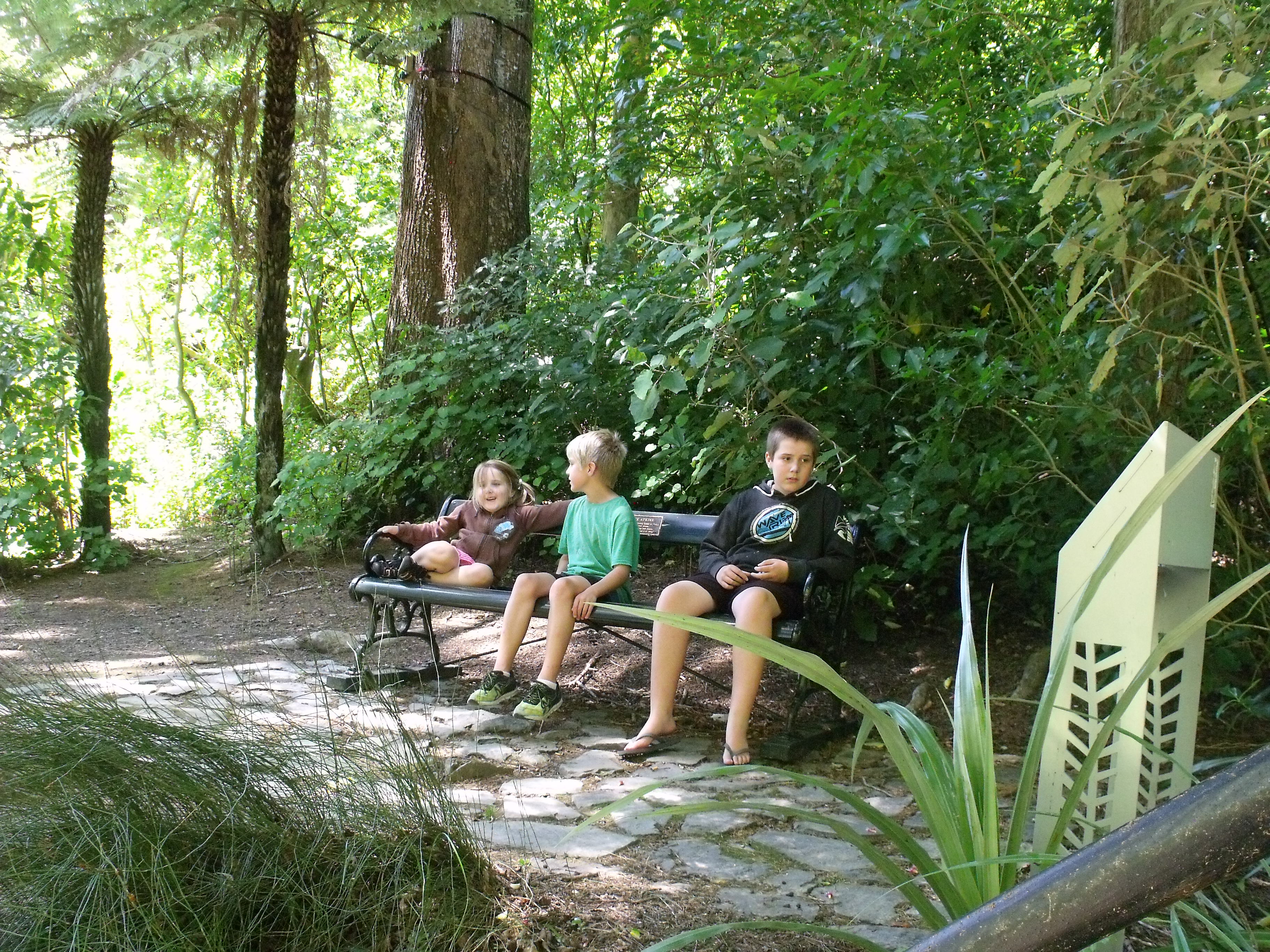
As I look outside now, it is pouring down! But on Friday it was beautiful and we took the grand-kids to visit Wellington’s Botanical Gardens. We parked in the CBD (which was expensive) and took the Cable Car up to the Gardens. The sun shone and the cicadas were making a din in the trees. We visited the Cable Car Museum, walked to Carter Observatory and walked down into the actual gardens by way of the kids’ playground. Finally we went through the floral displays and on to the Lady Norwood Rose Gardens.  You can’t beat Wellington on a good day, and this was one of them.

Hamish, Duncan and Louise at Wellington Botanical Garders
Enhanced by Zemanta

Why do people do evil and nasty things?

The Detective Game
The Detective Game (Photo credit: Wikipedia)

It is common in crime dramas on TV for the detective to exclaim “Where is the motive?”.  When the motive is found it goes a long way towards solving the crime. Eventually the perpetrator gives in and confesses or is carried away by the police and the closing credits roll. All good entertainment.

Every crime has a motive of some sort – that is fairly obvious – but some acts in the commission of a crime are very difficult to explain or for which it is difficult to find a motive. A robber may rob a store and on his way out, he may smash something or cause some damage. A burglar may steal from a house and then turn on all the taps or knock holes in walls or do even more obnoxious things.

Suprunyuck photographed with a hammer; the cou...
Suprunyuck photographed with a hammer; the court described the motive of the killers as “morbid self-affirmation.” (Photo credit: Wikipedia)

The reason that they do such things is a mystery to me. It’s not as if their original nefarious plans would have included such actions, I imagine, in so far as they had plans anyway. The only thing that I can think of is that it is a throwback to some distant time when an invading force (such as a Viking  band) would rape any women they came across, kill any men, steal any valuable goods, and burn down the houses.

Rape, pillage, kill and destroy. Raping the women and killing the men would ensure that the invaders genes would spread at the expense of the victims’ genes and destroying the houses would demonstrate the invaders’ power and discourage the victims from following and seeking revenge. I’m not sure if this is a likely motive for such ancillary acts in the commission of a crime.

viking
viking (Photo credit: What What)

Mass killers are another group where it is difficult to image what the motive for their crimes is. We tend to think of mass killers as a new phenomenon, but I’m not sure that they are. The earliest one that I can think of is “Jack the Ripper” who operated 1888. He was an instance of a subset of mass killers, a serial killer. Another type of mass killer is the person who open fires usually more of less indiscriminately in a public place. John Brunner’s 1968 prophetic novel “Stand on Zanzibar” calls such people “muckers” from the work “amok”.

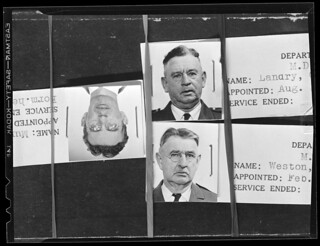
2 Bridgewater inmates kill 3 guards: sets fire...
2 Bridgewater inmates kill 3 guards: sets fire to building housing 545. State Farm guards killed by 2 inmates who ran amok in the Bridgewater institution yesterday. Frank L. Weston, Howard V. Murphy and George Landry. – Boston Herald (Photo credit: Boston Public Library)

I suspect that mass killers have been part of the human race for a very long time. In the bible Herod orders the “Slaughter of the Innocents”, which could be considered an early mass killing. Even if the event was made up by the gospel writer it was likely to have been based on some other real event. There is a story in the Old Testament about the killing of the Canaanites (the people who inhabited Canaan before Moses and his followers took over the land), a mass murder or genocide which is discussed (from a Christian perspective) in this article. Whether or not you believe the bible to be the word of God, or merely a collection of folk tales this could be construed to be evidence that mass killings have occurred for millennia.

English: A Land Flowing with Milk and Honey, i...
English: A Land Flowing with Milk and Honey, illustration from Henry Davenport Northrop’s 1894 “Treasures of the Bible” (Photo credit: Wikipedia)

After hunting about on theInternet for a while I came across the names of two serial killers,  Gilles de Rais and Elizabeth Bathory. I guess that while these two cases are the most prominent and remembered there have almost certainly been others that have not been recorded, or that I have missed.

de Rais’ motives appear to be purely sexual, and strongly sadistic, since there was no monetary or other advantage to him. Elizabeth Bathory’s motives do not on the face of it appear to be sexually motivated and appear pure sadistic. However, it is hard to tell for sure as I don’t believe that investigations would have been rigorous in those days and rumour and speculation was apparently often taken as fact.

Français : Exécution de Gilles de Rais (gibet ...
Français : Exécution de Gilles de Rais (gibet et bûcher). Armes du président Bouhier (Photo credit: Wikipedia)

It’s pretty certain that people like these are not normal, whatever normal is. As such I don’t think that we can guess their real motives, if they had any. They appear to be driven by urges which they were unable to control, and de Rais is supposed to have exhibited remorse, although that didn’t seem to stop him.

In modern times, there seems to be an increase in a particular sort of killing. This is where the perpetrator, usually a teenager or fairly young person, takes a gun into a public place and more or less indiscriminately  starts shooting, killing as many people as he can, before he is killed by the police or commits suicide. Of course, the ready availability of guns and ammunition facilitates these killing sprees – you probably couldn’t kill many people in a short time with a bow and arrow or a spear or a sword.

Boston Marathon 2013 ... Confronting Terror in...
Boston Marathon 2013 … Confronting Terror in Boston — Find ways to help (April 16, 2013 / 6 Iyar 5773) …item 2.. Meditation and Sleep Music — 30 minutes …item 3.. Mail Online – Daily Mail — WARNING: GRAPHIC CONTENT … (Photo credit: marsmet547)

Many of the perpetrators of these mass killings seem to be maladjusted or social outcasts, who are often fans of guns and weaponry. As outcasts, it is probably to simplistic to assume that their actions were some sort of revenge against society or against people around him, but that could possibly be a factor.

I don’t think that I have really answered the question I raised when I started this piece. People who are not extreme, as these killers are, can’t reliably guess the killers’ motives, I guess. What is apparent is that the killers don’t appear to have much control, if any, over their actions. It seems that the way to stop similar mass killings is to locate the killers before they have killed. It doesn’t seem that short of locking them up, there is any way to prevent them killing. Some potential killers have been given drugs and some killers have previously received drugs, but stopped taking them for one reason or another. All in all, I think that society is a long way from understanding the phenomenon of mass killers.

Forensic sketch of the Unabomber, commissioned...
Forensic sketch of the Unabomber, commissioned by the FBI, drawn by Jeanne Boylan. This copy was found at the url: http://members.aol.com/alvertc/Sketch.gif. According to Encarta, the drawing was released by the FBI in 1987. (Photo credit: Wikipedia)

I’ve had a lot of trouble writing this piece. Once I started I was determined to complete it, but I made at least two starts. My first start tended towards being an apologia for Naziism and I definitely didn’t want my piece to be that! The Nazis started from an invalid premise (the superiority of the Aryan race and the consequential inferiority of the other races) and their flawed logic led to the concept of racial cleansing. That together with the erroneous idea that the Jews caused the surrender of Germany at the end of the First World War did not justify their horrendous actions.

English: Adolf Hitler
English: Adolf Hitler (Photo credit: Wikipedia)

Hopefully I’ll hit on a much lighter topic next week.

Sun Rising in Kuakata, Bangladesh
Sun Rising in Kuakata, Bangladesh (Photo credit: Wikipedia)
Enhanced by Zemanta

Swings and roundabouts – a question of balance

The nature of precision
The nature of precision (Photo credit: Sergei Golyshev)

People are urged to strive for a “work/life balance”. This apparently implies that they are spending too much time working and not enough time going sky-diving, spear-fishing or taking the kids to the zoo. I doubt that it is ever phrased in this way to someone who is arriving at work at 8:45am and leaving at 4:45pm, having had a two hour lunch break.

Work-Life Balance
Work-Life Balance (Photo credit: Tanja FÖHR)

It is good advice in an era when a person may officially work 40 hours per week, but may actually work many more than that. In these days of smartphones and tablets it is often hard to keep work and home lives separate, and in many detective dramas on TV it is frequently made into a joke – the detective comes home, chats to his wife, his cellphone rings and he has to go and investigate a dead body. His wife is shown feeding his meal to the dog.

Of course some people, particularly high flyers, I think, thrive on the sort of life where they are never off duty. As Dogbert explains in his master class to the Pointy Haired Boss and the CEO, famous leaders work 16 hours a day and use their spare time reading about their industry. The PHB and CEO don’t like this so Dogbert asserts that famous leaders eat a lot of cake. Presumably the spouses of high flyers are the sort of people who are happy with the situation where their partners are never off duty.

The LEXUS LS600hL - Offical Vehicle of Chief E...
The LEXUS LS600hL – Offical Vehicle of Chief Executive of the Hong Kong Special Administrative Region (Photo credit: Wikipedia)

In general balance is taken to be a good thing and something to be strived for. We are exhorted to maintain a life balance, to ensure that the balance of nature is not disturbed and so on. (Balance my life? I can’t even balance my chequebook!) On closer inspection however, it can be seen that a balance is an unnatural state of affairs and is basically unstable, and that in many cases the imagined state of balance just does not exist.

Everyone knows the piece of playground equipment  called a teeter-totter or see-saw. In physical terms the see-saw is a lever and fulcrum system. It only really works for playing on if the two children on the two ends are pretty much the same weight. If one of the kids is significantly heavier than the other the see-saw fails to function and rests in a stable state with the heavier kid rooted to the ground and the lighter one high in the air. If the heavier kid hops off the see-saw rapidly moves to another stable state, with the lighter child on the ground and the empty end in the air. No doubt tears ensue.

A Golden Retriever going over a teeter-totter ...
A Golden Retriever going over a teeter-totter at an agility competition. Edited (cropped) by Pharaoh Hound (Photo credit: Wikipedia)

If the kids are the about the same size there is still no single balance point. In physics terms, any position of the see-saw is now a stable point, but any displacement results in the see-saw swinging to one extreme or the other. Without an extension to the model physics can’t say what happens then!

A balance point in physics is unstable, as a small displacement to either side result in the system getting further and further from the balance point. It’s like a snowball balanced on a mountain top – a small shove and it keeps rolling faster and faster. True there is a point in the valley below where the snowball comes to rest and where a small displacement results in the snowball returning to the bottom, but this is not what I would call a balance point. To a physicist both are “equilibrium points” and what I have called a “balance point” is an unstable equilibrium point, while the bottom of the valley is a stable equilibrium point. To a physicist the “balanced” see-saw would actually be a “neutral equilibrium”.

Česky: Příklad vratké rovnovážné polohy.
Česky: Příklad vratké rovnovážné polohy. (Photo credit: Wikipedia)

So what sort of equilibrium is a “work/life balance”? It’s not a stable equilibrium since that would imply that the “work/life balance” would return to the starting point after a small displacement. That’s not the point of a work/life balance – we would hope that things would change for the better. Neither is it a neutral equilibrium since that would imply no effective change. Like a change of job but no change in life or work practises. If it were an unstable equilibrium that would imply that a small change would lead to more and more change and that would not be what was desired. Consequently I would not categorise a “work/life balance” as any sort of equilibrium, but I am playing with words a bit here!

Equilibrio instabile
Equilibrio instabile (Photo credit: uomoelettrico)

But most people are not physicists and it is obvious what is meant by the phrase – work less, play more, separate work from home, and so on. All good advice. I have a bigger issue with things like “the balance of nature”. Is there any such thing?

Well, “balance” implies stability and nature is not stable. It is a dynamic system, and because of that, any state is unlikely to be long-term. For instance, a mutation or environmental change may lead to a species rising to prominence. A later mutation or environmental change may result in yet another species displacing the latest dominant species and becoming prominent. The same applies to groups of species and the dinosaurs would be the most obvious example.

Dinosaur track
Dinosaur track (Photo credit: mcdlttx)

Also, the idea of balance implies some sort of reversibility. If a system strays from the balance point it should, in theory, be able to return to that balance point. In the case of “nature” or rather, what might be loosely called “systems of nature” there is no balance point to return to as any change, say the decimation of a species, allows other species to expand and maybe dominate the system. If the decimated species were to rebound, it would have to displace the newer species that have taken its niche. That said, there have been cases where a group of species have been reintroduced into an area and the ecology has “regenerated” and the result looks much like what was originally in the area.

regenerating kanuka
regenerating kanuka (Photo credit: Mollivan Jon)

Some, maybe most, of these regenerated areas are fragile and need constant tending by enthusiasts or they will change away from the regenerated state, maybe by invasions of plants and animals from elsewhere. That is not a reason to not bother with conservation – it’s merely a recognition that a regenerated state is not usually natural and that a lot of work is required to maintain the regenerated state.

Male Bellbird, Zealandia wildlife sanctuary. W...
Male Bellbird, Zealandia wildlife sanctuary. Wellington, New Zealand. Māori: Korimako (Photo credit: Wikipedia)

One example of a regenerated area is Zealandia, a reserve in Wellington, New Zealand, of which I am a supporter. The reserve is only maintained in its regenerated state by an army of volunteers and a predator-proof fence. Nevertheless Zealandia is a wonderful place to visit where it is possible to see many species of animals and plants which are rare outside the reserve.

English: Lower Karori Reservior, looking North...
English: Lower Karori Reservior, looking North-East. Taken by Neil Leslie, Waitiangi Day 2006. Wellington, New Zealand. (Photo credit: Wikipedia)
Enhanced by Zemanta

The lull after Christmas

expenses-2011
expenses-2011 (Photo credit: Kyle McDonald)

I’m going to describe a graph, but I’m uncertain what to label the vertical axis. Probably labelling it “energy” would be the closest. The horizontal axis is definitely time, measured in days. The graph as a whole describes the Christmas – New Year period.

Starting on the day before Christmas Eve, the “energy” is high as people rush around preparing for Christmas. The mood is generally on the up, looking forward to the Christmas break. This year, as Christmas Day fell on a Wednesday, most people would have been off work, many until after the New Year holiday, so the Monday (the day before Christmas Eve) and the Tuesday (Christmas Eve) become part of the holiday.

Some children looking at a selection of Christ...
Some children looking at a selection of Christmas Cards during the 1910 holiday season. (Photo credit: Wikipedia)

Christmas Eve itself is an up day as everyone makes final preparations for the big day. Last minute shopping, cleaning, tidying have to be fitted around present wrapping and ensuring that the menu for the next day is in place. Some people prepare all the vegetables for Christmas day and nearly everyone remembers to get the turkey out of the freezer. Parents with children often face the twin task of preparing stockings and making the kids go to bed with the hope that they will finally drop off. Sometimes the duties extend well beyond midnight.

sleeping kids = clean house
sleeping kids = clean house (Photo credit: RAPACIBLE)

Christmas Day itself is a day of at least two parts. No matter how late they went to be the kids will wake up early, no doubt rousing their parents from some hastily snatched hours of sleep, then the day continues from there. Many families still go to church in the morning though this practise is declining.

The church of Tilly-la-Campagne with Christmas...
The church of Tilly-la-Campagne with Christmas lights (Photo credit: Wikipedia)

The rest of the morning goes into cooking, eating, and no doubt drinking, as well as unwrapping presents, stopping kids (and older people) squabbling about trivialities. All this peaks when lunch is served. In the southern hemisphere, if it doesn’t rain, this may be eaten outside.

Christmas barbeque
Christmas barbeque (Photo credit: QuinnDombrowski)

In the afternoon, the mood declines to the point where some people may become comatose. Granny always sleeps in the afternoon, but so will Uncle Bill, who ate too much pudding and drank too much alcohol. Parents with kids might not be able to relax completely and may be arm-twisted into games of backyard cricket, at least in this hemisphere. In the northern hemisphere parents will no doubt be required to help with those construction toys or technical gadgets that the kids have been given. Nevertheless the mood is definitely down on the peak of the Christmas meal.

Julie's New Toy
Julie’s New Toy (Photo credit: camknows)

Boxing is interesting. It may be a down day, if for instance you have over-indulged the day before. Or it may be an up day if you are interested in the ‘traditional’ Boxing Day sales. This year I had to make a small purchase so I went to the local mall. The place was crowded, but unfortunately for the retailers there was a glitch with the EFTPOS systems and all purchases had to be strictly cash. I believe that spending on Boxing Day 2013 still broke records.

English: White Christmas at Baltasound Well, B...
English: White Christmas at Baltasound Well, Boxing Day actually; looking across the Houb towards Valla Field. (Photo credit: Wikipedia)

After Boxing Day comes the lull. I’m writing this halfway through the lull, which extends from the day after boxing day to the day before New Year’s Eve. Most people celebrate the New Year, even if it is at a much less energetic level than Christmas Day. I generally stay up on New Year’s Eve to ‘see the new year in’ for no very good reason, I admit. Some people choose New Year as the chance to drink and eat more than usual, as a sort of full stop/period to mark the end of the holiday, even though they may not be returning to work until the beginning of the next week.

new year mice
new year mice (Photo credit: Natasha Fadeeva)

But back to the lull. The lull does not have to be an emotional down period, but it is probably, for most people, an energetic down period. People have survived Christmas and have a lesser celebration to look forward to in a week. It is a time for relaxing, taking the kids to the beach or the movies, visiting Granny, or merely settling down with that book that someone gave you for Christmas.

It’s a time for eating increasingly stale mince pies, trying to find leftovers interesting, and generally  tidying up the loose ends of Christmas. Maybe a trip to the mall with that token someone gave you. Maybe watching the England – Australia test match.

Boxing day test cricket, mate!
Boxing day test cricket, mate! (Photo credit: simonhn)

It’s a period with intrinsically no pressures, though for some people their circumstances may override this – from those who are about to give birth to those about to depart this life and those experiencing all life’s dramas in between, this period can be highly emotionally or energetically charged. But in general, it is a lull.

So my graph starts off low on the eve of Christmas Eve, and climbs through Christmas Eve. I originally wrote ‘climbs steadily’, but it may climb erratically but will trend upwards until the end of lunchtime Christmas Day. Then it drops dramatically, during the afternoon, as people relax after the exertions and excitements of the morning. Even washing up, while a chore, is still at a lower level than the peak of Christmas lunch.

Times Square on New Year's Day
Times Square on New Year’s Day (Photo credit: davehunt82)

On Boxing Day the graph may rise a little (for the shoppers) or drop (for those ‘tired’ from the exertions and consumption of the day before). And then comes the lull, a tranquil period between Boxing Day and the eve of New Year’s Eve, a relaxed period for most, I’d say. The graph remains low and level with maybe a lift as New Year gets closer.

On New Year’s Eve the graph may rise again. Some people like to party on the turn of the year, but the intensity of the celebration may not in most cases match Christmas. With the exception of the celebration of the year 2000, there is no real drive to make New Year an intense experience, though people do gather in the likes of Times Square to ‘see in the New Year’.

So, there you have my graph of the Christmas/New Year period. The rise from the foothills of pre-Christmas to the Everest of Christmas Day, followed by the valley of the lull before New Year and the minor peak of New Year itself. It remains to mention the lowlands of the period before those who work return to it at the beginning of January.

English: Sometimes the voice of Taka's Pack Re...
English: Sometimes the voice of Taka’s Pack Readers will lull him into a nap. But they are brief because he doesn’t like missing any part of a story. (Photo credit: Wikipedia)

I hope that all of you who celebrate Christmas had a good one and are looking forward to a pleasant New Year, and best wishes to those who do not celebrate this season either because of religion or conviction and those whose calendar does not align with the one to which I am accustomed.

Happy New Year (white camelia)
Happy New Year (white camelia) (Photo credit: tanakawho)

Love Actually….

(I’m running late this week. I hope to be on time next week).

English: Beautiful scenery beautiful love story.
English: Beautiful scenery beautiful love story. (Photo credit: Wikipedia)

Love. The word is thrown around with gay abandon, people claim to be motivated by it when they do extraordinary things. It’s been the subject of literature, from classics to stuff which perhaps should never have been written. Atrocious poetry attempts to define it and celebrate it, and sublime poetry achieves its heights for the same reasons.

There are many sorts of love, man for woman, woman for man, and also the love of a person for another of the same sex. People love animals and people love children, though there are certain loves of these kinds which are strange, bizarre, or wrong. There are the loves for team mates or squad members which strengthens the team or squad, to the extent that in wartime a squad member may sacrifice himself for the sake of the others in the squad.

Team GB
Team GB (Photo credit: the_junes)

People love things. The new Maserati, Holden or Ford. The latest iPhone. An iPad, or other tablet. A new dress, new shoes, new Gucci bag. A new hairdo, new sneakers or a nice juicy steak.

I love a good lie-in in the Morning. Some (who in my opinion are slightly insane) love to be up with the lark. Some love a tropical beach, others an alpine traverse. Some love to run, to the extent where sometimes they will run for hundreds of kilometres.

New York Marathon 2013
New York Marathon 2013 (Photo credit: jaroslavd)

Most people love a challenge, a crossword puzzle or Sudoku. Some love competing with others, some love to challenge themselves by jumping out of a plane, or climbing a high peak in the mountains.

Maybe some would quibble that I have used the word ‘love’ above where others would have used ‘like’. I make no apology for that as the one shades in to the other. But what are the characteristics of love? I’d say that no one definition fits all cases, as is common with any human characteristic.

Cherub
Cherub (Photo credit: Wikipedia)

Love primarily is understood to be most simply defined by the (usually) male/female couple. In a marriage ceremony, at least in the Christian rites, the couple pledge to love each other, (amongst other things). In other religions where marriages may be arranged by the parents and the couple may not know each other very well at the time of the marriage, I do not know what pledges are made. Of course, it is not unknown for marriages to be arranged in countries that have adopted the Christian religion. If fact it is probably more common than people realise. The opposite probably holds in countries where the religion is not Christianity.

Rahul's Arranged Marriage (2005)
Rahul’s Arranged Marriage (2005) (Photo credit: Wikipedia)

I’m aware that the above is horribly full of unwarranted assumptions and suppositions about culture of which I know little. Someone once joked that in a Hollywood love story, boy meets girl, they fall in love, and get married. In a Bollywood (Indian film industry) love story, boy meets girl, they are married, they fall in love.

A quick scan of the synopses of both Hollywood and Bollywood shows that the truth in much more complex. The Internet Movie Database like 50 Best Bollywood films, and the teasers for the films show plots which would not be out of place in a similar list of Hollywood love films, with only minor amendments. The Hollywood films tend to replace parental pressure with a societal one, but much else remains the same. The gloriously over-generalised Hollywood love story is boy meets girl, they are forced apart because perhaps one is one is from the wrong side of the tracks (a Hollywood favourite), or they initially hate each other, or they are about to be married to others, or they somehow misplace each other. Finally they resolve whatever difficulties separate them.

V.V.Pukirev - The Arranged Marriage
V.V.Pukirev – The Arranged Marriage (Photo credit: Wikipedia)

Perhaps there is only one love story, across all of mankind – boy meets girl, difficulties keep them apart and either they resolve them (happy ending) or they don’t (tragedy). Now I come to think of it, most love stories apart from fairytales are of the second sort – the films “Love Story”, “Titanic” and perhaps “Gone with the Wind” bear this out.

But what is love? It is something some people spend all their lives looking for, and something which others find easy to find. Spousal love seems to be a binding force. It creates an unbreakable team and gives a couple extra power over adversity through synergy. Spousal love can lead to a long lifetime together and passing on within hours of the second spouse when the first dies.

Long Wedding Dress for Couple with Flowers
Long Wedding Dress for Couple with Flowers (Photo credit: epSos.de)

Love in unidirectional. One can love someone without being loved back, but if one is loved back a positive feedback is achieved. Love is happiness, except for the case where the love is not returned, not even recognised. Love is eternal, except when the love ends. That is, if one loves one cannot conceive of the love ending. Love is generous, gentle and giving, unless the love of the loved one is claimed by another, in which case love engenders hate and loathing. Love is unselfish, unless the love is such that family and friends are cast aside. Love is selfish when the lovers are so engrossed in each other that worldly events pass them by.

love is not selfish
love is not selfish (Photo credit: Leonard John Matthews)

The Bible says this about love:

4 Love is patient, love is kind. It does not envy, it does not boast, it is not proud.
5 It does not dishonor others, it is not self-seeking, it is not easily angered, it keeps no record of wrongs.
6 Love does not delight in evil but rejoices with the truth.
7 It always protects, always trusts, always hopes, always perseveres.

This verse from 1 Corinthians 14:4-7, which is often used in marriage ceremonies in Christian churches only gives the positive aspects of love which is returned. Misdirected love has caused everything from domestic disputes to full scale wars. The mythical Trojan Wars were supposed to have been about the love of Helen who was already married to Menelaus for Paris. The story may have been based around true events which may have separately happened over some time around 1190BCE.

greece - scene of the trojan war
greece – scene of the trojan war (Photo credit: Xuan Che)

One can paraphrase the writer of the Epistile and say “Love is impatient, love is unkind. It is envious, it boasts and is proud”, because often it is. Love is not always good. But when it conforms to the Epistile writer’s definition, it is the oil that helps to make the world go around.

Love Actually
Love Actually (Photo credit: nehuenmingote)

Grandad’s a Geek!!

Geeks

The original geeks were sideshow performers who did disgusting things like disembowelling a chicken and eating it raw. They often had mental issues and lived in squalid conditions, maybe even cages. They might be billed as “a savage from the depths of darkest Africa” or some such nonsense but more likely they were just people who had sunk to the bottom of society and had fallen in with the carnival. Alcoholics who would work for a bottle of moonshine would reputedly sometimes  act the wild man for the carnival.

The film “Nightmare Alley” tells the story of one such geek, from his start as a sane and relatively normal person, who joins a carnival and works his way up to fame and fortune, only for his world to collapse around him, to his final fate as the alcoholic carnival geek.

Nightmare Alley

The word “geek” (together with the similar word “gook”) has been used as a derogatory term for Asian people by Americans and others during war time. Troops were supposedly encouraged to use such terms in order to “dehumanize” the people of the countries which were being fought in or over. Hence the connotations of dislike that comes with the word.

The word “geek” meaning a clever person may possibly have its origins in the United Kingdom. It’s possible that its use in this sense may have arisen when the word which had been used to target overseas people was instead used to target unlikeable  people much closer to home! The person who top scored in all tests and had no social graces became known as a “geek”. Of course, in some cases the so-called “geek” eventually by virtue of his smartness became the employer of those who belittled him at school.

Nerd

In the highly technical world that we live in, the “geek” naturally became a wanted person and while the term is still often used in the derogatory sense, it can be a term of back-handed admiration, and the term is often proudly asserted by the geeks themselves. Indeed, having worked in Computers and Information Technology for all of my working life, I somewhat proudly consider myself to be a “geek”.

79-365 I am a computer geek!

The techno-heroes of the current day are the likes of Bill Gates of Microsoft, Steve Jobs, Steve Wozniak and Ronald Wayne of Apple, and Bill Hewlett and Dave Packard of Hewlett Packard. There  is a sort of sense of awe that these geeks have achieved so much.

Latter day geeks have had films made about them. The founder of Facebook, Mark Zucherberg has been portrayed in a film, in a not so flattering light, I understand, not having seen the film. The school geek appears late on in the film “Romy and Michelle’s High School Reunion” to whisk the eponymous heroines off in his helicopter.

Cover of "Romy and Michele's High School ...

“Geeks”, “boffins”, “back room boys” have existed in every era of history, no doubt. They are relied upon to produce the technical goods while being regarded both as humorous and not quite normal. However their status has risen of late, driven by the vast technological boom that pretty much started during the Second World War. The Dambusters, the Enigma machine and the atomic bomb all came from that era and after the war the boom exploded.

ENIGMA cipher machine collection
ENIGMA cipher machine collection (Photo credit: brewbooks)

Geeks and computers go together. In the beginning, in the late 1940s, large machines started to appear in back rooms, tended by men and some women in white coats. These mysterious machines performed strange calculations and the geeks in control were treated like high priests of some mystery cult.

At this time a relatively new company called IBM rose to prominence and dominated the new field of computing. Mainframe computers as they were called swiftly spread to many companies, and special rooms were built to house the multitude of beige cabinets that formed a mainframe computer system. By the 1980s there were many computers performing many different tasks and companies began to depend on them.

English: IBM Personal Computer model 5150 with...
English: IBM Personal Computer model 5150 with monochrome phosphor monitor (model number 5151) and IBM PC keyboard. (Photo credit: Wikipedia)

However there were smaller, simpler computers starting to appear. Many households of that era would have had a Sinclair or Commodore or Atari computer on which to play games. IBM introduced a computer of this size, the IBM Personal Computer, but then they dropped the ball. While IBM is still one of the biggest companies in the world, they did not really embrace this technology, allowing the rise of the PC.

IBM System/360 at the Computer History Museum.
IBM System/360 at the Computer History Museum. (Photo credit: Wikipedia)

One company did embrace the technology and realised that the way to make the big money was not to provide the hardware, but to provide the software that ran on it and Microsoft became its rise to prominence, like IBM before it, and the Microsoft Operating System became dominant, and is still dominant today.

1993 - Grandad's old computer setup, Irith -
1993 – Grandad’s old computer setup, Irith – (Photo credit: Rev. Xanatos Satanicos Bombasticos (ClintJCL))

So what has this got to do with Grandad? Well, the current generation wonders whether the older generations will “get” the new technology. Consider though. Grandad will be 60-ish, right? That will mean that he would have been born in the early 1950s or late 1960s. In the 1980s he will have been around 20 and just the right age to take part in the spread of computing around the globe. He may have had a Commodore or an Atari at home.

Commodore 64
Commodore 64 (Photo credit: unloveablesteve)

In his thirties he will have seen the rise of DOS and Windows and he may even have had a 386 machine at home. Possibly he became proficient in DOS and the early Windows being what it was he probably was proficient obtaining and loading “drivers” for his machine.

It is likely that he has experienced the joys of persuading a  modem to connect to a bulletin board, or through a fledgling ISP to this new thing, the Internet. He may have spent hours downloading a blocky, slow game to display on his CGA-capable monitor, transferring it down the telephone lines at the rate of a few bytes a second. A megabyte download might have taken half an hour or more.

古董
古董 (Photo credit: alanine)

As the Internet grew he would have switched to the Netscape browser and accessed the Internet at 2400bps, then 4800bps, then a massive 9600bps and on to an astronomical 56kbps! Doubtless these days he uses some form of broadband or cable connection.

Today’s geeks believe that because they have grown up with the technology that Grandad (even Dad) will not be able to cope with it. They conveniently forget that while they may have grown up with the Internet and the technology, the Internet and technology have grown up with Grandad!

Blowing out Grandad's birthday candles
Blowing out Grandad’s birthday candles (Photo credit: djdpascoe)