Predicting the future

Future car!
Future car! (Photo credit: Little Black Cherry)

The farmer fed the chicken every morning at the same. The chicken realised this and ran up to the farmer every morning to be fed. One morning the chicken ran up to the farmer who grabbed it and chopped off its head. This demonstrates the dangers of inductive reasoning. The old turkey was a little more sophisticated however. When asked by a younger turkey when Thanksgiving was, he replied that it was on the fourth Friday in November. The younger turkey was incensed to find out that it was the fourth Thursday in November. The older turkey said to him “Boy, the humans celebrate it on the Thursday, but if I wake up on Friday morning, then I give thanks”.

Induction is looking at the past in a particular way to predict the future. Specifically, induction looks at a series of events in the past to predict the future. The sun has risen like clockwork every day, whether or not you can see it, for as long as anyone can remember and for as long as we can determine from reports from the past. Will it rise tomorrow morning?  I would put money on it because either it will, and I win, or it won’t and it won’t matter because we will almost certainly be dead. The argument comes down to “It has always happened in the past, so it will (or it is extremely like to) happen in the future.

Zabriskie Point at sunrise in Death Valley
Zabriskie Point at sunrise in Death Valley (Photo credit: Wikipedia)

The alternative method of reasoning is deductive reasoning. The deductive argument is that the rising of the sun is a consequence of the rotation of the earth. As the earth rotates, the sun appears to us on the earth’s surface to appear from beneath the horizon and travel across the sky. Actually, it is us who move, a good demonstration of relativity (but maybe I’ll go there another day). The argument goes stepwise from fact to fact and leads inevitably or logically to a conclusion.

Horus, ancient Egyptian God, the Sun God, depi...
Horus, ancient Egyptian God, the Sun God, depicted on papyrus (Photo credit: Wikipedia)

The trouble with this approach is that, for all its logical stepwise approach it is built on two things, a theory and a set of past observations. A scientist has a theory or decides to check a theory, so he does an experiment, and the results of his experiment support or do not support the experiment. The scientist assumes that the theory is true and bases his predictions on this. Unfortunately there is an inductive element to this – if the theory is true for the experiment, there is no guarantee that it will be true for subsequent experiments, even given that ‘ceteris paribus’ (all things remain the same). Some other unconsidered cause could affect the result. The argument is deductive, proceeding in logical steps from the theory, but the practise is inductive – the data has always supported the theory in the past, so it will continue to support the theory in the future.

New Scientist
New Scientist (Photo credit: Wikipedia)

To be fair to the inductivists, todays’ inductivists tend to specify the results of their arguments in terms of probabilities: the probability of the sun rising tomorrow is close to 100%, given that it has always risen in the morning for as far back as we can see, but there is a minute but finite possibility that it won’t for known or unknown reasons.

Let’s consider the case of the sun rising each day and suppose that the fact that the earth rotates is not known. To make the argument more deductive we can postulate causes and so long as the cause fits the facts, we can tentatively label the cause as a hypothesis. Suppose we conjecture that some deity causes the sun to rise each morning. This hypothesis certainly fits the facts and predicts with accuracy that the sun will continue to rise each morning. Such a hypothesis would not be accepted today, of course, except by some individuals.

Mathematical induction can be informally illus...
Mathematical induction can be informally illustrated by reference to the sequential effect of falling dominoes. (Photo credit: Wikipedia)

Is there any great difference between the theist and the scientist? The theist says “all things happen because of God”. The scientist says “all things happen because of the laws of nature”. They both explain things on the basis of their fundamental beliefs.

It is possible that people in the future may look at our theories of the sun rising and other things and consider them naive and consider our view of everything happening according to the laws of nature to be a quaint misunderstanding, in much the same way as many people would consider the “deity hypothesis” to be today.

cubed earth theory
cubed earth theory (Photo credit: Joelstuff V4)

In mathematics the situation is different. Induction is a much more formal process and is applied on top of an axiomatic system. Proved theorems are the results of the applying the axioms repeatedly to another proved theorem or the axioms themselves. Unproven assertions can be proved and turned into theorems or disproved and discarded (or possibly modified so that they can be proved). If something is proved in an axiomatic system, it is true for all time, and cannot be disproved in that system.

Specifically an inductive proof would go something like this: firstly the theorem would be proved for a generic case (eg if statement N is true, then statement N + 1 is true) and secondly it is proved for a specific case (eg statement 1 is true). Then all applicable statements are true because, if statement 1 is true, the generic case means that statement 2 is true, and so on for all cases. Because of the rigor of the argument and the undeniable conclusion of the argument, mathematical inductive proofs are of the same order of reliability as deductive proofs, that is, they are only wrong if there is an error in the logic.

English: Mathematical induction as domino effe...
English: Mathematical induction as domino effect, with text in Esperanto Esperanto: Matematika indukto kiel domen-efiko, kun teksto en Esperanto (Photo credit: Wikipedia)

Why the difference between scientific induction and mathematical induction? Well, I think that it is related to the fact that mathematics is axiomatic and therefore certain, whereas scientific induction is based on the laws of nature which are not and never will be, in my opinion, completely defined. If the basis of your argument is not certain, how can your conclusion be certain?

The End Of Certainty?
The End Of Certainty? (Photo credit: minifig)

There’s a Song in my Head.

Delicate (album)
Delicate (album) (Photo credit: Wikipedia)

(“There’s a song in my head” by Martha and the Muffins 1985 – NOT my kind of music by the way.)


The way the brain works fascinates me. It seems to favour the most unexpected linkages between memories. What brought this to mind was the fact that when I do some daily activity I often find myself humming a particular tune which my brain somehow for some reason links to that task. Now, sometimes it is easy to remember why there is a connection, but other times, I can think of no idea why that particular tune relates to that task.


Cassatt Mary The Cup of Tea 1880
Cassatt Mary The Cup of Tea 1880 (Photo credit: Wikipedia)

Obviously, it is probably true that at some time in the past there was an event, or even events which have caused that linkage to be formed. It may be that the linkage was indirect, through some other occurrence, but in any case the cause of the linkage has been long forgotten.


Evidently linkages can outlive the events that caused them. It may be that some traumatic event caused the linkage, and I have suppressed it. I think that this is unlikely, since it happens too often, and I don’t have that much trauma in my life, I believe!


It may be that my brain favours musical themes as mnemonics. Songs, poetry and repetition (chanting) are often used in schools to help student memorise things. How many days are there in June? And how many of you started mentally reciting that rhyme – “30 days hath September…”?


Knuckle mnemonic for the number of days in eac...
Knuckle mnemonic for the number of days in each month of the Gregorian Calendar. Each projecting knuckle represents a 31-day month. (Photo credit: Wikipedia)

When I make a cup of tea and the tune springs to mind, what is my brain trying to do? (He said, anthropomorphically). Is it trying to remind me of something important? If so, it is likely that the thing that it considers important is important no longer, so my response, when it occurs to me, is one of puzzlement.


There’s another category of “songs in your head” and that is the “mind worm”. I can think of several. There’s the tinkly accompaniment to Gotye’s “Somebody that I used to know”, There’s the Disney “Small World” theme, which may be merely more pervasive and not a true mind worm. Just recently there’s been the rail safety commercial “Dumb ways to die”. By the way, don’t click on the links unless you want the songs in your brain. Too late!


The hidden auditorium of my skull
The hidden auditorium of my skull (Photo credit: id-iom)

I can’t think of a good reason for musical mind worms. Maybe, as an offshoot of the remembering process the brain is so susceptible to simple musical phrases that it picks up these tunes because they are simple and memorable and this is the sort of thing that the brain finds easy to recall as well as remember, and each recollection reinforces the memory in a self maintaining endless cycle.

English: Animated Atkinson cycle.
English: Animated Atkinson cycle. (Photo credit: Wikipedia)

The Philosophy of Photography

Photomontage - Composite of 16 different photo...
Photomontage – Composite of 16 different photos which have been digitally manipulated to give the impression that it is a real landscape. Software used: Adobe Photoshop (Photo credit: Wikipedia)

One of my Facebook friends (a photographer) commented on another photographer’s picture, so I got to see the photo too. It was a stunning photograph but an interesting thing for me was the photographer’s description of the ‘post-processing’ that the picture had been subjected to. It was ‘soft’ because of the rain on the lens, but among things the photographer had done to the picture was to alter the contrast, and heightened the colour in the swathes of grass.

Now, I have no issue with post-processing and the photo in question was stunning, but it does raise the question as to at what point a processed photograph becomes less a photograph and more of a different type of work of art! Some people would not consider such a work a proper photograph. One wonders where they would draw the line. Would they, for example, allow that a cropped photo would be, in some sense, OK?

Interestingly (well, I think that it is interesting!) the photographers do it to themselves, too. Apparently a wild life photo was ruled out of a competition because it chopped off the heron’s toes. I’d be pleased to get any sort of a decent photograph of a heron.

A Great Blue Heron flying with nesting materia...
A Great Blue Heron flying with nesting material in Illinois, USA. There is a colony of about 20 heron nests in trees nearby. (Photo credit: Wikipedia)

Photos can be considered dubious for other reasons too. Brian Brake’s photo of a girl enjoying the onset of the monsoon was reputedly created with the aid of a watering can. It’s still a great photograph and does convey meaning and emotion.

Monsoon Girl
Monsoon Girl (Photo credit: colonos) Not the famous Brake picture however.

One of the factors that has perhaps brought such matters to the fore, at least for those who muse about philosophical matters, I suppose, is the digital revolution in photography. Post-processing used to be confined to the dark room, involving the use of dubious chemicals and often highly technical equipment. These days post-processing can be done on a computer, in comfort, with powerful helper programs such as Photoshop, and no chemicals, except possibly a quantity of water tainted with alcohol. And even more important perhaps, mistakes don’t matter so much. If the picture doesn’t turn out OK, hit the delete button and try again starting with the original image.

Photoshop Cow
Photoshop Cow (Photo credit: @Doug88888)

There are (at least) two other categories of photographs that are considered dubious. Photographs taken of glamourous people for glossy magazines are often highly touched up in post-processing, sometimes to an extraordinary extent. The pop singer Beyoncé was reportedly annoyed that her body shape was altered in a clothing commercial in which she starred (as reported by the Huffington Post anyway). The ethics of such ‘photoshopping’ as the above, and the removal of perceived blemishes, emphasis of facial symmetry, feature highlighting and so on are indeed dubious, and can give rise to unrealistic expectations in susceptible people. Against that, most people at least acknowledge that this manipulation of photographs is common, though few suspect the extent to which it goes on.

Popular Beauty Retouch
Popular Beauty Retouch (Photo credit: Tucia)

Secondly, and more troubling, it appears that news related photographs (and video materials) are often ‘doctored’. This could be used to promote a particular philosophy or point of view. For instance the North Korean regime appears to use photo manipulation to overstate its military capabilities. While this is amusing, one can’t help but wonder if our more benevolent regimes also use such alteration and exaggeration extensively. It is known that they do, on occasion, stretch the truth. For example, while TV was showing the successful recovery of the capsule ‘Liberty Bell’ of the fourth Mercury astronautical  test mission from the sea, the capsule was actually sinking in 15,000 feet of water.

Grissom Climbs into Liberty Bell 7
Grissom Climbs into Liberty Bell 7 (Photo credit: NASA on The Commons)

I’m not going to argue one way or the other. No doubt those who alter photographs as an attempt to make them better photographs in whatever way you use the word ‘better’ have the best of intentions. However there is a difference between the person who modifies his photograph to, say, enhance the colour of the grass and the person who manipulates a photograph of a political figure or a model selling hair treatments, or yet the person who modifies a photo for propaganda purposes. But they can all be considered art, even the propaganda. I’m thinking of Leni Riefenstahl, whose propaganda films are certainly art.

Bundesarchiv Bild 146-2004-0020, Polen, Truppe...
Bundesarchiv Bild 146-2004-0020, Polen, Truppenbesuch von Leni Riefenstahl (Photo credit: Wikipedia)

Humour

A Cheezle in a mousetrap

In an advert for Cheezles (a cheese flavoured snack) two mice are discussing the risks of trying for a Cheezle. One says “It’s worth a crack, Nigel”. Nigel apparently  tries for the Cheezle, and there is the crack of a mouse trap, and the other mouse says “Nigel? Nigel?”. Now the original ad was, most people would agree, very funny, even if my exposition lacks something. However it deals with something which could be considered tragic, the death of the unfortunate Nigel.

Humour is strange, almost beyond belief. The tragic is often funny. Death is a constant theme in humour. Disfigurement is also a common factor. Other factors are sexuality, criminality, embarrassment. From a different point of view, it’s about surprise and conflict, and a certain discontinuity. But I think that it is impossible to define humour.

English: Young seagull with a sense of humour ...
Juvenile seagull. It obviously doesn’t see the humour in this situation.

It is probably the only human trait which might be totally absent in ‘lower’ animals. I don’t know of any case where a human trait is totally absent in animals, but it may be merely that I haven’t come across humour in animals. It is my contention that no trait in humans is not demonstrated to a lesser extent in ‘lower’ animals. Maybe there is a chimp snatching another chimp’s plaything and then sniggering when his victim can’t find the toy. Maybe. The Internet has anecdotal evidence that animals can demonstrate humour, but nothing too convincing. Or maybe I didn’t search for long enough to come across any in-depth studies.

Animals show joy, a certain self-awareness, disappointment, anger and many other supposedly human traits. They can learn, remember and generally demonstrate that they share our attributes, maybe to a lesser extent (though I feel that for many animals it is not much lesser than humans).

Dogs and Joy
The word for joy is dog.

But animals don’t appear to have the capacity to experience humour (to my knowledge). If this is so, it is significant. It would be the only uniquely human attribute. My dog demonstrates joy, affection, desire, and many other things, but doesn’t demonstrate humour. A dog will never tease you. A dog is direct and forthright. You can’t share a joke with a dog. I’m fairly sure that you can’t share a joke with a chimpanzee or a gorilla, but I’d defer to an expert on that.

If humour is endemic to humans it is at least part of what distinguishes us from other animals. It may be the only thing that distinguishes us from them, as there is nothing else that I can think of that does. All animals have intelligence, at least to a degree, above a certain level of complexity. Some animals show preference for attractive appearance or display (particularly birds) which may be the basis of our aesthetic sense, but no animal, so far as I know shows a sense of humour.

Display
Display

There is a variety of humour that seems somewhat different to the ‘mainstream’ and that is the pun. Puns are plays on words in the majority of cases, but they may be visual. A pun can be based on homonyms, words which sound the same but which have different meanings, and even different spellings. For instance there is a village in Southern England called Brede, so if someone announces that “We are going to Brede” one can understand that a bystander might be somewhat taken aback. Another example is George Carlin‘s statement that “Atheism is a non-prophet institution”.

As I said above, humour often involves some sort of mishap or disaster for someone. In such cases it may act as some sort of tension release mechanism. That’s a fairly obvious, therefore suspect, suggestion, though in practise it seems to work and can be a recommended way to break the tension in difficult situations. Puns don’t give the same sort of release (generally), and mostly involve language so seem to be on a higher intellectual level than mainstream humour. In summary however, I’d say that humour is a facet of human beings, but it still seems mysterious to me. Strangely, infants seem to develop a sense of humour early in life. There’s not many things more infectious than a laughing child.

laughing
laughing (Photo credit: ayes)

Counting.

English: Counting sheep at Newport Cattle Mark...
Counting Sheep

If you want to count sheep, count the legs and divide by four. This piece of faux folk-wisdom has, as is usual in such cases, a grain of truth. The human eye finds it easier to distinguish elongated objects if the axes of the object are separated and perpendicular (or so I believe). It is easier to count the candles mounted on a cake than the same candles arranged in a line. This – | | | | | | | – is easier to count than this – _ _ _ _ _ _ _ , I feel. (I’ve used Google to see if I can find evidence and came across this, which seems to align with what I am saying, though I’ve not accessed the paper).

Ankole cattle
Ankole cattle

If I am correct it is easier to, say, count the horns on a herd of cattle and divide by two than count their backs. It occurs to me that an optical-electrical counting device might have issues in this regard too, since a leg might stand out from the background, and produce a short pulse in the sensor, but a whole cow might take a while and its colours would blend into the next cow.  Of course, one could always use higher technology to resolve the issue with respect to cow counting, (RFIDs in ear tags would be an obvious solution), but it doesn’t solve the wider issue.

Maybe the reason that the counting device and the eye/brain find it easier to distinguish objects orientated (roughly) perpendicular to  their (roughly) linear arrangement is similar. If they are (roughly) aligned in the same direction as their linear arrangement they may, possibly, overlap, and this can confuse sensor and/or eye. Was that one, two, or three objects that passed the sensor? It’s easy if they are perpendicular, but harder if they are aligned.

English: Geometrical-optical illusions: horizo...
English: Geometrical-optical illusions: horizontal/vertical anisotropy (Photo credit: Wikipedia)

I’m pretty much reduced to saying the same thing in different words, but I hope that what I am trying to get at is clear. It may or may not be relevant that humans and higher primates tend to stand more or less vertically, so one individual is more easily distinguished from others than an individual cow is from the herd.

Cow!
Cow! (Photo credit: StickerEsq)

About Loulou

A self-imposed deadline is, I think, the worst sort. I set my phone to alert me once a week to blog something. And it just went off. I have no definite plan so this is going to be off the top of my head. Call it “philosophy” or call it “miscellaneous”. I don’t care!

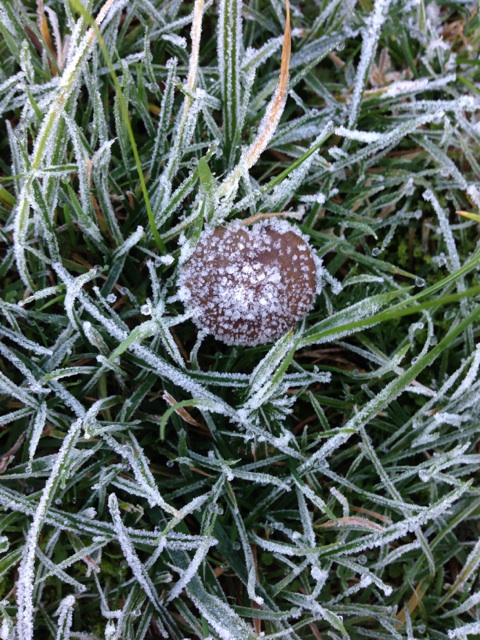
IMG_0301
An interesting fungus

Today my daughter texted me a picture of a smallish fungus. (Aside – the spell checker doesn’t recognise “texted”. The spell checker needs to be updated!) Apparently my grand-daughter, who knows of my interest in fungi, thought that Grandad might like this “interesting fungus”. Who knows, because of me she might grow up to be a famous mycologist, the one who saves the human race from the mutant spores. Hmm!

Which made me wonder about the effect we have on our descendants. Obviously there are two ways we can do that -the genetic and the environmental. Our genes may predispose our offspring to certain tendencies and our personal influences plus the environments (in the widest sense) in which we live effect the way that we and our children behave.

This image shows the coding region in a segmen...
Genes

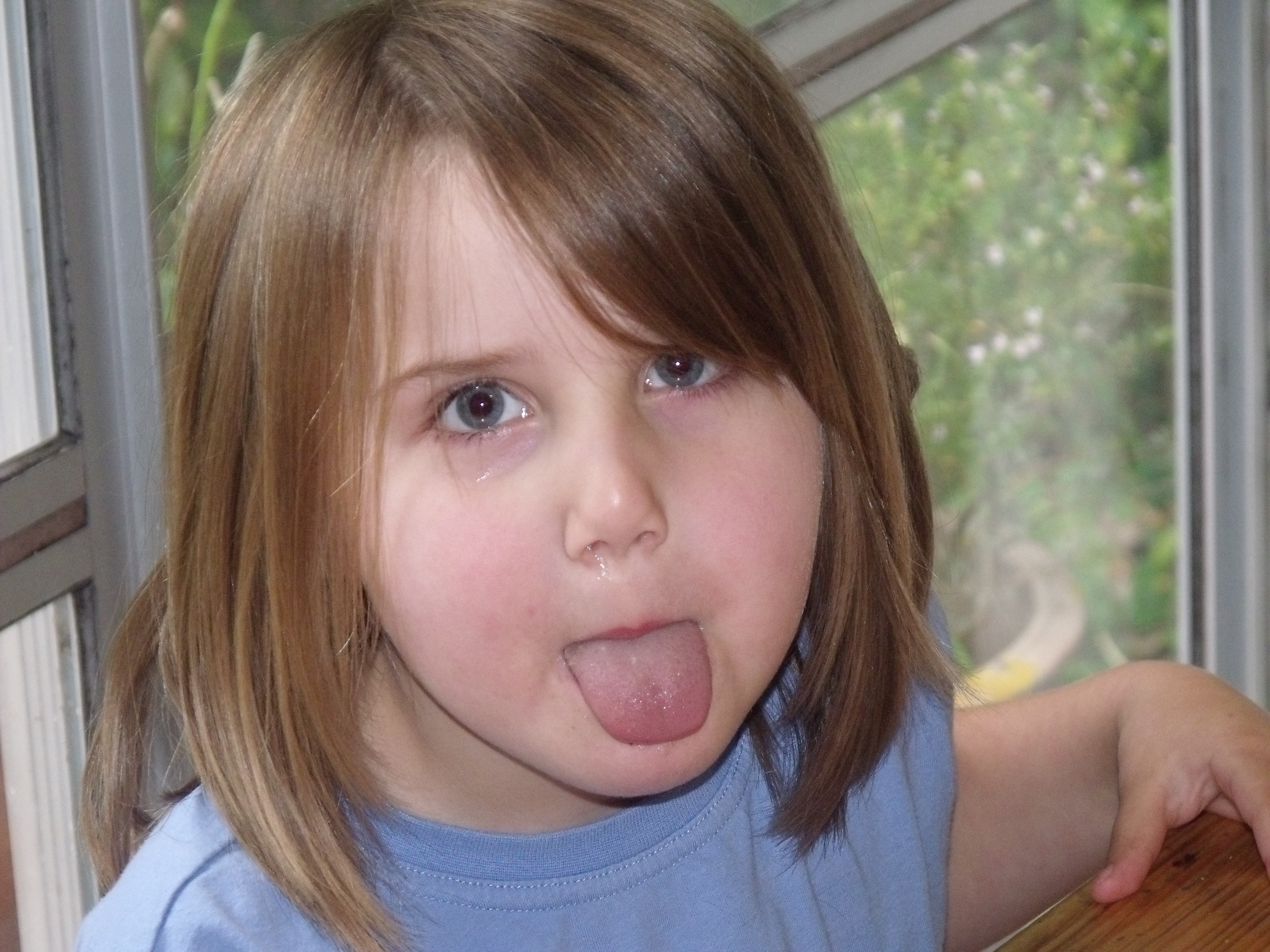
Of course I don’t know where Loulou will head in life, but I do recognise some traits in her which I see in myself, but I can’t tell whether or not these are inherited traits or learned ones. Computers are no mystery to her, and she knows that it is possible to take a photo (on a phone) and send it to Grandad. She knows how to unlock the iPad and has no fear of the Android tablet. She and I have a liking for a particular on-line game.

Loulou’s Dad works with computers. She has two older brothers who are computer literate. Her mother grew up  with Commodore 64s and computer games loaded from tape. Loulou’s mother’s Dad (me!) worked in computers from before Loulou’s mum was born, but I don’t think I bought the job home, though we did get a Vic 20 and later a Commodore 64.

Commodore VIC-20 Computer with later revision ...
Vic 20

But Loulou is not a geek. When we went on a walk Loulou decided that tights, t-shirt, a tutu, and gumboots were the appropriate wear. (I think that, stylistically, it worked). She’s a fan of Dora the Explorer but is not a fanatic. Maybe she will grow into that. However, her Mum and Auntie weren’t particularly doll orientated.

Hmm, this article seems to be all about Loulou. It’s too early to tell, but I won’t be disappointed if she goes down the geeky route. I’d be interested in how she gets on in that world. I won’t be disappointed if she *doesn’t* either. Either way she’s the most wonderful granddaughter.

DSCF8111
Loulou

Summer, Autumn, Winter and Spring

Revolving earth at winter solstice on the nort...
Northern winter solstice

On 21st June we in the Southern Hemisphere get our shortest day of the year. This corresponds to the longest day in the Northern Hemisphere of course, and my wall calendar, which originates from the Northern half of the planet says that 21st June is the start of summer. I believe that the official start of winter, here in New Zealand, is 1st June.

That started me thinking. One would expect that 21st June, the southern winter solstice, would be the middle on winter, since the earth is tilted furthest away from the sun in southern latitudes at that date, and that the seasons would change mid way between the solstices and the equinoxes in both hemispheres for similar reasons. The equinoxes are the days when the night and days are the same length in both the northern and southern hemispheres. (Pedants will notice that I’m not being precisely correct in my explanations of equinoxes and solstices, but that doesn’t matter for my purposes.)

English: Two equinoxes are shown as the inters...
Equinoxes

It is obvious to anyone who has reached a sufficient age that the warmest and coldest parts of the year don’t correspond to the solstices and that the change from higher than average temperatures to lower than average temperatures and vice versa don’t happen at the equinoxes, though these latter events are probably not that noticeable. There is obviously some seasonal lag.

Image representing Wikipedia as depicted in Cr...

So I browsed to Wikipedia, which is a useful place to start, even if some people question its accuracy and veracity. I’ve not found it too bad, myself. Sure enough, there is an article on seasonal lag, and I’ve no reason to doubt the information there. To summarise, the authors of the article attribute the lag to the oceans which, because of the latent heat of their water absorb heat energy and release energy as the seasons change. I’m not sure that I completely understand the reasons for this, but there are undoubtedly deeper analyses on the Internet. The Wikipedia article contains one reference.

Apparently the seasonal lag is different in each half of the year. I believe that means that the four seasons are not all equal in length. Hmm, summer does seem shorter than the other seasons, but that may be only subjective. However, our shortest day is only four weeks away, so we will at least be seeing more daylight each day from then on. We will be on the upwards slide to Spring and Summer, even though Winter will not have bottomed out, and we can look forward to barbecues and a summertime Christmas!

Pohutakawa
Pohutakawa flowers. They bloom at Christmas, in early summer.

Back to the beginning – Cheese Scones.

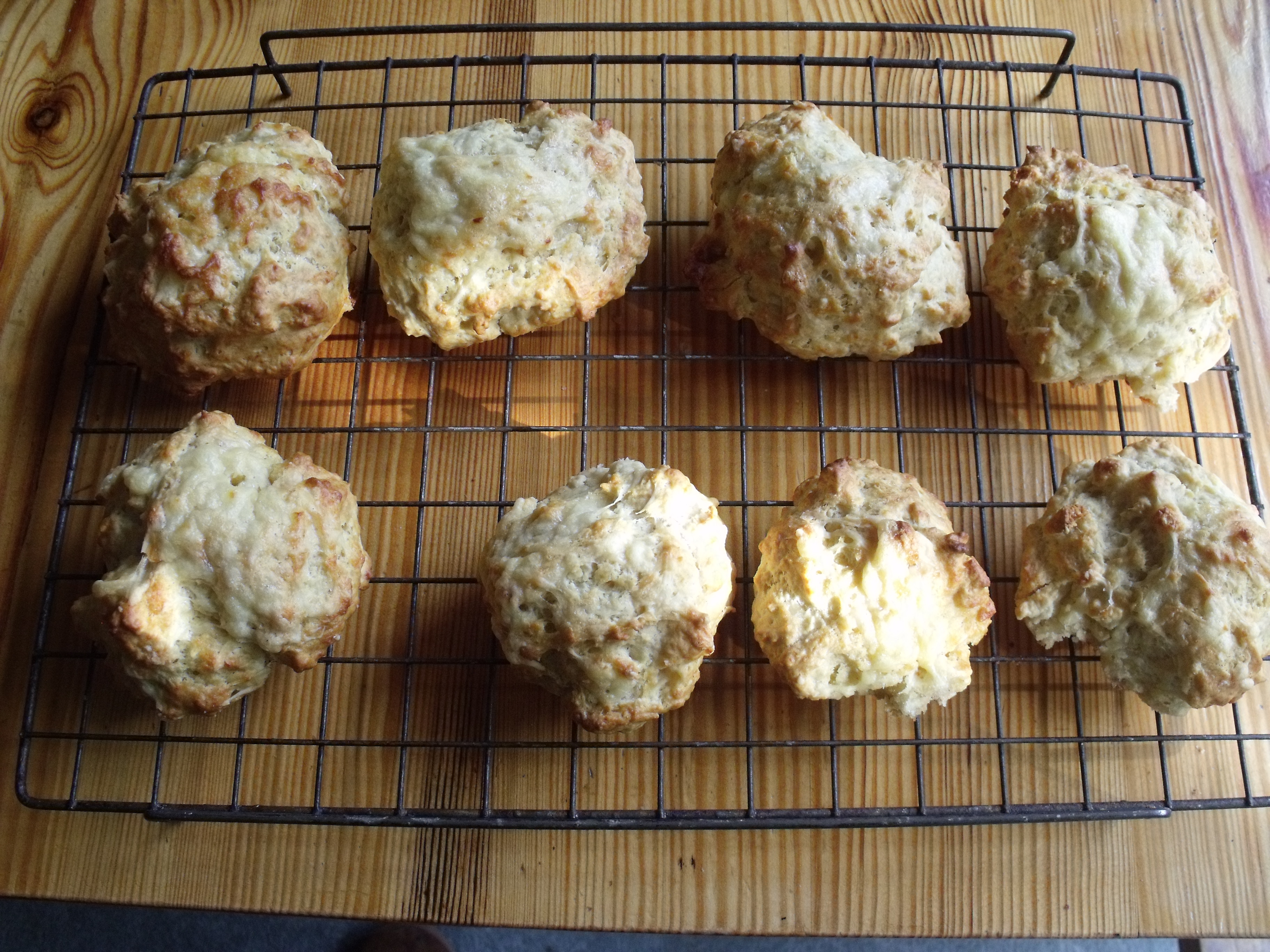
Cheese scones
Cheese scones

I think that the first thing that I ever cooked was cheese scones. They are an ideal project to start cooking on as they are so simple. I’m not going to mention the actual recipe that I used since there are probably millions of them and they all work pretty well. Basically cheese scones are made from flour (usually self-raising), some shortening (butter, margarine, oil), a small amount of liquid (water or milk), some baking soda (to give the typical scone ‘tang’), salt and a little mustard to taste and of course cheese, usually a fairly strong variety.

They are simple and quick to make and cook and equally simple and quick to eat! I like them hot with butter and apparently so do most people, and in fact I doubt that many scones get to cool to room temperature! If you fancied it, you could add a touch of chili I guess, or some ham or prosciutto. Of course, they don’t have to be cheese scones – I’ve always liked date scones. I suspect that with sweet scones you’d need to reduce or remove the baking soda though.

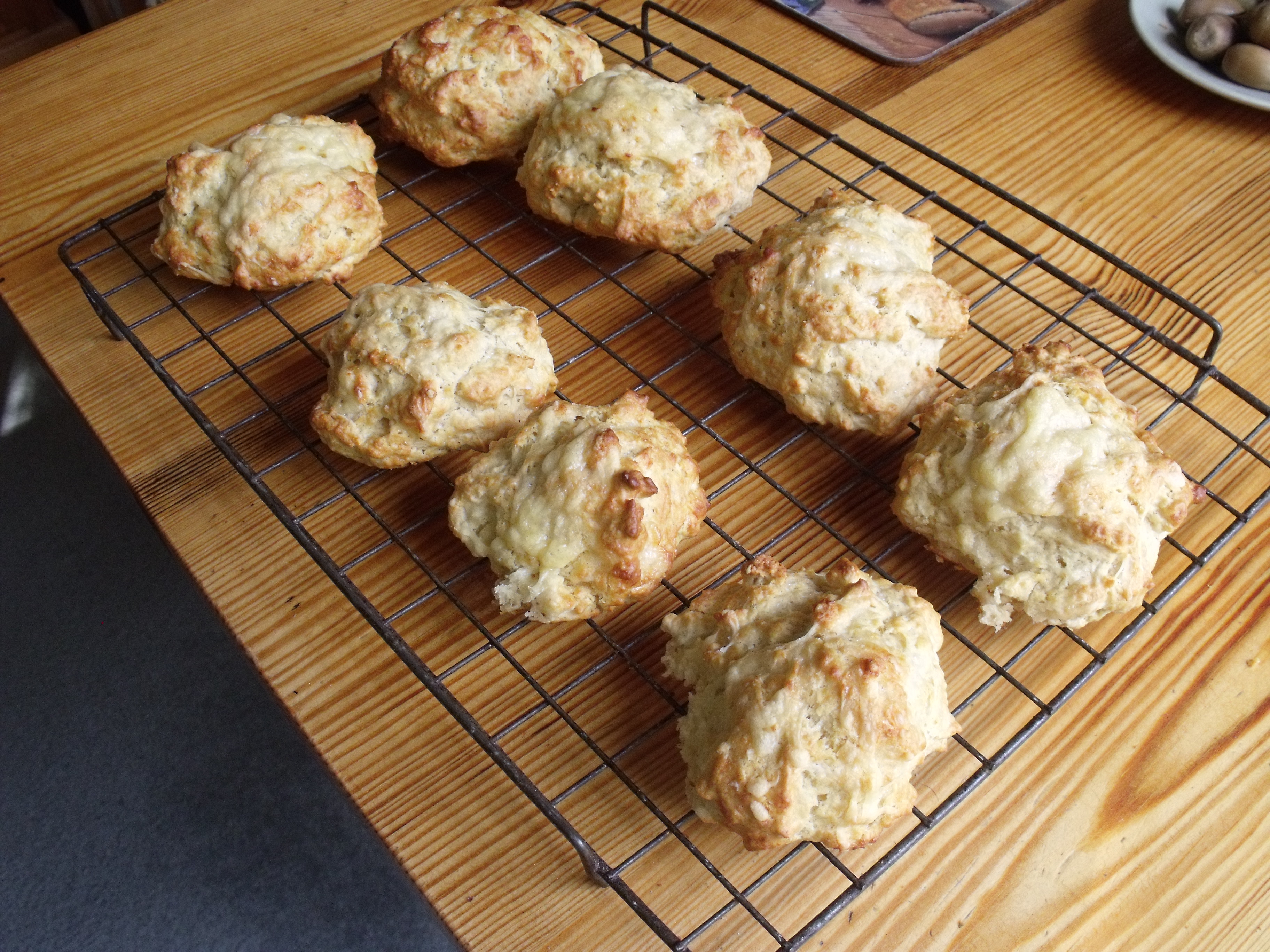
Anyway my efforts are shown above and below. The pictures don’t really show how toasty brown they were. They look a little pallid in the pictures. I can assure you that they tasted great!

Cheese Scones
Cheese Scones

(I intend to try to post to this blog at least once a week – I haven’t posted since the end of last month and that is not good!)

Soda Bread

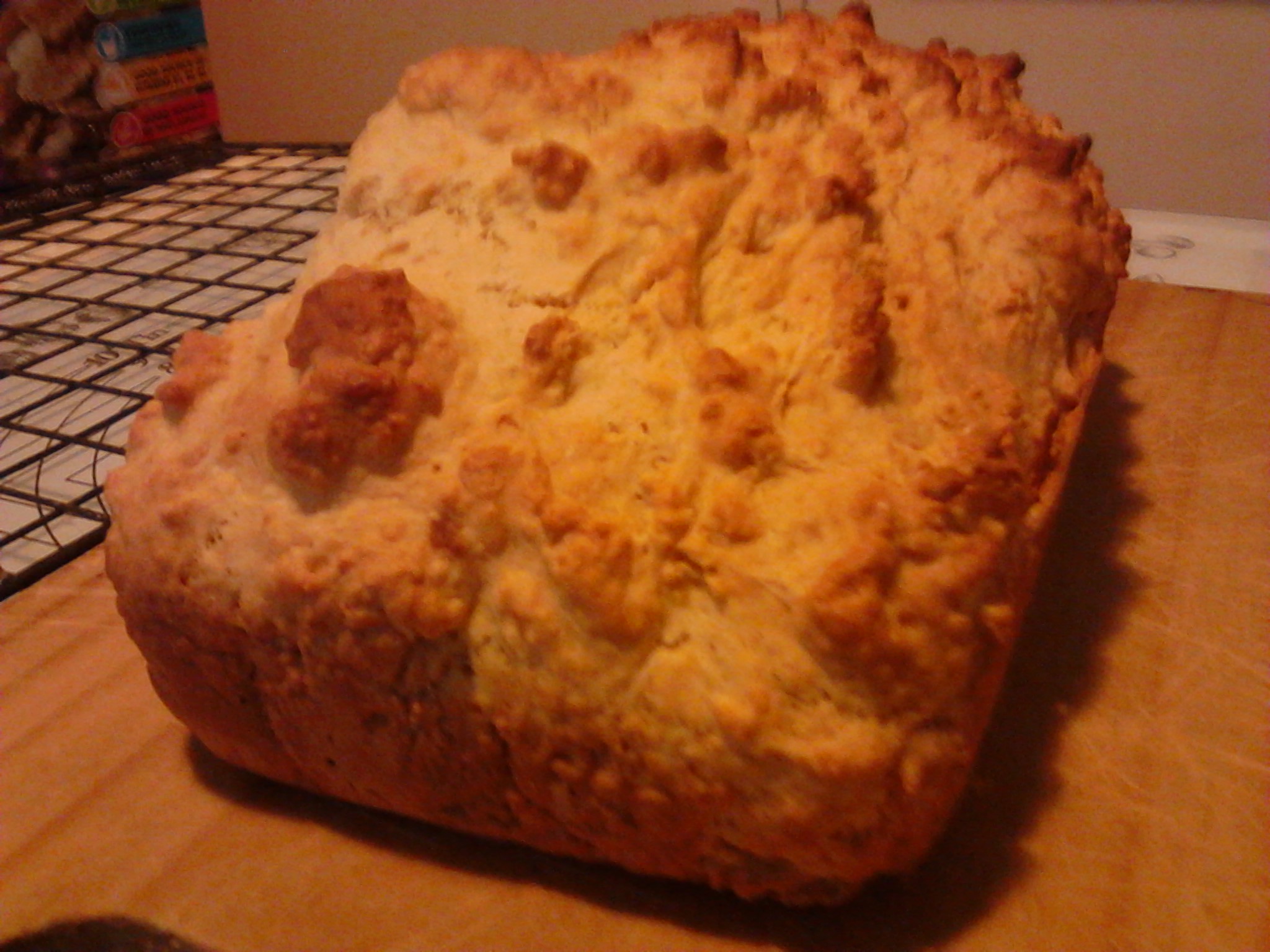
We had run out of bread through an oversight, so I decided to make a loaf of Soda Bread (from a recipe in “The Cookery Year”, Reader’s Digest, 1974). This is a non-yeast recipe and uses Bicarbonate of Soda and Cream of Tartar as raising agents. These ingredients produce the Carbon Dioxide in the dough that would be produced by yeast in a standard dough.

Bubbles of Sourdough
CO2 bubbles in a Sourdough ‘starter’.

I decided to cook the Soda Bread in a loaf tin instead of on a tray and it came out looking great. However, there was a tiny bit of uncooked dough at the centre. The outside was beautifully crunchy, so I’m guessing that the mixture was too deep in the tin and it would have been cooked all the way through if I had let it spread more thinly by cooking it on a tray.

IMG_20130425_125046
Soda Bread 1
IMG_20130425_125101
Soda Bread 2

Poems and poetry

I usually have some idea of where I am going when I start a post, but this time I’m starting with no real idea of what I’m going to say. It’s just that the idea of “Poetry” entered my brain from somewhere and some synapse went “ping” or some switch closed somewhere in my brain. Two metaphors for something stirring my interest.

(Ah yes! I remember now. I read somewhere that April is National Poetry Month in the USA.)

National Poetry Month Display @ Forest Hills

I’m not going to touch on what exactly poetry is. It doesn’t lend itself to easy definition, and in fact, any definition can only  partially explain what it is, so I’ll not try to define it, although I may touch on some of the aspects of what makes it poetry. If you try for a definition, you will find that you have to keep adding exclusions and extensions to your definition, and eventually you will find that you will need to add exclusions and extensions to your exclusions and extensions.

One of the things that poetry is, usually, is rhythmical. In the poems we learnt at school the rhythm was, usually, strong. Most people of my era will remember at least the first few words of “The Charge of the Light Brigade” by Alfred Lord Tennyson.

Half a league, half a league,
Half a league onward,
All in the valley of Death,
Rode the six hundred.

The poem also contains other well-remembered lines such as –

Theirs not to make reply,
Theirs not to reason why,
Theirs but to do and die
Charge of the Light Brigade. An example of the...
Charge of the Light Brigade.

Poetry teachers tend to emphasise that the rhythm of this poem echoes the rhythm of the galloping horses, and so it does, of course. But maybe what is more pertinent is that the rhythm of the poem possibly aids strongly in the retention in the brain of the memory of the poem. Maybe a memory needs to be refreshed periodically in order for the memory to be retained and a strongly rhythmical memory is more easily refreshed.

I have no idea if it still applies, but in the early days of computers for data to be retained in the memory of the computer it had to be regularly read and re-written or refreshed. There may or may not be any real parallel between the way that computer memory and memory in the brain works, but the idea is, for me, evocative of a connection.

We certainly remember the rhythm of a poem more strongly than we remember the words – someone may start to quote a poem, run out of remembered words and conclude with “dum-de-dum-de-dah” or something.

Symphony Hall abstract
Symphony Hall abstract – rhythm in shape

If the rhythms of poetry help the poem and the ideas presented by the poem be remembered, they also act to grab the attention of the person who hears or reads the poem. Poetry shades into music and in pop music almost every song or track has a “hook”, the hook being what grabs the listener’s attention. An outstanding example is the tinkly little phrase in the song “Somebody that I used to know” by Gotye. Or the Largo from the second movement of Dvořák’s Symphony number 9 in E Minor, (From the New World) if you want something more highbrow!

These are musical hooks, but rhythmical hooks abound, such as the one in the Charge of the Light Brigade.I’ll also mention the rhythmical hook in the little poem that helps English speakers remember the number of days in each month:

Thirty days hath September,
April, June, and November.
All the rest have thirty-one,
Excepting February alone,
And that has twenty-eight days clear,
And twenty-nine in each leap year.

This maybe works more because the rhythm and the rhyming is somewhat defective than for any other reason! Anthropomorphically, the brain goes “Ewww! That’s wrong!” and is hooked. Maybe.

I mentioned that poetry shades into song.  As an aside perhaps Rap falls into a gap between poetry and song. Ordinary speech shades into formal speeches, which shade into prose such as is found in great novels, which shade into poems, which shade into songs, which shade into music, at least in the way that I’ve been discussing.

Pranksta Rap
Rap – somewhere between poetry and song?

The common thread is rhythm to attract attention and rhythm to aid memory. Maybe if we understood more about the effects that rhythm and rhyme have on the brain, or how the brain uses rhythm and rhyme, or even how rhythm and rhyme are fundamental to the workings of the brain (if they are), then we would understand the brain much better.

Word is Born
Poetry is usually words, but there are exceptions to that, of course