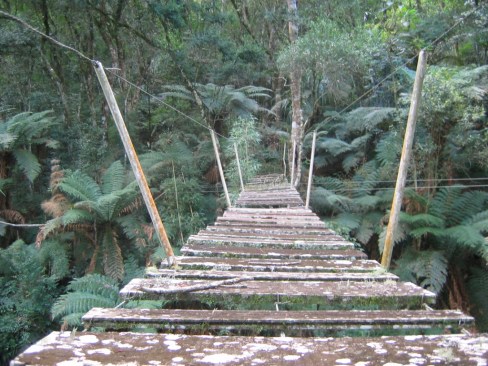
Writing is dangerous

Old rickety bridge
Photo by Raphael Pto from FreeImages

Writing is dangerous. When you put that pen to paper, or more likely, hit that first key, you don’t know where you will end up. You set up a situation, a garden, say, with God, a tree, a couple, and a serpent. The serpent urges the woman to eat fruit from the forbidden tree, but, of course, she doesn’t because God forbade it, and she and her husband live happily ever after in the garden.

Hmm, that’s a bit of a dead end, but I’d guess that you could think of improvements. Let’s say that God visits them one day.

“Adam, Eve, are you happy here?” asks God.

“It’s brilliant. We love it.”

“”How do you know?”

“You told us. You’re God. You must be right.”

“Just eat one of the apples on that tree, guys, please.”

Sounds of munching.

“Erm, God, what’s it like out there?”

“There’s misery, pain, trouble and worries, and there’s also joy, love, happiness. There’s also kids, who roll up all those things into one delightful, infuriating package.”

“Can we go and see?”

“Yeah, but you can’t come back again.”

“OK. We understand. Where’s the door?”
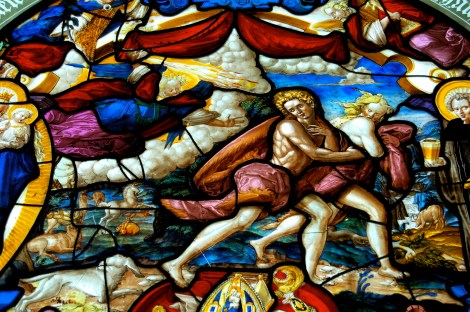
Stained Glass - Adam and Eve
Photo by Janet Burgess from FreeImages

So, I didn’t know where that was going and I’ve only just started! Obviously, I began from the Garden of Eden, and had Eve resist the blandishments of the serpent. Then I had God urge Adam and Eve to eat the fruit, and consequently Adam and Eve became curious about ‘out there’. God’s going to have to cut them some slack out there, since it was He who encouraged them to eat the fruit, but I’ll leave it there, for now.

In “The Lord of the Rings” Bilbo Baggins recites a poem several times. Bilbo is referring to a real journey of course, but writing a story is much like a journey. You start off with the first word, or the first step, and you have no idea where your journey or story may take you. No idea at all.

The Road goes ever on and on
Down from the door where it began.
Now far ahead the Road has gone,
And I must follow, if I can,
Pursuing it with eager feet,
Until it joins some larger way
Where many paths and errands meet.
And whither then? I cannot say.

At some point, your feet, or your words, come across a broader way. Your feet may encounter a highway, and other people. Your words may lead you to a larger narrative, in which are embedded new characters. These characters all have ambitions and objectives. They may help or hinder you. And so the road or narrative goes on, leading you to who knows where. Whither then? You cannot say.

As a writer you live your characters. You say their words. You fight their demons. You love their loves, and sometimes you die their deaths. You experience their defeats and their triumphs. You are the hero and the villain.

Pears on a tree
Photo by Linda DuBose from FreeImages

At the same time, paradoxically, you can’t predict what happens. Any writer knows the feeling of surprise when something unexpected happens. When Adam and Eve eventually find their way back to the Garden and politely request entry, God lets them in, because, after all, he told them them to eat fruit from the Tree of Curiosity. What? You thought it was the Tree of Knowledge? If the fruit gave them knowledge, why did they have to leave the Garden? They would have known what’s out there just by eating the pear from the Tree.

And God and Adam and Eve would sit down and Adam and Eve would relate their story. Oh, God would already know it of course, but a story, even if you know it, always sounds better coming someone else. They’d introduce their kids,  and God would ask them if they wanted to stay. Adam looks at Eve and they shake their heads. Nah, Eden is OK, but it’s a bit boring, duplicitous serpents aside. They’ll take real life. God saw what He had done, and it was good.

Writing is dangerous. You never know where it is going to take you, and you never know how long it will take. You start with one sentence and the next thing you know you have a whole book. You will have agonised with your characters, you will have been surprised or shocked at what they get up to, and you will discover that the house is a mess and the dog will have left you.

Yellow Labrador
Photo by ! Dujazz from FreeImages

Writing is dangerous. It soaks up you time, your energy, and possibly your money. You will have forgotten to do your washing, your diet will have lacked balance and vitamins, and your garden will resemble a jungle.

Writing is dangerous. You sit back having completed your story. And rewritten it, perhaps several times. And altered it, added characters, removed characters, changed characters. And spell checked. And grammar and syntax checked. Dozen of times. And then you have a thought. The serpent. Embodiment of evil? Or God’s loyal servant doing God’s bidding, maybe?

Writing is dangerous. Even after you’ve finally, finally finished, you sit back, momentarily satisfied. Then you jolt upright. That documentary on waterfalls! What if the world was split by a single humongous waterfall. Those living at the top would naturally look down from above and see the lands below, but they wouldn’t be able to reach them. Those down below look up and see the towering waters and wonder if there is anything up there. Then some intrepid top-dweller invents a hot air balloon and floats over the waterfall and his craft descends to the lands below. And then…

And then you type the first sentence and everything begins again.
Empty Valley
Photo by Wim Delen from FreeImages

The Coming Apocalypse

Bombed out church
Photo by Lisa Setrini-Espinosa from FreeImages

I see people and nations trying to come to terms with global warming, but the efforts to reverse it seems disorganised, incomplete and ineffective. Governments sign agreements containing measures that sound good, but which are not implemented or implemented badly, and all the time the ice melts and the ice caps break apart.

I see Greta Thunberg ranting at the United Nations about their inaction on climate change. She has a point. If the world is to be saved, then those in power should take decisive action, now. But she is preaching to the wrong congregation. Most of those in the UN are in the later stages of their careers. The people that Greta should be taking to task are those of her parents’ generation, those who are just coming into their powers, mainly the millennials.

Can the millennials save the world? I think not.

Can the world be saved through democratic processes? I think not.

The problem with global warming is not the flooding of islands and the melting of the icecaps inundating coastal areas. People can always move inland. No, the problem is inland, in the areas that grow the crops that feed the world and in the forests that provide the life-giving oxygen and remove the stifling carbon dioxide. Global warming is going to inevitably cause crops to fail and forests to die. Droughts, floods, storms that devastate large parts of whole countries will become common.

Dry ground
Photo by Scott Liddell from FreeImages

This will lead to food shortages and famine. Famine leads to the spread of disease and to war, as those without food invade those areas which have food, and those who have food fight to keep what they have. Inevitably the wars will result in the inability of the food growing areas to produce food, leading to deepening famine, and deaths in the billions.

Technology will suffer. The things that we use every day, like cooking equipment, technology that we utilize to entertain ourselves, or our means of communication, like our smartphones, will not be produced as people find it necessary to concentrate on obtaining food rather than producing technological wonders. The networks will fail.

We will see the failure of democracy and the rise of autocracies as wars proliferate and famine and disease spread.

Fidel Castro
Photo by Mike Minor from FreeImages

The autocracies and wholesale death by famine and disease may be the saving of the human race. If the human race is decimated, the pressure on the planet may ease, and the forests may return, springing up from remnants of the original forests or from species that have imported into the area by humans of our era. The autocrats may force workers to recreate the forests, because, after all, they will have experienced the effects of global warming. They can compel whereas democracies cannot. Autocrats are not magnanimous, but their best interests will hopefully be served by an end to global warming.

Where does that leave us? With a human population of much less than a billion. With the forests returning, maybe not the original forests, but forests made up of different species from other parts of the globe. There will be animals, but probably not the original species. With temperatures falling, and oceans returning to health.

There will be countries, but not the countries of today, and it is unlikely that any global organization, like the United Nations will remain. All current treaties and agreements will be long gone, replaced by other more local agreements and treaties.

Indigenous peoples may resurge in some places, but disappear in other.

It will be a world unlike our current world. Technology will have reverted as the huge factories needed to support it will have gone, but the knowledge may be retained, and the technology may resurge, but probably in a simpler fashion, using fewer resources. The day of the mega-factory will be over.

People will not fly around the world, and would probably live, and die close to where they were born. Large cities, of the size of London, Shanghi, or New York, will probably die, but smaller cities will likely survive.

That is the best case scenario. In the worst case the famines and wars will reduce the human race to very small numbers, and once the decline has got to those sorts of levels, the human race will fade away. No species resurges to previous levels after a die off of this magnitude without outside help. Where are the aliens when you need them ?

Inflatable aliens
Photo by Cheryl Empey from FreeImages

A New Book


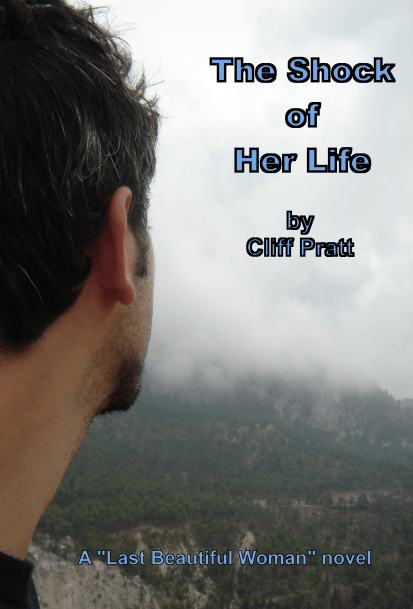
The Shock of Her Life
“The Shock of Her Life” Book Cover

I’ve just published a new book, a sequel to “The Last Beautiful Woman”. It’s a short novel (approx 20,000 words long) called “The Shock of Her Life”, and takes up the story of Jenna and her friends.

When it opens, Jenna’s life has settled down, and she is still trying to adopt the two kids, Isla and Ryan, who seem to be like her, and who may also live very long lives. All three are frustrated that it is taking so long.

Jenna still sees her purpose in life as helping others, and she and her staff guarantee that they will answer any question that is sent to her, whether it is mundane or complex, from a child or the largest business or government.

She is still searching for others like herself, and when this search goes wrong it triggers a series of events that result in Jenna getting the shock of her life.

The book is currently available only in eBook form, and can be found on Amazon, Kobo Books, Smashwords, and other eBook retailers.

In other news, I’m currently revising a project that I was working on a few years ago, and which has not yet seen the light of day. Please look out for it! It’s currently called “The Castle”.

A Can of Worms

The Writer at Work
The Writer at Work

This is yet another post about the writing process. OK, it fascinates me, as I consider what happens in my brain/mind as I write something, but I risk the possibility of it not being interesting to anyone else. It’s around 1500 words long, which is a bit longer than my usual posts.

So, the conventional view of the writing process is that it is a linear process. The writer sits down at his or her desk, starts furiously writing, casting off page after page, until with a final flourish he types or writes “The End” and the deed is done.

The real process is much more dynamic than that, at least for me. The following is a brief description of what happened when I wrote a story that I have written about in previous posts. I haven’t included any elements of the story because I want to concentrate on the process.

The End
The End

In a previous post, I wrote about a story that, as I wrote it, became too long for the competition in which I wanted to enter it. When I had completed it, I modified it and shortened it. However I wasn’t happy with the result, so I abandoned it, and started again from scratch, cutting and pasting bits from the original now and then.

This worked fine and I submitted the story into the competition. However, I now had three versions of the same story, and one of them, the original short one, was significantly different from the other two. A core topic in the story had changed, and the motivation of the main character was consequently different. There were other things about that version that I didn’t like so I considered consigning it to the bit bucket. However (fortunately) I didn’t do that right away.

I was happy with the version that I submitted for the competition, but I felt that the longer version could be improved. With no limit on the length, I could be more descriptive, go into the characters a bit more and draw out their motivations and fill in their back stories. I could also pull in bits from the short version which did work, and also ideas from the competition version that weren’t in the longer version.

Merging three stories into one

I hope that I’ve given some idea of how complex this was. I was effectively merging three versions into one, and some bits didn’t fit together too well. I was constantly revising the longer one so that the timeline and the events fitted together properly with the bits I was getting from the other two versions. Normally things don’t get as complex as this for me!

After I got a consistent story, I developed it further. I’d add a paragraph or two to bring out the motivation of some character or other, and as a result one or two of the minor characters blossomed into being more than minor characters.

Initially the main character and his wife were a bit aloof, but I decided to make them more sociable, more friendly. The wife mostly dropped out of the main story, but returns for a major cameo. Another major character developed to become almost the equal of the protagonist, and a minor character emerged from the shadows to become a more rounded character.

The Protagonist
The Protagonist, but not of my story! It’s actually the goddess, Nike.

By this stage my story was complete in the longer version, and, because I had effectively gutted and abandoned the original shortened version I deleted it, as mentioned above. So now I had two versions, the shorter competition version and the longer version.

Now, when I’ve written a story, and although it is in a sense complete, I don’t leave it there. I read it through, again and again, constantly revising and modifying it. I don’t usually change the story that much, but I go after spelling errors, grammatical errors, continuity errors, and so on. In every run through I change something. Maybe just the way that I said something. The position of a word in a sentence. Maybe a name, a location, a motivation. I could keep editing probably for ever. I never write “The End”.

My main point here is that, using modern technology, I have been able to, basically, rewrite the story twice and extend and revise the original story dramatically.

Juliet's Balcony
A balcony in Verona which has nothing to do with Romeo and Juliet, but still gets visited and photographed by tourists who think it has.

I wonder how ancient writers did it. I can’t imagine Shakespeare turning out multiple drafts of his plays. For one thing, he did it by hand. To create a new draft, he would have to write out the whole thing again with the changes. The decision to change the name of a character from “Fred” to “Mercutio” wouldn’t be taken lightly. For another thing, paper was, relatively speaking, expensive in those days. Printing was expensive.

Once he had written the play, it would be printed, but only a few copies would be produced. The printed copies were not intended for general reading, but were intended as “prompt books” for use in a theatre. This means, of course, that each printing might be different.

Old Books
Old books. I imagine that Shakespeare’s plays would have been printed in books like this.

I’ve not heard of Shakespeare making notes or outlines of his plays, but maybe he did. Maybe somewhere there is Shakespeare’s hand a scrap of paper that says something like “R sees J on blcny. J doesn’t see R. R calls J, J calls guards. R thrown out.” But we know that the final version doesn’t run that way!

I conclude that Shakespeare probably had the whole play mapped out in his mind, or at least great parts of it, including the words that he invented, the sentence construction, the characters and the plot. It’s an awesome feat if he did do it that way. The idea of juggling all those characters and scenes in his head, developing the story, and finally getting it down on paper in an almost final version is amazing.

Well, I wrote that before actually wondering if there was anything on the Internet about how Shakespeare wrote his plays. The answer is fascinating, at least to me! It seems that Shakespeare and his fellow playwrights of the era cooperated extensively with each other, adding bits to each other’s plays. So Shakespeare’s plays were, in part, written by others! Interestingly, that’s very similar to the way that TV shows are written today, I understand.

An author at work
An author at work

We have the luxury, these days to dash off a story (or a play or whatever) and not worry too much about the details. We can fix those on the second go through! Electrons are as cheap as chips. I could have edited the bit about Shakespeare above, but I wanted to demonstrate how I was thinking, since this is post is about my thought processes when I write things.

So, I’d say the my writing style is like opening a can of worms. Who knows in what direction they are going to wriggle? Who knows where they are going to take us? I have a strong feeling that when I write a story, I’m only nominally in charge. The characters seem to have a life of their own, and they have their own needs and desires. They interact in way that I would not have predicted when I started writing their story and often the story changes as I write it. I’m often interested in how it is going to turn out.

That’s how I write. But others do it differently. Some, even in this electronic era write things out by hand. Others use mechanical typewriters and a few swear by old, really old, versions of software.

Mechanical typewriter

Things are different from Shakespeare’s day in many ways. It is more usual to write novels, rather than plays, and books are cheap and widely available. Writers do not, as a general rule, cooperate, as in Shakespeare’s day. A book will perused by an editor and checked by a proof reader many times before it is printed, and may be revised many times.

Even for those who write things by hand have the advantage of paper being cheap and readily available. They, and those who use mechanical typewriters, can easily rewrite a page and slot it into the manuscript fairly easily.

If you read the advice out there on how to write, you would sometimes think that the bare essentials are a well developed plot and well defined characters. I’ve read advice to that effect many times, but there are people who advocate the “just start writing” approach, and that is, as you can see above, my preference. I would not like to be straitjacketed by a rigid plot and static characters.

Inspiration?
Inspiration?

But some people prefer that approach and good luck to them! And there are those in the middle. Those who might have plot in mind or a set of characters, but aren’t about to spend time in developing the plot or the characters in detail. That’s maybe most writers.

Whatever approach you prefer, it is a good idea to research how to write. How to structure a story, how to develop characters and so on. It’s silly to think that all you need to do is pick up a pen and write, and you will produce a best seller. Even the best writers didn’t do that. They wrote at home and at school as kids, and they will have read voraciously, in all sorts of genres, and they may have actually formally studied literature. They will have practised extensively. And that’s what I am doing, and continue to do. Studying and practising. It’s one of the reasons for this blog!

Editing the first draft
Editing the first draft. That’s not me. I would be doing it directly on the computer!

Tutorials and Hairy Balls

Cube with applied material.

There are hundreds of tutorials for Blender. Maybe thousands. As you might expect they vary in quality from not-so-good to very good. One of the characteristics that they all seem to share is that they are fast! Some are far too fast, some are not too fast and I can keep up with them. What I’ve decided to do is watch a tutorial without making note of the techniques used and then go through it again stopping and starting to get a better idea of what is going on.

Another issue is that Blender is complex, as it needs to be to produce realistic 3-D images. That often means that there are usually several ways of achieving something, and a tutorial author might prefer one over another for some reason. Rarely does an author go into why he did something a particular way, and if he does, it can be incredibly useful.

Anyway, I’ve been looking into ‘materials’ and ‘textures’ recently. ‘Materials’ are the stuff that things are made of, like ‘metal’ or ‘marble’. Textures are, as someone said in a tutorial, descriptive of the material. For example a metal object may be rusty, or a marble object might be dirty.

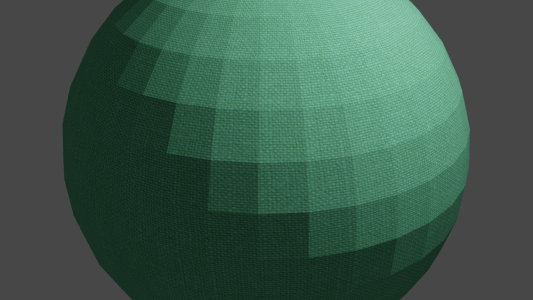
Fabric ball
Fabric covered ball

There are hundreds of free materials and textures available for anyone to download. I’ve downloaded a few from Chocofur who provide a several useful packs of free materials for download. You can also purchase some impressive models from them.

Another source of useful materials are the tutorials. Sometimes a tutorial author will include the materials that he has used in his tutorial, to help those who have taken his tutorial, so that they can repeat the steps he took in his tutorial and learn that way.

Of course, a simple image downloaded from the Internet or a camera image can be used as a source of material and/or textures, but that means that the artist will need to do more work, which brings me to another point. When a texture is downloaded from the Internet, it is usually in the form of a “blend” file which has to be ‘appended’ to the model being created. (A “blend” file is the format in which Blender saves a file, whether it’s one of  your own creations or one from the Internet) When I downloaded my first materials, I didn’t know this, so I just used the images from the downloaded files. This produces results which are, basically, rubbish.

A downloaded texture usually contains several images, used for different purposes – as a colour map, a displacement map, or one of several other types of map. I use the word “map” loosely here. These are used in the “shader” in various ways. I’m not going to define “shader”, but loosely, it’s how the material/texture is applied.

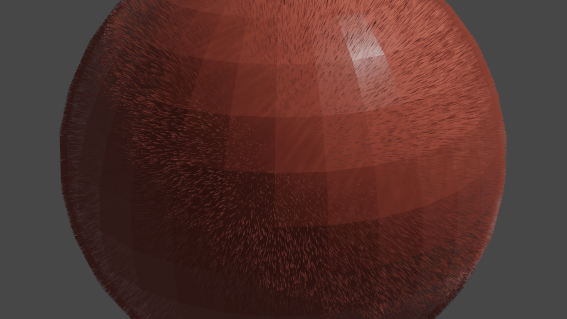
A Hairy Ball
A hairy ball

What I didn’t realise when I started to look into materials, and textures and shaders was that it is fun to play around with them. A shader is a bunch of nodes linked together. Each node is a box with adjustable sliders and values in it, and you can play with them to your hearts content.

Here’s one of Chocofur’s shaders below. Note all the options that you can change! You can also add other nodes to modify the provided shader, and that where the fun begins! Of course, it helps if you know what the nodes do, but that doesn’t prevent experimentation of course.


Node map of Chocfur’s Solid Marble shader

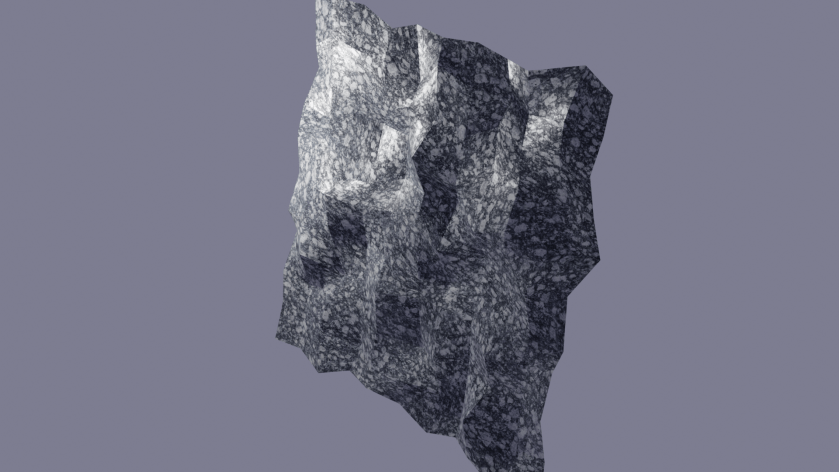
OK, to end with I’m going to show you two of my images, created in the last week or two. They are renders of a cliff face. The first is my first attempt. I created a plane mesh and subdivided it with the fractal parameter set to non-zero. This has the effect of “crumpling” the surface a little. Then I added a pretty bland texture and rotated the plane so that it looked like a cliff.

Cliff version one
Cliff version one

There’s obvious problems with of course. It’s pretty meh! And the bands across it are distracting. Here’s the second attempt.

Cliff version two
Cliff version two

This one is the opposite of the first! It has a bolder material, and is considerably more crumpled. Back to the drawing board. Oh, and I’ve got to work on the lighting.

Please read my books. The paperback versions can be found Amazon, and the eBooks can be found there or at your favourite eBook store. Just search for my name, Cliff Pratt. I mainly write fantasy fiction.

Progress with Blender

This is an update on how I’m getting on with Blender. I spent some time reading and viewing tutorials about the Blender interface, and it is unusual in many way. There are dozens and dozens of menus, panel, screens, and many of the buttons are small on my not-so-big screen (see above). That’s not so good for my ageing eyes.

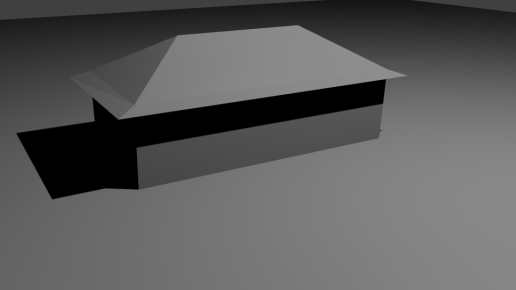
I decided to try some of the tutorials on how to build a simple house, and eventually I ended up with above. A grey house on a grey background in Blender’s 3D view window. I then tried to recreate the above without looking at the tutorial, but before I get into that, I’m going to mention “rendering”.

Rendering is the name of the process for converting the 3D model, whatever it is, into a image that can be used on the web, or as input for further processing using a different program such as the GIMP. It is during this stage that colours and textures get applied. Below is the image resulting from the rendering of the model above. I didn’t do any colouring or apply any textures so it still looks very grey.

As I said I now attempted to draw the house from scratch, not using the tutorial. It took me some time, but eventually I managed to create the model below.
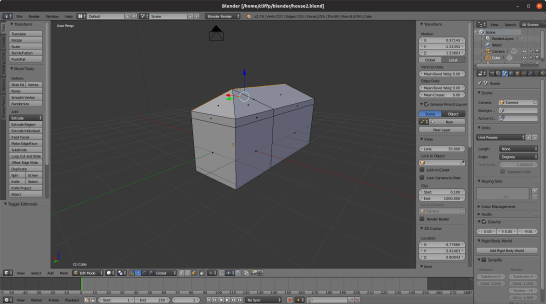
As you can see, I forgot to create the eaves, but apart from that I managed to recreate something like the tutorial model. I should have planned the house properly before I started it. I could correct it in Blender, but it is easier, with such a simple model, to start again.
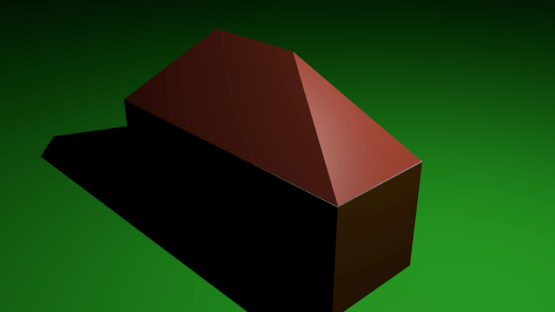
I’d read or watched a tutorial where materials were applied to a model to, among other things, apply colour to the scene. “Scene” in blender means a single model that can be worked on, such as the houses, backgrounds and lighting in the models above. I decided to render my house, and to colour it in the process, and ended up with the following image. The green area that the house stands on is an object in the scene that I created and coloured, a large flat “mesh”. In Blender your work sort of floats in space, although there is something called “Physics” that I haven’t investigated yet, that may change that.

I continued to familiarise myself with the Blender interface by playing around with house models, and then I decided to try to recreate my UFO from the GIMP in blender. Here it is, in Blender. Unfortunately, the image is quite small.
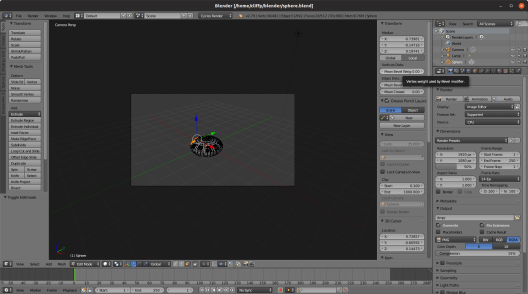
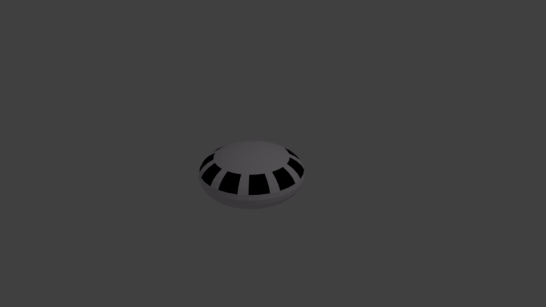
And here’s a rendered view. I coloured it black and white, so it doesn’t look too impressive and the light levels are a bit low.

I restarted building the UFO, and here’s a screenshot of the second version. This time it should be more visible. It’s view of the mesh that creates the shape of the UFO. Its skeleton, if you like.

And finally for this post, here’s a rendered image of the UFO. AS you can see, it’s a bit chunky, but I’ll be investigating how to smooth it out.

I’m deliberately not going into detail on how I built these images, since they only use the really basic tools, (the UFO is just a squashed sphere for example), and there are many good Blender tutorials on the Internet. If I find some process or facility that I find interesting, I might go into detail, and when I start building a full image, I may post the various steps that got me to the end result.

Please read my books. The paperback versions can be found Amazon, and the eBooks can be found there or at your favourite eBook store. I mainly write fantasy fiction.

My Books on Amazon

I’ve found that it is not easy to find my books Amazon. Simply searching for my name as author might find them, and it might not. Below I’ve listed my books and the Amazon ASIN numbers. I’ve also included a direct link to my books using the ASIN numbers.

[Update: My books on Amazon can be found a lot easier on my Author’s Page.]

If you use the links below and still have problems please leave me feedback and I will see what I can do to advise you. In particular, you may get a message like this : “This title is not currently available for purchase”. The message may be caused by technical issues at http://www.amazon.com.

The Last Beautiful Woman (Kindle)
ASIN : B07G6V3YZS
Link : https://www.amazon.com/gp/product/B07G6V3YZS

The Last Beautiful Woman (Paperback)
ASIN : 0473448858
Link : https://www.amazon.com/gp/product/0473448858

How I Wrote and Self Published My First Book (Kindle)
ASIN : B07GB6GZ3N
Link : https://www.amazon.com/gp/product/B07GB6GZ3N

The Mage and The Boffin (Kindle)
ASIN : B07JLG1YV5
Link : https://www.amazon.com/gp/product/B07JLG1YV5


So long. I may be back some time.

Embed from Getty Images

My first post on this blog was an introductory post, posted on January 24, 2013, and I’ve posted roughly once a week since that time. In recent times, it has become a real chore to keep up this schedule, and since it is no longer fun to write a post every week, I’ve decided to stop. I may decide to post here occasionally, and I may return to the weekly schedule sometime in the future.

Another factor that has influenced my decision to take a break is that I am concerned that I am repeating myself. I seem to return to the same or similar topics much of the time, and this spells ‘boring’. Maybe just for me, but possibly for any readers.

Recently I’ve started to do a different sort of writing. I’ve been writing short stories and novellas or longer stories and I’ve collected them here. Please take a look and, if you wish, send me some feedback.

Go back

Your message has been sent

Warning
Warning
Warning
Warning

Warning.

Embed from Getty Images

Cashing in the Cash

I can’t remember the last time I used cash. In fact, I actively avoid it. I don’t want crumpled grubby bits of paper in my pockets and heavy pocket wrecking pieces of metal weighing me down. When you have a pocket full of cash, you have a pocketful of inconvenience.

You have to keep track of how much you have, whether it is enough to pay for what you need and you have to periodically top up your supply from inconvenient locations at inconvenient times. I have no idea why people still use cash, I really don’t.

Embed from Getty Images

We got a cheque the other day. Yes, a real cheque with words and numbers written on it. A piece of paper worth a not inconsiderable amount of money. So we tried to pay it into my wife’s bank account. Oh no, sorry, this cheque is made out to both of you. You can’t put it into the bank account belonging to a single person.

So, we fortunately had a joint account, albeit with a different bank, so we took the valuable piece of paper to the second bank. It is not my purpose here to protest, complain or whinge about customer service, so I will merely say that it wasn’t a fun experience. Firstly we had to travel to the location of the second bank, who had, for very good reasons which I find acceptable, just closed our local branch. Secondly we had to deal with a ‘real person’, and actually living and breathing human being.

Embed from Getty Images

Now, I’ve got no problem with real persons. As long as they keep their distance, I will keep mine, and I grudgingly admit that sometimes you have to deal with a real person. But I shouldn’t have to deal with a real person just to deposit a cheque into a bank account, surely?

OK, most cheques can be deposited into your account via a hole in the wall ATM, I know, and this cheque was slightly different. It was a cheque from the UK being paid into a local account so currency conversion had to be done.

I’ve paid local cheques into local accounts in the past, and the process was much the same. The only difference was that we had to sign a piece of paper, extruded from a machine on the real person’s desktop, to agree to refund the money, should the cheque not be honoured by the UK bank.

There are other ways of transferring funds between local banks and the UK, of course, which don’t involve pieces of paper travelling the world, of course. We maintain a bank account in the UK, and it is relatively simple to transfer money from that account to one of our local accounts electronically with having to once deal with a real person.

We could, of course, get people to use electronic means to transfer money from their UK accounts to our UK accounts, but some people, for whatever reason, prefer to send pieces of paper. Probably they are either think that electronic transfers are complex and challenging, which of course they aren’t, or they prefer to send something at least a little tangible.

What kicked off this train of thoughts? It was one of a number of articles by finance industry players which were dismissive or antagonistic towards BitCoin. I bought $200 worth of BitCoin in November 2013, and if I still had it now it would be worth around $4200. Rumour has it that it will rise a lot more. Other rumours are that it is a bubble which will soon burst.

Embed from Getty Images

One of the accusations levelled against BitCoin is that there is no single entity behind it and if the bubble burst, people will be hurt and no one will be held responsible. Well, is that any different from a fiat currency or a commodity currency? A fiat currency is one whose value depends on the support of a government diktat, while a commodity currency has a value that is related to the value of a commodity such as gold.

In the case of a fiat currency, it is effectively the government saying “You can buy things with the dollar things”. So you take along pieces of paper, or these days more likely a bit of plastic, and get back a tin of beans, plus some heavy metal circular things if you use the paper, and feel (relatively) happy.

The government doesn’t do much more than guaranteeing “this is a dollar” and printing pieces of paper with that message, and similar for metal coins, but the number of coins and paper in circulation aren’t anywhere near to, say, the number of dollars in the government’s budget. The majority of dollars only exist as a number in an account somewhere, usually with a bank.

In the case of a commodity based currency, such as that based on gold, a government agrees to supply a given but variable amount of gold for a currency on demand. Of course no one ever demands gold for their dollars or whatever. Why gold? Because there were originally coins made out of gold and gold was relatively more valuable than silver or bronze.

Embed from Getty Images

This has meant that the metal gold is these days worth much more than its relative abundance would imply. In spite of gold rushes gold is a fairly common metal that is fairly useless for anything except decorative candlesticks and similar.

BitCoin is often represented as being different from either of these two types of currency. It doesn’t have a central authority to say “this is a BitCoin”, and no one is going to give you a hunk of metal for it, unless they actually want to buy the metal to make candlesticks.

But BitCoin is not really that different from the other two types of currency. Both of the above types of currency are just numbers in an account of some relatively reliable organisation like a bank or other organisation, just as the BitCoins in my wallet are just numbers in the bitchain.

The difference is that because no one owns the bitchain, that all sorts of dodgy dealings are possible and people like drug dealers and cartels and so on are adopting BitCoin and other so called cryptocurrencies.

However it is no use trying to ban such currencies. That particular genie can’t be forced back into the bottle. Any attempt to regulate cryptocurrencies will simply lead to them going underground.