Looking for Inspiration

Embed from Getty Images

I suppose that everyone has seen the so-called “Inspirational Quotes“. If you haven’t, it is unlikely that you have been using the Internet a lot! Inspirational Quotes are short sentences, usually totally devoid of context that, supposedly, provide guidance or inspiration for those who need it. Usually the quotation is in large font applied over the top of a sunset, or a couple hand in hand, or a cute puppy or other animal.

Since the quotation is usually without context, the reader is free to apply it however he or she wants. You can apply it to your own situation, whatever that might be. A large portion of the quotes exhort the reader to just get up and do it, whatever it might be. The idea is that one should take one’s chance and go for it.

Embed from Getty Images

This is all well and good if the advice is appropriate. The original writer has no way of knowing this. Someone might take the message as a sign to get out of a situation where they are safe and comfortable and to take risks. Unfortunately, if this turns out to be a mistake, there is usually no way back.

Many of the inspirational quotations have a religious slant to them.  Søren Kierkegaard reportedly said “Now, with God’s help, I shall become myself.” It’s easy to make fun of inspirational quotes, both religious and secular, such as the foregoing. After, if he wasn’t himself when he made the quotation, what was he? It is so devoid of context that one can’t help asking oneself what one is supposed to do to become oneself?

Embed from Getty Images

Can the quotations be dangerous? I suppose that if one is depressed or suicidal it would be unfortunate to come across a quotation that said, basically, “just do it,” but it is unlikely that a simple quotation like that would actually incite suicide.

I suspect that most of the inspirational quotations are pretty benign. People look at them and are momentarily uplifted or cheered up by then, but then just carry on with their lives. The quotations may help them cope with a difficult situation or help them be happy in the situation that they find themselves in. I doubt that the motivation goes deep enough to completely change their lives, but I don’t know if anyone has ever checked or studied the phenomenon.

Embed from Getty Images

After I started thinking about inspirational quotations, I wondered who it is who writes the things. Someone must spend a lot of time either extracting them from online books and pages and maybe they even type them up from paper books! In many cases they then paste the text onto pretty pictures of all sorts of things. Sunsets seem to be a favourite.

Then I discovered the on-line generators for these things. Some of them just allow you to type in whatever you like, but some of them will generate the whole thing for you. One that I’ve played with a bit is InspiroBot, which produces quotations using some sort of algorithm, and calls itself an Artificial Intelligence. It produces image/quote combinations which range from ones which seem sense free to those that seem like they mean something.

Embed from Getty Images

I was wondering how the meme arose, then I though back to the times when computers were just entering the workplace. Way back when printers could only print letters and numbers people would draw something using just letters and numbers. If you went up close you could see the letters and numbers but from a distance the different densities of the letters looked like a image of something, so people covered whole walls with, say, a picture of an astronaut, or a pinup.

When printers could print images these were replaced with smaller pictures of astronauts or pinups or someone’s kids. Then someone somewhere decided to inspire their staff with a poster or picture with an inspiring caption. Naturally spoof and satires of these soon appeared, and also people started putting up quotations that had inspired them, and spoofs and satires of those also appeared.

Nowadays of course, the whole thing has moved to “social media”. People spot a quotation which appeals to them and post it on Facebook. This quite often means that you might see the same “inspirational posting” several times, as other people share it with their friends which might include you!

I’m intrigued by the programs that produce the quotations by algorithmic means. Since they produce only a short sentence, there’s more chance that you can see sense in the result, than there would be if the algorithm produced a whole article or something. I’ve found one site where an algorithm produces a small article on each refresh, and the results seem to me to be a bit odd when I try to make sense of them.

Embed from Getty Images

It reminds me of a famous hoax perpetrated by Alan Sokal on the unwary editors of an academic journal. Sokal wrote an article which was composed of buzzwords and references to Post Modern writers, since he believed that all that was required of an article to get it published was the buzzwords and the gratuitous references to Post Modern writers.

He succeeded in getting it published, which ironically gives the article meaning of exactly the sort that he was ridiculing. While it had no meaning in the context of an academic article, it was an unfavourable commentary on the meanings and lack of rigour espoused by the Post Modern movement. If you are interested in producing your own Sokal-type article, there is a web site called “The Post Modern Essay generator, which will do it for you.

Embed from Getty Images

So, are all, or the majority of inspirational quotations generated by an algorithm or do people create them and post them themselves? I think that most are created by people. At least the quotes are, but the actual postings may not be. The quotes seem to, in most cases, almost make sense, but they don’t always seem to match with the pictures. I’d guess that people are using a generator but posting their quotes, whether gleaned from elsewhere or created by themselves, and the picture is more or less random and may not match the quotation.

Round it up!

Circle of Life
Circle of Life

Quite often a visit to Wikipedia starts of a train of thought that might end up as a post here, and often I forget the reason that I was visiting Wikipedia in the first place. However in this case I remember what sparked my latest trip to Wikipedia.

I was looking at the total number of posts that I have made and it turns out that I have posted 256. This is post number 257, which is a prime number incidentally. To many people 256 is not a particular interesting number but to those who program or have an interest in computers or related topics, it is a round number.

US 256
US 256

A round number, to a non-mathematician is a number with one or more zeroes at the end of it. In the numbering system with base 10, in other words what most people would considered to be the normal numbering system, 1000 would be considered to be a round number. In many cases 100 would also be a round number and sometimes 10 would be as well.

In the decimal system, which is another name for the normal numbering system, the number 110 would probably not usually be considered a round number. However, if we consider numbers like 109, 111, 108 and 112, then 110 is a round number relative to those numbers. Rounding is a fairly arbitrary thing in real life, usually.

We come across round numbers, or at least rounded numbers in the supermarket on a daily basis, if we still use cash. Personally I don’t. I recall when the one cent and two cent coins were introduced people were appalled that the supermarkets would round their bills to the nearest convenient five cents.

5 lirot
5 lirot


So a person would go to a supermarket and their purchases would total to, say, $37.04. The cashier would request payment of $37.05. Shock! Horror! The supermarket is stealing $0.01 off me! They must be making millions from all these $0.01 roundings. In fact, of course, the retailer is also rounding some amounts down too, so if the bill was $37.01 the customer would be asked to pay only $37.00. So the customer and the supermarket, over a large number of transactions, would end up even.

Then of course the 5 cents coins were removed and this added an extra dilemma. What if the total bill was $37.05? Should the customer’s bill be rounded to $37.00 or to $37.10? This is a real dilemma because, if the amount is rounded up, then the supermarket pockets five cents in one ten cases, and if it is rounded down the supermarket loses five cents in one in ten cases. If the supermarket a thousand customers in a day, one hundred of them will pay five cents more than the nominal amount on their bill, meaning that the supermarket makes a mere five dollars.

Big Money
Big Money

The emotional reaction of the customer, though, is a different thing. He or she may feel ripped off by this rounding process and say so, loudly and insistently. Not surprisingly most supermarkets and other retailers choose to round such bills down. Of course, all the issues go away if you don’t use cash, but instead use some kind of plastic to pay for your groceries, as most people do these days.

There are degrees of roundness. In one context the number 110 would be considered round, if you are rounding to the nearest multiple of ten. If you are rounding to the nearest multiple of one hundred, then 110 is not a round number, or, in other words a rounded number. If we are rounding to the nearest multiple of three, then 110 is not a rounded number but 111 is (111 is 37 multiplied by 3).

Binary Backdrop
Binary Backdrop

Real numbers can be rounded too. Generally, but not always, this is done to eliminate and small errors in measurement. You might be certain that the number you are reading off the meter is between 3.1 and 3.2, and it seems to be 3.17 or so, so you write that down. You take more measurements and then write them all down.

Then you use that number in a calculation and come up with a result which, straight out of the calculator, has an absurd number of decimal places. Suppose, he said, picking a number out of the air, the result is 47.2378. You might to choose to truncate the number to 47.23, but the result would be closer to the number that you calculated if you choose to round it 47.24.

Currency Symbols
Currency Symbols

A quick and easy way to round a real number is to add half of the order of the smallest digit that you want to keep and then truncate the number. For the example number the order of the smallest digit is 0.01 and half of that is 0.005. Adding this to 47.2378 gives 47.2428, and truncating that leaves 47.24. Bingo!

Another way of dealing with uncertain real numbers such as results from experiments is to calculate an error bound on the number and carrying that through to the calculated result. This is more complex but yields more confidence in the results than mere rounding can.

Tube
Tube

To get back to my 256th post. Why did I say that this is a round number in some ways? Well, if instead of using base 10 (decimal), I change to using base 16 (hexadecimal) the number 256 (base 10) becomes 100 (base 16), and those trailing zeroes mean that I can claim that it is a round number.

Similarly, if I choose to use base 2 (binary), 256 (base 10) becomes 100000000 (base 2). That is a really round number. But if I use base 8 (octal), 256 (base 10) becomes 400 (base 8). It’s still a round number but not as round as the binary and hexadecimal versions are, because it start with the digit 4. As a round number its a bit beige.

It’s interesting (well it is interesting to me!) that there are no real numbers in a computer. Even the floating point numbers that computers manipulate all the time are not real numbers. They are approximations of real number stored in a special way (which I’m not going to into).

General Double Precision Float

So when a computer divides seven by three, a lot of complex conversions between representations of these numbers goes on, a complex division process takes place and the result is not the real number 2.333333…. but an approximation, stored in the computer as a floating point number which only approximate, while still being actually quite accurate.

One third
One third


Writing

Japanese writing
Japanese writing (Photo credit: Wikipedia)

I’ve written about my process or lack of one when writing these posts. They sort of grow from an idea, a seed, a notion, a comment on something I’ve read. I rarely have a plan. I rarely have even an intro in mind and I definitely don’t have a finish in mind.

Mostly I write these 1000 word posts. In the past I’ve written some poetry, much of which I can reread without wincing too much. I’ve had goes at writing stories, technical articles and philosophical pieces of various lengths. I’ve never published any of this stuff, as I’ve never considered it good enough to be worth the effort. Or maybe I’m just lazy.

My success in keeping the blog going for over 250 posts has encouraged me. I’ve lately been writing something which I hope to make novel length, and I’ve learnt a few things.

When I thought about writing something novel length I researched the topic of novel writing a little. I found that a useful length for a novel is around a hundred thousand words. The number doesn’t scare me, as I’ve written around 250,000 words in this blog, admittedly spread over five years or so. If I write 1,000 words a day for one hundred days, that’ll do it. (Yeah right!)

The Majestic Hotel - geograph.org.uk - 654966
The Majestic Hotel – geograph.org.uk – 654966 (Photo credit: Wikipedia)

Advice about novel writing is scary though. You have to a plot, a timeline, a list of characters, and so on. Yikes! Then I stumbled upon a method called the snowflake method. The author writes that you still need the plan, the character biographies, and spreadsheets! Spreadsheets for goodness sake! But his overall concept attracted me. It’s based on a fractal called the Koch snowflake curve.

The Koch curve is easy to draw. First you draw an equilateral triangle, then you divide each side into three. On the middle bit you construct and outwards facing triangle. Then you erase the middle thirds of the original triangle and bingo, you have a six pointed star. Then you repeat this process a few times and end up with a fuzzy six lobed figure – the start of the Koch curve. Since this is a fractal you could do this forever and produce a rather boring snowflake shape.

A Koch curve has an infinitely repeating self-...
A Koch curve has an infinitely repeating self-similarity when it is magnified. (Photo credit: Wikipedia)

THAT process I could work with. Unfortunately when I read further on, as I said above, the author recommends spreadsheets, and character biographies and so on. I find that very off putting.

I had an idea, right from the start, for the main theme, the crux if you like. I had a main character. I had some of the development of the story, and some of the locations that the story took place in. And a scary fate, which led to the key story line. All good. But no supporting characters and no real way to go from premise to conclusion.

Spreadsheet
Spreadsheet

I decided to just go for it. While spreadsheets and lists sound like a good idea, I don’t think that I could work that way. So I just started.

I set up the main character in the prime location and I wrote his story. I filled in his back story, and suddenly he had a companion! I’m not too sure where she came from but the main character needed her. She knew the fate of the main character, and became close to him in spite of it. A potential reader, should the story ever get finished, is only given hints as to what that fate is.

In some sort of seismic story shift the main character became the son of the character facing the scary fate, and the father also acquired a partner. The son would also face the same fate but long in the future.

Now I had four characters needing a back story. Slowly but surely the female companion of the main character took over and became the main character. How did that happen? She quickly acquired a family who were mostly less important characters. Well, at the moment that’s true, but who knows? Certainly not me, and I’m writing the damn story!

The female main character had a female friend from the start. Well, from when she appeared that is. Originally the friend was going to serve as a brash contrast to the quietness of the female main character, but she swiftly mellowed to be just a bit more lively than the female main character. The friendship between the two girls became deeper and they became true BFFs. That meant that the friend had to come along with the now main character and soon developed her own story lines in parallel to her friend. She even gained a male partner of her own.

The main male character’s mother, the wife of the character who was the original main character also blossomed into a major character. She had to mentor the female main character and her origins became relevant so she also developed a story line.

Queen Wilhelmina & Juliana
Queen Wilhelmina & Juliana (Photo credit: Wikipedia)

Pause for thought. Oh yes, an additional theme running through the story is an unknown technology that enables a few things. If all goes well, it will remain a secondary theme and won’t crucially change any of the story line. It won’t be a magic bullet, and the characters will have to work hard to figure it out, like real technology. It won’t save any lives or change the characters into god like beings, if I have anything to do with it. But what do I know? I’m only writing the story. At the moment there only the merest hint of a link between the technology and the fate awaiting the main male characters.

So, at around 40,000 words, aiming for 100,000, where am I? Well, I started with one male character and an idea, but the girls have largely taken over, which is weird. They are strangely chaste – no sex scenes thank the little gods, but they are passionate – think Jane Austen. The girls outshine the boys in almost all departments. A gay couple appeared from nowhere. The BFF is poised for a major story thread. A couple of minor characters are begging for a story line, and I need to step back and review what I’ve done so far.

Jane Austen
Jane Austen (Photo credit: Wikipedia)

It’s been illuminating. It’s sort of like the snowflake method of perpetual refinement, and sort of like sheer random development, a mind dump put into words. I can only wonder where it will take me from here.

Snowflake
Snowflake

Two Hundred and Fifty

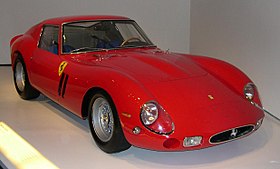
Ferrari 250 GTO
Ferrari 250 GTO

This post will be my 250th. 250 times approximation 1,000 words. A quarter of a million words. Wow. I didn’t think that I could do it. I hit the target. I reached the summit of Everest. I ran a marathon. And other similar metaphors for success.

Of course, I could be posting into a void. I see that I get, usually, a few dozen views for each post and some people are actually “following” me. I even, now and then, get a comment. I’ve done zero in the way of self promotion. I finish each post, figuratively pat it on its back and send it on its way, never to be seen again.

On its way
On its way

This doesn’t concern me. It seems that, for me, writing this blog is a bit like playing a piano in an empty room, or doing a jigsaw on the Internet. The reward is in the doing. I certainly feel a sense of achievement when I hit the “Publish” button, but I don’t often follow up on the post.

What I found amazing is my ability to ramble on for 1,000 words on any subject. I reckon that I could probably stretch any subject out to 1,000 words. In fact, I usually go over. Around the 300 to 400 word mark I’m wondering if I will reach the 1,000, and then suddenly I’m a couple of dozen words past the mark and wondering how to stop. Many times I will just stop so if you think I dropped a subject abruptly, you are probably right.

Analog television ends in Japan

Some subjects have come up more than once. If you have been a regular reader you will have noticed themes running through my posts. There’s science, particularly physics and cosmology, there’s philosophy, there’s maths. I’ve tried to steer away from politics, but Trump has crept in there somewhere.

There’s weather, there’s seasons, there’s discussion on society, as I see it, and occasionally I discuss my posts themselves. These things are, obviously, the things that interest me, the things that I tend to think about.

River Arun
River Arun

Apparently I have 144 followers. That’s 144 more than I expected. I hope that some of them read my posts on a regular basis, but that’s not necessary. I hope that more dip in from time to time and find some interest nugget.

That sound disparaging to my followers, but that’s not my intent. My intent is to reflect on the realities of blogging. I follow other blogs, but I don’t read all the posts on those blogs. Maybe one or two of them I read pretty much every time the blogger posts a new post.

Someone's blog post
Someone’s blog post

That’s the reality of blogging I think. Millions of blog plots are published every day, and I reckon that very few of them are read by more than one or two people at the most. Some blogs strike the jackpot, though, and have millions of followers.

I’d guess that the big blogs are about politics in some shape or form, or fashion and fashion hints and tips. Maybe cooking? I’ve seen a few cooking blogs and they seem to be quite popular. Some big firms have taken to publishing a blog. Some people blog about their illnesses and their battles with it. The best of the latter can be both sad and uplifting.

Protest
Protest

You know the sort I mean? You go to the firm’s website and there’s a button or menu item that proudly proclaims “Blog”. When you look at the blog, it’s simply a list of what the CEO and board have been up to, or releases of new products, or sometimes posts about workers at the firm getting involved with the local community. All good earnest stuff, but scarcely riveting. I wonder how many followers they get? Probably about as many as me! I hope so. At least they are trying.

(Approaching 600 words of waffle. I can do it!)

Since I’m not doing a political blog, I don’t think that anything I post is controversial, which is probably reflected in the number of my followers. I don’t stir up any furores with my words on Plato’s Cave analogy, so far as I know. I get no furious comments about my views on Schrodinger’s Cat. “You should see what he says about Plato’s Cave! You must go on there and refute it!” Nah, doesn’t happen!

Plato's Allegory of the cave, Engraving of Jan...
Plato’s Allegory of the cave, Engraving of Jan Saenredam (1565-1607) after a painting of Cornelis Corneliszoon van Haarlem (1562-1638) (Photo credit: Wikipedia)

As I said, the low number of hits doesn’t worry me. It would be a hassle if suddenly my followers shot up to thousands, and I felt obligated to provide all these people an interesting post on a regular basis. As it is I can ramble on about prime numbers or the relationship between the different number sets and potentially only disappoint a few people. If any.

What have I learnt from all this blogging? That it is hard. It’s not just a matter of sitting down and blasting out a 1,000 words. Well sometimes it is, actually, but most times I grind it out in 100 word or so chunks. I aim to write the blog on Sunday and add pictures and publish on Monday.

Hard work
Hard work

Sometimes I miss the Monday deadline, out of sheer forgetfulness, mostly and pop it out on Tuesday or even later. Sometimes I forget to write my post until late on Sunday, but it is only rarely that I have to write it on Monday or even later. So far as I can tell, I’ve not completely missed a weekly post since the earliest days.

This is not the first blog I’ve tried to write. I had several goes before this one and I think that maybe this attempt “stuck” because I set out my aim to publish weekly early on. Maybe. It may also be the target of 250 posts that I set myself early on. Now I’ve achieved that goal.

Mud
Mud

So what next? I’ve not decided. I might stop now, or I might go on to 500. I may not know right up until the last minute. 500 posts is approaching 10 years of posts which seems a phenomenally long time. But then again, 250 posts is around 5 years of posts and I achieved that. We’ll have to see.

(As I sail past 1,000 words, I reflect that I can extract that many words from practically nothing. It seems to be a knack.)

Fireworks in NZ
Fireworks in NZ

Virtually real

Antonin Artaud
Antonin Artaud

Reputedly the French avant-garde playwright Antonin Artaud took the view that illusion was not distinct from reality, advocating that spectators at a play should suspend disbelief and regard the drama on stage as reality. We do, in fact do this all the time.

From the slightly different perspective as spectators we watch our films and our soaps and our nature programs and we enter the reality shown on the screen while ignoring , to a large extent, what is going on around us. We even turn down the lights so that the brighter reality on the screen dominates. We cry for the characters, we laugh for and at them, we cheer their successes even though, at some level we realise that they are not “real”.

Movie Theatre
Movie Theatre

When we go to the cinema, we get the same thing only stronger, bigger and brighter. The theatre sound system knocks dust from the pelmets and detaches spider from the roof. The screen is so wide and we are so close that we are thrust deep into the action. The 5 metre high image of a face 15 metres away makes the same angle in the eye as a 200mm high face at arms length.

But we don’t need technology to enter a different reality. In a book we read of heroes and heroines, ogres and business men, of warfare and love making, of atoms and galaxies, of amoeba and star clouds. We use our imagination to enter their worlds and we get lost in them. We may beg, buy, borrow or steal a “page turner”, a book that we have to read through to the end, to find out the fate of the characters in it. We may purchase a travel book and visit in the imagination lands that we will never physically visit.

Books
Books

Photographs draw us in, religious books promise us heaven or hell, text books inform us and guide us, map books (or GPS) show us the way from A to B. Our games enter us into a different reality, sometimes one where it is kill or be killed, or where we get lost in a maze, or where we simply have to solve a puzzle. Games introduce us to a multilevel reality – we first enter the reality of the computer or PlayStation or XBox, or Nintendo, then we enter the reality of the game within the device.

Of course we may prefer old style board games like chess. Imagine a world that consists of 32 black and 32 white squares and black and white player pieces, which, quantum like, can only exist in one square at a time and when captured, cease to exist, so far as the reality of the chessboard is concerned. Players enter this reality in their minds and navigate their pieces in a war of black versus white, which starts with a given configuration and ends when the contest is decided, then returns like a cyclic Big Bang to the original configuration.

Big Bang
Big Bang

The fact that we can embed one reality (the fictional) inside another (the real) leads to the idea of an infinite regression of realities. In “The Matrix“, which I have never seen(!), Neo’s supposed reality turns out to be a simulation, and the real world is much more unpleasant than the supposed reality (not that unpleasant things don’t happen to Neo and others in the supposed reality).

The mathematician, the logician, the philosopher says “Only two?” If there are two realities, could it be possible that there are more? Maybe the real world of the Matrix is itself a simulation. Maybe that simulation is a simulation.

Wake up Neo
Wake up Neo

So we end up with the possibility of an infinite series of nested realities. There is one thing about the realities that I’ve been talking about though and that is that they are in our minds. If that pattern were to apply, every one of the nested realities would be in a mind. In the case of the Matrix Neo’s reality was imposed on his mind from outside, as it was for every other human in the Matrix.

The really clever thing about the Matrix was not that it was imposed on every human’s mind, but that it integrated all inputs from all the human minds into a consistent whole. For instance, if Neo sees a door and opens it, this information has to update the Matrix, and get downloaded into the minds of all the others in the Matrix, such as Trinity, who is waiting on the other side of the door.

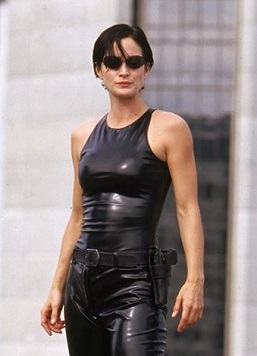
Trinity (Matrix)
Trinity (Matrix)

That’s an impressive feat! The updating of the Matrix by all the human minds and the broadcasting of it back to all human minds is a much more impressive task than creating the Matrix in the first place. It is several orders of magnitude harder.

For instance, consider the immersive and interactive virtual realities which we have built and which generally involve the wearing of special gear such as VR helmets and VR gloves and connection to a fast computer which holds the information about the VR “world”.

VR Helmet
VR Helmet

If there are two individuals using the VR “world” at the same time, when Player One raises his hand, the information is fed to the computer and updates the VR “world”. Player Two’s view of the world has to be updated to show the avatar of Player One with his hand raised. If there are even more players all moving around the problem becomes much worse. Each player’s updates need to be fed to all other players (or all the “close” players to each player). The traffic rises exponentially.

But most of the time we don’t need fully immersive virtual reality to achieve a virtual reality. A simple book can do it. A movie can do it, probably even better. A play will do it too. All it requires is the suspension of disbelief, and the ability of the mind to draw pictures and fill in the gaps. It may be apparent to a person who walks in on the performance that Inspector Goole is only an actor, as are the member of the cast. The set is not really the sitting room of the Birlings, but a roughly painted lath and hardboard approximation.

An Inspector Calls
An Inspector Calls

But in the minds of the audience, for the duration of the play, J. B Priestly gives them a view into a different reality. One that is not fully immersive, but which uses the power of the human mind.

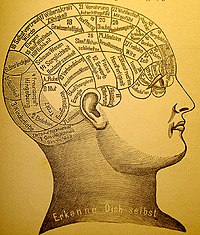
Phrenology
Phrenology


Makeup Your Mind

English: Green Dragon fantasy hair styling com...
English: Green Dragon fantasy hair styling combined with air brush body make-up (Photo credit: Wikipedia)

(I’m close to reaching my goal of 250 posts. What happens then? I don’t know).

I’ve just read a story about someone who went for 30 days without makeup. I’m not sure why I read it as I, like most men, don’t wear makeup. I have a beard so I don’t even shave. The idea of makeup if foreign to me. Even my wife doesn’t bother, except for special occasions.

The interesting thing for me was that the article recounted how her self-esteem plummeted. For the first few days it was “no one has noticed”, but later on it was “they’re all avoiding me”. She retreated from all social contact which interfered both with her work and in her personal life.

Exfoliation (PSF)
Exfoliation (PSF) (Photo credit: Wikipedia)

Even though her husband took two weeks to notice, she couldn’t really believe that it didn’t make any difference to him. She was surprised that he supported her in her goals, and wondered if it would help her marriage for her to go without makeup!

It seems to me that she is guilty of shallow thinking. She’s lived with this man for long enough that they are married, but presumably without children. (More on that later). They must have passed the initial attraction phase, and moved on to a deeper understanding of each other. In other words, they don’t judge the book by its cover any more. She could probably remove the wig and the false leg and it would not faze him. (I’m exaggerating of course – there’s no mention of such in her article).

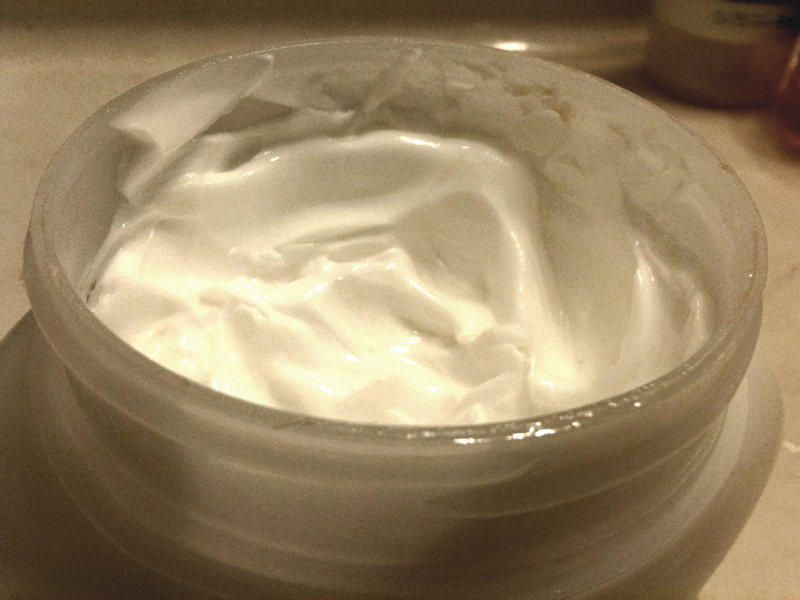
Cold Cream
Cold Cream

Having, as she sees it, dropped her standards a little, she continues to drop them, first letting her hair go, and then letting her wardrobe go. At this stage she’s convinced that she is getting strange looks from the bank teller, who if he was a man probably wouldn’t have noticed anything, and her dry cleaner, who I’d bet was a woman.

She ends up getting called into his office by her boss. My take on the conversation was that it was about her clothes. It seems that she had come to work in clothing that was too informal for the office. The boss didn’t (as reported) mention makeup, just her outfit. It is most likely, in my opinion that he had noticed the changes in her behaviour – coming to work in sloppy clothes, avoid contact with other staff and wanted to know what was going on. A good boss always notices such things as they can sometimes be precursors of trouble.

Clothes Rack
Clothes Rack

Women in general seem not to like doing their makeup in the mornings. A Google search turns up many articles on how to “look good” without makeup. This one starts with a recommendation that the woman starts with “exfoliation”. Exfoliation for you blokes out there is a process that literally scrubs the skin off the face (or where ever. I’ve no idea if it is used elsewhere on the body. I don’t think that I want to know).

Of course young girls and boys see their mothers putting on makeup and they want to do it too. It’s fun painting your face. Boys are often discouraged from doing it, for no really good reason, but girls are often encouraged to make up their faces. Of course if the kids go out in public with makeup on, someone is going to be outraged at the “sexualisation” of young girls, which is a bit silly really. It’s only practise. Now if a young boy were to go out with makeup on, all hell would break loose, the heavens would fall and it would be the end of the world.

English: Face Painting at South Estes Farmers'...
English: Face Painting at South Estes Farmers’ Market in Chapel Hill, NC (Photo credit: Wikipedia)

To get back to exfoliation – it remove everything, including the supposedly “dead skin”. It removes all the natural oils from the skin, so once the outer layers of the skin are removed, “moisturisers” and “serums” and so on have to be rubbed into the skin.

All traces of skin hair apparently have to be removed. There are various methods for this ranging from shaving to waxing, from really painful to the merely expensive. Women have body? Shock, horror! Of course I’m an excessively hairy male with beard and some body hair, so it is no wonder that I don’t understand the obsessions with body hair. The only hair that I remove is the long nose hairs that meet with my moustache – they tickle.

English: Mr Bauer, ca. 1870. Serious portrait ...
English: Mr Bauer, ca. 1870. Serious portrait of Mr Bauer, who has a beard and short hair. He is wearing a high collared jacket. (Photo credit: Wikipedia)

There are 20 tips in that article, all of which sound expensive, the lotions and serums and face masks, and the whatever. I know that a hairdo may cost a woman up to $200. And they all seem so time consuming! A face mask takes time to do, and then the woman has to lock herself away for an hour or so for it to work. The article was on how to “look good” without makeup, but reading through the list, I’d suspect that most women would do at least some of these things, makeup or not.

Kids! I’d suspect that women who do most of the things mentioned above have no children. Of course having children doesn’t stop women doing these things, wearing make up and the rest, but time is precious when you are a mother, assuming that the responsibility for their day to day care devolves on the mother. Some of the things I mention above naturally fall by the wayside.

Mum's Lipstick
Mum’s Lipstick

That’s why articles like this probably reflect more closely how women with children feel. Dropping kids off at school and at kindergarten, doesn’t leave a woman much time for makeup. Morning is all about wrangling kids out of bed, into clothes and into the car (back out of the car to pick up the packed meals that are sitting on the bench, also a coat for one child who seems oblivious to the temperature) leaving no slot for makeup, let alone exfoliation.

The rest of the day is washing and cleaning and removing the toy cowboy stuck in the vacuum cleaner. Of course she could wear a face mask while hoovering, but then she’d sweat under it with dire consequences. Then it’s time to pick up the kids again, and start preparing a meal.

Face Mask
Face Mask

So, makeup. The spouse probably doesn’t care. The spouse sees the woman, not the makeup, believe me. It’s absurd, really, that going without makeup could damage a woman’s self esteem. It’s just not that big a deal.

Makeup
Makeup

Fake News

News
News

All news is fake to some extent. When a reporter watches some event unfold he or she will have their own in-built and acquired biases, no matter how hard they try to keep them under control. Those who watch or read the news report will also have their own leanings and belief systems. In addition they will tend to view only those sources which fit with their world view.

Although I attempt to show that “news” as such is a severely distorted view of events, and that everyone has their own viewpoint on news events depending on their innate beliefs and acquired biases, this phenomenon is not restricted to news and the events that get reported by the news media. We filter all that we see through the sieve of these beliefs and therefore what we see conforms to our world view and naturally this acts to confirm these beliefs in our minds.

Beliefs Knowledge and Truth

Back in 1991 Jean Baudrillard said that “The Gulf War did not happen“. Of course, he did not mean that the events referred to as “The Gulf War” or “The Liberation of Kuwait” did not happen, but that the events as reported by the US authorities and others were highly edited and presented in a way that but the US and its allies in the best possible light. Baudrillard also contended that the so-called war was not a war in the usual sense as the American troops did not directly engage in conflict with the opposing forces.

I am not arguing on the rights or wrongs of the Gulf War, as that is not the main purpose of my posting here, but that what was reported by the Western media was a distorted view of the events that happened during that war. As I live in a “Western” nation, the view that I and billions of others had was highly tilted in the direction of the United States. If I had been able to see the reporting of the Iraqi media, I am sure that I would have a very different view of the events. Similarly it too would also be highly distorted.

Destroyed tank
Destroyed tank in Gulf War

Neither viewpoint could be considered “right” or “wrong”, as such. Neither is intended to be an accurate record of what actually happened, while the events as reported happened, the interpretation of the events may omit or emphasise some aspect over others. One report may record that several “insurgents” or “terrorists” were killed, while another report of the same event will record that some “freedom fighters” were killed. One report may leave out the fact that “non-combatants” were killed while the other may call them civilians and children.

In recent times though, so-called “fake news” has had some attention in the media itself. Kellyanne Conway used the phrase “alternative facts” to explain the claim that President Trump’s inauguration had the “largest audience to ever witness an inauguration – period – both in person and around the globe”, when less partial estimates put the crowd at a much lower level than it was at the previous three inaugurations. She was widely ridiculed for this, though, to be fair, she maybe meant to say “alternative information” or “incomplete information”, as she has claimed.

Presidential inauguration

Unfortunately for that interpretation, she later referred to something that did not happen. This may again have been a slip of the tongue or incorrect remembrance of the event referred to, but two such slips probably indicates that she should not be doing the job and should let other handle the interaction between the White House and the media. However while the media is focusing on her missteps they are not focusing on the President, and that may be the whole point.

Of course, “alternative facts” or alternative interpretations are not found just in politics, but in many walks of life. How many people have watched a sports match and have been surprised by the interpretation of the way that the match went that appears in the media. One group of supporters may think that the referee was biased in favour of the other team, while the opposition’s supporter might believe that the referee made the right calls. Of course it may depend a great deal on whether or not your team won!

Referee (Massimo Busacca)

However, in spite of all that I have said above, there has been a rise in recent time of true “Fake News” sites. These sites publish news items which are simply not true and the intent of these sites is to deliberately confuse and deceive those who read it. One interesting consequence is that China supported Americans who accused Facebook of spreading false news.

The most controlled regime outside of North Korea pointed out that in the free for all of democratic and liberal societies anyone could set up a web site and promulgate false news and views. In China however any site which published fake news would be hit by the full weight of the state. Of course the issue with this is that any site publishing views opposed by the state would be shut down immediately whether or not the news was actually fake.

The article on Chinese support for the opponents of fake news on Facebook come from the Huffington Post, and as such contains its own biases of course. Therefore the amount of credence that you put on the above article will depend on your political stance. However, it is likely that while the Huff may post satirical articles, it is unlikely, in my opinion, to post out and out fake news. Just use your brains when you read it, and be aware of your own and the site’s political biases.

The same goes for sites which promote miracle cures, or medicines which are outside of the mainstream medical province. Sites which promote anti-abortion, anti-vaccination, anti-fluoride, anti-folic acid, and other fringe beliefs really annoy me because they either ignore medical evidence or call into question by invoking conspiracy theories (“Big Pharma” anyone?) Beliefs like homeopathy and many other alternative medical beliefs belong with beliefs in psychic powers – in the rubbish bin of history.

Rubbish bin
Rubbish bin

The Search for the Fundamental

Motion of gas molecules Español: Animación mos...
Motion of gas molecules Español: Animación mostrando la agitación térmica de un gas. Cinco partículas han sido coloreadas de rojo para facilitar el seguimiento de sus movimientos. Русский: Хаотическое тепловое движение на плоскости частиц газа таких как атомы и молекулы (Photo credit: Wikipedia)

When does it stop? This screen that I am looking at, the keyboard that I am typing on, the invisible air between my eyes and the screen, even my body, all are composed of atoms, I told and believe. Apart from atoms, all there is is radiation, of various sorts.

The ancient Greek philosophers didn’t know about atoms so proposed various theories, which today seem quaint, but eventually they came around to atomism, and abandoned the other theories. In particular the theory of the four classical elements, earth, fire, water and air was dropped.

The four classical elements, after Aristotle. ...
The four classical elements, after Aristotle. Чотири стихії (за Арістотелем) (Photo credit: Wikipedia)

As I said, the theory now sounds quaint, but, given that the ancient Greek philosophers were not of an experimental frame of mind, the four classical elements could explain much of what could be observed. Everything could have been a mixture of these elements in various proportions.

After all, it appeared to work for colours – all colours that can be displayed on a computer screen can be specified in terms of the amount of the three primary colours of red, green and blue that a single pixel or dot on the screen emits. Why shouldn’t this scheme work for other things than light?

Barycentric RGB
Barycentric RGB (Photo credit: Wikipedia)

However Greek philosophers (and of course, philosophers in other cultures) noticed that, while some things could be broken down into component parts – sugar could be melted and burned, water could be driven off to leave the salts behind, and more importantly alcohol could be evaporated off and collected to make spirits, some things could not be broken down.

Gold, sulphur and phosphorus stubbornly refused to separate into earth, air, water or fire. Of course such stubbornness could be explained by the classical element theory – after all some things are easier to break down than others, but the Greeks eventually dropped the theory in favour of atomism. (This and what follows is highly simplified and condensed).

(Click here for rotating model)
(Click here for rotating model) (Photo credit: Wikipedia)

This is the belief that everything is made up of small indivisible particles which differ from element to element. The lump of gold contains billions of gold atoms, while the sulphur block contains sulphur atoms.

From about the start of the scientific revolution, people started to work out the rules of chemistry, and the ‘why’ of chemical reactions. Why did carbon in coal burn away and leave an ash? We know that the carbon in the coal burns using the oxygen in the air and creates oxides of carbon which are gasses and not easily detectable, but the experiments which led to this knowledge were preformed in the era of the scientific revolution.

So, matter is composed of atoms. That seemed to be the end of the story, as the vast majority of chemical experiments could be explained in terms of atoms, but exactly why atom A reacts in fixed proportions with atom B, but won’t have a bar of atom C. These relationships were noted but not really explained.

By the middle of the 19th century scientists began to detect problems with the “atoms as billiard balls” model. Electrons were discovered and soon related to chemistry, answering the above question. The new model, “atoms as small planetary-like systems”, had a small positively charged, and solid nucleus surrounded by a swarm of negatively charged electrons, with the electrons taking a major role in determining the chemistry of the atom.

It was discovered that many elements behaved as if each atoms of the element weighed the same, but some elements broke this rule. The gas Chlorine for example has an atomic weight of 35.45. In other words each atom weighed about 35 and half times as much as a Hydrogen atom.

It was eventually discovered that not all Chlorine atoms weighed the same. Most had an atomic weight of 35 but some (about half) had a weight of 36. To cut a long story short it was discovered that the supposedly solid nucleus was composed of a collection of other particles called protons and neutrons.

English: Liquid Chlorine in flask for analysis.
English: Liquid Chlorine in flask for analysis. (Photo credit: Wikipedia)

While the number of protons and electrons determine the chemistry of an atom almost completely, the number of neutrons contribute mass to the atom and barely affect the chemistry.

While electrons appear to be truly fundamental particles and cannot be broken down further, the protons and neutrons are composed of particles called quarks. For reasons mentioned in the Wikipedia article quarks cannot be found in isolation, but are only found in other particles.

English: The quark structure of the proton. Th...
English: The quark structure of the proton. There are two up quarks in it and one down quark. The strong force is mediated by gluons (wavey). The strong force has three types of charges, the so-called red, green and the blue. Note that the choice of green for the down quark is arbitrary; the “color charge” is thought of as circulating among the three quarks. (Photo credit: Wikipedia)

In addition to protons and neutrons, quarks make up other sub-atomic particles such as mesons. Scientists have discovered or postulated bosons which are particles that bind quarks and other fundamental particles together. From then on, things get complicated!

I haven’t mentioned the photon, which is bosonic, or the neutrino which is a fermion. All fundamental particles fit into one of these two families, and all sub-atomic interactions are the result of the rather incestuous exchange of these particles in their various groups and a strict set of rules. So far so good.

English: Enrico Fermi
English: Enrico Fermi (Photo credit: Wikipedia)

However, there are still questions to be answered. Are these particles truly fundamental or do they have components, which may or may not be particles in the classical sense? What are the sizes of these particles, if such a concept is appropriate at this level? Have we found them all? What about dark matter?

Scientists have abandoned the first question. They don’t generally refer to particles as fundamental. They have seen a long list of fundamental particles turn out to be not so fundamental after all.

Sizes of the particles may not make sense at the particle level, but the various theories may indicate sizes for some of them. There are difficulties over the size of the electron for instance. If it were a point object rather than having something that equates to size, then that causes difficulties with some theories.

As for the third and fourth questions, it appears that scientists may have found all the particles that explain ordinary matter, but naturally cautious, they don’t rule out other forms of matter such as the so called “dark matter” and “dark energy“. Dark matter and dark energy apparently interact with gravity and (from the Wikipedia article) and the Weak Nuclear Interaction.

pie chart of dark matter and normal energy rat...
pie chart of dark matter and normal energy ratio taken from en.wikipedia (Photo credit: Wikipedia)

My original question was “When does it stop?” By this I meant, which particles are truly fundamental and which have components that determine their properties? This question remains open, but if you have followed through my exposition, you will probably see that this is a question without an easy answer.


Mainframes were different

IBM System 360/65 Operator's Panel The IBM Sys...
IBM System 360/65 Operator’s Panel The IBM System/360 Model 65 first shipped in 1966 This photo was taken by Mike Ross of corestore.org . He has given permission via email “Feel free to make use of … my pictures under the GNU license. All I ask is that they are credited & linked…”. –agr 19:07, 17 Aug 2004 (UTC) (Photo credit: Wikipedia)

Mainframes were … different. Today we have devices that have orders of magnitude more processing power than the old mainframes. The old mainframes were big machines that performed business tasks for large organisations and that cost millions of dollars. The phone in your pocket shows you your email, let’s you Facebook or tweet your friends where ever you might be and what ever you might be doing. You can even use it to phone people!

Arguably we fritter away most of the enormous amount of processing power and storage that our hand held devices provide. We watch videos on them, yes, even porn, and play endless silly games on them. And cats. Cats have taken over the Internet and thereby our connected devices.

A six-week old kitten.
A six-week old kitten. (Photo credit: Wikipedia)

The fundamental concept of the mainframe is one single powerful(!) computer with all devices, such as card readers, terminals (screen and keyboard, no mouse), printers, tape units and other devices, more or less directly and permanently connected to the computer.

Interestingly, when you typed something into a terminal using the keyboard, it wasn’t sent immediately to the mainframe but was recorded in a buffer in the terminal. When one of a number of keys was hit the whole buffer was sent to the mainframe. These special keys were “Return”, which is similar to the “Enter” key, a “PF Key”, which is similar to a function key, and a few others.

Return
Return (Photo credit: Wikipedia)

This meant that you could type and edit stuff at your terminal and it would only be sent when you were finished. That is different from the model used by PCs and other modern devices, where every single key press that occurs is sent to the target computer, including typos and correction to typos.

Of course, when you press a key on your PC keyboard, the computer that is the target is the one that the keyboard is connected to, and what you type in goes into a buffer, but the principle still applies. The effect is more obvious if a lot of people are connected to a multi-user computer and are using it heavily, when the response to hitting a key takes a second or so to echo back to the screen.

Multi-user computers are not common these days as they are not trivial to set up, and computers and networks have become so fast that it is generally easier to change the model and access applications over the network rather than use the direct connect model that was used in the early days.

A lot of the features of modern computing devices originated in mainframes. Mainframes originally ran one job or task at a time, but soon they became powerful enough to run many jobs at the same time. Mainframe operating systems were soon written to take advantage of this ability, but to achieve the ability to run multiple jobs, the operating systems had to be able to “park” a running job while another job got a slice of the processor.

Punched card in the 80-column-format according...
Punched card in the 80-column-format according to the IBM standard. The card was used at the beginning of the 1970s at the University of Stuttgart (Germany) for the input of Fortran programms in the IBM mainframe. The plain text of the coded line is on the top left. (Photo credit: Wikipedia)

To do that the operating system had to save the state of the process, especially the memory usage. This was cleverly achieved by virtualising memory usage – the job or task would think that it was accessing this bit of memory but the memory manager would make it use that bit of memory instead. The job or task didn’t know.

For instance the job or task might try to read memory location #ff00b0d0 (don’t worry about what this means) and the memory manager would serve up #ffccbod0 instead. Then a moment of so later another job or task might try to read that memory location. It would expect to find its own data there not the first task’s data, and the memory manager would this time serve up, say, #ffbbb0d0.

SVG Graph Illustrating Amdahl's Law
SVG Graph Illustrating Amdahl’s Law (Photo credit: Wikipedia)

The key point is that the two tasks or jobs access the same address, but the address is not real, it is what is known as a virtual address, and the memory manager directs the request to different real addresses. This allows all sorts of cunning wheezes – a job or task can address more memory than the machine has installed and memory locations that have not been used in a while can be copied out to disk storage allowing the tasks in the machine to collectively use more memory than physically exists!

Exactly the same thing happens in your phone, your tablet, or your PC. Many tasks are running at the same time, using memory and processors as if these resources were dedicated to all the tasks. (Actually not all tasks are running at the same time – only as many tasks as there are processors in the processor chip can be running at the same time, but the processors are switched between task so fast it appears as if they are. The same is also true of mainframes).

Diagram showing the memory hierarchy of a mode...
Diagram showing the memory hierarchy of a modern computer architecture (Photo credit: Wikipedia)

Of course, there’s a downside to the mainframe model and that is that if the mainframe goes down, everyone is affected. In the early days of the PC era, every PC was independent and if it went down (which they often did) only one or two people, those who actually used the computer were directly affected. So if the Payroll computer crashed it didn’t affect Human Resources.

Soon though the ability to connect all the computers over a network became possible and computing once again became centralised. Things have changed, but the corporate server or servers now fulfil the role that once belonged to the mainframe.

All the advantages of centralisation have been realised again. Technical facets of the operation of computers have been removed from those whose job was not primarily computing, much to the relief of most them I’d suspect. Backups and technical updates are performed by those whose expertise is in those fields, rather than by reluctant amateurs in the field.

However, the downside is that a centralised computing facility is never as flexible as the end users would like it to be and, somewhat ironically, that as an outage of the old mainframe used to affect many people, so will an outage of a server or servers in the current milieu.

Ganglia report showing editing outage, when Wi...
Ganglia report showing editing outage, when Wikipedia server srv156 stopped responding (Photo credit: Wikipedia)