Too Much Sweetness

English: Macro photograph of a pile of sugar (...
English: Macro photograph of a pile of sugar (saccharose) (Photo credit: Wikipedia)

Sugar is a the name given by chemists to a family of compounds comprised of Carbon, Hydrogen and Oxygen in various configurations. Generally there are the same number of Carbon and Oxygen atoms and twice as many Hydrogen atoms, but this is not always true.

So far as I know all living things contain sugars, which supply the body with energy through a complex series of chemical reactions which function to slow down the release of energy from the sugar, which would otherwise be released in an unusable burst of energy.

English: Basic overview of energy and human li...
English: Basic overview of energy and human life (See also Wikipedia:Energy#Energy_and_life). (Photo credit: Wikipedia)

The end result of these reactions is the release of water and carbon dioxide. The cycle of reactions needs as many Oxygen molecules as there are sugar molecules, more or less, assuming the the sugar is fully broken down, and that is why all living things need to take in Oxygen and why we breath out carbon dioxide.

We don’t normally notice the sugar that we take into our bodies as it is largely contained in the foods that we eat. With the exception of the sugar in our tea and that we may scatter on our cereals, it is invisible to us. We actually take in a lot of sugar when we eat things.

WLA vanda English Tea Set 18th century
WLA vanda English Tea Set 18th century (Photo credit: Wikipedia)

In fact we are told that we take in far too much sugar in a modern diet. People drink tea and coffee with sugar, or drink copious amounts of sugar filled soft drinks and we know that this is bad for us. It rots our teeth and makes us fat. It predisposes us to diabetes and other metabolic problems.

The reason that it makes us fat is because early humans (and other animals) had a life which saw feasts and famines as the food supply fluctuated. The body evolved to take advantage of the feast phases by storing energy for the famine times by converting the excess sugars that were ingested to fat. Fat is harder to break down to release its stored energy, and the body preferentially uses any sugars circulating in the body (in the form of glucose).

The aldehyde form of glucose
The aldehyde form of glucose (Photo credit: Wikipedia)

As a species we have a taste for sugar. The body wants to take in as much as it can, in order to keep itself running, and to store up energy as fat for the lean times. However, these days, there are rarely any truly lean times for most people, so they take in more sugars than they need and store it as fat.

There is debate sometimes as to whether or not our desire for sugar amounts to an addition. Personally I don’t feel that it is truly an addiction, just a very strong desire to eat as much sugar containing food as possible. People don’t suffer intense reaction to the withdrawal of sugar from their diet as they would if it were an addition.

Chocolate cake with white chocolate squiggles.
Chocolate cake with white chocolate squiggles. (Photo credit: Wikipedia)

Generally they don’t suffer hallucinations, pains, or other mental or physical symptoms. Quite often they even feel better. Quite often they lose weight. Diabetes symptoms may abate, they may sleep better, and other physical problems may disappear.

It seems a no brainer that we should reduce the amount of sugar that we consume in our food and drink, yet we continue to consume it to excess. In my opinion there are at least three reasons for this.

Soft drinks 800x600
Soft drinks 800×600 (Photo credit: Wikipedia)

Firstly, the body itself makes us crave sugary foods, as it has evolved to make us feel pleasure when eating something that it can use for fuel and additionally store up for the leaner times that never come. We are predisposed to like sweet things, and our experience tells us that a chocolate bar is sweet.

Secondly, we have been given sweet things as a treat from the time that we are small, and we expect our treats to be sweet. In a restaurant the main course is about protein, usually with some meat or other as the star, but desserts are treats and therefore must be loaded with sugar.

Portuguese cuisine - Azorean sweet desserts
Portuguese cuisine – Azorean sweet desserts (Photo credit: Wikipedia)

Thirdly, it is absurdly easy to obtain sugar these days. The confectionery aisle of the supermarket has the most shelf space. Cakes and desserts take up shelves of their own, as do soft drinks which are laced with sugar.

That’s a big issue. Everything has sugar in it these days. In the past there was sugar in many things, but I believe that the quantity of sugar was lower. These days there is a large slug of sugar in almost everything.

It’s even crept into the main course. Glazes and marinades have always had sugar in them as the sugar caramelises on the meat as it cooks, and gives it a nice colour, but many pouring sauces and dressings also contain copious amounts of sugar. Even the humble meat pie contains sugar or so I heard. Something to do with giving the right consistency to the gravy, I believe. So what was wrong with the original ways of thickening it?

This has all led to an issue, so far as I am concerned. I can see all the health benefits of reducing one’s intake of sugar, but so far as others are concerned their bodies are their own responsibility. If they wish to make themselves fat and ill, that is up to them.

English: This is a graph showing the rate of o...
English: This is a graph showing the rate of obesity in adults and the rate of being overweight in both children and adults in the United States from 1960 – 2004. (Photo credit: Wikipedia)

What really annoys me about the sugar in everything trend is that almost everything tastes of sugar! I gave up sugar in tea many decades ago, and I didn’t miss it, but now I hate the taste of tea with sugar in it. I can’t drink it. I also gave up sugar on my morning cereal, which was harder, but I now don’t miss it. There’s already some sugar in it of course so why add more?

But everything else? Everything that you touch at the supermarket is laced with sugar, from the white stuff they call bread to the pickles and sauces you put in your sandwich. As a result, you can’t taste much of anything under the overpowering sweet taste.

A plate of fairy bread, cut into triangles.
A plate of fairy bread, cut into triangles. (Photo credit: Wikipedia)

Someone once commented when I complained about the overbearing sweet taste of everything, that I could just make my own. That’s fine, and I do do it as much as I can, but it’s not always possible, as the ingredients may already contain sugar, and sometimes i just wants the convenience of picking something off the shelf.

English: Organically produced blackstrap molas...
English: Organically produced blackstrap molasses produced in Paraguay. (Photo credit: Wikipedia)

Water, the cause of surfing.

English: Environmental Science student samplin...
English: Environmental Science student sampling water from a stream. Picture courtesy of Environmental Science program at Iowa State University. (www.ensci.iastate.edu) (Photo credit: Wikipedia)

I came across one of those pages on the Internet which state something like “At least a few molecules of the water in your body probably passed through the kidneys of Julius Caesar“. They generally use statistics to show that what they are saying is true.

Only those who believe in homeopathy should be disturbed by this. To anyone else, a molecule of water is a molecule of water, and the fact that it had once been contained in a stream of urine is irrelevant. In any case it is too late. 60% of our body is made up of water, so water from Caesar’s urine is already in us.

Julius Caesar, Summer garden, Saint-Petersburg
Julius Caesar, Summer garden, Saint-Petersburg (Photo credit: Wikipedia)

Water is a fascinating chemical. It carries stuff around as it is the basis for blood and lymph and all the other fluids of our bodies. It carries nutrients up the stems of plants. It wears away mountains and builds rocks, it cools lava to form other rocks. It brings nutrients to our crops and washes them away. It even sinks ships.

“You are water
I’m water
we’re all water in different containers
that’s why it’s so easy to meet
someday we’ll evaporate together.”
― Yoko Ono

It’s difficult to think of any occurrence in our familiar world which is not mediated or affected by water in some way. Shortage of water to a society is a disaster, as food cannot be produced, leading to famine and deaths.

Much of the western U.S. is in "extreme d...
Much of the western U.S. is in “extreme drought” (Photo credit: Wikipedia)

Water is thought by most people to be liquid at usual temperatures, though there are some places where it is to be found in solid form. Actually there is a great deal of it around in the gaseous phase, or vapour. We measure this airborne water in terms of the humidity or wetness of the air.

Water is extraordinarily pervasive and can be found in all the nooks and crannies in the materials that we have around us. It acts as a lubricate, and if the water is driven off, by heating or chemical means things become stiff and fragile. Even so, water cannot be completely removed from things – even a diamond probably has a few entrapped water molecules.

Water molecules attaching to each other by hyd...
Water molecules attaching to each other by hydrogen bonds (Photo credit: Wikipedia)

Water plays a role in rotting things down. A corpse kept in a very dry environment desiccates and turns leathery and fragile. I guess that this is because the organisms that rot a body away cannot function in a water free environment.

A body of liquid water fills things from the bottom up. Gravity pulls the water down to the lowest parts of a container and water continues to layer the container. The surface appears to be flat, but that is an illusion. At a small scale, if a tiny bit of the water happens to be higher than the rest of the water, gravity will pull it down, while the other water molecules resist by being in the way.

English: Dilmah - photo by me on today.
English: Dilmah – photo by me on today. (Photo credit: Wikipedia)

Eventually as the water stills, the differences in level even out, and the water surface becomes as level as it can. However, at the molecular level, molecules of water, which are moving relatively fast on these scales, can pop out of the liquid and float away. Other molecules can also pop in to the liquid, so that on average the water is level.

Why doesn’t the surface appear blurry and ill defined then? Well we can’t see at the molecular scale, and also the water molecules form weak electrical bonds with each other. A water droplet is like a large crowd of people all milling about, holding hands much of the time. Those on the outside are not as tightly bound as those further in.


Embed from Getty Images

Imagine now that the crowd is surrounded by a storm of people who are moving faster, and are more spread out so they rarely join hands. One of these gaseous people will now and then bump into the crowd. They may knock loose one of the crowd who will shoot off and become one of the gaseous people, while gaseous person who hit him may now be travelling more slowly and link up with the crowd.

Even in the macro world a water surface is rarely really flat. The dynamic nature of the flatness is apparent when a container is jolted slightly and tiny waves form on the surface as compression waves disturb it. Wind and rain also cause visible disturbances in a lake or pond.

Surface waves
Surface waves (Photo credit: Wikipedia)

Flowing water often forms a smooth, if not level surface. A submerged rock in a river or a weir or fall in a river can form persistent ripples of flumes as the water flows over them. Kayakers know to aim their craft at a flume to safely descend a rapid or waterfall, although downstream of flumes the river often forms “haystacks” where turbulent water is forced into humps which can prove difficult to navigate.

A little stream may be described as turbulent as it makes its way over and around boulders and small drops, but interestingly it is not random. It is not chaotic. A close look will reveal that the bow waves of stones in the flow may flutter and throw off little whirling vortexes, but the bow wave and the pattern of vortexes persists. The little waterfall over a small stone ledge persists, even though the shape of the waterfall may ripple a little.

Ripple effect on water.
Ripple effect on water. (Photo credit: Wikipedia)

In large bodies of water, such as lakes and seas, winds form waves which can travel many thousands of kilometres across oceans and seas. Water waves don’t represent the movement of water over those distances – the only thing that moves is the energy in the wave. Water molecules in a wave move mainly up and down and only a little forwards and backwards.

Circular water current in a wave
Circular water current in a wave (Photo credit: Wikipedia)

However when a wave travels over a beach or shoal, the movement in the vertical direction is curtailed, and the energy is transformed into a forward motion – the wave breaks. Water is transported forward, with the water higher up moving faster than the water at the sea bed which may be water draining off the beach from the previous wave and the wave steepens until it collapses. Hence surfing!


Embed from Getty Images


Time and time again

English: Albert Einstein Français : Portrait d...
English: Albert Einstein Français : Portrait d’Albert Einstein (Photo credit: Wikipedia)

It is often said that Einstein considered time to be an illusion, and web sites which collect notable quotes often just claim that Einstein said “Time is an illusion“. This a classic case of taking a quote and posting it out of context. What Einstein actually said was more complex and more subtle.

He actually said:

The distinction between the past, present and future is only a stubbornly persistent illusion.

He did not claim that time is an illusion, but that the moment of “now” is an illusion. In fact his equations give time the same status as space. For instance, the square of the space time interval between two events is defined by combining the square of the space interval minus the square of the time interval interval. (Provided all values are expressed in the same units.)

Time dilation spacetime diagram06
Time dilation spacetime diagram06 (Photo credit: Wikipedia)

The details don’t matter too much here. The point is that time is treated equally with the space dimensions, and no one is claiming that Einstein was arguing that space does not exist. There are many references to be found on the Internet which explain Einstein’s ideas with variable clarity and accuracy.

I said above that Einstein argued that the instance of “now” is an illusion, but I was over simplifying. What I believe that he was saying was that while we experience a “now” now, we also experienced a “now” ten seconds ago, and one second ago, and one instant ago. There is nothing special about the “now” moment and all instants of time are “now” moments.


Embed from Getty Images

This isn’t that surprising really. If you consider where you are at a particular place and at a particular time, not only is there a “now” moment, there is also a “here” place. When you move to another place, you have another “now” moment, and another “here” place. To experience an event you have to have both.

If we are taking a road trip we have no difficulty with the concept that the “here” place changes continually and that a place we have passed through was a “here” place when we passed through it, and that a place further on will later be a “here” place. Where ever we are we are “here”.


http://www.gettyimages.com/detail/500202414

You might argue that time is fundamentally different from space, in that we can see what is in front of us in space but we can’t see what is in front of us in time. This is true, but maybe we just don’t have the physical equipment to do so. We can use sight to look around as see what is not “here”, to some extent, but we don’t have complete visibility to things around us.

If we did we would not bump into things and fall off of things as much as we do. We use sight to build a picture of things around us, but we don’t have physical access to those things until we move up to them.

Human hand icon
Human hand icon (Photo credit: Wikipedia)

Since we don’t have “time vision” we have use whatever abilities we can to work out what is in the future, such as reason and intuition, both of which have limited success. We do have some ability to fairly accurately guess the future, as evidenced by our abilities to catch a ball thrown to us. If you have ever watched a top table-tennis match, you will no doubt be amazed at how accurately we can so this, as the ball whizzes from end to end of the table.

Time is measured in seconds and space is measured in metres (or hours and yards or other equivalent units). This seems to be a difference between the space dimensions and the time dimension.

Time dilation spacetime diagram05
Time dilation spacetime diagram05 (Photo credit: Wikipedia)

However it is easy to show that there is little fundamental difference. Distances are often measured in terms of time – astronomers refer to a light year, which is the distance that light travels in one year. It is not often, however, that the opposite is true. Times could be measured in terms of light metres, or the time it takes light to move a given number of metres, but this is not usual, possibly because a light metre is such a very short period of time.

Interestingly some people claim to be able to “see” the future. They are claiming that they have a sense similar to vision which they use to determine what is going to happen in the future. While it is possibly conceivable to have such a sense, there appear to be no organs in the body which could be used to “view” the future.

Panoramic view of the future Phoenix-Lake from...
Panoramic view of the future Phoenix-Lake from the observation deck of the Phoenix-Lake Infopoint (Photo credit: Wikipedia)

Such organs would have to have receptors which would have to receive information about the future just as the eyes receive information about things that are relatively distant, and that information would have to travel in time from the future to reach the receptors in the present. This appears to be counter to all known physics. Possibly “unknown physics” would allow this, but I suspect not.

In any case the human body doesn’t appear to have any receptors which could possibly serve this purpose, and although not everything is known about the human body, such organs, if such existed and could be used by some people, would be probably be apparent.

English: "Sight" - First of a series...
English: “Sight” – First of a series of 5 engravings illustrating the five senses (Photo credit: Wikipedia)

What about the brain? Could the brain perhaps receive information about future events in some way? Well, the brain is an organ for processing information, not for receiving information from the future.  There is nothing like a receptor in the brain, though it is connected via nerves to receptors which terminate those nerves and when stimulated excite the nerves which then pass the stimulation to the brain.

In my opinion, which of course could be wrong, there is no way that information from the future could be detected by the human body, and in particular by the brain acting as a receptor. That does not mean that time is in any way different from space as a dimension. What it does mean is that we are able to perceive the dimensions of space differently from the dimension of time.

Diagram of human brain
Diagram of human brain (Photo credit: Wikipedia)

That doesn’t address the question as to why the space dimensions are accessible to vision and time is not. It only addresses the question of why we can “see” the space dimension, but cannot “see” the time dimension. Something links the space dimensions into one seeming whole, while the time dimension seem singularly different.


Embed from Getty Images


Post-rational


Embed from Getty Images

Science has achieved marvellous things. It’s sent people to the moon, It’s reduced disease and the impact that disease has on people. It’s given us transistors, computers, the Internet and cell phones. It’s given us non-stick frying pans.


Embed from Getty Images

Science and its descendants, like biology, physics, and chemistry, and their descendants, like engineering, agriculture and medicine, have been an immense boon to the human race, to the extent that the human race would not have achieved the majority of things that we see around us. Railways, planes, roads and cars have all been achieved by the applied use of science.

Why then are people beginning to reject science and all that it has done for us? Why is there this anti-science, anti-rational groundswell, and does it really matter?

English: Anti-Science (including math, physics...
English: Anti-Science (including math, physics, chemistry, biology, computer science, etc.) (Photo credit: Wikipedia)

There have always been flat-earth proponents – people who disbelieve science, and bend the predictions of science almost to breaking point to favour their point of view. While they in general accept the facts, they do not like the conclusions drawn from the facts and build their own convoluted theories and explanations instead.

Then there are those who attack the theories of relativity. Here at least there is some justification as relativity is not easy to get your head around. It is not intuitive, and that is a weak way to some extent excuses the attacks on it. However the relativity opponents are generally unwilling to throw some maths at the problem – and without the maths, their objection do not stand up to scrutiny. In fact if they were to apply the maths, and were able to understand the maths, then probably the only conclusion they could come to is that the theories of relativity apply.

Banesh Hoffmann, in the 1979 film Continuum, s...
Banesh Hoffmann, in the 1979 film Continuum, speaking about the theory of relativity (Photo credit: Wikipedia)

Many of those who oppose scientific theories do not understand what a theory is. A typical case is where someone declares that “evolution is only a theory“! What they don’t understand is that everything is a theory.

It is a theory that the sun “rises” because the Earth spins in its orbit, causing the Sun appear to rise in the East. (I’ve lost the Flat Earthers by this point of course). It’s a very good theory and one that is incredibly unlikely to be disproved, but it is still a theory.

Only A Theory
Only A Theory (Photo credit: Wikipedia)

A theory is something that explains the known facts, and trying to dismiss something as “only a theory” pretty much amounts to dismissing all of science, as science is a network of interconnected theories.

This ignorance of what science is and theories are goes hand in hand with the simplified and cartoonish way that science is taught in schools. Here is an atom is behaves in so and so way, it reacts with these other atoms, and so on. Very little of the history of the development of the concepts is done, and unless someone gets interested and studies the roots of science, much of science becomes merely didactic and not fundamentally informative in any way.


Embed from Getty Images

Students do get told a little about how one theory may supplant another theory, but very often the concept doesn’t really sink in. A scientific theory is taught authoritatively – students are told that the ancient Greeks had some weak ideas which could barely be called theories, but Newton tossed that junk aside and used Reason to develop his theories. Then Einstein came along and “disproved” Newton’s theories.

There is an idea that theories can be discarded, but the next part, where another theory takes its place is skipped over or ignored. Inconvenient facts are ignored, or “explained” as errors or bias. It may often be implicitly or explicitly asserted that scientists have a vested interest or that there is a conspiracy to suppress the true theories.

Three models of change in scientific theories,...
Three models of change in scientific theories, depicted graphically to reflect roughly the different views associated with Karl Popper, Thomas Kuhn, and Paul Feyerabend. (Photo credit: Wikipedia)

There is one huge example, the tobacco industry, where bias and vested interests have had a negative influence on the science, and this, one can see, seems to validate the point of view that scientists are regularly distorting the results of science for their own ends.

So, it is not uncommon to have a case where people refuse to accept the science and go with their own views. One case that I saw recently was in a discussion of the so-called Supermoon on November 14th 2016 and the earthquake in North Canterbury, New Zealand early that same morning.

A SuperMoon is a perigee-syzygy, a new or full...
A SuperMoon is a perigee-syzygy, a new or full moon (syzygy) which occurs when the Moon is at 90% or greater of its mean closest approach to Earth (perigee). The March 19, 2011 supermoon is just 221,566 miles (356,577 kilometers) away from Earth. The last time the full moon approached so close to Earth was in 1993, according to NASA. it is about 20 percent brighter and 15 percent bigger than a regular full moon. (Photo credit: Wikipedia)

In the discussion several people were looking at the coincidence of the two events and linking them in their minds. After several people had pointed out that the science shows that there is no noticeable correlation between “supermoons” and big earthquakes, people were still saying that there must be something in it.

They had replaced the current scientific theory with their own thinking, without really explaining the facts away – there is no known or even noticeable link, and that lack of any apparent evidence should be explained by any replacement “theory” before any new theory can be put in place.

1755 copper engraving showing Lisbon in flames...
1755 copper engraving showing Lisbon in flames and a tsunami overwhelming the ships in the harbor. (Photo credit: Wikipedia)

Similarly, I’ve come across people who oppose the use of fluoride and chlorine in public water supplies, and those who refuse to inoculate their children against diseases. In past decades people died from water-borne diseases, children have died from childhood diseases and whole populations have been wiped out. Children’s’ teeth have rotted in their mouths.

Why do these people do these things? In general they are fairly well-educated, fairly well read, and not unintelligent. Of course there’s a fear factor, but in previous generations fear was the thing driving people towards chlorination and fluoridation and inoculation against diseases.

La vaccination. Inoculation against smallpox i...
La vaccination. Inoculation against smallpox in Paris in 1807 as shown in a painting by Louis-Léopold Boilly at The Wellcome Library, London. (Photo credit: Wikipedia)

However, I think that there’s more to it than that. There’s a rejection of rational thinking. They realise that science has done so much for them, yet they only pay it lip service. “Proof” of their views is obtained by scouring the Internet for the few dissenting voices. Any establishment voices are dismissed as biassed or merely toeing the establishment line. This is not a rational argument. A single or even a small set of dissenting voices is not proof of anything.

This worries me. We have always had the “alternative” views, the crystal gazers and the iridologists, but those people completely reject science as a world view. That’s OK. We don’t expect science from such people.

Human Iris, Blue Type
Human Iris, Blue Type (Photo credit: Wikipedia)

The antivaxers and the fluoride opponents however pay lip service to science while rejecting it, which is not logical. They know something of how science works, as evidenced by their rejection of current evidence of the benefits of fluoride and chlorine in the water, but they don’t follow through with meaningful data to support an alternative theory.

(Coincidentally I came across this article after publishing my post. http://www.irishtimes.com/news/education/teach-philosophy-to-heal-our-post-truth-society-says-president-higgins-1.2875247)

Cover
Cover (Photo credit: Wikipedia)

Measuring things

English: Ruler Italiano: Righello
English: Ruler Italiano: Righello (Photo credit: Wikipedia)

When we measure a length, with a ruler, say, we can’t measure it exactly. The ruler will be marked off in, say, millimetres, and the length we are measuring will probably fall somewhere between two markings on the ruler, so we can only say that the length is somewhere between the distance between the two markings and the start of the ruler.

Probably. Actually there are a number of things that could mess up our measurement. We may not be able to line up the start of the length we are measuring with the start marking on the ruler, as the marking on the ruler is not of zero width. The best we can do, when aligning one end of the length to be measured with the ruler, is to align the start of the length to the middle of the marking on the ruler.

English: A close-up picture of a section of ru...
English: A close-up picture of a section of ruler with British (inches) and Chinese (cun) scales on its two sides. This is the 10th cun – the last cun of a chi, so that one can see that 1 chi (10 cun) was equal to 14+5/8 inches, i.e. 371 mm. A metric ruler is shown next to it for scale. As can be seen from the worn corners, the ruler has been well used in measurements of length, such as perhaps of garment cloth, for trade transactions. (Photo credit: Wikipedia)

We then have to transfer our attention to the other end of the ruler. Probably the other end of the length and the edge of the ruler don’t align, so we shuffle the ruler to try to align the two ends of the length with the edge of the ruler, checking all the time that the start of the ruler is in line with the start of the length to be measured.

When all is aligned we can then read of the approximate value of the length, assuming that the ruler is still properly aligned and that the start of the ruler is still properly aligned with the start of the length. However, as mentioned above the end of the distance being measured will probably fall between two markings.

A carpenters' ruler with centimetre divisions
A carpenters’ ruler with centimetre divisions (Photo credit: Wikipedia)

So any measurement with the ruler should be stated with an estimate of the margin of error in the answer. “About 73mm, with an error of about 0.5mm” might be a reasonable estimate.

The accuracy of a measurement may depend on the material from which the ruler is made. It may be wood, plastic or metal, or some other material. Wood is a natural material, and as such it may warp, or shrink or expand unevenly. It may deteriorate over time, so that today’s measurement may be slightly different from today’s. The ink used to make the markings may migrate into the wood through natural pores and cracks in the wood, rendering them wider and fuzzier than when the ruler is new.

Diagram showing operation of temperature compe...
Diagram showing operation of temperature compensated “gridiron” pendulum, invented in 1726 by British clockmaker John Harrison. The pendulum uses rods of a high thermal expansion metal, zinc (yellow) to compensate for the expansion of rods of a low thermal expansion metal, iron (blue), so the overall pendulum doesn’t change in length with temperature changes. Therefore the period of swing of the pendulum, and the rate of the clock, are constant with temperature. (Photo credit: Wikipedia)

A metal ruler can be marked more accurately, and the markings won’t blur, and the markings can be much thinner or sharper than those of a wooden ruler. Unfortunately metal will expand and contract depending on the temperature, adding errors to the measurements. This can be alleviated by careful choice of alloy for the ruler, but not eliminated.

All rulers are these days fabricated by machines of course, and the markings are made by these machines. Such a machine has to be as accurate or more accurate than the end product of course, which means that the scale marks must be located more accurately, and probably be narrower than those of the end product.


Embed from Getty Images

In order to be more accurate, various techniques are used to achieve the extra accuracy, and I’m not going to discuss them here, mainly because I can only guess what they are! Vernier scales and error averaging techniques spring to mind, but as I said, I don’t what is actually used.

Microscopes and similar allow the measurement of very small distances against a scale calibrated to very small tolerances. This pattern is repeated endlessly – to measure small distances accurately your measuring device (or technique) needs to be an order of magnitude more accurate than the distance to be measured.

Microlitic volcanic lithic fragment, scale in ...
Microlitic volcanic lithic fragment, scale in millimeters. Top picture in plane-polarized light, bottom picture in cross-polarized light. (Photo credit: Wikipedia)

If we want to measure atoms, we need an atomic sized scale and that cannot be made of atoms, obviously. We can use electromagnetic waves, other atoms, subatomic particles and so on, of course, but we are now in the quantum world, so not only do we have the sorts of issues mentioned above, but we have issues that related primarily to the quantum world – such as the Uncertainty Principle, and the fact that an atom can behave like a particle or a wave.

Down at these levels we use atoms to measure other atoms – there is of course no possibility of a ruler type scale which is made up of atoms. Instead things are measured by noting the frequency of emissions from the atom as its electrons changes from one quantum state to another.

Atomic Clock FOCS-1 (Switzerland). The primary...
Atomic Clock FOCS-1 (Switzerland). The primary frequency standard device, FOCS-1, one of the most accurate devices for measuring time in the world. It stands in a laboratory of the Swiss Federal Office of Metrology METAS in Bern. (Photo credit: Wikipedia)

This is referred to as a quantum jump and is popularly interpreted as an electron moving from one electron shell to another, in the common view of an electron orbit around the nucleus of an atom like a planet around a star.

A popular view is that at quantum levels the apparent continuity in time and space is not seen and that space and time appear to have a discrete structure. At some scale this makes it impossible to measure very small lengths, as it is impossible to tell whether or not two points are at different locations or not.

Dr. Max Planck
Dr. Max Planck (Photo credit: Wikipedia)

It follows that in the usual macro world that apparent continuity is probably illusory – if we can’t tell the difference between two points at a very small level, our measurements at the macro level are not well defined. It seems that the appearance of continuity at the macro level is an emergent phenomenon.

Maybe. The appearance of continuity probably comes from the fact that when we look at a line from A to B we can always pick a point C between them. We can then pick a point D between A and C and a point E between A and D and so on, apparently forever. But in fact the process has to stop, and the stopping point is where we find that we can’t distinguish the two end points of the line.

Reality-Virtuality Continuum.
Reality-Virtuality Continuum. (Photo credit: Wikipedia)

Is the issue caused by a conflict between our physics, which is at heart a description of the world as we see it, and what the world is actually like? A line is a mathematical concept which has extent (length), but no width. In the real world a line is marked by some means, pencil or laser beam, and has an extent, which is what we are trying to measure, and certainly has some width, the width of the lead of the pencil, the width of the laser beam. Are we starting to find out about the things that we can’t know about the world?

PencilTip
PencilTip (Photo credit: Wikipedia)

Virtual Reality


Embed from Getty Images

Back in 1999 I was just finishing my Masters degree at Victoria University of Wellington. I needed a subject for my research paper and I chose what was then a hot topic, Virtual Reality (VR). At the time, the computing resources that were available to most people were, by today’s standards pretty limited.

17 years ago we measured RAM in megabytes, and disk space in gigabytes. The Internet was not as pervasive as it is today, and most people, if they accessed the Internet at all, used dial up modems. Broadband was for most people, still in their future. As were smartphones and all the technology that we immerse ourselves in today.

Exploded view of a personal computer
Exploded view of a personal computer (Photo credit: Wikipedia)

As could be imagined, this limited the effectiveness of VR. If you were trying to set up a VR session between two geographically separated places, then the VR experience could be somewhat limited by the low resolution, the speed of updates of the views that the users experienced, and the lags caused by the (relatively) slow connections.

Nevertheless, research was taking place, and Head Mounted Displays (HMDs) and VR gloves were researched and developed. The HMDs provided the user with displays of the virtual world around him/her, and the gloves provided the tactile element to some extent.

English: zSight HMD by Sensics, Inc.
English: zSight HMD by Sensics, Inc. (Photo credit: Wikipedia)

These devices have their current descendants of course, though more is heard of the HMDs than the gloves. The HMDs range from the highly developed devices like the Oculus Rift right down to cheap devices like Google Cardboard which literally that, a head mounted device consisting of a cardboard body and a cellphone. The cellphone’s screen is divided into two and different images are provided to each eye for the 3-Dimensional effect.

It was evident, back in 1999 when I wrote my paper that VR was a technology looking for an application, and it still is. Some TVs have been made which incorporate 3D technology, but the production of these appears to have tailed off almost completely. Apparently the added ability to experience movies in 3D which involved wearing special headsets, wasn’t enough to offset the necessity to wear the headsets.


Embed from Getty Images

People just used their imaginations when immersed in a program or movie and didn’t feel that they needed the extra dimension, and the headset added a barrier which prevented experience of shared movie watching that forms at least part of the entertainment value of watching movies with friends and families.

My paper was about diffusion of VR techniques into everyday life, and it mostly missed the point I think in retrospect (though the paper did help me get the degree!)  My paper used a Delphi Technique for the research. This technique involves posing a series of question on the research topic to a number of specialists in the field. Their answers are then summarised and passed back to the whole panel. Any subsequent comments are then also summarised.

English: Temple of Apollo in Delphi
English: Temple of Apollo in Delphi (Photo credit: Wikipedia)

Obviously as workers in the field my panel was positive about VR’s then prospects, as you would expect. They however did sounds some notes of caution, which proved to be well founded. I’m not going to do a critique of my paper and the panel’s findings, but I will touch on them.

Specifically, they mentioned that my questions were all about fully immersive VR, which is basically what I’ve been talking about above, the HMD thing. Augmented VR, where our view of the world in not (fully) obstructed by the technology, but the technology enhances our view of the world is used much more in practise, and was when I wrote my paper too.

Augmented reality - heads up display concept
Augmented reality – heads up display concept (Photo credit: Wikipedia)

Augmented VR is things like Head Up Displays (HUDs) and Google Glass where information is added to the user’s field of view, providing him/her with extra information about the world around him/her is much more common. HUDs are common in planes and the like where the operator cannot spare the time to go and look up important information so the information is projected into his field of view. Google Glass was similar but allowed the user to feed back or request information, but unfortunately this did not really catch on and was dropped.


Embed from Getty Images

I mentioned in my questions to my panel that maybe the speed of the Internet was a barrier to the introduction of VR into everyday life. The panel were mostly sympathetic to this viewpoint, but in summary thought that fibre, which was on the horizon would significantly reduce this barrier to the everyday adoption of VR techniques. In fact people do not use the extra bandwidth for VR (except in a way that I will touch on in a minute), but for other things, like streaming TV shows and downloading music.

English: Screenshot of NcFTP downloading a fil...
English: Screenshot of NcFTP downloading a file Category:Screenshots of Linux software (Photo credit: Wikipedia)

As I envisaged it, a typical VR setup would consist of someone in, say, London, with VR set interacting over the Internet with someone in, say, Tokyo who also has a VR set. They could shake each other’s hand, and view and discuss three dimensional objects in real time, regardless of whether the object was in London or Tokyo. Although I had not considered it at the time, a 3D printer could duplicate a 3D object in the other location, if required.

This has not happened. Teleconferences are stubbornly 2D, and there is no call for a third dimension. Some people, myself included, would not miss the 2D visual aspect at all, would quite happily drop back to voice only!

English: Washington, DC, August, 14, 2007 -- T...
English: Washington, DC, August, 14, 2007 — This FEMA video teleconference with the FEMA regional directors, state Emergency Operations Centers and Federal partners concerns Hurricane Flossie which is expected to pass just south of the island of Hawaii and Tropical Storm Dean which is building in the Atlantic and moving west toward the Caribbean Sea. FEMA’s National Response and Coordination Center (NRCC) is activated at Level 2. FEMA/Bill Koplitz (Photo credit: Wikipedia)

In one respect, though, VR has come and has taken over our lives without us realising. When we interact with our smartphones, texting, sending photos, emails and so on, in real time, we are immersing ourselves in a new sort of VR. When we are chatting about something and someone gets the cellphone out to google the Internet to check or look something up, we are delving into a new Virtual Reality that we could not have envisaged way back in 1999.


Embed from Getty Images

So when I look back at my paper from that era, I could easily update it and make relevant to the current era, but only in the respect of that limited view of VR. That has not really eventuated, and most likely will have limited application (remote appendectomy anyone?), but it could be considered that facebook/twitter/google/gmail/dropbox and all the other tools that we use on our smartphones has opened up a different alternate Virtual Reality that crept up on us while we were not watching.

facebook engancha
facebook engancha (Photo credit: Wikipedia)

Imagine this….

Flying Swan
Drawn using Python and Matplotlib. This picture is serendipitous and not intended.

[Grr! While I finished my previous post, I didn’t publish it. Darn it.]

Since I’ve been playing around with computer generated images recently, my thoughts turned to how we see images. When you look at a computer or television screen these days, you are looking at a matrix of pixels. A pixel can be thought of as a very tiny point of light, or a location that can be switched on and off very rapidly.

Pixels are small. There’s 1920 across my screen at the current resolution, and while I can just about see the individual pixels if I look up close, they are small. To get the same resolution with an array of 5cm light bulbs, the screen would need to be 96 metres in size! You’d probably want to sit at about 150m from the screen to watch it.

A closeup of pixels.
A closeup of pixels. (Photo credit: Wikipedia)

The actual size of a pixel is a complicated matter, and depends on the resolution setting of your screen. However, the rating of a camera sensor is a different matter entirely. When I started looking into this, I thought that I understood it, but I discovered that I didn’t.

What complicates things as regards camera sensor resolutions is that typically a camera will store an image as a JPG/JPEG image file, though some will save the image as a RAW image file. The JPG format is “lossy” so some information is lost in the process (though typically not much). RAW image file are minimally processed from the sensor data so contain as much information about what the sensor sees as is possible. Naturally they are larger than JPG format images.


Embed from Getty Images

When we look at a screen we don’t see an array of dots. We pretty much see a smooth image. If the resolution is low, we might consider the image to be grainy, or fuzzy, but we don’t actually “see” the individual pixels as such, unless we specifically look closely. This is because the brain does a lot of processing of an image before we “see” it.

I’ve used the scare quotes around the word “see”, because seeing is very much a mental process. The brain cells extend right out to the eye, with the nerves from the eye being connected directly into the brain.

Schematic diagram of the human eye in greek.
Schematic diagram of the human eye in greek. (Photo credit: Wikipedia)

The eye, much like a camera, consists of a hole to let in the light, a lens to focus it, and sensor at the back of the eye to capture the image. Apparently the measured resolution of the eye is 576 megapixels, but the eye has a number of tricks to improve its apparent resolution. Firstly, we have two eyes and the slightly different images are used to deduce detail that one eye alone will not resolve. Secondly, the eye moves slightly and this also enables it to deduce more detail than would be apparent otherwise.

That said, the eye is not made of plastic metal and glass. It is essentially a ball of jelly, mostly opaque but with a transparent window in it. The size of the window or pupil is controlled by small muscles which contract or expand the size of the pupil depending on the light level (and other factors, such as excitement).

English: A close up of the human eye. Notice t...
English: A close up of the human eye. Notice the reflection of the photographer. (Photo credit: Wikipedia)

The light is focused on to an area at the back of the eye, which is obviously not flat, but curved. Most the focusing is done by the cornea, the outermost layer of the eye, but the lens is fine tuned by muscles which stretch and relax the lens as necessary. This doesn’t on the face of it seem as accurate as a mechanical focusing system.

In addition to these factors, human eyes are prone to various issues where the eye cannot focus properly, such as myopia (short sightedness) or hyperopia (long sightedness) and similar issues. In addition the jelly that forms the bulk of the eye is not completely transparent, with “floaters” obstructing vision. Cataracts may cloud the front of the cornea, blurring vision.

English: Artist's impression of appearance of ...
English: Artist’s impression of appearance of ocular floaters. (Photo credit: Wikipedia)

When all this is considered, it’s amazing that our vision works as well as it does. One of the reasons that it does so well is, as I mentioned above, the amazing processing that our brains. Interestingly, what it works with is the rods and cones at the back of the eye, which may or may not be excited by light falling on them. This in not exactly digital data, since the associated nerve cells may react when the state of the receptor changes, but it is close.

It is unclear how images are stored in the brain as memories. One thing is for sure, and that is that it is not possible to dissect the brain and locate the image anywhere in the brain. Instead an image is stored, as it is in a computer, as a pattern. I suspect that the location of the pattern may be variable, just as a file in a computer may move as files are moved about.

Expanded version, with explanations.
Expanded version, with explanations. (Photo credit: Wikipedia)

The mind processes images after the raw data is captured by the eye and any gaps (caused by, for example, blood vessels in the eye blocking the light). This is why, most of the time, we don’t notice floaters, as the mind edits them out. The mind also uses the little movements of the eye to refine information that the mind uses to present the image to our “mind’s eye“. The two eyes, and the difference between the images on the backs of them also helps to build up the image.

It seems likely to me that memories that come in the form of images are not raw images, but are memories of the image that appears in the mind’s eye. If it were otherwise the image would lacking the edits that are applied to the raw images. If I think of an image that I remember, I find that it is embedded in a narrative.

Narrative frieze.
Narrative frieze. (Photo credit: Wikipedia)

That is, it doesn’t just appear, but appears in a context. For instance, if I recall an image of a particular horse race, I remember it as a radio or television commentary on the race. Obviously, I don’t know if others remember images in a similar way, but I suspect that images stored in the brain are not stored in isolation, like computer files, but as part of a narrative. That narrative may or may not relate to the occasion when the image was acquired. Indeed the narrative may be a total fiction and probably exists so that the mental image may be easily retrieved.

One bubble memory track and loop
One bubble memory track and loop (Photo credit: Wikipedia)


The Banach Tarski Theorem


Embed from Getty Images

There’s a mathematical theorem (the Banach Tarski theorem) which states that

Given a solid ball in 3‑dimensional space, there exists a decomposition of the ball into a finite number of disjoint subsets, which can then be put back together in a different way to yield two identical copies of the original ball.

This is, to say the least, counter intuitive! It suggests that you can dissect a beach ball, put the parts back together and get two beach balls for the price of one.

This brings up the question of what mathematics really is, and how it is related to what we loosely call reality? Scientists use mathematics to describe the world, and indeed some aspects of reality, such as relativity or quantum mechanics, can only be accurately described in mathematics.


Embed from Getty Images

So we know that there is a relationship of some sort between mathematics and reality as our maths is the best tool that we have found to talk about scientific things in an accurate way. Just how close this relationship is has been discussed by philosophers and scientists for millennia. The Greek philosophers, Aristotle, Plato, Socrates and others, reputedly thought that “all phenomena in the universe can be reduced to whole numbers and their ratios“.

The Banach Tarski theorem seems to go against all sense. It seems to be an example of getting something for nothing, and appears to contravene the restrictions of the first law of thermodynamics. The volume (and hence the amount of matter) appears to have doubled, and hence the amount of energy contain as matter in the balls appears to have doubled. It does not appear that the matter in the resulting balls is more attenuated than that in the original ball.

The Banach–Tarski paradox: A ball can be decom...
The Banach–Tarski paradox: A ball can be decomposed and reassembled into two balls the same size as the original. (Photo credit: Wikipedia)

Since the result appears to be counter intuitive, the question is raised as to whether or not it is merely a mathematical curiosity or whether it has any basis in reality, It asks something fundamental about the relationship between maths and reality.

It’s not the first time that such questions have been asked. When the existence of the irrational numbers was demonstrated, Greek mathematicians were horrified, and the discoverer of the proof (Hippasus) was either killed or exiled, depending on the source quoted. This was because the early mathematicians believed that everything could be reduced to integers and rational numbers, and their world did not have room for irrational numbers in it. In their minds numbers directly related to reality and reality was rational mathematically and in actuality.

English: Dedekind cut defining √2. Created usi...
English: Dedekind cut defining √2. Created using Inkscape. (Photo credit: Wikipedia)

These days we are used to irrational numbers and we see where they fit into the scheme of things. We know that there are many more irrational numbers than rational numbers and that the ‘real’ numbers (the rational and irrational numbers together) can be described by points on a line.

Interestingly we don’t, when do an experiment, use real numbers, because to specify a real number we would have write down an infinite sequence of digits. Instead we approximate the values we read from our meters and gauges with an appropriate rational number. We measure 1.2A for example, where the value 1.2 which equals 12/10 stands in for the real number that corresponds to the actual current flowing.

English: A vintage ampere meter. Français : Un...
English: A vintage ampere meter. Français : Un Ampèremètre à l’ancienne. (Photo credit: Wikipedia)

We then plug this value into our equations, and out pops an answer. Or we plot the values on a graph read off the approximate answer. The equations may have constants which we can only express as rational numbers (that is, we approximate them) so our experimental physics can only ever be approximate.

It’s a wonder that we can get useful results at all, what with the approximation of experimental results, the approximated constants in our equations and the approximated results we get. If we plot our results the graph line will have a certain thickness, of a pencil line or a set of pixels. The best we can do is estimate error bounds on our experimental results, and the constants in our equations, and hence the error bounds in our results. We will probably statistically estimate the confidence that the results show what we believe they show through this miasma of approximations.

Image of simulated dead pixels. Made with Macr...
Image of simulated dead pixels. Made with Macromedia Fireworks. (Photo credit: Wikipedia)

It’s surprising in some ways what we know about the world. We may measure the diameter of a circle somewhat inaccurately, we multiply it by an approximation to the irrational number pi, and we know that the answer we get will be close to the measured circumference of the circle.

It seems that our world resembles the theoretical world only approximately. The theoretical world has perfect circles, with well-defined diameters and circumference, exactly related by an irrational number. The real world has shapes that are more or less circular, with more or less accurately measured diameters and circumferences, related more or less accurately by an rational number approximating the irrational number, pi.

Pi Animation Example
Pi Animation Example (Photo credit: Wikipedia)

We seem to be very much like the residents of Plato’s Cave and we can only see a shadow of reality, and indeed we can only measure the shadows on the walls of the cave. In spite of this, we apparently can reason pretty well what the real world is like.

Our mathematical ruminations seem to be reflected in reality, even if at the time they seem bizarre. The number pi has been known for so long that it no longer seems strange to us. Real numbers have also been known for millennia and don’t appear to us to be strange, though people don’t seem to realise that when they measure a real number they can only state it as a rational number, like 1.234.

English: The School of Athens (detail). Fresco...
English: The School of Athens (detail). Fresco, Stanza della Segnatura, Palazzi Pontifici, Vatican. (Photo credit: Wikipedia)

For the Greeks, the irrational numbers which actually comprise almost all of the real numbers, were bizarre. For us, they don’t seem strange. It may be that in some way, as yet unknown, the Banach Tarski theorem will not seem strange, and may seem obvious.

It may be that we will use it, but approximately, much as we use the real numbers in our calculations and theories, but only approximately. I doubt that we will be duplicating beach balls, or dissecting a pea and reconstituting it the same size as the sun, but I’m pretty sure that we will be using it for something.


Embed from Getty Images

I see maths as descriptive. It describes the ideal world, it describes the shape of it. I don’t think that the world IS mathematics in the Pythagorean sense, but numbers are an aspect of the real world, and as such can’t help but describe the real world exactly, while we can only measure it approximately. But that’s a very circular description.

English: Illustrates the relationship of a cir...
English: Illustrates the relationship of a circle’s diameter to its circumference. (Photo credit: Wikipedia)


Turtles and More

Kina
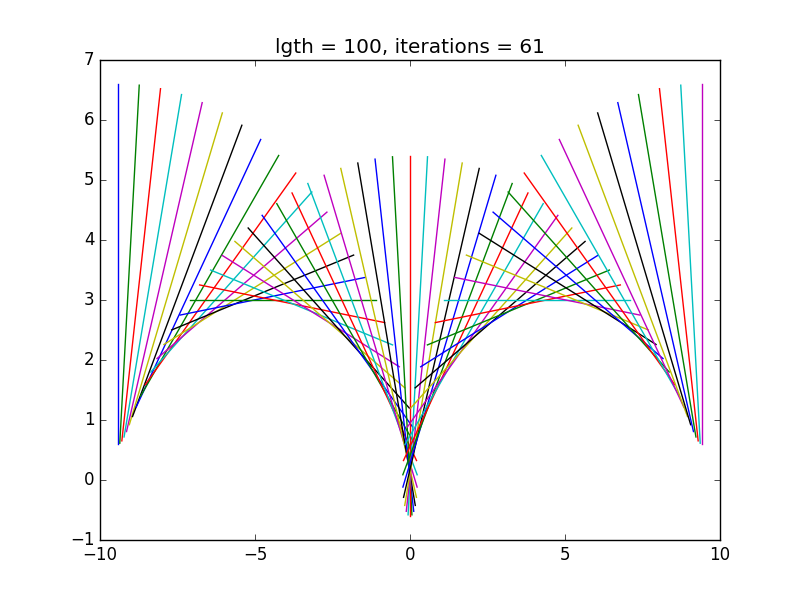
Turtle graphics. This to me resembles a Kina or Sea Urchin

My wife recently became interested in the Spirograph (™) system. Since her birthday was coming up, so did I, for obvious reasons. If you have never come across Spirograph (™) I can highly recommend it, as it enables the production of glorious swirls and spirals, using a system of toothed wheels and other shapes. When you use multicoloured pen, the results can be amazing.

Of course, I had to translate this interest into the computer sphere, and I immediately recalled “Turtle Graphics” which I have used before. It is possible to create graphics very similar to the Spirograph (™) designs very simply with Turtle Graphics.

Trefoil
This resembles the sort of things generated by Spirograph (TM)

Turtle Graphics have a long history, stretching back at least to the educational programming language Logo. Although variations of the original Logo language exist, they are fairly rare, but the concept of Turtle Graphics, where a cursor (sometimes shown as the image of a cartoon turtle) draws a line on a page, still exists. The turtle can be directed to move in a particular way, based on instructions by the programmer.

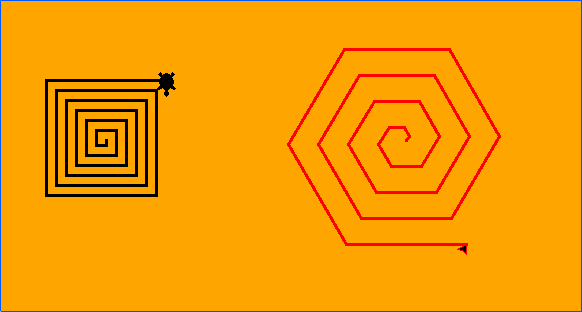
For instance the turtle can be instructed to move forward a certain distance, turn right through 90°, and repeat this process three times. The result is a small square. Or the turtle could be instructed to move forward and turn only 60°, repeating this 5 times to draw a hexagon. Using simple instructions like this allow the drawing of practically anything.

Square and Hexagonal spirals
Square and hexagonal spirals drawn by Turtle Graphics

I use an implementation of Turtle Graphics in the turtle module of the Python programming language but it is probably available for other programming languages. Python is probably an easy language to learn from scratch than Logo, and in addition Python can be used for many other things than Turtle Graphics. Python is available for Windows, OS/X, and Linux/Unix, and for several other older or less well known platforms.

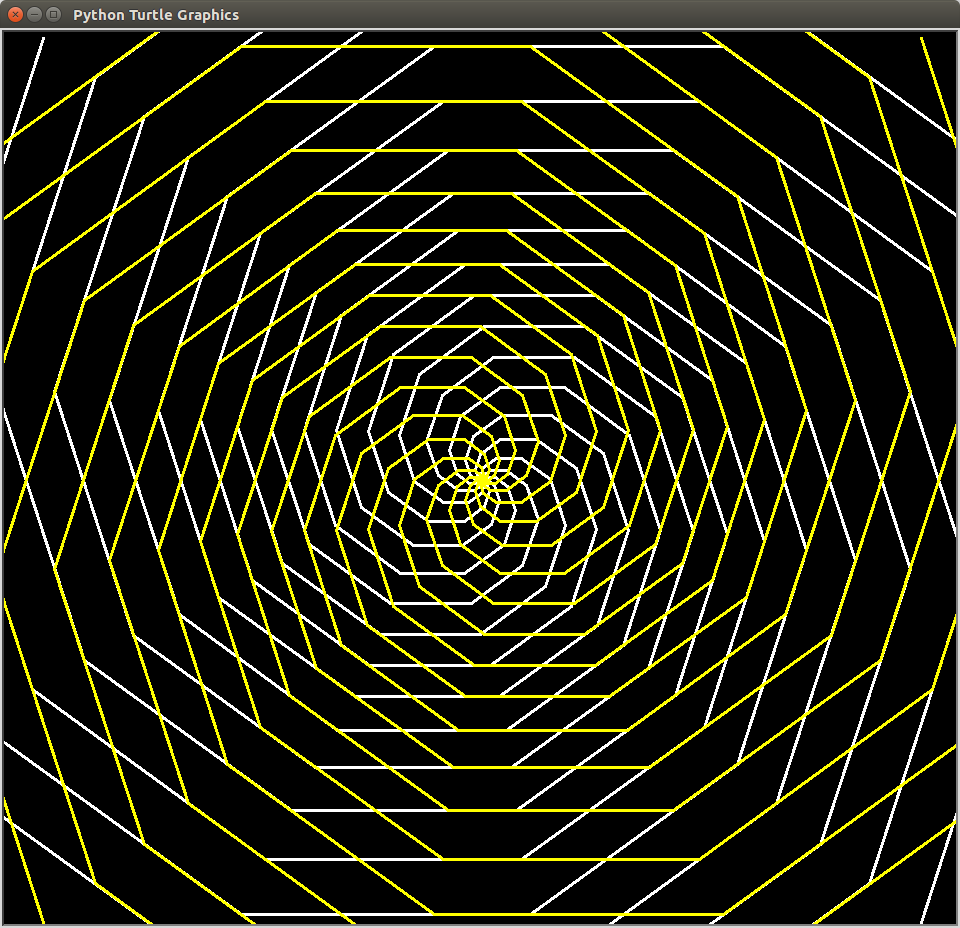
Where things become interesting is when the looping abilities of Python are used to enhance a program. If the programmer gets the turtle to draw a square, then makes the turtle turn a little and repeats the process, the result is a circular pattern. Starting with a more interesting shape can produce some interesting patterns.

Rotated Square - Turtle graphics
Rotated Square – Turtle graphics

After a while, though, the patterns begin to seem very similar to one another. One way to add a bit of variation is to use the ability to make the turtle move to a specific position, drawing a line on the way. As an example, consider a stick hinged to another stick, much like a nunchaku. If one stick rotates as a constant speed and the second stick rotates at some multiple of that, then the end of the second stick traces out a complex curve.

Flower shape
Flower shape – turtle graphics

In Python this can be expressed like this:

x = int(a * math.sin(math.radians(c * i)) + b * math.sin(math.radians(d * i)))
y = int(a * math.cos(math.radians(c * i)) + b * math.cos(math.radians(d * i)))

where c and d are the rates of rotation of the two sticks and and b are the lengths of the stick. i is a counter that causes the two sticks to rotate. If the turtle is moved to the position x, y, a line is drawn from the previous position, and a curve is drawn.

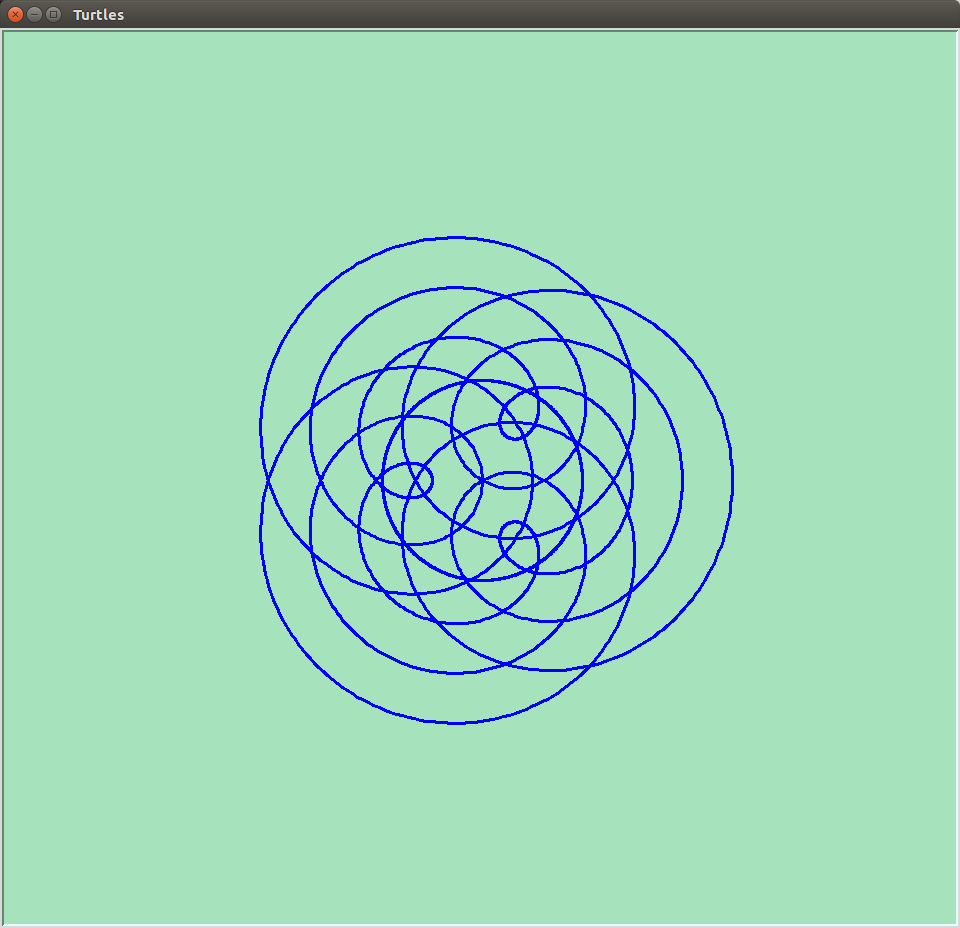
The fun part is varying the various parameters, a, b, c, d, to see what effect that has. The type of curve that is created here is an epicycloid. For larger values of c and d the curves resemble the familiar shapes generated by Spirograph (™).

Epitrochoids
Epitrochoids

The equations above use the same constants in each equation. If the constant are different, some very interesting shapes appear, but I’m not going to go into that here. Suffice it to say, I got distracted from writing this post by playing around with those constants!

The above equations do tend to produce curves with radial symmetry, but there is another method that can be used to produce other curves, this time with rotational symmetry. For instance, a curve can be generated by moving to new point depending on the latest move. This process is then iterative.

Gravity Wave - turtle graphics
Gravity Wave turtle graphics

For instance, the next position could be determined by turning through an angle and move forward a little more than the last time. Something like this snippet of code would do that:

for i in range(1, 200):
t.forward(a)
t.pendown()

t.left(c)
a = a + 1
c = c + 10

This brings up a point of interest. If you run code like this, ensure that you don’t stop it too soon. This code causes the turtle to spin and draw in a small area for a while, and then fly off. However it quickly starts to spin again in a relatively small area before once more shooting off again. Evidently it repeats this process as it continues to move off in a particular direction.

Turtle graphics - a complex curve from a simple equation
Turtle graphics – a complex curve from a simple equation

Another use of turtle graphics is to draw graphs of functions, much like we learnt to do in school with pencil and squared paper. One such function is the cycloid function:

x = r(t – sine(t))

y = r(1 – cosine))

This function describes the motion of a wheel rolling along a level surface and can easily be translated into Python. More generally it is the equation of a radius of a circle rolling along a straight line. If a different point is picked, such a point on a radius inside the circle or a point outside the circle on the radius extended, a family of curves can be generated.

Cycloid curve - turtle graphics
Cycloid curve – turtle graphics

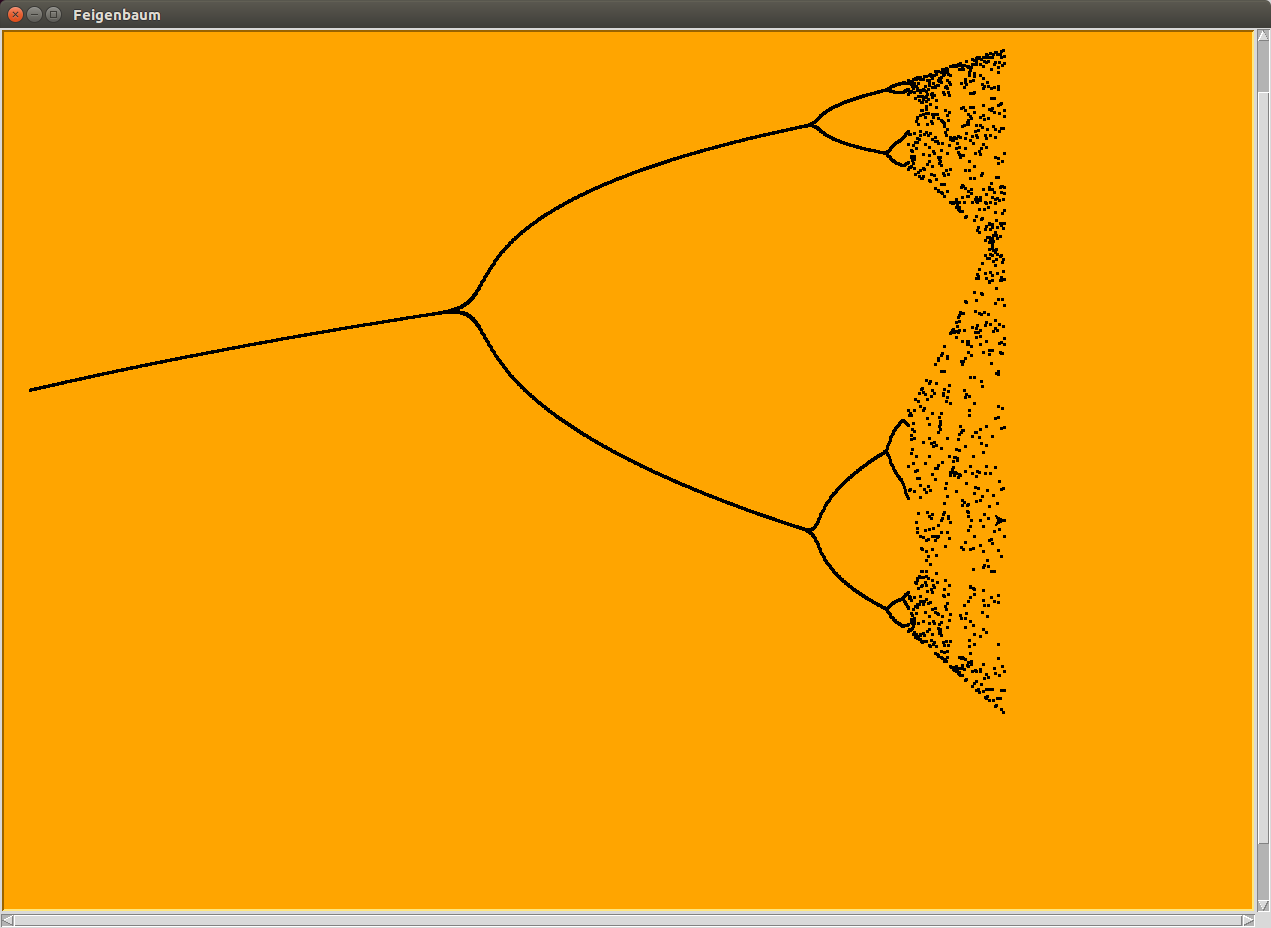
Finally, a really technical example. An equation like the following is called a dynamic equation. Each new ‘x’ is generated from the equation using the previous ‘x’. If this process is repeated many times, then depending on the value of ‘r’, the new value of ‘x’ may become ever closer to the previous value of ‘x’.

x(n+1) = rx(n)(1 – x(n))

If the value of ‘r’ is bigger than a certain value and less than another value, then ‘x’ flip-flops between two values. If the value of ‘r’ is bigger than the other value, and smaller than yet another value then ‘x’ rotates between 4 values. This doubling happens again and again in a “period doubling cascade“.

Turtle graphics - electron orbitals
Turtle graphics – electron orbitals

I’ve written a turtle program to demonstrate this. First a value for ‘r’ is chosen, then the equation is repeated applied 1,000 times, and the next 100 results are plotted, x against r. In the end result, the period doubling can easily be seen, although after a few doubling, the results become messy (which may be related to the accuracy and validity of my equations, and the various conversion between float and integer types).

Period doubling
The “fig tree” curve calculated in Python and plotted by Turtle Graphics.

Evolution

The modern theory of natural selection derives...
The modern theory of natural selection derives from the work of Charles Darwin in the nineteenth century. (Photo credit: Wikipedia)

If we accept Darwin’s theory of evolution, which I do, then we accept that we are the way we are as a result of a very period of gradual changes brought about by the pressures that our species has experienced through emergence and during process of its existence.

But let’s take a step back. All organisms have so called genetic material, stuff within them which encodes the way they are and the way that their offspring will be. The genetic material is copied as a part of the process of living, of growing and of repairing the organism if it sustains damage.


Embed from Getty Images

If that were all there was to the process, then organisms would be static, with no changes and no evolution. In fact the process is not perfect and both minor and major changes to the genetic material happen all the time, by all sorts of means.

Obviously, if too many changes or major changes occur in the genetic material, then the organism may not grow properly and may not repair itself properly when damaged. Also if the genetic material is passed to the organism’s descendants, they may they may not be viable or they may be disadvantaged and be unable to thrive and reproduce.

Baby turtle, species unknown.
Baby turtle, species unknown. (Photo credit: Wikipedia)

To counter this, our bodies have mechanisms to repair our genetic material, our DNA. If our bodies did not have this ability, it is unlikely that we would last long, as our body cells could experience millions of cases of damage to our genetic material per cell per day. That’s an awful lot of damage!

As described in the Wikipedia reference above, the errors in our genetic material could result in cell death or unregulated growth resulting in tumours. The DNA repair mechanism in our cells  do a good job, but they are only effective if the DNA strands are broken or incomplete. If a change is minor, and is properly reflected on both strands of our double helices, then the repair system will not notice the change.

English: Close up of The Double Helix
English: Close up of The Double Helix (Photo credit: Wikipedia)

This allows small changes to slip through, and provided they don’t cause life threatening problems, they may get passed to our descendants. The same applies to organisms other than ourselves of course.

Some major changes do slip through and organisms may end up with extra chromosomes or with damaged chromosomes. Sometimes these issues may not cause too many problems for the organism, while in other cases the descendant organism may not survive long enough to breed.

English: Illustration of the chromosomal organ...
English: Illustration of the chromosomal organisation of haploid and diploid organisms. (Photo credit: Wikipedia)

The minor errors mentioned above may affect the descendant organism to some extent, making it more or less successful than its parent organisms. The theory of evolution suggests that if the change in the genetic material makes it more successful than its siblings who don’t have the small errors, then, over generations, organisms carrying the new DNA changes will eventually replace those who don’t carry the change.

This could lead to problems for an organism. If we consider a stable population with few pressures, that has plenty of resources, there is little that would cause any permanent changes to the population, and small genetic traits could appear and disappear over time and not have any measurable effect.

Boreray sheep - on Boreray - geograph.org.uk -...
Boreray sheep – on Boreray – geograph.org.uk – 1439988 (Photo credit: Wikipedia)

If the environment then changes, such that one trait provides a large benefit to those individuals who have this trait, then over time there will be a tendency for the trait to be found in more individuals and the number of individuals without it would fall.

If the environment changes back again, then those with the trait may be disadvantaged and those without the trait could then come to dominate the population. However if enough time had passed and all the individuals without the trait in their genetic material had died out, then the population would be stuck with the trait.

Français : Trait du Nord - Salon de l'Agricult...
Français : Trait du Nord – Salon de l’Agriculture 2010 (Photo credit: Wikipedia)

It would be extremely unlikely but not impossible for the change in the genetic material to be reversed by chance as this would require another minor error to exactly reverse the original error. In effect, evolution as reflected in the genetic material never (or astronomically rarely) reverses.

If a group of organisms gets isolated from the rest of its species, some of the genes that are present in the population at large will not be present. In addition, some of the genes in the isolated population will also die out, either by chance, or because the trait that they confer is not beneficial in the isolated environment.


Embed from Getty Images

This can cause problems for the population if the environment changes dramatically to the detriment of the organisms. While the population at large may have genes which would enable the population to survive the changes, but those genes may have died out in the isolated environment, and the population may fail.

Of course, a mutation may arise which would enable organisms to survive in the new conditions, but environmental changes would almost certainly be faster than the rate of evolution through mutation.

exemples de mutations possibles sur l'ADN
exemples de mutations possibles sur l’ADN (Photo credit: Wikipedia)

Some species have different behaviours and appearance while still remaining the same species. Some of Darwin’s finches are an example. At least two varieties of one of the species feed on the Opuntia cactus, but they have different ways of feeding on them. One variety has a long beak and can punch holes in the cacti, while the other variety, with a short beak, break open the cacti to feed.

The birds can and do interbreed, so they are indeed the same species. This is similar, I presume, to the variation in skin colour in humans or the various blood types in humans. Such species have the same genes, but have slightly different versions (alleles) of it. This is called genetic polymorphism.

English: Trumpeter Finches (Bucanetes githagin...
English: Trumpeter Finches (Bucanetes githagineus), Valley of the kings, Egypt. Español: Camachuelos trompeteros (Bucanetes githagineus), Valle de los reyes, Egipto. (Photo credit: Wikipedia)

A species, like the finches, has to adapt. If its environment changes and it is unable to respond, then it will die out as innumerable species have done and are still doing. However, a species needs time to respond to environmental changes. For instance, polar bears may die out because the sea is is not freezing over as it usually does, and as a result there are no seals for the bears to hunt.

Whether or not you attribute the warming to mankind’s actions or not, the lack of freezing is a fact, and the bears are so far unable to adapt to the new conditions, and are often becoming a nuisance to arctic communities.


http://www.gettyimages.com/detail/506087692