Who’s a good boy, then?

Brygos Painter
Brygos Painter (Photo credit: Wikipedia)

We love our pets and they, so far as they are capable, love us back. In particular dogs reciprocate when we shower our affection on them. They are so grateful to us, and more than repay us for adopting them and looking after them, providing them with food, housing and the aforementioned affection.

Cats on the other hand, do not appear to be so grateful for us letting them into our lives, and some cats seem to have an air of disdain for anything human related. I’m told by cat lovers that they are as affectionate as dogs, but it all seems to be very much on their terms.

English: British Shorthair Deutsch: British Ku...
English: British Shorthair Deutsch: British Kurzhaar (Photo credit: Wikipedia)

Maybe that’s the way it should be. But maybe it is sheer hubris to assume that we are the top mammals, and that we should be treated as such. Cats are perhaps showing us that there are other ways to be superior.

There are other pets of course, such as birds and budgerigars, fish, rabbits and small rodents such as guinea pigs and hamsters, not to mention mice and rats. Some people have even more exotic pets, such as lizards and snakes, and even spiders.

Cuban Tarantula
Cuban Tarantula (Photo credit: Wikipedia)

While one can’t have as close relationship with these creatures as with dogs or cats, owners claim that these animals do show affection for their owners often in subtle ways. I’m sceptical that fish, snakes and spiders do so, but I’m willing to concede that the rodents probably do show affection to some small extents.

It’s probably that people began keeping pets as a convenient food supply. In some places rodents such as guinea pigs are bred for food, and the rabbits which have become pests in some parts of the world were definitely introduced as a food source. Apparently rabbits were introduced into the UK by the Romans as a food source, and it’s hard to realise that rabbits haven’t always been in the UK these days.

Meat-type rabbits being raised as a supplement...
Meat-type rabbits being raised as a supplementary food source during the Great Depression (Photo credit: Wikipedia)

Larger animals, such as pigs, sheep and goats and other animals that are kept for their meat sometimes end up as pets. Maybe the child of a farmer may have hand-reared the animal when something happened to the animal’s mother and become attached to it. This is often seen as a waste by the farmer, but he may indulge the child and allow the animal to live.

In most cases of such larger pet animals, the animal does not live with the owners, but merely gets special treatment from the owners. It is a sort of half and half pet animal. In rare cases the pig or other animal may actually live with the humans, but this is considered eccentric. Often media will use such cases for “human interest” stories. I often wonder if the pig on the couch is really happy with the situation or whether it would prefer to be grubbing around outside.


Embed from Getty Images

Some people keep horses. While horses are usually considered pets, but are working animals, some people get very close to their horses. It more of a close companionship than a really human and pet relationship, but horses do in many cases reciprocate when the humans show affection.

Showing affection implies some sort of consciousness behind the pet’s eyes. Some people argue that while animals do respond to human affection that their response is merely a stimulus/response reaction of the pet to the environment, which of course includes the human being. While pet seems to recognise that the human is being affectionate, the pet is a philosophical zombie, and there is nothing else going on.

English: Golden Retrievers posing for a photo ...
English: Golden Retrievers posing for a photo at Affectionate Pet Care Dog Daycare (Photo credit: Wikipedia)

I find this argument to be dubious. We after all are conscious beings, and this consciousness must have evolved in our ancestors from scratch. I don’t just mean our human ancestors, but the ancestors of us, apes, cat and dogs, pigs, and horses. In other words all mammals, and maybe even the ancestors of other types of animal. I’d like to think, for example, that Tyrannosaurus Rex had some dim idea of itself and its place in the world.

This is, of course, the view that animal rights’ activists and vegetarians and vegans have of animals as sentient beings. While I have certain sympathies for their points of view, I feel that humans have the right to eat meat as part of their diet, just as any carnivore like a lion or a tiger has the right to hunt, kill and eat other animals.

Male Lion (Panthera leo) and Cub eating a Cape...
Male Lion (Panthera leo) and Cub eating a Cape Buffalo in Northern Sabi Sand, South Africa. Italiano: Leone maschio (Panthera leo) e un cucciolo mentre mangiano un Bufalo nel Nord di Sabi Sand in Sud Africa. (Photo credit: Wikipedia)

We are have evolved from hunter-gatherers whose diet included meat from animals that we hunted and killed and our bodies have developed (maybe even evolved) to subsist on such a diet, and we have issues if we try to exclude meat from our diets. Vegetarian diets tend to favour beans and other plant proteins which our bodies are not adapted to digest and plants do not contain much of some nutrients which our bodies need.

Pets are probably kept more for companionship than anything else. The mutual affection between a pet and its owner probably arises from that. Some people (as in any group of humans) tend to go to an extreme, as epitomised by the familiar “cat woman”. Such people often have psychological problems and tend to be somewhat withdrawn from society, and may form an extreme connection with their cats, and have a disregard of their own well-being.


Embed from Getty Images

I prefer dogs over cats, because dogs interact with humans in a more human way than cats do, and kids who grow up with dogs will have seen all the training and looking after that their pets need, and themselves learn about responsibility. A pet dog is totally dependant on a human for housing, feeding and exercise. If the dog becomes ill, they learn that the owner is responsible for seeing that the illness is treated, and when the dog dies, they learn how to cope with death and grief.

When the human race expands to the stars, if we ever do, we will almost certainly take our pets with us. The dog, the cat, the guinea pig and the budgerigar will travel to the stars with us. They may be riding on our coat tails, but that is a measure of the success of their species and their connection to the human race.


Embed from Getty Images

Loneliness

English: The loneliness of Culloden Culloden i...
English: The loneliness of Culloden Culloden is one of the few areas that I leave feeling full of sadness. This lonely tree at the sight says it all. (Photo credit: Wikipedia)

Robinson Crusoe was marooned for years on a tropical island. At first he succumbs to despair, but later he starts to make things easier for himself, at first rescuing goods from the shipwreck which is fortunately accessible at least for a while on a reef.

He has no one to talk to, until Friday, but he is kept busy just surviving. This business, wondering where the next meal was coming from, how to provide himself with shelter, all the minutiae of just living would have initially staved off all sense of loneliness.

Robinson crusoe rescues friday-1868
Robinson crusoe rescues friday-1868 (Photo credit: Wikipedia)

Later on though, when his immediate needs were catered for, he must have reflected on the fact that he was totally alone on the island. (I read the book years ago, and I’m speculating – I can’t recall if he ever got into a philosophical mood or not). It would have been a driver to explore the island and finding no other people would have been a blow.

People in general need other people. In the book Treasure Island by Robert Louis Stevenson, Ben Gunn is marooned on an island for years and become slightly unhinged by the loneliness. He spent a lot of the time on the island dreaming of one thing – cheese. However, he does not completely lose his senses and is able to take part in the events that follow.

The Black Spot. Illustration by N. C. Wyeth fo...
The Black Spot. Illustration by N. C. Wyeth for Treasure Island by Robert Louis Stevenson, Charles Scribner’s Sons, 1911 (Photo credit: Wikipedia)

Some people choose to isolate themselves from the rest of the human race, mainly, it seems for religious reasons. It is possible for such hermits to voluntarily return to the human race, something which is not possible for those who are marooned on an island, and this may make the separation more bearable.

The reason that hermits choose to isolate themselves from the human race is so that they can concentrate or religious or spiritual matters without being distracted by the minutiae of human life. Obviously they still need to eat and perform bodily functions, but those can be kept to a minimum and the hermits mind can be free to concentrate on one thing for much of their waking moments.

English: St.Martin in Memmingen. Choir stalls:...
English: St.Martin in Memmingen. Choir stalls: Portrait of a hermit Deutsch: St.Martin in Memmingen. Chorgestühl: Porträt eines Eremiten. (Photo credit: Wikipedia)

While human companionship can help to keep one sane, the constant interruptions to one’s train of thought can be distracting or irritating. Samuel Taylor Coleridge was writing the poem “Kubla Khan” when he was distracted by a person from Porlock and the poem was not completed as originally Coleridge envisaged.

Computer programmers often find that when they are concentrating on their task they will “enter the zone or the flow“. This is an almost trance-like state where the programmer is totally immersed in the task at hand, and the interruptions of normal life are not welcomed. A programmer in the zone may regard time spent on sleep, food and other necessities as unimportant, and this is why programmers sometimes subsist on coffee or energy drinks, and eat pizza and other fast foods that can be ordered in.


http://www.gettyimages.com/detail/474217642

The immersive effects of the zone are not only felt in programming, I believe. Programming is in many ways an art, and I can imagine that the same is true of the other arts, such as painting and writing, as the example of Coleridge suggests, though he was using opium at the time he was writing Kubla Khan.

The feeling of being in the zone is, for the most part, intensely solo. While two or more programmers can work simultaneously of the same piece of code, this is much more difficult to achieve. I’ve seen programmers team up and program, but the feeling of being in the zone is much more fragile when more than one person is involved.

English: Programmer
English: Programmer (Photo credit: Wikipedia)

In contrast, debugging a malfunctioning piece of code can be easier for two or more, as the different insights broaden and direct the flow into areas that neither would have thought of by themselves but in general the immersion is not so deep.

Quite often an isolated person, say a shipwrecked person, or an elderly or sick person who is not mobile and therefore spends a lot of time alone, will have an animal as a companion. The little old lady has one or more cats. The shipwrecked or marooned person may have a dog. A companion animal eases the separation from the human race.


Embed from Getty Images

A lonely person may pick an unusual animal as a companion. Some sources suggest that Michael Jackson made a pet of a rat and that his father killed it, but this story is muddled with the story behind his hit song “Ben”.

An isolated person may talk to the animal in default of being able to talk to other human, and may unwisely attribute human traits to the animal. If the person is alone with the animal for too long he or she may come to believe that the animal responds either verbally or by actions.

An albino pet rat eating a piece of bread.
An albino pet rat eating a piece of bread. (Photo credit: Wikipedia)

Sometimes an isolated person may imagine a fictitious companion, either totally invented or based on a real person. He or she may act out what he believes that the imaginary person would act out. In the film “Psycho” Norman Bates assumes and acts out the identity of his dead mother, who he killed 10 years earlier. Bates was isolated by his mental illness, and not by being physically isolated.

There are various causes of isolation – it may be unintentional, as in a shipwreck, or it may be intentional as when a sailor is marooned for mutiny, or a person may be isolated as a result of sickness, either mental or physical, or it may be a side-effect of old age. A person may be isolated by deafness or blindness, or physical inability to move.

Blind Girl
Blind Girl (Photo credit: Wikipedia)

However, some people seek isolation in the form of “peace and quiet”. If a person is highly stressed in their day-to-day life, they may find themselves looking forward to immersing themselves in a book, or taking a bath, or in any of hundreds of ways of isolating themselves from the general hubbub of human society. Possibly with a reasonable supply of alcohol to hand, merely to aid the relaxation of course.

English: Peace and quiet This part of the trac...
English: Peace and quiet This part of the track is very quiet apart from birdsong, the gateway on the left is about four feet wide, small enough for animals to pass through when the farmers and lead miners had horses and carts. (Photo credit: Wikipedia)

Voters and non-voters


Hillary Clinton in Concord, New Hampshire
Hillary Clinton in Concord, New Hampshire (Photo credit: Wikipedia)

Hillary Clinton won more votes than Donald Trump in the US elections, yet she didn’t win the presidency. This has led to many of Clinton’s supporters to cry foul, and talk about getting rid of the electoral college system that they have in the US.

It’s not going to happen. The electoral college is a result of the unique formation of the United States of America. Before the Union all the states were autonomous and had their own laws and regulations and these were protected in the US Constitution. One of the safeguards which was built in was to protect the electoral system within a state from being replaced or modified by those not from that state, and this resulted more or less directly in the electoral college system.

English: 1908 Electoral College
English: 1908 Electoral College (Photo credit: Wikipedia)

As a consequence of this being part of the constitution, it is very difficult to change. To just become a proposal an amendment requires a two-thirds vote in congress, and requires a three-quarters vote by the states to be adopted. Since the two major parties pretty much share the country, it would require all the votes of one party and around half the votes of the other party.

There have been many ways that the leader or leaders of group of humans is chosen, and there are many words that end in the suffixes -ocracy or -archy. All have their advocates and their denigrators. All have probably been tried somewhere at sometime or other.

Countries highlighted in blue are designated &...
Countries highlighted in blue are designated “Electoral Democracies” in Freedom House’s 2006 survey Freedom in the World. (Photo credit: Wikipedia)

In an attempt to define how a person should be treated and the rights that he or she should have, Eleanor Roosevelt chaired a committee which wrote the Universal Declaration of Human Rights, a somewhat fatuous document which was adopted by the General Assembly of the United Nations.

Article 21 of the UDHR talks about the right of everyone to take part in the government of his/her country, and implies but stops short of prescribing representative democracy. As such, the UDHR has plenty of “wriggle room” for alternative for other methods of government, as even a dictator could argue, and they often do, that what preceded them was worse and the dictatorship is merely a step towards returning or giving the power to the people.

(1) Everyone has the right to take part in the government of his country, directly or through freely chosen representatives.
(2) Everyone has the right of equal access to public service in his country.
(3) The will of the people shall be the basis of the authority of government; this will shall be expressed in periodic and genuine elections which shall be by universal and equal suffrage and shall be held by secret vote or by equivalent free voting procedures.

Many regimes though, don’t even try to argue they are merely filling a gap, but no doubt think that they are doing the best for their people. No one surely sets out to be a blood-thirsty dictator, after all. Arguably, though, a volatile country might benefit from a period with a strong leader, but eventually a strong leader will become succumb to a feeling of hubris and entitlement. Eventually he will be overthrown.

60 th Anniversary of the Universal Declaration...
60 th Anniversary of the Universal Declaration of Human Rights (2008) (Photo credit: Wikipedia)

There exists a strong feeling that democracy is the best form of government that humans have tried. Whether or not it is the best system that is possible is another question. In a democracy everyone has a say and theoretically at least the government can be replaced, without revolution or bloodshed, if the population at large decides that it doesn’t like those it has elected.

Most democracies are representative democracies, in that the population do not normally vote on all issues, but elect a person to represent them in governing the country. Ideally such a representative would canvas or solicit views on topics that have to be decided, but in practise a potential representative will lay out his/her views and the electors pick the person who most closely fits their viewpoint.

Women standing in line to vote in Bangladesh.
Women standing in line to vote in Bangladesh. (Photo credit: Wikipedia)

Since this is done before the representative is selected, a future contentious issue may find the representative at odds with many of his constituents on the issue. While a good representative will make his views known and may solicit electoral views, and the electors can make the representative aware of their views by various means, the communication between the representative and his electors is to say the least inefficient.

A big thing about democracy is that everyone has at least one vote. In some systems a person may have more than vote, and in almost all democracies the voter gets a chance to vote to fill various roles, such as mayor, or sheriff, or local councillor. A democracy is an involving system, soliciting voter views on a periodic basis, so why don’t people get involved?


Embed from Getty Images

In the recent American Presidential election only just over 50% of the electorate voted, and this was in one of the most controversial elections of recent times. Since each candidate took almost half the popular vote only one in four voters voted to make Trump president. Of course only about one in four voters voted for Clinton (who got more votes than Clinton).

People don’t vote if they can’t be bothered, if they think that their vote will not make a difference and a small number don’t vote because they disagree with the process, maybe for political or religious reasons. The US is not alone in this, as a significant number of voters do not vote in an election in many democracies.


http://www.gettyimages.com/detail/599757474

I would suggest that this is true in most democracies, but I don’t have the data. Some people suggest that making the voting easier by introducing electronic voting over the Internet, but I feel that this will not make a big difference. I feel that the reason for low turnouts is disinterest and a belief voting doesn’t make any real difference.

“For politicians, passing laws is like passing water,” said Narayan. “It all ends down the drain.”
Rohinton Mistry, A Fine Balance

Election promises are rarely believed and seldom acted upon. There is unlikely to be a wall built between the United States and Mexico. Trump has succeeded with that promise however, not because people believe that he will do, but because he most aligns with what people would like to do, and I don’t mean build a wall. He has proposed a solution to a perceived problem, and that is good enough for those who turned out and voted. Any solution that catches the imagination of the voters would have done as well.


Embed from Getty Images


Post-rational


Embed from Getty Images

Science has achieved marvellous things. It’s sent people to the moon, It’s reduced disease and the impact that disease has on people. It’s given us transistors, computers, the Internet and cell phones. It’s given us non-stick frying pans.


Embed from Getty Images

Science and its descendants, like biology, physics, and chemistry, and their descendants, like engineering, agriculture and medicine, have been an immense boon to the human race, to the extent that the human race would not have achieved the majority of things that we see around us. Railways, planes, roads and cars have all been achieved by the applied use of science.

Why then are people beginning to reject science and all that it has done for us? Why is there this anti-science, anti-rational groundswell, and does it really matter?

English: Anti-Science (including math, physics...
English: Anti-Science (including math, physics, chemistry, biology, computer science, etc.) (Photo credit: Wikipedia)

There have always been flat-earth proponents – people who disbelieve science, and bend the predictions of science almost to breaking point to favour their point of view. While they in general accept the facts, they do not like the conclusions drawn from the facts and build their own convoluted theories and explanations instead.

Then there are those who attack the theories of relativity. Here at least there is some justification as relativity is not easy to get your head around. It is not intuitive, and that is a weak way to some extent excuses the attacks on it. However the relativity opponents are generally unwilling to throw some maths at the problem – and without the maths, their objection do not stand up to scrutiny. In fact if they were to apply the maths, and were able to understand the maths, then probably the only conclusion they could come to is that the theories of relativity apply.

Banesh Hoffmann, in the 1979 film Continuum, s...
Banesh Hoffmann, in the 1979 film Continuum, speaking about the theory of relativity (Photo credit: Wikipedia)

Many of those who oppose scientific theories do not understand what a theory is. A typical case is where someone declares that “evolution is only a theory“! What they don’t understand is that everything is a theory.

It is a theory that the sun “rises” because the Earth spins in its orbit, causing the Sun appear to rise in the East. (I’ve lost the Flat Earthers by this point of course). It’s a very good theory and one that is incredibly unlikely to be disproved, but it is still a theory.

Only A Theory
Only A Theory (Photo credit: Wikipedia)

A theory is something that explains the known facts, and trying to dismiss something as “only a theory” pretty much amounts to dismissing all of science, as science is a network of interconnected theories.

This ignorance of what science is and theories are goes hand in hand with the simplified and cartoonish way that science is taught in schools. Here is an atom is behaves in so and so way, it reacts with these other atoms, and so on. Very little of the history of the development of the concepts is done, and unless someone gets interested and studies the roots of science, much of science becomes merely didactic and not fundamentally informative in any way.


Embed from Getty Images

Students do get told a little about how one theory may supplant another theory, but very often the concept doesn’t really sink in. A scientific theory is taught authoritatively – students are told that the ancient Greeks had some weak ideas which could barely be called theories, but Newton tossed that junk aside and used Reason to develop his theories. Then Einstein came along and “disproved” Newton’s theories.

There is an idea that theories can be discarded, but the next part, where another theory takes its place is skipped over or ignored. Inconvenient facts are ignored, or “explained” as errors or bias. It may often be implicitly or explicitly asserted that scientists have a vested interest or that there is a conspiracy to suppress the true theories.

Three models of change in scientific theories,...
Three models of change in scientific theories, depicted graphically to reflect roughly the different views associated with Karl Popper, Thomas Kuhn, and Paul Feyerabend. (Photo credit: Wikipedia)

There is one huge example, the tobacco industry, where bias and vested interests have had a negative influence on the science, and this, one can see, seems to validate the point of view that scientists are regularly distorting the results of science for their own ends.

So, it is not uncommon to have a case where people refuse to accept the science and go with their own views. One case that I saw recently was in a discussion of the so-called Supermoon on November 14th 2016 and the earthquake in North Canterbury, New Zealand early that same morning.

A SuperMoon is a perigee-syzygy, a new or full...
A SuperMoon is a perigee-syzygy, a new or full moon (syzygy) which occurs when the Moon is at 90% or greater of its mean closest approach to Earth (perigee). The March 19, 2011 supermoon is just 221,566 miles (356,577 kilometers) away from Earth. The last time the full moon approached so close to Earth was in 1993, according to NASA. it is about 20 percent brighter and 15 percent bigger than a regular full moon. (Photo credit: Wikipedia)

In the discussion several people were looking at the coincidence of the two events and linking them in their minds. After several people had pointed out that the science shows that there is no noticeable correlation between “supermoons” and big earthquakes, people were still saying that there must be something in it.

They had replaced the current scientific theory with their own thinking, without really explaining the facts away – there is no known or even noticeable link, and that lack of any apparent evidence should be explained by any replacement “theory” before any new theory can be put in place.

1755 copper engraving showing Lisbon in flames...
1755 copper engraving showing Lisbon in flames and a tsunami overwhelming the ships in the harbor. (Photo credit: Wikipedia)

Similarly, I’ve come across people who oppose the use of fluoride and chlorine in public water supplies, and those who refuse to inoculate their children against diseases. In past decades people died from water-borne diseases, children have died from childhood diseases and whole populations have been wiped out. Children’s’ teeth have rotted in their mouths.

Why do these people do these things? In general they are fairly well-educated, fairly well read, and not unintelligent. Of course there’s a fear factor, but in previous generations fear was the thing driving people towards chlorination and fluoridation and inoculation against diseases.

La vaccination. Inoculation against smallpox i...
La vaccination. Inoculation against smallpox in Paris in 1807 as shown in a painting by Louis-Léopold Boilly at The Wellcome Library, London. (Photo credit: Wikipedia)

However, I think that there’s more to it than that. There’s a rejection of rational thinking. They realise that science has done so much for them, yet they only pay it lip service. “Proof” of their views is obtained by scouring the Internet for the few dissenting voices. Any establishment voices are dismissed as biassed or merely toeing the establishment line. This is not a rational argument. A single or even a small set of dissenting voices is not proof of anything.

This worries me. We have always had the “alternative” views, the crystal gazers and the iridologists, but those people completely reject science as a world view. That’s OK. We don’t expect science from such people.

Human Iris, Blue Type
Human Iris, Blue Type (Photo credit: Wikipedia)

The antivaxers and the fluoride opponents however pay lip service to science while rejecting it, which is not logical. They know something of how science works, as evidenced by their rejection of current evidence of the benefits of fluoride and chlorine in the water, but they don’t follow through with meaningful data to support an alternative theory.

(Coincidentally I came across this article after publishing my post. http://www.irishtimes.com/news/education/teach-philosophy-to-heal-our-post-truth-society-says-president-higgins-1.2875247)

Cover
Cover (Photo credit: Wikipedia)

Trumpery

Donald Trump enters the Oscar De LA Renta Fash...
Donald Trump enters the Oscar De LA Renta Fashion Show, New York. (Photo credit: Wikipedia)

Well, as politics goes that was great theatre. Trump won when no one thought that he had a chance of even getting the nomination for the Republican Party. Trump as president is highly scary, not only for the US, but for the whole world.

Given that Trump is the man that he is, why on earth did anyone vote for him, let alone around half the people who voted? People have been puzzling the answer to this one ever since the election, and while it is clear from the statistics that there was a big swing to Trump by white non-college male voters – blue collar America.

Blue Collar Radio
Blue Collar Radio (Photo credit: Wikipedia)

It would easy to attribute this swing to gullibility and malleability of the non-college voters male voters. It would be easy to suggest that Trump’s evident charisma appealed to this sector of the electorate, but there must be more to it than that. Much more.

Notably the statistics seem to show that no other group of people fell for the Trump’s braggadocio like the white male non-college voters. Of course he turned off female voters to some extent by his behaviour and attitude towards women, but really, there was no huge backlash in that respect.


Embed from Getty Images

It seems that Trump’s call to “Make America Great Again” (trademarked by him in 2012) resonated with many Americans in this election, but it is not the first time it has been used. Several previous presidential candidates have used it. It implies that things were better in the past, but in general, that view is illusory, and one sees the past through rose-tinted spectacles.

“How many people long for that “past, simpler, and better world,” I wonder, without ever recognizing the truth that perhaps it was they who were simpler and better, and not the world about them?”
R.A. Salvatore, Streams of Silver

Another button that Trump pressed for many people, not the white, male, non-college voters alone was the race button. Technically one should not be called racist if what one says is the truth. Trump in many peoples’ opinions went a long way past that point.

English: A racist drawing of blacks in the 189...
English: A racist drawing of blacks in the 1890s, made by whites. The caption says “Last one in’s a nigger.” (Photo credit: Wikipedia)

While labelling Mexicans as all being drug dealers and rapist, he definitely went well past the point of propriety, but it appears that many people believe that there is a grain of truth there. In an American post-911 many people are wary of all immigrants, especially those from the Middle East. Again many people resonate with this.

Trump’s stated policies are ridiculous. Building a wall between Mexico and the US and making the Mexicans pay for it is silly, though I note that there are fences along much of the border already. A wall can be climbed over, tunnelled under, flown over or merely circumvented. All known walls of this type, Hadrian’s Wall, the Great Wall of China, the Berlin Wall, have all failed.

English: Hadrian's wall just east of Greenhead...
English: Hadrian’s wall just east of Greenhead Lough, Northumberland in October 2005. (Photo credit: Wikipedia)

Trump threatens to catch and extradite all illegal immigrants in the US. Not only would this be fabulously expensive, it would cause immense upheavals and distress to many in the US, especially those families are mixed with legal and illegal immigrants. Apart from that the economy of California would collapse as many of the lower paid workers are illegal immigrants.

The threat to extradite all Muslims is not only silly, it is probably not legally possible. Many Muslims have been in the country legally for generations. A Muslim grandfather who came to America to escape conflict and even religious persecution in his homeland may face extradition merely because his sons or grandsons may at some time in the future become radicalised.

English: Turkmen Moslem Mullah, Nohur village,...
English: Turkmen Moslem Mullah, Nohur village, Turkmenistan, 21 April 2008. (Photo credit: Wikipedia)

Trump’s policies may be ridiculous, they may be very expensive, but above all they may be impossible to carry out. Trump cannot write the laws himself, and there are some things that it may be legally impossible to do, and there may arguably be things that are constitutionally impossible to carry out. Trump’s policies may fail when confronted with political reality.

Trump appears to be passing off at least some of his powers to his Vice-President Michael Pence. This makes sense because Trump is a political novice and Pence has years of experience. At best this could make Trump look weak, and at worst, it could turn him into a puppet. As it is it seems that Trump is softening his stance on the issues that have assisted him to the Presidency.

Official portrait of Congressman (R-IN)
Official portrait of Congressman (R-IN) (Photo credit: Wikipedia)

This raises the question of what happens at the next election in 2020? If the Republicans don’t make any progress in addressing the issues that the white male non college voters have, if they don’t produce jobs, if people don’t see any progress in handling the illegal immigrant issue or the issues around Muslims in the US, it is hard to see him or the Republicans retaining the presidency and their ascendancy in the Senate and the House.

Trump could be a great president or middling president or useless president. While it is hard to read the future, going by his character, his lack of political abilities, the possibility that he will have roadblock after roadblock placed in front of him, and the almost impossible task of “Making America Great Again”, and the need to retain the loyalty of white, male, non college voters, I’m going to predict that he will most likely achieve very little, and will not get a second term.

US Navy 040611-N-9319H-054 USS Ronald Reagan (...
US Navy 040611-N-9319H-054 USS Ronald Reagan (CVN 76) Sailors salute the American flag during the memorial service for President Ronald Reagan on the flight deck aboard his namesake aircraft carrier (Photo credit: Wikipedia)

In the mean time, while he is trying to actually achieve some of his goals, the Democratic Party has time to reflect, make changes especially to the party hierarchy and structure, and to win the loyalty of the voters. In particular they can reflect on what went wrong.

Would Bernie Saunders have done any better than Hillary Clinton? It is unlikely. The fact that Trump got selected for the race shows that voters wanted change and Saunders would most likely have provided a softer target for Trump.


http://www.gettyimages.com/detail/519579776

Should the Democrats select Saunders for President next time? Well, he is 75 now and will be 79 by the time of the next election, and that is ten years older than Ronald Reagan was when he became President. Incidentally Trump will become the oldest President to be elected when he is inaugurated.

I see some people are calling for Michelle Obama to stand in 2020. This doesn’t address any of the issues that this election has raised, so she would probably fail. In any case, she wisely says that she would not stand.

First Lady Michelle Obama visits with Former F...
First Lady Michelle Obama visits with Former First Lady Nancy Reagan at the White House on June 3, 2009. (Photo credit: Wikipedia)

Measuring things

English: Ruler Italiano: Righello
English: Ruler Italiano: Righello (Photo credit: Wikipedia)

When we measure a length, with a ruler, say, we can’t measure it exactly. The ruler will be marked off in, say, millimetres, and the length we are measuring will probably fall somewhere between two markings on the ruler, so we can only say that the length is somewhere between the distance between the two markings and the start of the ruler.

Probably. Actually there are a number of things that could mess up our measurement. We may not be able to line up the start of the length we are measuring with the start marking on the ruler, as the marking on the ruler is not of zero width. The best we can do, when aligning one end of the length to be measured with the ruler, is to align the start of the length to the middle of the marking on the ruler.

English: A close-up picture of a section of ru...
English: A close-up picture of a section of ruler with British (inches) and Chinese (cun) scales on its two sides. This is the 10th cun – the last cun of a chi, so that one can see that 1 chi (10 cun) was equal to 14+5/8 inches, i.e. 371 mm. A metric ruler is shown next to it for scale. As can be seen from the worn corners, the ruler has been well used in measurements of length, such as perhaps of garment cloth, for trade transactions. (Photo credit: Wikipedia)

We then have to transfer our attention to the other end of the ruler. Probably the other end of the length and the edge of the ruler don’t align, so we shuffle the ruler to try to align the two ends of the length with the edge of the ruler, checking all the time that the start of the ruler is in line with the start of the length to be measured.

When all is aligned we can then read of the approximate value of the length, assuming that the ruler is still properly aligned and that the start of the ruler is still properly aligned with the start of the length. However, as mentioned above the end of the distance being measured will probably fall between two markings.

A carpenters' ruler with centimetre divisions
A carpenters’ ruler with centimetre divisions (Photo credit: Wikipedia)

So any measurement with the ruler should be stated with an estimate of the margin of error in the answer. “About 73mm, with an error of about 0.5mm” might be a reasonable estimate.

The accuracy of a measurement may depend on the material from which the ruler is made. It may be wood, plastic or metal, or some other material. Wood is a natural material, and as such it may warp, or shrink or expand unevenly. It may deteriorate over time, so that today’s measurement may be slightly different from today’s. The ink used to make the markings may migrate into the wood through natural pores and cracks in the wood, rendering them wider and fuzzier than when the ruler is new.

Diagram showing operation of temperature compe...
Diagram showing operation of temperature compensated “gridiron” pendulum, invented in 1726 by British clockmaker John Harrison. The pendulum uses rods of a high thermal expansion metal, zinc (yellow) to compensate for the expansion of rods of a low thermal expansion metal, iron (blue), so the overall pendulum doesn’t change in length with temperature changes. Therefore the period of swing of the pendulum, and the rate of the clock, are constant with temperature. (Photo credit: Wikipedia)

A metal ruler can be marked more accurately, and the markings won’t blur, and the markings can be much thinner or sharper than those of a wooden ruler. Unfortunately metal will expand and contract depending on the temperature, adding errors to the measurements. This can be alleviated by careful choice of alloy for the ruler, but not eliminated.

All rulers are these days fabricated by machines of course, and the markings are made by these machines. Such a machine has to be as accurate or more accurate than the end product of course, which means that the scale marks must be located more accurately, and probably be narrower than those of the end product.


Embed from Getty Images

In order to be more accurate, various techniques are used to achieve the extra accuracy, and I’m not going to discuss them here, mainly because I can only guess what they are! Vernier scales and error averaging techniques spring to mind, but as I said, I don’t what is actually used.

Microscopes and similar allow the measurement of very small distances against a scale calibrated to very small tolerances. This pattern is repeated endlessly – to measure small distances accurately your measuring device (or technique) needs to be an order of magnitude more accurate than the distance to be measured.

Microlitic volcanic lithic fragment, scale in ...
Microlitic volcanic lithic fragment, scale in millimeters. Top picture in plane-polarized light, bottom picture in cross-polarized light. (Photo credit: Wikipedia)

If we want to measure atoms, we need an atomic sized scale and that cannot be made of atoms, obviously. We can use electromagnetic waves, other atoms, subatomic particles and so on, of course, but we are now in the quantum world, so not only do we have the sorts of issues mentioned above, but we have issues that related primarily to the quantum world – such as the Uncertainty Principle, and the fact that an atom can behave like a particle or a wave.

Down at these levels we use atoms to measure other atoms – there is of course no possibility of a ruler type scale which is made up of atoms. Instead things are measured by noting the frequency of emissions from the atom as its electrons changes from one quantum state to another.

Atomic Clock FOCS-1 (Switzerland). The primary...
Atomic Clock FOCS-1 (Switzerland). The primary frequency standard device, FOCS-1, one of the most accurate devices for measuring time in the world. It stands in a laboratory of the Swiss Federal Office of Metrology METAS in Bern. (Photo credit: Wikipedia)

This is referred to as a quantum jump and is popularly interpreted as an electron moving from one electron shell to another, in the common view of an electron orbit around the nucleus of an atom like a planet around a star.

A popular view is that at quantum levels the apparent continuity in time and space is not seen and that space and time appear to have a discrete structure. At some scale this makes it impossible to measure very small lengths, as it is impossible to tell whether or not two points are at different locations or not.

Dr. Max Planck
Dr. Max Planck (Photo credit: Wikipedia)

It follows that in the usual macro world that apparent continuity is probably illusory – if we can’t tell the difference between two points at a very small level, our measurements at the macro level are not well defined. It seems that the appearance of continuity at the macro level is an emergent phenomenon.

Maybe. The appearance of continuity probably comes from the fact that when we look at a line from A to B we can always pick a point C between them. We can then pick a point D between A and C and a point E between A and D and so on, apparently forever. But in fact the process has to stop, and the stopping point is where we find that we can’t distinguish the two end points of the line.

Reality-Virtuality Continuum.
Reality-Virtuality Continuum. (Photo credit: Wikipedia)

Is the issue caused by a conflict between our physics, which is at heart a description of the world as we see it, and what the world is actually like? A line is a mathematical concept which has extent (length), but no width. In the real world a line is marked by some means, pencil or laser beam, and has an extent, which is what we are trying to measure, and certainly has some width, the width of the lead of the pencil, the width of the laser beam. Are we starting to find out about the things that we can’t know about the world?

PencilTip
PencilTip (Photo credit: Wikipedia)

Virtual Reality


Embed from Getty Images

Back in 1999 I was just finishing my Masters degree at Victoria University of Wellington. I needed a subject for my research paper and I chose what was then a hot topic, Virtual Reality (VR). At the time, the computing resources that were available to most people were, by today’s standards pretty limited.

17 years ago we measured RAM in megabytes, and disk space in gigabytes. The Internet was not as pervasive as it is today, and most people, if they accessed the Internet at all, used dial up modems. Broadband was for most people, still in their future. As were smartphones and all the technology that we immerse ourselves in today.

Exploded view of a personal computer
Exploded view of a personal computer (Photo credit: Wikipedia)

As could be imagined, this limited the effectiveness of VR. If you were trying to set up a VR session between two geographically separated places, then the VR experience could be somewhat limited by the low resolution, the speed of updates of the views that the users experienced, and the lags caused by the (relatively) slow connections.

Nevertheless, research was taking place, and Head Mounted Displays (HMDs) and VR gloves were researched and developed. The HMDs provided the user with displays of the virtual world around him/her, and the gloves provided the tactile element to some extent.

English: zSight HMD by Sensics, Inc.
English: zSight HMD by Sensics, Inc. (Photo credit: Wikipedia)

These devices have their current descendants of course, though more is heard of the HMDs than the gloves. The HMDs range from the highly developed devices like the Oculus Rift right down to cheap devices like Google Cardboard which literally that, a head mounted device consisting of a cardboard body and a cellphone. The cellphone’s screen is divided into two and different images are provided to each eye for the 3-Dimensional effect.

It was evident, back in 1999 when I wrote my paper that VR was a technology looking for an application, and it still is. Some TVs have been made which incorporate 3D technology, but the production of these appears to have tailed off almost completely. Apparently the added ability to experience movies in 3D which involved wearing special headsets, wasn’t enough to offset the necessity to wear the headsets.


Embed from Getty Images

People just used their imaginations when immersed in a program or movie and didn’t feel that they needed the extra dimension, and the headset added a barrier which prevented experience of shared movie watching that forms at least part of the entertainment value of watching movies with friends and families.

My paper was about diffusion of VR techniques into everyday life, and it mostly missed the point I think in retrospect (though the paper did help me get the degree!)  My paper used a Delphi Technique for the research. This technique involves posing a series of question on the research topic to a number of specialists in the field. Their answers are then summarised and passed back to the whole panel. Any subsequent comments are then also summarised.

English: Temple of Apollo in Delphi
English: Temple of Apollo in Delphi (Photo credit: Wikipedia)

Obviously as workers in the field my panel was positive about VR’s then prospects, as you would expect. They however did sounds some notes of caution, which proved to be well founded. I’m not going to do a critique of my paper and the panel’s findings, but I will touch on them.

Specifically, they mentioned that my questions were all about fully immersive VR, which is basically what I’ve been talking about above, the HMD thing. Augmented VR, where our view of the world in not (fully) obstructed by the technology, but the technology enhances our view of the world is used much more in practise, and was when I wrote my paper too.

Augmented reality - heads up display concept
Augmented reality – heads up display concept (Photo credit: Wikipedia)

Augmented VR is things like Head Up Displays (HUDs) and Google Glass where information is added to the user’s field of view, providing him/her with extra information about the world around him/her is much more common. HUDs are common in planes and the like where the operator cannot spare the time to go and look up important information so the information is projected into his field of view. Google Glass was similar but allowed the user to feed back or request information, but unfortunately this did not really catch on and was dropped.


Embed from Getty Images

I mentioned in my questions to my panel that maybe the speed of the Internet was a barrier to the introduction of VR into everyday life. The panel were mostly sympathetic to this viewpoint, but in summary thought that fibre, which was on the horizon would significantly reduce this barrier to the everyday adoption of VR techniques. In fact people do not use the extra bandwidth for VR (except in a way that I will touch on in a minute), but for other things, like streaming TV shows and downloading music.

English: Screenshot of NcFTP downloading a fil...
English: Screenshot of NcFTP downloading a file Category:Screenshots of Linux software (Photo credit: Wikipedia)

As I envisaged it, a typical VR setup would consist of someone in, say, London, with VR set interacting over the Internet with someone in, say, Tokyo who also has a VR set. They could shake each other’s hand, and view and discuss three dimensional objects in real time, regardless of whether the object was in London or Tokyo. Although I had not considered it at the time, a 3D printer could duplicate a 3D object in the other location, if required.

This has not happened. Teleconferences are stubbornly 2D, and there is no call for a third dimension. Some people, myself included, would not miss the 2D visual aspect at all, would quite happily drop back to voice only!

English: Washington, DC, August, 14, 2007 -- T...
English: Washington, DC, August, 14, 2007 — This FEMA video teleconference with the FEMA regional directors, state Emergency Operations Centers and Federal partners concerns Hurricane Flossie which is expected to pass just south of the island of Hawaii and Tropical Storm Dean which is building in the Atlantic and moving west toward the Caribbean Sea. FEMA’s National Response and Coordination Center (NRCC) is activated at Level 2. FEMA/Bill Koplitz (Photo credit: Wikipedia)

In one respect, though, VR has come and has taken over our lives without us realising. When we interact with our smartphones, texting, sending photos, emails and so on, in real time, we are immersing ourselves in a new sort of VR. When we are chatting about something and someone gets the cellphone out to google the Internet to check or look something up, we are delving into a new Virtual Reality that we could not have envisaged way back in 1999.


Embed from Getty Images

So when I look back at my paper from that era, I could easily update it and make relevant to the current era, but only in the respect of that limited view of VR. That has not really eventuated, and most likely will have limited application (remote appendectomy anyone?), but it could be considered that facebook/twitter/google/gmail/dropbox and all the other tools that we use on our smartphones has opened up a different alternate Virtual Reality that crept up on us while we were not watching.

facebook engancha
facebook engancha (Photo credit: Wikipedia)

Imagine this….

Flying Swan
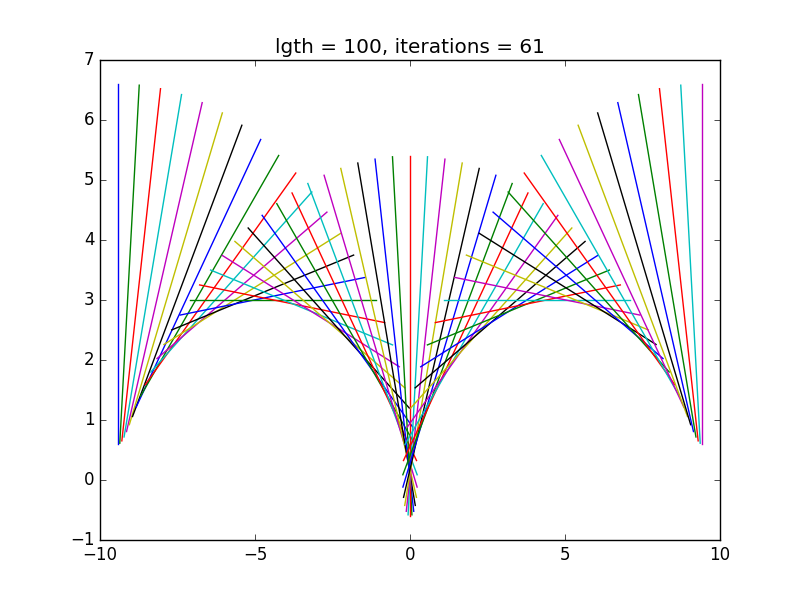
Drawn using Python and Matplotlib. This picture is serendipitous and not intended.

[Grr! While I finished my previous post, I didn’t publish it. Darn it.]

Since I’ve been playing around with computer generated images recently, my thoughts turned to how we see images. When you look at a computer or television screen these days, you are looking at a matrix of pixels. A pixel can be thought of as a very tiny point of light, or a location that can be switched on and off very rapidly.

Pixels are small. There’s 1920 across my screen at the current resolution, and while I can just about see the individual pixels if I look up close, they are small. To get the same resolution with an array of 5cm light bulbs, the screen would need to be 96 metres in size! You’d probably want to sit at about 150m from the screen to watch it.

A closeup of pixels.
A closeup of pixels. (Photo credit: Wikipedia)

The actual size of a pixel is a complicated matter, and depends on the resolution setting of your screen. However, the rating of a camera sensor is a different matter entirely. When I started looking into this, I thought that I understood it, but I discovered that I didn’t.

What complicates things as regards camera sensor resolutions is that typically a camera will store an image as a JPG/JPEG image file, though some will save the image as a RAW image file. The JPG format is “lossy” so some information is lost in the process (though typically not much). RAW image file are minimally processed from the sensor data so contain as much information about what the sensor sees as is possible. Naturally they are larger than JPG format images.


Embed from Getty Images

When we look at a screen we don’t see an array of dots. We pretty much see a smooth image. If the resolution is low, we might consider the image to be grainy, or fuzzy, but we don’t actually “see” the individual pixels as such, unless we specifically look closely. This is because the brain does a lot of processing of an image before we “see” it.

I’ve used the scare quotes around the word “see”, because seeing is very much a mental process. The brain cells extend right out to the eye, with the nerves from the eye being connected directly into the brain.

Schematic diagram of the human eye in greek.
Schematic diagram of the human eye in greek. (Photo credit: Wikipedia)

The eye, much like a camera, consists of a hole to let in the light, a lens to focus it, and sensor at the back of the eye to capture the image. Apparently the measured resolution of the eye is 576 megapixels, but the eye has a number of tricks to improve its apparent resolution. Firstly, we have two eyes and the slightly different images are used to deduce detail that one eye alone will not resolve. Secondly, the eye moves slightly and this also enables it to deduce more detail than would be apparent otherwise.

That said, the eye is not made of plastic metal and glass. It is essentially a ball of jelly, mostly opaque but with a transparent window in it. The size of the window or pupil is controlled by small muscles which contract or expand the size of the pupil depending on the light level (and other factors, such as excitement).

English: A close up of the human eye. Notice t...
English: A close up of the human eye. Notice the reflection of the photographer. (Photo credit: Wikipedia)

The light is focused on to an area at the back of the eye, which is obviously not flat, but curved. Most the focusing is done by the cornea, the outermost layer of the eye, but the lens is fine tuned by muscles which stretch and relax the lens as necessary. This doesn’t on the face of it seem as accurate as a mechanical focusing system.

In addition to these factors, human eyes are prone to various issues where the eye cannot focus properly, such as myopia (short sightedness) or hyperopia (long sightedness) and similar issues. In addition the jelly that forms the bulk of the eye is not completely transparent, with “floaters” obstructing vision. Cataracts may cloud the front of the cornea, blurring vision.

English: Artist's impression of appearance of ...
English: Artist’s impression of appearance of ocular floaters. (Photo credit: Wikipedia)

When all this is considered, it’s amazing that our vision works as well as it does. One of the reasons that it does so well is, as I mentioned above, the amazing processing that our brains. Interestingly, what it works with is the rods and cones at the back of the eye, which may or may not be excited by light falling on them. This in not exactly digital data, since the associated nerve cells may react when the state of the receptor changes, but it is close.

It is unclear how images are stored in the brain as memories. One thing is for sure, and that is that it is not possible to dissect the brain and locate the image anywhere in the brain. Instead an image is stored, as it is in a computer, as a pattern. I suspect that the location of the pattern may be variable, just as a file in a computer may move as files are moved about.

Expanded version, with explanations.
Expanded version, with explanations. (Photo credit: Wikipedia)

The mind processes images after the raw data is captured by the eye and any gaps (caused by, for example, blood vessels in the eye blocking the light). This is why, most of the time, we don’t notice floaters, as the mind edits them out. The mind also uses the little movements of the eye to refine information that the mind uses to present the image to our “mind’s eye“. The two eyes, and the difference between the images on the backs of them also helps to build up the image.

It seems likely to me that memories that come in the form of images are not raw images, but are memories of the image that appears in the mind’s eye. If it were otherwise the image would lacking the edits that are applied to the raw images. If I think of an image that I remember, I find that it is embedded in a narrative.

Narrative frieze.
Narrative frieze. (Photo credit: Wikipedia)

That is, it doesn’t just appear, but appears in a context. For instance, if I recall an image of a particular horse race, I remember it as a radio or television commentary on the race. Obviously, I don’t know if others remember images in a similar way, but I suspect that images stored in the brain are not stored in isolation, like computer files, but as part of a narrative. That narrative may or may not relate to the occasion when the image was acquired. Indeed the narrative may be a total fiction and probably exists so that the mental image may be easily retrieved.

One bubble memory track and loop
One bubble memory track and loop (Photo credit: Wikipedia)


The Banach Tarski Theorem


Embed from Getty Images

There’s a mathematical theorem (the Banach Tarski theorem) which states that

Given a solid ball in 3‑dimensional space, there exists a decomposition of the ball into a finite number of disjoint subsets, which can then be put back together in a different way to yield two identical copies of the original ball.

This is, to say the least, counter intuitive! It suggests that you can dissect a beach ball, put the parts back together and get two beach balls for the price of one.

This brings up the question of what mathematics really is, and how it is related to what we loosely call reality? Scientists use mathematics to describe the world, and indeed some aspects of reality, such as relativity or quantum mechanics, can only be accurately described in mathematics.


Embed from Getty Images

So we know that there is a relationship of some sort between mathematics and reality as our maths is the best tool that we have found to talk about scientific things in an accurate way. Just how close this relationship is has been discussed by philosophers and scientists for millennia. The Greek philosophers, Aristotle, Plato, Socrates and others, reputedly thought that “all phenomena in the universe can be reduced to whole numbers and their ratios“.

The Banach Tarski theorem seems to go against all sense. It seems to be an example of getting something for nothing, and appears to contravene the restrictions of the first law of thermodynamics. The volume (and hence the amount of matter) appears to have doubled, and hence the amount of energy contain as matter in the balls appears to have doubled. It does not appear that the matter in the resulting balls is more attenuated than that in the original ball.

The Banach–Tarski paradox: A ball can be decom...
The Banach–Tarski paradox: A ball can be decomposed and reassembled into two balls the same size as the original. (Photo credit: Wikipedia)

Since the result appears to be counter intuitive, the question is raised as to whether or not it is merely a mathematical curiosity or whether it has any basis in reality, It asks something fundamental about the relationship between maths and reality.

It’s not the first time that such questions have been asked. When the existence of the irrational numbers was demonstrated, Greek mathematicians were horrified, and the discoverer of the proof (Hippasus) was either killed or exiled, depending on the source quoted. This was because the early mathematicians believed that everything could be reduced to integers and rational numbers, and their world did not have room for irrational numbers in it. In their minds numbers directly related to reality and reality was rational mathematically and in actuality.

English: Dedekind cut defining √2. Created usi...
English: Dedekind cut defining √2. Created using Inkscape. (Photo credit: Wikipedia)

These days we are used to irrational numbers and we see where they fit into the scheme of things. We know that there are many more irrational numbers than rational numbers and that the ‘real’ numbers (the rational and irrational numbers together) can be described by points on a line.

Interestingly we don’t, when do an experiment, use real numbers, because to specify a real number we would have write down an infinite sequence of digits. Instead we approximate the values we read from our meters and gauges with an appropriate rational number. We measure 1.2A for example, where the value 1.2 which equals 12/10 stands in for the real number that corresponds to the actual current flowing.

English: A vintage ampere meter. Français : Un...
English: A vintage ampere meter. Français : Un Ampèremètre à l’ancienne. (Photo credit: Wikipedia)

We then plug this value into our equations, and out pops an answer. Or we plot the values on a graph read off the approximate answer. The equations may have constants which we can only express as rational numbers (that is, we approximate them) so our experimental physics can only ever be approximate.

It’s a wonder that we can get useful results at all, what with the approximation of experimental results, the approximated constants in our equations and the approximated results we get. If we plot our results the graph line will have a certain thickness, of a pencil line or a set of pixels. The best we can do is estimate error bounds on our experimental results, and the constants in our equations, and hence the error bounds in our results. We will probably statistically estimate the confidence that the results show what we believe they show through this miasma of approximations.

Image of simulated dead pixels. Made with Macr...
Image of simulated dead pixels. Made with Macromedia Fireworks. (Photo credit: Wikipedia)

It’s surprising in some ways what we know about the world. We may measure the diameter of a circle somewhat inaccurately, we multiply it by an approximation to the irrational number pi, and we know that the answer we get will be close to the measured circumference of the circle.

It seems that our world resembles the theoretical world only approximately. The theoretical world has perfect circles, with well-defined diameters and circumference, exactly related by an irrational number. The real world has shapes that are more or less circular, with more or less accurately measured diameters and circumferences, related more or less accurately by an rational number approximating the irrational number, pi.

Pi Animation Example
Pi Animation Example (Photo credit: Wikipedia)

We seem to be very much like the residents of Plato’s Cave and we can only see a shadow of reality, and indeed we can only measure the shadows on the walls of the cave. In spite of this, we apparently can reason pretty well what the real world is like.

Our mathematical ruminations seem to be reflected in reality, even if at the time they seem bizarre. The number pi has been known for so long that it no longer seems strange to us. Real numbers have also been known for millennia and don’t appear to us to be strange, though people don’t seem to realise that when they measure a real number they can only state it as a rational number, like 1.234.

English: The School of Athens (detail). Fresco...
English: The School of Athens (detail). Fresco, Stanza della Segnatura, Palazzi Pontifici, Vatican. (Photo credit: Wikipedia)

For the Greeks, the irrational numbers which actually comprise almost all of the real numbers, were bizarre. For us, they don’t seem strange. It may be that in some way, as yet unknown, the Banach Tarski theorem will not seem strange, and may seem obvious.

It may be that we will use it, but approximately, much as we use the real numbers in our calculations and theories, but only approximately. I doubt that we will be duplicating beach balls, or dissecting a pea and reconstituting it the same size as the sun, but I’m pretty sure that we will be using it for something.


Embed from Getty Images

I see maths as descriptive. It describes the ideal world, it describes the shape of it. I don’t think that the world IS mathematics in the Pythagorean sense, but numbers are an aspect of the real world, and as such can’t help but describe the real world exactly, while we can only measure it approximately. But that’s a very circular description.

English: Illustrates the relationship of a cir...
English: Illustrates the relationship of a circle’s diameter to its circumference. (Photo credit: Wikipedia)


Turtles and More

Kina
Turtle graphics. This to me resembles a Kina or Sea Urchin

My wife recently became interested in the Spirograph (™) system. Since her birthday was coming up, so did I, for obvious reasons. If you have never come across Spirograph (™) I can highly recommend it, as it enables the production of glorious swirls and spirals, using a system of toothed wheels and other shapes. When you use multicoloured pen, the results can be amazing.

Of course, I had to translate this interest into the computer sphere, and I immediately recalled “Turtle Graphics” which I have used before. It is possible to create graphics very similar to the Spirograph (™) designs very simply with Turtle Graphics.

Trefoil
This resembles the sort of things generated by Spirograph (TM)

Turtle Graphics have a long history, stretching back at least to the educational programming language Logo. Although variations of the original Logo language exist, they are fairly rare, but the concept of Turtle Graphics, where a cursor (sometimes shown as the image of a cartoon turtle) draws a line on a page, still exists. The turtle can be directed to move in a particular way, based on instructions by the programmer.

For instance the turtle can be instructed to move forward a certain distance, turn right through 90°, and repeat this process three times. The result is a small square. Or the turtle could be instructed to move forward and turn only 60°, repeating this 5 times to draw a hexagon. Using simple instructions like this allow the drawing of practically anything.

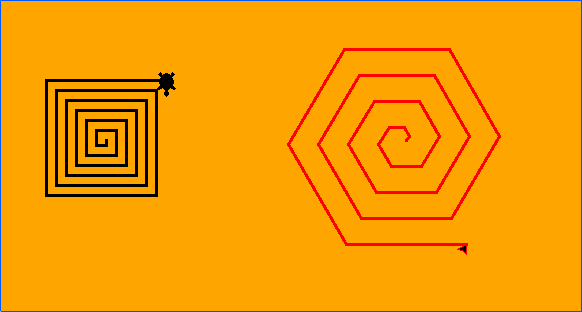
Square and Hexagonal spirals
Square and hexagonal spirals drawn by Turtle Graphics

I use an implementation of Turtle Graphics in the turtle module of the Python programming language but it is probably available for other programming languages. Python is probably an easy language to learn from scratch than Logo, and in addition Python can be used for many other things than Turtle Graphics. Python is available for Windows, OS/X, and Linux/Unix, and for several other older or less well known platforms.

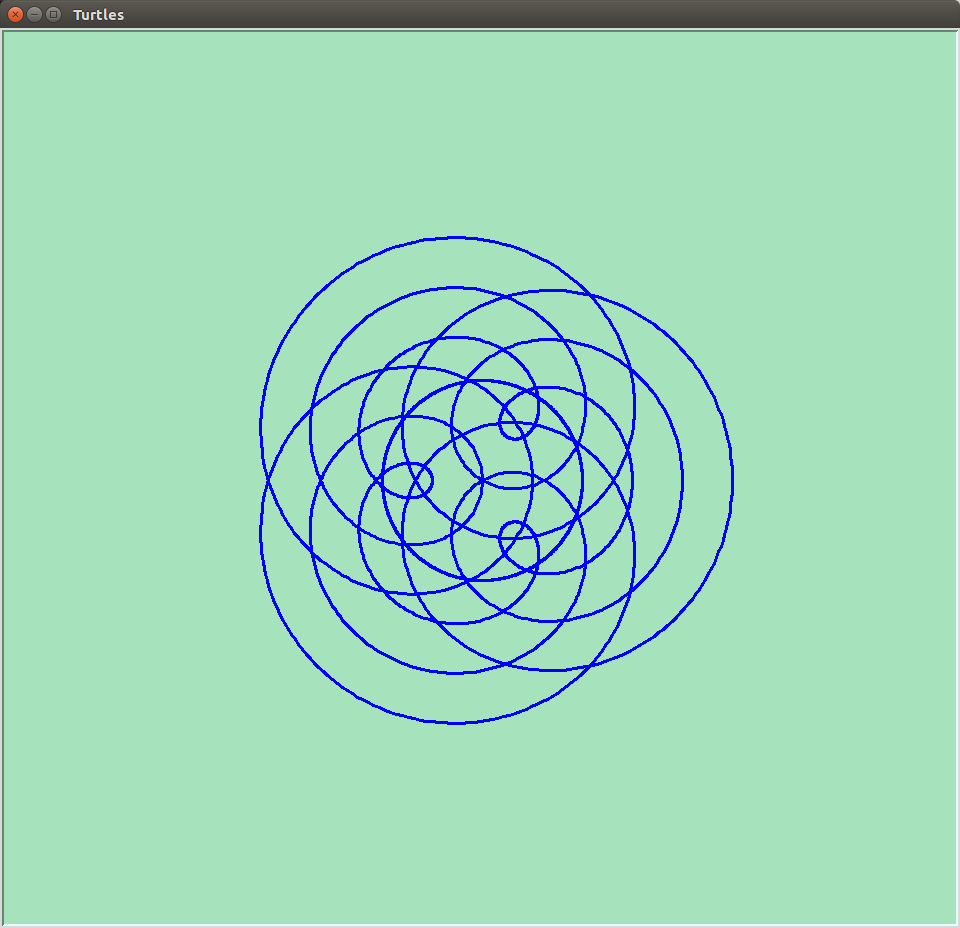
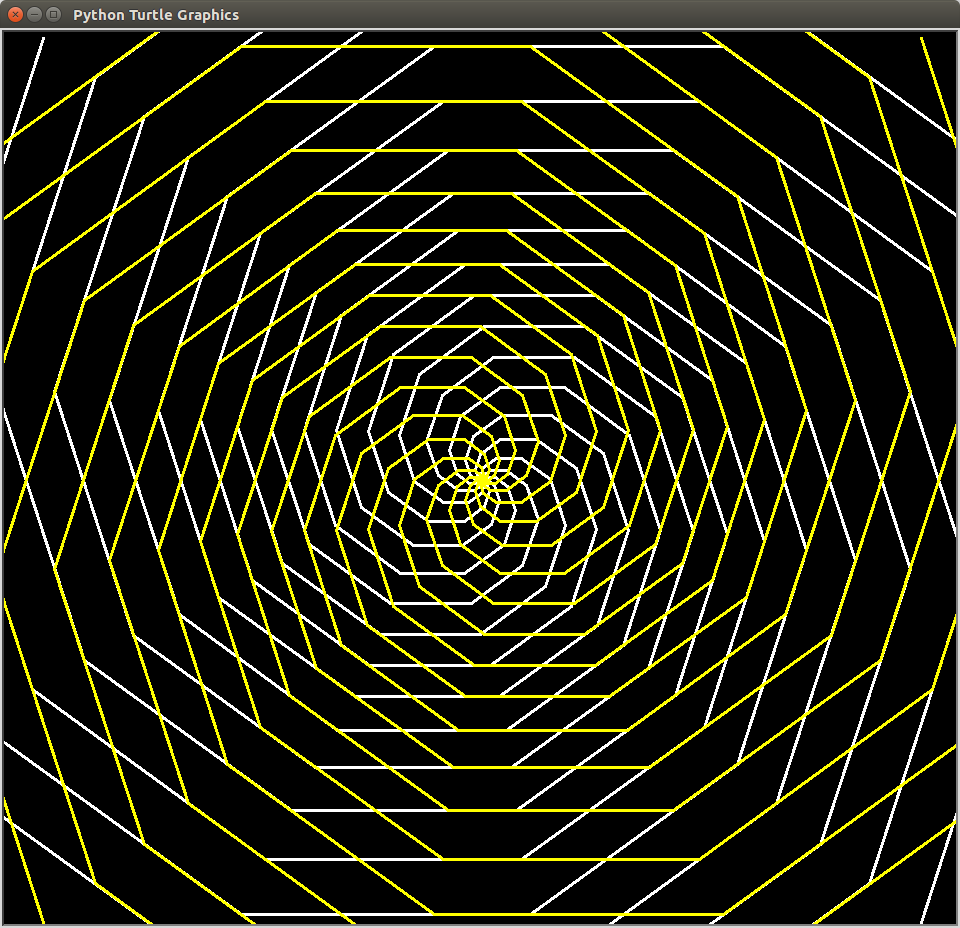
Where things become interesting is when the looping abilities of Python are used to enhance a program. If the programmer gets the turtle to draw a square, then makes the turtle turn a little and repeats the process, the result is a circular pattern. Starting with a more interesting shape can produce some interesting patterns.

Rotated Square - Turtle graphics
Rotated Square – Turtle graphics

After a while, though, the patterns begin to seem very similar to one another. One way to add a bit of variation is to use the ability to make the turtle move to a specific position, drawing a line on the way. As an example, consider a stick hinged to another stick, much like a nunchaku. If one stick rotates as a constant speed and the second stick rotates at some multiple of that, then the end of the second stick traces out a complex curve.

Flower shape
Flower shape – turtle graphics

In Python this can be expressed like this:

x = int(a * math.sin(math.radians(c * i)) + b * math.sin(math.radians(d * i)))
y = int(a * math.cos(math.radians(c * i)) + b * math.cos(math.radians(d * i)))

where c and d are the rates of rotation of the two sticks and and b are the lengths of the stick. i is a counter that causes the two sticks to rotate. If the turtle is moved to the position x, y, a line is drawn from the previous position, and a curve is drawn.

The fun part is varying the various parameters, a, b, c, d, to see what effect that has. The type of curve that is created here is an epicycloid. For larger values of c and d the curves resemble the familiar shapes generated by Spirograph (™).

Epitrochoids
Epitrochoids

The equations above use the same constants in each equation. If the constant are different, some very interesting shapes appear, but I’m not going to go into that here. Suffice it to say, I got distracted from writing this post by playing around with those constants!

The above equations do tend to produce curves with radial symmetry, but there is another method that can be used to produce other curves, this time with rotational symmetry. For instance, a curve can be generated by moving to new point depending on the latest move. This process is then iterative.

Gravity Wave - turtle graphics
Gravity Wave turtle graphics

For instance, the next position could be determined by turning through an angle and move forward a little more than the last time. Something like this snippet of code would do that:

for i in range(1, 200):
t.forward(a)
t.pendown()

t.left(c)
a = a + 1
c = c + 10

This brings up a point of interest. If you run code like this, ensure that you don’t stop it too soon. This code causes the turtle to spin and draw in a small area for a while, and then fly off. However it quickly starts to spin again in a relatively small area before once more shooting off again. Evidently it repeats this process as it continues to move off in a particular direction.

Turtle graphics - a complex curve from a simple equation
Turtle graphics – a complex curve from a simple equation

Another use of turtle graphics is to draw graphs of functions, much like we learnt to do in school with pencil and squared paper. One such function is the cycloid function:

x = r(t – sine(t))

y = r(1 – cosine))

This function describes the motion of a wheel rolling along a level surface and can easily be translated into Python. More generally it is the equation of a radius of a circle rolling along a straight line. If a different point is picked, such a point on a radius inside the circle or a point outside the circle on the radius extended, a family of curves can be generated.

Cycloid curve - turtle graphics
Cycloid curve – turtle graphics

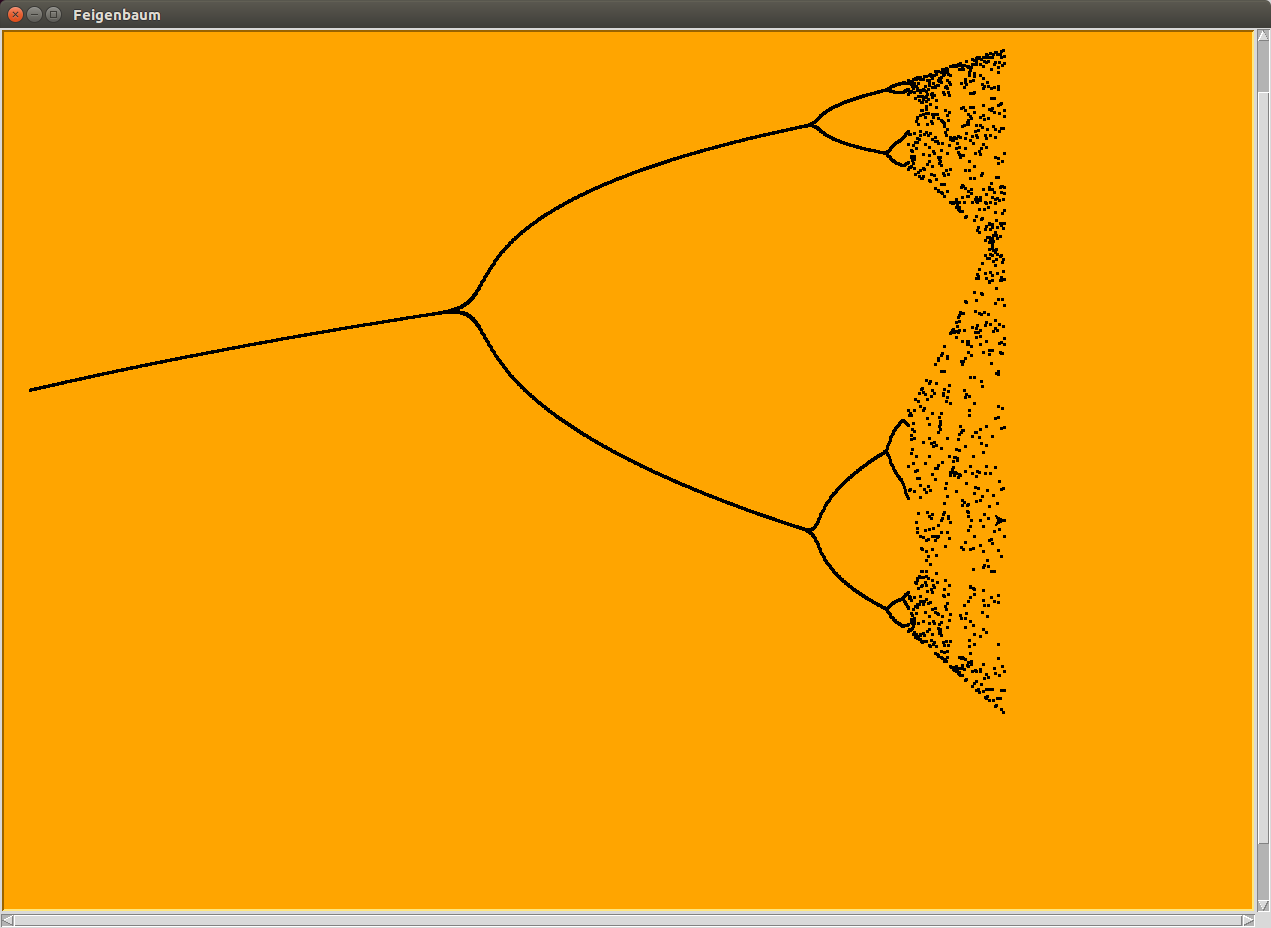
Finally, a really technical example. An equation like the following is called a dynamic equation. Each new ‘x’ is generated from the equation using the previous ‘x’. If this process is repeated many times, then depending on the value of ‘r’, the new value of ‘x’ may become ever closer to the previous value of ‘x’.

x(n+1) = rx(n)(1 – x(n))

If the value of ‘r’ is bigger than a certain value and less than another value, then ‘x’ flip-flops between two values. If the value of ‘r’ is bigger than the other value, and smaller than yet another value then ‘x’ rotates between 4 values. This doubling happens again and again in a “period doubling cascade“.

Turtle graphics - electron orbitals
Turtle graphics – electron orbitals

I’ve written a turtle program to demonstrate this. First a value for ‘r’ is chosen, then the equation is repeated applied 1,000 times, and the next 100 results are plotted, x against r. In the end result, the period doubling can easily be seen, although after a few doubling, the results become messy (which may be related to the accuracy and validity of my equations, and the various conversion between float and integer types).

Period doubling
The “fig tree” curve calculated in Python and plotted by Turtle Graphics.