A Programmer’s Lot is Not a Happy One?


Embed from Getty Images

Well, I don’t know really. Most programmers that I know seem about as happy as the rest of the population, but I was thinking about programming and that variation on “A Policeman’s Lot” from the Pirates of Penzance appealed to me.

Programming in often presented as being difficult and esoteric, when in fact it is only a variation of what humans do all the time. When you read a recipe or follow a knitting pattern, you are essentially doing what a computer does when it “runs a program”.

Unix program to display running processes
Unix program to display running processes (Photo credit: Wikipedia)

The programmer in this analogy corresponds to the person who wrote the recipe or knitting pattern. Computer programs are not a lot more profound than a recipe or pattern, though they are, in most cases, a lot more complicated than that.

It’s worth noting that recipes and patterns for knitting (and for weaving for that matter) have been around for many centuries longer than computer programs. Indeed it could be argued that computers and programming grew out of weaving and the patterns that could be woven into the cloth.

English: Pattern of traditional Norwegian Sete...
English: Pattern of traditional Norwegian Setesdal-sweater. The pattern is created to be used on a punch card in a knitting machine. Svenska: Klassiskt mönster från lusekofta från Setesdalen, Norge. Mönsterrapporten är skapad för att användas på hålkort i stickmaskin. (Photo credit: Wikipedia)

In 1801 Joseph Marie Jacquard invented a method of punched cards which could be used to automatically weave a pattern into textiles. It was a primitive program, which controlled the loom. I imagine that before it was invented the operators were giving a sheet to detail what threads to raise and which drop, and which colour threads to run through the tunnel thus formed. I can also imagine that such a manual process would lead to mistakes, leading to errors in the pattern created in the cloth. It would also be time consuming, I expect.

Jacquard’s invention, by bypassing this manual method would have led to accurately woven patterns and a great saving in time. Also, an added advantage was that changing to another pattern would be as simple as loading a new set of punched cards.

English: Jacquard loom in the National Museum ...
English: Jacquard loom in the National Museum of Scotland, Edinburgh. Nederlands: Weefgetouw met Jacquardmechanisme in het National Museum of Scotland, Edinburgh. (Photo credit: Wikipedia)

At around this time, maybe a little later, the first music boxes were produced. These contained a drum with pins that plucked the tines of a metal comb. However the idea for music boxes goes back a lot further as the link above tells.

The only significant difference between Jacquard’s invention and the music boxes is that Jacquard relied on the holes and music boxes relied on pins. They operated in different senses, positive and negative but the principle is pretty much the same.

A PN junction in thermal equilibrium with zero...
A PN junction in thermal equilibrium with zero bias voltage applied. Electron and hole concentrations are reported respectively with blue and red lines. Gray regions are charge neutral. Light red zone is positively charged. Light blue zone is negatively charged. Under the junction, plots for the charge density, the electric field and the voltage are reported. (Photo credit: Wikipedia)

Interestingly there is a parallel in semiconductors. While current is carried by the electrons, in a very real sense objects called “holes” travel in the reverse direction to the electrons. Holes are what they sound like, places where an electron is absent, however I believe that in semiconductor theory, they are much more than mere gaps, and behave like real particles.

It’s amazing how powerful programming is. Microsoft Windows is probably the most powerful program that non-programmers come into contact with, and it does so many things “under the hood” that people take for granted, and it is all based on the absence or presence of things, much like Jacquard’s loom and the music boxes. While that is an analogy, it is not too far from the mark, and many people will remember having been told, more or less accurately that computers run on ones and zeroes.


Embed from Getty Images

When a programmer sits down to write a program he or she doesn’t start writing ones and zeroes. He or she writes chunks of stuff which non-programmers would partially recognise. English words like “print”, “do”, “if” and “while” might appear. Symbols that look like maths might also appear. Depending on the language, the code might be sprinkled with dollar signs, which have nothing directly to do with money, by the way.

The programmer write in a “language“, which is much more tightly defined than ordinary language, but basically it details at a relatively high level what the programmer wants to happen.

Logo for the Phoenix programming language
Logo for the Phoenix programming language (Photo credit: Wikipedia)

The programmer may tell the program to “read” something and if the value read is positive or is “Baywatch” or is “true”, do something. The programmer has to bear in mind that often the value is NOT what the programmer wants the program to look for and it is the programmer’s responsibility to handle not only the “positive” outcome but also the “negative” one. He or she will tell the program to do something else.

When the programmer tells the program to “read” something, he or she essentially invokes a program that someone else has written whose only job is to respond to the “read” command. These “utility” program are often written in a more esoteric language than the original programmer uses (though they don’t have to be), and since they do one specific task they can be used by anyone who programs on the computer.


http://www.gettyimages.com/detail/107885297

This program instructs other, lower level programs to do things for it. Again these lower level programs do one specific thing and can be used by other programs on the computer. It can be seen that I am describing a hierarchy of ever more specialised programs doing more and more specific tasks. It’s not quite like the Siphonaptera though, as the programs eventually reach the hardware level.

At the hardware level it will not be apparent what the programs are intended for, but the people who wrote them know the hardware and what the program needs to do. This is partially from the hierarchy of programs above, but also from similar programs that have already been written.

English: CPU
English: CPU (Photo credit: Wikipedia)

Without going into detail, the low level program might require a value to be supplied to the CPU of the computer. It will cause a number of conducting lines (collectively a “bus”) to be in one of two states, corresponding to a one or a zero, or it might cause a single line to vary between the states, sending a chain of states to the CPU.

In either case the states arrive in a “register”, which is a bit like a railway station. The CPU sends the chains of states (or bits) through its internal “railway system”, arranging for them to be compared, shifted, merged and manipulated in many ways. The end result is one or more chains of states arriving at registers, from whence they are picked up and used by the programs, with the end result being whatever the programmer asked for, way up in the stratosphere!

Modelleisenbahn im Hauptbahnhof Wiesbaden
Modelleisenbahn im Hauptbahnhof Wiesbaden (Photo credit: Wikipedia)

This is monumental achievement, pun intended, and is only achievable because at each level the programmer writes a program that performs one task at that level which doesn’t concern itself at all with any other levels except that it conforms to the requests coming from above (the interface, technically). This is called abstraction.

Data abstraction levels of a database system
Data abstraction levels of a database system (Photo credit: Wikipedia)

Legalistic Stuff

Marooned
Marooned (Photo credit: Wikipedia

Suppose two men are marooned on a remote island somewhere. At first each is unaware that the other is there, but eventually they meet. Suppose that for some reason they don’t want to join up, but they do want to interact. So they set about working out ways to share the island, and obviously they want to live amicably until they are rescued.

So they might draw an imaginary line across the island. A can only go into B’s half as long as B is aware and approves, and vice versa. Maybe it turns out that food is easier to come by in B’s half, but there is plenty for both. B allows A to venture into parts of his half of the island and A drops off a few items that he has gathered as thanks.

The upper part of the stela of Hammurapis' cod...
The upper part of the stela of Hammurapis’ code of laws (Photo credit: Wikipedia)

Later on they find that A’s part of the island has the best spots to catch fish or something, and they come to an agreement about that. Slowly but surely they build up a set of rules on how to behave and live on the island in harmony.

One can imagine that an arbitrarily complex set of rules may be developed, and these rules could be further complicated if a third man, C, were to join them on the island.


Embed from Getty Images

You can probably see where I am going with this. As the population of the island rises, more and more rules will become necessary, or if not necessary, useful, and at some stage someone will have the idea of writing them down. The rules become laws and eventually attract all the mechanisms of a full legal system.

While browsing around while thinking about this sort of thing, I came across a review of “Day Z”, which the author of the review describes as “A Video Game Without Rules”. The author describes how the ability to do nasty things to others leads to characters in the game, especially established players doing nasty things to other players, usually new spawned players.

English: Uppercase and lowercase Greek letter ...
English: Uppercase and lowercase Greek letter zeta, the 6th letter of the Greek alphabet. Times New Roman font. (Photo credit: Wikipedia)

It’s possible that the behaviour of players in the game is merely an early stage in its evolution, and it may be that later on stronger players may band together to help the newly spawned players and the people who treat new players badly will be marginalised or persuaded to change their ways. One can hope.

Another dismal view of the island scenario was that of William Golding who wrote “The Lord of the Flies”, where a group of English schoolboys are marooned on an island, perhaps as the result of an atomic war. They soon revert to savagery and murder, overriding the civilised urgings of Piggy and Ralph. As Piggy says “Which is better—to have rules and agree, or to hunt and kill? … law and rescue, or hunting and breaking things up?” The rest of the boys obviously want to hunt and kill.

Pig head for sale at Cleveland's West Side Market
Pig head for sale at Cleveland’s West Side Market (Photo credit: Wikipedia)

Nevertheless, the process of generating laws by discussion and agreement was probably along the lines that I have suggested above. No doubt there were many tries to achieve this process which failed in the manner that things appear to have failed in the video game and how they were depicted as failing in “the Lord of the Files”, before a working system of laws was achieved.

It’s possible that the magic ingredient was the evolution of system of magistrates and a method of enforcing the laws. With a supposedly impartial system to decide the rights of a matter, and a special force or police system to enforce the laws, the weak individual would be protected against the stronger.

English: Hammurabi code. One of the first law ...
English: Hammurabi code. One of the first law sets in the world. Now it is in the Louvre museum, Mesopotamia section. Asia. Español: Código de Hammurabi. Uno de los primeros conjuntos de leyes del mundo. Se encuentra en el museo de Louvre, sección de Asia antigua. Mesopotamia, Babilonia. (Photo credit: Wikipedia)

In early days, the system of laws and the enforcement of them would have been vested in the priests and spiritual leaders, who would have controlled the enforcement system, probably “Temple Guards” or similar.

Where do kings fit in? The rulers were often not priests themselves, but the rulers were seen to rule by divine right, so there was a tight link between the rulers and the religious leaders. Kings such as Hammurabi supposedly led the way in law making, though no doubt there was much political to and fro between the kings and the priests.

English: Priest Mongaku's forty-five article r...
English: Priest Mongaku’s forty-five article rules and regulations (文覚四十五箇条起請文〈藤原忠親筆/, mongaku yonjūgokajō kishōmon). Document requesting the restoration of Jingo-ji temple from Emperor Go-Shirakawa. Located at Jingo-ji, Kyoto, Japan. The scroll has been designated as National Treasure of Japan in the category ancient documents. (Photo credit: Wikipedia)

These days, in many countries the law has been secularised and in many laws are decided by the government of the country, and are arbitrated by a separate branch of the administration called the justice system, and the enforcement is carried out by the police and retribution by the prisons system.

Lawmaking, justice and enforcement are in many countries legally independent of one another so that, for example, the government cannot manipulate the system for its own advantage. The principle is that justice should be independent of lawmaking and the enforcement systems.

English: The courthouse of Tours. Français : L...
English: The courthouse of Tours. Français : Le palais de justice de Tours. (Photo credit: Wikipedia)

How does all this affect the man in the street? Well, in practise, not very much, usually, at least not directly. When driving along the road, a motorist is aware that the speed limit is so-and-so, and usually keeps to it, more or less. He or she treats it as an advisory rather than a restriction, in that it is taken as the top speed that is safe for that road.

The man in the street also uses laws for his own protection. He will assume that the consumer protection laws back him up when he purchases something which it transpires is defective and will feel confident in returning it. In most cases the retailer would not be too upset by someone returning a defective product as in most cases the retailer would want a happy customer and can return the product to the manufacturer.


http://www.gettyimages.com/detail/169814593

In general, laws work best when they conform with the principle of “natural justice” or what would generally be considered fair. It is not fair for example for someone to keep others awake by holding noisy all night parties, and in most cases the law will support the sleepless neighbours over the noisy one, but it could come down to a matter of perception.

Things like disputes about access to properties can hinge on such matters and are very often cannot easily be settled. The law has been evolving for thousands of years, but it can’t solve every dispute, although we would be worse off without it. It has to change as the world is changing, so it is constantly evolving. We cannot expect it to be perfect.

At the Law Rock, or Lögberg, a rocky outcrop o...
At the Law Rock, or Lögberg, a rocky outcrop on which the Lawspeaker, or lögsögumaður, took his seat as the presiding official of the Icelandic Althing (Alþing), at Thingvellir, or Þingvellir, Iceland. assembly. (Photo credit: Wikipedia)

I forgot!


Embed from Getty Images

Well, I almost forgot to write my weekly post. My excuse is that Monday is a public holiday and this upset my schedule. Of course this is only an excuse.

It did start me thinking about forgetting things. We have probably all forgotten appointments at one time or another, though with cell phones being ubiquitous and possessing calendars, we probably should never do so in the future. Yeah, right!

A page of a calendar.
A page of a calendar. (Photo credit: Wikipedia)

The reasons why we forget appointments can be myriad, but I’d suggest that at least some of the appointments that we miss are ones that we would prefer to miss, such dentist appointments. I’d guess that we would be much more likely to remember lunch appointments or some other types of appointments that we would enjoy.

Some people seem to forget things that I am unlikely to forget, such as plane flights. It always amazes me that people can turn up for flights at the last minute. I’m usually in the airport, waiting, well before the official check-in time starts.


Embed from Getty Images

It is probably a consequence of our busy lives that we need calendars and other “aide memoires” like shopping lists. One can imagine that in earlier times to-do lists were shorter and the number things that one needed to carry on a normal life was a lot smaller and our memories were able to cope. But then again, that may be an illusion. Was life really simpler in the past?

If you miss an appointment that affects not only you, but the people with whom you have the appointment. The dentist will be looking at an empty chair, and while he may enjoy the break, it will cost him money. That’s why some service providers like dentists may charge you a fee if you forget an appointment. Some places get the receptionist to send you a text the day before as a reminder.

Honthorst, Gerard van - The Dentist - 1622
Honthorst, Gerard van – The Dentist – 1622 (Photo credit: Wikipedia)

Although I’ve suggested above that maybe in simpler times the need for a calendar was less, the need was not non-existent. Farmers, for example, need to know the best time to plant seeds to ensure a good crop.

The Babylonian calendar for example was based on both lunar and solar cycles which would enable the priests to suggest the correct time for planting crops. This calendar has its origins around 2000 BCE according to Wikipedia.

Map showing the Babylonian territory upon Hamm...
Map showing the Babylonian territory upon Hammurabi’s ascension in 1792 BC and upon his death in 1750 BC (Photo credit: Wikipedia)

The Mayan calendar is even older, with roots in the 5th century BCE. The Mayan calendar came to popular attention in 2012, when it was conjectured that the Mayan calendar would end on 21 December 2012, and that this would signal a global catastrophe.

Of course nothing significant happened and the Wikipedia article on the topic explains that the Mayan calendar did not end on that date. Surely very few people seriously thought that it would. Even the ancient Mayans did not predict a calamity at that time, so far as scholars are aware.

Complete Haab cycle. This photo was taken by t...
Complete Haab cycle. This photo was taken by the usuary Theilr and posted in the Flickr site (Photo credit: Wikipedia)

Forgetting important dates is a recipe for matrimonial disharmony. There seems to be a gender bias here as most males do not worry too much if you miss a birthday, but it seems more important to females. Whether or not this is real gender difference or merely a societal one, I’m not prepared to guess. Whatever the cause, it is best to remember one’s spouse’s birthday. I personally find it very difficult to remember dates other than the usual wedding anniversary, spouse’s birthday and my children’s birthdays.

There is another sort of forgetting though, one that creeps up on one as time passes. Some of that can be attributed to loss of facilities due to age, but memories do seem to fade regardless of ageing. Even in your twenties your recall of events ten years earlier can be faulty, though for some reason some things can be said to stick in your mind.

Candles spell out the traditional English birt...
Candles spell out the traditional English birthday greeting (Photo credit: Wikipedia)

It’s difficult to work out what we have forgotten and what we have simply had no reason to remember. Something may, for some reason or other, trigger a memory, and we say “Oh, I had forgotten that!” when obviously, we hadn’t.

Equally, memories may be replaced by false memories. For instance, for years I believed that I had a memory of an event at a particular place involving my sister’s pushchair. When I visited the place many years later, it was apparent that the event could not have happened as I remember it. The slope of the path, the flower beds were all wrong.

English: Versailles gardens with a fountain Fr...
English: Versailles gardens with a fountain Français : Bassin de Latone, jardin de Versailles. (Photo credit: Wikipedia)

It seems to me that memories can be true, or totally false, and that a memory of events may be completely lost, and this would make the study of memory very difficult and that relying on memory for veracity is impossible.

There are people who claim to have memories of a previous life. I don’t believe such claims, as I don’t believe that there is such a thing as reincarnation. If there were such a thing, one wonders why those who remember their previous lives were always important and powerful people in past lives.

Portrait of Marie-Antoinette of Austria
Portrait of Marie-Antoinette of Austria (Photo credit: Wikipedia)

But memory loss definitely gets worse as one gets older. Some unfortunate people suffer so badly from memory loss that they cannot recognise their own families and get lost in places with which they were once familiar. As people live for longer this phenomenon is becoming a big problem.

Of course there is research into both ageing and memory, so this situation will hopefully improve, but at the moment, it doesn’t seem attractive to live to 100+ and lose all one’s faculties.


Embed from Getty Images

Memory is one of the things that makes you you. You can remember many things from your past, and while you can’t completely remember being the person that you were, you can remember some of it. Maybe you can remember what you were feeling at the time, maybe not.

But you believe that the person that you remember was you, in spite of the forgotten things, the things that you remember wrongly, because there is a continuous thread of memory between the person that you remember and you in the here and now.

English: Graphic from the licensing tutorial
English: Graphic from the licensing tutorial (Photo credit: Wikipedia)

Yet in another sense, that person was not you. His memories only encompass the time up until his now. Your memories of the time from then on are of events that have changed you and your memory of events before that person’s now have also changed, or been lost. How could you be the same person?


Embed from Getty Images

One Hundred and One

English: Wayne County (NY) Route 101 shield. P...
English: Wayne County (NY) Route 101 shield. Public domain. Unlike most counties, Wayne County posts its county routes on blade signage. (Photo credit: Wikipedia)

The last post that I made was my 100th post on this blog. I’ve tried to keep blogs before now, but I’ve always failed at some point. There are blogs started by me at various places on the Internet, but this is the only one to have got past a few dozen posts.

I’m not sure of the reason why I’ve been able to keep this blog going and I’ve failed before. I don’t think that it is the fact that this is a WordPress blog, as I’ve not found significant differences between the various type of blog. They all do pretty much the same thing.

English: WordPress Logo
English: WordPress Logo (Photo credit: Wikipedia)

Of course, there are myriads of themes out there, but it is impossible to hide the underlying structure completely – you create a blog post, you post it and people are able to look at it.


Embed from Getty Images

There are no doubt those who have specific needs and need specific features, for example if they are selling something and need to accept payments, who find that a specific blogging platform is required to fill their needs, but most people will find, I think, that the blogging platform that they use is mostly irrelevant.

I have committed myself to creating blog post of around 1,000 words once per week and so far I’ve been able to achieve this. I plan to have a post ready to go on Monday evening. Below I’m going to describe how I write a post. It’s a creative process, with a small ‘c’. It’s not Creative with a large ‘C’, a work of Art, as I don’t aspire to such exalted levels. It’s just my small blog.

Brain, computer art
Brain, computer art (Photo credit: Wikipedia)

When I sit down to write a post, I usually, but not always, have a topic in mind. If I am lucky I will have been thinking about it during the week and I have some idea on what I am going to include in the post. However, I don’t plan it out as such. I just some ideas, some pretty well developed in mind.

Sometimes though, I sit down at the computer with maybe only a topic or not even that. I type the title and I’m away! So far I’ve not had any real difficulty in reaching the 1,000 words, and sometimes I have to leave things out.

1000 Pennies for Your Thoughts - NARA - 534149
1000 Pennies for Your Thoughts – NARA – 534149 (Photo credit: Wikipedia)

It is usually reckoned that a work of this sort has a distinct beginning and end. I certainly open with a sentence on what I about to write about  and then go on to write about it, but I don’t try to tag on a definitive conclusion, especially if I am running on, and the word count gets significantly higher than 1,000 words.

So anyway, I start writing. As I write I might plan ahead a little, but more often than not I put down my current thought which might take a sentence or three and I correct and formulate my sentences as I go. I look back a little too, and may revise a sentence or phrase in the current paragraph if it strikes me as being too ugly.

English: New York, New York. Newsroom of the N...
English: New York, New York. Newsroom of the New York Times newspaper. Reporters and rewrite men writing stories, and waiting to be sent out. Rewrite man in background gets the story on the phone from reporter outside. (Photo credit: Wikipedia)

I don’t however have the whole thing in my mind, though I may remember and revisit thoughts that I have written earlier if something strikes me. I do think ahead a little, or maybe a paragraph or two, but in general, I compose as I write as I go.

Sometimes I pause, as I just did, to think my way ahead. This is an indication to me that I’ve said all that comes to mind on the point that I was making and that I should start another point.


Embed from Getty Images

I am not formal about references and in fact mostly use Wikipedia for any references, but I try to link to the work of others and sometimes to major references. If a reader has an interest in any of the topics that I touch on, Wikipedia, for all its faults, can be a good place to start.

The result, I suspect, is almost certainly more of a ramble through the topic in question than a serious analysis of it. Caveat Emptor! Of course, anything that I write is my opinion only.

English: Front of Caveat Emptor, a rare books ...
English: Front of Caveat Emptor, a rare books store located at 112 N. Walnut Street in downtown Bloomington, , . Built in 1900, it is part of the Courthouse Square Historic District, a historic district that is listed on the . (Photo credit: Wikipedia)

When I have finished writing the post, I save it, and then start “decorating” it. By this I mean that I insert images every paragraph or so, to break up the post into more readable chunks. A single mass of text is off-putting I find. That’s also why I kept the paragraphs short too.

I choose the picture purely on their look. I don’t check the websites that the image come from, so people should not assume that I in any way agree or disagree with the authors of the websites that I borrow images from.

Internet packet path
Internet packet path (Photo credit: Wikipedia)

This is probably not a big deal, as I usually use Zemanta to provide the images and they provide links mainly from Wikipedia. Also using a source like Zemanta means that there should be no copyright issues with the images that I include.

When I have finished writing the post and I have inserted my images, I categorise the post using my usual categories and include tags. Doing this is supposed to help people looking for posts on particular topics and tagging in particular should enable my posts to come up in searches. Apparently tagging posts helps search engines.


Embed from Getty Images

The way that I write posts mean that there is a danger that I might meander through a topic rather than do a tight analysis of it. That’s OK by me. However I don’t know if the readers of my posts consider them to be rambling or whether I unconsciously put in there a structure that I am unaware of when I write a post.

Essentially, though, I write for myself, to get my ideas out there, to amuse myself and to test myself. When I write, I am, in my own mind, in a way, writing to myself, as if I the reader were a different person to I the writer. I know the occasional real person stumbles on my writing, and if they get something out of it, I am glad. If they don’t get something out of it, well, that’s fine, but I guess that they won’t be back!

Wayne County (NY) Route 102 shield. Public dom...
Wayne County (NY) Route 102 shield. Public domain. Unlike most counties, Wayne County posts its county routes on blade signage. (Photo credit: Wikipedia)

Electric Cars

English: Three converted Prius Plug-In Hybrids...
English: Three converted Prius Plug-In Hybrids Charging at San Francisco City Hall public recharging station (Photo credit: Wikipedia)

There is a perception that electric cars are greener than petrol-driven cars. While I would not like to give the impression that I am against electric cars, as I am actually in favour of them, long term, in the short term I see some issues with them.

Firstly, consider the auto mobile. There are 250 million of them in the United States alone. That require a huge infrastructure which we don’t often consider. Firstly the crude oil is extracted from the ground using huge drills. While the technology is fairly basic, a lot of planning goes into a well before the hole is drilled, and then the drilling rig, and the workers are brought in and eventually crude oil flows.

Detroit Electric car charging
Detroit Electric car charging (Photo credit: Wikipedia)

It flows, ultimately to refineries where, apart from fuel oil, many other oil based products are extracted. The fuel is then trucked around the country or to other countries and ultimately to petrol supply stations (or gas stations as they are referred to in North America). Special equipment, the bowsers, are used to load the fuel into the cars.

The cars also require lubricating oil, which can be purchased in the petrol supply stations. More often the lubrication oil is supplied at special workshops set up to cater for the auto mobile users. These have special equipment to attend to and repair internal combustion engine. Replacement parts are manufactured and distributed to these workshops.

English: Inspector on offshore oil drilling rig
English: Inspector on offshore oil drilling rig (Photo credit: Wikipedia)

In contrast the fledgling electric car industry is small. There are few recharging stations, and the repair stations for electric cars are currently few and far between. Technicians who can work safely on electric cars are rare.

For electric cars to compete directly with petrol engined cars the infrastructure for electrical cars needs to match the current infrastructure for the petrol cars and that will require significant investments from someone. New electrical charging stations will need to be created or petrol supply stations will have to give up some space to electrical charging stations.

Shell gas station Uddevalla
Shell gas station Uddevalla (Photo credit: Wikipedia)

While charging stations are being created, there are less than 10,000 world-wide and a few thousand in the US. In the US there are approximately 3 charging points per station, so there are relatively few places to charge electric cars.

Charging an electric car at an outlet takes a minimum of 10 minutes and to do it this fast requires special equipment, for which special expertise is required. To provide this expertise requires special training, comparable to the expertise required to deal with petrol bowsers. Cross-training of petrol bowser experts in electrical outlets is of course possible, but the expertise is sufficiently different that a whole new pool of experts will need to be built up.

Bowser at Ariah Park, New South Wales, Australia.
Bowser at Ariah Park, New South Wales, Australia. (Photo credit: Wikipedia)

When an electrical car requires repair for any reason, it will need to be taken to a mechanic who knows how to deal with one. It’s likely that some repair locations will switch to electric rather than petrol, since the equipment is so different, though these days the petrol repair locations already use sophistic electronics in the diagnosis and repair of petrol engined cars.

So, in summary, electric car facilities will have to replace petrol car facilities as electrical cars become more common. This will not happen quickly and easily as the industry supporting petrol cars will no doubt resist. The electric car industry will have an expensive fight on its hands as all new equipment will have to be provided and a fledgling industry wont have a lot of financial backing.

English: Road sign indicating a power station ...
English: Road sign indicating a power station for electric cars Deutsch: Verkehrsschild: Hinweis auf Elektrotankstelle (Photo credit: Wikipedia)

What is needed is for the costs of the petrol car industry to climb significantly, and that will cause other significant societal problems. Then it will make sense to invest in the electrical car industry.

Another issue as regards electric cars is related to the charging of them. It takes significantly longer to charge an electric car as opposed to filling up a car’s tank with petrol. In a fast charging station, with special equipment in the charging “bowser” and special connections in the car, it could take anything from 10 minutes upwards.

English: GM EV1 home charging station
English: GM EV1 home charging station (Photo credit: Wikipedia)

Cars can be charged at home, and from standard electrical connections, but this would normally have to happen overnight when there is less other usage of electricity in the home. However, if you charge a car from a standard electrical connection, it will take a long time, up to eight hours or more. So those who charge their cars at home can expect not to use the car in the evening, and a flat battery is more of an issue than a flat battery in a petrol car.

The cables both in the house and in the supply connections needs to be robust because of the inevitable heating from the continual high current, and if you be chance draw too much current, either the car charging or the house will be temporarily cut off. If you were to have medical equipment in the house then this could be life threatening.

A CH-46E Sea Knight helicopter's downwash kick...
A CH-46E Sea Knight helicopter’s downwash kicks up a dust cloud resulting in brownout (Photo credit: Wikipedia)

Of course there are mechanisms that can be ensured to reduce the impact of these problems, but that means that the wiring infrastructure in the house needs to be upgraded. It’s not a big problem until you multiply it by the number of houses that would need to be upgraded.

A bigger issue is that the electricity infrastructure is built for, really, quite light usage. If everyone in the street were to get an electric car, then the local infrastructure would come under stress. There are already “brown-outs” and “black-outs” of the infrastructure in the US at times of heavy demand. Add onto that the charging of numerous electric cars and one wonders if the infrastructure could be upgraded in a reasonable time or whether blackouts and flat batteries would become common.

The Blackout! The Blackout! The Blackout!
The Blackout! The Blackout! The Blackout! (Photo credit: Wikipedia)

This problem goes all the way back to generation, which currently depends mostly on fossil fuels in many parts of the world. It’s not much good if reducing fossil fuel usage at the consumer end results in increased fossil fuel usage at the generation end.

So while electric cars and fossil free generation should eventuate, at the moment there are high barriers to widespread adoption of electric cars and reduction of dependence on fossil fuels.


Embed from Getty Images


The Law of the Land and of Nature

(This should be posted early as I will not be in a position to write a post next weekend. If I don’t make it, it may be late!)

English: Rules bye laws and orders of the Beve...
English: Rules bye laws and orders of the Beverley Westwood The new set of boards with the rules of the Beverley Westwood pastures placed at the entrance of the common. (Photo credit: Wikipedia)

Laws. When we think of laws we think of speeding fines, fines for drunken driving and so on, but there are a myriad of other laws that we don’t often think about. Ones about wills and probate. Laws to protect the young, the elderly, and other vulnerable people. Laws to deter people from stealing and cheating. Laws for almost everything.

Ferrari speeding at Piazza Duomo, Milan.
Ferrari speeding at Piazza Duomo, Milan. (Photo credit: Wikipedia)

Laws are odd, when you think about it. They prevent or deter people from doing things. They basically act against personal freedom. They set limits and they are restrictive. But they are usually created on public demand or at least with public acquiescence, if not approval.

A whole section, a powerful section, of our societies has grown up to maintain and enforce our laws. The police are tasked with ensuring that laws are followed and are given the power to arrest those who appear to be breaking them, although they do not decide whether or not those persons have in fact broken the laws.

English: France in 2000 year (XXI century). Fl...
English: France in 2000 year (XXI century). Flying road police. France, paper card. : L’Agent Aviateur. Русский: Карточка серии “Франция в 2000 году” – “Воздушные полицейские”. Репродукция публиковалась в журнале “Очевидное и невероятное”, 2008 год. (Photo credit: Wikipedia)

The judiciary are the people who decide whether or not the laws have been broken, based on the evidence provided. Sometimes the judges or magistrates act alone, and at other times they use the judgement of a randomly selected group of citizens formed into a jury.

If the person is found guilty there are several types of punishments, fines, bans, even imprisonment and in the past, execution. A whole group of people is needed to oversee the sentence.

Dartmoor Prison in Princetown with North Hessa...
Dartmoor Prison in Princetown with North Hessary Mast and tor visible behind it. (Photo credit: Wikipedia)

From the time when the person is charged with a crime until and often after the verdict he or she will rely on the services of a specialist in laws, a lawyer or attorney. These people dedicate their lives to helping prove the innocence or guilt of persons charged with a crime.

Another huge section of society is responsible for making and amending laws. One of the functions of Government is to do this, but how do they decide how to add, change, or remove laws? I find that an interesting question. It seems to me that the representatives bring their own biasses and beliefs to the party.

A British government leaflet describing variou...
A British government leaflet describing various penalties given out to people breaching the wartime rationing legislation. (Photo credit: Wikipedia)

They would be bringing a need hopefully communicated to them by the people who they represent, either for a change in the law or a new law or for the removal of a redundant law.

There’s a huge part of human endeavours devoted to making and administrating laws. Why do we spend such a large effort in stopping people doing things that they basically want to do?

Thai lawyer in academic attorney gownl in the ...
Thai lawyer in academic attorney gownl in the court models of the Sukhothai Thammathirat Open University (Photo credit: Wikipedia)

Well, in most cases laws are there to prevent people doing things that cause harm to others, either intentionally (eg stealing) or inadvertently (eg drunken driving). Some laws are intended to prevent people harming themselves (eg drug laws).

Interestingly I heard about an experiment where a bunch of students were engaged to play a game, but the game had no rules. After a while the students started to make rules, even rules about how to make rules. So far as I know they didn’t make rules about enforcing rules or have penalties for breaking the rules! I’ve subsequently tried to find references on the Internet to this game, but I’ve been unable to find any, but it does seem as if human like rules or laws.

English: Quantum Cloud, Bugsby's Reach The scu...
English: Quantum Cloud, Bugsby’s Reach The sculpture by Antony Gormley stands in the River Thames by the jetty for the O2 Arena. A computer generated algorithm was used to position the tetrahedral units to create a figure inside the cloud. Now that’s what I call art. Seen better here : http://www.24hourmuseum.org.uk/trlout_gfx_en/TRA48231.html (Photo credit: Wikipedia)

There is another sort of law – one which cannot be broken, the so-called law (or laws) of nature. Mankind has been obsessed with these laws for a long time, longer even than they have known that there were laws.

It’s not difficult to spot that day follows night follows day. That is, I guess, a law in itself. The underlying causes for it are not apparent. All sorts of theories were tried, including Sun Gods and flaming chariots and things like that. It was realised fairly early on that the movement of the sun across the followed some fairly simple rules.

Ra, the egyptian god was the god of sun and kings
Ra, the egyptian god was the god of sun and kings (Photo credit: Wikipedia)

For example the sun is higher in the sky in summer, and lower in winter, and the day is longer in summer than in winter and its height depends on how far north or south one is. One of the better explanations involved celestial sphere rotating about the earth. By this time it was becoming clear that the earth was round.

As the power of the scientific method became apparent, the likes of Newton and his contemporaries really applied its power. The idea that everything was explainable in terms of a set of known laws became really prominent. I think that what was missed was that all descriptions, even back to the Sun Gods and similar, were just that, descriptions.

Some trajectories of a particle in a box accor...
Some trajectories of a particle in a box according to Newton’s laws of classical mechanics (A), and according to the Schrödinger equation of quantum mechanics (B-F). In (B-F), the horizontal axis is position, and the vertical axis is the real part (blue) or imaginary part (red) of the wavefunction. The states (B,C,D) are energy eigenstates, but (E,F) are not. (Photo credit: Wikipedia)

Newton’s laws of gravitational attraction were descriptions of how masses appeared to move under gravitational forces. Every massive object was described as being gravitationally attracted to any other massive object and Newton provided equations to model this interaction.

When one asks what a “massive object” is, one finds oneself in a spot. A massive object is one which has mass and which is attracted to other massive objects. It is evident that this is a circular definition. OK, given the concepts of massive objects and attraction, why should they have particular a particular mathematical relationship, rather than any other?

Infra-red image of the centre of our Milky Way...
Infra-red image of the centre of our Milky Way galaxy revealing a new population of massive stars. (Photo credit: Wikipedia)

Newton’s law of gravitational attraction have been hugely successful, notably being used to calculate the orbital period of Halley’s Comet. But in the early 1900s Einstein showed that Newton’s laws of motion and gravitation are not absolutely accurate if the massive objects. Einstein’s formulations of the laws is more accurate under these extreme conditions.

The question comes to mind – is Einstein’s formulation the ultimate explanation? Firstly I’d argue that it is a description and not an explanation at all. As such, some different description may be needed under even more extreme conditions or maybe to merge the scientific description of moving objects at high speeds and the description of quantum level events.

Eddington's photograph of a solar eclipse, whi...
Eddington’s photograph of a solar eclipse, which confirmed Einstein’s theory that light “bends”. (Photo credit: Wikipedia)

There may be no ultimate explanation or mathematical laws accessible to humans. A photon behaves as it does because that is the way that a photon behaves, if it is correct to label a particular physical phenomenon as a photon.

Diagram for quantum teleportation of a photon
Diagram for quantum teleportation of a photon (Photo credit: Wikipedia)

(This is the post for next Sunday/Monday, since I won’t be able to do a post then. The post after that should be back on schedule.)


For the little gods’ sake…

(Spoiler alert: This post contains commentary on “Small gods” by Terry Pratchett and as such gives away vital plot details.)

Cover of "Small Gods (Discworld)"
Cover of Small Gods (Discworld)

I often use the phrase “For the little gods’ sake…” as an expression of frustration. I got the expression from the Diskworld novel “Small gods” by Terry Pratchett. The premise of the story is that everything has a god or goddess,  and there is even a Goddess of Things That Get Stuck in Drawers, Anoia. These deities are constantly jostling for prominence and for followers, because followers equate with influence and without influence a god will fade away into a sort of background of powerless whispering.

Drawer pulls
Drawer pulls (Photo credit: Wikipedia)

Anoia is lucky in this respect as much of her influence comes from the annoyance that people feel when they open a drawer and it gets stuck. She doesn’t have to rely on believers. In the stories minor deities who do not have enough followers are served by priests of more major deities on an agency basis.

Although Anoia’s cause if peripherally helped by the events in the book, the book’s main theme is another small god, who is in desperate straits as he has only one follower and is accidentally incarnated as a tortoise. He regains his deity by persuading an eagle to drop him on the head of the villain of the story, thereby killing both himself and the baddie.

Tortoise 05
Tortoise 05 (Photo credit: Wikipedia) 

Pratchett is obviously drawing on the story of Aeschylus’ death as a result of a tortoise being dropped on his head. The interesting thing is the theology that Pratchett weaves around the incident where everything has a god or goddess and there is a hierarchy of gods who continually jostle for position.

PANTHEON
PANTHEON (Photo credit: Wikipedia)

A huge pantheon seems, well, wasteful. One single Deity seems more logical, as gods are supposed to be all-powerful, all-seeing, etc. One way out of this dilemma is to see each member of the pantheon as being mere aspects or manifestations of the one Deity. Many religions seem to make this compromise.

English: The Maya rain deity
English: The Maya rain deity (Photo credit: Wikipedia)

A god is supposedly a non-physical being, and supernatural. A deity is supposed to be able to subvert the laws of nature and cause unexplainable things to happen. Most if not all deities are thought of by believers as anthropomorphic manifestations – in other words, like people.

हिन्दी: Nature
हिन्दी: Nature (Photo credit: Wikipedia)

However, a non-physical being presumably cannot have physical attributes, like people, so it seems to me to be wrong to believe that a deity is in any way like a person. One consequence of ascribing attributes to deities is to make them fallible as people are fallible. One only has to look at descriptions of the supposed behaviours of  the Greek, Roman or Norse mythologies to see the consequences of your deities having human characteristics.

Captioned as "Balder und Nanna". The...
Captioned as “Balder und Nanna”. The god Baldr and his wife Nanna. (Photo credit: Wikipedia)

Gods are powerful beings and in most cultures power equates to ambition and ambition leads to conflict. Goddesses, if the religion has them, are generally idealisation of the status of women in the society, the mothers, the sisters, the daughters, the wives and generally the peace makers and the artists.

The head of an Egyptian goddess. The gender is...
The head of an Egyptian goddess. The gender is suggested by the lack of a beard, and the simple hairstyle points to the divine status of the subject. (Photo credit: Wikipedia)

The pantheon of many religions are an unruly bunch with cheating, back-stabbing, sex, killing and many other unsavoury pursuits, but these are stories made up by us humans about the deities. These behaviours are mirrors of our own best and worst characteristics, but on a heroic scale.

Obviously the stories come from the minds of the adherents to the religion, but where do they get the stories, how do these legends arise? They arise as a result of humans attributing human characteristics to their deities, and then wondering what they would do with these characteristics. The legend makers will see the goings on of the rich and famous and will see their deities behaving the same ways but writ larger than life. Others then pass these stories on as facts.

Illustration from a collection of myths.
Illustration from a collection of myths. (Photo credit: Wikipedia)

Deities are supernatural entities and have the ability to transcend the laws of nature. While many examples exist of unlikely, improbable and apparently impossible things happening, in the majority of cases it appears that there are physical explanations of these events. For a deity to perform a genuine miracle, then, the miracle should be without possible explanations.

English: Ruins of Santa Maria del Miracle Chur...
English: Ruins of Santa Maria del Miracle Church inside the Roman amphitheatre of Tarragona, Spain Français : Ruines de l’église Santa Maria del Miracle (Sainte Marie du Miracle) à l’intérieur de l’amphithéâtre romain de Tarragone, Espagne (Photo credit: Wikipedia)

The Roman Catholic faith has a church body which is concerned with verification of miracles called the “Congregation for the Causes of Saints.” They take miracles very seriously. Most modern miracles it seems are cures of illnesses, and documentary evidence of the state of health of the beneficiary of a miracle, both before and after the event are required.

English: Roman Catholic church, Târgovişte, Ro...
English: Roman Catholic church, Târgovişte, Romania (Photo credit: Wikipedia)

I am uncomfortable with the concept of miracles as it is hard to see how a non-physical cause can cause a physical event. I’m not even sure that “a non-physical cause” makes sense. All causes are physical, aren’t they? An effect without a physical cause would not then make sense.

All physical effects seem to have a physical cause, even if the statement is softened to an assertion that the state of the Universe now is caused by the state of the Universe before and the tendencies or laws of nature.

Laws
Laws (Photo credit: Wikipedia)

The concept of a miracle changes this to something like “the state of the Universe now is caused by the state of the Universe before and the tendencies or laws of nature, or something else, outside of the framework of the physical Universe and the laws of nature”.

This pretty much means that anything can happen, but we don’t see this in practise. The Universe follows the laws of nature, be they classical or be they quantum physical.

Quantum-atom
Quantum-atom (Photo credit: Wikipedia)

If a deity cannot have physical attributes, because a deity is not a physical entity, then what attribute can a deity have? Certainly a deity would not have a gender as that is a property of physical biological entities, such a animals and plants. I’ve said above that I don’t think that there can logically be more than one deity, but singularity or plurality seem to be physical properties (but numbers may not be).

If we work back from the definition above, a deity is “something else, outside the framework if the physical Universe that allows things to happen that are not the result of the laws of nature operating on the Universe”. I think that’s a round about way of saying that we don’t know what a deity would be like if there is such a thing.

English: Basic physical properties of soil Čes...
English: Basic physical properties of soil Česky: Základní fyzikální vlastnosti zeminy (Photo credit: Wikipedia)

Politics, the art of the Possible

English: Eva Perón (1919-1952) Español: Eva Pe...
English: Eva Perón (1919-1952) Español: Eva Perón (1919-1952) (Photo credit: Wikipedia)

The title quotation is from Otto von Bismark and previously attributed to R A Butler. It also features in the hit musical Evita, where the generals play a sedate games of musical chairs. At one stage Juan Perón is left without a chair, but one of the junior generals gives up his seat when Perón stares him down.

There are many forms of politics, and in my opinion, political systems work best when they are simple. Some systems which are simple in concept (such as democracy) are often implemented in a complicated fashion which arguably fails the test of providing the results implied or entailed in the objectives of the system.

The Houses of Parliament are situated within t...
The Houses of Parliament are situated within the Palace of Westminster, in London. (Photo credit: Wikipedia)

All systems provide some of the objectives that they are set up to provide and in that cases they pass the much weaker “Bismark test” of providing what it is possible for them to provide.

Politics is all about interactions between individuals and the system. The smallest possible political system is three people, I’d say, where there are a number of ways that they can interact. Each individual may act alone in interactions between the three or two may pair up in interactions with the third, or they may interact in a cooperative way. My mathematical tendencies see another options – they may choose to not interact at all, but in real situations that’s unlikely.

Women standing in line to vote in Bangladesh.
Women standing in line to vote in Bangladesh. (Photo credit: Wikipedia)

In political systems one or more people may become or make themselves leaders. In a group of three or even a pairing one person may always take the lead in things or leadership may be exercised by different individuals depending on the situation.

Most leaders will like leading, and may take steps to maintain their leadership, to the point of discouraging or even disposing of rivals for the task. Of course, there are generally some trapping of leadership, prestige, often respect, money, property, sometimes fancy dress and so on, but many leaders are likely to believe that at least in part, that they are the best people to lead.

Famous posthumous portrait of Niccolò Machiave...
Famous posthumous portrait of Niccolò Machiavelli (1469-1527). (Photo credit: Wikipedia)

The much maligned Niccolò di Bernardo dei Machiavelli is usually invoked when someone wants to describe an unscrupulous politician, but Machievelli’s book, the Prince, is a set of pragmatic options for retaining power. Machievelli argues that public and private morality are different, and as such a leader may do things which he might personally consider immoral to maintain his position.

In Machievelli’s day, it may be been accepted that torture and assassination were appropriate behaviour for a leader. Is the situation that different today, though? While physical torture and actual assassination no longer have a place in politics, political leaders may well use such tools in non-physical ways to rid themselves of unwanted opponents and would be future leaders.

Second round of the French presidential electi...
Second round of the French presidential election of 2007. (Photo credit: Wikipedia)

In democracies political parties tend to align themselves along a left-right spectrum as if politics has suddenly become one dimensional. This leads to a polarisation of political groups into left or right. So we see right wing adherents attacking left wing opponents in a modern day version of political assassination, while intra-group interactions may be characterised as “back stabbing”. Has politics really changed from Machievelli’s day?

Our voting system is called Mixed Member Proportional representation. It’s a superficially simple system, where people have an electoral vote and a party vote. Since the party vote determine the mix of MPs in Parliament, it is more important than the electorate vote in most cases.

The prescribed voting form for mixed-member pr...
The prescribed voting form for mixed-member proportional representation general elections in New Zealand. (Photo credit: Wikipedia)

We had one of the exceptions in our electorate. The local MP represents a small party and because the party is a small one, its party vote was tiny, both in the electorate and the party.

One effect of the proportional part of the system is that the various parties construct lists of candidates who don’t have to stand in an electorate. This essentially means that parties can put people on their lists who could run in an electorate, either because they are not popular, or because the party wants to run another person in a seat.

English: Voting booth
English: Voting booth (Photo credit: Wikipedia)

Obviously this “simple” system is not that simple in practise. As an example we had the bizarre case where an electorate candidate was urging voters to vote for another candidate! This was to insure that a third candidate did not win. The electorate candidate was also high on the party list, so enters Parliament anyway. (He would not have done so had the party vote fallen dramatically).

I hope that shows how a supposedly simple voting system can lead to complexities. As always parties and candidates (and voters for that matter) act pragmatically in their own best interests. Senior politicians of all shades tend to migrate to the safest options, and the newcomers are given the more risky options. A politician (and the public) can judge his standing in the party by where he ends up.

Image of a list of the major political parties...
Image of a list of the major political parties in Canada. The date is October 14th! Canadians, go vote! (Photo credit: Wikipedia)

Politics being “the art of the possible”, minor parties try to work the system. If they are left leaning they will usually try to engineer an alliance with the major left wing party, preferably before the election, but often after the event. The opposite applies to the minor right wing parties.

Minor parties may indicate which policies of their they are willing to forgo for this “marriage of convenience”. Even if they can’t get the major parties to agree before the election they can try to convince the public that the major party will agree after the election.

English: Flag of Asom Gana Parishad, a politic...
English: Flag of Asom Gana Parishad, a political party in Assam, India. (Photo credit: Wikipedia)

A minor party may strongly deny that they will ally with a major party before the election while forming an alliance with them after the election. This generally doesn’t harm the long prospects of party it seems!

Politics is indeed the “art of the possible”. Political expediency is the rule of thumb. To succeed in politics one must be prepared to compromise. A politician has to decide, when dealing with other parties and the public what his line in the sand comprises, which policies are essential to him, and which policies can be sacrificed or deferred. It surprises me that people do not appear to understand this issue, as it is exactly what happens when people deal with other people in non-political life.

English: Flag of Concert of Parties for Democr...
English: Flag of Concert of Parties for Democracy (Concertación), a Chilean political coalition founded in 1989. Español: Bandera de la Concertación de Partidos por la Democracia, una coalición política chilena fundada en 1989. (Photo credit: Wikipedia)

A equals B

Weather icon: temperature equal
Weather icon: temperature equal (Photo credit: Wikipedia)

The whole universe is full of inequality. No two galaxies are exactly alike, no two planets are exactly alike, no two grains of sand are exactly alike, no two atoms of silicon are exactly alike. Wait a minute, is that last one correct?

Well, in one sense each atom of silicon is alike. Every silicon atom has 14 protons in its nucleus, and, usually, 14 neutrons. However it could have one or two neutrons extra if it is a stable atom, or even more if it is a radioactive atom. Alternatively it could have less neutrons and again it would be radioactive.

Monocrystalline silicon ingot grown by the Czo...
Monocrystalline silicon ingot grown by the Czochralski process (Photo credit: Wikipedia)

So two silicon atoms with the same number of neutrons in the nucleus are “equal” right? Well, of course a single atom by itself is seldom if ever found in nature, and two isolated similar atoms are very unlikely. But suppose.

An atom of silicon is said to have electron shells with 14 electrons in them. Without going into unnecessary details these electrons can be in a base (lowest) state or in an excited state. With multiple excitation levels and multiple electrons the probability of two isolated atoms of silicon with all electrons in the same excitation state is extremely low.

Atom Structure
Atom Structure (Photo credit: Wikipedia)

In practise of course, you would not find isolated atoms of silicon at all. You would find masses of silicon atoms, perhaps in a random conformation, or maybe in organised rows and columns. One of the tricks of semi-conductors is that the silicon atoms are organised into an array, with an occasional atom of another element interspersed.

Atoms according cubical atom model
Atoms according cubical atom model (Photo credit: Wikipedia)

This has the effect of either providing an extra electron or one fewer in parts of the array. Under certain conditions this allows the silicon atoms and the doping element to pass the extra electron, or the lack of an electron (known as a hole) along the array in an organised manner, a phenomenon known in the macroscopic world as an electric current.

English: Drawing of a 4 He + -ion, with labell...
English: Drawing of a 4 He + -ion, with labelled electron hole. (Photo credit: Wikipedia)

So, while two atoms of silicon may in some theoretical physical and chemical sense be equal, in practice, they will be in different states, in different situations. What can be said about two silicon atoms is that fit an ideal pattern of a silicon atom, in that the nucleus of the atom has 14 protons. Some of the properties and states of the two atoms will be different.

At the very least the two atoms will be in different locations, moving with different velocities and with different amounts of energy. They can never be “equal as such. The best that you could probably say is that two atoms of the same isotope of silicon have the same number of neutrons and protons in their nuclei.

Periodic table with elements colored according...
Periodic table with elements colored according to the half-life of their most stable isotope. Stable elements. Radioactive elements with half-lives of over four million years. Half-lives between 800 and 34,000 years. Half-lives between 1 day and 103 years. Half-lives ranging between a minute and 1 day. Half-lives less than a minute. (Photo credit: Wikipedia)

When we talk about numbers we stray into the field of mathematics, and in maths “equal” has several shades of meaning. When we say that one integer equals another integer we are essentially saying that they are the same thing. So 2 + 1 = 3 is a bit more than a simple equality and in fact that expression can be referred to as an identity.

Algebraic proofs are all about changing the left hand side of an expression or the right hand side of the expression or both and still retaining that identity between the two sides.

Mnemosyne with a mathematical formula.
Mnemosyne with a mathematical formula. (Photo credit: Wikipedia)

In the real world we use mathematics to calculate things, such a velocities, masses, energy levels, in fact anything that can be calculated. Issues arise because we cannot measure real distances and times with absolute accuracy. We measure the length of something and we know that the length that we measure is not the same as the actual length of the object that we are measuring.

Lengths are conceptually not represented by integers but by ‘real numbers’. Real numbers are represented by two strings of digits separated by a period or full stop. Both strings can be infinite in length though the both strings are usually represented as being finite in length.

1 Infinite Loop, Cupertino, California. Home o...
1 Infinite Loop, Cupertino, California. Home of Apple Inc. and one of Silicon Valley’s best known streets. (Photo credit: Wikipedia)

If we measure a distance with a ruler or tape measure, the real distance will usually fall between two marks on the ruler or measure. So we can say that the length is, say, between 1.13 and 1.14 units of measurement. If use a micrometer we might squeeze and extra couple of decimal places, and say that the length is between 1.1324 and 1.1325. With a laser measuring tool we can estimate the length more accurately still.

You can see what is happening, I hope. The more accurately we measure a distance, the more decimal places we need. To measure something with absolute accuracy we would need an infinite number of decimal places. So when we say that the distance from A to B equals 1.345 miles, we are not being exact, but are approximating to the level of accuracy that we need. Hence A is not really equal to B.

Aurora during a geomagnetic storm that was mos...
Aurora during a geomagnetic storm that was most likely caused by a coronal mass ejection from the Sun on 24 May 2010. Taken from the ISS. (Photo credit: Wikipedia)

A particularly interesting case of A not being equal to B is in the mathematical case where one is trying to determine the roots of an equation. There are various method of doing this and there is a class of methods which can be designated as iterative.

One first makes a guess as to the correct value, puts that into the equation which generates a new value which is, if the iterative method chosen is appropriate, closer to the correct value. This process is repeated getting ever closer to the correct answer.

Plot of x^3 - 2x + 2, including tangent lines ...
Plot of x^3 – 2x + 2, including tangent lines at x = 0 and x = 1. Illustrates why Newton’s method doesn’t always converge for this function. (Photo credit: Wikipedia)

Of course this process never finishes, so we specify some rule to terminate the process, possibly some number of decimal places, at which to stop. More technically this is called a limit.

To prove convergence, in other words to prove that the process will generate the root if the process is taken to infinity, has proved mathematically difficult. I’m not going to attempt the proof here, but after several attempts from the time of Isaac Newton, this was achieved last century, with the introduction of the concept of limits.

English: A comparison of gradient descent (gre...
English: A comparison of gradient descent (green) and Newton’s method (red) for minimizing a function (with small step sizes). Newton’s method uses curvature information to take a more direct route. Polski: Porównanie metody najszybszego spadku(linia zielona) z metodą Newtona (linia czerwona). Na rysunku widać linie poszukiwań minimum dla zadanej funkcji celu. Metoda Newtona używa informacji o krzywiźnie w celu zoptymalizowania ścieżki poszukiwań. (Photo credit: Wikipedia)

One can then say, roughly, that the end result of an infinite sequence of steps in a process (A) is equal to a required value (B), even though the result no particular step is actually equal to B. You have to creep up on it, as it were.

I’ll briefly mention equality in computer programs and social equality/inequality, if only to say that I might come back to those topics some time.

English: Income inequality in the United State...
English: Income inequality in the United States, 1979-2007 (Photo credit: Wikipedia)

Father’s Day


Photo taken by me as an example of a stay at h...
Photo taken by me as an example of a stay at home dad and kids. (Photo credit: Wikipedia)

(I’m going to try writing this post from my Android tablet. It should be interesting!)

Father’s Day is a day of celebration of fatherhood, obviously! It’s of recent origin Wikipedia tells me, introduced in the early 1900s to complement Mother’s Day.

Mother's Day cake
Mother’s Day cake (Photo credit: Wikipedia)

As an aside, I looked up Mother’s Day and found that I was wrong in thinking that it was related to Mothering Sunday (a Christian holiday celebrating women and originally the Mother Church) or to the Christian rite of the Churching of Women (which was a blessing of those who had given birth).

c. 1470
c. 1470 (Photo credit: Wikipedia)

In fact Mother’s Day was introduced also in the early 1900s to celebrate mothers independently of the religious events that I mentioned.

Both events, while they initially included church links and sermons were quickly secularised and even commercialised.

English: Mother's Day card
English: Mother’s Day card (Photo credit: Wikipedia)

In particular, commercial suppliers of items which were associated with fathers, such as smoking pipe retailers and tobacconists, jumped on the bandwagon.

(From this point I am going to revert to using the PC. While using the tablet is possible, it is not as easy as doing it on the PC. One big loss on the tablet is the word count, so I can’t see how I’m going!)

English: I took this picture myself.
English: I took this picture myself. (Photo credit: Wikipedia)

Also, greeting card companies joined in in a big way. Special Father’s Day (and Mother’s Day) cards are created and snapped up by eager consumers. There are TV and press adverts not to mention and even adverts on the latest communication channels, web sites including Twitter and Facebook.

While many may abhor this “crass commercialisation” of Father’s Day (along with the “crass commercialisation” of Valentines Day, Christmas Day, Easter, and so on and on), having a special day for fathers does serve to direct the attention of offspring, who may be thousands of kilometres away, to their father and their unique bond with him.

English: James M Masters as a baby in his fath...
English: James M Masters as a baby in his father’s arms (Photo credit: Wikipedia)

It may be that the child doesn’t particularly want to remember the father, perhaps because an unhappy relationship between them, but in most cases I’d expect that the children enjoy strengthening the bonds with their father.

These days, with the decline of smoking as a pastime the commercialisation of the day is mostly, it seems, related to DIY. Power tools seem to be a favourite suggestion, and other “blokey” things like barbecues and car tools and parts. None of these would have much appeal to me!

Drill2
Drill2 (Photo credit: Wikipedia)

Secularisation of holidays (the word means “holy days” after all) goes hand in hand with commercialisation. About the only Christian holiday that I can think of which has been secularised but not commercialised is the Whit Monday holiday. This is not now celebrated in the UK, having been replaced by Spring Bank Holiday.

English: Return Whit-Monday Excursion from Wes...
English: Return Whit-Monday Excursion from Weston-super-Mare at Bristol Temple Meads, with unusual locomotive View southward from No. 9 Up platform, towards Weston-super-Mare and Taunton: ex-GW London and the North – Taunton – Exeter etc. main lines. The train is at No. 7 Up platform and is probably bound for South Wales as it is – unusually – headed by a Churchward ‘4200’ 2-8-0T, No. 4283 (built 6/20). (Photo credit: Wikipedia)

Of course commercialisation of holy days and religion matters is not new. The Bible tells of Jesus throwing the money changers and suppliers of animals for sacrifice out of the temple. Parents with small children at Christmas or Easter are likely to see his point.

While there may be an element of cynicism in commercially creating a Father’s Day to balance the idea of Mother’s Day, it appears that both Mother’s Day and Father’s Day originated at about the same time. It also appears that while the Church did not originate either celebration, it gladly assisted in the celebrations.

Jesus casting out the money changers from the ...
Jesus casting out the money changers from the Temple by Giotto, 14th century (Photo credit: Wikipedia)

Commercial Father’s day cards come in two main styles. They are the humorous style and the mawkish. Often a card will combine both styles. Very few Father’s Day cards could be classified as sincere, in my opinion.
This is different from the Mother’s Day cards, which often fall into the mawkish or humorous classifications, but a significant number can, in my opinion, be considered sincere.

Silly string in action
Silly string in action (Photo credit: Wikipedia)

Well, let me expand on that a little. I think that because a child is more likely to say “I love you” to his or her mother and have his or her mother respond with a hug and kisses, while a father would tend not to be as demonstrative in response to such a declaration. I don’t mean that fathers would not reciprocate, as most would, I believe. They just would not do it as enthusiastically as the mother would.

US Navy 030506-N-0685W-004 Aviation Anti-Subma...
US Navy 030506-N-0685W-004 Aviation Anti-Submarine Warfare Specialist 1st Class Ron Hoefer, from Alfa, Okla., holds his son in his arms for the first time (Photo credit: Wikipedia)

So Father’s Day cards tend to be a little more sheepish, have fewer roses and other flowers on them. They tend to the uplifting rather than the overtly affectionate. One example I have in front of me says “You taught me how to believe in myself. You showed me how to be the best person that I could be”.

Mother’s day cards, on the other tend to have slogans like “Beautiful, gentle, understanding, forgiving, my mother’s love“. However, it is only a tendency, as you will discover if you go through the 15 quotes in that link.

English: A young girl kisses a baby on the cheek.
English: A young girl kisses a baby on the cheek. (Photo credit: Wikipedia)

It can probably be expected that there are also special days for siblings, parents, grand-parents and so on. These haven’t really caught on like Mother’s Day and Father’s Day, fortunately. There is a Children’s Day, but that has a slightly different focus to the others, in that it is directed at children in general, and child poverty in particular, and not directed at children in the family.

That’s possibly because children in the family are celebrated at Christmas and to a lesser extent at Easter. At least from the secular point of view Christmas is mainly about the kids. OK, the parents get to have a holiday and eat and drink more than they should, but the kids’ excitement over presents and the whole Father Christmas thing drives the celebrations.

English: Santa Claus with a little girl Espera...
English: Santa Claus with a little girl Esperanto: Patro Kristnasko kaj malgranda knabino Suomi: Joulupukki ja pieni tyttö (Photo credit: Wikipedia)

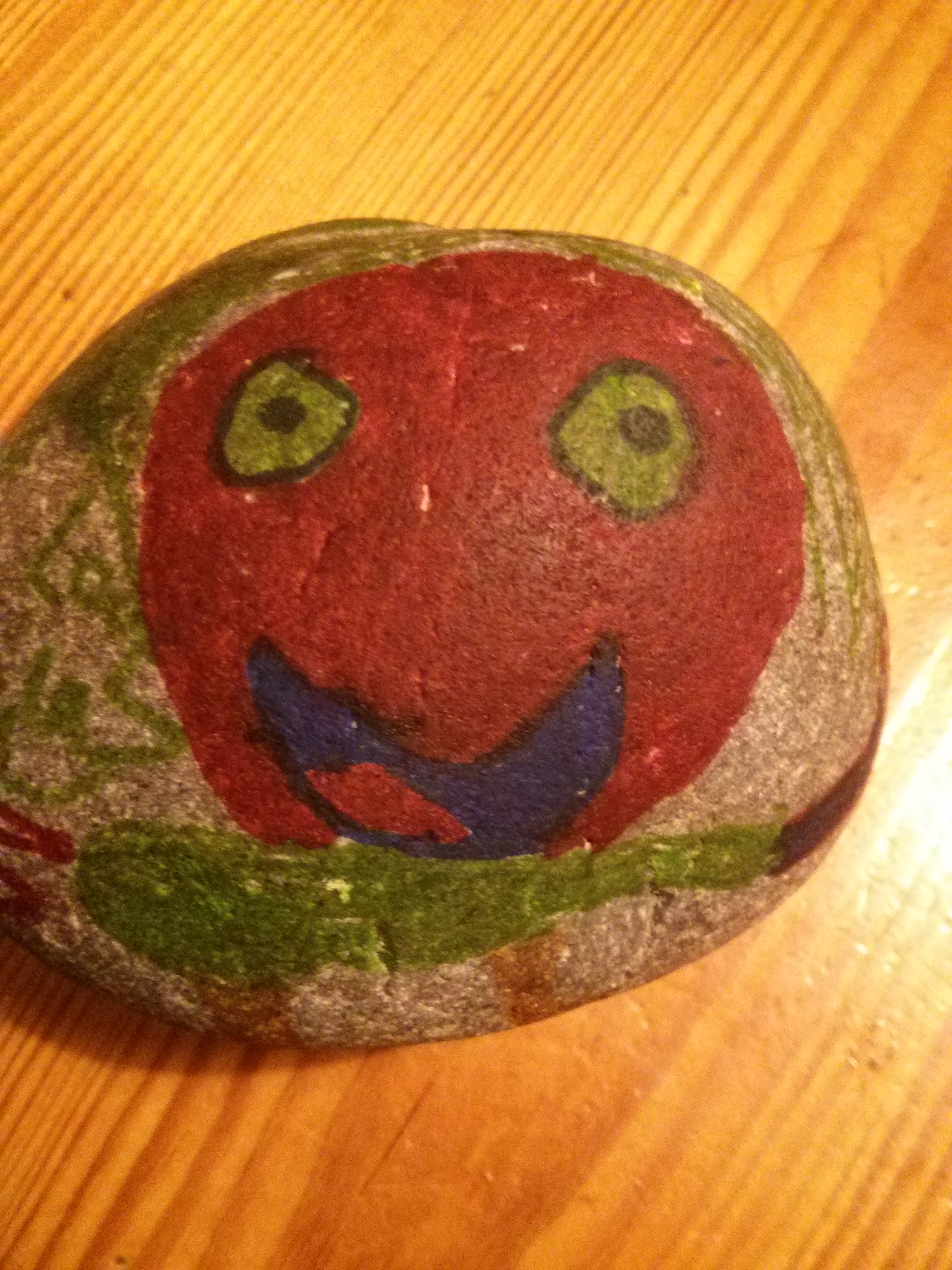
So, when Father’s Day rolls around, you could probably guess from the above that I am somewhat of a sceptic about it. Although it is a tradition, it is a very young one, and much of the impetus in supporting it comes from commercial interests. That doesn’t stop me enjoying the Father’s Day cards and gifts from my children, and even a slightly off the mark gift from my granddaughter!

Louise's Father's Day Stone
Louise’s Father’s Day Stone

Related articles