Little Green Men

SETI
SETI

SETI is short for “Search for Extraterrestrial Intelligence”, or in other words, a search for the “Little Green Men”. The main thrust of SETI is to examine the light from other stars for signs of intelligent life, often on well known wavelengths such as wavelengths near the “water hole“,  a section of the electromagnetic spectrum associated with hydrogen and hydroxyl ions emissions lines. Hydrogen and hydroxyl together make water and water is supposedly necessary for life, so the thinking is that technically advanced life would possibly use this frequency to initiate contact with other civilisations.

Denomination of atomic shells and of character...
Denomination of atomic shells and of characteristic emission lines (Photo credit: Wikipedia)

The trouble is that this is just a guess and there are many possible frequencies that might seem plausible to technically advanced civilisations. If the little green men are not made of water, as we essentially are, they might pick a different frequency band to search. XKCD, my favourite web site has a cartoon which makes this point:

XKCD - the search
The Search

Suppose a remote civilisation did decide to broadcast in that waveband. If they are just announcing their presence, they would need to broadcast their signal in all directions, or they would need to pick out some likely looking star systems and send a directed signal in just a few directions.

If they broadcast in all directions, the power that they would require would be huge. The problem is that in any average stellar neighbourhood, there aren’t many stars. In the sun’s neighbourhood there is an average of 0.004 stars in a cubic light year. So the probability of finding a star one light year from a star in a neighbourhood like the sun’s is four in 1,000. If you look two light years out from the star, you will enclose a volume of eight times the volume of the search area up to one light year, meaning that the probability of finding a star in that volume is 0.032. You would need to look further than five light years out for there to be a fifty-fifty chance of finding a star in that volume, which would be 125 time the size of the original volume of one cubic light year. At 15 lightyears, there would likely be at least 10 stars within the search area.

Globular Cluster NGC 6397
Globular Cluster NGC 6397 (Photo credit: Hubble Heritage)

That’s all very well, but most if not all of these stars will be of the wrong type to support planets of the type that will have free water on them. In fact it is extremely unlikely that a suitable star with suitable planets can be found within, say 200 light years of our hypothetical advanced civilisation. (That’s an out and out guess, but see later).

The remnant of a supernova located 6000 light ...
The remnant of a supernova located 6000 light years from Earth in the constellation Taurus. (Photo credit: Smithsonian Institution)

The trouble is that the signal gets weaker and weaker the further it travels. If you use the signal strength at one light year as the yardstick, the strength is reduced to one quarter at two light years, one ninth at three light years and one sixteenth at four light years and so on because the signal is spread over an area proportional to the square of the distance from the source.  So if the signal strength at 200 light years will be 1/40,000th of the strength of the signal at one light year. If the signal has to travel further it will be correspondingly weaker.

My second attempt at illustrating the Inverse ...
My second attempt at illustrating the Inverse Square Law. S represents an ideal source of electromagnetic radiation and A represents an arbitrary segment of the surface of a sphere of radius r. (Photo credit: Wikipedia)

So likely systems are rare and the signal strength will be weak at the distance of a suitable system. This means that the signal needs to be very strong to be detectable.  Very strong means lots of energy. To broadcast to the Universe at large the civilisation would have to expend a considerable amount of its available energy to only potentially contact another civilisation. Imagine trying to get a project like into the planetary budget!

Clark's accompanying book to Civilisation
Clark’s accompanying book to Civilisation (Photo credit: Wikipedia)

So the hypothetical civilisation is probably desperate to make contact. That may be because either they are in trouble themselves, or they want to warn all local civilisations about something. They are unlikely to do it on a whim, as they must know that the chances of success are pretty close to zero. There’s a faint possibility of a sort of “vampire civilisation” that must prey on other civilisations and so chooses to broadcast in the hope of finding a new victim. I consider that highly unlikely, since as I said the chances of success are nearly zero, and such a civilisation would need to find a new host in a relatively short period of time, astronomically speaking.

Mark of the Vampire
Mark of the Vampire (Photo credit: Wikipedia)

If a broadcast signal is very unlikely to find a receiver, how about a directional signal, maybe driven by a laser. The spread of a laser signal is much less than a broadcast signal, but the signal does spread. An advanced civilisation would still have to divert significant resources into sending the signal but it might be possible.

The civilisation would have an issue, though. If they wanted to get a signal to us and they used a ground based laser, their ground station would be in line with us once each local day, and our receiver would be in line with them once in every day too. Since it is unlikely that the day lengths would match, so the window for transmission would be short, even down to a minute or less.

Window of opportunity
Window of opportunity (Photo credit: GioPhotos)

The hypothetical aliens would most likely opt for an orbital laser. That could be pointed in our direction all the time, for every hour of every alien day, unless some local object got in the way. However we have a problem now. We would need to detect that a signal is coming from a point in space, in spite of all the extraneous noise that might mask it, and then we would need to concentrate our resources looking in that direction for a length of time. The hard part would probably be convincing ourselves that a signal is from LGM (little green men).

Littler Green Men
Littler Green Men (Photo credit: JD Hancock)

There’s an equation that purports to estimate the possible frequency of extraterrestrial civilisations, called the “Drake Equation”. It’s the sort of “equation” that gives mathematicians the heebie-jeebies, since it is derived from nothing and nothing is derivable from it. XKCD cruelly lampoons the equation, and while I don’t much like the sentiment expressed, I can understand why the Drake equation raises his ire – it is ad hoc, probabalistic, and presents as constants things which are fundamentally unknown. In other words, your guess is as good as mine, and both will fit comfortably in the Drake equation. I may return to the equation in a later post.

XKCD - the Drake Equation
The Drake equation as extended by XKCD


Enhanced by Zemanta

The Psi thing

Greek psi
Greek psi (Photo credit: Wikipedia)

I read a book recently, a real paper book, which was called “brain wars” and was written by Mario Beauregard, who is a neuroscience professor at the University of Montreal. The book amounts to an attack on materialist philosophy, arguing that the materialist philosophy cannot explain everything, especially the phenomenon of consciousness and “psi” phenomena.

One of the cornerstones of his argument is based around the dualist notion that mind and brain are separate “things”, and indeed one key section from the text, quoted in the blurb on the dust cover as follows:

The brain can be weighed, measured, scanned, dissected, and studied. The mind that we conceive to be generated by the brain, however, remains a mystery. It has no mass, no volume, and no shape and it cannot be measured in space and time. Yet it is as real as neurons, neurotransmitters, and synaptic junctions. It is also very powerful.

A little later he poses the question that the opponents of Decartes posed : “How, they asked, can an immaterial, mental substance act upon the material brain?”

A diagrammatic section of human brain by René ...

Beauregard later quotes Minsky’s statement “The brain is just a computer made out of meat”. For reasons that he goes into in depth later he states that quantum mechanics “has effectively smashed the scientific materialist worldview.” He then complacently concludes that “(m)aterialistic theories, despite their stubborn persistence in the scientific community, cannot solve the mind-brain problem”.

This despite the fact that Quantum Mechanics is completely materialistic and rational!

Marvin Minsky at the KI 2006 artificial intell...
Marvin Minsky at the KI 2006 artificial intelligence conference in Bremen (Photo credit: Wikipedia)

I believe that Minsky’s view is closer to true than the view that there is more to reality than the materialistic view allows. Beauregard is not a computer scientist so he would not know, in detail, how computers work, under the covers. At a basic level running computer is all about signals. These signals flow through the computer like signals flow through the brain’s network of neurons. (Caveat: I’m not a neuroscientist like Beauregard so I may be misrepresenting his field.)

neuron fractal 1
neuron fractal 1 (Photo credit: Anthony Mattox)

At a slightly higher level, a computer runs an operating system. This is program that runs all the time on the computer, running the programs that the user requires, handling the users input by running other little pieces of code, and handling all the bits of equipment (peripherals) that are connected to the computer. Crucially, the operating system can make the peripherals do things, like print the letter “A” on a sheet of paper, or spit out the sheet from the printer. Special purpose computers are the core of the robots that build cars or assemble toasters and pack them  and label them. They can even sort letters, reading ordinary human writing, much of the time accurately.

Factory Automation with industrial robots for ...
Factory Automation with industrial robots for metal die casting in foundry industry, robotics in metal manufacturing (Photo credit: Wikipedia)

Interestingly people don’t think of robots as mobile computers that can interact with physical objects. The computers in robots run an operating system like your ordinary laptop or desktop, but they are often special versions called “embedded” operating systems.

Open up a computer though, and boot it up. Although you can point to various named parts, like the CPU, or the memory chips, you can’t point to the operating system. It essentially just a pattern impressed on the memory and the various registers and the CPU, and it changes over time. As Beauregard said about the mind, “it has no mass, no volume, and no shape, and it cannot be measured in space and time”. Yet it can influence things, print a letter or paint a car chassis.

June 11, 2007
June 11, 2007 (Photo credit: HeatherKaiser)

It seems that the computer, with its operating system and subsidiary programs, is a good analogy for the brain/mind duality. A big caution here, in that this analogy is just analogy, but it could form the basis of a model of the way that the mind and brain work together. It doesn’t, per se, explain consciousness, but I think that I have, above, provided an explanation of how the supposedly immaterial mind can, through the brain, affect the body, so that we can think above moving a limb, and it happens.

Quantum Physics
Quantum Physics (Photo credit: Jonathan Thorne CC)

Beauregard fastens on “quantum physics” as a possible enabler of psi phenomena, arguing that in quantum physics there is no separation between the mental and the physical. He bases this on what he calls the observer effect : “particles being observed and the observer are linked, and the results of the observation are influenced by the observer’s conscious attempt”.

Hmm. Wikipedia defines the “observer effect” as follows :

In science, the term observer effect refers to changes that the act of observation will make on a phenomenon being observed. This is often the result of instruments that, by necessity, alter the state of what they measure in some manner. A commonplace example is checking the pressure in an automobile tire; this is difficult to do without letting out some of the air, thus changing the pressure. This effect can be observed in many domains of physics.

This is a purely physical effect of measurement – the measuring photon knocks the observed particle slightly off course. Nothing to do with the observer. (A related effect, the Heisenberg principle puts limits on the accuracy with which we can know both the original values of a pair related properties and the subsequent values – roughly speaking).

An optical illusion. Square A is exactly the s...
An optical illusion. Square A is exactly the same shade of grey as square B. See demonstration. (Photo credit: Wikipedia)

I think that Beauregard is actually referring to is an interpretation of quantum mechanics known as the “Copenhagen Interpretation” otherwise known as the “Collapse of the Waveform”. As such he interprets it as saying that the act of observation affects the result of the observation. This is fundamentally not true, because what really happens is that the act of observation merely determines which of probabilities is true. As Wikipedia says :

What collapses in this interpretation is the knowledge of the observer and not an “objective” wavefunction.

In no way does the observer influence the results of the experiment except as a result of the real “observer effect” above, so there is no room there for psi effects.

English: Example of a subject in a Ganzfeld ex...
English: Example of a subject in a Ganzfeld experiment. (Photo credit: Wikipedia)

You may think that I didn’t enjoy the book, but I did! There are unexplained and challenging events described in the book, but I don’t think that it goes anywhere near challenging the materialistic philosophy of science. The only part that I have issue with is when Beauregard challenges what he calls “pseudoskeptics”, those who profess to be skeptics and who are unwilling to look at the evidence for psi phenomenon.

USE IT...
USE IT… (Photo credit: Demetrios Georgalas aka brexians)

In fact these so called pseudoskeptics have probably looked into psi phenomenon at some stage and decided that further consideration is pointless given the diffuse and dubious nature of some evidence and the lack of any information about how this could tie in to or extend in some logical way existing materialistic physics.

Enhanced by Zemanta

Granny has an iPad

Español: Tim Berners-Lee En el Foro de la Gobe...
Español: Tim Berners-Lee En el Foro de la Gobernanza de Internet. (Photo credit: Wikipedia)

On 12 March 1989 Tim Berners-Lee wrote a proposal for what would become the “World Wide Web”, now enshrined in the “www” that is part of the name of many websites. This is often now voiced as “dub, dub, dub”, causing many people to cringe. Through 1990 and into 1991 Tim’s idea was refined until the idea was announced publicly on 7 August 1991.

Granny would have about 30 at the time, or maybe younger.

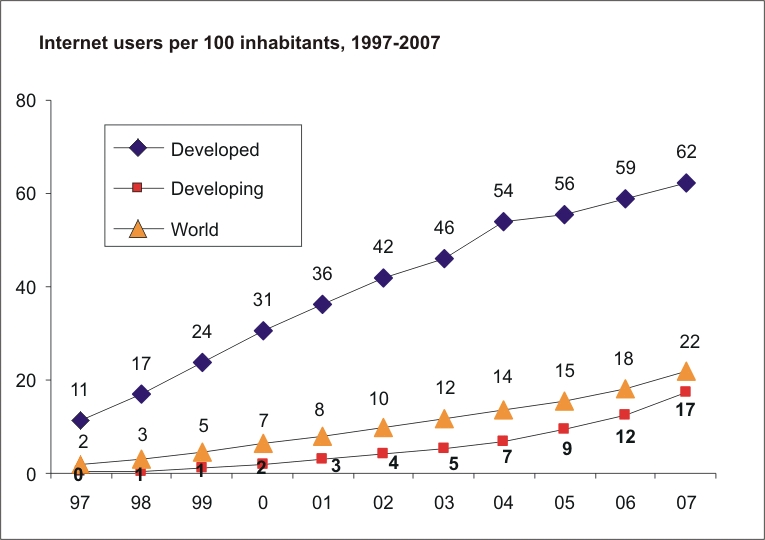
English: Graph of internet users per 100 inhab...
English: Graph of internet users per 100 inhabitants between 1997 and 2007 by International Telecommunication Union (ITU) recreated in OpenOffice Calc, source: http://www.itu.int/ITU-D/ict/statistics/ict/graphs/internet.jpg) (Photo credit: Wikipedia)

It’s worth remembering that the Internet had been around for a decade or so, in rudimentary form, so the chances are that Granny might have come into contact with it if she was working in it at the time, maybe at a university. It’s far more likely though that Granny’s first contact with computing would have come from working at a large firm where they had a mainframe computer.

IBM 3279-S3G
IBM 3279-S3G (Photo credit: vaxomatic)

Maybe she sat at an IBM 3270 screen and typed accounting data into it, or maybe she was one of the people who loaded punched cards into a reader or tended the huge printers  that spat out piles of paper with horizontal green stripes and sprocket holes down the edge. Or maybe she loaded magnetic tape reels into one of the tape reader machines which for some reason came to signify “computing” in many films of the era.

The Internet started as a linked network of computers, running online databases, using names such as “Archie” and “Gopher”. Everything was text based and there was no linking. That had to wait for Tim Berners-Lee’s insight. Universities embraced the new medium and most databases were held on University servers.

Gopher
Gopher (Photo credit: cambodia4kidsorg)

When you blithely click on link to visit a web page a number of things happen. Firstly your computer recognises that you want to do something. A program on your computer called the browser (Firefox, or Chrome or Internet Explorer) analyses your input and decides what you want it to do.

This may involve sending a request to a remote server, but your computer doesn’t know where the server, so it needs to find out. This is done by sending a message to yet another server which has information about where the requested server is on the Internet, or knows how to find out.

Description unavailable
Description unavailable (Photo credit: Forest Service Southwestern Region)

In the early days of the Internet, when Granny may have first come into contact with it, this system did not exist, so every computer on the Internet was required to know the whereabouts of every other computer on the Internet. As you can imagine, updating the address information became a tedious chore and that is why the system that I sketchily outlined above was invented.

Once Granny found a document whose title looked interesting, she would have to download it. Today we click on a link and the document appears on our screen. But Granny would have had to tediously search likely sources for the document, then she would transfer it to the server that she was connected to, and finally she would be able to print it on a printer. If she was lucky the printer would be nearby and it would actually have some paper in it. Granny’s document would be printed in a fixed width font on striped paper by a printer with a ribbon and little hammers, like a glorified typewriter.

English: demonstration of how an impact printe...
English: demonstration of how an impact printer works (Photo credit: Wikipedia)

Granny would have been around 20 when IBM introduced the first “IBM Personal Computer” in 1981, but she might have first come into contact with something like a Commodore 64 or Sinclair ZX 81 or Spectrum. She might have played games loaded tedious by command line commands from cassette tape. It’s possible that she was amazed by the blocky coloured graphics and the clunky game play, considering that the next best thing around was “Pong”, a primitive tennis game on a fixed device, sometimes set into a tabletop, or maybe “Space Invaders”, also hosted on a single purpose device.

English: Commodore 64 computer (1982). Post pr...
English: Commodore 64 computer (1982). Post processing: BG, B/C, noise, dust, spot Français : Ordinateur Commodore 64. Suomi: Commodore 64 -tietokone (Photo credit: Wikipedia)

If Granny had anything to do with computers in the early days of personal computers she would have had to deal with machines that by default booted into BASIC. That’s pretty much a fall-back as usually would have inserted a floppy disk with some version of DOS into the machine. Then she would have had to have loaded whatever program she wanted to run by using another floppy disk.

She would have had to become familiar with the DOS command line, including such quirks as the A: and B: drive referring to the same device. Most of the time. She might even have edited configuration files by hand.

Computer directory listing in a command shell.
Computer directory listing in a command shell. (Photo credit: Wikipedia)

When she got her first hard disk she would have installed DOS or even Windows on it from maybe three or four floppy disks. The first Windows versions ran as a shell on top of DOS, so she would have still needed to have a knowledge of DOS.

In addition she would have had to handle the dreaded device drivers. These were (and still are) small programs that handled interactions with specific installed hardware. Which in the early days of DOS and Windows meant just about any piece of hardware.

Mini CD used for delivering USB drivers for a ...
Mini CD used for delivering USB drivers for a webcam. Photo taken by user: O mores. (Photo credit: Wikipedia)

When Granny installed her new scanner she would have received a disk with it containing the drivers. She would know from prior experience that installing a driver could possibly make her system crash and be unbootable. But she would have still installed it and most probably (eventually) come out on top of it.

In addition before Granny got broadband she would have experienced the doubtful pleasures of using a dial-up modem, and would be familiar with the weird little song it sings to itself when it is handshaking with the remote modem. And she would certainly be familiar with waiting for half an hour to download a megabyte file and Grandad picking up the phone one minute before the end and breaking the connection.

Quicktel 2400EX
Quicktel 2400EX (Photo credit: debagel)

So, now Granny has bought an iPad. Don’t be surprised if she takes to it like a duck to water. After all, she probably has decades more experience with computers and networks, the Internet and downloading than you have. You weren’t born when she started!

she has a thing for it
she has a thing for it (Photo credit: creaid)
Enhanced by Zemanta

Blogging – how is it going?

blogging
blogging (Photo credit: Sean MacEntee)

When I started this blog, 60-odd posts ago, I had no idea where it was going. Of course I had some ideas on what I wanted. Philosophy, cooking and photography. As it turns out, there’s been a bit of philosophy going on, but it’s not been centre stage, as it were. There’s been a decline in the cooking posts, which I intend to remedy sooner or later, and the photography has been non-existent. That’s because most of my photography has gone into my Facebook page.

So what have I been blogging about? I looked back and, well, I’m surprised to note that my posts, were philosophical in tone, but not necessarily what I’d call “philosophically motivated”, but often triggered by events that have come to my attention either in my personal life or in the media. Some serious and some not serious. As an example this post has turned into a philosophical review of earlier posts.

P philosophy
P philosophy (Photo credit: Wikipedia)

So what can I reflect on over 60-odd posts, apart from my apparent tendency to seek deeper meaning in the relatively trivial? Because I don’t consider my posts to be “deeply meanignful”.

Well one aspect of this one-a-week blogging thing strikes me immediately. I am a procrastinator and my previous attempts at blogging or similar have failed miserably. Currently I am up to 60-odd posts and still going. (Pats self on back). What is different this time?

English: Old gatepost Field openings used to b...
English: Old gatepost Field openings used to be closed by putting posts in the holes. (Photo credit: Wikipedia)

Well, one of the factors I think is WordPress. As a confirmed technophile, I have tried many other solutions, and even tried the DIY approach. I can speak several computer languages like a native, and I can achieve passable programs in several others. I don’t care what language it is, if I want to learn it for anything, it doesn’t take me long. (Note to self: write an article about programming “in the zone” and “thinking in a programming language”!)

WordPress
WordPress (Photo credit: Adriano Gasparri)

WordPress is different in that I don’t have to program anything. I just write my thoughts in a fairly forgiving editor, add a few images and click the “Publish” button. No doubt there are other similar systems out there, but I came across WordPress and it works for me. I can bash out 1000-ish words per week and cast them into the ether, or at least the Internet, and I have achieved my self-imposed goal.

cassini science targets
cassini science targets (Photo credit: Wikipedia)

What happens when it gets out there depends on whether my thinking resonates with others out there on the Internet. I get emails saying that so-and-so “liked” a post, which is nice, or that so-and-so is now “following” my posts, which is nicer, but comments on my posts are rare. Insert not-smiley emoticon. I’m not sure why. Maybe I should solicit and respond to comments? Insert smiley emoticon.

Smiley Rocks
Smiley Rocks (Photo credit: w3i_yu)

Anyhow, I like WordPress and it works for me, but there are probably, almost certainly, other blogging systems that would do as well, each with their own quirks and wrinkles. I wouldn’t presume to say that WordPress is the best or that WordPress is for everyone. But it works for me.

I aim to do approximately 1000 words per post (the editor tells me I’m just over half way there – helpful). I base this on the concept that if the post is too long, it won’t get read to the end, unless it is *really* interesting. I don’t aspire to be more than 1000 words interesting! I think that’s reasonable and I hope it *is* reasonable, otherwise I’m wasting my time.

English: This is a modification of File:200902...
English: This is a modification of File:20090211 thousand words-01.jpg, which I digitally cropped, to remove the title and the copyright notice. (Photo credit: Wikipedia)

When I started this blog, I decided that I would post on Friday or Saturday each week. That has slid out to Tuesday occasionally, but I’m pleased to say that I have maintained the once a week target since I decided to attempt it. Yay! There are personal reasons why Friday and Saturday are not conducive to blog writing, and Sunday is the day that I am (effectively) targetting these days. I’m writing this on a Sunday.

Who am I blogging to? I putting these posts out there, on the Internet, and presumably I hope that someone will read them. Actually, that not as clear cut as all that. While I love the idea that some people might find my posts (ruminations? ramblings?) interesting, I don’t think that I’d be disappointed if nobody read them. If anyone does, please comment with “Hey, Cliff, I read the post.” Extra comments optional!

Duty Calls
Duty calls.

Blogging is a narcissistic occupation. The blogger puts his thoughts out there, on the Internet, because he thinks his thoughts are of some value. Maybe they are, maybe they aren’t. It doesn’t matter to the blogger, or at least to this blogger.  If you figure out the millions of bloggers world-wide and the number of postings that they make per day, it is unlikely that any one blogger is likely to attract a lot of attention. Unless they happen to be President of the United States or something.

I’m always grateful when someone comments on my posts though. I don’t think that the blogging medium is particularly good for having a conversation or discussion though, as I don’t spend a lot of time on it, and I don’t get a huge number of comments. I do know that some people do end up with 1000s of comments on their posts, but those blogs tend to be specialised – political blogs for example. I don’t have such a detailed target, so I’m happy with the few comments and likes that I get.

Models of Blogs: Blog as Participant in Conver...
Models of Blogs: Blog as Participant in Conversation (3 of 3) (Photo credit: robinhamman)
Enhanced by Zemanta

…Rain.

Rain camera

It might be a little perverse to write about rain when I look out of the window and see brilliant sunshine, but on the other side of the world they are thinking about building arks! They have had more than their fair share of rainy days recently, maybe more than forty of them perhaps.

In the West of England. south of the Mendip hills is an area I know quite well. It is known as the “Somerset Levels” and is essentially a large are of low lying land that would be either under water or marshy if it were not for the drains and pumps that keep the area relatively dry.

Map of the Somerset Levels, UK (and surroundin...

In the current few months torrential rain has fallen on the whole of the UK and in the Somerset Levels this has caused problems with the drainage systems. The rivers are full and overflowing which means that there is nowhere to pump the water from the low-lying areas, and large parts of the Levels have been flooded.

Some locals complain that the reason for the flooding is that the rivers have not been dredged by the local councils and so can’t carry the amount of water that they should be able to. Even if this is true, which it may well be, it is hard to see how the rivers could cope with the vat amounts of water that will have to be pumped off the levels.

Blagdon Pumping Station

North of the Mendip Hills is another low lying area which I am not sure can be considered part of the Levels. However this area has (so far as I know) been pretty much untouched by the floods. It is interesting to note that the village of Nailsea was originally on an island though it would be hard to tell that now. Besides the village has expanded vastly even in the time that I’ve known North Somerset, so most of it would probably be flooded if the waters came back.

English: Steam pumping engine Curry Moor Somer...

Most of the roads in the Levels follow the rivers and drainage channels and tend to be pretty straight, most of the time. Many of them date for Roman times or earlier and they were built over marshy land. The original road builders made causeways of bundles of reeds as foundations for the roads and new roads were simply built over the old roads. Over the years the reed bundles have not all rotted away equally, and as a result in some places the road level varies. As a result if you drive fast along some of the straighter roads it can feel like a gentle rollercoaster and can induce motion sickness in susceptible people.

Floods On The Levels - 3

It can also cause drivers to lose control and end up the drainage channel or rhyne, as they are known as in Somerset. This happened to a friend of mine, who then had to get the farmer to drag his car out of the rhyne. This obviously was not the first such happening at that spot (which was on a slight bend) because the car came out with someone else’s number plate hooked to the back.

My friend took another friend to show him where the accident had occurred and, in reversing the car onto a little bridge over the rhyne, missed the bridge and the car ended up in the rhyne again. The farmer, who towed him out again, grumpily mentioned that if this happened much more, he’d have to start charging.

English: Edmund, OK, June 15, 2010 --A car lie...

I should not give the impression that the flooding issues recently (2013-2014) were only in the West of England. I’ve seen reports of flooding in many areas of the UK, including low lying areas around the Thames and in places in the Weald, south of the North Downs and north of the South downs. There were even floods near my old school, in an area that I would not have thought to have been prone to flooding. These are only the places that I recall being flooded and I’ve remembered them because I know the areas. Other places were also flooded.

The River Mole Bursts Its Banks In Leatherhead

The recent heavy rain in the UK is unprecedented or at least very uncommon. It could be that this is merely a conjunction of unusual events that have happened by chance, or it could be that the cause is global warning, or at least global change. If it is caused by global warming, this could be caused by human activity or it be caused by something else, such as changes in the sun.

Global Warming

I tend to think that the increases in temperature and the changes in climate are undeniable and probably due to the activities of humans. I say “increases in temperature”, but the recent very cold weather in the USA probably a result of the warming too, as the changes in climate are all linked. As you raise one end of a balance you cause the other end to dip. Or it may be simply that the climate variations are becoming more extreme.

Since at the end of January and the beginning of February 2014 is close to a new moon, tides will be higher than usual. As result the storm swell which increases the height of a tide is going to cause flooding in coastal areas. While this is not directly related to rain, already sodden coastal areas can expect even more flooding.

IMGP7820-king tide over footpath

As a side note, the “king tides” caused by lunar conjunction have caused minor flooding in some areas in Auckland, New Zealand. However the weather is fine here, and it is mid-summer so people have been out and about observing and even enjoying the high tide. A recreational area has been partly flooded by the tide and provided some safe fun for children in canoes and on boogie boards.

Auckland residents have all headed to the beach to experience the super high tides, but because of the high tides there was little beach to see! Still, people had fun riding through the shallow water in the cycle lanes beside the motorway with other canoeing alongside them!

Wild Wild West

Enhanced by Zemanta

A Sunny Day

Sunny Day
Sunny Day (Photo credit: atlantic_lost)

Everyone loves a sunny day. Well, most people, most of the time love a sunny day. A farmer in the middle of a drought might prefer a substantial downpour. Sometimes, too, it can be too hot and that can be unpleasant. And you have to be careful of the sun, because too much exposure leads to sunburn and can lead to skin cancers.

"Avoid sunburn" - NARA - 513898
“Avoid sunburn” – NARA – 513898 (Photo credit: Wikipedia)

Most of the time, though, people enjoy a sunny day. Here in the southern hemisphere Christmas falls in the middle of summer, so there is some hope of a sunny and warm Christmas Day. Some people roll out the barbecue and cook the Christmas lunch on that. Some have even decided that the “Christmas Barbie” is “traditional” and hold one even if the weather is not particularly good.

Not a turkey or Brussell sprout in sight
Not a turkey or Brussell sprout in sight (Photo credit: bignoseduglyguy)

Sun on our skins causes our bodies to produce Vitamin D.  The New Zealand Ministry of Health says :

For most people, it’s easy to get enough vitamin D in New Zealand – our bodies produce it whenever we get the sun on our skin.

But they also warn :

However, because of the risks of sunburn and skin cancer, we need to be careful how much sun we get.

So, it’s a balancing act. Local newspapers give estimates of “burn time” and kids are much more covered up in the sun than we ever were when we were kids. It doesn’t seem to slow them down, though!

Incidentally, why doesn’t someone develop a sunscreen lotion that doesn’t feel so disgusting and sticky? Or is it just me?

English: Sunscreen lotion Deutsch: Sonnenschut...
English: Sunscreen lotion Deutsch: Sonnenschutz-Lotion fuer Kinder (Photo credit: Wikipedia)

When summer is over and shorter days and more inclement weather is here, most people stay inside more and there is a danger, for some people, of “Seasonal Affective Disorder” or SAD (I wonder how long it took to come up with that name and acronym!). People with this disorder suffer depression and other symptoms which can be relieved by subjecting them to periods of intense artificial light. Of course this may just be an effect and not a full-blown disorder. SAD does not appear to be related to a deficiency of Vitamin D, as the quoted Wikipedia article states that Vitamin D treatment doesn’t remove the symptoms of SAD.

English: A 30 kHz bright light therapy lamp (I...
English: A 30 kHz bright light therapy lamp (Innosol Rondo) used to treat seasonal affective disorder. Provides 10,000 lux at a distance of 25 cm. Suomi: 30 kilohertsin kirkasvalolamppu (Innosol Rondo) kaamosmasennuksen hoitoon. Kirkkaus 25 senttimetrin päässä 10 000 luksia. (Photo credit: Wikipedia)

It appears then, that a sunny day does more than give you a dose of Vitamin D – it also gives your spirits a lift. Even if I am working and have to stay indoors, I find life much more pleasant if the  sun is shining outside.

Of course we get sunny days in other seasons than summer, don’t we? In winter it is often bitingly cold, but people bundle up and head outside to enjoy the sunshine nevertheless. In the autumn a sunny day can be quite warm, leading to the term “Indian Summer”. In the spring a sunny day is often warmer than preceding days, especially in comparison to the cold, dark days of winter, and presages the spurt of growth that is the forerunner of summer. It may be a sunny day will be heralded by the songs of birds mating and nesting, and shoots of new grass growth and buds on trees may be evident, especially in deciduous plants which are native to colder climates.

English: Southside Road Christmas Day 2008. Mi...
English: Southside Road Christmas Day 2008. Midday winter sunshine on Juniper Lodge Bed and Breakfast and St Stephen’s Kirk. (Photo credit: Wikipedia)

Whatever the season sunny days are generally welcomed as a chance to get outside and “do things”. This may be as simple as gardening or as rigorous as some sport or other. Even something like taking the dog for a walk is always better on a sunny day. Bad weather may preclude some sports, such as mountain climbing, but with a clear morning and a good weather forecast and you can feel confident of tackling that peak, and standing on the top you can admire the view.

Aoraki/Mount Cook as seen from SSW flying at a...
Aoraki/Mount Cook as seen from SSW flying at altitude 4000m in a glider from Omarama, a commercial gliding site 100km from the mountain. Deutsch: Der Mount Cook aus etwa 4.000 Metern Höhe gesehen (Photo credit: Wikipedia)

Mothers and pre-school teachers look forward to sunny days. If rain keeps the kids inside, they get bored easily and that can lead to upset and even tantrums. On sunny days they can be urged outside to play on the trampoline or chase the chickens or whatever and they are not underfoot and don’t have to be kept busy.

In the biblical story of Noah and the Ark, Noah and his family, together with all the animals endured 40 days and nights of rain, before, eventually, seeing the sun and the rainbow. Imagine for a moment that the story was true. How glad would they have been to finally see the sun, and what sort of state would they have been in? They would probably have been bickering, playing cards with a pack of 51, arguing over the rules for checkers, blaming each other for not bringing along more beer, and arguing over whose turn it was to muck out the animals. The animals would not have been in a much better state either. The ducks arguing with the geese, the hyenas laughing at the dogs and the cats, not insisting, but expecting that everything would be done their way and for their benefit and comfort.

Noah's Ark, oil on canvas painting by Edward H...
Noah’s Ark, oil on canvas painting by Edward Hicks, 1846 Philadelphia Museum of Art (Photo credit: Wikipedia)

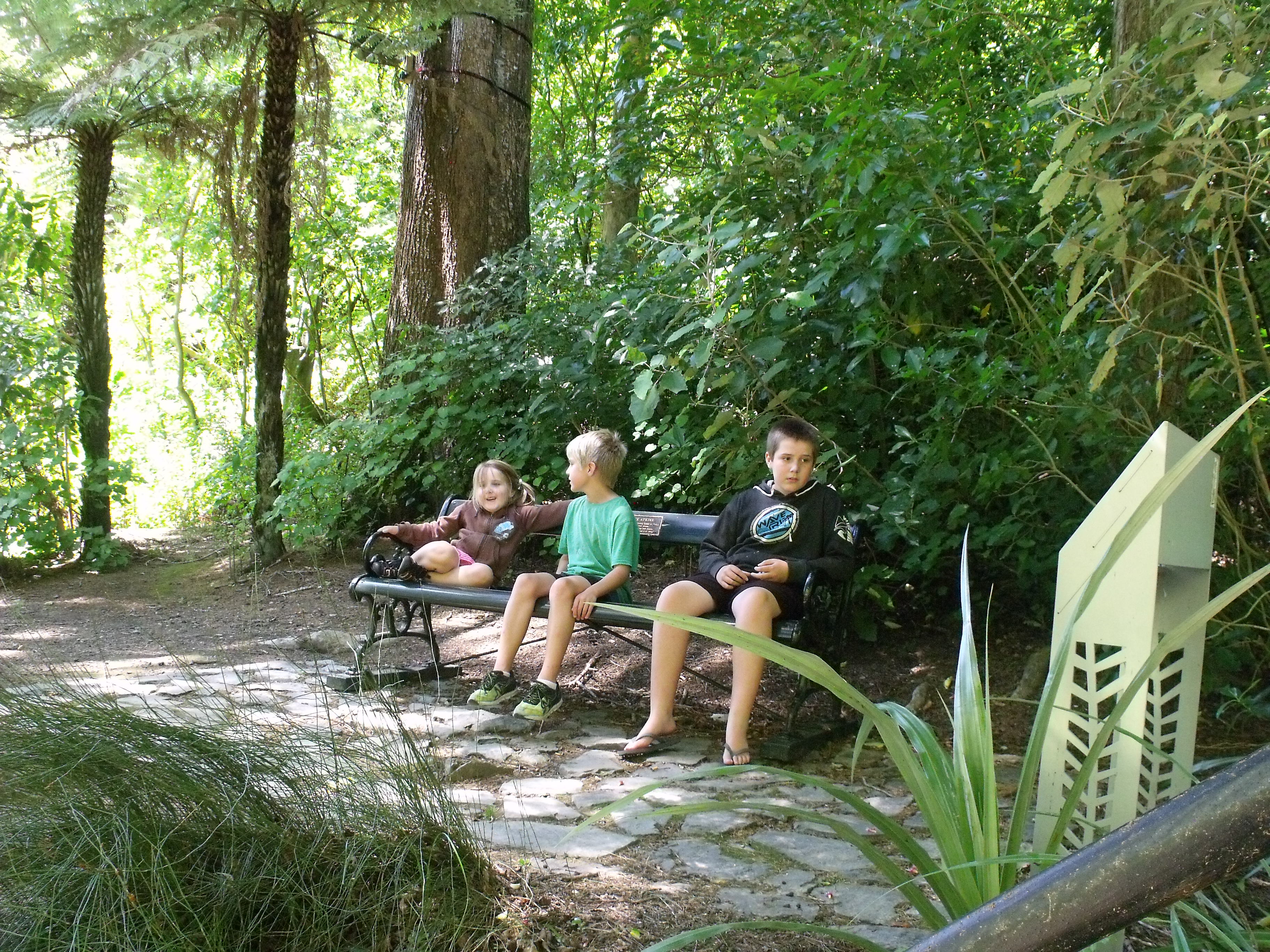
As I look outside now, it is pouring down! But on Friday it was beautiful and we took the grand-kids to visit Wellington’s Botanical Gardens. We parked in the CBD (which was expensive) and took the Cable Car up to the Gardens. The sun shone and the cicadas were making a din in the trees. We visited the Cable Car Museum, walked to Carter Observatory and walked down into the actual gardens by way of the kids’ playground. Finally we went through the floral displays and on to the Lady Norwood Rose Gardens.  You can’t beat Wellington on a good day, and this was one of them.

Hamish, Duncan and Louise at Wellington Botanical Garders
Enhanced by Zemanta

Why do people do evil and nasty things?

The Detective Game
The Detective Game (Photo credit: Wikipedia)

It is common in crime dramas on TV for the detective to exclaim “Where is the motive?”.  When the motive is found it goes a long way towards solving the crime. Eventually the perpetrator gives in and confesses or is carried away by the police and the closing credits roll. All good entertainment.

Every crime has a motive of some sort – that is fairly obvious – but some acts in the commission of a crime are very difficult to explain or for which it is difficult to find a motive. A robber may rob a store and on his way out, he may smash something or cause some damage. A burglar may steal from a house and then turn on all the taps or knock holes in walls or do even more obnoxious things.

Suprunyuck photographed with a hammer; the cou...
Suprunyuck photographed with a hammer; the court described the motive of the killers as “morbid self-affirmation.” (Photo credit: Wikipedia)

The reason that they do such things is a mystery to me. It’s not as if their original nefarious plans would have included such actions, I imagine, in so far as they had plans anyway. The only thing that I can think of is that it is a throwback to some distant time when an invading force (such as a Viking  band) would rape any women they came across, kill any men, steal any valuable goods, and burn down the houses.

Rape, pillage, kill and destroy. Raping the women and killing the men would ensure that the invaders genes would spread at the expense of the victims’ genes and destroying the houses would demonstrate the invaders’ power and discourage the victims from following and seeking revenge. I’m not sure if this is a likely motive for such ancillary acts in the commission of a crime.

viking
viking (Photo credit: What What)

Mass killers are another group where it is difficult to image what the motive for their crimes is. We tend to think of mass killers as a new phenomenon, but I’m not sure that they are. The earliest one that I can think of is “Jack the Ripper” who operated 1888. He was an instance of a subset of mass killers, a serial killer. Another type of mass killer is the person who open fires usually more of less indiscriminately in a public place. John Brunner’s 1968 prophetic novel “Stand on Zanzibar” calls such people “muckers” from the work “amok”.

2 Bridgewater inmates kill 3 guards: sets fire...
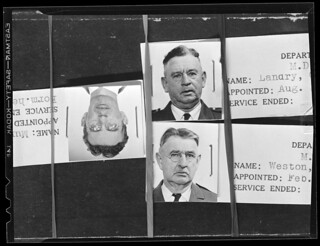
2 Bridgewater inmates kill 3 guards: sets fire to building housing 545. State Farm guards killed by 2 inmates who ran amok in the Bridgewater institution yesterday. Frank L. Weston, Howard V. Murphy and George Landry. – Boston Herald (Photo credit: Boston Public Library)

I suspect that mass killers have been part of the human race for a very long time. In the bible Herod orders the “Slaughter of the Innocents”, which could be considered an early mass killing. Even if the event was made up by the gospel writer it was likely to have been based on some other real event. There is a story in the Old Testament about the killing of the Canaanites (the people who inhabited Canaan before Moses and his followers took over the land), a mass murder or genocide which is discussed (from a Christian perspective) in this article. Whether or not you believe the bible to be the word of God, or merely a collection of folk tales this could be construed to be evidence that mass killings have occurred for millennia.

English: A Land Flowing with Milk and Honey, i...
English: A Land Flowing with Milk and Honey, illustration from Henry Davenport Northrop’s 1894 “Treasures of the Bible” (Photo credit: Wikipedia)

After hunting about on theInternet for a while I came across the names of two serial killers,  Gilles de Rais and Elizabeth Bathory. I guess that while these two cases are the most prominent and remembered there have almost certainly been others that have not been recorded, or that I have missed.

de Rais’ motives appear to be purely sexual, and strongly sadistic, since there was no monetary or other advantage to him. Elizabeth Bathory’s motives do not on the face of it appear to be sexually motivated and appear pure sadistic. However, it is hard to tell for sure as I don’t believe that investigations would have been rigorous in those days and rumour and speculation was apparently often taken as fact.

Français : Exécution de Gilles de Rais (gibet ...
Français : Exécution de Gilles de Rais (gibet et bûcher). Armes du président Bouhier (Photo credit: Wikipedia)

It’s pretty certain that people like these are not normal, whatever normal is. As such I don’t think that we can guess their real motives, if they had any. They appear to be driven by urges which they were unable to control, and de Rais is supposed to have exhibited remorse, although that didn’t seem to stop him.

In modern times, there seems to be an increase in a particular sort of killing. This is where the perpetrator, usually a teenager or fairly young person, takes a gun into a public place and more or less indiscriminately  starts shooting, killing as many people as he can, before he is killed by the police or commits suicide. Of course, the ready availability of guns and ammunition facilitates these killing sprees – you probably couldn’t kill many people in a short time with a bow and arrow or a spear or a sword.

Boston Marathon 2013 ... Confronting Terror in...
Boston Marathon 2013 … Confronting Terror in Boston — Find ways to help (April 16, 2013 / 6 Iyar 5773) …item 2.. Meditation and Sleep Music — 30 minutes …item 3.. Mail Online – Daily Mail — WARNING: GRAPHIC CONTENT … (Photo credit: marsmet547)

Many of the perpetrators of these mass killings seem to be maladjusted or social outcasts, who are often fans of guns and weaponry. As outcasts, it is probably to simplistic to assume that their actions were some sort of revenge against society or against people around him, but that could possibly be a factor.

I don’t think that I have really answered the question I raised when I started this piece. People who are not extreme, as these killers are, can’t reliably guess the killers’ motives, I guess. What is apparent is that the killers don’t appear to have much control, if any, over their actions. It seems that the way to stop similar mass killings is to locate the killers before they have killed. It doesn’t seem that short of locking them up, there is any way to prevent them killing. Some potential killers have been given drugs and some killers have previously received drugs, but stopped taking them for one reason or another. All in all, I think that society is a long way from understanding the phenomenon of mass killers.

Forensic sketch of the Unabomber, commissioned...
Forensic sketch of the Unabomber, commissioned by the FBI, drawn by Jeanne Boylan. This copy was found at the url: http://members.aol.com/alvertc/Sketch.gif. According to Encarta, the drawing was released by the FBI in 1987. (Photo credit: Wikipedia)

I’ve had a lot of trouble writing this piece. Once I started I was determined to complete it, but I made at least two starts. My first start tended towards being an apologia for Naziism and I definitely didn’t want my piece to be that! The Nazis started from an invalid premise (the superiority of the Aryan race and the consequential inferiority of the other races) and their flawed logic led to the concept of racial cleansing. That together with the erroneous idea that the Jews caused the surrender of Germany at the end of the First World War did not justify their horrendous actions.

English: Adolf Hitler
English: Adolf Hitler (Photo credit: Wikipedia)

Hopefully I’ll hit on a much lighter topic next week.

Sun Rising in Kuakata, Bangladesh
Sun Rising in Kuakata, Bangladesh (Photo credit: Wikipedia)
Enhanced by Zemanta

Swings and roundabouts – a question of balance

The nature of precision
The nature of precision (Photo credit: Sergei Golyshev)

People are urged to strive for a “work/life balance”. This apparently implies that they are spending too much time working and not enough time going sky-diving, spear-fishing or taking the kids to the zoo. I doubt that it is ever phrased in this way to someone who is arriving at work at 8:45am and leaving at 4:45pm, having had a two hour lunch break.

Work-Life Balance
Work-Life Balance (Photo credit: Tanja FÖHR)

It is good advice in an era when a person may officially work 40 hours per week, but may actually work many more than that. In these days of smartphones and tablets it is often hard to keep work and home lives separate, and in many detective dramas on TV it is frequently made into a joke – the detective comes home, chats to his wife, his cellphone rings and he has to go and investigate a dead body. His wife is shown feeding his meal to the dog.

Of course some people, particularly high flyers, I think, thrive on the sort of life where they are never off duty. As Dogbert explains in his master class to the Pointy Haired Boss and the CEO, famous leaders work 16 hours a day and use their spare time reading about their industry. The PHB and CEO don’t like this so Dogbert asserts that famous leaders eat a lot of cake. Presumably the spouses of high flyers are the sort of people who are happy with the situation where their partners are never off duty.

The LEXUS LS600hL - Offical Vehicle of Chief E...
The LEXUS LS600hL – Offical Vehicle of Chief Executive of the Hong Kong Special Administrative Region (Photo credit: Wikipedia)

In general balance is taken to be a good thing and something to be strived for. We are exhorted to maintain a life balance, to ensure that the balance of nature is not disturbed and so on. (Balance my life? I can’t even balance my chequebook!) On closer inspection however, it can be seen that a balance is an unnatural state of affairs and is basically unstable, and that in many cases the imagined state of balance just does not exist.

Everyone knows the piece of playground equipment  called a teeter-totter or see-saw. In physical terms the see-saw is a lever and fulcrum system. It only really works for playing on if the two children on the two ends are pretty much the same weight. If one of the kids is significantly heavier than the other the see-saw fails to function and rests in a stable state with the heavier kid rooted to the ground and the lighter one high in the air. If the heavier kid hops off the see-saw rapidly moves to another stable state, with the lighter child on the ground and the empty end in the air. No doubt tears ensue.

A Golden Retriever going over a teeter-totter ...
A Golden Retriever going over a teeter-totter at an agility competition. Edited (cropped) by Pharaoh Hound (Photo credit: Wikipedia)

If the kids are the about the same size there is still no single balance point. In physics terms, any position of the see-saw is now a stable point, but any displacement results in the see-saw swinging to one extreme or the other. Without an extension to the model physics can’t say what happens then!

A balance point in physics is unstable, as a small displacement to either side result in the system getting further and further from the balance point. It’s like a snowball balanced on a mountain top – a small shove and it keeps rolling faster and faster. True there is a point in the valley below where the snowball comes to rest and where a small displacement results in the snowball returning to the bottom, but this is not what I would call a balance point. To a physicist both are “equilibrium points” and what I have called a “balance point” is an unstable equilibrium point, while the bottom of the valley is a stable equilibrium point. To a physicist the “balanced” see-saw would actually be a “neutral equilibrium”.

Česky: Příklad vratké rovnovážné polohy.
Česky: Příklad vratké rovnovážné polohy. (Photo credit: Wikipedia)

So what sort of equilibrium is a “work/life balance”? It’s not a stable equilibrium since that would imply that the “work/life balance” would return to the starting point after a small displacement. That’s not the point of a work/life balance – we would hope that things would change for the better. Neither is it a neutral equilibrium since that would imply no effective change. Like a change of job but no change in life or work practises. If it were an unstable equilibrium that would imply that a small change would lead to more and more change and that would not be what was desired. Consequently I would not categorise a “work/life balance” as any sort of equilibrium, but I am playing with words a bit here!

Equilibrio instabile
Equilibrio instabile (Photo credit: uomoelettrico)

But most people are not physicists and it is obvious what is meant by the phrase – work less, play more, separate work from home, and so on. All good advice. I have a bigger issue with things like “the balance of nature”. Is there any such thing?

Well, “balance” implies stability and nature is not stable. It is a dynamic system, and because of that, any state is unlikely to be long-term. For instance, a mutation or environmental change may lead to a species rising to prominence. A later mutation or environmental change may result in yet another species displacing the latest dominant species and becoming prominent. The same applies to groups of species and the dinosaurs would be the most obvious example.

Dinosaur track
Dinosaur track (Photo credit: mcdlttx)

Also, the idea of balance implies some sort of reversibility. If a system strays from the balance point it should, in theory, be able to return to that balance point. In the case of “nature” or rather, what might be loosely called “systems of nature” there is no balance point to return to as any change, say the decimation of a species, allows other species to expand and maybe dominate the system. If the decimated species were to rebound, it would have to displace the newer species that have taken its niche. That said, there have been cases where a group of species have been reintroduced into an area and the ecology has “regenerated” and the result looks much like what was originally in the area.

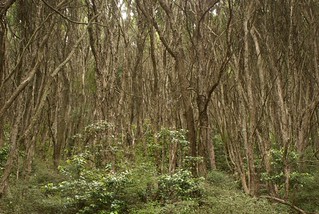
regenerating kanuka
regenerating kanuka (Photo credit: Mollivan Jon)

Some, maybe most, of these regenerated areas are fragile and need constant tending by enthusiasts or they will change away from the regenerated state, maybe by invasions of plants and animals from elsewhere. That is not a reason to not bother with conservation – it’s merely a recognition that a regenerated state is not usually natural and that a lot of work is required to maintain the regenerated state.

Male Bellbird, Zealandia wildlife sanctuary. W...
Male Bellbird, Zealandia wildlife sanctuary. Wellington, New Zealand. Māori: Korimako (Photo credit: Wikipedia)

One example of a regenerated area is Zealandia, a reserve in Wellington, New Zealand, of which I am a supporter. The reserve is only maintained in its regenerated state by an army of volunteers and a predator-proof fence. Nevertheless Zealandia is a wonderful place to visit where it is possible to see many species of animals and plants which are rare outside the reserve.

English: Lower Karori Reservior, looking North...
English: Lower Karori Reservior, looking North-East. Taken by Neil Leslie, Waitiangi Day 2006. Wellington, New Zealand. (Photo credit: Wikipedia)
Enhanced by Zemanta

Quite a Quiche

Late... Again ?
Late… Again ? (Photo credit: M_AlPhotography)

Ooops! Late again. I really have to get myself organised and get a post out on time. On time is sometime before last thing Sunday. Today is Tuesday!

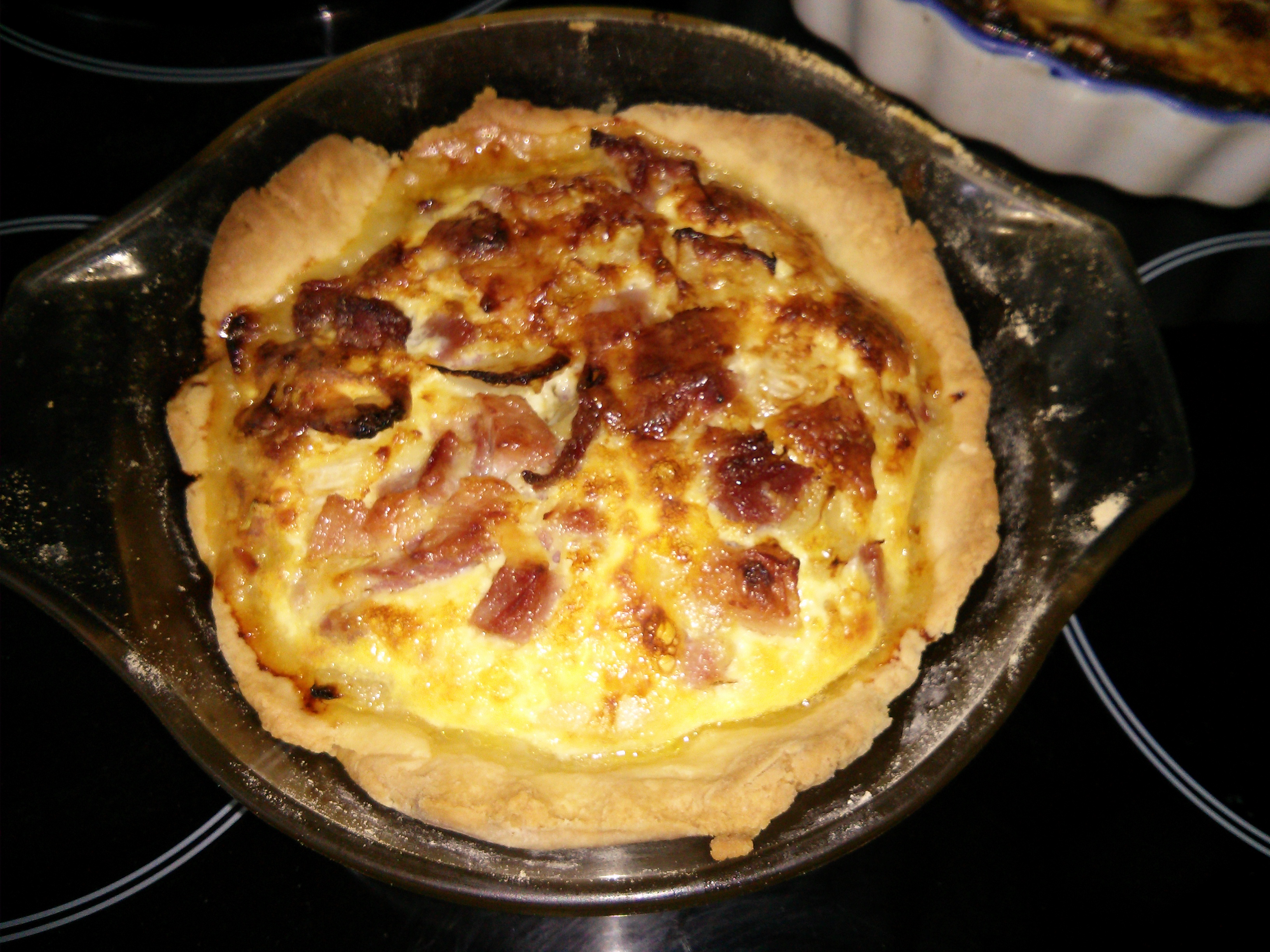
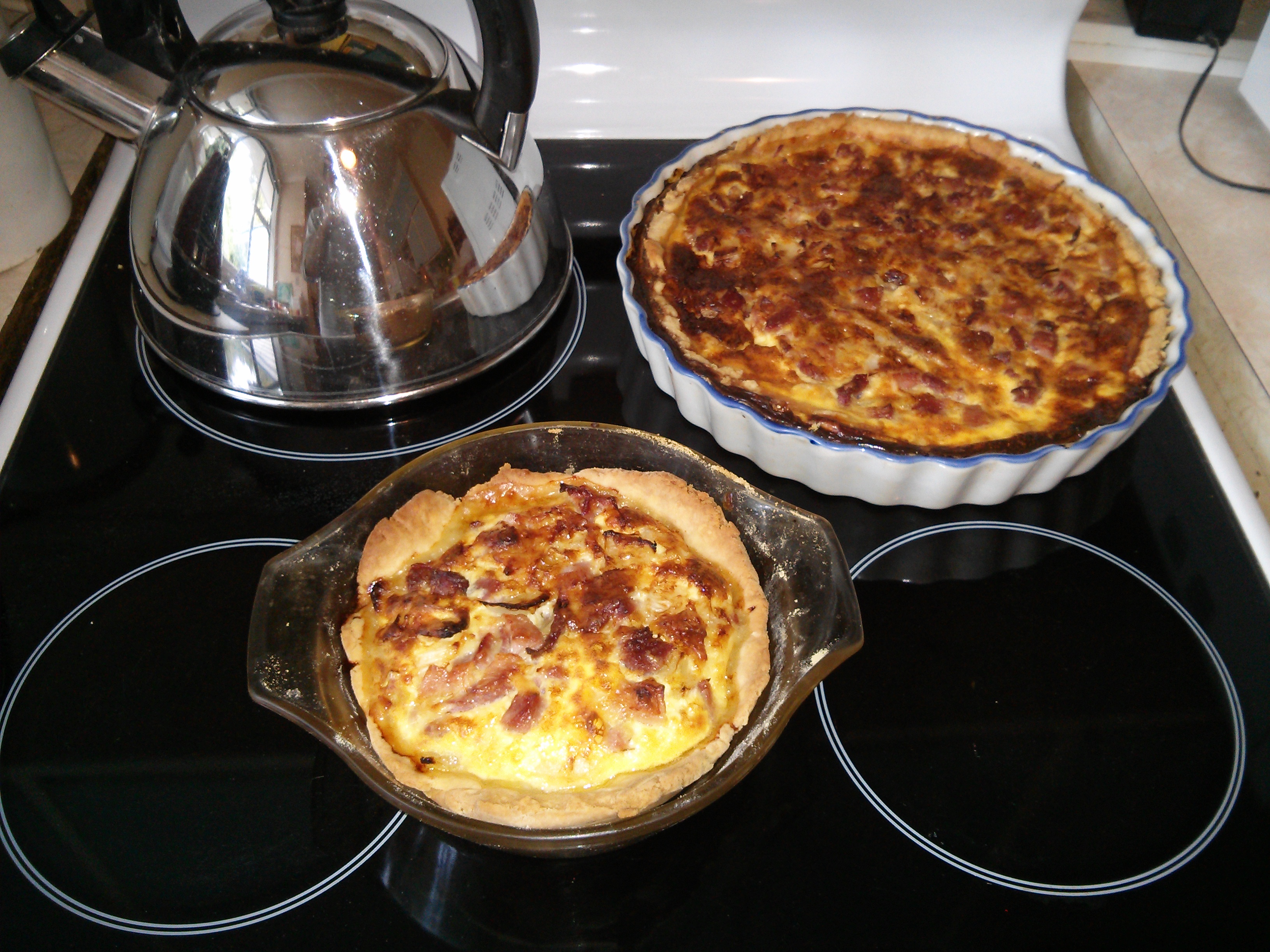
Anyway, this time I’m going to do a cooking post as I can’t remember the last time that I did one. (It was 15th May 2013, actually). I cooked a quiche this weekend and it turned into two quiches. As I usually do I looked on the Internet for a recipe and came up with this one here. Yes, you are correct, I was using up some of the Christmas ham, but I do like quiches with ham in them. I also like quiches with leek or silver beet, but I didn’t have any of those at the time.

Ham and cheese quiches

The recipe that I found doesn’t include the pastry and uses two 9 inch pastry shells, but my dish was around 10 inches across and I guessed that the area would be about the same. If I’d done the maths, I would have seen that one 9 inch shell would have an area of 81 * pi square inches, so two would come to 162 * pi square inches and the 10 inch pie dish would have an area of 100 * pi square inches, so I’d likely have around a third of the mixture left over.

imaginary calculation
imaginary calculation (Photo credit: monkeyinfez)

Anyway, I ploughed on, not realising the problem. I made some ‘short pastry’, which is basically just fat and flour and a little water to bind it. I mixed 5 ounces of margarine and 8 ounces of flour in a bowl. I used the technique of “rubbing in” the fat to the flour and this markedly changes the consistency of the mixture. It starts off with the flour being, well, powdery, but after mixing it with the margarine, the consistency changes to a more “bread crumb” structure. That is, the mixture has a more particulate structure, and the powderiness disappears. When just a little water is added and the mixture is kneaded a little it changes again to a smooth consistency and becomes a ball of dough. There are good reasons why these changes occur, physical and chemical ones, no doubt, but I find them fascinating. What early cook discovered these changes and thereby started the whole culinary business?

Baked pastry dough
Baked pastry dough (Photo credit: 3liz4)

I rolled out the pastry and lined the dish and stabbed the base of the pastry case with a knife. Then I put it into the oven (at around 200 degrees C for 15 minutes). As an experiment I didn’t line it or cover it and I didn’t fill the pastry case with beans or pastry beads or similar. It came out fine and that may be because the oven has a fan to circulate the heat.

The recipe calls for two cups of chopped ham and two cups of cheese. It also calls for dried onion, but I used half a normal onion, which I lightly fried first. Two cups of chopped ham seems a lot when you are slicing it off the bone and then cutting it into small bits. The cheese was OK, and grating that amount doesn’t take long. I had the cheese, ham and onion in a bowl and it already looked a lot.

Grated Cheese
Grated Cheese (Photo credit: Annie Mole)

I used two cups of milk instead of cream and added the four eggs to it. It became obvious that there was too much mixture for the pie dish that I had! I put a large part of the ham, cheese and onion into the pastry case and tipped a similarly large amount of the liquid mixture over it and put it into the oven for the requisite 35 – 40 minutes.

Large quiche
Large quiche

While that was cooking I grabbed a smaller dish and made some more pastry to line it. Half of the above quantities was enough and I put the pastry in the oven with the first quiche for 15 minutes. Again it came out OK, and I filled it with the rest of the mixtures and they filled nicely, so into the oven it went. At this stage I managed to burn myself a little on one of the oven racks.

Smaller quiche
Smaller quiche

Both quiches came out looking fine, and I’m pleased to report they tasted fine too!

Two quiches
Two quiches

Some people may be wondering what re-ignited my interest in cookery. Well, I’d been complaining for some time about my wife’s scales, as it is difficult to measure small quantities on them. So she bought me a small electronic scales for Christmas and I love them! They have an incremental function on them so that you can put a dish on the scales, set the scale to zero, add the correct amount of an ingredient, set the scales to zero again and add another ingredient into the dish and so on. The scales also have a timer function for the actual cooking.

Electronic cooking scales

Before Christmas I bought a heat pad, so that I could raise bread and other yeast doughs in a more consistent way. Watch out for more blogs about bread making!

Heating pad

Enhanced by Zemanta

The lull after Christmas

expenses-2011
expenses-2011 (Photo credit: Kyle McDonald)

I’m going to describe a graph, but I’m uncertain what to label the vertical axis. Probably labelling it “energy” would be the closest. The horizontal axis is definitely time, measured in days. The graph as a whole describes the Christmas – New Year period.

Starting on the day before Christmas Eve, the “energy” is high as people rush around preparing for Christmas. The mood is generally on the up, looking forward to the Christmas break. This year, as Christmas Day fell on a Wednesday, most people would have been off work, many until after the New Year holiday, so the Monday (the day before Christmas Eve) and the Tuesday (Christmas Eve) become part of the holiday.

Some children looking at a selection of Christ...
Some children looking at a selection of Christmas Cards during the 1910 holiday season. (Photo credit: Wikipedia)

Christmas Eve itself is an up day as everyone makes final preparations for the big day. Last minute shopping, cleaning, tidying have to be fitted around present wrapping and ensuring that the menu for the next day is in place. Some people prepare all the vegetables for Christmas day and nearly everyone remembers to get the turkey out of the freezer. Parents with children often face the twin task of preparing stockings and making the kids go to bed with the hope that they will finally drop off. Sometimes the duties extend well beyond midnight.

sleeping kids = clean house
sleeping kids = clean house (Photo credit: RAPACIBLE)

Christmas Day itself is a day of at least two parts. No matter how late they went to be the kids will wake up early, no doubt rousing their parents from some hastily snatched hours of sleep, then the day continues from there. Many families still go to church in the morning though this practise is declining.

The church of Tilly-la-Campagne with Christmas...
The church of Tilly-la-Campagne with Christmas lights (Photo credit: Wikipedia)

The rest of the morning goes into cooking, eating, and no doubt drinking, as well as unwrapping presents, stopping kids (and older people) squabbling about trivialities. All this peaks when lunch is served. In the southern hemisphere, if it doesn’t rain, this may be eaten outside.

Christmas barbeque
Christmas barbeque (Photo credit: QuinnDombrowski)

In the afternoon, the mood declines to the point where some people may become comatose. Granny always sleeps in the afternoon, but so will Uncle Bill, who ate too much pudding and drank too much alcohol. Parents with kids might not be able to relax completely and may be arm-twisted into games of backyard cricket, at least in this hemisphere. In the northern hemisphere parents will no doubt be required to help with those construction toys or technical gadgets that the kids have been given. Nevertheless the mood is definitely down on the peak of the Christmas meal.

Julie's New Toy
Julie’s New Toy (Photo credit: camknows)

Boxing is interesting. It may be a down day, if for instance you have over-indulged the day before. Or it may be an up day if you are interested in the ‘traditional’ Boxing Day sales. This year I had to make a small purchase so I went to the local mall. The place was crowded, but unfortunately for the retailers there was a glitch with the EFTPOS systems and all purchases had to be strictly cash. I believe that spending on Boxing Day 2013 still broke records.

English: White Christmas at Baltasound Well, B...
English: White Christmas at Baltasound Well, Boxing Day actually; looking across the Houb towards Valla Field. (Photo credit: Wikipedia)

After Boxing Day comes the lull. I’m writing this halfway through the lull, which extends from the day after boxing day to the day before New Year’s Eve. Most people celebrate the New Year, even if it is at a much less energetic level than Christmas Day. I generally stay up on New Year’s Eve to ‘see the new year in’ for no very good reason, I admit. Some people choose New Year as the chance to drink and eat more than usual, as a sort of full stop/period to mark the end of the holiday, even though they may not be returning to work until the beginning of the next week.

new year mice
new year mice (Photo credit: Natasha Fadeeva)

But back to the lull. The lull does not have to be an emotional down period, but it is probably, for most people, an energetic down period. People have survived Christmas and have a lesser celebration to look forward to in a week. It is a time for relaxing, taking the kids to the beach or the movies, visiting Granny, or merely settling down with that book that someone gave you for Christmas.

It’s a time for eating increasingly stale mince pies, trying to find leftovers interesting, and generally  tidying up the loose ends of Christmas. Maybe a trip to the mall with that token someone gave you. Maybe watching the England – Australia test match.

Boxing day test cricket, mate!
Boxing day test cricket, mate! (Photo credit: simonhn)

It’s a period with intrinsically no pressures, though for some people their circumstances may override this – from those who are about to give birth to those about to depart this life and those experiencing all life’s dramas in between, this period can be highly emotionally or energetically charged. But in general, it is a lull.

So my graph starts off low on the eve of Christmas Eve, and climbs through Christmas Eve. I originally wrote ‘climbs steadily’, but it may climb erratically but will trend upwards until the end of lunchtime Christmas Day. Then it drops dramatically, during the afternoon, as people relax after the exertions and excitements of the morning. Even washing up, while a chore, is still at a lower level than the peak of Christmas lunch.

Times Square on New Year's Day
Times Square on New Year’s Day (Photo credit: davehunt82)

On Boxing Day the graph may rise a little (for the shoppers) or drop (for those ‘tired’ from the exertions and consumption of the day before). And then comes the lull, a tranquil period between Boxing Day and the eve of New Year’s Eve, a relaxed period for most, I’d say. The graph remains low and level with maybe a lift as New Year gets closer.

On New Year’s Eve the graph may rise again. Some people like to party on the turn of the year, but the intensity of the celebration may not in most cases match Christmas. With the exception of the celebration of the year 2000, there is no real drive to make New Year an intense experience, though people do gather in the likes of Times Square to ‘see in the New Year’.

So, there you have my graph of the Christmas/New Year period. The rise from the foothills of pre-Christmas to the Everest of Christmas Day, followed by the valley of the lull before New Year and the minor peak of New Year itself. It remains to mention the lowlands of the period before those who work return to it at the beginning of January.

English: Sometimes the voice of Taka's Pack Re...
English: Sometimes the voice of Taka’s Pack Readers will lull him into a nap. But they are brief because he doesn’t like missing any part of a story. (Photo credit: Wikipedia)

I hope that all of you who celebrate Christmas had a good one and are looking forward to a pleasant New Year, and best wishes to those who do not celebrate this season either because of religion or conviction and those whose calendar does not align with the one to which I am accustomed.

Happy New Year (white camelia)
Happy New Year (white camelia) (Photo credit: tanakawho)