Dis-Continuum

English: The Clump looking from the Redhouse
English: The Clump looking from the Redhouse (Photo credit: Wikipedia)

Where ever one looks, things mostly seem to be in lumps or clumps of matter. We live on a lump of matter, one of a number of lumps of matter orbiting an even bigger lump of matter. We look into the sky when the bigger lump of matter is conveniently on the other side of our lump of matter and we see evidence of other lumps of matter similar to the lump of matter that our lump of matter orbits.

We see stars, in short, which poetically speaking float in a void empty of matter. We can see that these stars are not evenly distributed and that they gather together in clumps which we call galaxies. Actually stars seem to clump together in smaller clumps such as the Local Cluster of a dozen or so stars, and most galaxies have arms or other features that show structure at all levels.

Ancient Galaxy Cluster Still Producing Stars
Ancient Galaxy Cluster Still Producing Stars (Photo credit: Wikipedia)

The galaxies, which we can see between the much closer stars of our own galaxy, also appear to be clustered together in clumps, and the clumps seem to be clumped together. Of course, the ultimate clump is the Universe itself, but at all levels the Universe appears to have structure, to be organised, to be formed of lumps and clumps, variously shaped into loops, whorls, sheets, arms, rings, bubbles, and so on.

OK, but in the other direction, towards the smaller rather than the larger, our planet has various systems, weather, orogenic, natural, social and evolutionary. All sorts of systems at all levels, from global scope to the scope of the smallest element.


Embed from Getty Images

In other personal worlds, below the level our interactions with our families, we have all the systems that make up our own bodies. The system that circulates our blood, the system that processes our food, the system that maintains our multiple systems in a state homeostasis.

That is, not a steady state, but a state where all the individual systems self-adjust so that the larger system does not descend into a state of chaos, leading to a disruption of the larger whole. Death.

The main pathways of metabolism in humans, sho...
The main pathways of metabolism in humans, showing all metabolites that account for >1% of an excreted dose. ;Legend PNU-142300, accounts for ~10% of excreted dose at PNU-142586, accounts for ~45% of excreted dose at steady state PNU-173558, accounts for ~3.3% of excreted dose at steady state (Photo credit: Wikipedia)

By and large most systems in our environment are made up of molecules, which are in turn made up of atoms. Atoms are a convenient stopping point on the scale from very large to very small. They are pretty “well defined”, in that they are a very strong concept.

Atoms are rarely found solo. They are sociable critters. They form relationships with other atoms, but some atoms are more sociable than others, forming multiple bonds with other atoms. Some are more promiscuous than others, changing partners frequently.


Embed from Getty Images

These relationships are called molecules, and range from simple to complex, containing from two or three atoms, to millions of atoms. The really large molecules can be broken down to smaller sub-molecules which are linked repeatedly to make up the complex molecules.

To rise higher up the scale for a moment, these molecules, large and small are organised into cells, which are essentially factories for making identical or nearly identical copies of themselves. The differences are necessary to make cells into muscles or organs and other functional features, and cells that make bones and sinews and other structural parts of a body.

A section of DNA; the sequence of the plate-li...
A section of DNA; the sequence of the plate-like units (nucleotides) in the center carries information. (Photo credit: Wikipedia)

As I said, atoms are a convenient stopping point. Every atom of an element is identical at least in its base state. It may lose or gain electrons in a “relationship” or molecule, but basically it is the same as any other element of the same sort.

Each atom consists of a nucleus and surrounding electrons, a model which some people liken to a solar system. There are similarities, but there are also differences (which I won’t go into in this post). The nucleus consists a mix of protons and neutrons. While the number neutrons may vary, they don’t significantly affect the chemical properties of the atom, which makes all atoms of an element effectively the same.

An early, outdated representation of an atom, ...
An early, outdated representation of an atom, with nucleus and electrons described as well-localized particles on well-localized orbits. (Photo credit: Wikipedia)

Each component of an atom is made up of smaller particles called “elementary” particles, although they may not be fundamentally elementary. At this level we reach the blurry level of quantum physics where a particle has an imprecise definition and an imprecise location in macroscopic terms.

Having travelled from the largest to the smallest, I’m now going to talk mathematics. I’ll link back to physics at the end.

Nucleus
Nucleus (Photo credit: Wikipedia)

We are all familiar with counting. One, two, three and so on. These concepts are the atoms of the mathematical world. They can be built up into complex structures, much like atoms can be built into molecules, organelles, cells, tissues and organs. (The analogy is far from perfect. I can think of several ways that it breaks down).

Below the “atomic” level of the integers is the “elementary” level of the rational numbers, what most people would recognise as fractions. Interestingly between any two rational numbers, you can find other rational numbers. These are very roughly equivalent to the elementary particles. Very roughly.

Half of the Hadron Calorimeter
Half of the Hadron Calorimeter (Photo credit: Wikipedia)

One might think that these would exhaust the list of types of numbers, but below (in a sense) the rational numbers is the level of the real numbers. While many of the real numbers are also rational numbers, the majority of the real numbers ate not rational numbers.

The level of the real numbers is also known as the level of the continuum. A continuum implies a line has no gaps, as in a line drawn with a pencil. If the line is made up of dots, no matter how small, it doesn’t represent a continuum.

Qunatum dots delivered by ccp
Qunatum dots delivered by ccp (Photo credit: Wikipedia)

A line made up of atoms is not a continuum, nor is a line of elementary particles. While scientists have found ever more fundamental particles, the line has apparently ended with quarks. Quantum physics seems to indicate that nature, at the lowest level, is discrete, or, to loop back to the start of this post, lumpy. There doesn’t seem to be a level of the continuum in nature.

That leaves us with two options. Either there is no level of the continuum in nature and nature is fundamentally lumpy, or the apparent indication of quantum physics that nature is lumpy is wrong.

Pineapple Lumps (240g size)
Pineapple Lumps (240g size) (Photo credit: Wikipedia)

It’s hard to believe that a lumpy universe would permit the concept of the continuum. If the nature of things is discrete, it’s hard to see how one could consider a smooth continuous thing. It’s like considering chess, which fundamentally defines a discontinuous world, where a playing piece is in a particular square and a square contains a playing piece or not.

It’s a weak argument, but the fact that we can conceive the concept of a continuum hints that the universe may be fundamentally continuous, in spite of quantum physics’ indications that it is not continuous.


Embed from Getty Images


Fractals

A Julia set, a fractal related to the Mandelbr...
A Julia set, a fractal related to the Mandelbrot set (Photo credit: Wikipedia)

Now and then I fire up one of those programs that displays a fractal on the screen. These programs use mathematical programs to display patterns on the screen. Basically the program picks the coordinates of a pixel on the screen and feeds the resulting numbers to the program. Out pop two more numbers. These are fed back to the program and the process is repeated.

There are three possible outcomes from this process.

Firstly, the situation could be reached where the numbers being input to the program also pop out of the program. Once this situation is reached it is said that the program has converged.

Convergent light beam passing through a square...
Convergent light beam passing through a square hole (Photo credit: Wikipedia)

Secondly, the numbers coming out of the program can increase rapidly and without bounds. the program can be said to be diverging.

Thirdly, the results of the calculation could meander around without ever diverging or converging.

English: The Markov chain for the drunkard's w...
English: The Markov chain for the drunkard’s walk (a type of random walk) on the real line starting at 0 with a range of two in both directions. (Photo credit: Wikipedia)

A point where the program converges can then be coloured white. Where it diverges, the point or pixel can be coloured black. A point where the program seems to neither converge nor diverge can then be coloured grey. A pattern will then appear in the three colours which is defined by the equation used.

Anyone who has seen fractals and fractal programs will realise that a three colour fractal is pretty boring as compared to other published fractal images. Indeed the process that I have described is pretty basic. A better image could be drawn by colouring points differently depending on how fast the program converges to a limit. This obviously requires a definition of what constitutes convergence to a limit.

Fractal Art
Fractal Art (Photo credit: Wikipedia)

Convergence is a tricky concept which I’m not going to go into, but to compute it to say in a computer program you have to take into account the errors and rounding introduced by the way that a computer works. In particular the computer has a largest number which it can physically hold, and a smallest number. Various mathematical techniques can be used to extend this, but the extra processing required means that the program slows down.

[Fractal]
[Fractal] (Photo credit: Wikipedia)
I’m not going to explain how this difficulty is circumvented, since I don’t know! However the fact is that the computer generated fractals are fascinating. Most will allow you to continually zoom in on a small area, revealing fantastic “landscapes” which demonstrate similar features at all the descending levels. Similar, but not the same.

fractal landscape
fractal landscape (Photo credit: Wikipedia)

The above far from rigorous description describes one type of fractal of which there are various sorts. Others are described on the Wikipedia page on the subject.

Another interesting fractal is created on the number line. Take a fixed part of the number line, say from 0 to 1, and divide it into three parts. Rub out the middle one third. This leaves two smaller lines, from 0 to 1/3 and from 2/3 to 1. Divide these lines into three parts and perform the same process. Soon, all that is left is practically nothing. This residue is known as the Cantor set, after the mathematician Georg Cantor.

English: A Cantor set Deutsch: Eine Cantor-Men...
English: A Cantor set Deutsch: Eine Cantor-Menge Svenska: Cantordamm i sju iterationer, en fraktal (Photo credit: Wikipedia)

This particular fractal can be generalised to two, three, or even higher dimensions. The two dimensional version is called the Sierpinski curve and the three dimensional version is called the Menger sponge.

One of the fractal curves that I was interested in was the Feigenbaum function. This fractal shows a “period doubling cascade” as shown in the first diagram in the above link. If you see some versions of this diagram the doubling points (from which the constant is determined) often look sharply defined.

English: A very old ficus tree in São Paulo, B...
English: A very old ficus tree in São Paulo, Brasil. Deutsch: Ein sehr alter Feigenbaum in São Paulo, Brasilien. Português do Brasil: Uma figueira muito antiga nas ruas de São Paulo, Brasil. (Photo credit: Wikipedia)

I was surprised the doubling points were not in fact sharply defined. You can see what I mean if you look closely at the first doubling point in the Wolfram Mathworld link above. Nevertheless, the doubling constant is a real constant.

English: Bifurcation diagram Česky: Bifurkační...
English: Bifurcation diagram Česky: Bifurkační diagram Polski: Zbieżność bifurkacji (Photo credit: Wikipedia)

Another sort of fractal produces tree and other diagrams that look, well, natural. A few simple rules, a few iterations and the computer draws a realistic looking skeleton tree. A few tweaks to the program and a different sort of tree is drawn. The trees are so realistic looking that it seems reasonable to conclude that there is some similarity between the underlying biological process and the underlying mathematical process. That is the biological tree is the result of an iterative process, like the mathematical trees.

Русский: Ещё одно фрактальное дерево. Фракталь...
Русский: Ещё одно фрактальное дерево. Фрактальное дерево. (Photo credit: Wikipedia)

I’ve mentioned natural objects, trees, which show fractal characteristics. Many other natural objects show such characteristics, the typical example which is usually given is that of the coastline of a country. On a large scale the coastline of a country is usually pretty convoluted, but if one zooms in the art of the coastline that one zooms in on stays pretty much as convoluted as the large scale view.

Mandelbrot fractal. Rendered as an island with...
Mandelbrot fractal. Rendered as an island with Terragen, a fractal-based landscape generator. (Photo credit: Wikipedia)

This process can be repeated right down to the point where one can see the waves. If you can imagine the waves to be frozen, then one can take the process even further, but at some point the individual water molecules become visible and the process (apparently) reaches an end.

If you want a three dimensional example, clouds, at least clouds of the same type, probably fit the bill. Basically what makes the clouds fractal is the fact that one cannot easily tell the size of a cloud if one is simple given a photograph of a cloud. It could be a huge cloud seen from a distance or a smaller cloud seen close up. Of course if one gets too close to a cloud it becomes hazy, indistinct, so one can use those clues to guess the size of a cloud.


http://www.gettyimages.com/detail/165590047

Fractals were popularised by the mathematician Benoit Mandlebrot, who wrote about and studied the so-called Mandlebrot set, wrote about it in his book, “The Fractal Geometry of Nature”.  I’ve read this fascinating book.

English: Topological model of Mandelbrot set( ...
English: Topological model of Mandelbrot set( reflects the structure of the object ) Polski: Topologiczny model zbioru Mandelbrota ( pokazuje strukturę obiektu) (Photo credit: Wikipedia)

While I was searching for links to the Mandlebrot Set I came across the diagram which shows the correspondence of the period doubling cascade mentioned above and the Mandlebrot set. This correspondence, which I did not know about before, demonstrates the interlinked nature of fractals, and how simple mathematics can often have hidden depths. Almost always has hidden depths.

English: Paths of correspondence between scien...
English: Paths of correspondence between scientists (Photo credit: Wikipedia)


A Programmer’s Lot is Not a Happy One?


Embed from Getty Images

Well, I don’t know really. Most programmers that I know seem about as happy as the rest of the population, but I was thinking about programming and that variation on “A Policeman’s Lot” from the Pirates of Penzance appealed to me.

Programming in often presented as being difficult and esoteric, when in fact it is only a variation of what humans do all the time. When you read a recipe or follow a knitting pattern, you are essentially doing what a computer does when it “runs a program”.

Unix program to display running processes
Unix program to display running processes (Photo credit: Wikipedia)

The programmer in this analogy corresponds to the person who wrote the recipe or knitting pattern. Computer programs are not a lot more profound than a recipe or pattern, though they are, in most cases, a lot more complicated than that.

It’s worth noting that recipes and patterns for knitting (and for weaving for that matter) have been around for many centuries longer than computer programs. Indeed it could be argued that computers and programming grew out of weaving and the patterns that could be woven into the cloth.

English: Pattern of traditional Norwegian Sete...
English: Pattern of traditional Norwegian Setesdal-sweater. The pattern is created to be used on a punch card in a knitting machine. Svenska: Klassiskt mönster från lusekofta från Setesdalen, Norge. Mönsterrapporten är skapad för att användas på hålkort i stickmaskin. (Photo credit: Wikipedia)

In 1801 Joseph Marie Jacquard invented a method of punched cards which could be used to automatically weave a pattern into textiles. It was a primitive program, which controlled the loom. I imagine that before it was invented the operators were giving a sheet to detail what threads to raise and which drop, and which colour threads to run through the tunnel thus formed. I can also imagine that such a manual process would lead to mistakes, leading to errors in the pattern created in the cloth. It would also be time consuming, I expect.

Jacquard’s invention, by bypassing this manual method would have led to accurately woven patterns and a great saving in time. Also, an added advantage was that changing to another pattern would be as simple as loading a new set of punched cards.

English: Jacquard loom in the National Museum ...
English: Jacquard loom in the National Museum of Scotland, Edinburgh. Nederlands: Weefgetouw met Jacquardmechanisme in het National Museum of Scotland, Edinburgh. (Photo credit: Wikipedia)

At around this time, maybe a little later, the first music boxes were produced. These contained a drum with pins that plucked the tines of a metal comb. However the idea for music boxes goes back a lot further as the link above tells.

The only significant difference between Jacquard’s invention and the music boxes is that Jacquard relied on the holes and music boxes relied on pins. They operated in different senses, positive and negative but the principle is pretty much the same.

A PN junction in thermal equilibrium with zero...
A PN junction in thermal equilibrium with zero bias voltage applied. Electron and hole concentrations are reported respectively with blue and red lines. Gray regions are charge neutral. Light red zone is positively charged. Light blue zone is negatively charged. Under the junction, plots for the charge density, the electric field and the voltage are reported. (Photo credit: Wikipedia)

Interestingly there is a parallel in semiconductors. While current is carried by the electrons, in a very real sense objects called “holes” travel in the reverse direction to the electrons. Holes are what they sound like, places where an electron is absent, however I believe that in semiconductor theory, they are much more than mere gaps, and behave like real particles.

It’s amazing how powerful programming is. Microsoft Windows is probably the most powerful program that non-programmers come into contact with, and it does so many things “under the hood” that people take for granted, and it is all based on the absence or presence of things, much like Jacquard’s loom and the music boxes. While that is an analogy, it is not too far from the mark, and many people will remember having been told, more or less accurately that computers run on ones and zeroes.


Embed from Getty Images

When a programmer sits down to write a program he or she doesn’t start writing ones and zeroes. He or she writes chunks of stuff which non-programmers would partially recognise. English words like “print”, “do”, “if” and “while” might appear. Symbols that look like maths might also appear. Depending on the language, the code might be sprinkled with dollar signs, which have nothing directly to do with money, by the way.

The programmer write in a “language“, which is much more tightly defined than ordinary language, but basically it details at a relatively high level what the programmer wants to happen.

Logo for the Phoenix programming language
Logo for the Phoenix programming language (Photo credit: Wikipedia)

The programmer may tell the program to “read” something and if the value read is positive or is “Baywatch” or is “true”, do something. The programmer has to bear in mind that often the value is NOT what the programmer wants the program to look for and it is the programmer’s responsibility to handle not only the “positive” outcome but also the “negative” one. He or she will tell the program to do something else.

When the programmer tells the program to “read” something, he or she essentially invokes a program that someone else has written whose only job is to respond to the “read” command. These “utility” program are often written in a more esoteric language than the original programmer uses (though they don’t have to be), and since they do one specific task they can be used by anyone who programs on the computer.


http://www.gettyimages.com/detail/107885297

This program instructs other, lower level programs to do things for it. Again these lower level programs do one specific thing and can be used by other programs on the computer. It can be seen that I am describing a hierarchy of ever more specialised programs doing more and more specific tasks. It’s not quite like the Siphonaptera though, as the programs eventually reach the hardware level.

At the hardware level it will not be apparent what the programs are intended for, but the people who wrote them know the hardware and what the program needs to do. This is partially from the hierarchy of programs above, but also from similar programs that have already been written.

English: CPU
English: CPU (Photo credit: Wikipedia)

Without going into detail, the low level program might require a value to be supplied to the CPU of the computer. It will cause a number of conducting lines (collectively a “bus”) to be in one of two states, corresponding to a one or a zero, or it might cause a single line to vary between the states, sending a chain of states to the CPU.

In either case the states arrive in a “register”, which is a bit like a railway station. The CPU sends the chains of states (or bits) through its internal “railway system”, arranging for them to be compared, shifted, merged and manipulated in many ways. The end result is one or more chains of states arriving at registers, from whence they are picked up and used by the programs, with the end result being whatever the programmer asked for, way up in the stratosphere!

Modelleisenbahn im Hauptbahnhof Wiesbaden
Modelleisenbahn im Hauptbahnhof Wiesbaden (Photo credit: Wikipedia)

This is monumental achievement, pun intended, and is only achievable because at each level the programmer writes a program that performs one task at that level which doesn’t concern itself at all with any other levels except that it conforms to the requests coming from above (the interface, technically). This is called abstraction.

Data abstraction levels of a database system
Data abstraction levels of a database system (Photo credit: Wikipedia)

A equals B

Weather icon: temperature equal
Weather icon: temperature equal (Photo credit: Wikipedia)

The whole universe is full of inequality. No two galaxies are exactly alike, no two planets are exactly alike, no two grains of sand are exactly alike, no two atoms of silicon are exactly alike. Wait a minute, is that last one correct?

Well, in one sense each atom of silicon is alike. Every silicon atom has 14 protons in its nucleus, and, usually, 14 neutrons. However it could have one or two neutrons extra if it is a stable atom, or even more if it is a radioactive atom. Alternatively it could have less neutrons and again it would be radioactive.

Monocrystalline silicon ingot grown by the Czo...
Monocrystalline silicon ingot grown by the Czochralski process (Photo credit: Wikipedia)

So two silicon atoms with the same number of neutrons in the nucleus are “equal” right? Well, of course a single atom by itself is seldom if ever found in nature, and two isolated similar atoms are very unlikely. But suppose.

An atom of silicon is said to have electron shells with 14 electrons in them. Without going into unnecessary details these electrons can be in a base (lowest) state or in an excited state. With multiple excitation levels and multiple electrons the probability of two isolated atoms of silicon with all electrons in the same excitation state is extremely low.

Atom Structure
Atom Structure (Photo credit: Wikipedia)

In practise of course, you would not find isolated atoms of silicon at all. You would find masses of silicon atoms, perhaps in a random conformation, or maybe in organised rows and columns. One of the tricks of semi-conductors is that the silicon atoms are organised into an array, with an occasional atom of another element interspersed.

Atoms according cubical atom model
Atoms according cubical atom model (Photo credit: Wikipedia)

This has the effect of either providing an extra electron or one fewer in parts of the array. Under certain conditions this allows the silicon atoms and the doping element to pass the extra electron, or the lack of an electron (known as a hole) along the array in an organised manner, a phenomenon known in the macroscopic world as an electric current.

English: Drawing of a 4 He + -ion, with labell...
English: Drawing of a 4 He + -ion, with labelled electron hole. (Photo credit: Wikipedia)

So, while two atoms of silicon may in some theoretical physical and chemical sense be equal, in practice, they will be in different states, in different situations. What can be said about two silicon atoms is that fit an ideal pattern of a silicon atom, in that the nucleus of the atom has 14 protons. Some of the properties and states of the two atoms will be different.

At the very least the two atoms will be in different locations, moving with different velocities and with different amounts of energy. They can never be “equal as such. The best that you could probably say is that two atoms of the same isotope of silicon have the same number of neutrons and protons in their nuclei.

Periodic table with elements colored according...
Periodic table with elements colored according to the half-life of their most stable isotope. Stable elements. Radioactive elements with half-lives of over four million years. Half-lives between 800 and 34,000 years. Half-lives between 1 day and 103 years. Half-lives ranging between a minute and 1 day. Half-lives less than a minute. (Photo credit: Wikipedia)

When we talk about numbers we stray into the field of mathematics, and in maths “equal” has several shades of meaning. When we say that one integer equals another integer we are essentially saying that they are the same thing. So 2 + 1 = 3 is a bit more than a simple equality and in fact that expression can be referred to as an identity.

Algebraic proofs are all about changing the left hand side of an expression or the right hand side of the expression or both and still retaining that identity between the two sides.

Mnemosyne with a mathematical formula.
Mnemosyne with a mathematical formula. (Photo credit: Wikipedia)

In the real world we use mathematics to calculate things, such a velocities, masses, energy levels, in fact anything that can be calculated. Issues arise because we cannot measure real distances and times with absolute accuracy. We measure the length of something and we know that the length that we measure is not the same as the actual length of the object that we are measuring.

Lengths are conceptually not represented by integers but by ‘real numbers’. Real numbers are represented by two strings of digits separated by a period or full stop. Both strings can be infinite in length though the both strings are usually represented as being finite in length.

1 Infinite Loop, Cupertino, California. Home o...
1 Infinite Loop, Cupertino, California. Home of Apple Inc. and one of Silicon Valley’s best known streets. (Photo credit: Wikipedia)

If we measure a distance with a ruler or tape measure, the real distance will usually fall between two marks on the ruler or measure. So we can say that the length is, say, between 1.13 and 1.14 units of measurement. If use a micrometer we might squeeze and extra couple of decimal places, and say that the length is between 1.1324 and 1.1325. With a laser measuring tool we can estimate the length more accurately still.

You can see what is happening, I hope. The more accurately we measure a distance, the more decimal places we need. To measure something with absolute accuracy we would need an infinite number of decimal places. So when we say that the distance from A to B equals 1.345 miles, we are not being exact, but are approximating to the level of accuracy that we need. Hence A is not really equal to B.

Aurora during a geomagnetic storm that was mos...
Aurora during a geomagnetic storm that was most likely caused by a coronal mass ejection from the Sun on 24 May 2010. Taken from the ISS. (Photo credit: Wikipedia)

A particularly interesting case of A not being equal to B is in the mathematical case where one is trying to determine the roots of an equation. There are various method of doing this and there is a class of methods which can be designated as iterative.

One first makes a guess as to the correct value, puts that into the equation which generates a new value which is, if the iterative method chosen is appropriate, closer to the correct value. This process is repeated getting ever closer to the correct answer.

Plot of x^3 - 2x + 2, including tangent lines ...
Plot of x^3 – 2x + 2, including tangent lines at x = 0 and x = 1. Illustrates why Newton’s method doesn’t always converge for this function. (Photo credit: Wikipedia)

Of course this process never finishes, so we specify some rule to terminate the process, possibly some number of decimal places, at which to stop. More technically this is called a limit.

To prove convergence, in other words to prove that the process will generate the root if the process is taken to infinity, has proved mathematically difficult. I’m not going to attempt the proof here, but after several attempts from the time of Isaac Newton, this was achieved last century, with the introduction of the concept of limits.

English: A comparison of gradient descent (gre...
English: A comparison of gradient descent (green) and Newton’s method (red) for minimizing a function (with small step sizes). Newton’s method uses curvature information to take a more direct route. Polski: Porównanie metody najszybszego spadku(linia zielona) z metodą Newtona (linia czerwona). Na rysunku widać linie poszukiwań minimum dla zadanej funkcji celu. Metoda Newtona używa informacji o krzywiźnie w celu zoptymalizowania ścieżki poszukiwań. (Photo credit: Wikipedia)

One can then say, roughly, that the end result of an infinite sequence of steps in a process (A) is equal to a required value (B), even though the result no particular step is actually equal to B. You have to creep up on it, as it were.

I’ll briefly mention equality in computer programs and social equality/inequality, if only to say that I might come back to those topics some time.

English: Income inequality in the United State...
English: Income inequality in the United States, 1979-2007 (Photo credit: Wikipedia)

The Negative Universe

Dandelion(negative)
Dandelion(negative) (Photo credit: tanakawho)


If cosmologists are to be believed the Universe came from nothing and is likely to return to nothing. This is odd as there seems to be an awful lot of it! There are between ten to the power 78 and ten to the power 82 atoms in the observable universe, according to some estimates. There’s also a huge amount of energy out there in the universe, and as Einstein said, this is equivalent to matter, according to his famous equation.

Maxwell's Equations
Maxwell’s Equations (Photo credit: DJOtaku)


It is likely that the enormous amount of matter and energy that we see out there is balanced by an equivalent amount of “negative” matter and energy somehow. “Negative” is in scare quotes because it may not describe what is actually going on. Anyway, the negative matter and energy may be incorporated into this universe somehow, which means that on average half the universe is this sort of energy. We can’t see it anywhere so far as I know, so it is a bit of a puzzle.

Large Format Doha Panorama Portra 400
Large Format Doha Panorama Portra 400 (Photo credit: Doha Sam)

We can see evidence everywhere for “normal” matter and energy, and we should be able to see evidence of “negative” matter if it is anywhere near us. As I understand it, “negative” matter would behave differently to “normal” in various ways and should be detectable. I’m not sure in what ways it would be different – I can guess that there could be a gravitational attraction between particles of “negative” matter, just as there is between particles of “normal” matter, but there could be a gravitational repulsion between “negative” matter and “normal” matter for example.

Galaxy NGC 720 (NASA, Chandra, 10/22/02)
Galaxy NGC 720 (NASA, Chandra, 10/22/02) (Photo credit: NASA’s Marshall Space Flight Center)

But my ignorance is almost total. I do believe it is true that “negative” matter should be detectable.) Since we can’t see or detect “negative” matter within our locality (ie “the observable universe“) it may be grouped elsewhere in the universe. If so, it may not have any observable effect in our neck of the woods, but inevitable it will have an effect at some time in the astronomical future.

Español: es la misma imagen que aparece en el ...
Español: es la misma imagen que aparece en el articulo en ingles: http://en.wikipedia.org/wiki/Sloan_Great_Wall (Photo credit: Wikipedia)

The reason that I say this is that the universe doesn’t seem to be expanding faster than the speed of light so any effect such as (possibly) gravity which does appear to have a “speed of light” effect will eventually affect our corner of the universe. But the situation is complex, and as the Wikipedia article says,

Due to the non-intuitive nature of the subject and what has been described by some as “careless” choices of wording, certain descriptions of the metric expansion of space and the misconceptions to which such descriptions can lead are an ongoing subject of discussion in the realm of pedagogy and communication of scientific concepts.

In other words, there are many misconceptions and misinterpretations around this topic. However any effect of the possible existence of “negative” matter on our little neck of the universe is likely to be felt a long time in the future, even on a cosmological time scale, I feel. “Negative” matter could have created a negative universe, I guess, which mirrors this universe.

Photo of a printout of the Wikipedia Copyleft ...
Photo of a printout of the Wikipedia Copyleft reflection in mirror, with pen (Photo credit: Wikipedia)

In a negative universe at least one dimension would be reversed but all other dimension would have the same polarity as our universe. If an odd number of dimensions were reversed, would all but one cancel out? I’m not sure but a cursory mathematical examination would indicate that this would not be so, but I lack the time to explore the concept in depth.

Dimensions
Dimensions (Photo credit: Wikipedia)

In our universe things tend to a state of disorder. If one partition of a closed system contains all the matter (in the simplest case, as a gas) and the partition is removed then eventually the matter is eventually dispersed through the whole system. In a negative universe, possibly the opposite would apply – gas dispersed through a system could tend to bunch up in one part of the system. Maxwell’s demon could watch benignly without lifting a finger.

Demonio Maxwell 2
Demonio Maxwell 2 (Photo credit: Wikipedia)

Our view of this is that it is extremely unlikely – would a glass spontaneously rise from the floor, gathering the scattered wine and land on the table complete with wine? Perhaps this is a parochial view, only true in our universe. In some alternate universe, this may be the normality – entropy may tend to decrease, order may tend to increase. Such an entropy twin may simple be the time reversed twin of the original universe. Or the original universe perceived from a time reversed perspective.

The Grand Canyon Time-Zero Project
The Grand Canyon Time-Zero Project (Photo credit: futurowoman)

If the universe sprung out of nothing, then the sum of the universe is zero. Any object has its anti-object. Any event has its anti-event. Maybe the universe has a partner, an anti-universe if you like, or even a mirror universe. Time in our universe runs from the zero moment into the positive future. In a mirror universe would presumably (and debatably) run in the opposite direction from the zero moment and all spacial dimensions would be reversed.

Plus-Reversed,-1960
Plus-Reversed,-1960 (Photo credit: Wikipedia)

This would correspond to a point reflection in time and space, which may or may not be the same as a rotation in time and space. I’m not sure. Some of complexities can be seen in this Wikipedia article on “parity”. In particular some interactions of elementary particles may display chirality, which means that they come in left and right handed versions, like gloves or shoes. All of the above means that if a person were to be point reflected into an anti-universe and all the elementary particles of his body were switched with their anti-particles, there may be no way for the person to tell that the switch had occurred.

different flowers from same plant
different flowers from same plant (Photo credit: ghedo)

Sure, time would be reversed, but so would literally everything else, so a left-handed glove would appear, in the point reflected world, to still be a left-handed glove even though, if we could see the glove it would appear to us, from our point of view to be right-handed. Of course I’ve assumed for much of the above that the reflection that transforms a universe to its anti-universe is a point reflection.

Axial chirality
Axial chirality (Photo credit: Wikipedia)

In mathematical terms that means that all variables are reversed. That is x is replaced by -x, y by -y, z by -z and so on. It may be that the reflection may be in a line and the x dimension stays the same while the others are negated. Or it may be a reflection in a plane (a mirror reflection) where 2 dimensions are unchanged. Or it may be a reflection in a higher number of dimensions.

English: Upper Yosemite fall with reflection
English: Upper Yosemite fall with reflection (Photo credit: Wikipedia)

As you can see, the subject is complex and I’ve not got my head around it (obviously!), but I believe that if we were switched into the anti-universe (including all out particles) it would not look any different from this universe. In fact we would probably find ourselves discussing our anti-universe, which would be our original universe. In fact it would not matter which universe we called “the original” because they both would have come into existence at the same time and there would be no meaning to the term “original”.

A face.. (the original OMG Wall)
A face.. (the original OMG Wall) (Photo credit: eworm)


Is “schooling” an education?

School
School (Photo credit: Krzysztof Pacholak)

Well, schooling should be an education. It should prepare the pupil for life. Dictionary.com has this as a prime definition of education:

The act or process of imparting or acquiring general knowledge, developing the powers of reasoning and judgement, and generally of preparing oneself or others intellectually for life.

Schooling doesn’t always do this – Greek history is probably of little use to a car mechanic and scientists are only interested in Greek history in so far as it has cool cast list of names and an alphabet from which they can plunder names for obscure fundamental particles or asteroids.

View from one end of Eros across the gouge on ...
View from one end of Eros across the gouge on its side towards the opposite end.(greyscale) (Photo credit: Wikipedia)

Arguably, though, Greek history is a fascinating window into an early culture, and studying events in Greek history can provide insights into contemporary society and while it may not be of obvious direct benefit to the mechanic and the scientist, such studies can inform sociologists, political studies specialists and many others, and it is worth remembering that mathematics, science, logic, philosophy, politics and many other fields of human endeavour have their roots in ancient Greece.

Temple Statue of Poseidon
Temple Statue of Poseidon (Photo credit: greekgeek)

But back to schooling. Everyone has been bored at school, for a number of reasons. The subject could be more than the student can handle, or it could be too simple, or it may not be a subject in which the student has no interest.

One of the issues with schooling is that we are taught, well, “subjects”. Well, we are taught “maths” or “biology” or “French”, or “Woodworking” or whatever. We are taught “English”, which is about how sentences are formed and we are drilled in verbs, nouns, adjectives and more esoteric beasts of the English language. Then there is “English Literature”, which largely consists of forcing pupils to read and “study” relatively old English language texts ranging from Shakespeare to Dickens. Rarely anything more modern.

English: Literature
English: Literature (Photo credit: Wikipedia)

There is a syllabus, specifying what we are to be taught. This is used to constrain the teachers and students, so that they can be set examinations to see, basically, how much the teachers have been able to force into usually unwilling minds.

writing/editing my environmental sustainabilit...
writing/editing my environmental sustainability cornerstone seminar syllabus at nabolom bakery in berkeley (Photo credit: davidsilver)

This all seems mechanical and soulless, but a good teacher will try to insert into the gaps and voids of the subject and the syllabus a little education. He or she will try to convey the beauty of the English language as used by Shakespeare and the other authors, he or she will try to make Romeo and Juliet into real people for the students, he or she will explain the societal background of the Dickens tales.

English: Title page of the second quarto editi...
English: Title page of the second quarto edition (Q2) of William Shakespeare’s play Romeo and Juliet printed by Thomas Creede in 1599. (Photo credit: Wikipedia)

The good teacher will teach something more – how to look beyond the surface story to the people and the societal background, not just in the set books or any books, but in all the situations that life may throw at the student over the years.

"Good Teacher"
“Good Teacher” (Photo credit: MightyBoyBrian)

A study of literature can not only give the student the knowledge of what is in the books, and maybe an appreciation of the era in which the books are set but may also provide the student with the ability to look critically at the era in which they are living. For some, maybe more than a few of the students, this will provide them with the tools to examine sources like the media and consider such things as bias and veracity.

A book pile illustrating the theme of the fest...
A book pile illustrating the theme of the festival of 2005 “Education, why?”. (Photo credit: Wikipedia)

A teacher of maths will try to not only enable the students to pass their maths exams but also to prepare them, a little, for life. The simple techniques of addition and subtraction may be all that they need, but sometimes they may need a bit more. Some of the students may go on to be mathematicians, to study the subject in its own right. But many more may acquire the tools to understand some of the numbers that surround us all in our daily lives.

Day 304: Problem Solving Strategies for Math
Day 304: Problem Solving Strategies for Math (Photo credit: Old Shoe Woman)

For instance, when a poll result is given on television, often they also quote a ‘margin of error’. A small but significant number of people will have some idea of what that actually means from some long ago statistics class. The vast majority doesn’t have a clue as to what it means, but the brightest might gather that it relates to how accurately the poll represents the wider population.

Margin of error-visual
Margin of error-visual (Photo credit: Wikipedia)

Another example of a mathematical tool that could be useful is contained in an episode of the British sitcom, “Please Sir!”. This is a comedy about an inspirational teacher and a class of pupils who are rejects from other classes. The teacher follows an informal teaching agenda as it is evident that his class is not going to pass any exams.

English: Statue of Sir Hugh Owen , A Pioneer o...
English: Statue of Sir Hugh Owen , A Pioneer of Welsh Education Sir Hugh Owen was a pioneer of secondary and tertiary education in Wales. (Photo credit: Wikipedia)

He tries to instil some mathematics into his students, using as an example a bet on a horse race. He calculates the odds only for one of his students, the son of a bookie, to correct him. The teacher is astounded that the student can calculate the odds so accurately in his head, saying to the student that he didn’t know that the student was good with maths. The student replies that this wasn’t maths, it was “odds”.

At the bookies
At the bookies (Photo credit: Phil Burns)

Science, likewise, has ramifications beyond the bland and often boring stuff a student learns at school. While he or she may come close to disaster in a lab, he or she may take away the concept of analysis and the scientific method that may help him or her in later life. At least when one of the TV detectives grabs a scrap of clothing or a sample of blood or something and sends it for analysis, he or she may have an inkling of what is happening. Though these shows are an education of a sort in themselves.

Day 53 - West Midlands Police Forensic Scene I...
Day 53 – West Midlands Police Forensic Scene Investigators Lab (Photo credit: West Midlands Police)

So why is the educational system focussed on schooling rather than educating? Well, for one thing it is easier to measure schooling rather than education. Facts trotted out for an exam yield a measurable yardstick to judge both student and teacher. It’s altogether more difficult to measure education.

Seal of the United States Department of Education
Seal of the United States Department of Education (Photo credit: Wikipedia)

That’s because an education is not about facts learned. It’s about facts learned and a deeper understanding of how the facts interrelate within the system, be it Greek history, English literature, maths or science. Nevertheless, the best teachers provide an education as well as schooling. They should be applauded for it.

English: Primary School in "open air"...
English: Primary School in “open air”, in Bucharest, around 1842. Wood engraving, 11x22cm (Photo credit: Wikipedia)


Random musings

sigh-ness#1
sigh-ness#1 (Photo credit: parth joshi)


My musings are pretty random anyway, so here’s some musings on randomness.

Most people have an inkling of what the word ‘random’ means, but if you try and tie it down, it proves to be a concept that is difficult to define. OK, let me start with a dictionary definition from Dictionary.com:

Lacking any definite plan or prearranged order; haphazard

That’s just one of many similar definitions of ‘random’ to be found at Dictionary.com. But hang on a minute – isn’t having no definite plan a plan of sorts. We can imagine Mad King Wotzit from Philopotamia talking with his generals. “Look, we don’t know where the enemy is, and we don’t know many of them there are, and we don’t know if they have muskets, so the plan is to go ahead with no plan and react to circumstances as they arise. Are we all agreed?”

Coup d'oeil #25
Coup d’oeil #25 (Photo credit: ryansarnowski)

I don’t think that definition is strong enough. We often proceed without a plan, but not randomly, and the obstacles in our way may appear haphazard but there will be a reason why every single one exists.

Randomness for a mathematician, a statistician or a philosopher is something deeper. Take, for instance, the tossing of a coin. It may come down head up or tail up and there are no other options (if we declare the case where it lands on its edge as a no throw). So a sequence of throws could go H, T, T, T, H, T…..


Commandant of the Marine Corps James T. Conway...
Commandant of the Marine Corps James T. Conway participates in the coin toss at the New Orleans Saints Military Appreciation Game against the Atlanta Falcons at the Louisiana Superdome. (Photo credit: Wikipedia)

The critical thing is that any toss doesn’t depend on any of the previous tosses, so it has a 50% chance of being heads and 50% chance of being tails. If we have tossed the coin one million times we would ‘expect’ to get 500,000 heads  and 500,000 tails, but, if fact we may get 499,997 heads meaning we tossed a tail 500,003 times. The average number of heads we would get if we did this a number of times would be very close to 500,000, but it might, by chance, be several hundred away.

English: Five flips of a fair coin. Español: C...
English: Five flips of a fair coin. Español: Cinco lanzamientos de una moneda. (Photo credit: Wikipedia)

Suppose we had thrown the fair coin a million times and we came up with 499.000 heads and 501,000 tails, and we continue for another million tosses. Should we expect more heads this time, so that the average comes out right? I believe that it is obvious that if the coin and tosses are fair, then we cannot tell before hand if the gap between heads and tails would close or get wider. The second million, like the first million will result in about 500,000 each heads and tails.

One-tenth penny coins from British West Africa...

One-tenth penny coins from British West Africa, dated 1936 and 1939. (Photo credit: Wikipedia)

Nevertheless gamblers waste their money on the belief that the odds will even up over time. This is therefore known as the Gambler’s Fallacy.


English: Simulation illustrating the Law of La...
English: Simulation illustrating the Law of Large Numbers. Each frame, you flip a coin that is red on one side and blue on the other, and put a dot in the corresponding column. A pie chart notes the proportion of red and blue so far. Notice that the proportion varies a lot at first, but gradually approaches 50%. Animation made in Mathematica–I’m happy to give you the source code if you want to improve the animation or for any other reason. (Photo credit: Wikipedia)

But how do you know if a real coin, as opposed to a theoretical coin is fair. Well, you test it of course. You toss the coin, say 1,000,000 times and see if you achieve 500,000 heads and 500,000 tails. If you get 500,000 heads or near that number, you can say that the coin is ‘probably fair’. What you can’t say, of course, is that the coin is ‘definitely fair’ as the coin could be a dud, but still produce, by chance, the result that a fair coin would.

Shove ha'penny for charity
Shove ha’penny for charity (Photo credit: HowardLake) A coin, at a fair – fair coin?

In addition a real coin is subject to physical laws. Given the starting conditions of the flip, and given the laws of physics, a tossed coin behaves deterministically, resulting in only one possible outcome for the toss. So the toss is not random as people usually use the term. Calculating  what the result might be will likely forever be impossible though.


Uni Cricket: Captain PJ and the Coin Toss
Uni Cricket: Captain PJ and the Coin Toss (Photo credit: pj_in_oz)

Do things happen randomly? I don’t believe that real events can be random. If an event is truly random it cannot depend on events that have gone before, because otherwise it would be, in principle, be predictable from the earlier events. The real events that come closest to being unpredictable are decay events and other events at the quantum level, but even there the outcome is fixed, and only the time that the event happens is variable.


English: Simulation of many identical atoms un...
English: Simulation of many identical atoms undergoing radioactive decay, starting with either four atoms (left) or 400 atoms (right). The number at the top indicates how many half-lives have elapsed. Note the law of large numbers: With more atoms, the overall decay is less random. Image made with Mathematica, I am happy to send the source code if you would like to make this image more beautiful, or for any other reason. (Photo credit: Wikipedia)

Computer science requires randomness for various purposes, most notably for generation of keys for ciphers for encryption. However the numbers that are generated are not truly random, but involve some heavy computation with very large integers. Encrypted information requires decryption, which also requires some very heavy computational lifting. Often extra ‘entropy’ is added from mouse movements and key presses.


Thermodynamic system with a small entropy
Thermodynamic system with a small entropy (Photo credit: Wikipedia)

Computer and other physical random numbers can use physical sources such as cosmic rays or the decay of an unstable atom to seed the calculation of a random number. Both the cosmic ray count and the decay of an unstable atom appear to be random locally, but cosmologically both events are the result of the state of the universe and its history to that point in time which is deterministic and deterministic processes are the opposite of random.


Thermodynamic system with a high entropy
Thermodynamic system with a high entropy (Photo credit: Wikipedia)

I feel strongly that the universe is deterministic, and at a classical level this is almost indisputable, but at the quantum level things are not so clear and at our current level of understanding, I believe that it is correct to say that happenings at the quantum level appear to be only statistically predictable. I understand that this is not because of some aspect of quantum mechanics that is currently unknown. There are no ‘hidden variables‘. Some other way around this dilemma may be found, probably involving another way of looking at the problem.


TESORO DE CORAL, NOSTOC
TESORO DE CORAL, NOSTOC (Photo credit: PROYECTO AGUA** /** WATER PROJECT)

Since the numbers generated by a computational process are not truly random, it is theoretically possible to crack the cipher and decode the message without the key. The numbers involved are so large that this would be extremely difficult and time-consuming using conventional techniques. Quantum computing techniques can theoretically be used to crack current classical encryption schemes.

Mathematical randomness is a totally different thing. Any finite number can be generated by many methods and if the method is known, then the number can’t be called random. This is the basis of a mathematical game where a sequence of numbers is given and the next number is required to solve the puzzle. I don’t like these games because it is possible that two different algorithms may produce the required answer, and an algorithm could be imagined that gives an answer different to the ‘solution’. In other words there is not one unique solution.


A roulette wheel.
A roulette wheel. (Photo credit: Wikipedia)

This makes it extremely hard, if not impossible to decide if a ‘black-box’ algorithm (one where the working are unknown) is producing a random sequence of numbers. Beyond that point, I’m not going to go, as I do not have the knowledge, nor currently the space in this post, to make a stab at a decent discussion. Maybe I’ll come back to the topic.

Toledo 65 algorithm - 8 / 12
Toledo 65 algorithm – 8 / 12 (Photo credit: jm_escalante)


Enhanced by Zemanta

Inequality and equality

Triangle_inequality
Triangle_inequality (Photo credit: Wikipedia)

Usually, but not always, I have an idea in the back of my mind of the structure of a post before I write it. Well, I have an idea of a few key concepts and how they will fit together. Sometimes it goes much like my skeleton idea and sometimes it turns out completely different. However, today, I have no structure in mind.

Inequality. It’s an interesting concept. The things that are being compared can be practically anything, but have to be of the same sort, hence the saying “you can’t compare apples with oranges”. Like all adages, this saying has more depth than appears at first glance. Of course you can compare apples with oranges if, for example, you are comparing their Vitamin C content or their fibre content. What the saying conveys is that it is incorrect to mix categories when the attribute being comparing is obviously not found in one of the categories, or the attribute is expressed differently in the two categories.

Apples & Oranges - They Don't Compare
Apples & Oranges – They Don’t Compare (Photo credit: TheBusyBrain)

For example, it would be wrong in most cases to compare the tastes of apples and oranges since the tastes of apples and oranges are significantly different. Or one might compare the performance of a truck and sedan car, and someone might object that any comparison is like comparing apples and oranges – while both are vehicles, but they are by nature significantly different.

Apples and Oranges
Apples and Oranges (Photo credit: Automania)

An inequality yields a true or false verdict. In logic and mathematics this is often called a Boolean value after mathematician and philosopher George Boole. In computer languages a Boolean value is usually, but not invariably, given a value of 1 for true and 0 for false.

George Boole, mathematician, 1858-1908
George Boole, mathematician, 1858-1908 (Photo credit: Wikipedia)

When children learn arithmetic and mathematics the emphasis is usually on equality rather than inequality. They learn that 1 + 1 = 2 and often don’t get taught such formulations as 1 + 1 < 6. When learning algebra they may be taught that y = x² is the equation of a parabola, but they may only learn in passing that y > x² represents all the points in the plane inside the parabola, and that y ≥ x² also includes the points on the parabola.

This is a graph of an inequality.
This is a graph of an inequality. (Photo credit: Wikipedia)

Computer programmers are usually deft at dealing with inequalities. When programming a payroll for example, the programmer may be required to calculate the tax that an employee may have to pay. Say the first $10,000 is taxed at 5%, and anything between $10,000 and $50,000 is taxed at 7%, and anything over $50,000 is taxed at 10%.

Tax
Tax (Photo credit: 401(K) 2013)

The programmer has to check if the salary is less than or equal to $15,000 (≤) and if it is he or she taxes the pay at 5%. If the pay is greater than (>) $10,000 and less than or equal to (≤) $50,000 he or she subtracts $15,000 from the salary and calculates 7% of that. He or she then calculates 5% of $15,000 and adds the two numbers to make up the tax for that employee. And so on, for the CEO who obviously exceeds the $50,000 threshold.

"Pay Day! Pay Day!"
“Pay Day! Pay Day!” (Photo credit: JD Hancock)

The simple statement – “Is the pay ≤ $15,000?” hides a complexity that is not obvious. It can be rewritten as – “Is it true that the pay ≤ $15,000?”. Such a statement has a value of “true” or “false”. The sub-statement “the pay ≤ $15,000” has a value of “true” or “false “. If the pay is $9,000 then the sub-statement  has the value “true”. Putting that back in the original statement yields “Is it true that true”. A little ungrammatical maybe, but it can seen that the whole statement is in this case true. This sort of complexity can trip up the unwary.

True/False Film Festival
True/False Film Festival (Photo credit: Wikipedia)

Logicians and mathematicians aren’t content with simple “true” and “false”. They have contemplated a third value, neither true nor false. Some versions call it “unknown” but it could be called “fred” or something. It doesn’t make any difference. Of course, mathematicians would not be satisfied with that, so they have derived “many-valued” logic systems.

It’s probably worth mentioning that some computer language allow for a “null” value, which is essentially the value you have when you haven’t set a value. Using the old pigeon hole analogy, if a pigeon hole is called “A”, then when the pigeon hole is empty, its value is “null”. When it contains, say, the integer 3, it’s value can be said to be “the integer 3”, so the statement “A contains a value greater than 1?” can be “true”, “false” or “null” so multi-valued logics can be more than an intellectual exercise.

Graphic for "the present king of France&q...
Graphic for “the present king of France”, a philosophical quasi-paradox from Bertrand Russell’s work on “definite descriptions” (is the statement “The present King of France is bald” true or false if France is a republic?). (Photo credit: Wikipedia)

Another form of inequality relates to societal inequality. There are very poor people and astronomically rich people. Of course people will never be universally equal, but a society that doesn’t recognise the extreme inequalities will not be a good society by most people. We don’t have a working philosophy which can address this inequalities. We have Marxism economics which favours the workers, and the Smithian lassez-faire economics which favours market forces, and Keynesian which has supply and demand economics.

English: The invisible hand of the market. Fra...
English: The invisible hand of the market. Français : La main invisible du marché. (Photo credit: Wikipedia)

None of these philosophies (and there are many others to choose from) really deal with the gap between the rich and the poor. Marxists would destroy society to rebuild it, but there is no guarantee that it will be better, and a very large chance that society would easily recover from such a cataclysm. Smithian economics would not admit to there being a problem. Keynesian economics at least considers unemployment but doesn’t directly address poverty.

English: Differences in national income equali...
English: Differences in national income equality around the world as measured by the national Gini coefficient. The Gini coefficient is a number between 0 and 1, where 0 corresponds with perfect equality (where everyone has the same income) and 1 corresponds with perfect inequality (where one person has all the income, and everyone else has zero income). (Photo credit: Wikipedia)

There does not appear to be a working economic model that deals with poverty as such. Distributing public funds through the dole doesn’t result in a decrease in poverty and merely reduces the self-esteem of the poor. Likewise, reducing support through reduced “benefits” doesn’t drive the poor into employment and doesn’t reduce poverty by providing an incentive to the poor. This is largely because the few jobs available to the unskilled don’t provide a route out of poverty as they are not well paid.

English: Arkwright - Colliery wages office Sho...
English: Arkwright – Colliery wages office Shortly after the pit closed in 1988. (Photo credit: Wikipedia)

There is no doubt that poverty is relative. The poor in the developed countries are well off as compared to the poor in developing countries, but that’s not really a justification for the vast inequality that is seen between the very rich and the very poor, in any country.

Strike Solidarity
Strike Solidarity (Photo credit: Light Brigading)
Enhanced by Zemanta

The process of Philosophy

Philosophy & Poetry
Philosophy & Poetry (Photo credit: Lawrence OP)

Philosophy is a strange pastime. Scientists measure and weigh. Mathematicians wrangle axioms and logical steps. All other disciplines draw on these two fields, which are probably linked at deep level, but philosophy draws from nothing except thoughts and the philosopher’s view of the Universe.


Mathematics
Mathematics (Photo credit: Wikipedia)

Well, that’s not completely accurate because philosophy has to be about something and the only something we have is the universe. But philosophy does not have to be about the universe as we know it. What if there was no such thing as electrical charge, or, the prudent philosopher thinks, what if there was no such thing as the thing we call electrical charge. At a more basic level, what is electrical charge.

Lichtenberg
Lichtenberg (Photo credit: caddymob)


Philosophers are always getting pushed back by scientists as scientists figure what they think is the case. If there is a scientific consensus on what comprises an electric charge then that question no longer interest philosophers to any great extent. Philosophers mentally travel through the lands marked “Here be dragons”.


Dragon from PSF D-270006.png
Dragon from PSF D-270006.png (Photo credit: Wikipedia)

Philosophy is also interested in less “physical” things like ethics and morals, what comprises identity, predestination or free will, what can we know and what knowing is all about. How did the Universe come to exist, or more basically, why is there something rather than nothing?


If you look at this list it comprises extensions to or extrapolations from physics, psychology, physiology, medicine, biology, and other fields of science. Philosophy doesn’t use mathematics (usually), but it uses logical argument or should. It not (usually) built on axioms, so doesn’t have the rigid formality of mathematics.

Illustration of Plato's Allegory of the cave.
Illustration of Plato’s Allegory of the cave. (Photo credit: Wikipedia)

Philosophers are big users of metaphor, such as Plato’s “Allegory of the Cave”. A metaphor of the expansion of a balloon was used as a philosophical explanation of the expansion of the Universe discovered by Edwin Hubble. Philosophers also imagine physical machines which do not yet exist and which may never exist, such as the ‘teleporter’ which makes a material object at point A disappear and reappear at point B.

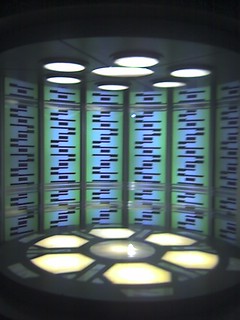
Star Trek - Enterprise D Transporter
Star Trek – Enterprise D Transporter (Photo credit: tkksummers)

Quantum physicists have teleported quantum information from one point to another, but this is not the same as teleporting atoms. So far as I can gather from the Wikipedia article, what is teleported is information about the state of an atom, so the same atoms must already be at point B before the teleportation event, and the event is a sort of imprinting on the target atoms. It sounds like the atoms at point A remain in situ, so it is more of a tele-duplication process really. However I don’t really understand the Wikipedia article so I may be wrong.

Diagram for quantum teleportation of a photon
Diagram for quantum teleportation of a photon (Photo credit: Wikipedia)

The philosopher is not interested in the quantum nuts and bolts though. He or she would be interested in the process – is a person walks in to the teleporter at point A the same person as the person who walks out of the transporter at point B? Unless his actual atoms are transported by the process, which seems an unlikely implementation, the person at point A shares nothing with the person at point B except a configuration of a second set of atoms. Is the person at point A destroyed by the machine and recreated at point B? What if something goes wrong and the person at point A does not disappear when the button is pressed? Then we have two instances of the person. Which is the real instance?

Unknown Person
Unknown Person (Photo credit: Wikipedia)

Notice that the philosopher takes a physical situation of travel from point A to point B and considers a special case, that of travelling between the two point without travelling the old slow way of travelling between all the intervening points and doing it quickly. There is no physics which can currently perform this task, but as usual, scientists are working to, one might say, fill in the gaps.

The Sci-Fi Fly!
The Sci-Fi Fly! (Photo credit: Carolyn Lehrke)

Many times the scientist is also a philosopher – he may have at the back of his mind the concept of teleportation when he creates his hypotheses and does his experiments, but he probably doesn’t concern himself with identity. That is still the realm of the philosopher at present, but if a teleportation device were ever created, it would stop being a philosophical matter, and become a matter of law and psychology and maybe some field that does not exist yet, just as the field of psychology did not exist at one time.

General Psychology
General Psychology (Photo credit: Psychology Pictures)

I’m trying to paint a picture of the area that a philosopher is interested in. If the whole of human knowledge is a planet, then physics and maths are part of the outer most layers of the atmosphere, the exosphere, and this merges with the depths of space are the domain of philosophy. At lower levels are things like chemistry, biology, psychology and other more applied sciences. Don’t look too closely at this analogy because I can see two or three things wrong with it, and I’m not even trying.

English: View of the crescent moon through the...
English: View of the crescent moon through the top of the earth’s atmosphere. Photographed above 21.5°N, 113.3°E. by International Space Station crew Expedition 13 over the South China Sea, just south of Macau (NASA image ID: ISS013-E-54329). Français : Photo des couches hautes de l’atmosphère terrestre. Polski: Zdjęcie górnych warstw atmosfery ziemskiej z widocznym przejściem w przestrzeń kosmiczną. Ελληνικά: Η Γήινη ατμόσφαιρα, η φωτογραφία ελήφθη από το διάστημα κι ύψος 335 χιλιόμετρα (Photo credit: Wikipedia)

But the main point I am making is that philosophy purposefully pokes and prods the areas beyond the domain of current mathematics and physics. Of course the line is not a definite line and there is a grey area. Some physical hypotheses verge into philosophy and some philosophical ideas are one step from becoming physical hypotheses. The suggestion that there be many universe like and unlike ours is one such suggestion that physicists are taking seriously these days.

2-step branching in many-worlds theory
2-step branching in many-worlds theory (Photo credit: Wikipedia)

Many of these ideas are not new and many have been used in what has been called “science fiction” for many years, especially the parallel universe theory. Time travel is another common science fiction theme. Although these ideas are used and developed by authors of fiction, physicists have adopted such ideas to advance science, though I don’t mean to suggest that scientists have directly borrowed the ideas of science fiction authors. It is probable that many ideas actually travelled in the opposite direction, from science to fiction.

English: Minkowski diagram of the twin paradox.
English: Minkowski diagram of the twin paradox. (Photo credit: Wikipedia)

Since philosophy is at heart discursive and not rigidly analytical (in most cases), there is more freedom to expand on ideas that are not what is called “mainstream”. Because of this freedom it is likely that (like economists) no two philosophers will agree on anything, but they will have fun arguing about it.


The Argument Sketch
The Argument Sketch (Photo credit: Wikipedia)


Related articles


Enhanced by Zemanta

Two-ness

Lane #2 Swimming
Lane #2 Swimming (Photo credit: clappstar)

Last week’s post was going to be about the number two, but I got diverted into talking about existence/non-existence instead. Existence/non-existence is only one of the many attributes that comes in only two possible varieties or types. Up and down, left and right, in and out, positive and negative.

These attributes might be associated with another attribute representing a magnitude, such as distance, weight or other attribute. So we may say 20 metres to the left, thus locating the object or event in relation to the datum or origin. Both attributes are required in such circumstances, since the directional attribute (left/right) does not completely locate whatever it is, event or object. Neither does distance, by itself, locate the event or object.

Directions
Directions (Photo credit: Gerry Dincher)

Relative to datum, in a three dimensional world, any three axes define direction and the datum itself divides the direction into two opposite parts. If you include the fourth dimension of time, the datum, now, still divides the direction into two parts, before and after. This of course can be extended to as many dimensions as you may choose to conjecture.

English: A compact convex set has finite perim...
English: A compact convex set has finite perimeter in dimension 2 Français : Figure illustrative du fait qu’un compact convex est de périmètre fini en dimension 2. (Photo credit: Wikipedia)

One interesting two-ism is the two-ism of a mirror. When you look in the mirror you see an image of yourself. When you move your left hand, the image appears to move its right hand, and the image’s hair parting appears to be on the opposite side to yours. This is a mind trick, since if you see a person raise the hand on their right as you look at them, your mind says that it is their left hand that has been raised. If they have a parting on the left as you look at them, your mind tells you that their parting is on their right.

English: : A mirror, reflecting a vase. Españo...
English: : A mirror, reflecting a vase. Español: : Un espejo, reflejando un vasija. (Photo credit: Wikipedia)

This illusion is so strong that people misunderstand the reason why words appear reversed in the mirror, and why it is hard to trim your moustache, or pluck hairs in the mirror.

Many people are puzzled because a mirror appears to reverse things left-to-right but not up-to-down. It doesn’t – your left hand is still on the left, and your right hand is still on the right, your head is still at the top and your feet are at the bottom.

Flowers in Mirror Image
Flowers in Mirror Image (Photo credit: ClaraDon)

The trick is that your nose is closer to the mirror than the back of your head and the same is true of the image. The image’s nose is closer to the mirror than the back of the image’s head. If you draw a map of yourself, the mirror and the image, you will see that the mirror reverses the axis between the original and the image. The front/back axis. Once you see that, it is obvious, and it is hard to see how you could have thought otherwise. It doesn’t help your coordination when you part your hair though!

"The Strange Case of Dr. Jekyll and Mr. H...
“The Strange Case of Dr. Jekyll and Mr. Hyde” (Photo credit: Profound Whatever)

When we consider the number two, it is an interesting integer, the second of the natural numbers. Interestingly we use the second ordinal number to describe the second natural number, and we use the second ordinal number in that definition too. I’m sure that the circular nature of this description is apparent.

English: Odd numbers : Even numbers Sedgefield...
English: Odd numbers : Even numbers Sedgefield Close of course. Somehow at the time this sign just seemed odd. Even now it still does. (Photo credit: Wikipedia)

I’m a fan of the axiomatic approach to number theory. An axiomatic system consists of a set of axioms that are used as the basis of reasoning. A theorem in such a system is a set of steps leading from a premise to a conclusion. A premise should be the conclusion of a previous theorem.

Skipping a lot of details, one axiomatic approach is to define a function S, the successor function. S(x) then refers to the successor of x, where x is a natural number. So S(7) is 8, S(1,000,000) is 1,000,001. S(1) is 2, and we have a non-circular definition of the number 2. Erm, almost. The number and its successor form a pair and a pair has how many members? Two. There’s still a whiff of circularity there, to my mind.

Two of Arts - 2000 Visual Mashups
Two of Arts – 2000 Visual Mashups (Photo credit: qthomasbower)

Two is an even number and the first of them. An even number is a number which can be split into two in such a way that the two parts are the same number. To put it another way, if you take an even number of stones and put them alternately into two piles, you will be left with two piles each with the same number of stones. If you take an odd number of stones, and perform this test, you will find that the two piles have a different number of stones.

Stone Texture
Stone Texture (Photo credit: Poe Tatum)

If you consider the set of even number and the set of all natural numbers you might conclude that there will be less even numbers than natural numbers. Paradoxically, there are as many even numbers as there are natural numbers.

It is possible to demonstrate this by a process of mapping the even numbers to the natural numbers. 1 then maps to 2, 2 maps to 4, 3 maps to 6 and so on. This mapping process is also called ‘counting’. For each and every natural number there is a corresponding even number and for each and every even number there is a natural number. The two sets of numbers map one to one. If two sets map one to one, it is said that their cardinality is the same, or in common language, they are the same size.

Pack of playing cards.
Pack of playing cards. (Photo credit: Wikipedia)

We are more used to finite sets of things (like the set consisting of a pack of cards) than infinite sets of things (like the set of even numbers or the set of natural numbers). If you take half the members of a finite set away, you have a smaller set of things. For example if you take all the black cards out of a set consisting of a pack of cards, the resulting set is smaller, but for infinite sets of things like the natural numbers this is just not true. If you take the odd numbers from the set of natural numbers, the resulting set of even numbers is the same size as the original set, not smaller.

English: Combe Martin, The "Pack 'o Cards...
English: Combe Martin, The “Pack ‘o Cards” Inn. Built to relate to a pack of cards, i.e. 4 floors to represent suits in a pack and 13 fireplaces to correspond to the number of cards in a suit and reputedly 52 windows as per the number of cards in a pack. (Photo credit: Wikipedia)

Much of the above is far from rigorous, and I’m aware of that. However, the main thrust of the arguments is still, I believe, valid. Numbers are fascinating things, with each one having unique properties, and a whole lifetime could be spent considering just one number.

English: Unusual chimney These brick chimneypo...
English: Unusual chimney These brick chimneypots can be seen on the original school building, dated 1857, which lies behind its successor, see 438699. (Photo credit: Wikipedia)


Enhanced by Zemanta