Writing and Arrogance

Arrogance
Arrogance

Have you ever written a word and wondered if you spelled it right? You say to yourself, “That word looks weird!” But the spellchecker doesn’t underline the word. It must be right, mustn’t it? I typed “arrogance” above and it looked wrong, but it is right.

Anyway, that is an aside. As I’m taking a break from the GIMP and Blender, I decided to do some writing. I had an idea in mind, but when I started to write, another story decided it wanted to be written. I mean this seriously, though, obviously stories can’t actually decide anything. It just feels like that.

I had vaguely thought of submitting the story, when I had finished it, in a competition, but it got longer and longer and by the time I had tied up all the loose ends, it had exceeded the competition limit. Rats!

So, I took a copy of the story and set about shrinking it. That’s not too hard, in practise, but it does change the story. I got it down below the limit, but then I had doubts about whether or not it was good enough in the shrunken version. Or for that matter the full version.

Reducing the Size
Reducing the Size

So I asked my daughter.  I didn’t show her about the story, but I asked her questions like “How would you react if this happened….” At the end she said something which shocked me. She said something like “It has to be really different from <a TV series>, otherwise it is not worth writing.”

My story did have similarities to the TV series. Was it different enough to make it interesting? It’s a lot of work, blood, sweat and tears, to write a story. Now it appeared that, not only do I have to ask myself, “Is it good enough?”, but I also have to ask myself, “Is it too similar to anything else?” Ouch!

OK, I took that on board and I’ve parked the abbreviated version for a while, and I’m working on the slightly longer version. I’ll see if I can polish the shorter version until it glows like a pearl later maybe.

This is Weka
This is a Weka. He came up in a search for “short” and “long” for some reason.

So, around the time that I was revising the shorter version, I came across several web pages which categorised adverbs as bad. If a famous writer like Stephen King thinks that adverbs are bad, then they must be bad, right? Well, I invite you to go on a search for articles about adverbs and writing, and while they mostly stop short of demonising adverbs, the consensus is that it is best, and usually more descriptive, if you don’t use them.

OK, I’m convinced. Mostly. So I had a look at my stories and replaced or removed as many adverbs as I could find. That added a few dozen words to each version, so I still had work to do to get the short version down to the limit. Oh well.

This is where the arrogance comes in. (The word still looks weird!) I’ve never read any articles or tutorials on how to write stories. I always just sit down and write. I don’t have even so much as a skeleton of a plan, and indeed, my stories often end up in places that I hadn’t even thought about when I started. I have generally been thinking about the story for some time before I start. I usually have a character or characters in mind and one or two scenes (for want of a better word).
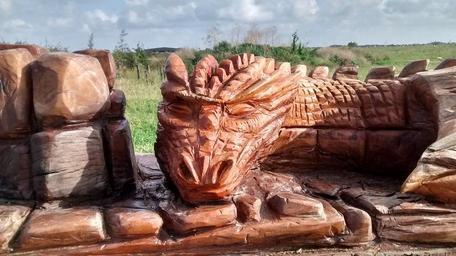
Wooden Dragon
Dragon without her rider

Maybe the lead character sits on her dinosaur at the top of the mountain pass and contemplates the view before she descends to the peace conference. Or the big battle. She and I will find out which it is as she follows her friends and comrades down into the valley.

So, I searched out a few articles on how to write a story. I’d expected them to all insist on a plan or a synopsis. A character list, a world for them to interact in, and a reason for them to interact. Days, weeks, maybe months before I would get to write a word.

Of course some do suggest that sort of thing, and sometimes they even suggest using spreadsheets! For the record, I’ve tried that, even before I read the articles, before I’d written much at all. It seemed logical. Get the ducks in a row and you can knock them off one by one.

It might work for some people, but it didn’t work for me. As my story grew, it deviated from my plan, and I didn’t go back and change it. Change it? I didn’t even look at it. But it did give me a start.
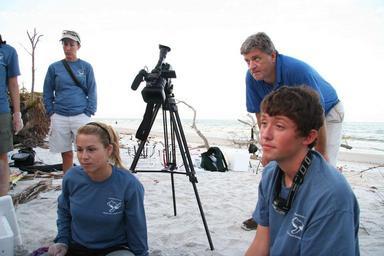
People on a Beach
People on a beach. (The logos imply that they are probably filming turtles)

OK, the Prince didn’t rescue the Princess from a dragon. No, the Prince rescued his Prince from a forced marriage to the Princess, who was pleased because she was über-friendly with the strapping female leader of the Guard. Only the Princess’ parents were miffed.

I might use this seed of a story sometime. But it started with the idea of someone rescuing someone from something, and I was already vaguely dissatisfied with standard boy saves girl and they fall in love thing. That’s just the Hero Syndrome. Boring. The above scenario still uses the syndrome, but it does give it a bit of a twist.

But anyway, he said, returning to the point, I discovered that the articles on how to write a story were full of useful advice, including in some cases, suggesting the avoidance of adverbs. Who knew? Well not me obviously.

Problem
Problem or Puzzle

The articles were full of good advice, techniques for pressing on when you are stuck, which is something that doesn’t happen to me. Many of them emphasise the trio of people, problem, and place.

What I mean by that is that almost every story needs characters. Oh, of course they needn’t be human. Almost every story needs a reason for the characters to interact, and they to have somewhere to interact.

Take the film “Lost in Space“. The ‘people’ were the Robinson family, together with the Robot and Doctor Zachary Smith. The ‘problem’ was that, because of Smith’s actions they had crash landed on an alien planet and couldn’t make it home. The ‘place’ was obviously the alien planet. Consideration of these three components no doubt helped the writers of the series. I’ll bear that in mind in future.

I’m going to read more of these “How to Write” web pages, to see what I can glean. It was arrogant of me to think that they had nothing to offer me. If I come across something that seems to me to be extra useful, I may write about later.

Alien landscape
Alien landscape

Please read my books. The paperback versions can be found Amazon, and the eBooks can be found there or at your favourite eBook store. Just search for my name, Cliff Pratt. I mainly write fantasy fiction.

Tutorials and Hairy Balls

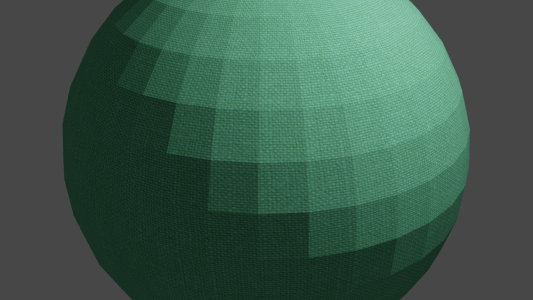
Cube with applied material.

There are hundreds of tutorials for Blender. Maybe thousands. As you might expect they vary in quality from not-so-good to very good. One of the characteristics that they all seem to share is that they are fast! Some are far too fast, some are not too fast and I can keep up with them. What I’ve decided to do is watch a tutorial without making note of the techniques used and then go through it again stopping and starting to get a better idea of what is going on.

Another issue is that Blender is complex, as it needs to be to produce realistic 3-D images. That often means that there are usually several ways of achieving something, and a tutorial author might prefer one over another for some reason. Rarely does an author go into why he did something a particular way, and if he does, it can be incredibly useful.

Anyway, I’ve been looking into ‘materials’ and ‘textures’ recently. ‘Materials’ are the stuff that things are made of, like ‘metal’ or ‘marble’. Textures are, as someone said in a tutorial, descriptive of the material. For example a metal object may be rusty, or a marble object might be dirty.

Fabric ball
Fabric covered ball

There are hundreds of free materials and textures available for anyone to download. I’ve downloaded a few from Chocofur who provide a several useful packs of free materials for download. You can also purchase some impressive models from them.

Another source of useful materials are the tutorials. Sometimes a tutorial author will include the materials that he has used in his tutorial, to help those who have taken his tutorial, so that they can repeat the steps he took in his tutorial and learn that way.

Of course, a simple image downloaded from the Internet or a camera image can be used as a source of material and/or textures, but that means that the artist will need to do more work, which brings me to another point. When a texture is downloaded from the Internet, it is usually in the form of a “blend” file which has to be ‘appended’ to the model being created. (A “blend” file is the format in which Blender saves a file, whether it’s one of  your own creations or one from the Internet) When I downloaded my first materials, I didn’t know this, so I just used the images from the downloaded files. This produces results which are, basically, rubbish.

A downloaded texture usually contains several images, used for different purposes – as a colour map, a displacement map, or one of several other types of map. I use the word “map” loosely here. These are used in the “shader” in various ways. I’m not going to define “shader”, but loosely, it’s how the material/texture is applied.

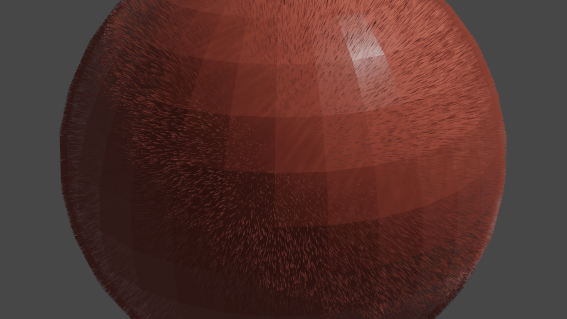
A Hairy Ball
A hairy ball

What I didn’t realise when I started to look into materials, and textures and shaders was that it is fun to play around with them. A shader is a bunch of nodes linked together. Each node is a box with adjustable sliders and values in it, and you can play with them to your hearts content.

Here’s one of Chocofur’s shaders below. Note all the options that you can change! You can also add other nodes to modify the provided shader, and that where the fun begins! Of course, it helps if you know what the nodes do, but that doesn’t prevent experimentation of course.


Node map of Chocfur’s Solid Marble shader

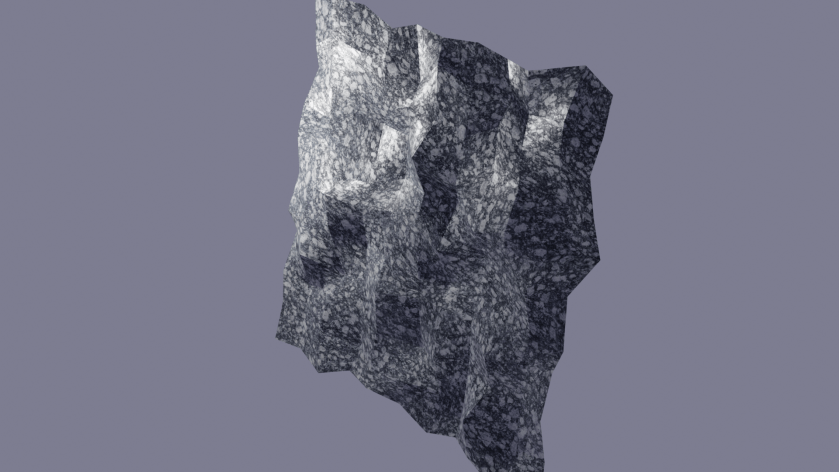
OK, to end with I’m going to show you two of my images, created in the last week or two. They are renders of a cliff face. The first is my first attempt. I created a plane mesh and subdivided it with the fractal parameter set to non-zero. This has the effect of “crumpling” the surface a little. Then I added a pretty bland texture and rotated the plane so that it looked like a cliff.

Cliff version one
Cliff version one

There’s obvious problems with of course. It’s pretty meh! And the bands across it are distracting. Here’s the second attempt.

Cliff version two
Cliff version two

This one is the opposite of the first! It has a bolder material, and is considerably more crumpled. Back to the drawing board. Oh, and I’ve got to work on the lighting.

Please read my books. The paperback versions can be found Amazon, and the eBooks can be found there or at your favourite eBook store. Just search for my name, Cliff Pratt. I mainly write fantasy fiction.
A Long Long Way to Go

River valley (Blender)
My first attempt at a landscape with river valley in Blender 2.8.

I’m pressing on with Blender, using the 2.8 beta, rather than the current 2.79 version. I figure that if I’m going to learn Blender, I might as well use the version that will be the current version when I get up to speed.

I’ll get to Blender in a minute but I’d just like to mention that I have a few writing ideas floating around in my head. I’ve completed one story and I’m mulling one story line in my head, but the characters want to do something that I’m not completely happy with. Yes, that is how it seems to me. I have little control over the characters and what they do!

The way that they want to act is within character, so I suppose I will put pen to paper, or rather, pound the keyboard, eventually. Sometime soon I’ll drop Blender for a while and switch over  to my word processor, but for now I’m still learning Blender.

https://www.freeimages.com/photo/television-studio-1-1171607
The image is from FREEIMAGES (https://www.freeimages.com/photo/television-studio-1-1171607), supplied to them by Joseph Hoban.

Blender is complex because real life 3-D objects which artists are trying to draw are complex. For instance, in real life there is rarely a single source of light. We may say that a an object in a scene is lit by the sun, but really it is lit by the sun, by the ambient light from the sky and the surroundings, and by reflections from other objects in the scene.

The image above shows a studio set up for television, and it shows multiple sources of light and the stage on which the scene, whatever it is, is to be set. The stage is illuminated by a lamp, but there is also a shadow on it. The shadowed part can be seen because it is illuminated by other lamps. Things in the unlit areas around the stage can be seen dimly because some light is reflected from the stage or it spills over from other lamps.

Lighting is complex and one of the things that Blender does is emulate some of this complexity. When someone builds something in Blender the object that is modelled is colourless and textureless. It’s like one of those dressmaker dummies that is merely a shape and a framework for the clothes to be are created on it.

No materials
Some of the lighting has been set up for this object, but not enough. No materials have been applied.

The object in the above image is illuminated by a light source (or rather the object is drawn as if it is illuminated by a light source). It stands on nothing, is surrounded by grey, and is visually it is not that impressive.

For a number of reasons I recreated the tower and this time I gave it some colour by adding colour to the background and another light source, and some ambient lighting.

Cartoon tower
Cartoonish tower, with background, something to stand on and some ambient lighting. There is some other lighting, but it is a bit dim and hard to see.

That still looks cartoonish! It’s still decidedly unimpressive, but I am, I hope, making progress. I’ve learned a lot and hope to put some of it into practise soon. I’ve watched dozens of videos, some of which helped and some of which didn’t. Some of the people making the videos are very good. Others click rapidly on the various windows and menus, leaving me confused.

Some videos seem to refer to earlier versions of the software, which means I have to figure out some of the steps that the video creator just quickly clicked over. Some show how to do specific tasks, like create a floating island, or realistic landscapes, and I have to extract from those the techniques that I need. But I believe that I’m making progress. Maybe by 2020 or early 2021…

I forgot to mention that once the model has been built and been decorated with materials and  textures, it is finished but only exists as a Blender file. To produce images, like those above, the object needs to be rendered. The 3-D object needs to be converted to a 2-D image file. Rendering of complex Blender files can take hours as it is a complex mathematical task. The above images, and the one below that I am going to leave you with, took only a minute or less.

The last image is an early version of the river valley that I started this post with. Since then I have dialled back the ambient lighting and added some “materials” to colourise it. It’s probable that I will rebuild the river valley completely.

River valley (early version)
An early version of the valley and river.

Please read my books. The paperback versions can be found Amazon, and the eBooks can be found there or at your favourite eBook store. Just search for my name, Cliff Pratt. I mainly write fantasy fiction.

My Books in eBook form, half price.

OLYMPUS DIGITAL CAMERA

I publish my eBooks through Smashwords and Amazon, so that I get the highest visibility for them. Smashwords has a “New Year” promotion, starting Christmas Day and extending through to New Years Day. During this period, my eBooks will be available through Smashwords at half price.

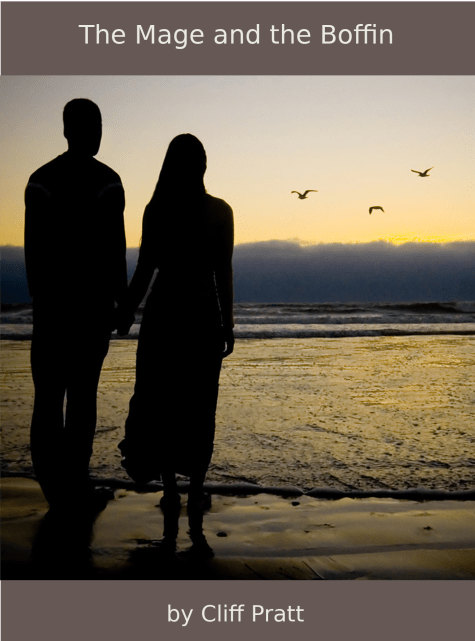
My paperback versions of “The Last Beautiful Woman” and “The Mage and The Boffin” parts one and two are available on Amazon only.

The Mage and The Boffin in paperback

I’ve published some of Mage and Boffin stories in paperback on Amazon. I discovered that if I’d included them all, the paperback would be too long, so this is the first of two parts! The second part might make it onto Amazon by Christmas, but failing that, watch for an update in the New Year!

The details are as follows:

The Mage and the Boffin – Part One: The Early Stories (Paperback)
ASIN : 0473461900
Link : https://www.amazon.com/gp/product/0473461900


My Books on Amazon

I’ve found that it is not easy to find my books Amazon. Simply searching for my name as author might find them, and it might not. Below I’ve listed my books and the Amazon ASIN numbers. I’ve also included a direct link to my books using the ASIN numbers.

[Update: My books on Amazon can be found a lot easier on my Author’s Page.]

If you use the links below and still have problems please leave me feedback and I will see what I can do to advise you. In particular, you may get a message like this : “This title is not currently available for purchase”. The message may be caused by technical issues at http://www.amazon.com.

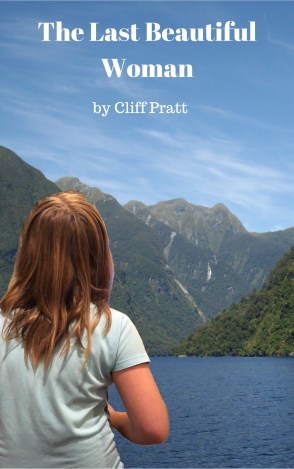
The Last Beautiful Woman (Kindle)
ASIN : B07G6V3YZS
Link : https://www.amazon.com/gp/product/B07G6V3YZS

The Last Beautiful Woman (Paperback)
ASIN : 0473448858
Link : https://www.amazon.com/gp/product/0473448858

How I Wrote and Self Published My First Book (Kindle)
ASIN : B07GB6GZ3N
Link : https://www.amazon.com/gp/product/B07GB6GZ3N

The Mage and The Boffin (Kindle)
ASIN : B07JLG1YV5
Link : https://www.amazon.com/gp/product/B07JLG1YV5


“The Last Beautiful Woman” publication details

I have published my novel, “The Last Beautiful Woman” in paperback and several electronic versions. Please take a look and see if you like it. The details are below.

  • Firstly, the paperback version. This is to be found on Amazon here. The link refers to the American Amazon site and your local Amazon site may also have the book. Please search for my name, “Cliff Pratt”, and ensure that you have selected the paperback version if that is the one that you want.
  • Secondly, the Kindle eBook version, which can be read on Kindle devices or through an app on Android and Apple platforms. This can be found on the Amazon Kindle Store here. Once again it may be available on your local Kindle site. Search for my name.
  • Thirdly, it is available as an eBook on Kobo here. The Kobo eReader app is available for Android and for Apple devices, and there is also a Kobo app for Windows and Mac desktops, but unfortunately, not one for Linux desktops. There are Linux eReader apps which will read many eBook types and you may find one which will read Kobo eBooks, which are simply ePub format.
  • Fourthly and finally, I have uploaded my novel to SmashWords. As well as the eBook being available on the SmashWords site itself, SmashWords distributes uploaded eBooks to several other bookshop sites as well. At SmashWords eBooks are available in several formats, including PDF. You should be able to find one in a format that suits you there!

Here’s the ‘teaser’ for the book. Please take a look!

What is it like to live at least three times as long as the average human? Jenna has just passed her one hundred and fiftieth birthday and looks to be just over thirty, and she is, so far as she knows, unique. She lives in isolation from the rest of the human race in an inaccessible and protected location known simply as “her home”.

Although she is physically isolated, she still communicates extensively with other people. She has a few loyal staff in her retreat, and a number of others around the world. She has enormous global influence and talks to the leaders of the nations and other powerful people around the world by videoconference and videophone almost every day.

She is reconsidering the reasons for her isolation, and wonders whether those reasons still apply. How did she come to be living in isolation. Is it time for the isolation to end?

She sees in an article by a newspaper reporter an indication that, perhaps, her affect on society has not been completely positive. She decides to ask the newspaper reporter to visit her to discuss his views, but she underestimates the effect of this break in one hundred years of tradition. George, the reporter, and his friends are sucked into a whirlwind of global interest.

Their lives will never be the same again.

So long. I may be back some time.

Embed from Getty Images

My first post on this blog was an introductory post, posted on January 24, 2013, and I’ve posted roughly once a week since that time. In recent times, it has become a real chore to keep up this schedule, and since it is no longer fun to write a post every week, I’ve decided to stop. I may decide to post here occasionally, and I may return to the weekly schedule sometime in the future.

Another factor that has influenced my decision to take a break is that I am concerned that I am repeating myself. I seem to return to the same or similar topics much of the time, and this spells ‘boring’. Maybe just for me, but possibly for any readers.

Recently I’ve started to do a different sort of writing. I’ve been writing short stories and novellas or longer stories and I’ve collected them here. Please take a look and, if you wish, send me some feedback.

Go back

Your message has been sent

Warning
Warning
Warning
Warning

Warning.

Embed from Getty Images

Supply Chain

When I go into the supermarket, I see foods from all over the world. I’m not talking about the items in the so-called International section, but even the stuff on the other shelves. I just picked up the nearest supermarket purchased item that came to hand. Batteries. They are packed locally, but are manufactured in China. When I say locally, I mean almost 500 kilometres away.

Much of the fruit and veges that I purchase come from overseas. Bananas and pineapples don’t grow here and are imported from various countries. If I want to buy a t-shirt it will almost certainly originate in Asia somewhere. I just looked at the t-shirt that I’m wearing at the moment, and yup, while it has a designed featuring a local attraction it is manufactured and printed in China.

All our electronic gear come from Asia, our clothes from Asia and plastic ware like laundry baskets also originates overseas.

This is not unique to this country though. It’s much the same in any other country. This country produces dairy products, meat and meat products, fruit and wine which are exported to other countries. The world is full of goods being shipped from one place to another, and sometimes a product will go to more than one location on its journey from where it is produced to the supermarket that it ends up in.

I don’t know if this actually happens, but one can envisage that milk taken from a cow is turned into milk powder here, sent elsewhere to be turned into mozzarella cheese, which is then sent to a pizza manufacturer, who sends the finished pizza to an pizza outlet where it is cooked and then sent out to satisfy the appetites of people somewhere else yet again.

Embed from Getty Images

There’s a term for this. It is “supply chain”. Actually it’s more like a supply network as, if we consider the pizza case, the pizza is made up of multiple ingredients all of which pass through several stages. Even the box that contains the pizza may have a complex history before the pizza is dropped into it and it is sent off.

It’s also possibly that the box may be made of recycled material. Cardboard collected at a recycling station may be pulped, processed and made into pizza boxes. Some of the collected cardboard may be old pizza boxes.

Generally, though, the components or ingredients of a consumer item, like a cell phone or a pizza with extra pepperoni start out by being harvested or dug out of the ground. If you want to cut out the supply chain, you could grow your own, but then you need to source the seeds, you need to buy in compost, unless you make it yourself from vegetables that you’ve sourced somewhere else, which come from goodness knows where, and you need to feed the plants with chemicals which have all come from somewhere else, and most likely have been processed in various ways.

So what would happen if the supply chain broke? People in the cities, who have no other way to acquire things except through the supply network would quickly starve, and would likely flee the city for the countryside, where things would be much better, and where they could settle down and grow things, right?

Embed from Getty Images

Except that most useful productive land in most countries has already been taken for farms, and the fleeing city folk would be forced onto marginal land and would starve, or they would be forced to steal from the farmers who are already there, or maybe they would beg for food from the farmers or work for them for food. Or they would fight to displace the farmers from their lands. In any case a flood of refugees from the city would likely be a trigger for conflict.

Actually the farmers would not be that much better off than the city folks. Most farms these days are more like little factories feeding into the supply chain and would concentrate on one or two crops. A beef farmer would have a surplus of beef, a potatoes farmer would have nothing but potatoes, and so on.

Embed from Getty Images

So, it is likely that even farmers would have severe problems if the supply network broke. Even if the farmer could trade most of his produce with other farmers so that he did not have to subsist purely on potatoes, he would have great difficulty in producing more crops after the first one. He’d quickly run out of fertiliser and without insecticides he would probably loose a lot of his crops.

The problems would be even worse if his land was deficient in some critical mineral. Many farmers these days have to add traces of minerals to their land, either to help grow bigger produce or to add the trace elements that the crops need to even grow.

Of course, not everyone would starve. Some non-city dwellers would eventually, after a period of realignment, be able to feed themselves. But many, many city dwellers would die, and a significant number of non-city dwellers would also die before an new balance is found. All trade would be local, probably barter based, as the city dwellers are the ones who keep the banking systems going, and they would be dead.

I haven’t yet considered what sort of catastrophe could disrupt the global supply network. If the oil ran out, and couldn’t be replaced by some other source of energy, that would do it. Local power could be generated using solar energy or water power, but the ships that ship goods from one place to another run on oil. That means that we would not be able to source solar cells in sufficient number.

If someone started a global nuclear war, then that could cause significant disruption and throw many countries back on their own resources, especially those who are more isolated than most. Similarly, if a super volcano were to erupt anywhere in the world, and as a result the world would become shrouded in clouds of dust for years on end, killing all food crops, then there would be no food to be shipped, even if the ships were to keep on working. And without food crops animals would starve, and so would we.

Rehabilitation

Embed from Getty Images

Rehabilitation. Let’s start from that word and see where it takes us. The definition that most appeals to me is the restoration of someone to a useful place in society”. I was surprised that most definitions appear to emphasise the restoration of appearance or status, which is not quite the same thing.

To physically restore something, it must have gone wrong or been damaged. Rehabilitation of a person similarly means that they have gone wrong or been damaged. By “gone wrong”, we probably mean that they have committed a crime and they may have been damaged by their environment.

Embed from Getty Images

There is an argument that a tendency to commit crimes may be have some genetic component and thus you have families where several generations have committed crimes. However, while there probably is a genetic component it is difficulty to distinguish between genetic reasons and a environmental reasons for a person committing a crime. In most cases of course, both causes may be in effect. It’s the ancient nature versus nurture debate, of course.

It’s possible that a solution to the genetic predisposition to commit crime might be found and a future criminal may be offered a choice – take this pill or go to jail. At the very least, it may be possible to spot potential criminals when they are very young, and use environmental means to combat their innate tendency to crime.

Embed from Getty Images

Any genetic tendency to crime may arise from something missing in a person. One obvious lack would be lack of empathy. If a person is empathetic, they can put themselves in the other person’s shoes so to speak and can imagine what it feels like to be robbed or raped or even murdered. I’ve simplified a bit there, but it will do.

On the other hand, if you live in an environment where violence is common, and lying and cheating is commonplace, then you are likely to come to think that such behaviour is normal. You literally wouldn’t be able to conceive of an environment where violence never happens or is very rare.

Embed from Getty Images

Society promotes the view that crime should be punished and that retribution in the form of punishment is to be expected if a crime has been committed. Punishment often takes the form of locking the criminal up with other criminals away from their home environment.

Without anything else happening, this seems like a singularly ineffective strategy. It does remove the criminal from society, but forces the criminal to associate with others who have similar antisocial defects. They learn off each other, not to be better people, but to better at whatever criminal activity that they have indulged in.

Embed from Getty Images

When the criminal is released, he or she is sent back to the very environment that may have been a large factor in causing him or her to become a criminal in the first place. The result is that he or she may go back to behaving as he or she did before, and indeed may introduce new antisocial behaviours that he or she has learnt in prison.

Another aspect of punishment of any sort is that it is supposed to deter others from similar actions. This assumes that the others in question have the empathy to understand the effect that punishment has on someone and the effect that this punishment would have on them.

Embed from Getty Images

How would we rehabilitate someone, if we had to resources to do so? Most such attempts appear to involve teaching the criminal a trade, so that when they get out of prison, they can take up a useful trade and not have the desire to commit any more crimes.

There’s a couple of problems with this, and one is what I’ve already mentioned above – they are going back into the same environment that had probably been a factor in their committing the crime that got them sent to prison in the first place. And they have more skills which could be used in criminal pursuits.

Embed from Getty Images

Of course being taught a trade in prison works for some people, or so I believe. These people would be those on the borderline environments where there is some criminal activity, but not much, and prison is seen as a deterrent and not as an occupational hazard. Nevertheless, they still face huge barriers, not the least of which is getting a job when they have a criminal record.

So it’s not surprising that rehabilitation, as it happens today, doesn’t seem to be effective, and that is because it doesn’t address the causes, genetic and environmental that cause people to commit crimes.

Embed from Getty Images

I suspect that any genetic tendency to commit crimes would be next to impossible to remedy. If the genes which cause a tendency to antisocial behaviour were to be identified, then the next question is what to do about it. Until and if it is possible to medically change the expression of these genes in utero or after birth, it would become an ethical dilemma. Just how far should society go in ensuring that crime is not committed. Should society prevent the full expression of a human being’s abilities and tendencies, even if they are criminal.

Society could somehow prevent people who carry such genes from reproducing, or at least stop then from producing offspring with those genes, but again that merely makes the issue an ethical one. Such meddling is usually labelled “eugenics” and generally frowned upon.

Embed from Getty Images

Various science fiction novels present arguments both for and against it. The major argument against eugenics as a way of reducing crimes is that the preconceptions and biases of individuals and societies make their choices suspect.

The environmental issues may be easier address. It is often thought that crime and poverty are linked, and that removing poverty may reduce crime. This is plausible, but while someone who is poor might be pushed over the line and commit a crime, there is no doubt that there is a great deal of crime committed by people who are not usually considered to be facing poverty.

Embed from Getty Images

So called white collar crime can be committed on all scales from defrauding individuals to crimes committed by people in huge corporations. While poverty related crime affects a few people, white collar crimes can be perpetrated on millions of people, and by people who have never had direct contact with their victims.

So, it seems to me that society is not really addressing rehabilitation. We concentrate on punishment, which is a deterrent, but once a person commits a crime, no real attempt to rehabilitate them happens. For it do so, society may have to change dramatically, and I don’t see that happening any time soon.

Embed from Getty Images